Hall Effect Sensor (Linear, Latch, Switch) Market Insights
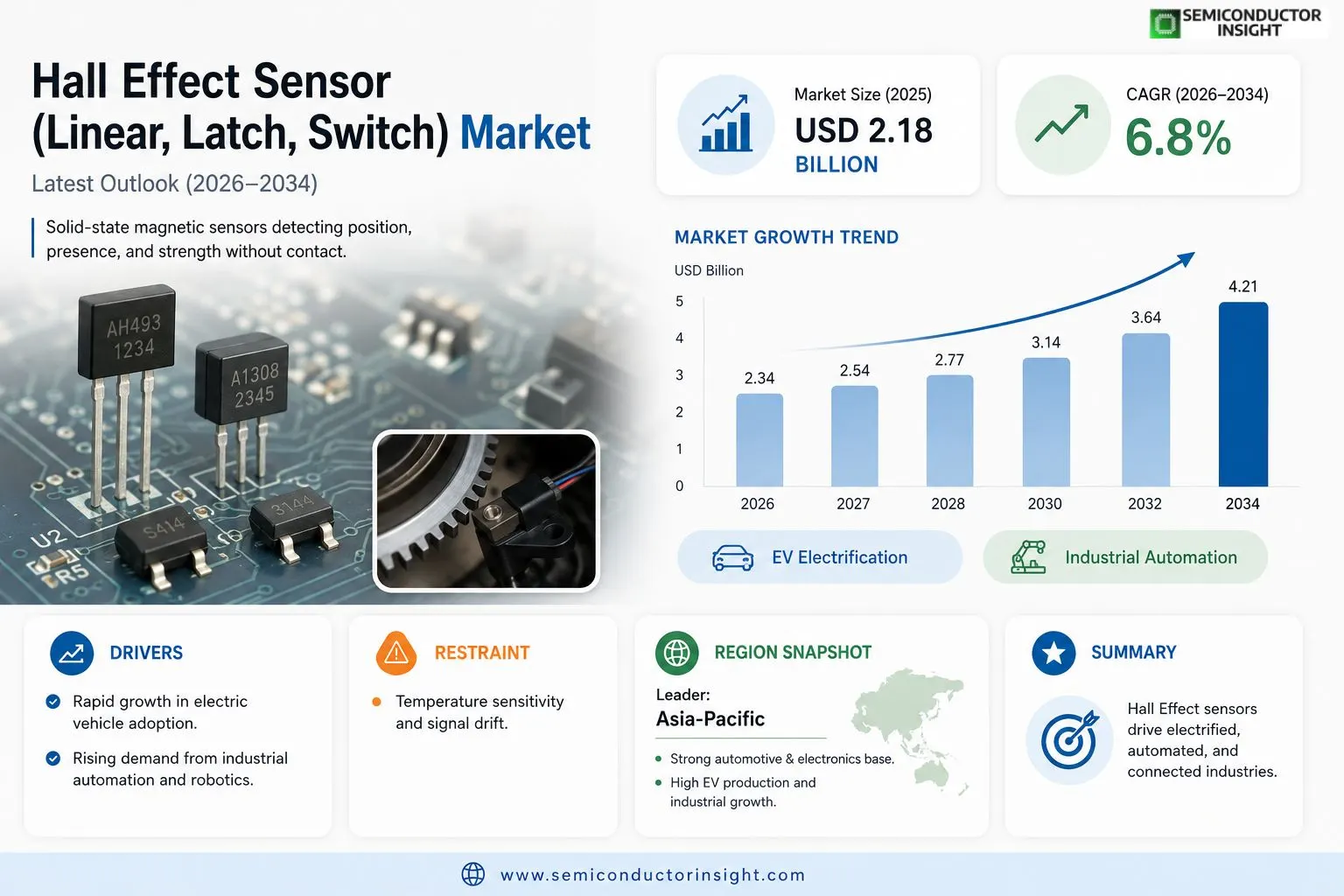
Global Hall Effect Sensor (Linear, Latch, Switch) market size was valued at USD 2.18 billion in 2025. The market is projected to grow from USD 2.34 billion in 2026 to USD 4.21 billion by 2034, exhibiting a CAGR of 6.8% during the forecast period.
Hall Effect sensors are solid-state magnetic sensing devices that detect the presence, strength, and direction of a magnetic field by generating a voltage proportional to the field applied perpendicular to an electric current. These sensors are broadly categorized into three types , linear (analog) sensors, which provide a continuous output proportional to magnetic flux density; latch sensors, which toggle their output state and retain it until an opposing magnetic pole is applied; and switch sensors, which activate or deactivate output based on a defined magnetic threshold. Their non-contact operating principle makes them inherently durable, resistant to dust and moisture, and well-suited for demanding industrial and automotive environments.
Hall Effect Sensor (Linear, Latch, Switch) Market is experiencing robust growth driven by accelerating electrification of vehicles, expanding industrial automation, and rising adoption of consumer electronics with integrated position-sensing capabilities. The rapid proliferation of electric vehicles (EVs) , with global EV sales surpassing 13.7 million units in 2023 , has significantly elevated demand for Hall Effect sensors in motor control, battery management, and throttle position applications. Furthermore, initiatives undertaken by key market participants continue to shape competitive dynamics. Allegro MicroSystems, Infineon Technologies AG, Texas Instruments, Honeywell International, and Melexis NV are among the leading players operating in this market with broad and diversified sensor portfolios.
MARKET DRIVERS
Rising Adoption of Electric Vehicles Accelerating Demand for Hall Effect Sensors
Global Hall Effect Sensor (Linear, Latch, Switch) Market is experiencing robust growth, driven significantly by the rapid expansion of the electric vehicle (EV) industry. Hall effect sensors are integral components in EV powertrains, battery management systems, and motor control units, where precise, contactless position and current sensing are critical. As EV production scales globally, automakers are integrating linear Hall effect sensors for throttle position detection and latch-type sensors for brushless DC motor commutation, creating a sustained and expanding demand pipeline across the automotive supply chain.
Industrial Automation and Smart Manufacturing Fueling Sensor Integration
The accelerating shift toward Industry 4.0 and smart factory environments is a powerful driver for Hall Effect Sensor (Linear, Latch, Switch) Market. Switch-type Hall effect sensors are widely deployed in robotics, conveyor systems, and CNC machinery for proximity detection and rotational speed monitoring. Their non-contact operating principle offers superior durability in harsh industrial environments compared to mechanical alternatives, making them a preferred choice for engineers designing automated production lines. The growing integration of predictive maintenance systems further elevates sensor demand, as real-time feedback from Hall effect devices enables condition monitoring with minimal operational disruption.
➤ The proliferation of brushless DC motors across industrial and consumer electronics applications continues to be one of the most consistent demand drivers for latch and switch Hall effect sensors, as these motors fundamentally rely on magnetic field sensing for commutation and speed control.
Consumer electronics represent another compelling growth avenue for Hall Effect Sensor (Linear, Latch, Switch) Market. Smartphones, laptops, and wearables increasingly incorporate miniaturized Hall effect switch sensors for lid-close detection, stylus proximity sensing, and haptic feedback systems. The ongoing miniaturization trend in semiconductor design has enabled manufacturers to produce highly compact sensor packages without compromising performance, further broadening the application scope and reinforcing market momentum across multiple end-use verticals.
MARKET CHALLENGES
Temperature Sensitivity and Signal Drift Posing Design Constraints
Despite strong growth prospects, Hall Effect Sensor (Linear, Latch, Switch) Market faces notable technical challenges related to temperature-dependent performance variations. Hall effect sensors, particularly linear variants, can exhibit output voltage drift across wide temperature ranges, which poses reliability concerns in automotive underhood applications or industrial environments with significant thermal cycling. Engineers must incorporate additional signal conditioning circuitry or calibration algorithms to compensate for these variations, adding to system design complexity and overall bill-of-materials costs. Addressing thermal drift without compromising sensor sensitivity remains a persistent engineering challenge for manufacturers.
Other Challenges
Magnetic Interference and Stray Field Susceptibility
Hall effect sensors are inherently sensitive to external magnetic fields, which can introduce measurement errors in densely populated electronic assemblies. In automotive and industrial environments where multiple magnetic sources coexist , including motors, transformers, and power cables , ensuring adequate magnetic shielding and sensor placement becomes a complex design consideration. This susceptibility to stray magnetic fields can limit the deployment of Hall effect switch and latch sensors in certain high-interference environments, requiring additional engineering effort and cost to mitigate.
Competition from Alternative Sensing Technologies
Hall Effect Sensor (Linear, Latch, Switch) Market also contends with growing competition from alternative position and proximity sensing technologies, including magnetoresistive (MR) sensors, inductive sensors, and optical encoders. In specific applications requiring ultra-high resolution or immunity to magnetic interference, these alternatives can offer performance advantages. Manufacturers in the Hall effect sensor space must continuously innovate in terms of sensitivity, power consumption, and integration density to maintain competitive differentiation and defend their market position across key application segments.
MARKET RESTRAINTS
Supply Chain Vulnerabilities and Semiconductor Component Shortages
Hall Effect Sensor (Linear, Latch, Switch) Market is subject to restraints stemming from broader semiconductor supply chain vulnerabilities. Hall effect sensors are fabricated using specialized semiconductor processes, and disruptions in the availability of raw materials such as indium arsenide or gallium arsenide , as well as foundry capacity constraints , can create supply imbalances that hinder market growth. Global semiconductor shortage experienced in recent years highlighted the fragility of these supply chains, leading to extended lead times and cost pressures that affected sensor availability across automotive and industrial customer segments.
Pricing Pressure from Low-Cost Regional Manufacturers
Intense pricing competition, particularly from low-cost manufacturers in the Asia-Pacific region, represents a structural restraint on profit margins within Hall Effect Sensor (Linear, Latch, Switch) Market. Established players from North America and Europe face pressure to reduce sensor pricing while simultaneously investing in research and development to deliver next-generation performance. This margin compression can constrain R&D budgets, potentially slowing the pace of product innovation. For smaller and mid-tier sensor manufacturers, competing effectively against high-volume, cost-optimized regional suppliers requires deliberate strategic positioning around quality, customization, and application-specific expertise rather than price alone.
MARKET OPPORTUNITIES
Expansion of Renewable Energy Infrastructure Creating New Application Frontiers
Global transition toward renewable energy generation presents a significant opportunity for Hall Effect Sensor (Linear, Latch, Switch) Market. Wind turbines rely on Hall effect sensors for blade pitch control, rotor speed monitoring, and generator current sensing. Solar tracking systems similarly utilize position-sensing Hall effect devices to optimize panel alignment for maximum energy capture. As governments worldwide accelerate clean energy investments and installed renewable capacity expands, the ancillary demand for reliable, contactless sensing solutions is expected to grow in parallel, opening a substantial and long-duration market opportunity for sensor manufacturers with established industrial-grade product portfolios.
Growth of Advanced Driver Assistance Systems (ADAS) and Autonomous Vehicles
The accelerating development of Advanced Driver Assistance Systems (ADAS) and autonomous vehicle platforms presents a compelling growth opportunity for Hall Effect Sensor (Linear, Latch, Switch) Market. These applications demand high-precision, redundant sensing architectures where linear Hall effect sensors play key roles in steering angle detection, pedal position sensing, and gear selector position monitoring. As vehicle electrification deepens and autonomy levels increase, the per-vehicle sensor content is projected to rise significantly, translating into a structurally higher addressable market for Hall effect sensor manufacturers capable of meeting stringent automotive-grade quality and functional safety standards such as ISO 26262.
Emerging Opportunities in Medical Devices and Healthcare Equipment
The medical device sector represents an emerging yet increasingly relevant opportunity for Hall Effect Sensor (Linear, Latch, Switch) Market. Infusion pumps, surgical robotics, prosthetic limb control systems, and MRI-compatible positioning equipment are among the growing range of healthcare applications where contactless, hygienic, and highly reliable magnetic sensing is valued. Hall effect switch and latch sensors offer the non-contact operation and long-term reliability that medical device designers require, particularly in applications where mechanical wear or contamination risk must be eliminated. As global healthcare infrastructure investment grows and medical device innovation accelerates, this vertical is poised to become a meaningful incremental growth contributor for the broader Hall Effect Sensor market.
Trends
Electrification of Vehicles Driving Demand for Hall Effect Sensors
Hall Effect Sensor (Linear, Latch, Switch) Market is witnessing accelerated growth fueled by the rapid global transition toward electric vehicles. With global EV sales surpassing 13.7 million units in 2023, automakers are increasingly integrating Hall Effect sensors across motor control, battery management systems, and throttle position applications. Linear sensors provide continuous analog output critical for precise motor feedback, while latch and switch variants serve reliable position detection in powertrain and braking systems. This surge in EV adoption has established automotive electrification as one of the most influential demand drivers shaping the Hall Effect sensor landscape.
Other Trends
Industrial Automation and Smart Manufacturing Integration
Industrial automation is emerging as a significant growth vector for Hall Effect Sensor (Linear, Latch, Switch) Market. As manufacturers worldwide accelerate deployment of robotics, conveyor systems, and programmable logic controllers, the need for non-contact, durable magnetic sensing solutions has intensified. Hall Effect sensors , valued for their resistance to dust, moisture, and mechanical wear , are increasingly embedded in proximity detection, speed monitoring, and end-of-travel detection applications across factory floors. The ongoing expansion of Industry 4.0 initiatives across Asia-Pacific and Europe continues to amplify this trend.
Rising Adoption in Consumer Electronics
Consumer electronics manufacturers are progressively incorporating Hall Effect sensors into smartphones, laptops, wearables, and gaming peripherals for position sensing, lid detection, and stylus tracking. The miniaturization capabilities of modern Hall Effect switch and latch sensors make them particularly suited for compact portable devices where non-contact operation and low power consumption are essential design criteria. This proliferation across consumer-grade applications is broadening the addressable market beyond traditional industrial and automotive segments.
Competitive Innovation Among Leading Market Participants
Key players including Allegro MicroSystems, Infineon Technologies AG, Texas Instruments, Honeywell International, and Melexis NV are actively driving product innovation within Hall Effect Sensor (Linear, Latch, Switch) Market. These companies are advancing sensor accuracy, temperature resilience, and integration density to meet evolving requirements across automotive, industrial, and consumer end-use segments. Strategic portfolio diversification covering all three sensor types , linear, latch, and switch , positions leading participants to address a wide spectrum of application demands, reinforcing competitive differentiation and sustaining long-term market momentum.
COMPETITIVE LANDSCAPE
Key Industry Players
Hall Effect Sensor (Linear, Latch, Switch) Market: Competitive Dynamics and Leading Manufacturers
Global Hall Effect Sensor (Linear, Latch, Switch) market is characterized by the presence of several well-established semiconductor and sensing technology companies competing across linear, latch, and switch sensor segments. Allegro MicroSystems holds a prominent position in this market, offering an extensive portfolio of Hall Effect ICs widely adopted in automotive motor control, current sensing, and position detection applications. Infineon Technologies AG similarly commands a significant market share, leveraging its advanced CMOS and BiCMOS process technologies to deliver high-precision Hall sensors for EV powertrain systems, industrial drives, and consumer electronics. Texas Instruments and Honeywell International further strengthen the competitive field with diversified sensing solutions catering to both analog and digital output requirements across automotive, aerospace, and industrial automation verticals. Melexis NV is another key contributor, particularly recognized for its programmable and ratiometric Hall Effect sensors optimized for demanding automotive-grade applications.
Beyond the dominant players, the Hall Effect Sensor market features a number of niche yet significant participants driving innovation in miniaturization, low-power consumption, and high-temperature operation. Semiconductor Components Industries (onsemi) and STMicroelectronics have expanded their Hall sensor product lines to address growing EV and industrial robotics demand. Asahi Kasei Microdevices (AKM) and Diodes Incorporated are recognized for compact, high-sensitivity solutions targeting consumer electronics and portable device applications. Littelfuse, ROHM Semiconductor, and Standex Electronics contribute specialized latch and switch sensor variants widely used in proximity detection and flow metering. TDK Corporation and NXP Semiconductors round out the competitive landscape with automotive-qualified Hall sensors designed to meet stringent functional safety standards such as ISO 26262, reflecting the market’s increasing alignment with electrification and smart mobility trends.
List of Key Hall Effect Sensor Companies Profiled
- Allegro MicroSystems, LLC
- Infineon Technologies AG
- Texas Instruments Incorporated
- Honeywell International Inc.
- Melexis NV
- Semiconductor Components Industries, LLC (onsemi)
- STMicroelectronics N.V.
- Asahi Kasei Microdevices Corporation (AKM)
- Diodes Incorporated
- Littelfuse, Inc.
- ROHM Semiconductor
- Standex Electronics, Inc.
- TDK Corporation
- NXP Semiconductors N.V.
Segment Analysis:
| Segment Category | Sub-Segments | Key Insights |
| By Type |
|
Linear (Analog) Hall Effect Sensors represent the leading segment within the type classification, driven by their ability to deliver continuous, proportional output corresponding to magnetic flux density variations.
Latch and switch variants, while more specialized, command strong adoption in applications requiring binary state detection, such as brushless DC motor commutation and proximity sensing in consumer appliances. |
| By Application |
|
Position & Displacement Sensing stands as the leading application segment, underpinned by pervasive demand across automotive, industrial, and consumer electronics verticals.
Speed and rotation detection also commands a significant application share, particularly in anti-lock braking systems, wheel speed sensors, and conveyor belt monitoring within logistics and warehousing operations. |
| By End User |
|
Automotive & Transportation is the dominant end-user segment, reflecting the deep integration of Hall Effect sensors across virtually every electromechanical system within modern vehicles.
Industrial automation and consumer electronics represent the next most significant end-user categories, with growing adoption in smart home appliances, wearable devices, and programmable logic controller (PLC)-based factory systems. |
| By Output Type |
|
Digital Output Sensors represent the leading segment within this classification, owing to their seamless compatibility with microcontrollers, embedded processors, and digital communication architectures prevalent in modern electronic systems.
|
| By Package Type |
|
Surface Mount (SMD) Package sensors lead this segment, propelled by the ongoing miniaturization trend across automotive electronics, consumer devices, and industrial control boards.
|
Regional Analysis: Hall Effect Sensor (Linear, Latch, Switch) Market
Asia-Pacific
Asia-Pacific’s electric vehicle revolution is one of the most powerful demand catalysts for Hall Effect sensors in the region. Linear and latch variants are essential components in EV powertrains, battery management systems, and motor control units. With China leading global EV production and countries like India rapidly scaling up their own electric mobility infrastructure, demand for precision sensing solutions continues to expand at an accelerating pace.
The rapid embrace of industrial automation and robotics across manufacturing hubs in China, Japan, and South Korea has significantly increased the deployment of Hall Effect switch and linear sensors in production lines. These sensors play a critical role in position detection, speed monitoring, and proximity sensing within automated systems, making them indispensable as factories upgrade to smart, connected operations aligned with Industry 4.0 frameworks.
Asia-Pacific houses the world’s most prolific consumer electronics supply chain, with Hall Effect latch and switch sensors deeply integrated into smartphones, laptops, gaming peripherals, and wearable devices. The continuous launch of next-generation consumer products, combined with the region’s manufacturing agility, ensures sustained demand. Innovation in sensor miniaturization and energy efficiency is being driven by leading electronics firms headquartered across this region.
Governments across Asia-Pacific are actively supporting semiconductor and sensor technology development through subsidies, industrial policies, and strategic investment programs. Initiatives such as China’s semiconductor self-sufficiency drive, India’s production-linked incentive schemes, and Japan’s advanced technology roadmaps are creating favorable conditions for domestic Hall Effect sensor manufacturing and innovation, strengthening the region’s competitive advantage in Global market.
North America
North America represents a highly mature and technologically advanced market for Hall Effect sensors, with the United States serving as the primary engine of growth and innovation. The region’s strong automotive sector, particularly its rapid transition toward electric and hybrid vehicles, is a significant driver for linear and latch Hall Effect sensor adoption in powertrain management, steering systems, and safety-critical applications. Beyond automotive, North American demand is shaped by the expansion of industrial robotics, aerospace electronics, and medical device manufacturing , all sectors where precise, non-contact sensing is essential. The presence of leading semiconductor and sensor companies within the region fosters a robust ecosystem of research, development, and commercialization. Additionally, the increasing integration of Hall Effect switch sensors in smart home technologies and consumer electronics reflects evolving end-user expectations. Regulatory emphasis on vehicle safety standards and energy efficiency continues to accelerate sensor adoption across multiple verticals, positioning North America as a high-value, innovation-driven market for Hall Effect Sensor (Linear, Latch, Switch) Market through 2034.
Europe
Europe occupies a significant position in Global Hall Effect Sensor (Linear, Latch, Switch) Market, supported by its world-renowned automotive engineering heritage and strong industrial manufacturing base. Germany, France, and the United Kingdom are among the key contributors, with Hall Effect sensors widely deployed in premium automotive platforms, factory automation systems, and renewable energy infrastructure. European automotive manufacturers’ commitment to electrification and stringent emission reduction targets are creating sustained demand for precision sensing solutions, particularly linear Hall Effect variants used in motor control and position sensing. The region also benefits from a culture of engineering excellence and a strong emphasis on product quality and reliability, which drives preference for high-performance sensor technologies. Industrial IoT adoption and smart grid development further expand the application landscape. Europe’s regulatory environment, particularly around vehicle safety and energy efficiency, acts as a consistent structural driver for the Hall Effect Sensor market, ensuring steady, quality-focused demand across the forecast period.
South America
South America represents an emerging and progressively evolving market for Hall Effect sensors, with Brazil and Argentina serving as the primary demand centers. The region’s automotive manufacturing sector , historically a key industry in Brazil , continues to incorporate Hall Effect switch and latch sensors in conventional and increasingly electrified vehicle platforms. Industrial automation is gradually gaining traction as manufacturers seek to improve operational efficiency and compete globally, creating new opportunities for sensor deployment in production environments. While Hall Effect Sensor (Linear, Latch, Switch) Market in South America remains at an earlier stage of development compared to North America, Europe, and Asia-Pacific, underlying economic modernization trends and infrastructure investments are laying the groundwork for accelerated growth. Challenges such as economic volatility and import dependency on advanced components temper the pace of adoption, but long-term prospects remain constructive as the region deepens its industrial and technological capabilities through 2034.
Middle East & Africa
The Middle East & Africa region represents a nascent but increasingly noteworthy participant in Global Hall Effect Sensor (Linear, Latch, Switch) Market. Demand is primarily shaped by infrastructure development, oil and gas sector automation, and the gradual modernization of industrial operations across Gulf Cooperation Council countries. The UAE and Saudi Arabia are leading adoption within the region, driven by large-scale smart city initiatives, industrial diversification programs, and growing investments in advanced manufacturing. In Africa, demand is concentrated in key economies such as South Africa, where automotive assembly and mining operations generate meaningful sensor requirements. While the overall scale of the Hall Effect sensor market in this region is comparatively limited, sustained investment in industrial technology, energy sector automation, and infrastructure modernization is expected to progressively expand the addressable market. The region’s long-term growth potential is underpinned by its economic diversification ambitions and increasing integration with global technology supply chains over the 2026 to 2034 forecast horizon.
Report Scope
This market research report provides a comprehensive analysis of the Hall Effect Sensor (Linear, Latch, Switch) Market , covering the forecast period 2026–2034. It offers detailed insights into market dynamics, technological advancements, competitive landscape, and key trends shaping the industry.
Key focus areas of the report include:
- Market Overview: The report begins with an overview outlining its current market scenario, key growth indicators, and industry transformation drivers. It discusses macroeconomic factors, demand–supply balance, regulatory landscape, and the strategic role of semiconductors in powering advancements across industries such as automotive, telecommunications, consumer electronics, and industrial automation.
- Market Size & Forecast: Historical data and future projections for revenue, unit shipments, and market value across major regions and segments.
- Segmentation Analysis: Detailed breakdown by product type, technology, application, and end-user industry to identify high-growth segments and investment opportunities.
- Regional Insights: Insights into market performance across North America, Europe, Asia-Pacific, Latin America, and the Middle East & Africa, including country-level analysis where relevant.
- Competitive Landscape: Profiles of leading market participants, including their product offerings, R&D focus, manufacturing capacity, pricing strategies, and recent developments such as mergers, acquisitions, and partnerships.
- Technology Trends & Innovation: Assessment of emerging technologies, integration of AI/IoT, semiconductor design trends, fabrication techniques, and evolving industry standards.
- Market Drivers & Restraints: Evaluation of factors driving market growth along with challenges, supply chain constraints, regulatory issues, and market-entry barriers.
- Stakeholder Insights: Insights for component suppliers, OEMs, system integrators, investors, and policymakers regarding the evolving ecosystem and strategic opportunities.
Primary and secondary research methods are employed, including interviews with industry experts, data from verified sources, and real-time market intelligence to ensure the accuracy and reliability of the insights presented.
FREQUENTLY ASKED QUESTIONS:
What is the current market size of Hall Effect Sensor (Linear, Latch, Switch) Market?
-> Hall Effect Sensor (Linear, Latch, Switch) Market was valued at USD 2.18 billion in 2025 and is expected to reach USD 4.21 billion by 2034, growing at a CAGR of 6.8% during the forecast period.
Which key companies operate in Hall Effect Sensor (Linear, Latch, Switch) Market?
-> Key players include Allegro MicroSystems, Infineon Technologies AG, Texas Instruments, Honeywell International, and Melexis NV, among others.
What are the key growth drivers?
-> Key growth drivers include accelerating electrification of vehicles, expanding industrial automation, and rising adoption of consumer electronics with integrated position-sensing capabilities. The rapid proliferation of electric vehicles (EVs) , with global EV sales surpassing 13.7 million units in 2023 , has significantly elevated demand for Hall Effect sensors in motor control, battery management, and throttle position applications.
Which region dominates the market?
-> Asia-Pacific is the fastest-growing region, driven by strong automotive manufacturing activity and electronics production, while North America and Europe remain significant markets supported by advanced industrial automation and EV adoption.
What are the emerging trends?
-> Emerging trends include non-contact magnetic sensing technologies, integration of Hall Effect sensors in EV powertrains, smart industrial automation systems, and miniaturized solid-state sensors resistant to dust and moisture for demanding automotive and industrial environments.

Get Sample Report PDF for Exclusive Insights
Report Sample Includes
- Table of Contents
- List of Tables & Figures
- Charts, Research Methodology, and more...
 Download Sample Report PDF