GNSS (GPS, Galileo) Receiver for Automotive Market Insights
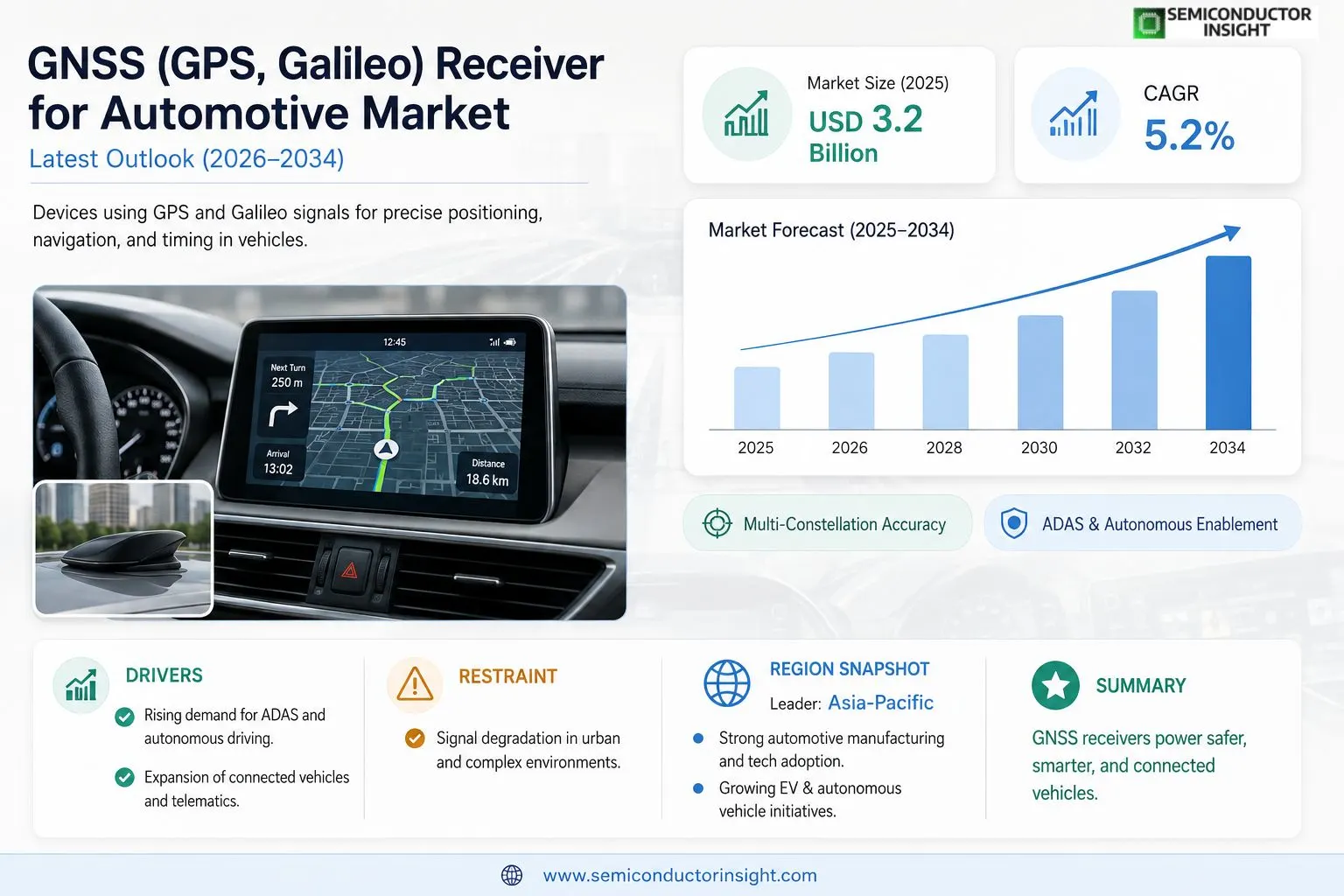
Global GNSS (GPS, Galileo) Receiver for Automotive Market size was valued at USD 3.2 billion in 2025. The market is projected to grow from USD 3.4 billion in 2026 to USD 5.1 billion by 2034, exhibiting a CAGR of 5.2% during the forecast period.
GNSS receivers for automotive applications are specialized devices that utilize signals from multiple satellite constellations, including GPS and Galileo, to provide precise positioning, navigation, and timing information essential for modern vehicles. These receivers enable accurate location tracking, support advanced driver assistance systems (ADAS), facilitate autonomous driving features, and enhance vehicle telematics by delivering real-time data on speed, direction, and route optimization.
The market is experiencing steady growth due to several factors, including the rising integration of connected car technologies, increasing demand for safety features in vehicles, and the expansion of autonomous and semi-autonomous driving solutions. Furthermore, advancements in multi-constellation support that combine GPS, Galileo, and other systems improve accuracy and reliability in challenging environments such as urban canyons. Initiatives by key players in the market are also expected to fuel the market growth. For instance, collaborations focusing on high-precision positioning solutions for automated vehicles continue to drive innovation. u-blox Holding AG, STMicroelectronics, Qualcomm Technologies, and MediaTek are some of the key players that operate in the market with a wide range of portfolios.
MARKET DRIVERS
Rising Demand for ADAS and Autonomous Driving
GNSS (GPS, Galileo) Receiver for Automotive Market is propelled by the accelerating adoption of Advanced Driver Assistance Systems (ADAS) and the development of autonomous vehicles. Multi-constellation receivers integrating GPS and Galileo deliver the precise, real-time positioning essential for lane-level navigation and safe operation in connected vehicle ecosystems. Automotive manufacturers increasingly incorporate these receivers to support features like automated lane-keeping, adaptive cruise control, and precise mapping.
Expansion of Connected Vehicle Technologies and Telematics
Growing integration of GNSS receivers in vehicle telematics systems supports fleet management, emergency eCall services, and real-time traffic optimization. The push toward connected cars, combined with regulatory mandates for safety features, drives demand for reliable GNSS solutions that leverage both GPS and Galileo for enhanced accuracy and redundancy. Electric vehicles further amplify this trend, requiring precise navigation for route planning and charging station integration.
➤ The development of autonomous vehicles presents a major opportunity for GNSS receiver manufacturers, with testing underway for lane-level positioning systems.
Advancements in multi-frequency and multi-constellation technology improve performance in challenging environments, supporting broader automotive applications and contributing to steady market expansion projected through the coming decade.
MARKET CHALLENGES
Signal Degradation in Urban and Complex Environments
In dense urban canyons and areas with foliage or tunnels, GNSS (GPS, Galileo) receivers face multipath effects, signal blockage, and non-line-of-sight issues that degrade positioning accuracy. These conditions challenge the reliability required for advanced autonomous driving applications, necessitating sensor fusion with other technologies like LiDAR and inertial navigation systems.
Other Challenges
Cybersecurity Vulnerabilities
GNSS signals remain susceptible to jamming and spoofing attacks, which can compromise vehicle positioning and safety. Incidents of spoofing have highlighted the need for authentication and anti-jamming capabilities in automotive-grade receivers.
High Precision Requirements and Cost Pressures
Achieving consistent centimeter-level accuracy for Level 3+ autonomy demands advanced hardware and correction services, increasing system complexity and costs while automotive OEMs seek affordable solutions for mass-market vehicles.
MARKET RESTRAINTS
Environmental and Technical Limitations
Performance of GNSS (GPS, Galileo) receivers in automotive applications is constrained by signal availability issues in certain geographies and weather conditions. Urban multipath interference and temporary outages continue to limit standalone GNSS reliability, requiring costly integration with supplementary sensors and maps. High development costs for robust, automotive-grade multi-constellation solutions and the need for ongoing infrastructure support from satellite systems like Galileo pose additional barriers to faster market penetration, particularly in price-sensitive segments.
MARKET OPPORTUNITIES
Technological Advancements and Emerging Applications
Opportunities abound in the development of next-generation GNSS receivers that combine GPS and Galileo with real-time kinematic (RTK) and precise point positioning (PPP) techniques. These innovations enable higher accuracy for autonomous vehicle testing, smart city mobility solutions, and enhanced ADAS features across global markets. Expansion into electric and software-defined vehicles, alongside regulatory support for Galileo integration in Europe and modernization of GPS, creates significant growth potential. Partnerships between receiver manufacturers and automotive technology providers are accelerating the deployment of resilient, multi-sensor positioning platforms.
GNSS (GPS, Galileo) Receiver for Automotive Market Trends
Rising Integration with Advanced Driver Assistance Systems and Autonomous Driving
GNSS (GPS, Galileo) Receiver for Automotive Market continues to evolve as automakers prioritize precise positioning technologies that support advanced driver assistance systems (ADAS) and autonomous driving features. These specialized receivers utilize signals from multiple satellite constellations, including GPS and Galileo, to deliver accurate location tracking, navigation, and timing information critical for modern vehicles. The technology enables real-time data on vehicle speed, direction, and route optimization while enhancing vehicle telematics capabilities across diverse driving conditions.
Other Trends
Multi-Constellation Support for Enhanced Reliability
Advancements in multi-constellation capabilities represent a significant development in GNSS (GPS, Galileo) Receiver for Automotive Market. By combining signals from GPS, Galileo, and additional satellite systems, these receivers achieve improved accuracy and reliability, particularly in challenging urban environments such as city canyons where signal obstruction is common. This technological progress addresses key requirements for safety-focused applications and supports consistent performance needed for next-generation automotive systems.
Growing Adoption of Connected Car Technologies
The expansion of connected car solutions drives increased demand for robust GNSS (GPS, Galileo) Receiver for Automotive Market applications. These receivers play an essential role in delivering the positioning data required for seamless vehicle-to-everything communication and intelligent navigation services. Rising consumer expectations for safety features and enhanced driving experiences further accelerate the integration of these technologies into new vehicle models worldwide.
Industry Collaborations Driving Innovation
Strategic initiatives among leading technology providers continue to shape GNSS (GPS, Galileo) Receiver for Automotive Market landscape. Companies such as u-blox Holding AG, STMicroelectronics, Qualcomm Technologies, and MediaTek maintain active portfolios focused on high-precision positioning solutions tailored for automated vehicles. These collaborations emphasize the development of reliable systems that meet the stringent requirements of autonomous and semi-autonomous driving platforms, fostering ongoing innovation in positioning accuracy and system integration.The convergence of safety regulations, consumer demand for advanced features, and technological improvements positions GNSS (GPS, Galileo) receivers as foundational components in the future of automotive mobility. Industry participants remain focused on enhancing receiver performance to support increasingly sophisticated vehicle applications while maintaining compatibility across global satellite navigation networks.
COMPETITIVE LANDSCAPE
Key Industry Players
GNSS (GPS, Galileo) Receiver for Automotive Market Competitive Analysis
GNSS Receiver Market for automotive applications is led by a mix of semiconductor giants and specialized positioning technology providers. Qualcomm Technologies and u-blox Holding AG stand out as dominant players due to their extensive portfolios in multi-constellation receivers supporting GPS, Galileo, and other systems. These companies drive market structure through innovations in high-precision positioning essential for ADAS and autonomous driving, supported by strong integration capabilities with vehicle telematics and connected car platforms.
Other significant players include STMicroelectronics, MediaTek, and Broadcom, which focus on cost-effective, high-performance chipsets tailored for mass-market vehicles. Niche contributors such as Septentrio, Trimble, and Quectel enhance the ecosystem with specialized solutions for challenging environments like urban canyons, emphasizing reliability, anti-jamming features, and seamless multi-GNSS support.
List of Key GNSS Receiver for Automotive Companies Profiled
- u-blox Holding AG
- Qualcomm Technologies
- STMicroelectronics
- MediaTek Inc.
- Broadcom Inc.
- Texas Instruments
- Septentrio N.V.
- Trimble Inc.
- Furuno Electric Co., Ltd.
- Quectel Wireless Solutions
- Unicore Communications
- Hemisphere GNSS
- Hexagon AB
- Skyworks Solutions
- NovAtel (Hexagon)
Segment Analysis:
| Segment Category | Sub-Segments | Key Insights |
| By Type |
|
Multi-Constellation Receivers stand out as the preferred choice in automotive applications due to their ability to leverage signals from GPS, Galileo, and other systems simultaneously. This delivers superior positioning accuracy and reliability even in dense urban environments or areas with obstructed sky views. They enable seamless signal acquisition and faster time-to-first-fix, which is critical for real-time navigation and safety systems. Their robust performance supports continuous operation during challenging conditions like tunnels or heavy foliage, enhancing overall driver confidence and system dependability. |
| By Application |
|
Advanced Driver Assistance Systems (ADAS) represent the leading application segment as GNSS receivers provide essential real-time positioning data for features like lane-keeping assistance, adaptive cruise control, and collision avoidance. Integration with other sensors creates comprehensive environmental awareness that improves vehicle safety and operational efficiency. These systems benefit from the precise timing and location information to coordinate complex maneuvers. The growing emphasis on vehicle safety standards continues to drive sophisticated GNSS adoption in ADAS platforms. |
| By End User |
|
Passenger Vehicles dominate as the primary end-user category owing to widespread consumer demand for enhanced navigation, connectivity, and safety features in personal cars. Manufacturers integrate GNSS receivers to deliver premium infotainment experiences and support semi-autonomous capabilities that appeal to modern drivers seeking comfort and protection. These receivers facilitate personalized route optimization and location-based services that improve daily usability. The focus on user experience in premium and mid-range models accelerates technology adoption across this segment. |
| By Technology |
|
Real-Time Kinematic (RTK) technology leads this segment by offering centimeter-level accuracy essential for advanced automotive functions including autonomous parking and platooning. It utilizes correction data from reference stations to eliminate common errors in satellite signals, resulting in highly reliable positioning outputs. Automotive integrators value its rapid convergence times and consistent performance that support safety-critical applications. Continuous improvements in RTK implementation make it increasingly viable for mass-market vehicles. |
| By Integration Level |
|
Embedded Systems emerge as the leading integration approach because they allow seamless incorporation of GNSS functionality directly into the vehicle’s electronic architecture during manufacturing. This delivers optimized performance, reduced power consumption, and better synchronization with other onboard systems like inertial measurement units. Embedded designs support compact packaging and enhanced cybersecurity measures vital for connected vehicles. Automakers prefer this level for achieving streamlined production and superior overall system reliability. |
Regional Analysis: GNSS (GPS, Galileo) Receiver for Automotive Market
Asia-Pacific
Asia-Pacific leads in the development of multi-frequency GNSS (GPS, Galileo) receivers optimized for automotive use. Companies focus on enhancing signal processing algorithms to maintain accuracy amid urban canyons and high-speed travel. Integration with AI-driven mapping and sensor fusion technologies distinguishes regional solutions, supporting advanced driver assistance systems and paving the way for higher levels of vehicle autonomy.
Regional authorities actively promote the deployment of GNSS-enabled intelligent transportation infrastructure. Policies encouraging electric vehicle adoption and connected mobility create sustained demand for high-precision receivers. Collaborative projects between governments and industry accelerate standardization efforts, ensuring compatibility across diverse automotive platforms and boosting overall market momentum.
The region’s extensive automotive supply chain enables efficient production and customization of GNSS receivers. Proximity between component manufacturers, assemblers, and vehicle makers streamlines development, reducing time-to-market for new receiver models featuring enhanced Galileo signal utilization and improved resilience against signal disruptions.
Rising consumer expectations for sophisticated navigation and safety features, combined with expanding autonomous vehicle testing programs, position Asia-Pacific for continued leadership. Focus remains on developing receivers that deliver dependable performance across varied climatic conditions while supporting the evolving requirements of software-defined vehicles.
North America
North America maintains a significant position in GNSS (GPS, Galileo) Receiver for Automotive Market through its emphasis on innovation and premium vehicle segments. The United States leads in the integration of GNSS technology with advanced safety and infotainment systems, where manufacturers prioritize multi-constellation receivers for reliable performance in both urban and rural settings. Strong collaboration between technology firms and automakers drives the development of receivers optimized for autonomous applications, leveraging GPS alongside Galileo for enhanced precision. Regulatory frameworks supporting connected vehicles further stimulate demand, while consumer preference for high-end features sustains steady market expansion across passenger cars and commercial fleets.
Europe
Europe demonstrates notable strength in GNSS (GPS, Galileo) Receiver for Automotive Market, benefiting from the Galileo satellite system’s maturity and regional focus on safety regulations. Countries across the continent integrate GNSS receivers into vehicles to comply with stringent driver assistance mandates and support intelligent mobility initiatives. Automotive manufacturers emphasize accuracy, security, and interoperability, creating opportunities for advanced receiver solutions that combine Galileo signals with GPS for superior reliability. The region’s commitment to sustainable transport and autonomous driving pilots encourages ongoing investment in next-generation positioning technologies tailored to dense traffic networks and cross-border operations.
South America
South America shows emerging potential in GNSS (GPS, Galileo) Receiver for Automotive Market as automotive production grows and demand for modern navigation systems increases. Brazil and other key markets witness gradual adoption of GNSS receivers in both passenger and commercial vehicles, primarily for fleet management and improved safety features. While infrastructure challenges persist, rising urbanization drives interest in reliable positioning solutions. Local assemblers increasingly incorporate cost-effective multi-GNSS receivers to meet consumer expectations for connectivity, setting the foundation for future expansion as economic conditions improve and technology awareness spreads.
Middle East & Africa
The Middle East and Africa region presents developing opportunities within GNSS (GPS, Galileo) Receiver for Automotive Market, fueled by infrastructure modernization and growing automotive sectors. Gulf countries invest in smart city projects that incorporate GNSS-enabled vehicle technologies for navigation and traffic management. In parallel, select African markets explore GNSS receivers for commercial fleet optimization across expansive terrains. Though adoption remains concentrated in premium and specialized segments, improving economic indicators and urbanization trends support gradual uptake of advanced receivers that deliver dependable performance in challenging environments.
Report Scope
This market research report provides a comprehensive analysis of the GNSS (GPS, Galileo) Receiver for Automotive Market , covering the forecast period 2026–2034. It offers detailed insights into market dynamics, technological advancements, competitive landscape, and key trends shaping the industry.
Key focus areas of the report include:
- Market Overview: The report begins with an overview outlining its current market scenario, key growth indicators, and industry transformation drivers. It discusses macroeconomic factors, demand–supply balance, regulatory landscape, and the strategic role of semiconductors in powering advancements across industries such as automotive, telecommunications, consumer electronics, and industrial automation.
- Market Size & Forecast: Historical data and future projections for revenue, unit shipments, and market value across major regions and segments.
- Segmentation Analysis: Detailed breakdown by product type, technology, application, and end-user industry to identify high-growth segments and investment opportunities.
- Regional Insights: Insights into market performance across North America, Europe, Asia-Pacific, Latin America, and the Middle East & Africa, including country-level analysis where relevant.
- Competitive Landscape: Profiles of leading market participants, including their product offerings, R&D focus, manufacturing capacity, pricing strategies, and recent developments such as mergers, acquisitions, and partnerships.
- Technology Trends & Innovation: Assessment of emerging technologies, integration of AI/IoT, semiconductor design trends, fabrication techniques, and evolving industry standards.
- Market Drivers & Restraints: Evaluation of factors driving market growth along with challenges, supply chain constraints, regulatory issues, and market-entry barriers.
- Stakeholder Insights: Insights for component suppliers, OEMs, system integrators, investors, and policymakers regarding the evolving ecosystem and strategic opportunities.
Primary and secondary research methods are employed, including interviews with industry experts, data from verified sources, and real-time market intelligence to ensure the accuracy and reliability of the insights presented.
FREQUENTLY ASKED QUESTIONS:
What is the current market size of GNSS (GPS, Galileo) Receiver for Automotive Market?
-> GNSS (GPS, Galileo) Receiver for Automotive Market was valued at USD 3.2 billion in 2025 and is expected to reach USD 5.1 billion by 2034.
Which key companies operate in GNSS (GPS, Galileo) Receiver for Automotive Market?
-> Key players include u-blox Holding AG, STMicroelectronics, Qualcomm Technologies, and MediaTek, among others.
What are the key growth drivers?
-> Key growth drivers include rising integration of connected car technologies, increasing demand for safety features in vehicles, and the expansion of autonomous and semi-autonomous driving solutions.
Which region dominates the market?
-> Asia-Pacific is the fastest-growing region with strong adoption of advanced automotive technologies.
What are the emerging trends?
-> Emerging trends include multi-constellation support combining GPS and Galileo, high-precision positioning for automated vehicles, and improved reliability in urban environments.

Get Sample Report PDF for Exclusive Insights
Report Sample Includes
- Table of Contents
- List of Tables & Figures
- Charts, Research Methodology, and more...
 Download Sample Report PDF