Key Statistics
Key Takeaways
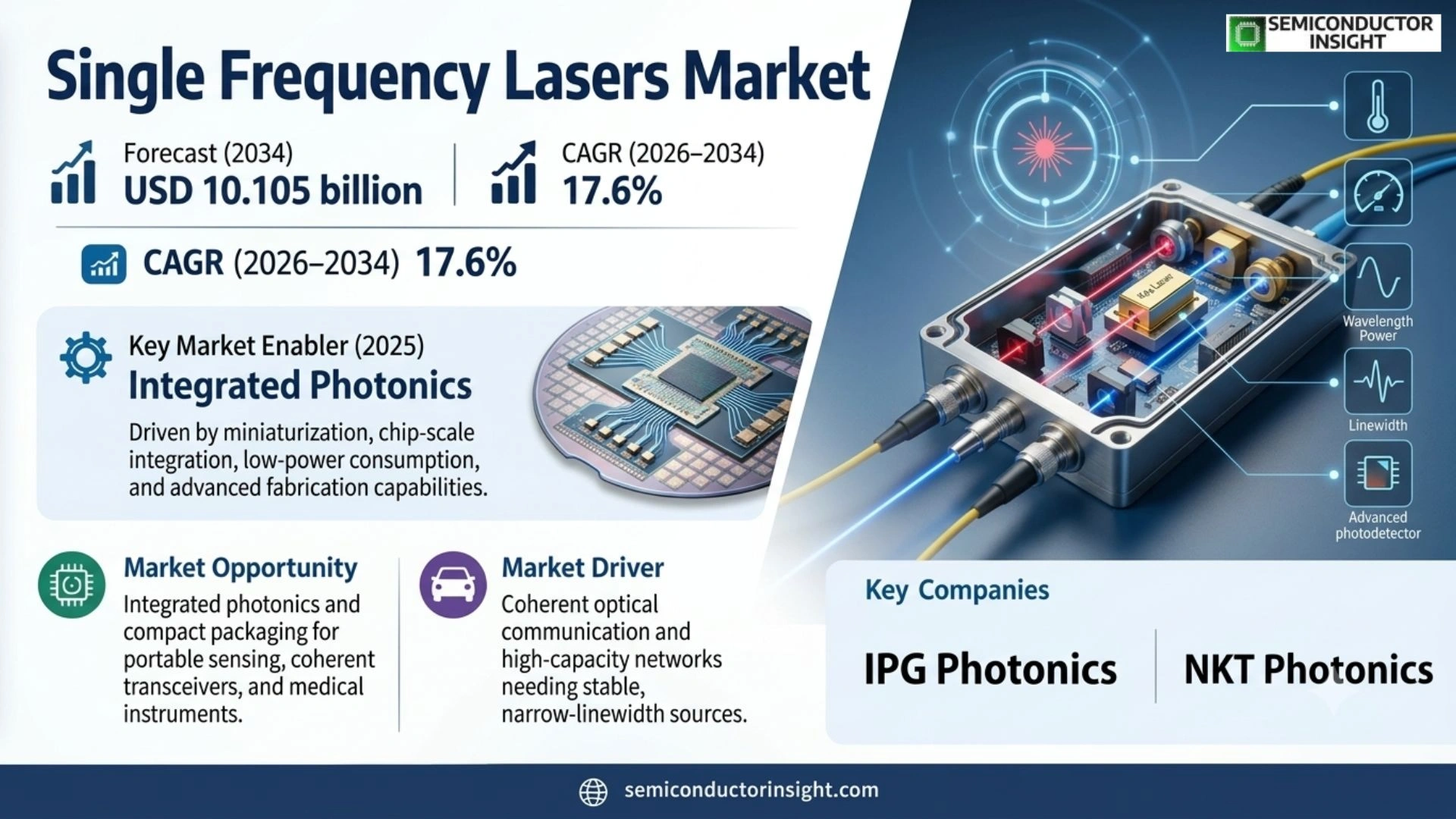
- The Global Single Frequency Lasers Market was valued at USD 2.349 billion in the 2025 base year and is projected to reach USD 10.105 billion by 2034, expanding at a 17.6% CAGR during 2026–2034.
- Single-frequency fiber lasers lead commercial adoption where narrow linewidth, long coherence, robust fiber delivery, and scalable power are required.
- Optical communication, LiDAR, quantum, spectroscopy, metrology, medical, and defense applications broaden demand beyond laboratory instruments.
- North America leads the regional market through telecom, defense, photonics research, quantum-computing, aerospace, and established laser manufacturing ecosystems.
- Linewidth, stability, wavelength, power, packaging, control electronics, and application support define supplier differentiation.
Global Single Frequency Lasers Market Overview
Global Single Frequency Lasers Market was valued at USD 2.349 billion in 2025 and is projected to reach USD 10.105 billion by 2034, growing at a CAGR of 17.6% during 2026–2034. North America held the largest regional position in 2025, supported by concentrated manufacturing, downstream electronics production and established component supply networks.
Single-frequency lasers emit light in a single longitudinal mode with narrow linewidth, long coherence length, high spectral purity, and stable frequency behavior. Fiber, diode, and solid-state architectures serve precision metrology, optical communications, coherent sensing, spectroscopy, atomic and quantum technologies, LiDAR, defense, medical systems, and industrial instrumentation. Product value depends on wavelength, linewidth, power, noise, tuning, stability, packaging, control electronics, and the quality of the reference or locking system.
The market enters the 2026 estimated year with demand from coherent optical networks, scientific instruments, quantum research, navigation, sensing, defense, and high-resolution measurement. Customers increasingly require compact sources with low phase noise, stable polarization, rapid tuning, and integration with photonic circuits or fiber systems. Growth remains application-led because specifications that are essential for an optical clock or coherent receiver may be unnecessary for a lower-cost industrial instrument.
Commercial competition spans specialist laser manufacturers, photonics groups, component suppliers, research-oriented firms, and system integrators. Product qualification often involves long testing because frequency drift, mode hops, vibration, thermal behavior, and serviceability matter over the full operating life. Suppliers that provide application engineering, control software, calibration, reference electronics, and field support can capture more value than firms selling an isolated laser head.
Segment Analysis: By Type
By type, the Single Frequency Lasers market is segmented into Single Frequency Fiber Laser · Single Frequency Diode Laser · Single Frequency Solid State Laser. Each category represents a different degree of integration, qualification burden and value capture, so suppliers compete through a combination of material performance, design support, manufacturing consistency, package architecture and application-specific testing rather than through unit price alone. Procurement also reflects lifecycle support, interoperability, compliance evidence, warranty exposure, and the cost of unsuccessful qualification.
| Type | Market relevance |
|---|---|
| Single Frequency Fiber Laser | Distinct performance, condition, integration, and qualification requirements shape demand and supplier positioning. |
| Single Frequency Diode Laser | Distinct performance, condition, integration, and qualification requirements shape demand and supplier positioning. |
| Single Frequency Solid State Laser | Distinct performance, condition, integration, and qualification requirements shape demand and supplier positioning. |
Segment Analysis: By Application
By application, the market covers LiDAR · Optical Communication · Laser Weapon · High-precision Spectral Measuring Instrument · Laser Medical Device · Other Applications. Demand varies by production volume and qualification intensity: consumer programmes reward scale and miniaturisation, while automotive, industrial, aerospace, medical or security designs place greater weight on reliability evidence, long product availability and system-level performance under demanding operating conditions. Channel design, documentation, service coverage, and total ownership economics further determine which application converts technical interest into repeat purchasing.
| Application | Market relevance |
|---|---|
| LiDAR | Purchasing criteria reflect use-case economics, technical requirements, warranty expectations, and channel support. |
| Optical Communication | Purchasing criteria reflect use-case economics, technical requirements, warranty expectations, and channel support. |
| Laser Weapon | Purchasing criteria reflect use-case economics, technical requirements, warranty expectations, and channel support. |
| High-precision Spectral Measuring Instrument | Purchasing criteria reflect use-case economics, technical requirements, warranty expectations, and channel support. |
| Laser Medical Device | Purchasing criteria reflect use-case economics, technical requirements, warranty expectations, and channel support. |
| Other Applications | Purchasing criteria reflect use-case economics, technical requirements, warranty expectations, and channel support. |
Regional Analysis
North America is the largest regional market for Single Frequency Lasers products, combining an established component-production ecosystem with major downstream customers. North America and Europe are strategically important for premium, automotive, aerospace, industrial and specialised applications, while South America and Middle East & Africa are primarily import- and project-led markets where distributor reach, local support and supply continuity shape vendor selection.
How does regional demand differ across this market?
For Global Single Frequency Lasers, North America holds the largest position, supported by an established customer base, supplier presence, and mature purchasing channels. Europe contributes regulation, industrial demand, and technical expertise, while Asia Pacific combines electronics manufacturing, large device populations, and expanding engineering capability. South America and the Middle East and Africa develop through targeted infrastructure, enterprise, research, consumer, or public-sector programs rather than uniform adoption.
| Region | Position |
|---|---|
| North America | Largest and most established demand base |
| Europe | Developing demand shaped by local applications, channels, and qualification conditions |
| Asia Pacific | Developing demand shaped by local applications, channels, and qualification conditions |
| South America | Developing demand shaped by local applications, channels, and qualification conditions |
| Middle East & Africa | Developing demand shaped by local applications, channels, and qualification conditions |
Key Single Frequency Lasers Manufacturers and Competitive Landscape
The Single Frequency Lasers competitive landscape includes global technology leaders, diversified semiconductor or component groups, RF and imaging specialists, and regional manufacturers. The report profiles every named company across product positioning, manufacturing footprint, application exposure, recent development activity and strategic strengths; the complete coverage list is reproduced below so the intended company universe is explicit.
The competitive landscape covers IPG Photonics, NKT Photonics, HÜBNER PHOTONICS, Lumibird, TOPTICA, Optromix, ALPHALAS, IxBlue, NP Photonics, Changchun New Industries Optoelectronics Technology, Connet Laser Technology, Coherent (Ondax), CrystaLaser, Focusing Optics, MPB Communications, Thorlabs, Nanguang Hi-Tech, Precilasers, and Hefei Max-Ray Photonics. These companies span fiber lasers, diode sources, solid-state products, amplifiers, tunable systems, quantum instruments, communication components, and application-specific modules.
Suppliers compete on linewidth, relative intensity noise, phase noise, output power, wavelength stability, tuning range, coherence length, polarization, thermal control, packaging, reliability, software, and integration support. Telecom customers prioritize narrow-linewidth performance and volume consistency, while research and quantum users value tunability, locking, low noise, and specialized wavelengths. Defense, LiDAR, and industrial buyers additionally assess ruggedness, shock and vibration, eye safety, supply continuity, export controls, and lifecycle service.
Key companies profiled
- IPG Photonics
- NKT Photonics
- HÜBNER PHOTONICS
- Lumibird
- TOPTICA
- Optromix
- ALPHALAS
- IxBlue
- NP Photonics
- Changchun New Industries Optoelectronics Technology
- Connet Laser Technology
- Coherent (Ondax)
- CrystaLaser
- Focusing Optics
- MPB Communications
- Thorlabs
- Nanguang Hi-Tech (Xiamen) Laser
- Precilasers
- Hefei Max-Ray Photonics
Single Frequency Lasers Production Capacity Analysis
Production capacity is a material competitive factor in the Single Frequency Lasers market because electrical performance depends on specialised processes, qualified materials, repeatable yields and application-specific test capability. Capacity cannot be assessed only by nominal factory floor area: effective supply is the output that passes dimensional, electrical, reliability and customer qualification requirements at the required product mix.
Production capacity depends on semiconductor or fiber gain media, pump diodes, gratings, resonators, cavities, nonlinear crystals, isolators, modulators, optical coatings, precision mechanics, control electronics, and firmware. Each architecture requires alignment, thermal management, mode control, noise testing, and calibration. Effective capacity is therefore the number of tested and stabilized sources that meet linewidth, power, wavelength, and environmental specifications, not simply the number of laser components assembled.
Fiber systems benefit from repeatable splicing, packaging, grating fabrication, and automated optical test, while solid-state and diode systems may require precision cavity alignment, crystal processing, temperature control, and current-noise management. Custom wavelengths, high-power amplifiers, vacuum or space-qualified packaging, and narrow-linewidth locking add engineering time. Modular platforms and common electronics can increase throughput, but application-specific qualification remains a meaningful capacity constraint.
Service and calibration capacity support market growth after shipment. Users may need wavelength checks, frequency locking, replacement modules, software updates, optical alignment, environmental testing, and repair. Suppliers with regional laboratories and field engineers can shorten downtime and support regulated or safety-critical deployments. Long-term reliability data, traceable calibration, and documented changes are particularly important for quantum, metrology, telecom, defense, and medical customers.
Single Frequency Lasers Market Dynamics: Drivers, Restraints and Opportunities
Single Frequency Lasers market growth reflects expanding electronic content and higher performance requirements, moderated by manufacturing complexity, long qualification cycles and competing technologies. The impact ranges below are directional analytical estimates rather than additive forecasts; they show the relative pressure each factor can place on the baseline CAGR when other assumptions remain broadly stable.
Market growth reflects the expansion of coherent communications, fiber sensing, quantum research, precision spectroscopy, autonomous systems, industrial metrology, and defense sensing. Single-frequency sources benefit when users need phase coherence, narrow spectral lines, or stable references rather than only high optical power. Adoption is moderated by the cost and integration effort required to control temperature, vibration, feedback, and optical alignment, especially outside laboratory environments.
Architectural tradeoffs shape product positioning. Fiber lasers offer robust alignment and long fiber paths, diode lasers enable compact and efficient modules, and solid-state systems can deliver high spectral quality or specialized wavelengths. Higher power may increase thermal and nonlinear effects, while wider tuning can complicate mode control. Buyers therefore compare complete system performance, control electronics, and service support rather than selecting solely on wavelength or output-power figures.
MARKET DRIVERS
Drivers Impact Analysis*
| Driver | (~) % impact on CAGR forecast | Geographic relevance | Impact timeline |
|---|---|---|---|
| Coherent optical communication upgrades | +3.2% | North America, Europe, Asia Pacific | Long term (≥4 years) |
| Quantum computing and precision timing | +2.8% | North America, Europe, Japan | Long term (≥4 years) |
| LiDAR and autonomous sensing | +2.3% | North America, Europe, Asia Pacific | Medium term (2–4 years) |
| Defense and aerospace photonics | +1.8% | North America, Europe, Asia Pacific | Long term (≥4 years) |
| Spectroscopy and industrial metrology | +1.3% | Global research and industrial hubs | Medium term (2–4 years) |
| Integrated rugged laser modules | +1.0% | Global OEM markets | Short term (≤2 years) |
Coherent optical communication and high-capacity networks require stable, narrow-linewidth sources for modulation, detection, frequency references, and signal processing. Data-center interconnects, submarine systems, metro networks, and emerging coherent access architectures increase the value of low-noise lasers. Suppliers that offer consistent wavelengths, polarization control, integrated modulation, and production-scale quality can address telecom volumes, while specialist vendors serve laboratory and high-performance links.
Quantum computing, quantum communication, atomic clocks, and quantum sensing depend on accurately controlled optical frequencies and low-noise sources. Experimental platforms may require multiple wavelengths, fast switching, precise locking, and phase stability, creating opportunities for integrated laser assemblies and control software. As quantum systems move toward engineering prototypes, suppliers that provide reproducible modules, fiber coupling, reference electronics, and technical support can transition demand from research orders to program-scale procurement.
LiDAR, spectroscopy, metrology, navigation, defense, and medical instruments broaden demand. Narrow linewidth and long coherence improve range resolution, interferometric accuracy, gas or material identification, and frequency discrimination. Compact packaging and rugged environmental performance determine whether a source can move from a laboratory into a vehicle, aircraft, field instrument, or production line. Application partnerships can therefore be more important than generic laser specifications for commercial scale.
MARKET RESTRAINTS
Restraints Impact Analysis*
| Restraint | (~) % impact on CAGR forecast | Geographic relevance | Impact timeline |
|---|---|---|---|
| High price and stabilization complexity | −1.5% | OEM and research buyers | Persistent |
| Environmental sensitivity and mode-hop risk | −1.0% | Field and mobile systems | Persistent |
| Competing laser architectures | −0.8% | Cost-sensitive applications | Medium term (2–4 years) |
| Specialized qualification and integration | −0.7% | Medical, defense and telecom programs | Medium term (2–4 years) |
| Supply constraints for precision components | −0.5% | Global laser manufacturing | Medium term (2–4 years) |
High price and integration complexity limit adoption in cost-sensitive equipment. Single-frequency performance may require temperature control, optical isolators, feedback electronics, frequency references, vibration management, and specialized packaging. Customers must also validate mode stability and noise under real operating conditions. If an application does not benefit materially from narrow linewidth or long coherence, a broader-linewidth diode or fiber source may provide an adequate and less expensive solution.
Environmental sensitivity creates reliability risk. Temperature, pressure, vibration, humidity, acoustic noise, optical feedback, and aging can shift frequency or trigger mode hops. Field systems may need active stabilization, hermetic packaging, shock qualification, and maintenance. These features increase size, power, and cost. Suppliers must demonstrate stable performance across the intended operating envelope rather than relying only on laboratory measurements taken under carefully controlled conditions.
Alternative laser architectures and internal development constrain the addressable market. Tunable, multi-mode, distributed-feedback, external-cavity, frequency-comb, and superluminescent sources can satisfy selected applications at lower cost or with simpler integration. Large telecom, defense, and research organizations may also develop proprietary sources or buy subsystems directly. Vendors must demonstrate a clear performance, reliability, or lifecycle advantage to displace established components and qualification records.
MARKET OPPORTUNITIES
Integrated photonics and compact packaging can expand single-frequency lasers into portable sensing, coherent transceivers, medical instruments, and field metrology. Combining the source with isolators, modulators, monitoring photodiodes, thermal control, and digital interfaces reduces integration work for OEMs. Suppliers can differentiate through application-ready modules, automated calibration, low power, rugged packaging, and software that exposes frequency, power, and health data to the host system.
Quantum and precision-measurement platforms offer high-value opportunities for multi-wavelength, tunable, and ultra-low-noise sources. Product families that support locking, modulation, fiber delivery, frequency doubling, and synchronized operation can serve complex experimental setups. As customers move from one-off laboratory builds toward repeatable systems, standardized interfaces, documentation, reliability testing, and supply commitments become important commercial advantages. Partnerships with universities, national laboratories, and quantum-system developers can accelerate qualification.
LiDAR, coherent sensing, satellite communications, optical clocks, and defense systems create opportunities for ruggedized and space- or field-qualified products. These markets value low size, weight, and power together with vibration tolerance, radiation or environmental screening, and stable frequency references. Suppliers that combine a narrow-linewidth source with amplifiers, detectors, control electronics, and system-level support can capture more of the program value than component-only competitors.
Single Frequency Lasers Supply Chain Analysis
The Single Frequency Lasers supply chain links specialty materials and wafer or ceramic processing equipment to high-precision manufacturing, packaging, distribution and downstream system integration. Commercial resilience depends on qualified alternate materials, realistic yield assumptions, geographic redundancy and traceable process controls because a nominal second source is not interchangeable until the customer has validated electrical behaviour, reliability and package compatibility.
The supply chain includes pump diodes, semiconductor gain chips, optical fiber, gratings, crystals, mirrors, isolators, modulators, coatings, photodiodes, temperature controllers, drivers, precision mounts, electronics, software, and test references. Laser manufacturers integrate these components into fiber, diode, and solid-state products, then qualify them for telecom, sensing, research, defense, industrial, or medical applications. Distributors, photonics integrators, and OEMs provide final system integration and service.
Resilience depends on qualified optical materials, stable pump-diode sources, traceable coatings, controlled firmware, calibration references, and alternate suppliers for precision mechanics and electronics. A change in fiber, grating, crystal, coating, driver, or feedback component can alter linewidth, noise, wavelength, or reliability. Strong vendors maintain documented change control, environmental test capability, repair programs, and regional inventory so long-lived instruments do not become unsupported when a component is discontinued.
Recent Developments in the Single Frequency Lasers Market
Developments tracked to September 2026 and linked to official company or industry sources.
- August 2026 Published
IPG Photonics reported continued portfolio development across fiber lasers and advanced solutions while maintaining a dedicated single-frequency fiber-amplifier offering for precision applications. Source - June 2025 Published
IPG Photonics presented new fiber-laser technologies and highlighted single-frequency fiber amplifiers at Laser World of Photonics 2025 for advanced industrial and scientific applications. Source - May 2025 Published
IPG Photonics appointed a new Senior Vice President for Global Laser Systems, reinforcing leadership and application development across industrial, medical, and high-technology laser markets. Source - January 2025 Published
IPG Photonics announced that it would showcase linearly polarized single-frequency laser sources and amplifiers designed for quantum-computing applications at Photonics West 2025. Source - 2025 Published
NKT Photonics continued to offer Koheras single-frequency fiber lasers with narrow linewidth and low phase- and intensity-noise characteristics for sensing, metrology, communications, and research. Source
REPORT SCOPE & SEGMENTATION
| Attribute | Details |
|---|---|
| Study Period | 2021–2034 |
| Base Year | 2025 |
| Estimated Year | 2026 |
| Forecast Year | 2034 |
| Historical Period | 2021–2025 |
| Market Size 2025 | USD 2.349 billion |
| Market Size 2034 | USD 10.105 billion |
| Growth Rate | CAGR of 17.6% from 2026–2034 |
| Unit | Value in USD billion and shipment or production volume where disclosed |
| Segmentation | By Type, By Application, additional technology axis and By Region |
| By Type | Single Frequency Fiber Laser · Single Frequency Diode Laser · Single Frequency Solid State Laser |
| By Application | LiDAR · Optical Communication · Laser Weapon · High-precision Spectral Measuring Instrument · Laser Medical Device · Other Applications |
| By Wavelength and Buyer Type | Visible and Near-infrared · Telecom C-band and O-band · Mid-infrared and Specialty Wavelengths · Research Laboratories · Telecom Operators · Defense and Aerospace · Medical and Industrial OEMs |
| By Region | Each region analysed by type, application and countryNorth AmericaU.S., Canada, MexicoEuropeGermany, France, U.K., Italy, Nordic Countries, BeneluxAsia PacificChina, Japan, South Korea, India, Southeast AsiaSouth AmericaBrazil, Argentina, Rest of South AmericaMiddle East & AfricaTurkey, Israel, Saudi Arabia, UAE, Rest of MEA |
| Key Companies Profiled | IPG Photonics; NKT Photonics; HÜBNER PHOTONICS; Lumibird; TOPTICA; Optromix; ALPHALAS; IxBlue; NP Photonics; Changchun New Industries Optoelectronics Technology; Connet Laser Technology; Coherent (Ondax); CrystaLaser; Focusing Optics; MPB Communications; Thorlabs; Nanguang Hi-Tech (Xiamen) Laser; Precilasers; Hefei Max-Ray Photonics |
| Customization Scope | Free report customization equivalent to up to four analyst working days with purchase, including additions or alterations to country, regional and segment coverage. |
Frequently Asked Questions
What is a single-frequency laser?
The Global Single Frequency Lasers Market is valued at USD 2.349 billion in the 2025 base year and is projected to reach USD 10.105 billion by 2034, expanding at a CAGR of 17.6% during 2026–2034. The outlook covers fiber, diode and solid-state single-frequency lasers used in LiDAR, optical communications, defense, spectroscopy, medical and other applications, with North America holding the leading regional position.
What is the market outlook through 2034?
Demand is expected to grow rapidly through 2034 as coherent networks, quantum systems, optical clocks, LiDAR, satellite links, spectroscopy, medical diagnostics, industrial metrology and defense sensing expand. Integrated modules combining narrow-linewidth sources with amplification, locking, modulation, monitoring, thermal management and digital interfaces can reduce OEM engineering time and support deployment outside controlled laboratories.
Which laser type leads?
Single-frequency fiber lasers are well positioned because they combine robust alignment, efficient fiber delivery, low maintenance, and strong performance for sensing, communications, metrology, and research. Diode lasers support compact and efficient modules, while solid-state lasers serve high spectral quality, specialized wavelengths, and higher-power applications. Leadership varies by wavelength, linewidth, power, environmental qualification, tuning requirement, and the integration level purchased by the customer.
Which applications create the strongest demand?
Optical communications, precision measurement, scientific research, quantum systems, LiDAR, spectroscopy, defense, and medical equipment create the strongest demand. Telecom customers emphasize narrow linewidth, wavelength consistency, polarization, and volume reliability. Research and quantum users value low noise, tunability, locking, and multiple synchronized wavelengths. LiDAR and field instruments add requirements for compact size, ruggedness, low power, environmental stability, and serviceable system integration.
Why does North America lead?
North America combines major optical-communications companies, national laboratories, universities, defense programs, photonics startups, quantum developers, and established laser manufacturers. These organizations purchase premium sources for research, sensing, telecom, and aerospace applications and often influence product roadmaps. Europe remains strong in photonics engineering and scientific instrumentation, while Asia Pacific adds telecom, electronics, manufacturing, and expanding research demand with growing local supply capability.
What drives market growth?
Growth is driven by coherent data transmission, high-capacity networks, quantum computing and communication, optical clocks, precision spectroscopy, autonomous sensing, LiDAR, industrial metrology, medical devices, and defense systems. Narrow linewidth and phase stability can improve resolution, coherence, frequency discrimination, and signal integrity. Miniaturization, integrated control electronics, fiber delivery, and rugged packaging make single-frequency products more practical outside laboratory environments and broaden the addressable market.
What limits adoption?
High price, active stabilization, environmental sensitivity, integration effort, competing laser architectures, and customer qualification requirements limit adoption. Temperature, vibration, optical feedback, humidity, and aging can cause drift or mode hops, so field systems may need thermal control, isolation, monitoring, and calibration. If the application does not need narrow linewidth or long coherence, a simpler diode, fiber, or tunable source may deliver sufficient performance at lower cost.
How do suppliers compete?
Suppliers compete on linewidth, phase and intensity noise, power, wavelength, tuning, polarization, coherence length, thermal stability, package size, reliability, control software, and application support. Telecom and research users assess different performance priorities, while defense and medical programs add environmental qualification, security, traceability, and lifecycle requirements. Vendors with integrated modules, calibrated references, regional service, and stable long-term supply can win programs over lower-priced component-only alternatives.
Where are the best opportunities?
Opportunities include quantum platforms, coherent transceivers, LiDAR, optical clocks, satellite links, fiber sensing, spectroscopy, medical diagnostics, defense sensing, and portable metrology. Integrated source modules that include locking, amplification, modulation, monitoring, thermal control, and digital interfaces can reduce OEM engineering time. Ruggedized low-size, weight, and power products, plus multi-wavelength synchronized systems, offer attractive value as laboratory technologies move into field and production deployments.
Which companies are covered?
The report covers IPG Photonics, NKT Photonics, HÜBNER PHOTONICS, Lumibird, TOPTICA, Optromix, ALPHALAS, IxBlue, NP Photonics, Changchun New Industries Optoelectronics Technology, Connet Laser Technology, Coherent (Ondax), CrystaLaser, Focusing Optics, MPB Communications, Thorlabs, Nanguang Hi-Tech, Precilasers, and Hefei Max-Ray Photonics. Profiles examine laser architecture, product range, wavelength and performance focus, applications, manufacturing and service capability, regional presence, partnerships, and recent developments.
Get Sample Report PDF for Exclusive Insights
Report Sample Includes
- Table of Contents
- List of Tables & Figures
- Charts, Research Methodology, and more...
 Download Sample Report PDF