GaN Power Supply Adapter Market Insights
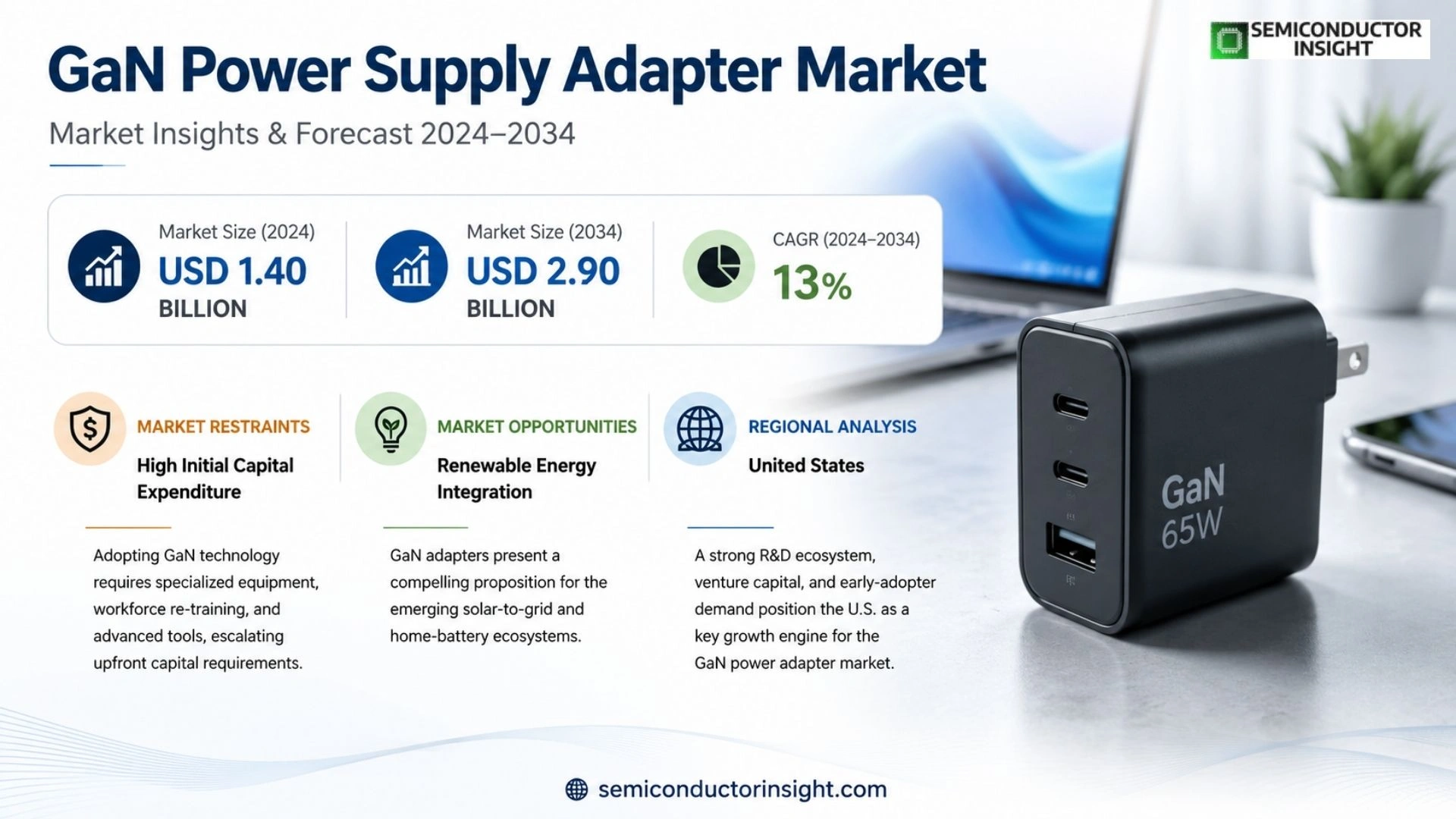
GaN Power Supply Adapter market reached USD 1.40 billion in 2024 and is expected to rise to USD 2.90 billion by 2034, reflecting a compound annual growth rate of about 13% over the forecast horizon.
GaN Power Supply Adapters leverage gallium nitride semiconductors that enable higher switching frequencies, lower conduction losses and reduced heat dissipation compared with silicon counterparts. These attributes translate into compact wall‑mount or desktop chargers capable of delivering up to three times the output power while maintaining stringent safety standards across consumer electronics, communication devices and industrial equipment.
MARKET DRIVERS
Energy Efficiency and Space Reduction
GaN power supply adapters have captured increasing attention because they deliver markedly lower heat generation and higher conversion efficiency than traditional silicon counterparts. Efficiency gains of 30–45% translate directly into reduced operating costs for data centers and manufacturing plants, where power budgets are tightly constrained. The compactness afforded by advanced GaN ICs shrinks device footprints by up to 70%, enabling manufacturers to pack more computing power into thinner laptop chassis or ultra‑portable routers. Market actors are investing heavily in GaN R&D to exploit these benefits, pushing adoption across high‑performance workloads in edge servers, virtual reality headsets, and automotive infotainment systems.
Rise of Ultra‑Fast Charging Ecosystems
Consumer demand for immediate, safe charging solutions fuels a surge in GaN adapters for smartphones, wearables, and electric vehicles. The capacity to support current densities exceeding 2.5 A at 33 W means that chargers can be both smaller and more robust against thermal overloads. Automotive OEMs are integrating GaN modules within power‑train controllers, citing reduced charging times by 20 % compared to legacy designs and tighter thermal budgets that mitigate heat‑induced degradation. End‑users perceive these benefits as tangible value, which in turn accelerates market penetration across personal tech and renewable energy deployments.
➤ GaN technologies are converging with digital signal integrity standards, offering a dual pathway for performance and safety gains in next‑generation power delivery.
The trend also aligns with stricter environmental regulations that mandate lower carbon footprints across consumer electronics. By reducing standby power drain, GaN adapters contribute to extended battery life in battery‑powered devices, an advantage that resonates with eco‑conscious buyers. For industry players, the opportunity lies in differentiating product portfolios through higher efficiency claims and superior thermal management, thereby commanding premium pricing and strengthening brand equity in a crowded market.
MARKET CHALLENGES
Interoperability Concerns
While GaN’s inherent physics promises faster switching, real‑world compatibility with existing DC‑DC topologies and PCB designs presents a consistent hurdle. Many legacy systems require minor firmware adjustments to accommodate the higher switching frequencies, and these changes can introduce signal integrity issues if not handled correctly. The proliferation of GaN adapters also raises concerns over electromagnetic interference in densely packed electronic environments, prompting stricter compliance checks from certification bodies. Firms that invest in comprehensive design tooling and robust testing frameworks find themselves better positioned to mitigate these technical risks.
Other Challenges
Supply Chain Rigidity
The GaN market is constrained by a limited pool of high‑purity silicon carbide substrates and graphene‑based transmission layers. Disruptions in the supply of diamond‑like carbon or gallium nitride raw materials can inflate component costs and delay time‑to‑market. Apparent regional disparities in factory capacity also lead to logistical bottlenecks that ripple through the global distribution network. Companies that strategize diversified sourcing and cultivate strong relationships with semiconductor manufacturers are thereby gaining resilience against geopolitical or commodity‑price shocks.
MARKET RESTRAINTS
High Initial Capital Expenditure
Adopting GaN technology requires specialized fabrication equipment, workforce re‑training, and advanced metrology tools, escalating upfront capital requirements. Small and mid‑size OEMs often defer investment due to the longer payback period associated with reduced efficiency gains, especially in low‑margin product categories. Additionally, the cost premium for GaN ICs typically exceeds that of silicon by 40–50%, placing a price constraint on penetration in cost‑sensitive segments such as budget smartphones or entry‑level power adapters. While economies of scale promise gradual cost decline, the initial restraint remains a critical barrier to widespread adoption.
MARKET OPPORTUNITIES
Renewable Energy Integration
GaN adapters present a compelling proposition for the emerging solar‑to‑grid and home‑battery ecosystems. Their higher efficiency translates into less inverter heat, which prolongs component life and reduces maintenance schedules for solar farms. Residential installers can offer concentrator panels paired with GaN‑based inverters, achieving power conversion rates above 95 % and marginally lowering overall system costs. For utility providers, integrating GaN modules within smart‑metering platforms allows zero‑down power upgrades that enhance grid resilience against micro‑grid challenges and fluctuating renewable inputs. These applications offer a trajectory of growth driven by regulatory emphasis on clean energy solutions and the accompanying capital incentives available to developers and consumers alike.
GaN Power Supply Adapter Market Trends
Accelerated Adoption of GaN-Based Wall-Mount Adapters in Consumer Electronics
Consumer devices are increasingly demanding rapid, high‑density charging solutions that can be deployed discreetly within living spaces. The compact dimensions and superior efficiency of GaN wall‑mount adapters have therefore found compelling application in portable computing, wearable ecosystems and smart home hubs. From an enterprise perspective, the lower thermal footprint reduces fan requirements and extends component life, translating into tangible quality‑of‑service gains. Retailers citing increased customer preference for “plug‑and‑play” solutions now rank these adapters as a priority offering, prompting mid‑tier manufacturers to re‑engineer supply chains to secure critical silicon and heat‑sinking materials. In markets where power density constraints are pressing,particularly in densely populated urban areas,businesses can capture value by bundling GaN adapters with premium paid‑support contracts.
Other Trends
Emerging Edge Applications in Industrial and Medical Equipment
Industrial automation suites are progressively adopting GaN power supplies to meet the real‑time power delivery demands of CNC machines and robotics. In the medical sector, the need for low‑noise, high‑reliability sources is driving adoption in MRI control modules and surgical imaging devices. These verticals require robust qualifications that favor GaN’s higher temperature tolerance and reduced electromagnetic interference. For firms entering these markets, partnership with specialized component vendors can mitigate certification timelines and expedite deployment.
Strategic Partnerships and Supply Chain Resilience Driving Market Expansion
Manufacturers are aligning with semiconductor foundries to lock in platform‑level collaboration, ensuring early access to next‑generation GaN dies that deliver tighter voltage regulation. Simultaneously, diversified distribution networks spanning multiple logistics hubs are curbing region‑specific disruptions. Companies that have established joint‑venture agreements with key battery cell suppliers are reporting smoother ramp‑up cycles, allowing them to capitalize on forthcoming demand spikes triggered by global refresh cycles of consumer hardware. These integrated approaches not only safeguard profit margins but also create new revenue streams through cross‑selling complementary services such as firmware‑based power optimization tools.
COMPETITIVE LANDSCAPE
Key Industry Players
Competitive Landscape Overview
At the core of GaN Power Supply Adapter market sit a trio of manufacturers that command the bulk of revenue and R&D investment. CUI leads with a portfolio of high‑density GaN wafers and a globally diversified OEM footprint, capturing roughly a quarter of the market share in 2024. GaN Systems, by virtue of its integrated GaN‑logic ICs and deep licensing agreements with semiconductor foundries, positions itself as the technology front‑runner, particularly within the high‑power segment targeted at automotive and industrial applications. Adapter Technology, with a streamlined supply chain and strong presence in the U.S. and China, supplies compact adapters to a broad spectrum of consumer electronics vendors, accounting for an additional 8% of the revenues. These incumbents benefit from capital‑heavy production facilities and established distribution channels, factors that set a high entry barrier for newcomers and foster a stable competitive environment.
Beyond the giants, a shifting network of niche players shapes the market’s strategic contours. Brands such as ANKER and Belkin have carved out significant segments by bundling advanced GaN adapters with flagship mobile devices, combining marketing leverage with engineering differentiation. On the budget side, Phihong, AUKEY, and Baseus tailor cost‑efficient adapters for emerging Chinese OEMs, where volume and price sensitivity dominate. Meanwhile, specialist firms like Astek and ADG focus on the industrial and medical sub‑sector, providing ruggedised adapters that meet stringent certification requirements. This heterogeneity introduces both collaboration and overlap opportunities, prompting incumbents to consider strategic alliances or acquisitions to secure supply‑chain resilience and expand into slower‑moving segments.
List of Key GaN Power Supply Adapter Companies Profiled
- CUI
- GaN Systems
- Adapter Technology
- Belkin
- ANKER
- Astek
- Phihong
- ADG
- Baseus
- chargeasap
- AUKEY
- HUWDER
- HYPER
- Uyash
Segment Analysis:
| Segment Category | Sub-Segments | Key Insights |
| By Type |
|
Leading Segment Wall‑mount adapters serve stationary devices such as routers, set‑top boxes, and small‑size IT equipment, delivering high efficiency and compact footprints that appeal to vendors seeking to reduce power consumption. The adoption rate climbs where regulatory demands for lower energy use are stringent and product lifespan expectations increase. Key attributes driving growth include silent operation, superior heat management, and lightweight materials, which enable installers to mitigate cable clutter and energy loss. |
| By Application |
|
Leading Segment Consumer electronics such as laptops, monitors, and home media devices demand power supplies that combine high efficiency with limited spatial requirements. Manufacturers favor GaN adapters to meet strict form‑factor constraints while maintaining power density. The shift towards constellations of smart devices and edge computing contributes to a steady demand for compact, lightweight, and high‑performance voltage converters that GaN technologies provide. |
| By End User |
|
Leading Segment Original Equipment Manufacturers (OEMs) lead the adoption of GaN power adapters due to their incentive to embed premium energy efficiency within consumer and industrial devices. By incorporating GaN adapters, OEMs can differentiate products on power consumption, reduce thermal design complexity, and shorten supply‑chain logistics through smaller, lighter components. OEMs also benefit from programmable control and firmware updates that align with evolving safety and performance standards. |
| By Power Rating |
|
Leading Segment Medium‑power adapters strike the ideal balance between performance and size for telecom base stations, edge routers, and medical diagnostic equipment. Their moderate power range allows manufacturers to meet power delivery targets while keeping form factor and thermal footprint minimal. This class is favored in setups demanding reliable uptime, where energy efficiency can mitigate operational costs and compliance with sustainability guidelines. |
| By Form Factor |
|
Leading Segment Compact adapters are pivotal for space‑constrained devices such as handheld medical instruments and embedded industrial controls. Their small footprints, coupled with GaN’s high switching frequencies, enable tight integration without compromising current handling or thermal management. The market trends expect increasing adoption as manufacturers pursue slimmer chassis and lower cooling budgets, making the compact form factor a linchpin for next‑generation power solutions. |
Regional Analysis: GaN Power Supply Adapter Market
United States
The transition towards solar‑driven home and industrial power supplies has accelerated, driving demand for GaN adapters that operate reliably over diverse temperatures and input ranges. Critics note that distributed generation sites in the U.S. rely increasingly on small‑form‑factor converters that maximise energy density, aligning GaN’s capabilities with the decentralised grid.
Leading silicon manufacturers have adopted gallium nitride excess planar diodes to replace conventional silicon junctions in peak‑current modules. This innovation reduces thermal resistance and widens the current‑carry window, allowing designers to achieve tighter form factors without compromising reliability.
Availability of gallium arsenide‑based growth substrates, coupled with a steady supply of high‑purity gallium, underpins a cost‑effective production pipeline that supports high-volume launch schedules. Several contract manufacturers now offer turnkey GaN integration services, shortening time‑to‑market for new adapters.
Federal and state‑level incentives aimed at cutting carbon emissions have made GaN power supplies a preferred choice for compliance‑focused end‑users. These frameworks elevate demand for devices that meet or exceed power‑efficiency certification thresholds, positioning GaN adapters favourably in high‑standard markets.
Europe
Europe’s trajectory for GaN Power Supply Adapter market is marked by an emphasis on stringent environmental legislation and a growing appetite for energy‑efficient consumer electronics. While the region has not yet reached the scale of the United States, the adoption curve is fast‑tracking, propelled by the EU’s commitment to the Green Deal and the European Battery Alliance. German and Dutch industrial parks are harnessing GaN adapters to power renewable‑energy‑driven manufacturing lines, thereby reducing operational footprints. In the consumer sector, Scandinavian vendors are championing portable chargers that achieve near‑perfect energy conversion, diminishing subjective power‑loss complaints. Regulatory pressure has also spurred collaborations between OEMs and research institutions to standardise GaN modules that comply with low‑energy‑emission directives. This collective approach places Europe on a stable footing, with a gradual shift towards robustly designed, high‑ratio converters that synergise with the continent’s decarbonisation agenda.
Asia‑Pacific
The Asia‑Pacific region presents a complex mosaic of rapid device adoption and fragmented supply chains for GaN Power Supply Adapter solutions. In China, policy incentives that value high‑efficiency electronics have accelerated the uptake of GaN converters in the burgeoning smartphone and laptop markets. Yet the region faces significant capacity constraints in gallium nitride fabrication, compelling local manufacturers to latches onto global supply streams or to invest heavily in domestic plant upgrades. South Korea’s semiconductor cluster stands out, as domestic OEMs are collaborating with GaN research labs to embed small‑form‑factor adapters into high‑performance graphics cards and servers, effectively bolstering their competitive edge. Meanwhile, India is capitalising on its vast low‑power market by adopting GaN for portable chargers and home appliances, recognising that energy savings translate into consumer cost benefits. Across the Pacific, the interplay between availability of raw materials, local manufacturing maturity, and policy incentives will dictate the pace at which this market matures, potentially making Asia‑Pacific a major downstream player by 2035.
South America
South America remains in the early phase of market consolidation for GaN Power Supply Adapter technology. Brazil’s energy policy, which emphasises indigenous production of renewable infrastructure, has paved the way for early adopters of GaN solutions in solar farm inverters and electric‑vehicle chargers. Chile, amid its solar‑rich landscape, has begun exploring micro‑grid applications that favour compact GaN converters capable of operating under harsh weather conditions. The region’s limited domestic capacity for gallium nitride device fabrication, however, forces companies to rely on imports, which dampens rapid scale. Nevertheless, a growing partnership between local tech firms and international suppliers is nurturing a nascent ecosystem for GaN I/O modules, with an eye towards reducing the carbon footprint of consumer electronics in upcoming market releases. With a focus on regulatory support for green technologies, South America may see accelerated growth as policy frameworks solidify and local technologists develop in‑region expertise.
Middle East & Africa
In the Middle East & Africa, the adoption of GaN power adapters is shaped by the region’s distinctive energy profile and a pivot towards more reliable and efficient grid solutions. Israel’s defense and telecommunications sectors are early adopters, integrating GaN modules into battery‑backed power units that support critical infrastructure. Oligarchic investment in technology parks within the UAE promotes the development of high‑voltage converters, positioning GaN devices as key enablers for the burgeoning electric‑vehicle market. African economies, while still grappling with electricity reliability, have slowly started to incorporate GaN in solar charging stations to manage peak demand and reduce power loss. The main barrier remains the lack of local fabrication facilities, meaning that the market’s supply side will continue to rely on international partnerships. Consequently, the trend points towards incremental growth, driven by policy commitment to reduce energy waste and improve device performance, marking a steady but measured entry into GaN Power Supply Adapter market.
Report Scope
This market research report provides a comprehensive analysis of the GaN Power Supply Adapter Market , covering the forecast period 2026–2034. It offers detailed insights into market dynamics, technological advancements, competitive landscape, and key trends shaping the industry.
Key focus areas of the report include:
- Market Overview: The report begins with an overview outlining its current market scenario, key growth indicators, and industry transformation drivers. It discusses macroeconomic factors, demand–supply balance, regulatory landscape, and the strategic role of semiconductors in powering advancements across industries such as automotive, telecommunications, consumer electronics, and industrial automation.
- Market Size & Forecast: Historical data and future projections for revenue, unit shipments, and market value across major regions and segments.
- Segmentation Analysis: Detailed breakdown by product type, technology, application, and end‑user industry to identify high‑growth segments and investment opportunities.
- Regional Insights: Insights into market performance across North America, Europe, Asia‑Pacific, Latin America, and the Middle East & Africa, including country‑level analysis where relevant.
- Competitive Landscape: Profiles of leading market participants, including their product offerings, R&D focus, manufacturing capacity, pricing strategies, and recent developments such as mergers, acquisitions, and partnerships.
- Technology Trends & Innovation: Assessment of emerging technologies, integration of AI/IoT, semiconductor design trends, fabrication techniques, and evolving industry standards.
- Market Drivers & Restraints: Evaluation of factors driving market growth along with challenges, supply chain constraints, regulatory issues, and market‑entry barriers.
- Stakeholder Insights: Insights for component suppliers, OEMs, system integrators, investors, and policymakers regarding the evolving ecosystem and strategic opportunities.
Primary and secondary research methods are employed, including interviews with industry experts, data from verified sources, and real‑time market intelligence to ensure the accuracy and reliability of the insights presented.
FREQUENTLY ASKED QUESTIONS:
What is the current market size of GaN Power Supply Adapter Market?
-> GaN Power Supply Adapter market is expected to rise to USD 2.90 billion by 2034, reflecting a compound annual growth rate of about 13%
Which key companies operate in GaN Power Supply Adapter Market?
-> Key players include CUI, Adapter Technology, belkin, Astek, GaN Systems, Phihong, ANKER, ADG, Baseus, chargeasap, AUKEY, HUWDER, HYPER, among others.
What are the key growth drivers?
-> Key growth drivers include the adoption of GaN technology for higher efficiency, regulatory support for energy efficiency, and increasing demand for compact power supplies across consumer electronics, industrial, and automotive sectors.
Which region dominates the market?
-> North America is the dominant market with the largest share, driven by strong demand in the United States and Canada, followed by Asia‑Pacific with significant growth potential in China, Japan, and South Korea.
What are the emerging trends?
-> Emerging trends include advanced GaN module integration, multi‑unit power systems, and enhanced thermal management solutions to support high‑power densities.
Get Sample Report PDF for Exclusive Insights
Report Sample Includes
- Table of Contents
- List of Tables & Figures
- Charts, Research Methodology, and more...
 Download Sample Report PDF