GaN for Data Center Power Supply Market Insights
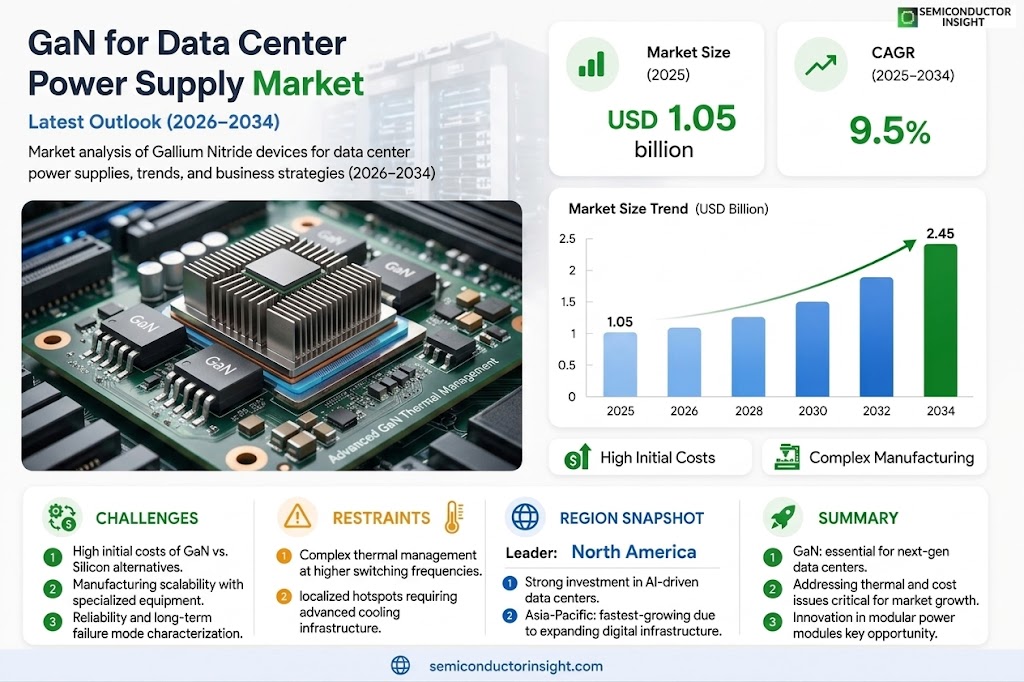
GaN for Data Center Power Supply Market size was valued at USD 1.05 billion in 2025. The market is projected to grow from USD 1.12 billion in 2025 to USD 2.45 billion by 2034, exhibiting a CAGR of 9.5% during the forecast period.
Gallium Nitride (GaN) technology is a semiconductor material that offers superior performance compared to traditional silicon in power electronics. GaN devices enable higher efficiency, faster switching speeds, and reduced power loss, making them ideal for data center power supplies where energy efficiency and thermal management are critical. GaN power supplies are designed to convert and regulate electrical power with minimal energy waste, supporting the increasing demand for high-density, high-performance computing infrastructure.
The market is witnessing rapid adoption due to the growing need for energy-efficient data centers driven by the surge in cloud computing, big data analytics, and AI workloads. Furthermore, advancements in GaN device fabrication and integration are lowering costs and improving reliability. However, challenges such as high initial costs and integration complexities remain. Leading companies in the market are investing heavily in R&D to enhance GaN power supply solutions, which is expected to further accelerate market growth.
MARKET DRIVERS
Rising Demand for Energy-Efficient Data Centers
GaN for Data Center Power Supply Market is primarily driven by the increasing need for energy-efficient power supplies in data centers. With data centers consuming significant amounts of electricity globally, the adoption of GaN technology offers substantial improvements in power conversion efficiency and thermal performance compared to traditional silicon-based components. This efficiency gain translates directly to lower operational costs and reduced carbon footprints, encouraging widespread deployment of GaN solutions.
Advancements in GaN Technology and Integration
Continued innovations in GaN semiconductor fabrication and integration techniques have expanded the capabilities of power supplies for data center applications. Improved material quality, enhanced reliability, and better thermal management systems have made GaN devices increasingly viable for high-voltage and high-frequency operations, which are critical in modern data center infrastructure.
➤ Adoption of GaN devices can improve power density by over 30% compared to traditional silicon MOSFETs, enabling more compact and efficient power modules.
These technological advancements shorten deployment timelines and offer enhanced system-level benefits, making GaN an attractive choice for next-generation data center power supplies.
MARKET CHALLENGES
Costs and Manufacturing Scalability
Despite the clear performance benefits, GaN for Data Center Power Supply Market faces challenges associated with the higher initial costs of GaN-based components compared to conventional silicon alternatives. Manufacturing processes for GaN devices require specialized equipment and materials, which can limit scalability and keep unit costs elevated in early adoption phases. Many data center operators are cautious about transitioning due to the upfront investment needed.
Other Challenges
Reliability and Long-Term Testing
Although GaN devices demonstrate high efficiency, the technology is relatively newer in high-power data center environments. Long-term reliability data and failure mode characterization are still evolving, raising concerns among stakeholders about lifecycle performance and maintenance costs.
MARKET RESTRAINTS
Thermal Management Complexity
One of the key restraints limiting rapid adoption of GaN in data center power supplies is the complexity associated with thermal management. GaN devices operate at higher switching frequencies that, while improving efficiency, can lead to localized hotspots. Efficient heat dissipation solutions are required to prevent premature device failure and ensure system stability. The need for advanced cooling infrastructure increases the overall system design complexity and cost.
MARKET OPPORTUNITIES
Integration in Next-Generation High-Density Power Modules
Emerging opportunities lie in integrating GaN technology within compact, high-density power modules tailored for hyperscale and edge data centers. GaN’s ability to handle higher power densities efficiently aligns with the evolving requirements for modular, scalable power systems in modern data infrastructure. These integration trends enable faster adoption of GaN technology by offering tailored applications that reduce design complexity and improve overall power system performance.
Additionally, collaborations between GaN device manufacturers and data center equipment producers are expected to accelerate innovation cycles, producing optimized solutions that leverage the full potential of GaN semiconductors. The transition toward renewable energy sources also opens avenues for GaN-based power supplies to support green data center initiatives, boosting the market’s growth potential globally.
Trends
Rising Adoption Driven by Energy Efficiency Imperatives
Gallium Nitride (GaN) technology is increasingly recognized as a game-changer in the data center power supply domain. GaN devices outperform traditional silicon counterparts by enabling higher efficiency, faster switching speeds, and lower power dissipation. This translates into significant energy savings and superior thermal management, essential requirements for modern high-density data centers. The growing deployment of advanced computing infrastructure powered by cloud services, big data analytics, and AI applications has fueled demand for these efficient power solutions.
Other Trends
Advancements in Fabrication and Integration
Continuous improvements in GaN device fabrication are contributing to cost reduction and enhanced reliability, which are critical enablers for broader industry acceptance. Innovations focusing on monolithic integration and packaging techniques reduce complexity in system design, making GaN power supplies more accessible for data centers aiming to optimize power delivery without compromising performance. These technological strides are directly addressing historical barriers like high initial costs and integration challenges.
Strategic R&D Investments by Leading Companies
Key market participants are intensifying research and development efforts to introduce next-generation GaN power supply products tailored specifically for data center environments. Such investments are targeted at increasing power density, improving system-level efficiency, and streamlining thermal management. These endeavors are expected to accelerate GaN adoption rates by delivering scalable and cost-effective power modules aligned with the evolving computational demands.
Future Prospects and Market Dynamics
Looking ahead, GaN for Data Center Power Supply Market is anticipated to benefit from stringent energy efficiency regulations and the push for sustainable data center operations globally. While initial cost remain a consideration, the total cost of ownership advantage offered by GaN solutions is prompting a paradigm shift. As data centers continue to expand their computational capabilities, GaN-based power supplies are positioned to become an integral component of energy-conscious infrastructure strategies, underpinning the next era of digital transformation.
COMPETITIVE LANDSCAPE
Key Industry Players
Competitive dynamics and major players shaping the GaN data center power supply market
GaN for Data Center Power Supply Market is characterized by a competitive landscape dominated by several well-established semiconductor and power electronics companies. Leading players are leveraging extensive research and development capabilities to drive innovation in GaN device design, focusing on improving efficiency and integration for data center power supply applications. Market structure is gradually evolving with new entrants introducing specialized GaN components while incumbents continue to capitalize on economies of scale and broad product portfolios.
Besides large multinationals, numerous niche and emerging players have gained recognition by offering tailored GaN power supply solutions targeting the unique requirements of high-density data centers. These companies emphasize reducing thermal losses and improving switching speeds, addressing the operational demands of cloud computing and AI workloads. Strategic collaborations and partnerships are also frequent to accelerate adoption and drive cost-effective advancements in GaN technologies.
List of Key GaN for Data Center Power Supply Companies Profiled
- Cree/Wolfspeed
- Infineon Technologies
- STMicroelectronics
- Efficient Power Conversion Corporation (EPC)
- Texas Instruments
- GaN Systems
- ON Semiconductor
- Qorvo
- Panasonic
- Renesas Electronics
- MACOM Technology Solutions
- Analog Devices
- Nexperia
- Navitas Semiconductor
- Excelsys Technologies
Segment Analysis:
| Segment Category | Sub-Segments | Key Insights |
| By Type |
|
Integrated GaN Power Modules lead this segment due to their compact design and superior integration capabilities that simplify power supply architecture. Key qualitative benefits include enhanced efficiency, reduced thermal challenges, and easier system integration which appeals to data center operators aiming to optimize space and energy usage. Additionally, the modularity facilitates scalability and maintenance, aligning well with evolving data center power requirements. |
| By Application |
|
Server Power Supplies dominate this application segment, driven by the critical importance of efficiency and thermal management in high-density computing environments. GaN technology significantly enhances server power conversion efficiency and supports high switching frequencies, which reduces energy loss and cooling demands. This suitability results in better performance reliability and operational cost savings for data centers under heavy computational load. |
| By End User |
|
Cloud Service Providers lead due to their demand for scalable, energy-efficient power solutions capable of handling dynamic and intensive workload environments. Their adoption of GaN technology is motivated by the need to minimize operational expenses and support sustainability goals. Furthermore, the rapid expansion of cloud infrastructure necessitates power supplies that optimize both performance and reliability. |
| By Cooling Technology |
|
Air Cooling is the predominant segment owing to its wide acceptance and cost-effectiveness in data center environments. GaN’s reduced power loss leads to lower heat generation, enhancing the efficiency of air-cooled systems. This synergy offers data centers an effective method for managing thermal challenges without significant infrastructural changes, making it a practical solution for existing facilities. |
| By Deployment Type |
|
New Data Center Builds represent a significant opportunity as designers integrate GaN power supplies from the ground up to maximize energy savings and space efficiency. This allows for optimized infrastructure tailored for GaN technology benefits. Retrofit and upgrades also play a substantial role by enabling existing centers to improve performance and reduce operational costs through incremental modernization. |
Regional Analysis: Asia-Pacific
Asia-Pacific
The Asia-Pacific market is propelled by escalating demand for energy-efficient power solutions amid surging data center establishments. GaN technology’s higher switching frequencies and heat tolerance enable more compact power supplies, aligning with regional data centers’ space-saving needs.
Innovations like improved device integration and cost reduction strategies in Asia-Pacific accelerate GaN adoption. Collaborations between semiconductor firms and data center operators foster customized solutions tailored to regional power supply requirements.
Government policies prioritizing clean energy and energy conservation catalyze market expansion. Various countries promote GaN technology adoption through incentives and research grants aimed at sustainable power infrastructure upgrades.
Despite advantages, challenges such as initial cost barriers and limited awareness in certain regional markets temper rapid uptake. Addressing supply chain complexities remains vital to sustaining growth momentum.
North America
North America remains a key player GaN for Data Center Power Supply Market driven by established data center networks across the United States and Canada. Innovation hubs focus on integrating GaN devices to enhance power density and thermal efficiency, optimizing data center operations. The region benefits from strong collaborations between semiconductor manufacturers and tech giants, facilitating seamless technology adoption. Stringent energy efficiency regulations further encourage replacement of legacy silicon components with GaN alternatives. Business strategies emphasize scalable solutions and partnerships targeting sustainable infrastructure, positioning North America as a significant contender in global market growth despite Asia-Pacific’s dominance.
Europe
Europe focuses on advancing energy-efficient power supply systems in data centers to support its commitment to environmental targets. GaN for Data Center Power Supply Market here is influenced by robust governmental frameworks promoting renewable energy and emissions reduction. European enterprises prioritize research and development to innovate GaN applications suitable for diverse climatic and regulatory conditions. Collaborative projects among nations drive standardization efforts, enhancing market consistency. While market penetration grows steadily, adoption rates vary as some countries face infrastructural and economic challenges influencing speed of implementation and investment scope.
South America
South America’s GaN for Data Center Power Supply Market is in an emerging phase characterized by incremental adoption driven by expanding digital infrastructure and data center projects. Although the region trails leading markets in scale, increased foreign investments and governmental initiatives aiming at improved energy utilization stimulate interest in GaN technologies. Market growth is influenced by infrastructural development and a rising focus on reducing operational costs in data centers. Businesses leverage GaN’s operational efficiency advantages to deliver competitive power solutions tailored to evolving regional data center demands.
Middle East & Africa
The Middle East & Africa region exhibits growing awareness of GaN technology benefits in enhancing data center energy efficiency, especially within burgeoning tech hubs and smart city projects. Renewed investments focus on sustainable power infrastructure, with GaN-based power supplies considered key enablers for next-generation data centers. Market progress faces challenges linked to uneven technological readiness and resource allocation. Strategic partnerships and government-backed incentives aimed at innovation and sustainability are pivotal in fostering wider commercial acceptance. The region exhibits significant long-term potential as the digital economy expands.
Report Scope
This market research report provides a comprehensive analysis of the GaN for Data Center Power Supply Market , covering the forecast period 2026–2034. It offers detailed insights into market dynamics, technological advancements, competitive landscape, and key trends shaping the industry.
Key focus areas of the report include:
- Market Overview: The report begins with an overview outlining its current market scenario, key growth indicators, and industry transformation drivers. It discusses macroeconomic factors, demand–supply balance, regulatory landscape, and the strategic role of semiconductors in powering advancements across industries such as automotive, telecommunications, consumer electronics, and industrial automation.
- Market Size & Forecast: Historical data and future projections for revenue, unit shipments, and market value across major regions and segments.
- Segmentation Analysis: Detailed breakdown by product type, technology, application, and end-user industry to identify high-growth segments and investment opportunities.
- Regional Insights: Insights into market performance across North America, Europe, Asia-Pacific, Latin America, and the Middle East & Africa, including country-level analysis where relevant.
- Competitive Landscape: Profiles of leading market participants, including their product offerings, R&D focus, manufacturing capacity, pricing strategies, and recent developments such as mergers, acquisitions, and partnerships.
- Technology Trends & Innovation: Assessment of emerging technologies, integration of AI/IoT, semiconductor design trends, fabrication techniques, and evolving industry standards.
- Market Drivers & Restraints: Evaluation of factors driving market growth along with challenges, supply chain constraints, regulatory issues, and market-entry barriers.
- Stakeholder Insights: Insights for component suppliers, OEMs, system integrators, investors, and policymakers regarding the evolving ecosystem and strategic opportunities.
Primary and secondary research methods are employed, including interviews with industry experts, data from verified sources, and real-time market intelligence to ensure the accuracy and reliability of the insights presented.
FREQUENTLY ASKED QUESTIONS:
What is the current market size of GaN for Data Center Power Supply Market?
-> GaN for Data Center Power Supply Market was valued at USD 1.05 billion in 2025 and is expected to reach USD 2.45 billion by 2034, exhibiting a CAGR of 9.5% during the forecast period.
Which key companies operate GaN for Data Center Power Supply Market?
-> Key players include leading semiconductor manufacturers and power electronics companies actively investing in GaN technology, among others.
What are the key growth drivers?
-> Key growth drivers include growing demand for energy-efficient data centers, surge in cloud computing, big data analytics, AI workloads, technological advancements in GaN device fabrication and integration.
Which region dominates the market?
-> Asia-Pacific is the fastest-growing region, driven by rapid adoption of advanced data center technologies, while North America and Europe remain dominant markets due to established infrastructures and innovation.
What are the emerging trends?
-> Emerging trends include improvements in GaN power supply efficiency, cost reduction through advanced fabrication techniques, and enhanced integration capabilities for high-density data center applications.

Get Sample Report PDF for Exclusive Insights
Report Sample Includes
- Table of Contents
- List of Tables & Figures
- Charts, Research Methodology, and more...
 Download Sample Report PDF