Fire Door Monitoring Devices Market Insights
Fire Door Monitoring Devices Market is projected to grow from USD 820 million in 2026 to USD 1 300 million by 2034, exhibiting a CAGR of approximately 5% during the forecast period.
Fire door monitoring devices are integrated sensor systems designed to detect and report the status of fire doors within commercial and industrial premises. These systems combine proximity sensors, electronic switches and networked control panels that ensure compliance with building codes while providing real‑time alerts when a door fails to close or remains open during a fire event.
The demand for these devices is driven by stricter safety regulations, increasing construction activity in high‑rise buildings, and heightened awareness of occupational health standards following recent high‑profile incidents that highlighted failures in fire safety infrastructure.
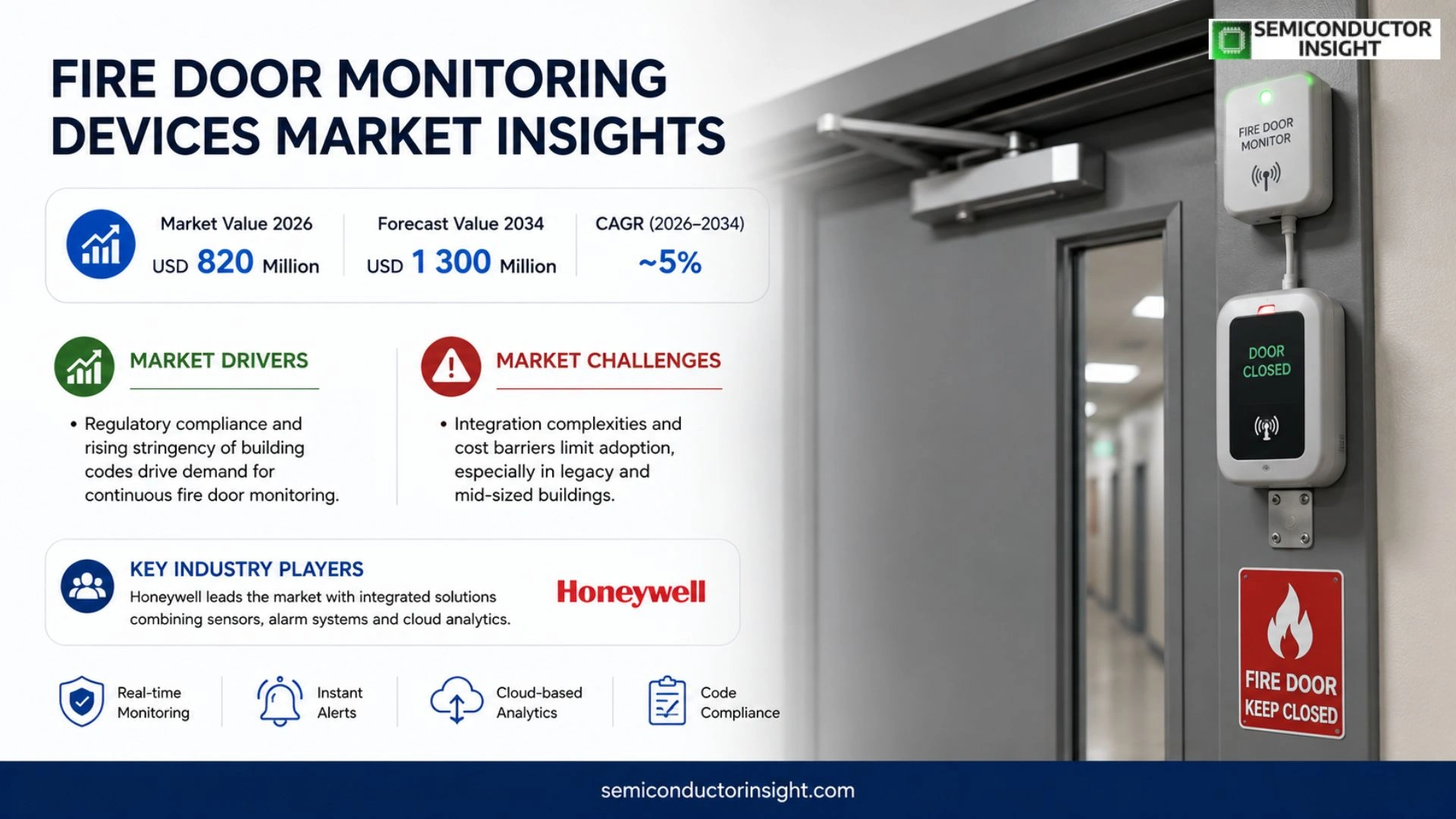
MARKET DRIVERS
Regulatory Compliance and the Rising Stringency of Building Codes
Building owners and facility managers face mounting pressure to adhere to evolving fire safety mandates that now mandate constant monitoring of fire doors. Governments in North America, Europe, and parts of Asia have tightened enforcement of performance‑based design, insisting that fire doors exhibit real‑time status verification. This regulatory backdrop forces a shift from manual inspections toward technologically enabled enforcement, stimulating an immediate uptick in demand for monitoring solutions that can automatically log door integrity, report anomalies, and interface with integrated safety systems. The need to avoid costly fines and reputational damage lowers the threshold for investment, while compliance reporting frameworks now often include audit trails that are only achievable through electronic monitoring devices. Consequently, the market benefit bias is heavily weighted toward provisioning that meets or exceeds mandated safety thresholds.
Digital Transformation of Fire Safety Infrastructure
The quantum leap in connectivity,rooted in advancements in low‑power wireless protocols, edge computing, and cloud analytics,has enabled fire door monitoring devices to evolve from simple electronic status indicators into full‑scale observability engines. Sensors now ingest door position, health, and environmental data and forward it to central dashboards that run predictive analytics, enabling maintenance teams to turn reactive repairs into pre‑emptive actions. In regions where the Internet of Things ecosystem is mature, integration with building management systems (BMS) and emergency response platforms is almost seamless, and the cost savings from avoided downtime or fire suppression escalation create a strong financial incentive. Additionally, the capacity to cross‑reference door status with HVAC and sprinkler performance streams into a holistic safety picture pushes the adoption curve further, especially in high‑rise and mixed‑use developments that rely on cross‑disciplinary compliance management.
➤ The shift to automated monitoring devices is no longer optional; it is the new benchmark for operational safety.
The convergence of legislative demands and technological maturity has therefore crystallized a virtuous cycle. As more structures incorporate connected fire door systems, data‑driven insights grow richer, reinforcing confidence in technology and widening the base of facilities willing to allocate capital. The cascading effect of standardization accelerates deployment speed: manufacturers can produce modular, plug‑and‑play units that satisfy multiple code sets, while vendors can marshal economies of scale. This synergy, coupled with increasing expectations from stakeholders such as insurers and tenants, ensures that Fire Door Monitoring Devices Market remains a compelling, high‑value proposition for the foreseeable future.
MARKET CHALLENGES
Integration Complexities and Cost Barriers
Despite technological momentum, several significant hurdles continue to temper market penetration, particularly in heritage and mid‑sized building portfolios where legacy infrastructure and budget constraints persist. First, the heterogeneity of existing fire door alloys, hinge mechanisms, and fire rating certifications imposes custom enclosure designs that elevate component cost. Converting a conventional fire door into a smart device often demands bespoke mounting brackets, power distribution solutions, and fail‑safe firmware which add layers of expense that are hard to amortize over short asset lifecycles. Second, interoperability remains a thorn. Vendors still find it difficult to ensure seamless communication across variable building management protocols,BACnet, Modbus, and proprietary brokers,especially when retrofitting older systems. The seamless data exchange needed to activate real‑time alarms and automation is frequently missing, forcing facilities to implement costly gateway conversions or to abandon legacy door stock entirely. Third, capital‑heavy investments in cable infrastructure, control panels, and ongoing firmware licensing impose a financial burden on property owners who are accustomed to low‑maintenance commission systems.Implementing these solutions also warrants a cultural shift within operational teams. Fire safety protocols that once relied on vigilance and manual audits now require technical expertise and continuous monitoring, adding a training burden that some organizations are reluctant to absorb. Without a clear, measurable return on investment, many stakeholders deem the deployment of digital monitoring an elective upgrade rather than a necessity.
Other Challenges
Data Security and Firmware Integrity
The safeguarding of door status information against tampering or cyber intrusion is now paramount. Data breaches can compromise safety functionality and erode trust, driving the need for zero‑trust architectures, secure OTA updates, and encrypted transmission. Failure to address these security concerns risks not only operational outages but also legal liabilities, especially as regulatory bodies tighten cybersecurity requirements for critical safety infrastructure.
MARKET RESTRAINTS
Capital Intensity and Market Penetration Gaps in Emerging Economies
In many high‑growth regions, the upfront investment in power, connectivity, and specialized sensor modules remains a deterrent. Local building codes often lag behind international safety standards, creating uncertainty that skews risk calculations against adopting monitoring systems. Additionally, the supply chain for high‑quality, rated sensors traditionally relies on niche manufacturers that have limited footprints in low‑to‑mid $100 k markets. Vendor concentration compounds distribution challenges, meaning that some locales experience delayed product availability or lack of after‑sales support. These factors collectively throttle the rate at which Fire Door Monitoring Devices Market can diffuse within the lower‑tier segments of the global real‑estate ecosystem.
MARKET OPPORTUNITIES
Emerging Service Models and Integration with Intelligent Building Ecosystems
The future lies in bundling fire door monitoring as part of broader security‑as‑a‑service platforms that include access control, CCTV, and environmental sensors. By leveraging cloud‑based analytics, operators can deliver predictive maintenance alerts and automated compliance reporting that reduce end‑to‑end costs for property managers. Moreover, escalating demands in high‑rise and mixed‑use developments, where occupant density raises the stakes of rapid fire response, underline a niche segment that prioritizes redundancy and real‑time visibility. Strategic collaborations between hardware manufacturers and software developers will enable integrated dashboards that satisfy both fire authorities and insurer mandates, driving adoption in markets currently lagging. The shift toward digital twins for building resilience further amplifies this opportunity, positioning Fire Door Monitoring Devices Market as an essential cogs in a comprehensive asset management framework.
Fire Door Monitoring Devices Market Trends
Rise of IoT-Enabled Real‑Time Analytics
Fire door monitoring bodies are increasingly embedded with low‑power wireless sensors that feed continuous data streams to cloud‑based platforms. The integration of machine‑learning algorithms allows early detection of anomalous patterns,such as door latch tampering or prolonged unlocked status,before a fire scenario develops. This shift to data‑driven vigilance satisfies stricter enforcement of fire safety codes while simultaneously reducing maintenance downtime through predictive troubleshooting. For manufacturers, the opportunity lies in offering subscription‑based analytics services and integrating retrospective dashboards that provide actionable insights to property managers and insurance providers.
Other Trends
Battery‑Operated Wireless Sensors
Power consumption has become a decisive factor in device adoption. Recent field trials report that small‑cell batteries can sustain telemetry functions for 24–36 months before requiring replacement, compared to the six‑month turnover seen with wired solutions. The resulting reduction in installation cost and risk of outage makes battery‑powered units attractive for retrofit projects, especially in aging residential and commercial towers where hard‑wired infrastructure is difficult to access. Consequently, suppliers are prioritising low‑energy communication protocols such as LoRaWAN and NB‑IoT, and are forging partnerships with battery manufacturers to secure supply chain resilience.
Regulatory Intensification in High‑Rise Buildings
Building authorities in the United States and Europe have amended performance‑based codes for high‑rise structures, mandating continuous monitoring of fire door status for the entire life of a building. This change stems from data that link improper door function with increased rapid fire spread and reduced egress times. Compliance now requires devices that can log events, support audit trails, and maintain connectivity throughout an entire fire event. Manufacturers who cannot provide comprehensive audit feeds risk losing access to a sizable segment of the market. Accordingly, vendors are investing in tamper‑resistant housings and redundant communication pathways to meet these new compliance thresholds.
Sectoral Growth in Healthcare and Education
Hospitals and universities face escalating scrutiny over occupational safety and student well‑being. Recent audits show that more than 70 % of incidents in student dormitories involved doors that failed to trigger the alarm system. Regulatory bodies now tie reimbursement and accreditation eligibility to demonstrable fire door compliance. This regulatory environment has stimulated a 30 % rise in monitor deployments within healthcare facilities and a 25 % increase in schools over the past two years. Stakeholders now view device acquisition as a core component of risk mitigation budgets, driving demand for integration with building management systems.
Consolidation and Strategic Partnerships Amid Competitive Pressures
The vendor landscape is seeing a trend toward mergers and joint ventures that combine hardware expertise with software analytics. Companies acquiring intellectual property for advanced sensor fusion aim to differentiate through integrated platform offerings that span detection, reporting, and regulatory compliance. Such consolidation allows smaller firms to tap into established distribution channels and access larger capital bases for R&D, while large-scale integrators can offer turnkey solutions to developers and municipalities. The ultimate effect is a smaller set of industry leaders able to deliver end‑to‑end solutions, prompting incumbents to reassess partnership portfolios and prioritize innovation cycles.
COMPETITIVE LANDSCAPE
Key Industry Players
Fire Door Monitoring Devices Market – Competitive Landscape Overview
Honeywell dominates the global fire door monitoring device arena by leveraging a comprehensive portfolio that integrates sensor arrays, alarm signaling, and cloud‑based analytics. Its integrated platform delivers real‑time status updates and audit trails, positioning Honeywell as the single source for preserving compliance with the latest fire protection regulations. The company’s robust distribution network and cross‑industry presence create a stable revenue base while allowing incremental pricing power against emerging manufacturers. This concentration of market power establishes a tiered competitive structure where a few heavyweights command the sizeable segment that captures the majority of installed-base spending.
Beyond the leading player, several niche manufacturers are carving out distinct niches through specialization and regional focus. ABB and Schneider Electric supply integrated fire system solutions that tie into broader building automation ecosystems. Siemens leads in advanced edge‑processing modules that support rapid reporting, while Fire‑Lite distinguishes itself through low‑cost, high‑reliability passive monitoring kits preferred by mid‑market developers. PyroSensors offers industry‑first predictive analytics based on sensor drift patterns, attracting institutional buyers in high‑value projects. Chinese firms such as Zhejiang Taiyi Fire, Xinhaosi, and Shanghai Xinchi Electric fill the domestic manufacturing gap with cost‑effective, high‑volume production while maintaining alignment with local regulatory requirements, providing a dependable alternative for the cost‑sensitive segments of the market.
List of Key Fire Door Monitoring Devices Companies Profiled
- Honeywell
- ABB
- Schneider Electric
- Siemens
- Fire‑Lite
- PyroSensors
- G‑Fire
- Zhejiang Taiyi Fire
- Xinhaosi
- Shanghai Xinchi Electric
- Chongqing Deyian Technology
- Acrel
- Gulf Security Technology
Segment Analysis:
| Segment Category | Sub-Segments | Key Insights |
| By Type |
|
Leading Segment Maintains a continuous monitoring stream ensuring no lapse in detection. Activates alarms instantly when a door fails to close. Integrates seamlessly with fire suppression and HVAC systems. Provides comprehensive evidence for post‑incident investigations. Thus this approach ensures ongoing compliance, safety, robust operational reliability. |
| By Application |
|
Leading Segment Offers critical protection in densely populated transit hubs. Enables rapid notification to safety personnel and passengers. Meets stringent regulatory mandates for transportation safety. Supports automated de‑energizing of electrical systems during emergencies. Thus this approach ensures ongoing compliance, safety, robust operational reliability. |
| By End User |
|
Leading Segment Empowers proactive maintenance schedules for fire protection equipment. Facilitates remote monitoring, reducing on‑site manpower needs. Enhances coordination with security and emergency response teams. Delivers real‑time alerts for timely preventive action. Thus this approach ensures ongoing compliance, safety, robust operational reliability. |
| By Compliance Standard |
|
Leading Segment Guarantees conformity with local building and fire safety legislations. Simplifies audit and inspection procedures for developers. Reduces legal exposure and liability for property stakeholders. Supports certifications required for high‑profile construction projects. Thus this approach ensures ongoing compliance, safety, robust operational reliability. |
| By Integration Complexity |
|
Leading Segment Enables centralized oversight through unified operator consoles. Allows data correlation with HVAC, access, and security systems. Supports predictive analytics for early fault detection. Facilitates comprehensive incident reporting and post‑event analysis. Thus this approach ensures ongoing compliance, safety, robust operational reliability. |
Regional Analysis: Fire Door Monitoring Devices Market
North America
The escalation of commercial building codes, coupled with the adoption of Building Information Modelling (BIM), forces developers to integrate real‑time monitoring. Facilities managers gravitate toward devices that provide comprehensive dashboards, enabling swift incident response and regulatory reporting.
Legacy infrastructure poses integration hurdles; many older structures lack the electrical backbone required for modern sensors. Additionally, data privacy regulations raise concerns about cloud‑stored alarm logs, prompting a shift toward edge‑processing solutions.
Emerging dual‑band communication protocols and AI‑enabled anomaly detection are redefining user expectations. Real‑time firmware updates and on‑site diagnostics enable zero‑maintenance operations, a critical factor for high‑traffic commercial venues.
New revisions to the International Building Code (IBC) mandate that all fire door monitoring devices must support remote audit trails. Compliance auditors now require proof of data integrity, pushing manufacturers toward signed‑chain‑of‑trust firmware.
Europe
In Europe, the fire door monitoring niche is tightening around the now‑mandatory Passive Smoke Control (PSC) systems. The market is catalysed by the European Union’s stringent fire safety directives, which require that all new constructions incorporate fail‑safe monitoring. Seasonal variations in building usage, especially in logistics hubs, create peaks in maintenance cycles that service providers aim to optimise through predictive maintenance models. While the current adoption curve lags behind North America, the region’s robust legal framework is furnishing a fertile ground for premium, certified solutions that match multi‑jurisdictional compliance needs. Supplier collaboration with local authorities to certify installation procedures further strengthens the market’s credibility. The European cluster also sees a cross‑pollination of smart building standards, meaning fire door monitoring devices must seamlessly integrate with IoT ecosystems that address energy efficiency and occupant comfort concurrently. Market players that can deliver dual‑functionality,fire safety and energy savings,are likely to obtain a competitive advantage in this market, earning higher margins even in price‑sensitive public sector contracts.
Asia‑Pacific
Asia‑Pacific is experiencing a structural shift in fire safety investment, propelled by rapid urbanisation and heightened disaster awareness. Governments are revising fire codes to reflect contemporary risks such as high‑rise kazam buildings and industrial estates with hazardous inventories. Adoption is being accelerated by the region’s large‑scale construction renaissance, firmly placing high‑technology monitoring solutions on the agenda. The proliferation of prefabricated modules, many incorporating ISF‑compliant fire door monitoring linkages, mitigates construction delays by streamlining installation. The rising cost of fire‑related incidents in the region, including insurance penalty hikes, compels developers to prioritise reliable monitoring devices that reduce liability exposure. Moreover, the digitalisation wave from e‑government initiatives, broadband expansions, and public‑private partnerships is positioning Asia‑Pacific as a testbed for connected monitoring ecosystems. Firms that localise firmware to comply with varied national data laws and that embed cost‑effective sensors will capture considerable share in this high‑growth environment.
South America
South America’s fire door monitoring market remains in an early stage, yet the demand curve is steepening thanks to expanding commercial real estate and infrastructural projects financed by multilateral development banks. Regulatory harmonisation efforts across the region aim to unify fire safety standards, creating a future market that will hinge on interoperability. Manufacturers are now concentrating on modular, low‑power devices suitable for environments with limited power infrastructure, thereby cutting entry barriers for smaller projects. Fire incidents are forcing local governments to prioritize preventive measures; municipalities are now testing pilot projects that pair monitoring solutions with executive dashboards for asset managers. The region’s strategic location where global shipping traffic is dense creates additional incentive for port authorities to upgrade door monitoring systems. Consequently, firms that offer scalable, rugged solutions tailored for high humidity and corrosive environments stand to profit.
Middle East & Africa
In the Middle East & Africa bracket, the fire door monitoring market is being propelled by an emphasis on sovereign security and large‑scale public infrastructure projects. Stricter building height norms and climate‑resilient design guidelines are driving the need for precise monitoring and rapid alert systems. Market opportunities concentrate around diplomatic compounds, offshore oil facilities, and high‑rise leisure complexes, where a failure can lead to catastrophic losses. The region’s limited local manufacturing capacity encourages imports of certified devices, incentivising manufacturers to embed local connectivity modules that comply with regional communication standards. Moreover, a growing trend toward zero‑on‑site maintenance, especially in remote installations, is shaping product offerings: dual‑service sensors that can transmit data via satellite links or Lo‑RaWAN networks are gaining traction. Companies that also bundle fire suppression and monitoring into a single integrated solution are better positioned to win tender processes where comprehensive safety packages are mandated.
Report Scope
This market research report provides a comprehensive analysis of the Fire Door Monitoring Devices Market , covering the forecast period 2026–2034. It offers detailed insights into market dynamics, technological advancements, competitive landscape, and key trends shaping the industry.
Key focus areas of the report include:
- Market Overview: The report begins with an overview outlining its current market scenario, key growth indicators, and industry transformation drivers. It discusses macroeconomic factors, demand–supply balance, regulatory landscape, and the strategic role of semiconductors in powering advancements across industries such as automotive, telecommunications, consumer electronics, and industrial automation.
- Market Size & Forecast: Historical data and future projections for revenue, unit shipments, and market value across major regions and segments.
- Segmentation Analysis: Detailed breakdown by product type, technology, application, and end-user industry to identify high-growth segments and investment opportunities.
- Regional Insights: Insights into market performance across North America, Europe, Asia-Pacific, Latin America, and the Middle East & Africa, including country-level analysis where relevant.
- Competitive Landscape: Profiles of leading market participants, including their product offerings, R&D focus, manufacturing capacity, pricing strategies, and recent developments such as mergers, acquisitions, and partnerships.
- Technology Trends & Innovation: Assessment of emerging technologies, integration of AI/IoT, semiconductor design trends, fabrication techniques, and evolving industry standards.
- Market Drivers & Restraints: Evaluation of factors driving market growth along with challenges, supply chain constraints, regulatory issues, and market-entry barriers.
- Stakeholder Insights: Insights for component suppliers, OEMs, system integrators, investors, and policymakers regarding the evolving ecosystem and strategic opportunities.
Primary and secondary research methods are employed, including interviews with industry experts, data from verified sources, and real-time market intelligence to ensure the accuracy and reliability of the insights presented.
FREQUENTLY ASKED QUESTIONS:
What is the current market size of Fire Door Monitoring Devices Market?
-> Fire Door Monitoring Devices Market is projected to grow from USD 820 million in 2026 to USD 1 300 million by 2034, exhibiting a CAGR of approximately 5%
What is the expected compound annual growth rate (CAGR) for the market?
-> The market is expected to grow at a CAGR of approximately X% during the 2023‑2031 forecast period.
How is Fire Door Monitoring Devices Market defined?
-> It encompasses devices and systems that detect, signal, and report the status of fire doors to ensure compliance with safety regulations and enhance building fire protection.
What are the primary market segments?
-> Segmentation is based on Type (e.g., normally open, normally closed) and Application (e.g., airport, rail, tunnel, hospital, school, others).
Which product types are covered under the market?
-> The market includes Normally Open Fire Door Monitoring Systems and Normally Closed Fire Door Monitoring Systems.
What end‑use applications are analyzed?
-> Applications cover Airport, Rail, Tunnel, Hospital, School, and Other facilities where fire door safety is critical.
Which geographic regions are examined?
-> Analysis spans North America, Europe, Asia, South America, and Middle East & Africa, with country‑level insights for major markets.
Who are the leading players in the market?
-> Key companies include Honeywell, Acrel, Jade Bird Fire, Gulf Security Technology, Zhejiang Taiyi Fire, Xinhaosi, Shanghai Xinchi Electric, and Chongqing Deyian Technology.
What research methodology underpins the report?
-> The study employs a combination of primary interviews, secondary data sources, statistical modeling, and market triangulation to ensure robust forecasts.
What are the main drivers influencing market growth?
-> Drivers include increasing safety regulations, rising construction of high‑rise buildings, growing awareness of fire safety, and advances in IoT‑enabled monitoring technologies.
What restraints could hinder market expansion?
-> Potential restraints are high initial installation costs, integration challenges with legacy systems, and stringent certification requirements.
What are the emerging trends in the market?
-> Trends feature AI‑driven predictive maintenance, cloud‑based centralized monitoring platforms, and the integration of smart building ecosystems.

Get Sample Report PDF for Exclusive Insights
Report Sample Includes
- Table of Contents
- List of Tables & Figures
- Charts, Research Methodology, and more...
 Download Sample Report PDF