Ferroelectric Memory (FeFET) Integration Market Insights
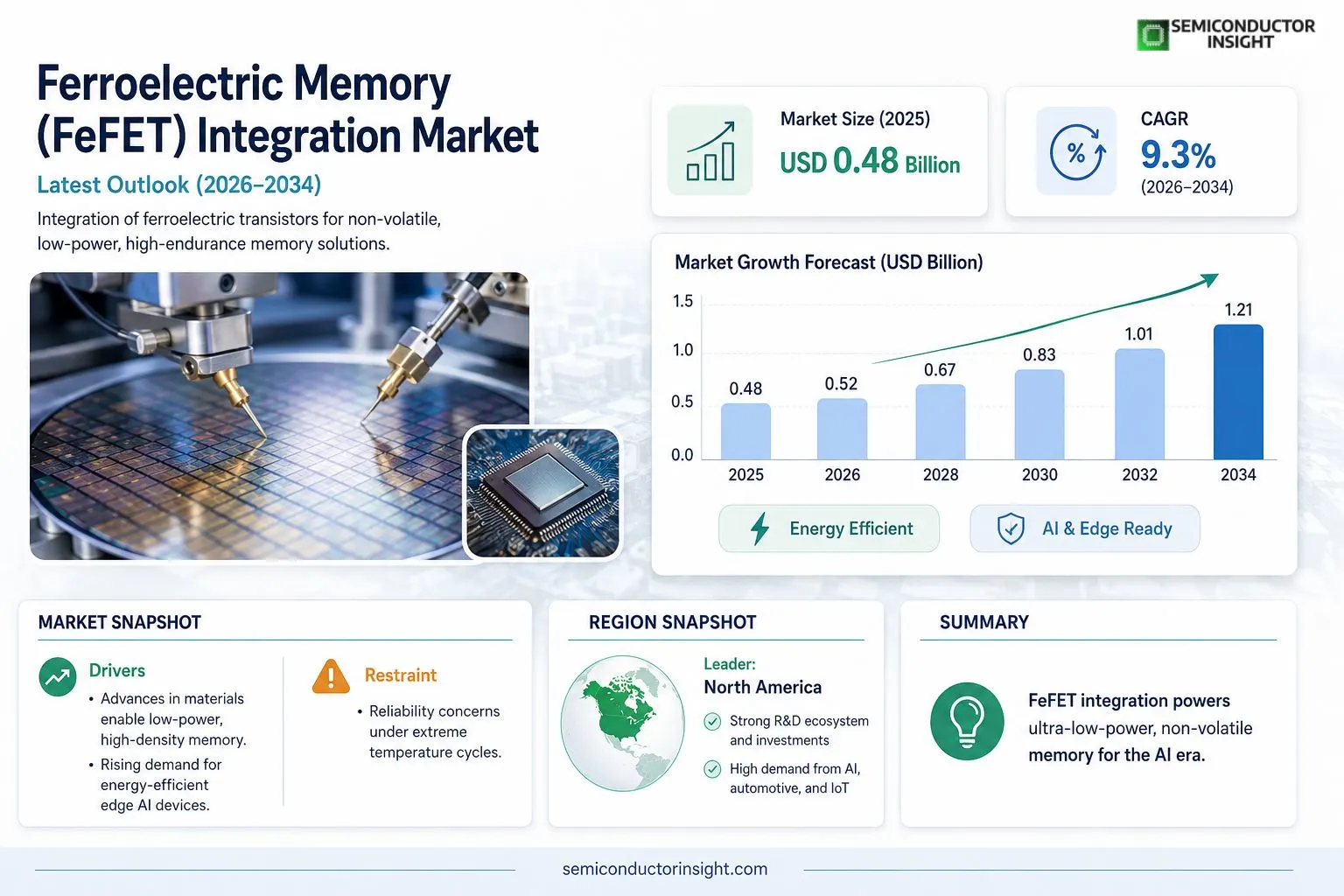
Global Ferroelectric Memory (FeFET) Integration market size was valued at USD 0.48 billion in 2025. The market is projected to grow from USD 0.52 billion in 2026 to USD 1.21 billion by 2034, exhibiting a CAGR of 9.3% during the forecast period.
Ferroelectric Memory (FeFET) integration refers to the incorporation of ferroelectric field‑effect transistors into semiconductor processes to enable non‑volatile storage with low power consumption and high endurance. These devices leverage a ferroelectric layer that retains polarization states, allowing data retention without power.The market is experiencing rapid growth due to several factors, including rising demand for energy‑efficient AI accelerators, increased investment in advanced node scaling, and the push for embedded memory solutions in automotive and IoT applications. Furthermore, advancements in hafnium‑oxide based ferroelectrics and strategic collaborations among leading foundries are accelerating adoption. Key players such as Samsung Electronics, Intel Corporation, STMicroelectronics, and Texas Instruments are actively expanding their FeFET portfolios through R&D partnerships and technology licensing agreements.
MARKET DRIVERS
Advances in Semiconductor Materials
The shift toward low‑power, high‑density memory solutions is propelled by rapid innovation in thin‑film ferroelectric materials. Recent breakthroughs in hafnium‑oxide based ferroelectrics have enabled CMOS‑compatible processes, reducing manufacturing costs and accelerating adoption across consumer electronics and automotive electronics.
Growing Demand for Edge AI
Edge‑AI devices require fast, non‑volatile memory that can retain data without power. The inherent fast switching speed and high endurance of ferroelectric‑field‑effect transistors make them ideal for inference accelerators, driving significant interest from chipset manufacturers.
➤ Industry analysts forecast a compound annual growth rate above 15% for the sector through 2032, reflecting strong adoption momentum.
Regulatory incentives for energy‑efficient computing further reinforce market expansion, as governments promote technologies that lower data‑center power consumption. These combined forces create a robust growth engine for the market.
MARKET CHALLENGES
Integration Complexity with Existing Foundries
Despite material advances, integrating ferroelectric layers into mature process flows remains technically demanding. Alignment of etch chemistries, thermal budgets, and contamination controls require extensive re‑qualification, extending time‑to‑market for new products.
Other Challenges
Cost Competitiveness
The capital expenditure associated with new deposition tools can be higher than for conventional DRAM or flash, making price‑sensitive OEMs cautious about early adoption.Supply‑chain resilience is another concern; the limited number of qualified suppliers for high‑purity ferroelectric precursors can lead to bottlenecks, especially during periods of rapid demand escalation.
MARKET RESTRAINTS
Reliability and Longevity Concerns
Long‑term data retention under extreme temperature cycles is still under intensive study. Some early‑stage devices have shown degradation after repeated high‑field stress, prompting cautious qualification processes by automotive OEMs.
MARKET OPPORTUNITIES
Emerging Applications in Secure Computing
The intrinsic non‑volatility of ferroelectric memory provides a hardware root of trust, opening lucrative avenues in secure key storage and tamper‑detectable devices. As cybersecurity budgets expand, vendors are positioning the technology as a differentiator for confidential computing platforms.
Expansion into 3D Integration
Stacking ferroelectric layers with logic circuits in three‑dimensional architectures can dramatically improve area efficiency. Early prototypes demonstrate up to 30% density gains over planar implementations, suggesting a compelling value proposition for next‑generation system‑in‑package solutions.
Ferroelectric Memory (FeFET) Integration Market Trends
Rapid Adoption Driven by Energy‑Efficient AI Accelerators
Ferroelectric Memory (FeFET) Integration Market is gaining momentum as semiconductor manufacturers target the growing need for ultra‑low‑power, high‑speed non‑volatile storage in AI‑centric processors. FeFET devices combine sub‑nanosecond write latency with power consumption measured in micro‑watts per bit, a combination that directly supports edge‑AI workloads where battery life and thermal budgets are tightly constrained. Beyond AI, the same efficiency gains are being leveraged in automotive safety controllers and IoT sensors that must retain data through power‑loss events without resorting to power‑hungry refresh cycles. The convergence of advanced node scaling, which now accommodates ferroelectric layers without additional lithography steps, and the rising demand for embedded memory in heterogeneous system‑on‑chip (SoC) designs is creating a clear pathway for FeFET integration across a broad spectrum of applications.
Other Trends
Advanced Hafnium‑Oxide Ferroelectrics
Material engineering breakthroughs in hafnium‑oxide (HfO₂) have produced ferroelectric films that maintain polarization stability for more than a decade while tolerating endurance levels exceeding 10¹⁵ switching cycles. These characteristics eliminate the need for periodic data refresh and enable FeFET cells to be placed directly alongside logic transistors in FinFET and gate‑all‑around (GAA) platforms. Foundries are now offering pre‑qualified HfO₂ stacks as part of their standard process design kits (PDKs), allowing chip designers to instantiate FeFET‑based SRAM‑like structures without introducing custom process steps. The reliability improvements also satisfy automotive qualification standards such as AEC‑Q100, encouraging wider adoption in safety‑critical modules where long‑term data integrity is mandatory.
Strategic Partnerships Accelerate Market Penetration
Major industry players,including Samsung Electronics, Intel Corporation, STMicroelectronics, and Texas Instruments,have entered multi‑year research collaborations and technology‑licensing agreements that streamline FeFET adoption across sub‑5 nm process nodes. These alliances focus on co‑development of cell libraries, joint silicon validation, and the creation of reference designs that showcase FeFET‑enabled secure key storage and ultra‑low‑latency cache hierarchies. By sharing intellectual property and pooling validation resources, the partners reduce development risk and accelerate time‑to‑market for products that require both non‑volatility and high endurance. The cumulative effect is a steadily expanding ecosystem of design‑win opportunities, particularly in sectors such as autonomous driving, high‑performance edge computing, and secure embedded firmware, positioning Ferroelectric Memory (FeFET) Integration Market for sustained growth in the coming years.
COMPETITIVE LANDSCAPEKey Industry Players
Ferroelectric Memory (FeFET) Integration Market – Competitive Overview
FeFET integration market, valued at USD 0.48 billion in 2025, is being shaped primarily by a handful of semiconductor leaders that command the majority of R&D spend and wafer capacity. Samsung Electronics and Intel Corporation have launched joint development programs to embed hafnium‑oxide ferroelectrics into their advanced‑node process flows, targeting AI accelerator and automotive workloads. STMicroelectronics leverages its analog‑mixed‑signal heritage to offer integrated FeFET IP for embedded non‑volatile memory, while Texas Instruments advances low‑power FeFET‑based microcontroller families for IoT edge devices. These four firms together control a significant share of technology licensing agreements and occupy the top tier of the competitive hierarchy, setting performance benchmarks for endurance, voltage scaling, and manufacturing yield.Beyond the dominant quartet, a broader cohort of niche and regional players is expanding the ecosystem and addressing specialty applications. GLOBALFOUNDRIES and TSMC provide foundry services that enable smaller fabless designers to access FeFET layers through multi‑project wafer runs. Micron Technology and NXP Semiconductors are integrating FeFET cells into mixed‑signal memory arrays for automotive safety and secure boot. Infineon Technologies, Renesas Electronics, and Toshiba focus on automotive and industrial control modules, while Fujitsu and SK Hynix explore high‑density FeFET stacks for next‑generation AI inference chips. Qualcomm’s research division is probing FeFET‑enabled on‑chip cache architectures, adding further depth to the competitive landscape.
List of Key Ferroelectric Memory (FeFET) Integration Market Companies Profiled
- Samsung Electronics
- Intel Corporation
- STMicroelectronics
- Texas Instruments
- GLOBALFOUNDRIES
- TSMC
- Micron Technology
- NXP Semiconductors
- Infineon Technologies
- Renesas Electronics
- Toshiba
- Fujitsu
- SK Hynix
- Qualcomm
Segment Analysis:
| Segment Category | Sub-Segments | Key Insights |
| By Type |
|
FeFET‑Based Type drives the market by enabling truly non‑volatile logic‑in‑memory architectures. It offers ultra‑low leakage, high endurance, and near‑instantaneous switching, which appeals to designers of power‑constrained AI accelerators. The thin‑film capacitor approach provides a simpler integration path for older nodes, while the transistor‑centric variant is the preferred route for advanced node scaling and heterogeneous integration strategies. |
| By Application |
|
AI Accelerators emerge as the dominant application because FeFETs combine compute and storage, reducing data movement and power consumption. In automotive, the technology satisfies stringent reliability and temperature‑range requirements while supporting over‑the‑air updates. IoT edge nodes benefit from the minimal standby power, enabling battery‑free or long‑life deployments. Embedded memory uses FeFETs to replace traditional e‑DRAM, offering persistent state without additional refresh circuitry. |
| By End User |
|
Semiconductor Foundries are pivotal as they embed FeFET processes into standard CMOS lines, unlocking volume production. System integrators leverage the technology to differentiate next‑generation modules that require instant‑on capability. OEMs, especially in automotive and industrial sectors, adopt FeFET‑enabled solutions to meet reliability mandates and to future‑proof designs against emerging security and data‑integrity challenges. |
| By Technology |
|
Hafnium‑Oxide Ferroelectrics dominate the innovation landscape because they are compatible with existing high‑k gate stacks, facilitating seamless integration. Lead‑based options offer higher remnant polarization but encounter stricter environmental regulations, limiting their long‑term viability. Hybrid structures blend ferroelectric layers with conventional CMOS, delivering a compromise that accelerates time‑to‑market while preserving performance gains. |
| By Market Driver |
|
Energy‑Efficiency Demands shape the narrative, as designers seek memory that consumes virtually no power in standby. The pressure to scale to sub‑10 nm nodes amplifies the need for materials that retain functionality at reduced dimensions, positioning FeFETs as a strategic enabler. Environmental and regulatory frameworks encourage low‑power semiconductor solutions, reinforcing the market’s momentum toward ferroelectric integration. |
Regional Analysis: North America
United States
The automotive sector is increasingly adopting FeFET for applications requiring high reliability and low power, such as in-vehicle infotainment systems and advanced driver-assistance systems (ADAS). The demand for non-volatile memory in automotive is expected to grow significantly with the advancement of autonomous driving technologies.
The Industrial Internet of Things (IIoT) presents a substantial opportunity for FeFET integration. The need for rugged, energy-efficient memory in industrial devices, sensors, and edge computing platforms is driving market expansion. FeFET’s ability to withstand harsh environments makes it particularly suitable for industrial applications.
While mature memory technologies are prevalent in consumer electronics, FeFET is gaining traction for specialized applications demanding higher performance and lower power, such as in smartphones and wearables. The miniaturization trend in consumer devices necessitates advanced memory solutions like FeFET.
Data centers are exploring FeFET for potential benefits in data storage efficiency and performance. The increasing demand for data processing and storage necessitates innovative memory technologies that can offer higher density and lower latency.
Europe
Europe represents a significant and growing market for Ferroelectric Memory (FeFET) Integration. The region’s strong focus on technological innovation, particularly within the automotive and industrial sectors, is fueling demand. Several European semiconductor companies and research institutions are actively involved in FeFET development and integration. The European Union’s emphasis on digital sovereignty and advanced manufacturing further supports the growth of this market. While the adoption rate might lag slightly behind the US, Europe is poised for substantial expansion in the coming years, driven by the increasing need for enhanced memory performance and energy efficiency in various applications.
Asia-Pacific
Asia-Pacific is emerging as a dynamic and rapidly expanding market for Ferroelectric Memory (FeFET) Integration. Countries like China, Japan, and South Korea are investing heavily in semiconductor manufacturing and advanced technology research. The strong growth in the automotive, consumer electronics, and industrial IoT sectors within the region is driving significant demand for FeFET-based memory solutions. The competitive landscape in Asia-Pacific is intense, with numerous players vying for market share. Government support for domestic semiconductor industries is a key factor contributing to the region’s growth potential.
South America
South America presents a nascent yet promising market for Ferroelectric Memory (FeFET) Integration. The region’s growing industrial sector, particularly in Brazil and Argentina, is creating demand for advanced memory solutions. While the adoption of FeFET is currently limited compared to other regions, the increasing focus on technology and digitalization is expected to drive market growth in the long term. The automotive industry in South America is also showing early signs of interest in FeFET for specific applications.
Middle East & Africa
The Middle East & Africa region is an emerging market with moderate potential for Ferroelectric Memory (FeFET) Integration. The region’s increasing investments in infrastructure development, digital transformation, and automotive manufacturing are creating a gradual demand for advanced memory technologies. While the market is currently small, the growing adoption of IoT devices and the expansion of the automotive sector in countries like Saudi Arabia and South Africa are expected to drive future growth in FeFET adoption.
Report Scope
This market research report provides a comprehensive analysis of the Ferroelectric Memory (FeFET) Integration Market , covering the forecast period 2026–2034. It offers detailed insights into market dynamics, technological advancements, competitive landscape, and key trends shaping the industry.
Key focus areas of the report include:
- Market Overview: The report begins with an overview outlining its current market scenario, key growth indicators, and industry transformation drivers. It discusses macroeconomic factors, demand–supply balance, regulatory landscape, and the strategic role of semiconductors in powering advancements across industries such as automotive, telecommunications, consumer electronics, and industrial automation.
- Market Size & Forecast: Historical data and future projections for revenue, unit shipments, and market value across major regions and segments.
- Segmentation Analysis: Detailed breakdown by product type, technology, application, and end-user industry to identify high-growth segments and investment opportunities.
- Regional Insights: Insights into market performance across North America, Europe, Asia-Pacific, Latin America, and the Middle East & Africa, including country-level analysis where relevant.
- Competitive Landscape: Profiles of leading market participants, including their product offerings, R&D focus, manufacturing capacity, pricing strategies, and recent developments such as mergers, acquisitions, and partnerships.
- Technology Trends & Innovation: Assessment of emerging technologies, integration of AI/IoT, semiconductor design trends, fabrication techniques, and evolving industry standards.
- Market Drivers & Restraints: Evaluation of factors driving market growth along with challenges, supply chain constraints, regulatory issues, and market-entry barriers.
- Stakeholder Insights: Insights for component suppliers, OEMs, system integrators, investors, and policymakers regarding the evolving ecosystem and strategic opportunities.
Primary and secondary research methods are employed, including interviews with industry experts, data from verified sources, and real-time market intelligence to ensure the accuracy and reliability of the insights presented.
FREQUENTLY ASKED QUESTIONS:
What is the current market size of Ferroelectric Memory (FeFET) Integration Market?
-> Ferroelectric Memory (FeFET) Integration Market was valued at USD 0.48 billion in 2025 and is expected to reach USD 1.21 billion by 2034.
Which key companies operate in Ferroelectric Memory (FeFET) Integration Market?
-> Key players include Samsung Electronics, Intel Corporation, STMicroelectronics, Texas Instruments.
What are the key growth drivers?
-> Key growth drivers include rising demand for energy‑efficient AI accelerators, increased investment in advanced node scaling, and the push for embedded memory solutions in automotive and IoT applications.
Which region dominates the market?
-> The reference indicates global growth without highlighting a single dominant region; adoption is strong across North America, Europe, and Asia‑Pacific.
What are the emerging trends?
-> Emerging trends include advancements in hafnium‑oxide ferroelectric materials and strategic collaborations among leading foundries.

Get Sample Report PDF for Exclusive Insights
Report Sample Includes
- Table of Contents
- List of Tables & Figures
- Charts, Research Methodology, and more...
 Download Sample Report PDF