Key Statistics
Key Takeaways
- Silicon FRDs remain the largest mainstream type because they combine proven reliability, broad voltage coverage and cost-effective manufacturing for consumer, industrial and automotive power conversion.
- Motor drives are the leading application in the report scope, supported by industrial automation, EV power electronics and the need for low-recovery-loss freewheel and boost functions.
- Asia Pacific is the fastest-growing region, driven by electronics manufacturing, EV production, solar deployment and industrial power demand in China, India, Japan and Southeast Asia.
- No single dominant region is identified in the report’s regional overview, reflecting a globally distributed demand base spanning North America, Europe and Asia Pacific.
- Medium voltage (200–600 V) is the leading voltage band in the report scope because it aligns with many motor-drive, PFC and inverter designs.
- Recovery charge and softness matter as much as nominal recovery time. Low Qrr, controlled reverse current and soft recovery can reduce switching loss, EMI and snubber requirements in high-frequency converters.
Fast Recovery Diodes Market Overview
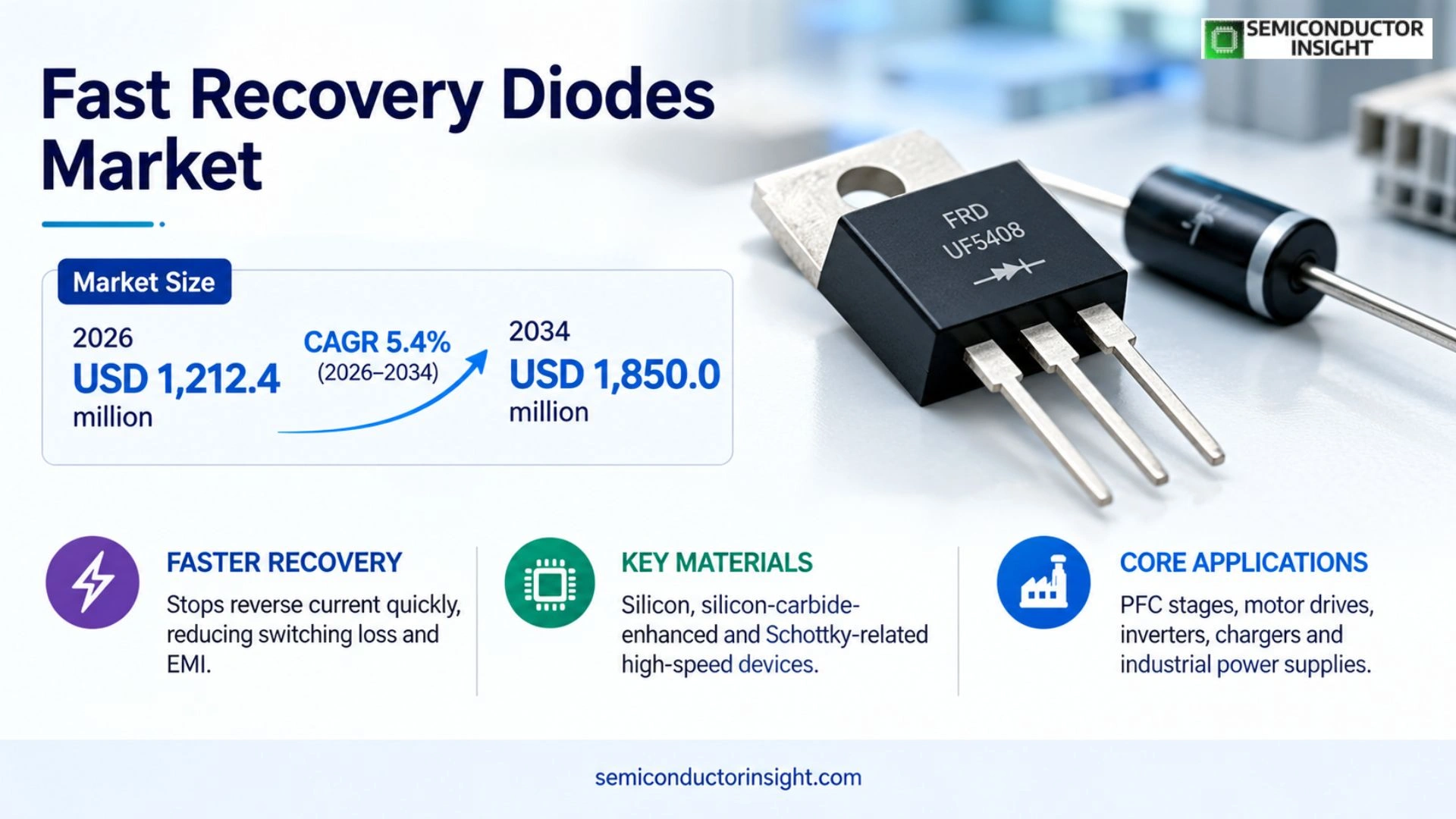
Fast Recovery Diodes Market is valued at USD 1,150.0 million in 2025, is estimated at USD 1,212.4 million in 2026, and is projected to reach USD 1,850.0 million by 2034, representing a CAGR of 5.4% during 2026–2034. No single region identified is the 2025 market-position reference used in this overview.
Base year: 2025 · Estimated year: 2026 · Forecast period: 2026–2034 · Values in USD million unless otherwise stated
Fast recovery diodes are rectifiers engineered to stop conducting reverse current much more quickly than conventional power diodes when the applied voltage changes polarity. Their reverse-recovery behavior directly affects switching loss, electromagnetic interference and stress on the companion transistor in PFC stages, motor drives, inverters, chargers and industrial power supplies.
The market covers silicon fast-recovery and ultrafast devices, silicon-carbide-enhanced rectifiers and Schottky-related high-speed alternatives. Silicon remains important because it offers mature cost structures and broad package availability, while higher-performance architectures compete by reducing reverse-recovery charge, lowering forward voltage and improving soft-switching behavior.
Application engineering is central to supplier differentiation. A device with a very short trr can still create EMI if recovery is abrupt, while a lower-Qrr diode can improve transistor turn-on loss even when headline recovery time is similar. Vendors therefore optimize the complete VF/Qrr/softness trade-off for specific converter topologies and temperature ranges.
Segment Analysis: By Type
By type, the market is segmented into Silicon FRDs, Silicon-Carbide FRDs, and Schottky FRDs. Silicon FRDs remain the broad mainstream choice because they provide cost-effective high-speed rectification across established power-supply, motor-drive and automotive platforms.
| Segment Category | Sub-Segments | Key Insights |
|---|---|---|
| By Type | Silicon FRDs | Proven silicon epitaxial and lifetime-control technologies support broad voltage and current ranges with familiar design behavior and strong cost competitiveness. |
| By Type | Silicon-Carbide FRDs | Wide-bandgap rectifiers reduce reverse-recovery loss sharply at high voltage and temperature, making them attractive in demanding PFC, charging and renewable-energy converters. |
| By Type | Schottky FRDs | Schottky-related fast rectification emphasizes low forward drop and negligible minority-carrier recovery, especially at lower and medium voltage. |
Why does reverse-recovery charge matter in modern converters?
When a fast diode commutates from forward to reverse bias, stored charge must be removed before the device blocks voltage fully. That current pulse increases switching loss in the companion MOSFET or IGBT and can create EMI. Power Integrations’ Qspeed H-Series emphasizes low Qrr and soft recovery, while ST’s ultrafast families balance forward voltage and recovery characteristics across different PFC, boost, freewheel and high-frequency rectification functions.
Segment Analysis: By Application
By application, the market is segmented into AC-DC adapters, Motor drives, Photovoltaic inverters, and Others. Motor drives are the leading application in the report scope because efficient switching is important in industrial automation and electrified motion systems.
| Application | Demand characteristics | Key Insights |
|---|---|---|
| Motor drives | Freewheel and boost rectification in industrial drives, HVAC, robotics and vehicle systems requires fast commutation to limit switching loss and EMI. | The leading application in the report scope, strengthened by automation and electrification. |
| AC-DC adapters | PFC, flyback and other converter stages use fast rectifiers where switching frequency, efficiency and thermal limits are important. | A broad volume segment spanning consumer electronics, telecom and computing power supplies. |
| Photovoltaic inverters | Solar inverters and DC/DC stages require low switching loss, high reliability and robust reverse-voltage performance. | A structural growth application supported by renewable-energy deployment and higher converter efficiency targets. |
| Others | Includes EV chargers, UPS, telecom power, aerospace and specialized industrial conversion. | A diversified high-value pool where voltage, surge, temperature and qualification requirements can support premium products. |
Why do motor drives continue to use fast recovery diodes despite wide-bandgap competition?
Silicon FRDs remain attractive where switching frequency and bus voltage do not justify the cost of SiC. Mature footprints, robust surge behavior and established qualification also reduce redesign risk. At the same time, suppliers are pushing silicon performance through lower Qrr, softer recovery and compact packages, preserving a competitive position in many industrial and automotive power stages.
Regional Analysis
The report does not identify a single dominant regional market. North America, Europe and Asia Pacific all have meaningful demand, while Asia Pacific is identified as the fastest-growing region through EV production, renewable-energy investment and electronics manufacturing.
How should regional leadership be interpreted when no single region is dominant?
Fast recovery diode demand is tied to several geographically distributed industries: industrial drives, consumer power supplies, automotive electronics, renewable-energy conversion and telecom power. Asia Pacific has the strongest volume-growth mechanism, North America has high-value industrial and infrastructure demand, and Europe has deep automotive and power-electronics engineering.
| Region | Position | Growth outlook | Demand profile | What decides supplier selection |
|---|---|---|---|---|
| Asia Pacific | Fastest-growing | Strong | EVs, electronics, industrial and renewable energy | Cost, qualification, package density and local supply |
| North America | Major high-value market | Moderate to strong | Industrial, data center, EV and renewable power | Efficiency, EMI, reliability and distribution |
| Europe | Automotive & industrial specialist | Moderate | Motor drives, automotive and energy | AEC-Q101, recovery softness and thermal performance |
| South America | Developing market | Selective | Industrial, solar and automotive | Price, availability and distributor support |
| Middle East & Africa | Emerging infrastructure market | Selective | Solar, telecom and industrial power | Ruggedness, voltage capability and supply |
Competitive Landscape
Key companies include Vishay Intertechnology, onsemi, Infineon Technologies, STMicroelectronics, Diodes Incorporated, ROHM Semiconductor, Nexperia, Littelfuse, Microchip Technology, Semikron, Texas Instruments and Analog Devices.
Vishay, onsemi, STMicroelectronics and Infineon compete across high-current, industrial and automotive rectifier applications with broad package and voltage portfolios. Their scale supports global distribution and long product lifecycles.
ROHM and Nexperia differentiate through compact automotive-qualified packages and optimized silicon recovery behavior. Power Integrations is an important technology benchmark through Qspeed, which competes directly against SiC in selected 600–650 V PFC and industrial applications.
The market remains highly segmented by voltage, current, forward drop and recovery behavior. Suppliers that provide broad cross-reference portfolios and stable manufacturing can win replacement and platform business even when the underlying diode technology is mature.
| Competitive tier | Representative companies | Commercial basis |
|---|---|---|
| Global power-semiconductor leaders | Vishay; onsemi; STMicroelectronics; Infineon | Broad ultrafast, automotive and industrial portfolios with global distribution. |
| Specialist discrete suppliers | ROHM; Nexperia; Diodes Incorporated; Littelfuse | Compact packages, silicon optimization, automotive qualification and cross-reference breadth. |
| Integrated power / module suppliers | Microchip; Semikron; Power Integrations | Fast diode technologies integrated into broader converter and power-module platforms. |
Key Participants
Vishay Intertechnology, onsemi, Infineon Technologies, STMicroelectronics, Diodes Incorporated, ROHM Semiconductor, Nexperia, Littelfuse, Microchip Technology, Semikron, Texas Instruments, Analog Devices.
Production Capacity Analysis
Fast recovery diode capacity uses mature silicon or wide-bandgap wafer processes followed by diffusion or implantation, lifetime control, metallization, wafer thinning, dicing, packaging and recovery-characteristic testing. Performance depends on both device physics and package parasitics.
Silicon FRDs use controlled carrier lifetime and epitaxial structures to reduce stored charge while maintaining acceptable forward voltage and leakage. Tighter lifetime control improves switching but can increase conduction loss, so process tuning is application specific.
Packaging determines thermal resistance and parasitic inductance. Compact clip-bonded and TO-277-class packages can replace larger legacy footprints while improving current density, but junction temperature must remain within the device’s qualification limits.
Final test measures forward voltage, leakage, reverse voltage, recovery time and in some cases reverse-recovery charge or softness. Automotive products add AEC-Q101 qualification and stricter process-change control.
| Capacity layer | Where it concentrates | Commercial constraint |
|---|---|---|
| Silicon / SiC wafer fabrication | Asia, Europe and North America | Epitaxy, lifetime control, defect density and wafer yield. |
| Junction & metallization processing | Integrated diode fabs | VF/Qrr trade-off, breakdown voltage and current density. |
| Packaging | Asia Pacific, Europe and global backend hubs | Thermal path, package inductance, footprint and automotive inspection. |
| Electrical qualification | Global device suppliers | trr, Qrr, leakage, surge, AEC-Q101 and temperature performance. |
Market Dynamics
Growth is supported by higher-frequency power conversion, EVs, industrial automation and renewable energy, while the main competitive pressure comes from SiC Schottky devices and synchronous MOSFET architectures.
Market Drivers
| Factor | Directional impact | Why it matters |
|---|---|---|
| Higher-frequency power conversion | High | Lower recovery loss supports smaller magnetics and higher efficiency. |
| EV and motor-drive demand | High | Electrification increases switching stages and high-reliability rectifier content. |
| Renewable-energy inverters | Medium-High | PV and storage systems reward lower switching and thermal losses. |
| 5G and data-center power | Medium-High | Compact power supplies require low EMI and high efficiency. |
Switching frequency raises the cost of reverse recovery
As converters switch faster, the diode’s stored charge is removed more often per second. Lower Qrr therefore translates directly into lower switching loss and reduced transistor stress.
Electrification expands motor-drive volume
EV auxiliaries, industrial motors and HVAC all use high-frequency conversion. Fast recovery diodes support freewheel, boost and PFC functions where conventional rectifiers would lose too much energy.
Renewable energy creates long operating-hour demand
Solar and storage inverters operate for many hours under load, so efficiency improvements accumulate into meaningful energy and thermal savings.
EMI reduction is increasingly valuable
Soft recovery reduces ringing and electromagnetic noise, potentially lowering filter and snubber requirements and simplifying compliance.
Market Restraints
| Factor | Directional impact | Why it matters |
|---|---|---|
| SiC Schottky substitution | High | Wide-bandgap diodes offer negligible minority-carrier recovery at high voltage. |
| Synchronous rectification | Medium-High | MOSFET-based rectification can reduce low-voltage conduction loss. |
| Cost pressure | High | Mature silicon FRDs face intense price competition. |
| Thermal trade-offs | Medium | Lower recovery charge can increase forward loss or leakage depending on design. |
SiC sets a higher high-voltage efficiency benchmark
At 650 V and above, SiC Schottky devices can remove recovery-tail losses almost entirely. Silicon FRDs must compete on cost, softness, supply assurance and package compatibility.
Active rectification replaces some diode sockets
In low-voltage high-current systems, controlled MOSFETs can outperform a passive diode. FRDs remain strongest where simplicity, reverse blocking or cost favors a passive device.
Commodity pricing limits margin expansion
Many silicon FRDs have multiple pin-compatible alternatives. Suppliers need package innovation, qualification or unusually low Qrr to protect pricing.
Device optimization involves unavoidable trade-offs
Reducing stored charge often affects forward voltage, leakage or surge behavior. The best device depends on switching frequency, load profile and thermal conditions.
Market Opportunities
Automotive ultrafast silicon
AEC-Q101-qualified compact FRDs can serve auxiliary power, DC/DC and motor-control functions.
Low-Qrr 600–650 V silicon
Advanced silicon can remain competitive against SiC in cost-sensitive PFC and industrial systems.
Compact clip-bonded packages
Smaller packages improve thermal density and reduce PCB area.
Hybrid silicon / wide-bandgap portfolios
Suppliers can address each converter stage with the most economical rectification technology.
Supply Chain Analysis
Wafer & Epitaxy. Mature silicon capacity keeps mainstream FRD cost competitive, while SiC adds a higher-cost wide-bandgap option at higher voltage.
Device Processing. Carrier-lifetime engineering is central to silicon FRD performance. Process stability is necessary because small variations can shift Qrr and forward voltage.
Packaging & Test. Low-inductance packages preserve fast switching and improve heat flow. Automotive variants require traceability and qualification beyond electrical specifications.
Converter Design-In. The diode must be evaluated with the actual MOSFET or IGBT, switching frequency and layout. Recovery current can change system EMI and transistor loss, so design-in testing remains important.
Recent Developments in the Fast Recovery Diodes Market
Developments tracked to September 2026. Entries use official publication dates where available.
-
22–26 March 2026Technology showcasePower Integrations featured Qspeed H-Series diodes at APEC 2026 alongside its newest high-efficiency power technologies. Qspeed targets low-Qrr silicon rectification in PFC, motor-drive and inverter applications.
-
2026Active productROHM’s RFN4RSM2STF provides 200 V automotive ultrafast recovery in a compact TO-277A package. The device combines low forward voltage and high-speed switching for automotive rectification.
-
2026Active productSTMicroelectronics keeps the STTH30M06S 600 V, 30 A ultrafast diode in volume production. It targets high-frequency boost and clamping circuits in heavy-duty and telecom power supplies.
-
April 2025Packaging roadmapNexperia published an expanded CFP recovery-rectifier portfolio including automotive-qualified 200 V and 650 V devices. Clip-bonded flat-power packages target higher thermal density and smaller board area.
-
29 January 2025Wide-bandgap benchmarkVishay introduced 650 V and 1200 V SiC Schottky diode modules for high-frequency power conversion. The products raise the competitive performance benchmark for silicon FRDs in PV, charging, UPS and telecom systems.
Report Scope & Segmentation
| Attribute | Coverage |
|---|---|
| Report title | Fast Recovery Diodes Market, Trends, Business Strategies 2026-2034 |
| Base Year | 2025 |
| Estimated Year | 2026 |
| Forecast Period | 2026–2034 |
| By Type | Silicon FRDs; Silicon-Carbide FRDs; Schottky FRDs |
| By Application | AC-DC adapters; Motor drives; Photovoltaic inverters; Others |
| By End User | Consumer electronics; Automotive; Industrial equipment |
| By Voltage Rating | Low voltage (<200 V); Medium voltage (200-600 V); High voltage (>600 V) |
| By Material Technology | Standard silicon; Silicon-carbide enhanced; Gallium nitride (emerging) |
| Regions | North America; Europe; Asia Pacific; South America; Middle East & Africa |
| Companies | Vishay Intertechnology; onsemi; Infineon Technologies; STMicroelectronics; Diodes Incorporated; ROHM Semiconductor; Nexperia; Littelfuse; Microchip Technology; Semikron; Texas Instruments; Analog Devices |
| Customization scope | Country, segment, company, application, technology, production and competitive-detail customization available within the study scope. |
Frequently Asked Questions
What is the size of the Fast Recovery Diodes market?
The market is valued at USD 1,150.0 million in 2025, is estimated at USD 1,212.4 million in 2026, and is projected to reach USD 1,850.0 million by 2034, representing a 5.4% CAGR during 2026–2034. This point remains commercially relevant because qualification, lifecycle support, supply continuity and system-level performance can materially affect supplier selection during the 2026–2034 forecast period. For the Fast Recovery Diodes market, this also affects supplier qualification, product positioning and purchasing decisions across the 2026–2034 forecast period.
Which region leads the Fast Recovery Diodes market?
The report does not identify a single dominant region. Asia Pacific is identified as the fastest-growing region, while North America and Europe remain significant high-value power-electronics markets. This point remains commercially relevant because qualification, lifecycle support, supply continuity and system-level performance can materially affect supplier selection during the 2026–2034 forecast period. Buyers therefore evaluate lifecycle support, technical fit, application performance and supply continuity alongside the headline device or system specification.
Which type is most widely used?
Silicon FRDs remain the mainstream choice because they combine mature cost, broad voltage coverage and proven reliability across power supplies, motor drives and automotive systems. This point remains commercially relevant because qualification, lifecycle support, supply continuity and system-level performance can materially affect supplier selection during the 2026–2034 forecast period. This remains commercially important because successful design-in decisions can persist for several product generations once performance, reliability and availability are validated.
Which application leads?
Motor drives are the leading application in the report scope because industrial automation and electrified motion systems require efficient freewheel and rectification functions. This point remains commercially relevant because qualification, lifecycle support, supply continuity and system-level performance can materially affect supplier selection during the 2026–2034 forecast period. For the Fast Recovery Diodes market, this also affects supplier qualification, product positioning and purchasing decisions across the 2026–2034 forecast period.
What is reverse recovery time?
Reverse recovery time is the interval required for a diode to stop conducting reverse current after switching from forward to reverse bias. Shorter and softer recovery can reduce switching loss and EMI. This point remains commercially relevant because qualification, lifecycle support, supply continuity and system-level performance can materially affect supplier selection during the 2026–2034 forecast period. Buyers therefore evaluate lifecycle support, technical fit, application performance and supply continuity alongside the headline device or system specification.
Why does Qrr matter?
Reverse-recovery charge measures the stored charge that must be removed during commutation. Lower Qrr reduces current spikes, transistor turn-on loss and often the need for snubbers or larger EMI filters. This point remains commercially relevant because qualification, lifecycle support, supply continuity and system-level performance can materially affect supplier selection during the 2026–2034 forecast period. This remains commercially important because successful design-in decisions can persist for several product generations once performance, reliability and availability are validated.
What are the main restraints?
SiC Schottky substitution, synchronous MOSFET rectification, price competition and the VF/Qrr thermal trade-off are the main restraints. This point remains commercially relevant because qualification, lifecycle support, supply continuity and system-level performance can materially affect supplier selection during the 2026–2034 forecast period. For the Fast Recovery Diodes market, this also affects supplier qualification, product positioning and purchasing decisions across the 2026–2034 forecast period. Buyers therefore evaluate lifecycle support, technical fit, application performance and supply continuity alongside the headline device or system specification.
Who are the major companies?
Major companies include Vishay, onsemi, Infineon, STMicroelectronics, Diodes Incorporated, ROHM, Nexperia, Littelfuse, Microchip and Semikron. This point remains commercially relevant because qualification, lifecycle support, supply continuity and system-level performance can materially affect supplier selection during the 2026–2034 forecast period. Buyers therefore evaluate lifecycle support, technical fit, application performance and supply continuity alongside the headline device or system specification. This remains commercially important because successful design-in decisions can persist for several product generations once performance, reliability and availability are validated.
Why are automotive FRDs still relevant?
Automotive systems value AEC-Q101 qualification, long supply life, robust surge behavior and familiar silicon design rules. Compact ultrafast devices can remain attractive in auxiliary and motor-control functions. This point remains commercially relevant because qualification, lifecycle support, supply continuity and system-level performance can materially affect supplier selection during the 2026–2034 forecast period. This remains commercially important because successful design-in decisions can persist for several product generations once performance, reliability and availability are validated.
Where are the strongest opportunities?
The strongest opportunities are in automotive ultrafast silicon, low-Qrr 600–650 V devices, compact thermal packages and mixed silicon/wide-bandgap portfolios. This point remains commercially relevant because qualification, lifecycle support, supply continuity and system-level performance can materially affect supplier selection during the 2026–2034 forecast period. For the Fast Recovery Diodes market, this also affects supplier qualification, product positioning and purchasing decisions across the 2026–2034 forecast period. Buyers therefore evaluate lifecycle support, technical fit, application performance and supply continuity alongside the headline device or system specification.
Research Sources & Evidence Base
Get Sample Report PDF for Exclusive Insights
Report Sample Includes
- Table of Contents
- List of Tables & Figures
- Charts, Research Methodology, and more...
 Download Sample Report PDF