Fast Charging Protocol (PD, VOOC, Turbo) IC Market Insights
Fast Charging Protocol (PD, VOOC, Turbo) IC Market size was valued at USD 1.85 billion in 2025. The market is projected to grow from USD 2.05 billion in 2026 to USD 4.85 billion by 2034, exhibiting a CAGR of 11.3% during the forecast period.
Fast Charging Protocol ICs are specialized semiconductor components designed to manage and control high-speed charging standards in consumer electronics and other devices. These integrated circuits support protocols such as USB Power Delivery (PD), OPPO VOOC, and Motorola Turbo, enabling efficient power negotiation, voltage regulation, thermal management, and safe rapid energy transfer while protecting batteries from overcharging and overheating.
The market is experiencing robust growth driven by the widespread adoption of smartphones, laptops, tablets, and wearable devices that demand quicker charging times. Rising consumer expectations for convenience, coupled with advancements in battery technology and the proliferation of USB-C interfaces, continue to accelerate demand. Furthermore, the integration of these ICs in automotive applications and portable electronics adds momentum, as manufacturers seek to differentiate products through superior charging performance.
Key factors fueling expansion include increasing investments in semiconductor innovation, the global shift toward universal charging standards, and supportive regulatory initiatives promoting energy efficiency. Major industry participants are actively developing multi-protocol solutions that ensure compatibility across diverse devices and brands. Companies such as Texas Instruments, Infineon Technologies, Qualcomm, and MediaTek lead with comprehensive portfolios that address varying power levels and safety requirements in this dynamic sector.
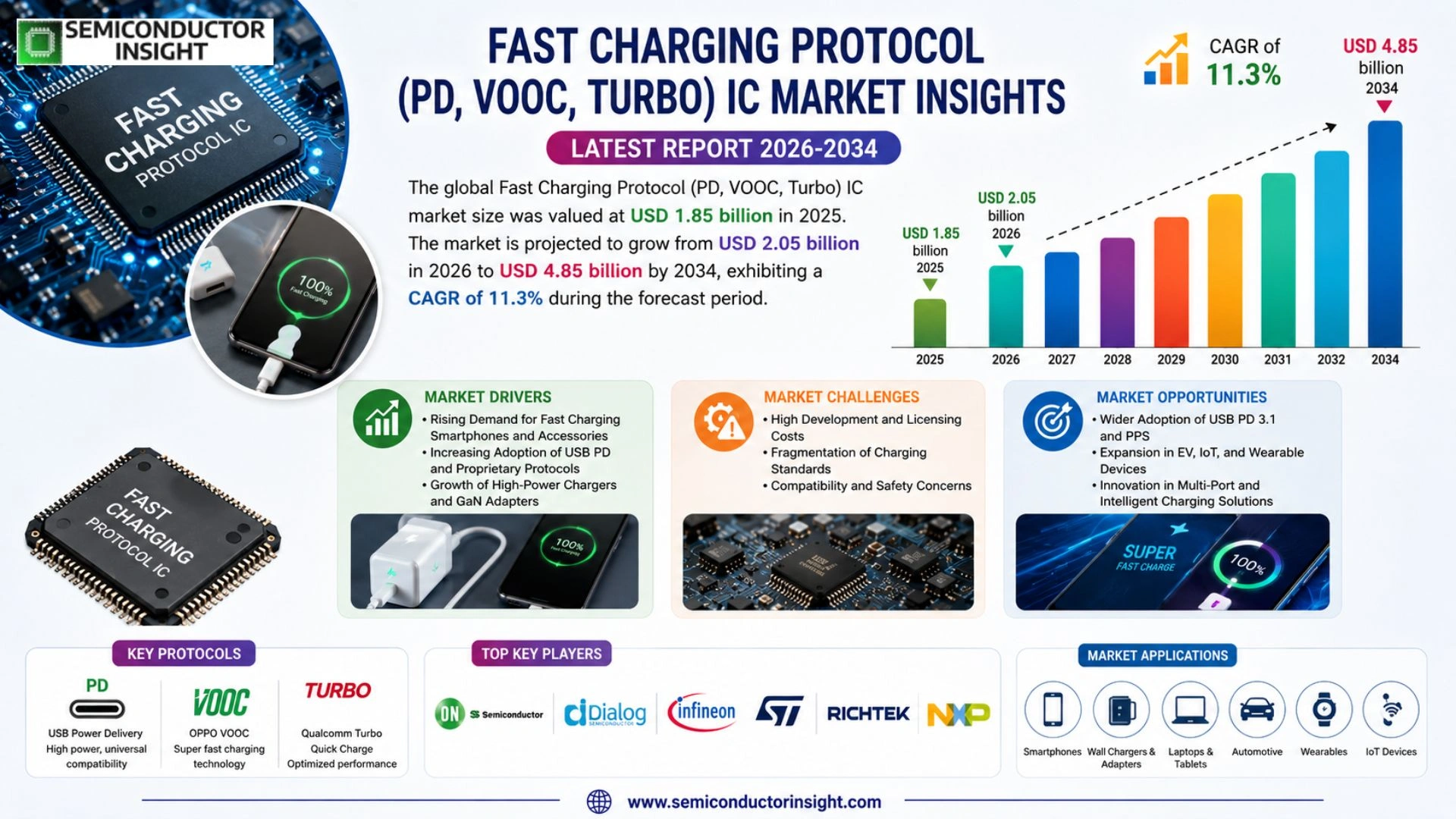
MARKET DRIVERS
Rising Demand for Rapid Charging in Consumer Electronics
Fast Charging Protocol (PD, VOOC, Turbo) IC Market is propelled by the exponential growth in smartphone and portable device adoption, where consumers demand significantly reduced charging times. USB Power Delivery (PD) has become a dominant standard enabling up to 240W power delivery, while proprietary protocols like OPPO’s VOOC/SuperVOOC and similar Turbo technologies offer optimized high-current charging solutions that enhance user convenience and device performance.
Expansion of Electric Vehicles and Automotive Applications
Electric vehicle proliferation drives substantial demand for advanced fast charging protocol ICs capable of supporting high-power delivery while maintaining safety and efficiency. Integration of USB PD and multi-protocol support in automotive electronics enables faster in-vehicle charging for devices and contributes to broader EV infrastructure development. Market reports indicate robust double-digit growth fueled by these trends.
➤ The convergence of USB PD, VOOC, and Turbo protocols in multi-protocol controller ICs allows manufacturers to address diverse market needs while reducing system complexity.
Technological advancements in GaN-based solutions and battery management further accelerate adoption, positioning fast charging ICs as essential components across consumer, automotive, and industrial segments.
MARKET CHALLENGES
Fragmented Charging Standards and Compatibility Issues
The coexistence of multiple fast charging protocols including USB PD, VOOC, Turbo, and others creates compatibility challenges for device manufacturers and consumers. Ensuring seamless interoperability across different brands and ecosystems remains a persistent technical hurdle that impacts widespread adoption.
Other Challenges
Thermal Management and Safety Concerns
High-power fast charging generates significant heat, requiring sophisticated thermal management within protocol ICs to prevent battery degradation and ensure user safety during extended high-current operations.
Supply Chain and Component Integration
Complex integration of protocol negotiation logic, power stages, and protection features in compact ICs increases design complexity and can lead to higher development costs for semiconductor suppliers.
MARKET RESTRAINTS
High Development Costs and Regulatory Compliance
Developing multi-protocol fast charging ICs that support PD, VOOC, Turbo, and emerging standards involves substantial R&D investment. Stringent safety regulations and certification requirements for high-power applications add layers of complexity and cost, potentially slowing innovation cycles for smaller market players.
Legacy system compatibility and varying regional adoption rates of unified standards further restrain uniform market expansion across global regions.
MARKET OPPORTUNITIES
Emergence of Multi-Protocol and AI-Enabled Solutions
Fast Charging Protocol (PD, VOOC, Turbo) IC Market presents significant opportunities in developing universal controllers that seamlessly negotiate between multiple protocols. Integration of AI-driven adaptive charging algorithms and advanced power management features can optimize efficiency, extend battery life, and differentiate products in competitive consumer electronics and EV segments. Expansion into industrial automation, renewable energy storage, and next-generation wearables offers new growth avenues for specialized fast charging IC solutions.
Trends
Rising Demand for Multi-Protocol Compatibility
Fast Charging Protocol (PD, VOOC, Turbo) ICs continue to evolve as essential components that enable efficient power management across diverse charging standards in modern electronics. These specialized integrated circuits facilitate seamless power negotiation, precise voltage regulation, and advanced thermal management to support rapid energy transfer while ensuring device safety. Manufacturers are prioritizing the development of multi-protocol solutions that deliver compatibility with USB Power Delivery (PD), OPPO VOOC, and Motorola Turbo standards, allowing devices to adapt dynamically to different chargers and ecosystems.
Other Trends
Integration with USB-C and Advanced Battery Technologies
The proliferation of USB-C interfaces has significantly influenced Fast Charging Protocol (PD, VOOC, Turbo) IC Market, driving the need for ICs that optimize charging performance in smartphones, laptops, tablets, and wearables. As battery technologies advance, these ICs play a critical role in maximizing charging speeds without compromising battery health through sophisticated overcharge and overheating protection mechanisms. Consumer demand for convenience and reduced charging times is pushing semiconductor companies to innovate in power efficiency and compact designs suitable for slim devices.
Expansion into Automotive and Portable Electronics Applications
Automotive applications represent a growing area for Fast Charging Protocol (PD, VOOC, Turbo) IC adoption, where reliable high-power charging solutions enhance user experience in electric vehicles and in-cabin electronics. Portable electronics manufacturers are also incorporating these ICs to differentiate their products through superior charging capabilities. Leading players such as Texas Instruments, Infineon Technologies, Qualcomm, and MediaTek are investing in semiconductor innovations to address varying power levels and safety requirements across consumer and industrial segments. Supportive regulatory initiatives focused on energy efficiency and the global push toward universal charging standards further accelerate the integration of these advanced ICs, fostering a competitive landscape centered on performance, compatibility, and reliability.
COMPETITIVE LANDSCAPE
Key Industry Players
Competitive Dynamics Fast Charging Protocol (PD, VOOC, Turbo) IC Market
Fast Charging Protocol (PD, VOOC, Turbo) IC Market is led by established semiconductor giants such as Texas Instruments, Infineon Technologies, Qualcomm, and MediaTek, which command significant market share through comprehensive portfolios supporting multiple protocols including USB Power Delivery (PD), proprietary standards, and advanced power management features. These leaders drive industry standards with innovations in voltage regulation, thermal management, and multi-protocol compatibility, shaping a competitive landscape characterized by high barriers to entry due to complex certification requirements and ongoing R&D investments in GaN and silicon-based solutions.
Other significant players including STMicroelectronics, NXP Semiconductors, Analog Devices, onsemi, Renesas Electronics, and specialized firms like Southchip Semiconductor and Injoinic Technology focus on niche applications, cost-effective solutions for mid-market devices, and emerging automotive integrations. This tier of competitors enhances market fragmentation while pushing advancements in efficiency and protocol interoperability to meet diverse OEM demands across consumer electronics.
List of Key Fast Charging Protocol IC Companies Profiled
- Texas Instruments
- Infineon Technologies
- Qualcomm
- MediaTek
- STMicroelectronics
- NXP Semiconductors
- Analog Devices
- onsemi
- Renesas Electronics
- ROHM Semiconductor
- Power Integrations
- Southchip Semiconductor
- Injoinic Technology
- Richtek Technology
- Dialog Semiconductor
Segment Analysis:
| Segment Category | Sub-Segments | Key Insights |
| By Type |
|
Multi-Protocol ICs represent the forefront of innovation by seamlessly supporting multiple fast charging standards within a single chip. These solutions offer exceptional flexibility for device manufacturers seeking broad compatibility across ecosystems. Key advantages include streamlined design processes that reduce component count and simplified inventory management. Advanced negotiation capabilities enable optimal power transfer while maintaining robust safety protocols. Their adaptability positions them as preferred choices for next-generation devices requiring universal charging support. |
| By Application |
|
Smartphones and Tablets lead adoption due to intense consumer demand for minimal downtime and rapid top-ups during daily use. These applications require precise voltage regulation and thermal management to safeguard high-capacity batteries under frequent charging cycles. Integration with USB-C interfaces further enhances user convenience through reversible connectivity. Manufacturers prioritize these ICs to differentiate products with superior charging experiences that align with evolving lifestyle needs. Enhanced power negotiation features ensure safe and efficient energy delivery tailored to dynamic usage patterns. |
| By End User |
|
Consumer Electronics OEMs drive primary demand through their focus on creating seamless, user-centric charging solutions. These organizations value ICs that support rapid energy transfer while incorporating comprehensive protection mechanisms against overheating and overvoltage. Collaboration between IC suppliers and OEMs accelerates the development of customized solutions that meet stringent performance and reliability standards. The emphasis on compact designs and energy efficiency makes these components essential for maintaining competitive edges in fast-paced markets. |
| By Power Level |
|
High Power ICs excel in delivering substantial energy transfer rates suitable for power-hungry devices. They incorporate sophisticated thermal regulation and current control mechanisms that maintain stability during extended high-output operations. These solutions support evolving battery technologies by enabling faster replenishment without compromising device longevity or safety. Their robust architecture facilitates integration into diverse platforms requiring quick recovery times, making them vital for premium product lines where performance expectations continue to rise. |
| By Integration Type |
|
System-on-Chip (SoC) Integrated solutions gain prominence by combining fast charging protocol management with other critical functions within a unified architecture. This approach minimizes board space requirements and reduces overall system complexity while enhancing communication efficiency between components. Seamless protocol handling becomes more reliable through tight integration, leading to improved power efficiency and reduced latency in negotiations. Device designers benefit from simplified development cycles and lower power consumption profiles that align with modern sustainability goals across various product categories. |
Regional Analysis: Fast Charging Protocol (PD, VOOC, Turbo) IC Market
Asia-Pacific
Asia-Pacific’s dense network of semiconductor firms and research institutions accelerates development of multi-protocol Fast Charging ICs. Companies focus on integrating PD, VOOC, and Turbo capabilities into single chips that reduce component count while enhancing safety features and energy efficiency for diverse device categories.
Established supply chains and specialized fabrication facilities enable cost-effective production of high-performance charging protocol ICs. Regional expertise in miniaturization supports creation of compact solutions that meet stringent thermal and power requirements demanded by modern portable electronics.
High smartphone penetration and fast-paced lifestyles fuel preference for rapid charging technologies. Users expect versatile ICs supporting multiple protocols, pushing manufacturers to deliver solutions that balance speed, compatibility, and battery longevity across various price segments.
Close collaboration between IC designers, device brands, and protocol developers creates tailored fast charging solutions. These partnerships emphasize seamless interoperability and future-proof designs ready for evolving power delivery standards in consumer electronics.
North America
North America exhibits steady growth Fast Charging Protocol (PD, VOOC, Turbo) IC Market driven by premium device adoption and emphasis on user convenience. The region maintains strong focus on USB Power Delivery standards while gradually incorporating support for additional protocols in laptops, tablets, and accessories. Tech companies prioritize safety certifications and energy efficiency in IC designs to meet regulatory expectations and consumer preferences for reliable performance. Innovation centers emphasize software-hardware integration for intelligent charging management that protects device longevity. Strategic investments in semiconductor R&D support development of versatile ICs compatible with diverse ecosystems. Market dynamics reflect growing demand for fast charging infrastructure in both consumer and enterprise segments, with particular attention to thermal optimization and power management features.
Europe
Europe demonstrates measured expansion Fast Charging Protocol (PD, VOOC, Turbo) IC Market influenced by strict regulatory frameworks and sustainability goals. Emphasis on standardized solutions like USB PD aligns with regional preferences for interoperability and reduced electronic waste. Manufacturers focus on developing energy-efficient ICs that comply with environmental directives while delivering competitive charging speeds. The automotive sector increasingly integrates fast charging protocols for electric vehicles and connected devices, creating additional opportunities for specialized IC designs. Collaborative industry initiatives promote harmonized standards across borders. Consumer awareness regarding sustainable technology encourages adoption of advanced charging solutions that balance performance with eco-friendly attributes.
South America
South America shows emerging potential Fast Charging Protocol (PD, VOOC, Turbo) IC Market as smartphone penetration increases across urban centers. Growing middle-class consumers drive demand for affordable devices featuring fast charging capabilities. Local distributors and assemblers adapt global technologies to regional power conditions and usage patterns. Market participants explore opportunities to incorporate multi-protocol support that accommodates both international standards and popular proprietary solutions. Infrastructure development in telecommunications supports wider deployment of devices requiring efficient charging ICs. Educational campaigns on technology benefits help accelerate consumer acceptance of fast charging features in daily use.
Middle East & Africa
Middle East and Africa present developing opportunities withFast Charging Protocol (PD, VOOC, Turbo) IC Market fueled by expanding digital connectivity and youth demographics. Rising adoption of smartphones creates demand for reliable fast charging solutions suitable for varied climatic conditions and power availability. Regional players focus on robust IC designs that withstand environmental challenges while supporting popular charging protocols. Investment in mobile infrastructure encourages integration of advanced charging technologies in new device launches. Strategic partnerships with global technology providers help introduce cutting-edge Fast Charging Protocol ICs tailored to local market requirements. The sector benefits from increasing emphasis on digital inclusion initiatives that promote accessible and efficient consumer electronics.
Report Scope
This market research report provides a comprehensive analysis of the Fast Charging Protocol (PD, VOOC, Turbo) IC Market , covering the forecast period 2026–2034. It offers detailed insights into market dynamics, technological advancements, competitive landscape, and key trends shaping the industry.
Key focus areas of the report include:
- Market Overview: The report begins with an overview outlining its current market scenario, key growth indicators, and industry transformation drivers. It discusses macroeconomic factors, demand–supply balance, regulatory landscape, and the strategic role of semiconductors in powering advancements across industries such as automotive, telecommunications, consumer electronics, and industrial automation.
- Market Size & Forecast: Historical data and future projections for revenue, unit shipments, and market value across major regions and segments.
- Segmentation Analysis: Detailed breakdown by product type, technology, application, and end-user industry to identify high-growth segments and investment opportunities.
- Regional Insights: Insights into market performance across North America, Europe, Asia-Pacific, Latin America, and the Middle East & Africa, including country-level analysis where relevant.
- Competitive Landscape: Profiles of leading market participants, including their product offerings, R&D focus, manufacturing capacity, pricing strategies, and recent developments such as mergers, acquisitions, and partnerships.
- Technology Trends & Innovation: Assessment of emerging technologies, integration of AI/IoT, semiconductor design trends, fabrication techniques, and evolving industry standards.
- Market Drivers & Restraints: Evaluation of factors driving market growth along with challenges, supply chain constraints, regulatory issues, and market-entry barriers.
- Stakeholder Insights: Insights for component suppliers, OEMs, system integrators, investors, and policymakers regarding the evolving ecosystem and strategic opportunities.
Primary and secondary research methods are employed, including interviews with industry experts, data from verified sources, and real-time market intelligence to ensure the accuracy and reliability of the insights presented.
FREQUENTLY ASKED QUESTIONS:
What is the current market size of Fast Charging Protocol (PD, VOOC, Turbo) IC Market?
-> Fast Charging Protocol (PD, VOOC, Turbo) IC Market was valued at USD 1.85 billion in 2025 and is expected to reach USD 4.85 billion by 2034.
Which key companies operate Fast Charging Protocol (PD, VOOC, Turbo) IC Market?
-> Key players include Texas Instruments, Infineon Technologies, Qualcomm, and MediaTek, among others.
What are the key growth drivers?
-> Key growth drivers include widespread adoption of smartphones, laptops, tablets, wearable devices, advancements in battery technology, proliferation of USB-C interfaces, and integration in automotive applications.
Which region dominates the market?
-> Asia-Pacific is the fastest-growing region due to strong electronics manufacturing base and consumer demand.
What are the emerging trends?
-> Emerging trends include multi-protocol solutions, semiconductor innovation for higher power levels, universal charging standards, and enhanced thermal management features.

Get Sample Report PDF for Exclusive Insights
Report Sample Includes
- Table of Contents
- List of Tables & Figures
- Charts, Research Methodology, and more...
 Download Sample Report PDF