Factory Automation (EtherCAT) Slave Controller IC Market Insights
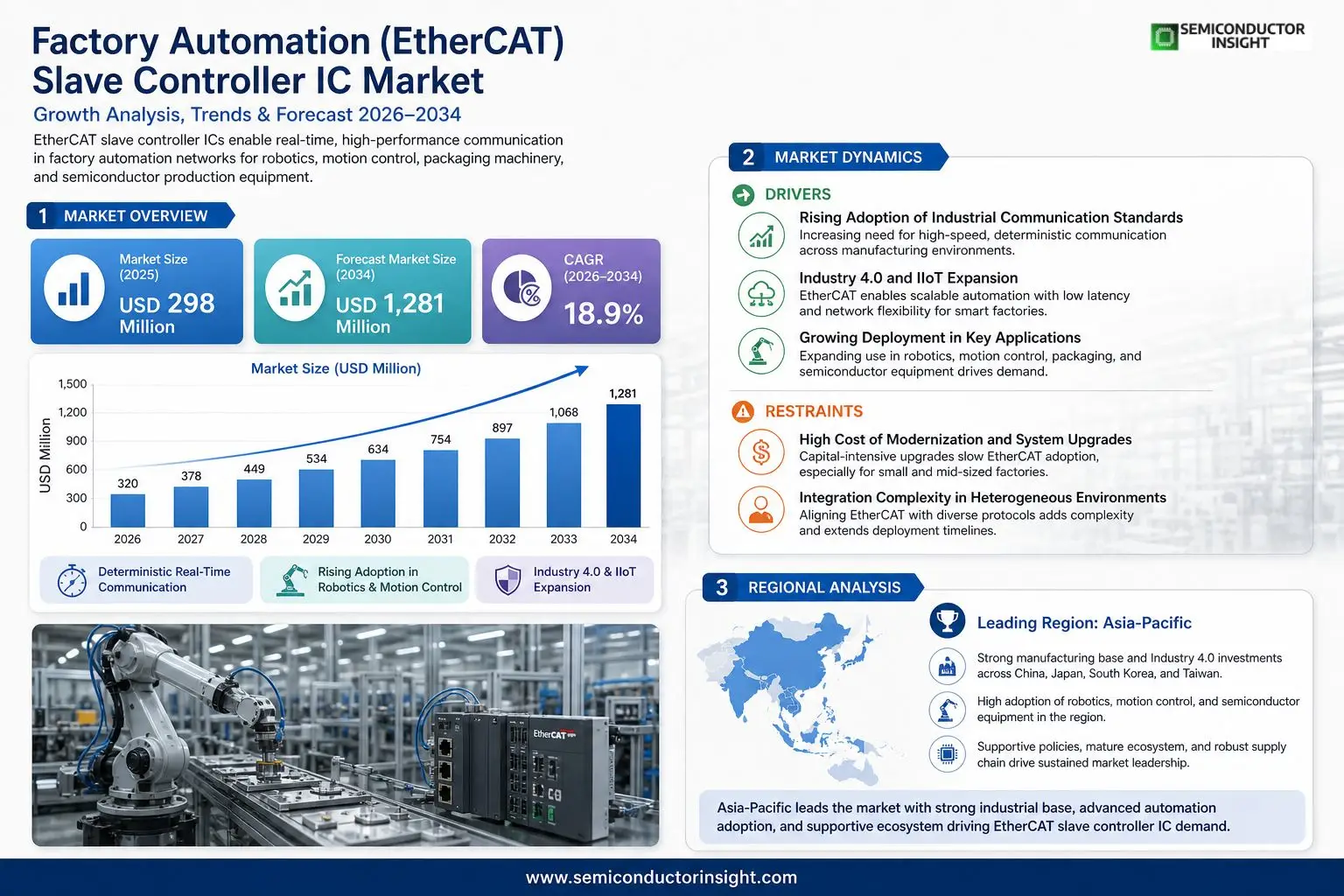
Global Factory Automation (EtherCAT) Slave Controller IC market size was valued at USD 298 million in 2025. The market is projected to grow from USD 320 million in 2026 to USD 1281 million by 2034, exhibiting a CAGR of 18.9% during the forecast period.
EtherCAT slave controller ICs serve as specialized integrated circuits that enable real-time, high-performance communication in factory automation networks. These components act as the hardware foundation for EtherCAT slave devices, processing on-the-fly data frames with minimal latency while supporting distributed clock synchronization and precise motion control. They integrate features such as dual-port Ethernet PHYs or MII interfaces, fieldbus memory management units (FMMUs), sync managers, and process data interfaces that connect to microcontrollers or application processors.
The market is experiencing robust growth due to several factors, including the accelerating adoption of Industry 4.0 principles, the expansion of smart manufacturing initiatives, and the rising demand for deterministic networking in complex automation systems. Furthermore, increasing deployment of EtherCAT in robotics, motion control applications, packaging machinery, and semiconductor production equipment drives the need for reliable, cost-effective slave controller solutions. While legacy fieldbus systems continue to coexist in brownfield installations, the superior speed and flexibility of EtherCAT encourage migration toward Ethernet-based architectures, however challenges such as supply chain complexities for specialized silicon persist. Initiatives by key players continue to fuel market expansion through enhanced product portfolios and ecosystem support. For instance, companies have introduced new EtherCAT subdevice controllers featuring integrated MCUs and advanced security capabilities to address demanding industrial environments. Microchip Technology, Infineon Technologies, Beckhoff Automation, ASIX Electronics, and GigaDevice are among the key players that operate in the market with a wide range of portfolios offering both standalone slave controllers and highly integrated system-on-chip solutions.
MARKET DRIVERS
Rising Adoption of Advanced Industrial Communication Standards
Factory Automation (EtherCAT) Slave Controller IC Market is being propelled by the increasing need for high‑speed, deterministic industrial communication across manufacturing environments. EtherCAT has become a preferred choice in various automation architectures due to its efficiency in synchronizing distributed control systems. The surge in modernizing legacy factory setups and the growing demand for real‑time data exchange continue to reinforce adoption across sectors such as machinery, packaging, and process industries.
Industry 4.0 and IIoT Expansion
As manufacturers accelerate their transition toward Industry 4.0 ecosystems, EtherCAT-enabled slave controller ICs are increasingly recognized for enabling scalable automation. Their performance benefits, including reduced latency and improved network flexibility, support the broader deployment of smart sensors, robotic systems, and advanced control units. The integration of machine data analytics and predictive maintenance platforms further strengthens the demand for EtherCAT-based architectures.
➤ The shift toward flexible, software-defined automation environments continues to elevate the relevance of EtherCAT slave controller IC solutions.
Growing deployment of compact automation modules, combined with higher expectations for interoperability across multi-vendor systems, ensures consistent long-term demand for advanced slave controller ICs within the factory automation landscape.
MARKET CHALLENGES
Integration Complexity in Heterogeneous Automation Environments
One of the persistent challenges for Factory Automation (EtherCAT) Slave Controller IC Market is the complex integration effort required when aligning EtherCAT networks with diverse industrial protocols. Many facilities operate mixed communication infrastructures, making it difficult to achieve seamless interoperability. Integration engineers must manage compatibility constraints, varying cycle-time requirements, and device configuration complexities, which can extend deployment timelines.
Other Challenges
Limited Skilled Workforce
Manufacturers continue to experience shortages of engineers with specialized expertise in industrial networking and EtherCAT-based control architectures, which can delay system upgrades and reduce operational efficiency.
MARKET RESTRAINTS
High Cost of Modernization and System Upgrades
Despite the benefits of EtherCAT technology, implementation often requires capital-intensive upgrades to controller hardware, network infrastructure, and automation modules. Many small and mid-sized factories continue to rely on legacy fieldbus systems due to cost limitations, slowing widespread adoption of EtherCAT slave controller ICs. Additionally, procurement cycles in the industrial sector can be lengthy, further restraining quicker market expansion.
MARKET OPPORTUNITIES
Emergence of Modular Automation and Compact EtherCAT Devices
The transition toward modular, decentralized automation architectures is creating strong opportunities for EtherCAT slave controller IC manufacturers. Compact machines and distributed I/O systems benefit significantly from EtherCAT’s scalability and deterministic performance. Growth in robotics, motion control applications, and next-generation smart sensors also presents substantial prospects for semiconductor companies specializing in EtherCAT-enabled components. Broadening adoption in semiconductor manufacturing, electronics assembly, and high-precision industrial processes continues to support robust future demand.
Factory Automation (EtherCAT) Slave Controller IC Market Trends Trends
Accelerated Adoption of Real-Time Industrial Networking
Factory Automation (EtherCAT) Slave Controller IC Market is being shaped by rapid technological shifts as manufacturers intensify the transition toward Ethernet-based industrial communication. EtherCAT-enabled architectures are increasingly preferred due to their deterministic data handling, high synchronization accuracy, and ability to support complex automation workloads. As production systems demand tighter real-time control and flexibility, these ICs are becoming integral to robotics, packaging lines, motion systems, and semiconductor equipment. The efficiency gains observed in cycle-time reduction and enhanced communication bandwidth are supporting stronger integration across distributed control layers. This trend is reinforced by the broader movement toward Industry 4.0 environments, where data-rich and time-critical operations require consistently low-latency networking chips.
Other Trends
Integration of Advanced Features in Slave Controller ICs
Market activity reflects a clear shift toward higher integration as vendors embed microcontrollers, security features, and advanced synchronization units directly into slave controller ICs. This consolidation reduces component count while improving system reliability, a key requirement in demanding automation environments. Solutions featuring optimized fieldbus memory management units and dual-port interfaces allow manufacturers to streamline board design and accelerate deployment in high-performance motion and safety systems. Leading suppliers continue refining architectures to support more nodes, faster processing, and improved noise immunity, aligning with the enhanced robustness expected in industrial networks.
Growing Use of EtherCAT in Robotics and Motion Control
Robotics and precision motion platforms remain among the strongest adopters of EtherCAT slave controller ICs due to their need for tightly coordinated control loops. The deterministic behavior of EtherCAT supports synchronized multi-axis motion, making these ICs well-suited for robotic arms, pick-and-place systems, and advanced assembly machinery. As factories expand automation to optimize throughput and reduce variability, demand for highly reliable slave controllers with efficient process data interfaces continues to climb, particularly in equipment requiring microsecond-level timing accuracy.
Shift Toward Scalable and Flexible System Architectures
Manufacturers are increasingly favoring scalable automation infrastructures that allow easy system expansion. EtherCAT’s flexible topology and low hardware overhead enable straightforward cascading of devices, placing pressure on IC vendors to deliver cost-efficient and versatile solutions. This trend aligns with the growing replacement of legacy fieldbus systems, where EtherCAT’s superior performance offers measurable advantages in speed, configuration simplicity, and diagnostics. Although specialized silicon supply chain dynamics pose challenges, ecosystem collaboration across suppliers is helping mitigate disruptions and widen product availability.
Strategic Product Development Supporting Long-Term Market Momentum
Continuous enhancements in slave controller IC designs reflect strategic commitments from key players focused on durability, functional integration, and long operating lifecycles. With industrial customers prioritizing reliability and compatibility, manufacturers are refining portfolios to accommodate diverse application needs, from compact embedded modules to high-bandwidth control systems. As automation footprints expand globally, ongoing product innovation is expected to reinforce market stability and deepen adoption across emerging and established industrial segments.
COMPETITIVE LANDSCAPE
Key Industry Players
Factory Automation (EtherCAT) Slave Controller IC Market Competitive Analysis
Factory Automation (EtherCAT) Slave Controller IC Market is shaped by a concentrated yet dynamic competitive landscape, led by semiconductor and industrial automation specialists with strong expertise in real-time industrial communication. Beckhoff Automation remains a foundational player due to its pioneering role in EtherCAT technology, offering certified and widely adopted slave controller chipsets. Companies such as Microchip Technology and Infineon Technologies continue to expand their EtherCAT-enabled portfolios with highly integrated ICs that support on-the-fly processing and deterministic communication, reinforcing their positions in high-performance motion control and robotics applications. These firms collectively drive technological benchmarks by integrating advanced synchronization, embedded security modules, and cost-effective architecture designs tailored to Industry 4.0 and smart factory demands.
Alongside these leading companies, a broader ecosystem of specialized semiconductor manufacturers contributes niche expertise and diversified portfolios to serve emerging automation use cases. ASIX Electronics and GigaDevice provide optimized controller ICs that emphasize low power consumption and efficient data throughput, addressing requirements of compact industrial devices. Renesas Electronics, Texas Instruments, and NXP Semiconductors leverage their deep industrial MCU and networking competencies to support EtherCAT adoption across programmable logic controllers, drives, and compact robotic systems. Additional firms such as Maxim Integrated (Analog Devices), Onsemi, and Broadcom supplement the market with communication subsystems and integrated PHY technologies that strengthen interoperability within EtherCAT-based architectures. Overall, the market’s competitiveness is characterized by continuous innovation, silicon optimization, and ecosystem expansion aimed at meeting the rigorous latency and synchronization demands of next-generation factory automation environments.
List of Key Factory Automation (EtherCAT) Slave Controller IC Market Companies Profiled
- Beckhoff Automation
- Microchip Technology
- Infineon Technologies
- ASIX Electronics
- GigaDevice Semiconductor
- Renesas Electronics
- Texas Instruments
- NXP Semiconductors
- Analog Devices (Maxim Integrated)
- Onsemi
- Broadcom
- STMicroelectronics
- Cypress (Infineon)
- Hilscher Gesellschaft für Systemautomation
- Altera (Intel Programmable Solutions Group)
Segment Analysis:
| Segment Category | Sub-Segments | Key Insights |
| By Type |
|
Integrated MCU-Based Controllers are gaining traction due to their ability to consolidate processing, networking, and memory functions into a single package.
|
| By Application |
|
Motion Control Systems represent the most influential application segment due to the need for high-speed signal processing and deterministic communication.
|
| By End User |
|
Electronics & Semiconductor manufacturers are at the forefront of EtherCAT adoption due to their demand for ultra-precise motion control and cleanroom-compatible automation.
|
| By Communication Interface |
|
Integrated PHY-Based Interfaces dominate due to their ability to reduce external dependency on separate Ethernet modules.
|
| By Integration Level |
|
High-Integration SoC Solutions lead this category as manufacturers prioritize compact, power-efficient systems capable of supporting demanding real-time tasks.
|
Regional Analysis: Factory Automation (EtherCAT) Slave Controller IC Market
Asia-Pacific
China’s manufacturing sector represents the single largest consumption base for EtherCAT slave controller ICs within Asia-Pacific. National industrial policies prioritizing smart factory upgrades and domestic automation content are compelling manufacturers to deploy advanced real-time fieldbus solutions at scale. The rapid proliferation of collaborative robots and automated assembly lines across automotive, electronics, and consumer goods industries continues to create sustained, broad-based demand across multiple application verticals.
Japan and South Korea collectively drive technological innovation in the Asia-Pacific EtherCAT slave controller IC landscape. Japanese robotics giants and South Korean semiconductor conglomerates are deeply invested in ultra-precise motion control architectures where EtherCAT’s deterministic communication capabilities are essential. Both nations lead in deploying next-generation servo systems and multi-axis controllers, reinforcing their status as critical technology development and consumption hubs within the regional Factory Automation market.
Taiwan’s world-class electronics manufacturing ecosystem provides a robust secondary demand center for EtherCAT slave controller ICs, supported by a deep network of ODM and EMS providers. Meanwhile, Southeast Asian economies including Vietnam, Thailand, and Malaysia are experiencing rapid factory automation investment as global supply chain diversification accelerates. These emerging manufacturing destinations are increasingly adopting EtherCAT-enabled automation platforms, broadening the regional market’s geographic footprint considerably.
Asia-Pacific benefits from an exceptionally mature and vertically integrated supply chain for Factory Automation EtherCAT Slave Controller IC components. The presence of leading semiconductor foundries, IC design houses, and industrial automation OEMs within the same geographic cluster reduces development cycles and time-to-market. This deep ecosystem integration, combined with strong intra-regional trade flows and technical collaboration networks, creates durable competitive advantages that reinforce the region’s dominant market position through the forecast horizon.
North America
North America represents a strategically significant region within Global Factory Automation (EtherCAT) Slave Controller IC Market, underpinned by a strong tradition of advanced manufacturing, industrial automation investment, and technology innovation. The United States leads regional demand, with automotive, aerospace, semiconductor fabrication, and food processing sectors driving consistent adoption of EtherCAT-based control architectures. The ongoing reshoring of critical manufacturing operations, accelerated by supply chain resilience initiatives, is generating fresh capital investment in smart factory infrastructure where EtherCAT slave controller ICs play a pivotal role. Canada contributes meaningfully to regional demand through its automotive assembly corridor and growing industrial robotics base. The region’s robust ecosystem of automation system integrators, industrial software developers, and end-user enterprises creates a favorable environment for continued EtherCAT technology penetration. North America’s emphasis on Industry 4.0 digital transformation and the integration of artificial intelligence with real-time control systems further elevates the strategic importance of high-performance EtherCAT slave controller solutions across the forecast period.
Europe
Europe occupies a position of considerable strategic importance in Factory Automation (EtherCAT) Slave Controller IC Market, owing largely to the region’s historical leadership in industrial automation technology and its status as the birthplace of EtherCAT protocol through Beckhoff Automation in Germany. Germany remains the dominant national market, with its powerful Mittelstand manufacturing base, world-class machine tool industry, and deeply embedded automation culture sustaining robust demand for EtherCAT-enabled slave controller ICs. Italy’s mechanical and packaging machinery sectors, along with France’s automotive and aerospace manufacturing base, represent additional pillars of regional demand. Europe’s strong regulatory focus on energy efficiency, operational safety, and digital factory standards is consistently pushing industrial operators toward advanced real-time communication solutions. The region’s network of specialized automation OEMs, research institutions, and industrial consortia continues to drive both technology refinement and market expansion for the EtherCAT Slave Controller IC ecosystem throughout the 2026–2034 outlook period.
South America
South America presents a gradually expanding opportunity within Global Factory Automation (EtherCAT) Slave Controller IC Market, albeit from a relatively early stage of industrial automation maturity. Brazil serves as the region’s primary market anchor, with its diversified manufacturing base spanning automotive assembly, agricultural equipment production, and food and beverage processing increasingly adopting automated production technologies. Argentina and Mexico, the latter closely integrated with North American supply chains, also contribute to regional demand growth. Investment in industrial modernization is being supported by a combination of foreign direct investment inflows and domestic industrial policy initiatives aimed at improving manufacturing competitiveness. While infrastructure limitations and economic volatility present near-term constraints, the underlying trajectory for EtherCAT slave controller IC adoption in South America is positive, with multinational manufacturers establishing regional facilities that demand globally standardized automation communication protocols and high-reliability control components.
Middle East & Africa
The Middle East and Africa region occupies an emerging position in Factory Automation (EtherCAT) Slave Controller IC Market, characterized by selective but growing adoption concentrated in specific industrial sectors and geographies. Gulf Cooperation Council nations, particularly Saudi Arabia and the United Arab Emirates, are channeling substantial investment into industrial diversification and smart manufacturing as part of broader economic transformation agendas such as Saudi Vision 2030. Oil and gas processing, petrochemical manufacturing, and utilities infrastructure represent the primary demand verticals for advanced automation solutions including EtherCAT-enabled systems in this sub-region. South Africa leads African market activity, driven by its mining, automotive assembly, and food processing industries. While the region as a whole remains at an early stage relative to Asia-Pacific and North America, increasing technology transfer, growing foreign industrial investment, and rising awareness of industrial efficiency imperatives are collectively establishing a foundation for longer-term Factory Automation EtherCAT Slave Controller IC Market growth through the 2034 horizon.
Report Scope
This market research report provides a comprehensive analysis of the Factory Automation (EtherCAT) Slave Controller IC Market , covering the forecast period 2026–2034. It offers detailed insights into market dynamics, technological advancements, competitive landscape, and key trends shaping the industry.
Key focus areas of the report include:
- Market Overview: The report begins with an overview outlining its current market scenario, key growth indicators, and industry transformation drivers. It discusses macroeconomic factors, demand–supply balance, regulatory landscape, and the strategic role of semiconductors in powering advancements across industries such as automotive, telecommunications, consumer electronics, and industrial automation.
- Market Size & Forecast: Historical data and future projections for revenue, unit shipments, and market value across major regions and segments.
- Segmentation Analysis: Detailed breakdown by product type, technology, application, and end-user industry to identify high-growth segments and investment opportunities.
- Regional Insights: Insights into market performance across North America, Europe, Asia-Pacific, Latin America, and the Middle East & Africa, including country-level analysis where relevant.
- Competitive Landscape: Profiles of leading market participants, including their product offerings, R&D focus, manufacturing capacity, pricing strategies, and recent developments such as mergers, acquisitions, and partnerships.
- Technology Trends & Innovation: Assessment of emerging technologies, integration of AI/IoT, semiconductor design trends, fabrication techniques, and evolving industry standards.
- Market Drivers & Restraints: Evaluation of factors driving market growth along with challenges, supply chain constraints, regulatory issues, and market-entry barriers.
- Stakeholder Insights: Insights for component suppliers, OEMs, system integrators, investors, and policymakers regarding the evolving ecosystem and strategic opportunities.
Primary and secondary research methods are employed, including interviews with industry experts, data from verified sources, and real-time market intelligence to ensure the accuracy and reliability of the insights presented.
FREQUENTLY ASKED QUESTIONS:
What is the current market size of Factory Automation (EtherCAT) Slave Controller IC Market?
-> Factory Automation (EtherCAT) Slave Controller IC Market was valued at USD 298 million in 2025 and is expected to reach USD 1281 million by 2034, growing at a CAGR of 18.9% during the forecast period from 2026 to 2034.
Which key companies operate in Factory Automation (EtherCAT) Slave Controller IC Market?
-> Key players include Microchip Technology, Infineon Technologies, Beckhoff Automation, ASIX Electronics, and GigaDevice, among others, offering a wide range of portfolios with both standalone slave controllers and highly integrated system-on-chip solutions.
What are the key growth drivers?
-> Key growth drivers include accelerating adoption of Industry 4.0 principles, expansion of smart manufacturing initiatives, rising demand for deterministic networking, and increasing deployment of EtherCAT in robotics, motion control applications, packaging machinery, and semiconductor production equipment.
Which region dominates the market?
-> Asia-Pacific is the fastest-growing region, driven by rapid industrialization and smart factory investments, while Europe remains a dominant market due to its strong industrial automation and manufacturing base.
What are the emerging trends?
-> Emerging trends include EtherCAT subdevice controllers featuring integrated MCUs, advanced security capabilities for industrial environments, migration from legacy fieldbus systems to Ethernet-based architectures, and the development of highly integrated system-on-chip solutions to address demanding industrial automation requirements.

Get Sample Report PDF for Exclusive Insights
Report Sample Includes
- Table of Contents
- List of Tables & Figures
- Charts, Research Methodology, and more...
 Download Sample Report PDF