Key Statistics
Key Takeaways
- Combustion-wash systems are the broadest current technology class because they can destroy flammable, toxic and fluorinated process gases and then remove soluble or particulate by-products in an integrated treatment flow.
- Plasma etching and CVD/ALD are the largest application groups because these processes use fluorinated gases, chamber-cleaning chemistries, silanes and other hazardous materials that require high destruction and removal efficiency.
- Asia Pacific is the dominant regional market because Taiwan, South Korea, China and Japan contain the largest concentration of semiconductor wafer-fabrication capacity and therefore the largest subfab installed base.
- Regulation and climate targets are raising the performance bar. Fluorinated gases such as NF3, CF4 and SF6 have very high global-warming potential, and advanced fabs increasingly require treatment efficiency, lower utilities and emissions monitoring together.
- 2026 product development is moving toward hybrid and secondary abatement. DAS launched ALCEA for up to 95% NOx reduction, while EBARA began 2026 rollout of new plasma abatement and Edwards continues to expand integrated high-efficiency subfab systems.
Exhaust Abatement Systems for Semiconductor Market Overview
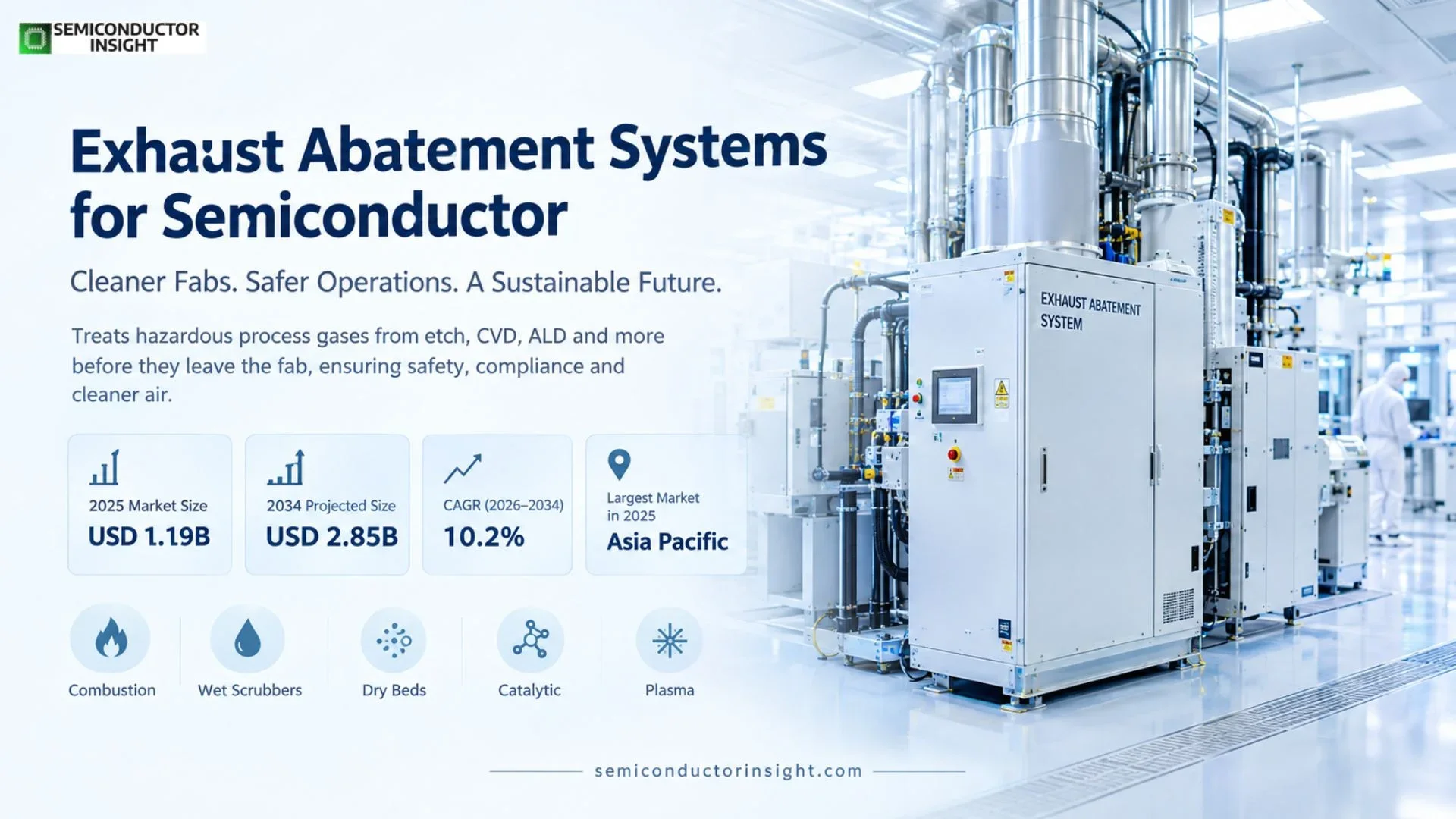
Exhaust Abatement Systems for Semiconductor market is estimated at USD 1.19 billion in 2025 and is projected to reach USD 2.85 billion by 2034, representing a 10.2% CAGR during 2026–2034. The published 2026 market size is USD 1.31 billion. Asia Pacific is the dominant regional market because it contains the largest concentration of semiconductor fabs and subfab exhaust-treatment infrastructure.
Semiconductor exhaust abatement systems treat hazardous process gases before they leave the fab. Etch, CVD, ALD, epitaxy, chamber cleaning and ion implantation can generate toxic, flammable, corrosive, pyrophoric and greenhouse-gas exhaust streams. Point-of-use abatement is installed close to process tools to destroy or capture these substances before they enter central ducting.
Technology selection depends on gas chemistry, flow, by-product formation, water availability and maintenance strategy. Combustion systems oxidize or decompose combustible and fluorinated gases, wet scrubbers remove soluble species, dry beds adsorb or chemically react with contaminants, catalytic systems reduce fuel demand, and plasma systems create reactive high-energy environments for difficult compounds.
The market is shifting from basic detoxification toward full subfab optimization. Fabs increasingly evaluate destruction and removal efficiency, energy use, fuel, water, NOx generation, particulate handling, footprint, uptime and remote monitoring together. This favors multi-stage and hybrid platforms that can manage several gas families while reducing operating cost.
Segment Analysis: By Type
By type, the market is segmented into Combustion-Wash, Dry, Catalytic, Wet, Plasma-Wet and Other Abatement Systems. Combustion-wash remains the broadest technology class because it combines thermal destruction with downstream scrubbing for complex semiconductor gas streams.
| System type | Treatment mechanism | Market position |
|---|---|---|
| Combustion-Wash | Burns or thermally decomposes flammable and greenhouse gases, then uses a wet stage to cool exhaust and remove soluble or particulate by-products. Fuel, water and maintenance efficiency are major design variables. | Largest broad-use class. Common across CVD, etch, epitaxy and multi-gas applications where several hazardous species must be handled together. |
| Dry Type | Uses solid sorbents or reactive media to chemically capture target gases without wastewater generation. Media is replaced when capacity is exhausted. | Valuable where water conservation, low utility use or simple gas streams justify cartridge/media-based treatment. |
| Catalytic Type | Uses catalysts to lower the temperature required for decomposition or oxidation, reducing fuel consumption. EBARA’s GCR combines catalytic treatment with wet scrubbing for PFC gases. | Energy-saving segment gaining value as fabs target lower carbon and utility intensity. |
| Wet Type | Uses liquid scrubbing to absorb soluble acids, alkalis and other contaminants. Wet treatment is widely used as a secondary stage or for water-soluble gas streams. | Established technology with strong use in acid-gas and by-product control. |
| Plasma-Wet | Uses plasma to dissociate difficult molecules before downstream wet removal. The architecture can achieve high destruction efficiency on selected fluorinated gases with compact point-of-use installation. | High-growth advanced segment for stringent greenhouse-gas and multi-chemistry treatment requirements. |
Gas-family and treatment-location segmentation
The market can also be segmented by gas family and installation architecture. Fluorinated greenhouse gases create climate pressure, while hydrides, halides and pyrophoric gases create acute safety risks. Most advanced semiconductor fabs use point-of-use systems close to the process tool and may add secondary duct or central treatment for residual NOx or other emissions.
| Axis | Segments | Commercial implication |
|---|---|---|
| By Gas Family | Fluorinated Gases · Hydrides / Pyrophorics · Acid / Halide Gases · NOx / N2O · Particulate By-products | Different gases require different destruction temperatures, sorbents and scrubbing chemistries. Multi-gas platforms reduce the number of separate systems in the subfab. |
| By Treatment Location | Point-of-Use · Secondary Duct Treatment · Central / Facility Treatment | Point-of-use systems protect ducts and operators, while secondary or central systems address residual emissions and broader facility targets. |
Segment Analysis: By Application
By application, Plasma Etching and CVD/ALD are the largest segments, followed by epitaxy, ion implantation and other process areas. Etch and chamber-clean steps are particularly important because they use fluorinated gases with high global-warming potential.
| Application | Key market insight |
|---|---|
| Plasma Etching | Etch uses CF4, C2F6, C4F8, SF6 and related chemistries for material removal. Unreacted gas and by-products require high destruction efficiency, corrosion resistance and particulate handling. |
| CVD and ALD | Deposition tools use silanes, organometallics and fluorinated chamber-clean gases such as NF3. Abatement must manage both hazardous process gases and solid by-products without frequent blockage. |
| Epitaxy | Epitaxial reactors can use hydrogen, chlorine-containing gases and precursor chemistries at high flow. Systems such as EBARA G6-E and Edwards Atlas Helios are designed around large hydrogen and halogen streams. |
| Ion Implantation | Implant tools use toxic dopant gases including arsine and phosphine. Dry and specialized point-of-use systems can provide safe capture with minimal secondary chemistry. |
| Other Processes | Diffusion, oxidation, clean, EUV support and specialty compound-semiconductor processes create additional combinations of fluorinated, toxic and energetic exhaust. |
Regional Analysis
Asia Pacific dominates the Semiconductor Exhaust Abatement market because most global semiconductor wafer capacity is concentrated in Taiwan, South Korea, China and Japan. North America is growing through new U.S. fabs, while Europe combines new semiconductor capacity with strict environmental policy and a strong abatement-equipment technology base.
Why does fab geography determine abatement-system demand?
Abatement is installed in direct proportion to active process chambers rather than downstream chip consumption. Each new etch, deposition or epitaxy tool can require dedicated or shared exhaust treatment. Regions adding front-end wafer capacity therefore generate recurring abatement equipment, service, spare-parts and upgrade demand.
| Region | Market position | Growth outlook | Core demand | Commercial priority |
|---|---|---|---|---|
| Asia Pacific | Dominant | Very high | Foundry, memory & display | High DRE, uptime and compact subfab footprint |
| North America | Fast-expanding | High | New fabs, AI logic & memory | Local service and emissions reduction |
| Europe | Technology / regulatory hub | High | Power, auto & advanced fabs | Carbon efficiency and strict compliance |
| South America | Small | Selective | Research / specialty | Fab installed base |
| Middle East & Africa | Emerging | Selective | Existing / future fabs | Local support and utility availability |
Competitive Landscape
Key participants include EBARA, Atlas Copco / Edwards, GST, Shanghai Shengjian Technology, Busch Group, DAS Environmental Expert, CS Clean Solutions, Kanken Techno, Beijing Jingyi Automation Equipment and Ecosys Abatement. Competition centers on destruction efficiency, uptime, by-product handling, footprint, utilities, service and process-specific gas expertise.
EBARA offers combustion, wet, dry, catalytic and plasma-related exhaust treatment. Its G5 and G6-E systems address PFC, flammable, hydrogen and chlorine gases, while the GCR catalytic platform reduces fuel demand. The company’s LPCMN and ELF developments extend its range for newer semiconductor chemistries.
Edwards, part of Atlas Copco, has one of the largest semiconductor vacuum-and-abatement installed bases. Atlas combustion systems are tuned for CVD, PFC, etch and hydrogen processes, while integrated solutions combine pumps, abatement, monitoring and facility connections.
DAS Environmental Experts differentiates through point-of-use burner/scrubber, plasma-wet, scrubber and secondary-emission technologies. Its 2026 ALCEA launch adds compact duct-integrated NOx reduction, showing the market’s shift toward complete emissions management rather than single-pollutant destruction.
Competitive tier structure
| Competitive tier | Representative companies | Competitive strengths |
|---|---|---|
| Global semiconductor abatement leaders | EBARA; Edwards / Atlas Copco; DAS Environmental Expert | Broad gas coverage, global service, high installed base and advanced process integration |
| Asia regional leaders | GST; Kanken Techno; Shanghai Shengjian; Beijing Jingyi | Local fab proximity, competitive cost and process-specific products |
| Specialty / niche suppliers | CS Clean Solutions; Busch Group; Ecosys and others | Dry media, integrated vacuum, regional service and targeted gas chemistries |
Key companies profiled
Semiconductor Abatement Capacity & Subfab Integration Analysis
Manufacturing capacity depends on combustion reactors, plasma sources, scrubber vessels, catalysts, control electronics, corrosion-resistant plumbing and safety-certified integration. Effective market capacity also depends on field service because systems operate continuously and require preventive cleaning, media replacement and by-product management.
Subfab footprint is an important constraint. Advanced fabs contain hundreds or thousands of process chambers, so each abatement cabinet competes for limited space with vacuum pumps, gas delivery and utility systems. Compact multi-inlet and duct-integrated architectures can reduce facility cost.
Utilities determine total operating economics. Fuel, electricity, nitrogen, water and wastewater treatment can exceed the purchase price over equipment life. Vendors therefore compete on low-idle modes, catalytic treatment, heat recovery and reduced wet-scrubber demand.
Market Dynamics
Growth is driven by new semiconductor fabs, fluorinated-gas climate targets, process complexity and stricter safety requirements. Restraints include high utilities, maintenance, secondary emissions and chemistry-specific qualification. Opportunities center on plasma-wet systems, NOx secondary abatement, catalytic low-fuel treatment, smart monitoring and combined gas-water solutions.
MARKET DRIVERS
Every new process chamber creates exhaust-treatment demand
Etch, CVD and epitaxy tool growth directly expands the subfab installed base.
Fluorinated gases have very high climate impact
NF3, CF4, C2F6, SF6 and related gases can pass through process chambers unreacted, making high-DRE abatement strategically important.
Advanced structures increase process steps
3D NAND, GAA logic and advanced DRAM use more deposition, cleaning and etch cycles, raising total waste-gas volume per wafer.
Safety standards require reliable detoxification
Toxic, pyrophoric and corrosive gases must be reduced below safe thresholds before release or duct transport.
Drivers Impact Analysis
| Driver | Impact | Primary markets | Time horizon |
|---|---|---|---|
| New fab construction | High | Asia, U.S., Europe | Medium to long term |
| GHG reduction targets | High | Global advanced fabs | Persistent |
| 3D logic / memory process intensity | High | Leading-edge fabs | Persistent |
| Worker / facility safety | High | All fabs | Persistent |
MARKET RESTRAINTS
Abatement can consume significant fuel and water
Poorly optimized systems raise fab energy use and operating cost.
Solid by-products reduce uptime
Powders can block inlets, burners and ducts, increasing planned maintenance frequency.
One treatment stage can create another pollutant
Combustion may generate NOx, while wet scrubbing creates wastewater, encouraging multi-stage treatment.
New chemistries require testing
A system proven on NF3 may not deliver the same performance on new organometallic, chlorine or precursor combinations.
Restraints Impact Analysis
| Restraint | Impact | Exposure | Time horizon |
|---|---|---|---|
| Utility consumption | High | Combustion / wet systems | Persistent |
| Maintenance / powder buildup | High | CVD / etch applications | Persistent |
| Secondary NOx / wastewater | Medium to high | Multi-stage treatment | Persistent |
| Process-specific qualification | Medium | New chemistries | Persistent |
MARKET OPPORTUNITIES
Add secondary NOx treatment
Duct-integrated catalytic systems can reduce residual NOx without consuming large subfab floor area.
Expand plasma-wet treatment
Plasma enables high-energy destruction of difficult fluorinated gases and can reduce dependence on fuel combustion.
Use catalytic systems to lower utilities
Catalytic decomposition can cut fuel use for selected gas streams and support fab decarbonization.
Integrate exhaust and water treatment
Combined approaches can recover resources, manage PFAS and reduce the environmental impact of both gas and liquid waste streams.
Semiconductor Exhaust Abatement Value Chain Analysis
Process gas / chemistry knowledge
Abatement equipment manufacturing
Subfab integration & qualification
Service / emissions compliance
Gas chemistry determines the technology choice
Fluorinated gases, hydrides, acids and pyrophorics react differently and can generate different secondary products.
Mechanical design determines uptime
Powder handling, corrosion resistance and inlet geometry affect service intervals.
Integration determines total facility performance
Vacuum pump temperature, exhaust dilution and duct design can change how effectively the abatement system operates.
Monitoring turns compliance into measurable performance
DRE, emissions sensors and predictive maintenance allow fabs to track environmental and uptime targets.
Recent Developments in the Exhaust Abatement Systems for Semiconductor Market
DAS launches ALCEA secondary NOx abatement
The duct-integrated plasma-enhanced catalytic system is designed to reduce NOx by up to 95% while minimizing additional subfab floor space.
EBARA begins rollout of new plasma abatement Model ELF
EBARA announced mass production and 2026 release of its new plasma abatement platform alongside a dry vacuum pump for advanced semiconductor processes.
DAS advances >99.9% CF4 destruction technology
Current TILIA materials highlight destruction and removal efficiency above 99.9% for CF4, targeting a zero-emission subfab approach.
Edwards Atlas platform supports etch, CVD, PFC and hydrogen processes
Atlas uses inward-fired combustion and process-specific variants including TCS, TPU, Etch and Helios with strong semiconductor installed-base support.
EBARA broadens treatment across combustion, catalytic and wet architectures
Current products include G5, G6-E, GCR and wet treatment for PFC, hydrogen, chlorine and water-soluble gas streams.
REPORT SCOPE & SEGMENTATION
| Attribute | Details |
|---|---|
| Study Period | 2020–2034 |
| Base Year | 2025 |
| Estimated Year | 2026 |
| Forecast Period | 2026–2034 |
| Historical Period | 2020–2025 |
| Market Size 2025 | USD 1.19 billion |
| Market Size 2034 | USD 2.85 billion |
| Growth Rate | 10.2% during 2026–2034 |
| Unit | Value (USD Million/Billion) and abatement-system shipments |
| By Type | Combustion-Wash Type · Dry Type · Catalytic Type · Wet Type · Plasma-Wet Type · Others |
| By Application | Plasma Etching · CVD and ALD · EPI · Ion Implantation · Others |
| By Gas Family | Fluorinated Gases · Hydrides / Pyrophorics · Acid / Halide Gases · NOx / N2O · Particulate By-products |
| By Treatment Location | Point-of-Use · Secondary Duct Treatment · Central / Facility Treatment |
| By Region | Each region analysed by abatement type, process application, gas family, treatment location and country fab ecosystem North AmericaUnited States, Canada, Mexico EuropeGermany, United Kingdom, France, Italy and other European markets Asia PacificTaiwan, South Korea, China, Japan, Singapore and other Asian markets South AmericaBrazil, Argentina and other South American markets Middle East & AfricaIsrael, Saudi Arabia, UAE and other MEA markets |
| Key Companies Profiled | EBARA Corporation · Atlas Copco / Edwards · GST (Global Standard Technology) · Shanghai Shengjian Technology · Busch Group · DAS Environmental Expert · CS Clean Solutions · Kanken Techno · Beijing Jingyi Automation Equipment · Ecosys Abatement |
| Customization Scope | Free report customization equivalent to up to four analyst working days with purchase. Addition or alteration to country, regional and segment scope. |
Frequently Asked Questions
What is the 2025 size of the semiconductor exhaust abatement market?
The market is estimated at USD 1.19 billion in 2025 and is projected to reach USD 2.85 billion by 2034. The published 2026 market size is USD 1.31 billion and the endpoint-derived annual growth rate is 10.2%.
Which abatement type is most widely used?
Combustion-wash is the broadest technology class because it can destroy several hazardous and fluorinated gases and then scrub soluble or particulate by-products.
Which applications drive the market?
Plasma etching and CVD/ALD are the largest application groups because they use fluorinated gases, chamber-clean chemistry and precursors that require high-efficiency exhaust treatment.
Which region leads the market?
Asia Pacific dominates because Taiwan, South Korea, China and Japan contain the largest concentration of semiconductor wafer fabs.
What is the market size in 2026?
The published 2026 market size is USD 1.31 billion. The 2025 and 2034 values are backcast and extended from the 2026–2033 endpoint-consistent growth path.
Why are fluorinated gases important to abatement?
Several fluorinated gases used in etch and chamber cleaning have very high global-warming potential and can leave process chambers unreacted unless process optimization or abatement removes them.
What are the main market restraints?
Fuel and water consumption, powder buildup, secondary NOx or wastewater generation, and process-specific qualification are the main constraints.
How are newer systems improving?
New platforms combine plasma, catalytic, wet and secondary treatment with compact footprints, lower utilities, better powder handling and remote monitoring.
Which companies are active in the market?
Major participants include EBARA, Edwards/Atlas Copco, GST, DAS Environmental Expert, Kanken Techno, CS Clean Solutions, Busch Group and regional Asian suppliers.
What does the report cover?
The report covers combustion, dry, catalytic, wet and plasma abatement; etch, CVD/ALD, epitaxy and implantation; gas families; regions; competition; capacity; dynamics; developments and value chain.
Research Sources & Evidence Base
View primary and authoritative evidence used in this overview
- U.S. EPA. Semiconductor Industry – Fluorinated GHG Emissions – Authoritative evidence on semiconductor fluorinated-gas use, unreacted emissions and abatement relevance.
- EBARA. Exhaust Abatement Systems – Official product evidence on combustion, wet, dry and catalytic treatment methods.
- Edwards Vacuum. Environmental Solutions – Abatement – Official evidence on semiconductor exhaust-management systems and fab applications.
- Edwards Vacuum. Atlas Abatement – Official technical evidence on combustion abatement for CVD, PFC, etch and hydrogen processes.
- DAS Environmental Expert. Semiconductor Industry Waste Gas Treatment – Official evidence on point-of-use abatement, process gases and semiconductor waste-gas applications.
- DAS Environmental Expert. ALCEA NOx Abatement – September 2026 product launch for integrated secondary NOx treatment.
Get Sample Report PDF for Exclusive Insights
Report Sample Includes
- Table of Contents
- List of Tables & Figures
- Charts, Research Methodology, and more...