Evaporation Material (Au, Pt, Ni) Market Insights
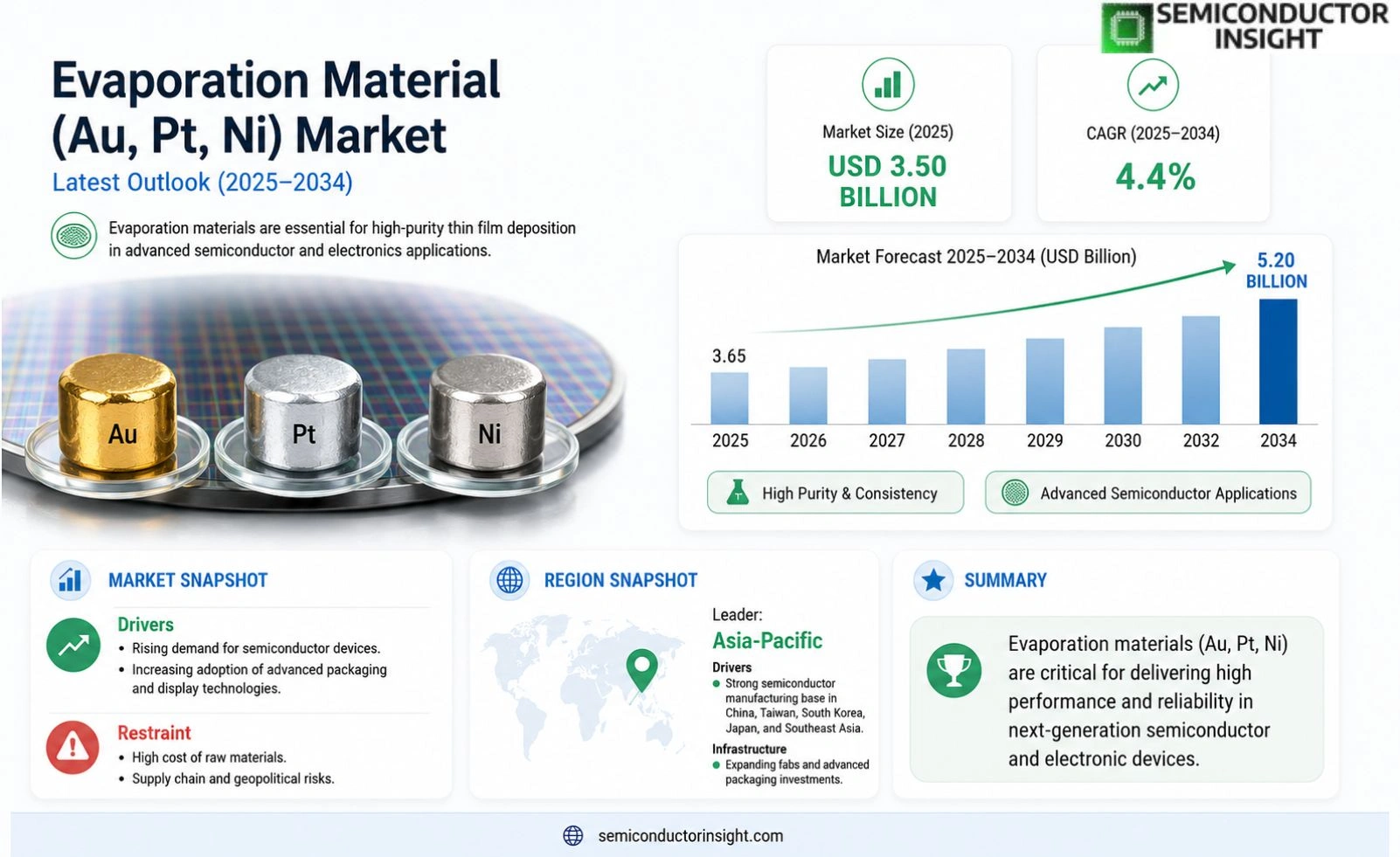
Global Evaporation Material (Au, Pt, Ni) Market size was valued at USD 3.50 billion in 2025. The market is projected to grow from USD 3.65 billion in 2025 to USD 5.20 billion by 2034, exhibiting a CAGR of 4.4% during the forecast period.
Evaporation materials, specifically Gold (Au), Platinum (Pt), and Nickel (Ni), are high-purity metals utilized in physical vapor deposition processes to create thin films. These materials are essential for applications ranging from semiconductor manufacturing and optical coatings to decorative finishes, offering superior conductivity, corrosion resistance, and thermal stability.
The market is expanding due to the increasing demand for advanced semiconductor packaging and the proliferation of consumer electronics. Furthermore, the shift towards miniaturization in electronics necessitates high-performance deposition materials. Key players are focusing on supply chain security and material purity enhancements to meet the rigorous standards of the electronics industry. Companies such as Kurt J. Lesker Company, Goodfellow, and Alfa Aesar are actively contributing to market growth through continuous innovation and extensive product portfolios.
MARKET DRIVERS
Expansion of Semiconductor Fabrication
The rapid evolution of the global semiconductor industry serves as the primary catalyst for Evaporation Material (Au, Pt, Ni) Market. As manufacturers push the boundaries of transistor density and device miniaturization, the demand for high-purity vapor deposition materials has surged. Gold (Au) and Platinum (Pt) are crucial for creating high-reliability interconnects and contacts that can withstand high temperatures and harsh environments, directly driving market growth. Simultaneously, Nickel (Ni) is increasingly utilized in magnetic storage applications requiring robust deposition properties, underscoring the critical role of these raw materials in next-generation computing hardware.
Growth in Renewable Energy Sector
The transition toward renewable energy solutions, particularly in photovoltaics, creates a significant demand for specific evaporation materials. Evaporation Material (Au, Pt, Ni) Market benefits significantly as manufacturers require advanced materials to improve the efficiency and longevity of solar cells and display panels. The unique chemical stability of Pt and the favorable conductivity properties of Ni make them indispensable in the deposition of conductive layers and transparent conductive oxides, thereby fueling sustained industrial expansion. Strategic investments in Research and Development (R&D) focusing on material purity and deposition efficiency are increasingly shaping the trajectory of the market. As the industry moves toward nanotechnology and high-precision layering, the ability to provide material with atomic-level purity becomes a competitive advantage Evaporation Material (Au, Pt, Ni) Market.
MARKET CHALLENGES
Fluctuations in Metal Prices
One of the most significant hurdles facing stakeholders Evaporation Material (Au, Pt, Ni) Market is the extreme price volatility associated with precious and base metals. The availability and pricing of Gold, Palladium, and Nickel are subject to geopolitical tensions, trade regulations, and supply chain disruptions. This unpredictability can severely impact the profit margins for material suppliers and end-user manufacturers alike, as raw material costs account for a substantial portion of the total product price.
Other Challenges
Supply Chain Disruptions
Global logistics bottlenecks and mining restrictions often lead to procurement delays, affecting production schedules and market supply.
Precious Metal Sourcing Constraints
The depletion of easily accessible ore deposits necessitates more expensive extraction methods, driving up the baseline cost of High-Quality material production.
MARKET RESTRAINTS
Stringent Environmental Regulations
Environmental mandates regarding mining waste and chemical processing are imposing operational constraints on Evaporation Material (Au, Pt, Ni) Market. Compliance with global environmental standards requires significant capital investment in cleaner technologies and waste management systems. This pushes up operational costs and can act as a barrier to entry for smaller enterprises seeking to compete in the advanced deposition materials sector.
MARKET OPPORTUNITIES
Adoption of 5G Infrastructure
The widespread deployment of 5G networks presents a massive opportunity for Evaporation Material (Au, Pt, Ni) Market. 5G technology requires advanced materials with superior electrical and thermal conductivity for antennas and filter components. The growing infrastructure projects globally are expected to drive a robust demand for specifically formulated evaporation materials.
Automotive Industry Electrification
As the automotive sector accelerates toward electrification, the need for specialized coatings and components in electric vehicles (EVs) offers new growth avenues. The integration of Ni and Pt in various sensor applications and battery contacts within EVs is set to expand the utility of Evaporation Materials, creating a diverse and high-growth market landscape.
Trends
Growing Dependence on Advanced Semiconductor Manufacturing
Evaporation Material (Au, Pt, Ni) Market is currently witnessing significant momentum driven by the rapid expansion of the semiconductor and electronics sectors. These metals are pivotal components in physical vapor deposition, used to manufacture thin films with exceptional conductivity, corrosion resistance, and thermal stability. Analytical insights suggest that the global Evaporation Material (Au, Pt, Ni) market size was valued at USD 3.50 billion in 2025, reflecting a robust foundation for current operations. While a short-term projection sees a marginal growth to USD 3.65 billion, the forecast period promises substantial expansion, with estimates reaching USD 5.20 billion by 2034. This trajectory highlights a stable Compound Annual Growth Rate (CAGR) as industries demand more reliable and high-performance material solutions.
Other Trends
Critical Role of Purity
The necessity for high-purity evaporation materials has never been greater. Whether for protective optical coatings or decorative high-tech finishes, the specific attributes of Gold, Platinum, and Nickel remain unmatched. Market analysis indicates that ensuring material purity is a primary factor driving purchasing decisions across the board, as even minor impurities can compromise the final film properties essential for high-end applications.
Miniaturization and Technology Integration
Furthermore, the overarching push towards technology integration and miniaturization in consumer electronics serves as a major catalyst for this market. To sustain the performance of next-generation devices, manufacturers are compelled to utilize advanced deposition processes. Industry leaders like Kurt J. Lesker Company and Goodfellow are actively securing supply chains and innovating product portfolios to address these complex requirements.
COMPETITIVE LANDSCAPE
Key Industry Players
Global Market Growth and Strategic Material Innovation
Evaporation Material (Au, Pt, Ni) Market is witnessing significant expansion, valued at USD 3.50 billion in 2025 and projected to reach USD 5.20 billion by 2034. The competitive landscape is defined by specialized manufacturers focusing on high-purity metals essential for global physical vapor deposition processes. Key players are prioritizing supply chain security and enhanced material purity to meet the rigorous, evolving standards of the semiconductor manufacturing and optical coating sectors.
As the industry shifts towards miniaturization in consumer electronics and advanced packaging, companies are increasingly expanding their portfolios to include critical metals like Gold, Platinum, and Nickel. The market structure is characterized by a synergy of global chemical giants offering broad-spectrum materials and agile niche suppliers providing customized deposition solutions for high-performance applications.
List of Key Evaporation Material Companies Profiled
- Kurt J. Lesker Company
- Heraeus Materials Technology
- Alfa Aesar
- MKS Instruments
- Edwards Group
- Stanford Materials
- Advanced Metallurgical Concepts
- Tocci Incorporated
- Umicore
- JPT Advanced Materials
- DOWA METALS
- Nanostructured & Amorphous Materials
- Goodfellow
- American Elements
- Praxair Surface Technologies
Segment Analysis:
| Segment Category | Sub-Segments | Key Insights |
| By Type |
|
Material Composition Dominance The market is primarily segmented by the chemical nature of the material, distinguishing between conductive, inert, and catalytic properties. Gold is the leading choice for high-conductivity requirements due to its inability to oxidize, making it essential for interconnects. Platinum leads the sector requiring high corrosion resistance and thermal stability. Nickel is frequently utilized for its barrier properties and cost-effectiveness in specific applications. The differentiation is heavily qualitative, driven by the specific functional outcomes required for circuitry and coating durability rather than volume. |
| By Application |
|
Process Integration Needs The leading segment in application lies within semiconductor manufacturing, where material purity directly dictates yield rates. Optical coatings follow closely as the demand for high-refractive index materials grows in sensors and lenses. Decorative applications, while smaller, rely on the specific aesthetic luster provided by noble metals. A key trend is the expansion into flexible electronics, which necessitates materials capable of enduring mechanical stress without cracking or degrading, shifting focus towards robust deposition processes. |
| By End User |
|
Industrial Demand Patterns Semiconductor foundries are the primary end users, driving the need for continuous supply chains to ensure device reliability. Display manufacturers prioritize material consistency for large-panel production. Optoelectronics firms focus on the optical performance of deposited layers. Major market players are increasingly engaging with end users to co-develop materials that meet specific thermal and mechanical requirements, ensuring that the supply of evaporation materials remains aligned with the rapid evolution of circuit designs and device architectures. |
| By Purity Grade |
|
Purity Requirements The industry is segmented based on the chemical purity level, which dictates the application suitability. High-purity grades dominate the market as semiconductor fabrication processes have become highly sensitive to contamination. Even trace elements can cause short circuits or variability. Consequently, the high-purity segment is critical for premium electronics, while standard grades support secondary applications. The shift towards miniaturization means that the threshold for acceptable impurity levels is constantly tightening, driving quality across the entire supply chain. |
| By Functional Benefit |
|
Performance Attributes This segment categorizes materials by the physical property they contribute to the final product. The leading segment is conductive layers, which are vital for establishing electrical pathways. Reflective coatings are essential for maximizing light transmission in optical devices and anti-reflective applications. Barrier layers are an emerging focus, protecting electronics from moisture and oxidation. The choice of a specific material is driven by the need to meet precise thermal expansion and conductivity benchmarks without compromising the structural integrity of the device. |
Regional Analysis: Evaporation Material (Au, Pt, Ni) Market
Asia-Pacific: The Global Production Engine
APAC companies leverage vertical integration to secure raw material availability for Au, Pt, and Ni, significantly reducing logistical costs and ensuring consistent high-quality delivery to downstream clients in the semiconductor sector, a critical component of Evaporation Material (Au, Pt, Ni) Market.
The region fosters a competitive environment where R&D initiatives prioritize ultra-high purity evaporation materials, enabling advanced photovoltaic and coating applications that meet stringent international standards for safety and efficacy across Evaporation Material (Au, Pt, Ni) Market.
Stringent government policies in key economies allocate substantial capital for manufacturing modernization, ensuring the region remains at the forefront of industrial automation and material science innovation, which is essential for sustaining growth Evaporation Material (Au, Pt, Ni) Market.
The relentless demand for smartphones, wearables, and displays creates a continuous upward trajectory for material usage, making APAC the primary growth engine for Evaporation Material (Au, Pt, Ni) Market as manufacturers seek better conductivity for next-gen devices.
North America
The United States acts as a critical hub for high-value application industries, particularly in data centers and aerospace. Demand here is driven by the need for high-performance materials in sputtering and evaporation processes to ensure reliability under extreme conditions. Market players focus on advanced R&D to utilize these materials efficiently, though higher labor costs impact regional pricing strategies. The strong presence of technology giants keeps the demand for specialty metals like Gold and Platinum steady, reflecting a mature yet sophisticated approach to Evaporation Material (Au, Pt, Ni) Market.
Europe
Heavy influence from the automotive industry, specifically the transition to Electric Vehicles, propels the market in Germany and France. The demand for Evaporation Material (Au, Pt, Ni) Market components is rising as manufacturers aim to improve conductive coatings and battery management systems for sustainable transport technologies, aligning with the region’s strong sustainability goals.
South America
The region represents a developing segment with potential growth driven by incremental industrialization. While primary consumption remains moderate, there is an increasing interest in adopting vapor deposition technologies for localized manufacturing and food preservation, contributing to a steady, albeit unique, market footprint withEvaporation Material (Au, Pt, Ni) Market analysis.
Middle East & Africa
This region is characterized by emerging market opportunities where infrastructure development and limited domestic manufacturing lead to import dependency. Growth is projected to be gradual, fueled by investments in construction and limited electronics production facilities that seek to diversify their industrial capabilities using advanced materials.
Report Scope
This market research report provides a comprehensive analysis of the Evaporation Material (Au, Pt, Ni) Market , covering the forecast period 2026–2034. It offers detailed insights into market dynamics, technological advancements, competitive landscape, and key trends shaping the industry.
Key focus areas of the report include:
- Market Overview: The report begins with an overview outlining its current market scenario, key growth indicators, and industry transformation drivers. It discusses macroeconomic factors, demand–supply balance, regulatory landscape, and the strategic role of semiconductors in powering advancements across industries such as automotive, telecommunications, consumer electronics, and industrial automation.
- Market Size & Forecast: Historical data and future projections for revenue, unit shipments, and market value across major regions and segments.
- Segmentation Analysis: Detailed breakdown by product type, technology, application, and end-user industry to identify high-growth segments and investment opportunities.
- Regional Insights: Insights into market performance across North America, Europe, Asia-Pacific, Latin America, and the Middle East & Africa, including country-level analysis where relevant.
- Competitive Landscape: Profiles of leading market participants, including their product offerings, R&D focus, manufacturing capacity, pricing strategies, and recent developments such as mergers, acquisitions, and partnerships.
- Technology Trends & Innovation: Assessment of emerging technologies, integration of AI/IoT, semiconductor design trends, fabrication techniques, and evolving industry standards.
- Market Drivers & Restraints: Evaluation of factors driving market growth along with challenges, supply chain constraints, regulatory issues, and market-entry barriers.
- Stakeholder Insights: Insights for component suppliers, OEMs, system integrators, investors, and policymakers regarding the evolving ecosystem and strategic opportunities.
Primary and secondary research methods are employed, including interviews with industry experts, data from verified sources, and real-time market intelligence to ensure the accuracy and reliability of the insights presented.
FREQUENTLY ASKED QUESTIONS:
What is the current market size of Evaporation Material (Au, Pt, Ni) Market?
-> Evaporation Material (Au, Pt, Ni) Market size was valued at USD 3.50 billion in 2025. The market is projected to grow from USD 3.65 billion in 2025 to USD 5.20 billion by 2034, exhibiting a CAGR of 4.4% during the forecast period.
Which key companies operate Evaporation Material (Au, Pt, Ni) Market?
-> Key players include Kurt J. Lesker Company, Goodfellow, and Alfa Aesar, among others, actively contributing through continuous innovation and extensive product portfolios.
What are the key growth drivers?
-> Key growth drivers include the increasing demand for advanced semiconductor packaging and the proliferation of consumer electronics. The shift towards miniaturization in electronics also necessitates high-performance deposition materials.
Which region dominates the market?
-> Europe remains a dominant market, driven by demands for semiconductor manufacturing and optical coatings.
What are the emerging trends?
-> Emerging trends include the demand for Gold (Au), Platinum (Pt), and Nickel (Ni) for superior conductivity, corrosion resistance, and thermal stability in thin film deposition applications.

Get Sample Report PDF for Exclusive Insights
Report Sample Includes
- Table of Contents
- List of Tables & Figures
- Charts, Research Methodology, and more...
 Download Sample Report PDF