EV Charging Station (AC/DC) Power Control IC Market Insights
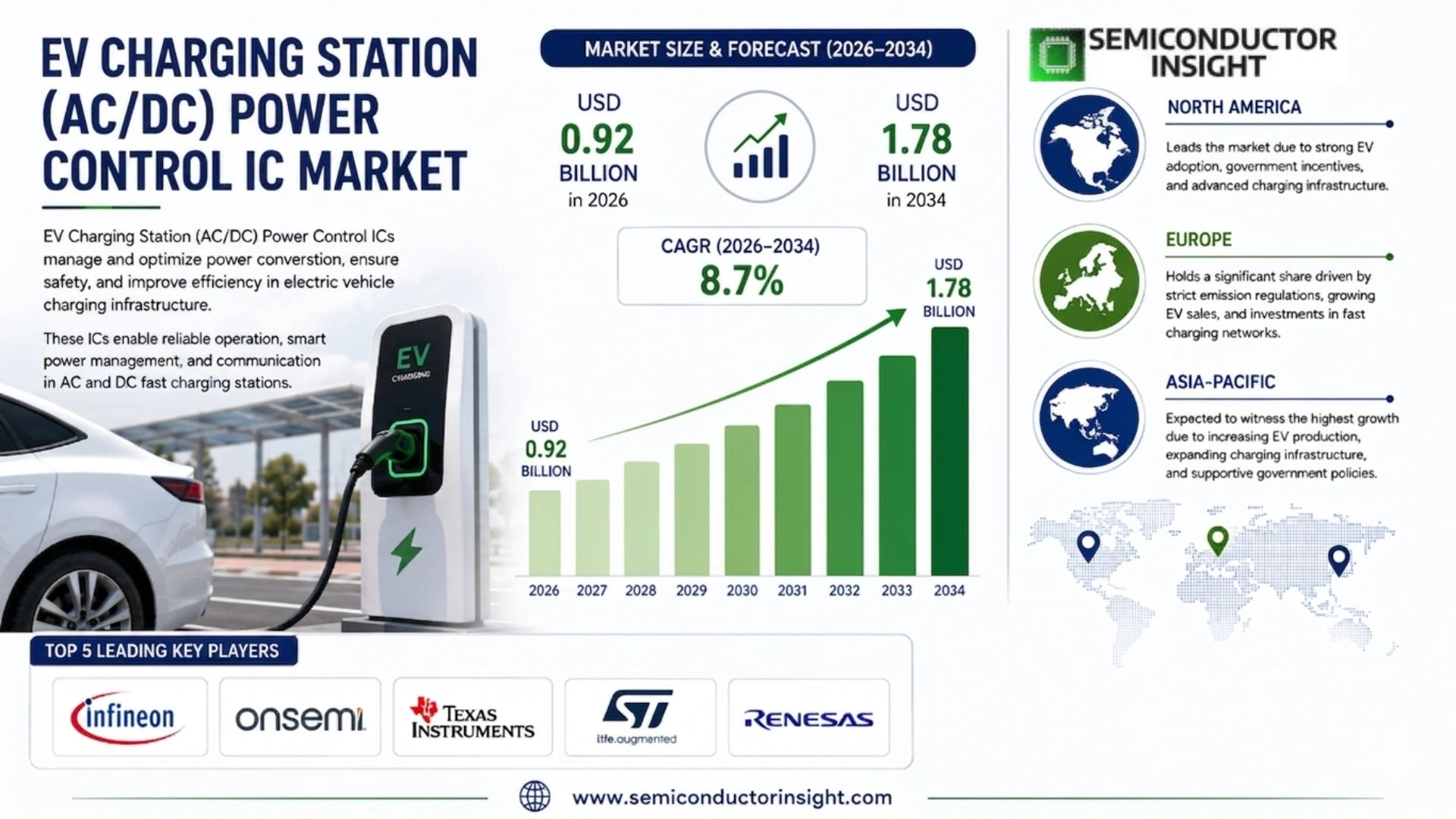
EV Charging Station (AC/DC) Power Control IC Market size was valued at USD 0.85 billion in 2025. The market is projected to grow from USD 0.92 billion in 2026 to USD 1.78 billion by 2034, exhibiting a CAGR of 8.7% during the forecast period.
EV Charging Station (AC/DC) Power Control ICs are specialized semiconductor components designed to manage and regulate power flow in electric vehicle charging infrastructure. These integrated circuits handle critical functions including AC to DC conversion control, voltage regulation, current monitoring, power factor correction, and thermal management to ensure safe, efficient, and reliable charging operations for both alternating current (AC) and direct current (DC) charging stations.
The market is experiencing robust growth driven by the accelerating global adoption of electric vehicles, expansion of public and private charging networks, and increasing demand for high-power fast-charging solutions. As charging stations become more sophisticated with bidirectional capabilities and smart grid integration, the need for advanced power control ICs that offer higher efficiency, compact designs, and enhanced safety features continues to rise. Furthermore, regulatory pushes for sustainable transportation and infrastructure development are supporting broader deployment of EV chargers worldwide.
MARKET DRIVERS
Rising EV Adoption and Charging Infrastructure Expansion
The global surge in electric vehicle sales continues to propel demand for advanced EV Charging Station (AC/DC) Power Control IC solutions. As public and private charging networks scale rapidly,with over 1.3 million public charging points added globally in 2024,power control ICs play a critical role in managing efficient AC to DC conversion, power factor correction, and voltage regulation in charging stations.
Technological Advancements in Power Electronics
Innovations in wide-bandgap semiconductors such as SiC and GaN are enhancing the performance of Power Control ICs, enabling higher switching frequencies, improved thermal management, and greater efficiency in both AC and DC charging systems. These advancements support faster charging times and higher power densities essential for modern DC fast chargers while reducing energy losses.
➤ Government policies and incentives worldwide are accelerating the deployment of high-power charging infrastructure, directly boosting the need for sophisticated power control integrated circuits in EV stations.
Integration of smart features like bidirectional power flow and vehicle-to-grid capabilities further drives the evolution of these ICs, positioning them as key enablers for sustainable energy ecosystems.
MARKET CHALLENGES
Grid Capacity and Infrastructure Limitations
Deploying high-power EV Charging Station (AC/DC) systems places significant strain on existing electrical grids, with grid access and capacity constraints emerging as primary hurdles for charge point operators. Power Control ICs must address complex load management to prevent overloads while maintaining stability.
Other Challenges
High Installation and Component Costs
The elevated costs associated with advanced power electronics, including specialized Power Control ICs for high-voltage applications, continue to impact deployment economics for many charging station projects.
Interoperability and Standardization Issues
Diverse charging protocols and connector standards require flexible Power Control IC designs that can support multiple communication interfaces and ensure seamless operation across different EV models and networks.
MARKET RESTRAINTS
Supply Chain and Technical Complexity
Complex design requirements for high-reliability Power Control ICs in harsh operating environments, combined with qualification processes for automotive-grade components, slow down innovation cycles and increase development costs for EV charging applications.
The need for precise energy metering, robust security features, and thermal management in compact form factors adds layers of engineering challenges that restrain faster market penetration.
MARKET OPPORTUNITIES
Smart and Bidirectional Charging Solutions
Emerging opportunities in intelligent load management and vehicle-to-grid technologies create substantial demand for advanced EV Charging Station (AC/DC) Power Control ICs capable of dynamic power flow control and renewable energy integration.
Expansion into fleet electrification, ultra-fast charging networks, and emerging markets offers significant growth potential for manufacturers developing cost-effective, high-efficiency power management solutions tailored to next-generation charging infrastructure.
Trends
Rising Integration of Bidirectional Power Capabilities
EV Charging Station (AC/DC) Power Control IC Market is witnessing significant momentum from the growing emphasis on vehicle-to-grid (V2G) technologies. Power control ICs are essential for managing bidirectional energy flow, allowing EV chargers to not only deliver power to vehicles but also enable excess energy from batteries to support the electrical grid during peak demand periods. This capability requires sophisticated AC to DC conversion control, precise voltage regulation, and real-time current monitoring to maintain system stability and efficiency. As utilities and charging network operators seek smarter infrastructure solutions, manufacturers are prioritizing IC designs that support seamless grid interaction while ensuring compliance with emerging safety standards.
Other Trends
Expansion of High-Power Fast-Charging Networks
Public and private charging infrastructure continues to scale rapidly to accommodate longer-range electric vehicles and reduce charging times. EV Charging Station (AC/DC) Power Control ICs play a pivotal role in enabling high-power DC fast charging systems by incorporating advanced power factor correction and thermal management features. These components help optimize energy transfer efficiency and prevent overheating during extended high-current operations. The proliferation of ultra-fast charging stations along highways and in urban fleets is driving demand for compact, high-performance ICs capable of handling increased power densities without compromising reliability.
Focus on Enhanced Efficiency and Smart Grid Compatibility
Market participants are increasingly developing power control solutions that deliver superior energy efficiency and support intelligent communication protocols for grid integration. Modern EV Charging Station (AC/DC) Power Control ICs incorporate features for dynamic load balancing, fault detection, and adaptive power management to align with renewable energy sources and fluctuating grid conditions. This evolution supports broader sustainability goals by minimizing energy losses during conversion processes and enhancing overall system performance. Regulatory initiatives promoting sustainable transportation are further accelerating the adoption of these advanced semiconductor technologies across global charging networks, fostering innovation in compact designs that reduce material usage while improving operational safety.
COMPETITIVE LANDSCAPE
Key Industry Players
EV Charging Station (AC/DC) Power Control IC Market Competitive Analysis
EV Charging Station (AC/DC) Power Control IC Market is led by established semiconductor giants with strong expertise in power electronics and automotive-grade solutions. Infineon Technologies stands out as a dominant player, leveraging its comprehensive portfolio of power management ICs, SiC-based components, and advanced control solutions optimized for high-efficiency AC-DC conversion in fast-charging infrastructure. The market structure remains moderately consolidated, with leading firms focusing on innovation in voltage regulation, power factor correction, and thermal management to support bidirectional charging and smart grid integration.
Other significant players include specialized semiconductor companies addressing niche requirements such as compact designs for residential AC chargers and high-power DC fast-charging modules. These firms compete through technological differentiation in efficiency, safety features, and integration with emerging EV standards, driving overall market expansion amid global charging network growth.
List of Key EV Charging Station (AC/DC) Power Control IC Companies Profiled
- Infineon Technologies
- Texas Instruments
- STMicroelectronics
- ON Semiconductor (onsemi)
- NXP Semiconductors
- Renesas Electronics
- Analog Devices
- Microchip Technology
- ROHM Semiconductor
- Power Integrations
- Monolithic Power Systems
- Silergy Corporation
- Navitas Semiconductor
- GaN Systems
- Toshiba Electronic Devices
Segment Analysis:
| Segment Category | Sub-Segments | Key Insights |
| By Type |
|
DC Power Control ICs represent the leading segment due to their critical role in managing high-voltage conversion and rapid power delivery essential for modern fast-charging infrastructure. These ICs excel in precise current regulation and thermal management, enabling safer operations under demanding load conditions. Their integration of advanced protection mechanisms helps prevent overloads and ensures consistent performance across varying environmental factors. Manufacturers prioritize these components for their ability to support bidirectional power flow, facilitating vehicle-to-grid capabilities that enhance overall system intelligence and efficiency. |
| By Application |
|
Public Charging Networks emerge as the dominant application segment as operators focus on scalable solutions that deliver reliable high-power performance to serve diverse vehicle types. Power control ICs in this segment emphasize robust communication protocols for seamless user authentication and grid interaction. They incorporate sophisticated monitoring features that optimize energy distribution during peak usage periods. This results in enhanced user experience through minimized downtime and improved charging speeds while maintaining stringent safety standards across multi-unit installations. |
| By End User |
|
Charging Station Operators lead this segment by demanding highly durable and efficient power control ICs capable of supporting continuous operation in outdoor environments. These users prioritize components that offer superior power factor correction and minimal energy losses to reduce operational costs over time. The ICs enable advanced diagnostic capabilities that support predictive maintenance, thereby extending equipment lifespan. Integration with smart grid technologies further allows operators to dynamically balance loads and participate effectively in energy markets. |
| By Power Rating |
|
High Power stands out as the leading category driven by the growing requirement for ultra-fast charging solutions that minimize vehicle downtime. Power control ICs in this range focus on exceptional voltage stability and heat dissipation to handle intense operational stresses. They facilitate precise power modulation that protects both the charger and vehicle battery systems. Enhanced safety features including rapid fault detection make these ICs indispensable for next-generation charging stations aiming to replicate conventional refueling convenience. |
| By Technology |
|
Smart Integrated ICs lead due to their comprehensive functionality combining power management with communication and monitoring capabilities in a single compact package. These solutions support real-time data exchange with central management systems for optimized network performance. They incorporate adaptive algorithms that adjust charging parameters based on grid conditions and user requirements. This technology advancement promotes greater system interoperability and prepares infrastructure for future vehicle innovations while enhancing overall reliability and user satisfaction. |
Regional Analysis: EV Charging Station (AC/DC) Power Control IC Market
Asia-Pacific
Asia-Pacific features concentrated innovation clusters where semiconductor firms and automotive suppliers co-develop next-generation power control ICs. These hubs prioritize solutions that minimize energy losses during AC/DC conversion while supporting ultra-fast charging protocols essential for long-distance EV travel.
The region maintains a vertically integrated ecosystem that ensures stable supply of critical materials and components for EV Charging Station (AC/DC) Power Control IC production. This resilience supports rapid scaling of manufacturing to meet surging demand from expanding charging networks.
Supportive regulatory frameworks encourage deployment of intelligent charging stations, driving adoption of sophisticated power control ICs with embedded communication and safety features. This policy landscape promotes standardization and interoperability across different charger types.
Rapid urbanization and rising consumer preference for electric mobility fuel continuous investment in charging infrastructure. Power control ICs are central to developing cost-effective, energy-efficient solutions that align with regional sustainability targets.
North America
North America exhibits dynamic growth EV Charging Station (AC/DC) Power Control IC Market fueled by increasing investments in public and commercial charging networks. The focus remains on developing reliable power management solutions that enhance grid stability and support bidirectional energy flow. Stakeholders emphasize IC designs offering superior protection features and compatibility with diverse voltage standards prevalent across the United States and Canada. Innovation centers on integrating artificial intelligence for predictive maintenance and optimized power delivery in EV chargers.
Europe
Europe demonstrates strong momentum EV Charging Station (AC/DC) Power Control IC Market through stringent emissions regulations and ambitious infrastructure targets. The region prioritizes high-efficiency power electronics that comply with rigorous safety and environmental standards. Power control ICs play a vital role in enabling smart grid integration and seamless user experiences at charging points. Collaborative projects between automakers, utilities, and semiconductor companies accelerate the refinement of AC/DC conversion technologies tailored to European energy systems.
South America
South America is gradually building its presence EV Charging Station (AC/DC) Power Control IC Market as electric mobility gains traction in key economies. Development centers on cost-effective solutions suitable for emerging charging networks and variable grid conditions. Local initiatives focus on adapting power control technologies to regional requirements, including resilience against environmental challenges. Partnerships with global IC providers help bridge technological gaps while fostering domestic capabilities in power electronics for EV infrastructure.
Middle East & Africa
The Middle East and Africa region shows promising potential EV Charging Station (AC/DC) Power Control IC Market driven by strategic diversification into sustainable transport. Investments target high-power charging solutions for commercial fleets and urban hubs, with power control ICs enabling efficient operation in harsh climatic environments. The market evolves around creating robust, low-maintenance designs that support renewable energy integration. Growing awareness of EV benefits stimulates demand for advanced AC/DC power management components across developing charging ecosystems.
Report Scope
This market research report provides a comprehensive analysis of the EV Charging Station (AC/DC) Power Control IC Market , covering the forecast period 2026–2034. It offers detailed insights into market dynamics, technological advancements, competitive landscape, and key trends shaping the industry.
Key focus areas of the report include:
- Market Overview: The report begins with an overview outlining its current market scenario, key growth indicators, and industry transformation drivers. It discusses macroeconomic factors, demand–supply balance, regulatory landscape, and the strategic role of semiconductors in powering advancements across industries such as automotive, telecommunications, consumer electronics, and industrial automation.
- Market Size & Forecast: Historical data and future projections for revenue, unit shipments, and market value across major regions and segments.
- Segmentation Analysis: Detailed breakdown by product type, technology, application, and end-user industry to identify high-growth segments and investment opportunities.
- Regional Insights: Insights into market performance across North America, Europe, Asia-Pacific, Latin America, and the Middle East & Africa, including country-level analysis where relevant.
- Competitive Landscape: Profiles of leading market participants, including their product offerings, R&D focus, manufacturing capacity, pricing strategies, and recent developments such as mergers, acquisitions, and partnerships.
- Technology Trends & Innovation: Assessment of emerging technologies, integration of AI/IoT, semiconductor design trends, fabrication techniques, and evolving industry standards.
- Market Drivers & Restraints: Evaluation of factors driving market growth along with challenges, supply chain constraints, regulatory issues, and market-entry barriers.
- Stakeholder Insights: Insights for component suppliers, OEMs, system integrators, investors, and policymakers regarding the evolving ecosystem and strategic opportunities.
Primary and secondary research methods are employed, including interviews with industry experts, data from verified sources, and real-time market intelligence to ensure the accuracy and reliability of the insights presented.
FREQUENTLY ASKED QUESTIONS:
What is the current market size of EV Charging Station (AC/DC) Power Control IC Market?
-> EV Charging Station (AC/DC) Power Control IC Market was valued at USD 0.85 billion in 2025 and is expected to reach USD 1.78 billion by 2034.
Which key companies operate EV Charging Station (AC/DC) Power Control IC Market?
-> Key players include leading semiconductor manufacturers specializing in power management solutions.
What are the key growth drivers?
-> Key growth drivers include accelerating global adoption of electric vehicles, expansion of public and private charging networks, and increasing demand for high-power fast-charging solutions.
Which region dominates the market?
-> Asia-Pacific is the fastest-growing region, while Europe remains a dominant market.
What are the emerging trends?
-> Emerging trends include bidirectional charging capabilities, smart grid integration, higher efficiency designs, and enhanced safety features.

Get Sample Report PDF for Exclusive Insights
Report Sample Includes
- Table of Contents
- List of Tables & Figures
- Charts, Research Methodology, and more...
 Download Sample Report PDF