Enterprise Use Optical Disk Market Insights
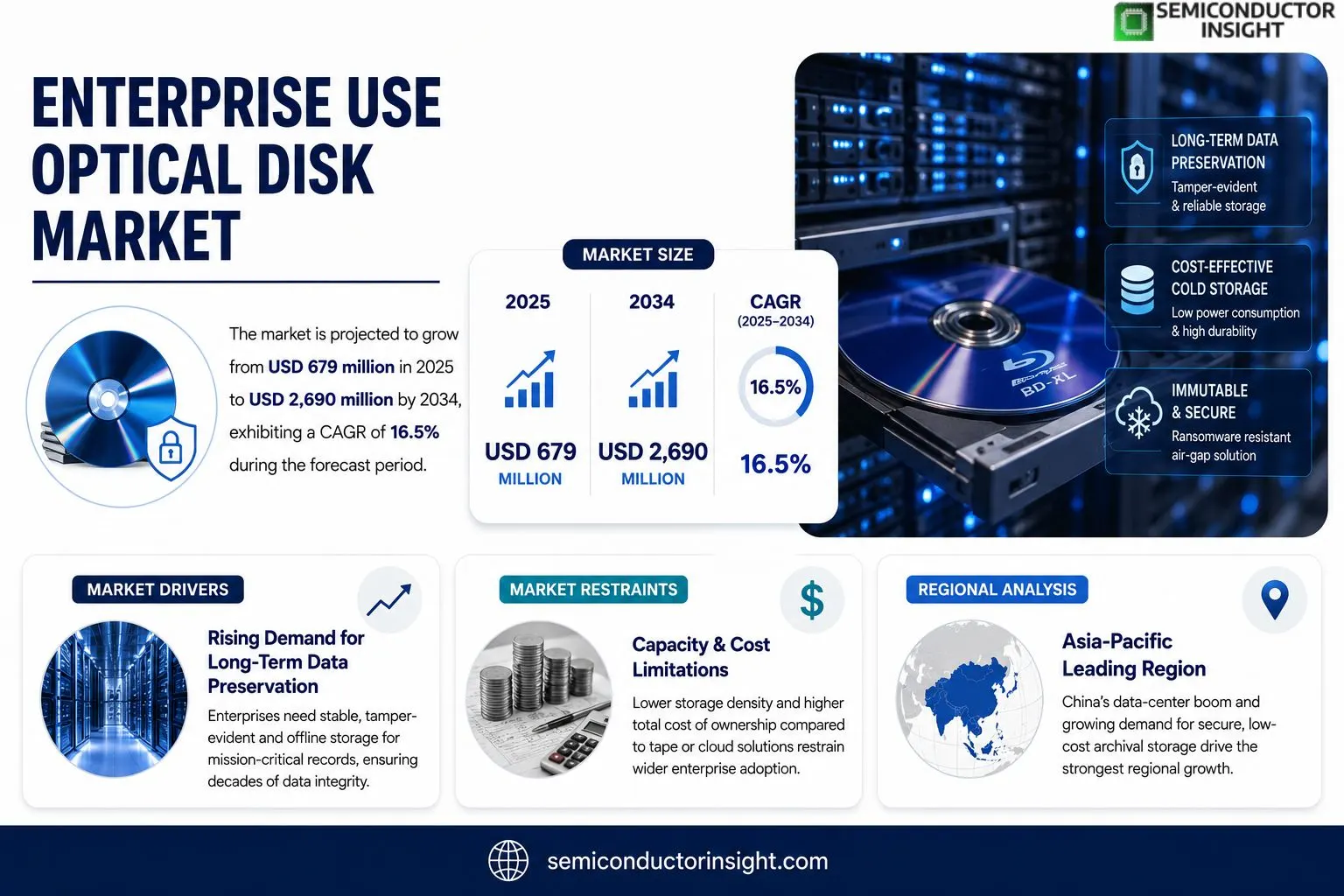
Enterprise Use Optical Disk market size was valued at USD 679 million in 2025. The market is projected to grow from USD 679 million in 2025 to USD 2,690 million by 2034, exhibiting a CAGR of 16.5% during the forecast period.
Enterprise‑use optical disks are removable storage media engineered for high‑capacity, long‑term archival of mission‑critical data within corporate environments. Technologies such as Blu‑ray, Archival Disc (AD) and emerging optical‑magnetic hybrids provide cold‑data retention with low power consumption and resistance to magnetic interference.The upward trajectory is driven by several dynamics: IDC forecasts indicate that China will host the world’s largest data circle by 2025, prompting enterprises to seek cost‑effective cold storage where Blu‑ray offers stability advantages; the shift of “hot” workloads toward faster magnetic media creates demand for optical‑magnetic hybrid solutions that balance performance with longevity; major manufacturersincluding Sony, Fujifilm, Hitachi Maxell and Panasonicare expanding product portfolios and investing in next‑generation disc formats to capture this expanding niche.
MARKET DRIVERS
Data Preservation Requirements
Enterprises continue to rely on optical media for long‑term archiving because the media provides a physically immutable format that resists electromagnetic interference and accidental overwrites. In environments where data must survive decades without revalidation, the stable write‑once nature of optical disks offers a risk‑averse alternative to magnetic tapes.
Regulatory Compliance Pressures
Industries such as finance, healthcare, and aerospace face strict record‑keeping mandates that specify offline, tamper‑evident storage. Optical disks satisfy many of these criteria without requiring expensive encryption appliances, allowing firms to meet audit timelines while keeping operational overhead low.
➤ “The offline nature of optical media reduces the attack surface for ransomware, a factor increasingly weighted in cybersecurity‑centric procurement decisions.”
Finally, the cost per archived terabyte of optical media has narrowed relative to legacy tape solutions, nudging organizations that already own optical drives to extend the lifecycle of their infrastructure rather than undertake wholesale migration.
MARKET CHALLENGES
Cost Competitiveness
Although the unit price of optical disks has fallen, the total cost of ownershipincluding handling, labeling, and periodic verificationoften exceeds that of bulk‑scale tape or cloud‑based cold storage. Decision‑makers must justify the premium by quantifying risk mitigation or compliance benefits, a calculus that is not always transparent.
Other Challenges
Supply Chain Vulnerabilities
Manufacturing capacity for high‑density optical media is concentrated in a limited number of facilities. Recent component shortages have led to longer lead times, compelling enterprises to hold safety stock that inflates inventory costs.
MARKET RESTRAINTS
Capacity Limitations
The maximum sustainable density of current Blu‑ray and archival disc formats hovers around 300 GB per disc, a figure that lags behind evolving data growth curves. For enterprises managing petabytes of structured and unstructured information, the sheer number of discs required for comprehensive backup becomes a logistical restraint, introducing handling complexity and retrieval latency.
MARKET OPPORTUNITIES
Emerging High‑Capacity Formats
Research and development efforts are delivering next‑generation optical solutionssuch as multi‑layer 1 TB Blu‑ray variants and M‑Disc‑grade materialsthat promise longer lifespan and greater data density. Enterprises that adopt these formats early can differentiate their archival strategy, positioning themselves to meet future compliance thresholds without extensive infrastructure overhaul.
Enterprise Use Optical Disk Market Trends
Cold‑Data Archival Migration
Enterprise Use Optical Disk Market recorded revenue of US$ 579 million in 2024 and is on track to surpass US$ 1.68 billion by 2031. The upward trajectory reflects a shift among large‑scale IT operators toward media that can hold massive volumes of static information at low unit cost. Blu‑ray‑based archival discs, with their intrinsic longevity and resistance to magnetic interference, have become the preferred medium for regulatory‑driven record keeping and long‑term research datasets. As organizations convert frequently accessed (“hot”) workloads to slower‑tier storage, they increasingly pair magnetic drives with optical platters, creating a tiered architecture that maximizes cost efficiency while preserving data integrity. This reallocation reshapes procurement cycles, prompting vendors to prioritize capacity‑dense disc formats and to offer bundled migration services that smooth the transition from legacy tape libraries.
Other Trends
Hybrid Optical‑Magnetic Solutions
Hybrid drives combine a magnetic cache for rapid retrieval with an optical backend that secures data for years without power. The model exploits the speed advantage of flash‑assisted magnetic storage for “hot” queries while relegating seldom‑used files to optical layers that remain stable under temperature fluctuations. Early adopters in the financial and defense sectors report a 30 % reduction in total storage spend after integrating such systems, largely because the optical segment eliminates the need for periodic media refreshes. Suppliers are now engineering discs with higher reflectivity to accelerate read cycles, a refinement that narrows the performance gap with pure‑magnetic solutions and widens the appeal of the hybrid approach across midsized enterprises.
Regional Demand Surge in Asia
IDC forecasts position China’s data ecosystem as the world’s largest by 2025, a development that directly fuels the Asian slice of Enterprise Use Optical Disk Market. Manufacturing hubs in Shenzhen and Wuhan have expanded capacity, introducing next‑generation 300 GB archival discs that align with local data‑privacy mandates. The combined effect of regulatory pressure and cost‑sensitive cloud providers accelerates adoption, especially among government agencies tasked with preserving citizen records. Companies that can navigate regional standards and provide localized support are seeing order volumes climb by double‑digit percentages year over year. This geographic momentum signals a restructuring of the competitive landscape, where alliances with Asian distributors become a decisive factor for players seeking sustained growth.
COMPETITIVE LANDSCAPE
Key Industry Players
Enterprise Use Optical Disk Market Competitive Overview
Sony continues to dominate the enterprise‑grade optical storage segment, leveraging its long‑standing Blu‑ray technology and expansive distribution network. The company’s portfolio blends high‑capacity archival discs with integrated drive solutions that cater to data centers seeking cost‑effective cold storage. Sony’s scale enables aggressive pricing while sustaining R&D investment in optical‑magnetic hybrid prototypes, positioning it as the benchmark for performance and reliability in the space. Market structure remains top‑heavy, with Sony capturing a substantial share of both volume and revenue, compelling smaller players to differentiate through niche formats or regional focus.Beyond Sony, a constellation of manufacturers competes on specialization and geographic reach. Fujifilm and Panasonic have intensified their focus on high‑density archival discs for Asian data hubs, where demand for stable, low‑energy storage is rising. Mid‑tier firms such as Hitachi Maxell, RITEK and CMC Magnetics target cost‑sensitive segments, often partnering with system integrators to embed optical drives in hybrid storage appliances. Emerging entrantsincluding Amethystum Storage Tech, Falcon Technologies International, and Taiyo Yudenare experimenting with novel polymer substrates to boost longevity. European and North‑American markets see contributions from Philips and Lenovo, the latter leveraging its enterprise hardware ecosystem to bundle optical drives with server packages. Collectively, these players generate a fragmented yet purposeful competitive landscape, where differentiation hinges on technological innovation, supply‑chain agility, and the ability to serve regulated industries such as medical and defense.
List of Key Enterprise Use Optical Disk Companies Profiled
- Sony
- Fujifilm
- Amethystum Storage Tech
- RITEK
- CMC Magnetics
- Hitachi Maxell
- Showa Denko
- Panasonic
- Taiyo Yuden
- Falcon Technologies International (FTI)
- Philips
- Lenovo
- Tsinghua Unigroup
Segment Analysis:
| Segment Category | Sub-Segments | Key Insights |
| By Type |
|
Archival Disc (AD)
|
| By Application |
|
Medical
|
| By End User |
|
Data Centers
|
| By Technology |
|
Optical‑Magnetic Hybrid
|
| By Storage Requirement |
|
Cold Data
|
Regional Analysis: Enterprise Use Optical Disk Market
North America
Stringent data‑retention mandates in the United States push enterprises toward optical disks, which are recognized for their resistance to electromagnetic interference and long‑term stability, making them a preferred medium for compliance‑bound archives.
Corporate IT budgets in North America allocate a measurable share to redundant storage architectures, and optical media remains a cost‑effective component of multi‑tiered backup strategies, especially when paired with cloud tiering.
A mature supplier base, including both legacy manufacturers and newer specialty firms, provides a diverse catalog of high‑density disks, fostering competitive pricing and rapid innovation cycles in the region.
While solid‑state storage gains traction, many enterprises adopt a hybrid approach; optical disks are retained for cold storage tiers where write‑once‑read‑many (WORM) capability aligns with risk‑averse policies.
Europe
European enterprises exhibit a cautious yet steady affinity for optical disks, driven largely by data‑sovereignty concerns and the EU’s stringent General Data Protection Regulation (GDPR). Companies in Germany and France, for instance, favor physical media to ensure that sensitive records remain insulated from cloud‑based jurisdictional ambiguities. The region’s fragmented market, with varying national standards, encourages vendors to offer customized disk formats that satisfy both local compliance and cross‑border archival needs. As sustainability becomes a corporate priority, optical media’s low‑energy footprint during idle periods is highlighted as an advantage over constantly powered‑on solid‑state arrays.
Asia‑Pacific
In Asia‑Pacific, Enterprise Use Optical Disk Market is still nascent, but growth is fueled by expanding manufacturing hubs that require secure backup of proprietary designs. Japanese firms, renowned for meticulous quality control, retain optical solutions as a safeguard against data loss in high‑value production lines. Meanwhile, emerging economies such as India leverage optical disks for cost‑effective long‑term storage in public sector projects where budget constraints limit cloud adoption. Regional trade agreements are beginning to harmonize standards, allowing multinational corporations to deploy uniform archival policies across the Pacific rim.
South America
South American enterprises, particularly in Brazil and Chile, turn to optical disks as a pragmatic response to intermittent power reliability and limited broadband penetration. Physical media provides a dependable fallback when network‑based backup cannot be guaranteed. Local regulators encourage tangible record‑keeping for financial disclosures, prompting banks to integrate optical archives into their disaster‑recovery playbooks. The market remains price‑sensitive; therefore, suppliers that can deliver high‑capacity disks at competitive rates gain a decisive edge.
Middle East & Africa
The Middle East & Africa region reflects a mixed landscape where oil‑rich economies invest heavily in data preservation for geological surveys, while many African nations prioritize foundational IT infrastructure. In the United Arab Emirates, government ministries mandate optical storage for classified documents, valuing its durability against harsh climatic conditions. Conversely, sub‑Saharan markets rely on optical disks as an affordable alternative to costly cloud subscriptions, especially where connectivity is sporadic. Partnerships between OEMs and regional distributors are beginning to standardize product offerings, laying groundwork for broader enterprise adoption.
Report Scope
This market research report provides a comprehensive analysis of the Enterprise Use Optical Disk Market , covering the forecast period 2026–2034. It offers detailed insights into market dynamics, technological advancements, competitive landscape, and key trends shaping the industry.
Key focus areas of the report include:
- Market Overview: The report begins with an overview outlining its current market scenario, key growth indicators, and industry transformation drivers. It discusses macroeconomic factors, demand–supply balance, regulatory landscape, and the strategic role of semiconductors in powering advancements across industries such as automotive, telecommunications, consumer electronics, and industrial automation.
- Market Size & Forecast: Historical data and future projections for revenue, unit shipments, and market value across major regions and segments.
- Segmentation Analysis: Detailed breakdown by product type, technology, application, and end-user industry to identify high-growth segments and investment opportunities.
- Regional Insights: Insights into market performance across North America, Europe, Asia-Pacific, Latin America, and the Middle East & Africa, including country-level analysis where relevant.
- Competitive Landscape: Profiles of leading market participants, including their product offerings, R&D focus, manufacturing capacity, pricing strategies, and recent developments such as mergers, acquisitions, and partnerships.
- Technology Trends & Innovation: Assessment of emerging technologies, integration of AI/IoT, semiconductor design trends, fabrication techniques, and evolving industry standards.
- Market Drivers & Restraints: Evaluation of factors driving market growth along with challenges, supply chain constraints, regulatory issues, and market-entry barriers.
- Stakeholder Insights: Insights for component suppliers, OEMs, system integrators, investors, and policymakers regarding the evolving ecosystem and strategic opportunities.
Primary and secondary research methods are employed, including interviews with industry experts, data from verified sources, and real-time market intelligence to ensure the accuracy and reliability of the insights presented.
FREQUENTLY ASKED QUESTIONS:
What is the current market size of Enterprise Use Optical Disk Market?
-> Enterprise Use Optical Disk Market was valued at USD 579 million in 2024 and is expected to reach USD 1,685 million by 2031, growing at a CAGR of 16.9% during the forecast period.
Which key companies operate in Enterprise Use Optical Disk Market?
-> Key players include Sony, Fujifilm, Amethystum Storage Tech, RITEK, CMC Magnetics, Hitachi Maxell, Showa Denko, Panasonic, Taiyo Yuden Co, Falcon Technologies International (FTI), Philips, Lenovo, and Tsinghua Unigroup.
What are the key growth drivers?
-> Key growth drivers include rising demand for low‑cost, long‑term cold data storage, the superior stability of Blu‑ray archival discs, the emergence of optical‑magnetic hybrid storage solutions, and the rapid expansion of data centre capacity in China.
Which region dominates the market?
-> Asia is the dominant region, driven by China’s data‑center boom, which is projected to become the world’s largest data circle by 2025.
What are the emerging trends?
-> Emerging trends include optical‑magnetic hybrid storage, increased adoption of Blu‑ray for archival cold‑storage, and the growth of large‑scale data‑center ecosystems in the Asia‑Pacific region.

Get Sample Report PDF for Exclusive Insights
Report Sample Includes
- Table of Contents
- List of Tables & Figures
- Charts, Research Methodology, and more...
 Download Sample Report PDF