Endoscopic CMOS Image Sensor (<2mm) Market Insights
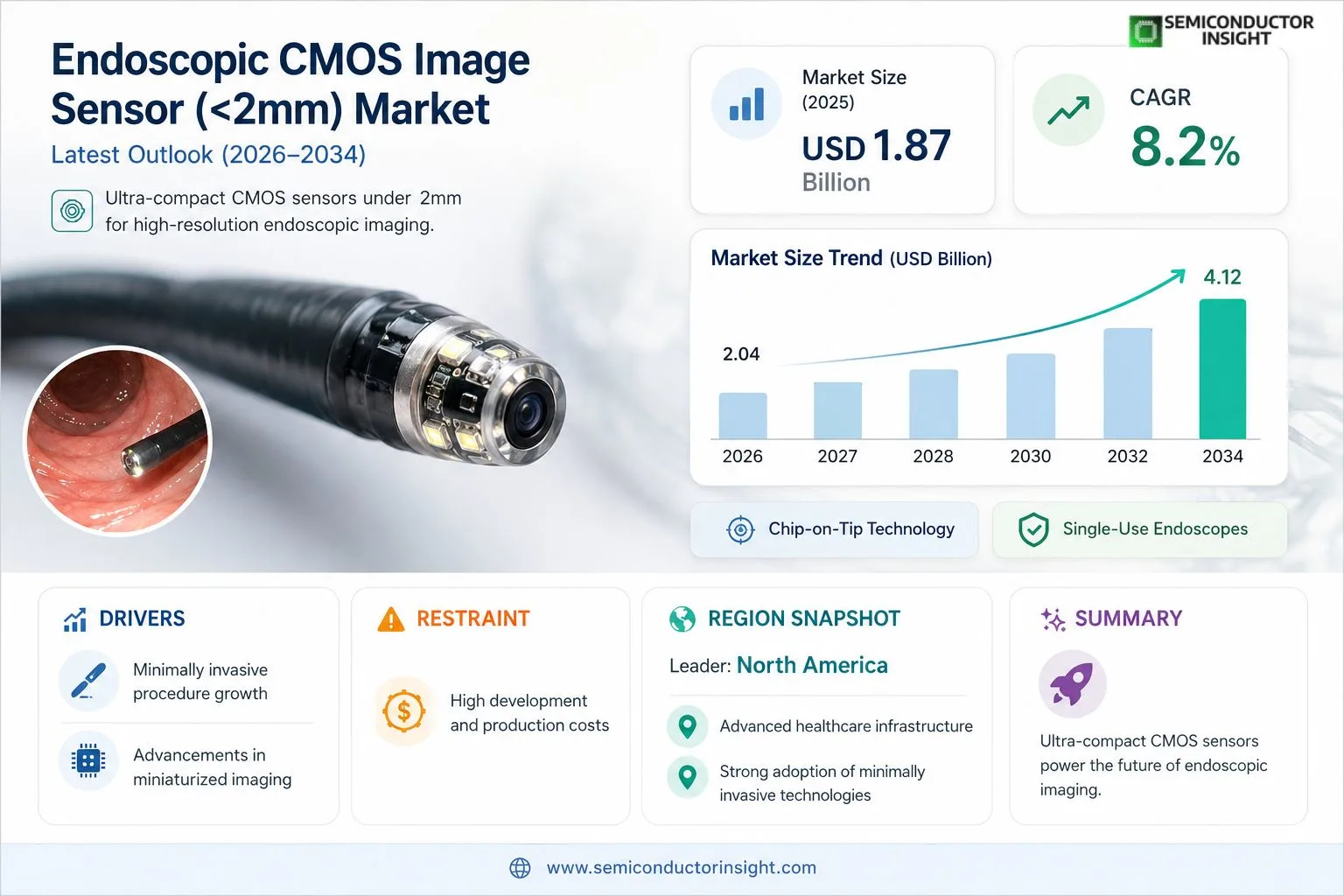
Global endoscopic CMOS image sensor (<2mm) market size was valued at USD 1.87 billion in 2025. The market is projected to grow from USD 2.04 billion in 2026 to USD 4.12 billion by 2034, exhibiting a CAGR of 8.2% during the forecast period.
Endoscopic CMOS image sensors with a diameter of less than 2mm are highly miniaturized semiconductor imaging devices engineered specifically for use in minimally invasive medical endoscopes and capsule endoscopy systems. These sensors leverage complementary metal-oxide-semiconductor (CMOS) technology to deliver high-resolution imaging, low power consumption, and compact form factors, making them indispensable in diagnostic and therapeutic endoscopic procedures across gastrointestinal, urological, and ENT applications.
The market is witnessing robust expansion driven by the rising global prevalence of gastrointestinal disorders, growing preference for minimally invasive surgical procedures, and continued advancements in chip-on-tip sensor technology. Furthermore, increasing healthcare infrastructure investment across emerging economies and the accelerating adoption of single-use flexible endoscopes are reinforcing demand for sub-2mm CMOS imaging solutions. Key industry participants such as Sony Semiconductor Solutions Corporation, OmniVision Technologies, and Olympus Corporation maintain significant market presence through diversified and technologically advanced product portfolios.
MARKET DRIVERS
Rising Demand for Minimally Invasive Diagnostic Procedures
Global endoscopic CMOS image sensor (≤2mm) market is experiencing significant growth momentum, driven primarily by the accelerating shift toward minimally invasive diagnostic and therapeutic procedures across gastroenterology, pulmonology, and urology. Clinicians and healthcare institutions are increasingly prioritizing patient-friendly approaches that reduce recovery time, lower procedural risks, and improve diagnostic accuracy. Ultra-compact CMOS image sensors with diameters at or below 2mm are enabling a new generation of single-use and reusable endoscopes that deliver high-resolution imaging in anatomically constrained spaces, fundamentally expanding the clinical utility of endoscopic examination beyond traditional indications.
Technological Advancements in Miniaturized Imaging and Sensor Integration
Continuous innovation in semiconductor fabrication and back-side illumination (BSI) CMOS technology is a core driver enabling manufacturers to achieve higher pixel density, improved low-light sensitivity, and reduced power consumption within sub-2mm form factors. Integration of on-chip signal processing, advanced noise reduction algorithms, and wider dynamic range capabilities has elevated image quality to levels that rival traditional rigid endoscopy systems. These developments are making capsule endoscopy, bronchoscopy, ureteroscopy, and neurovascular endoscopy increasingly viable in clinical settings that were previously underserved by conventional imaging tools. Investments in wafer-level packaging and chip-on-tip (CoT) architectures are further accelerating product miniaturization across leading sensor manufacturers.
➤ The adoption of chip-on-tip CMOS technology in disposable endoscopes has been identified as one of the most transformative developments in endoscopic imaging, enabling clinicians to obtain real-time, high-definition visuals through working channels previously too narrow for conventional camera systems.
The growing prevalence of gastrointestinal disorders, colorectal cancer, and respiratory diseases globally is generating sustained procedural volume that directly supports demand for advanced endoscopic imaging components. Healthcare systems in both developed and emerging economies are expanding endoscopy infrastructure, creating a durable and broad-based demand environment for high-performance endoscopic CMOS image sensors at or below the 2mm threshold. The parallel expansion of outpatient and ambulatory surgical centers is further amplifying procurement of compact, cost-effective endoscopic equipment embedded with next-generation imaging sensors.
MARKET CHALLENGES
Complexity of Manufacturing Ultra-Compact CMOS Sensors for Medical-Grade Applications
One of the most significant challenges confronting the endoscopic CMOS image sensor (≤2mm) market is the exceptional difficulty of manufacturing sensors at sub-2mm dimensions that simultaneously meet stringent medical-grade performance, sterilization compatibility, and regulatory compliance requirements. Achieving consistent yield rates in wafer-level and chip-scale packaging processes at this size range demands highly specialized fabrication infrastructure and process control. Any variation in pixel uniformity, thermal noise, or signal integrity at this miniaturized scale can materially compromise diagnostic image quality, making quality assurance a persistent and costly operational challenge for sensor manufacturers operating in this space.
Other Challenges
Regulatory and Biocompatibility Compliance Burden
Medical device regulations in key markets including the United States, European Union, Japan, and China impose rigorous pre-market approval and quality system requirements on endoscopic imaging components. Demonstrating biocompatibility of sensor materials, hermetic sealing integrity, and electromagnetic compatibility under IEC and ISO standards imposes substantial time and financial burdens on manufacturers, particularly smaller and mid-tier players. Navigating the overlap between semiconductor industry standards and medical device regulatory frameworks adds a layer of compliance complexity that can delay product commercialization cycles and increase development costs significantly.
Thermal Management in Confined Anatomical Environments
Operating CMOS image sensors within the human body in narrow-bore endoscopic devices introduces thermal management challenges that are technically difficult to resolve at sub-2mm dimensions. Heat dissipation within sealed, non-ventilated endoscope tips must remain within safe tissue-contact temperature limits mandated by safety standards, requiring careful co-design of sensor power consumption, drive circuitry, and thermal interface materials. Balancing high frame rates and resolution with acceptable power budgets in this constrained environment remains an active engineering challenge across the industry.
MARKET RESTRAINTS
High Development Costs and Capital-Intensive Production Infrastructure
The development and commercialization of endoscopic CMOS image sensors at or below 2mm diameters require substantial capital investment in specialized semiconductor fabrication equipment, cleanroom facilities, and advanced packaging technologies. These high fixed and variable cost structures create meaningful barriers to entry and can constrain margin profiles for established suppliers, particularly in the face of pricing pressure from healthcare procurement organizations seeking cost reductions in endoscopic device components. The capital intensity of wafer-level optics integration, chip-on-tip assembly, and medical-grade testing limits the number of suppliers capable of competing at the leading edge of miniaturization, potentially creating supply concentration risks that procurement teams and OEM device manufacturers must actively manage.
Limited Reimbursement Frameworks for Advanced Endoscopic Technologies in Emerging Markets
In many high-growth emerging economies, reimbursement frameworks for advanced endoscopic procedures utilizing next-generation imaging systems remain underdeveloped or inconsistently applied, limiting the effective demand for premium endoscopic CMOS image sensor-equipped devices. Hospitals and clinics in these markets often face budget constraints that incentivize the procurement of lower-cost conventional endoscopy equipment rather than devices incorporating cutting-edge sub-2mm CMOS sensor technology. Until payer systems and government health programs in these regions formally recognize and reimburse the clinical value delivered by advanced miniaturized endoscopic imaging, market penetration in emerging economies will remain constrained relative to the underlying epidemiological need for endoscopic diagnostics.
MARKET OPPORTUNITIES
Expansion of Single-Use Endoscope Platforms Embedding Sub-2mm CMOS Sensors
Global transition toward single-use, disposable endoscope platforms represents one of the most strategically significant growth opportunities for the endoscopic CMOS image sensor (≤2mm) market. Infection control imperatives, cross-contamination risks associated with reusable endoscope reprocessing failures, and evolving hospital policies are accelerating adoption of disposable endoscopic devices across bronchoscopy, ureteroscopy, and gastrointestinal applications. Single-use endoscopes require cost-optimized, high-volume CMOS sensor supply chains at sub-2mm dimensions, creating large and durable procurement opportunities for sensor manufacturers who can demonstrate scalable production, consistent quality, and competitive unit economics for OEM device partners developing next-generation disposable platforms.
Integration with AI-Assisted Image Analysis and Robotic Endoscopy Systems
The convergence of miniaturized endoscopic CMOS imaging with artificial intelligence-driven diagnostic software and robotic-assisted endoscopy platforms creates compelling downstream opportunities for sensor technology providers. High-resolution, high-frame-rate image data generated by advanced sub-2mm CMOS sensors serves as the foundational input for AI algorithms targeting real-time polyp detection, lesion characterization, and procedural guidance in gastrointestinal and pulmonary endoscopy. As robotic endoscopy systems advance toward autonomous and semi-autonomous procedural capabilities, the performance specifications of the embedded CMOS image sensor become increasingly critical to system-level outcomes, positioning leading sensor manufacturers as strategic technology partners for robotic surgery and AI diagnostics companies seeking differentiation through superior imaging quality at the point of care.
Growth in Neurovascular and Pediatric Endoscopy Applications
Emerging clinical applications in neurovascular endoscopy, pediatric bronchoscopy, and trans-nasal esophagoscopy represent underpenetrated segments where the sub-2mm endoscopic CMOS image sensor form factor offers distinct functional advantages over larger conventional imaging systems. Pediatric patients and anatomically challenging adult cases demand instruments with the smallest possible outer diameters without sacrificing image quality, placing a premium on advanced CMOS sensor technology at the leading edge of miniaturization. Increased research investment in neurovascular interventional procedures and growing clinical awareness of trans-nasal diagnostic techniques are expanding the total addressable market for ultra-compact endoscopic imaging sensors beyond the historically dominant gastroenterology and pulmonology segments, providing manufacturers with diversified revenue opportunities across a broader spectrum of specialty medical disciplines.
Endoscopic CMOS Image Sensor (<2mm) Market Trends
Rising Adoption of Minimally Invasive Procedures Driving Demand
Endoscopic CMOS image sensor (<2mm) Market is experiencing significant momentum as healthcare providers worldwide increasingly prioritize minimally invasive diagnostic and therapeutic procedures. The growing global prevalence of gastrointestinal disorders has emerged as a primary catalyst, compelling medical device manufacturers to accelerate the development of highly miniaturized, high-resolution imaging solutions. Sub-2mm CMOS sensors are now integral to next-generation flexible endoscopes and capsule endoscopy systems, enabling clinicians to perform precise diagnostics with reduced patient discomfort and shorter recovery times.
Other Trends
Advancements in Chip-on-Tip Sensor Technology
One of the most transformative trends reshaping Endoscopic CMOS image sensor (<2mm) Market is the rapid progression of chip-on-tip technology. By integrating the image sensor directly at the distal tip of the endoscope, manufacturers achieve superior image clarity, reduced signal interference, and enhanced maneuverability within narrow anatomical pathways. These innovations are particularly impactful in urological and ENT applications, where anatomical constraints demand the most compact imaging architectures available.
Accelerating Shift Toward Single-Use Flexible Endoscopes
The increasing adoption of single-use flexible endoscopes represents a defining structural shift in Endoscopic CMOS image sensor (<2mm) Market. Driven by heightened infection control standards and cost-efficiency goals across healthcare facilities, disposable endoscope platforms rely heavily on advanced sub-2mm CMOS imaging components to deliver clinical-grade performance in a cost-optimized form factor. This trend is reinforcing consistent demand for high-volume production of miniaturized CMOS sensors globally.
Expanding Healthcare Infrastructure in Emerging Economies
Increased healthcare infrastructure investment across emerging economies in Asia-Pacific, Latin America, and the Middle East is broadening the addressable base for Endoscopic CMOS image sensor (<2mm) Market. As hospital networks modernize and endoscopy adoption expands beyond tertiary care centers, demand for affordable yet high-performance sub-2mm CMOS imaging solutions is steadily rising. Key market participants, including Sony Semiconductor Solutions Corporation, OmniVision Technologies, and Olympus Corporation, are actively aligning their product strategies to serve these high-growth regional markets.
Low Power Consumption and High-Resolution Imaging as Competitive Differentiators
As competition intensifies within Endoscopic CMOS image sensor (<2mm) Market, low power consumption and high-resolution output have become critical performance benchmarks. CMOS technology’s inherent advantage over legacy CCD sensors in terms of energy efficiency directly supports the operational requirements of battery-powered capsule endoscopy systems and portable diagnostic platforms. Manufacturers investing in pixel-level optimization and noise reduction architectures are well-positioned to capture growing clinical demand across gastrointestinal, urological, and ENT specialties.
COMPETITIVE LANDSCAPE
Key Industry Players
Endoscopic CMOS Image Sensor (<2mm) Market: Competitive Dynamics and Leading Innovators Shaping the Future of Minimally Invasive Imaging
Global endoscopic CMOS image sensor (<2mm) market is characterized by intense competition among a mix of established semiconductor giants, specialized medical imaging firms, and vertically integrated endoscope manufacturers. Sony Semiconductor Solutions Corporation holds a prominent position in this space, leveraging its deep expertise in CMOS sensor fabrication and chip-on-tip technology to supply high-resolution, ultra-compact imaging solutions to leading OEM endoscope developers. OmniVision Technologies is another dominant force, offering purpose-built sub-2mm medical-grade CMOS sensors widely adopted across capsule endoscopy and single-use flexible endoscope platforms. Olympus Corporation, as both an endoscope manufacturer and imaging technology developer, maintains a vertically integrated competitive advantage, enabling it to optimize sensor-to-system performance across its gastrointestinal, urological, and ENT product lines. The competitive environment is further shaped by aggressive R&D investment, strategic partnerships with hospital networks, and a growing emphasis on single-use endoscope compatibility as infection control concerns continue to reshape procurement decisions globally.
Beyond the leading players, the market features several technologically specialized companies making notable inroads. SmartSens Technology and Gpixel Inc. have emerged as significant contributors to the medical-grade CMOS sensor segment, with competitive offerings in ultra-low-power, high-sensitivity imaging arrays suited to sub-2mm form factors. Hamamatsu Photonics brings its photonic device expertise to bear in niche endoscopic and diagnostic imaging applications, while ON Semiconductor (onsemi) supplies imaging solutions that meet the stringent performance and biocompatibility requirements of minimally invasive medical devices. KARL STORZ SE & Co. KG and Richard Wolf GmbH, both established endoscopy system manufacturers, maintain in-house or closely partnered sensor development capabilities that support differentiated product positioning. Additionally, Forza Silicon and Pixelplus Co., Ltd. serve as specialized fabless design houses contributing to the expanding supplier ecosystem, while companies such as STMicroelectronics and Teledyne Technologies continue to broaden their medical imaging sensor portfolios to capture emerging opportunities in diagnostic endoscopy across Asia-Pacific and North American markets.
List of Key Endoscopic CMOS Image Sensor (<2mm) Companies Profiled
- Sony Semiconductor Solutions Corporation
- OmniVision Technologies
- Olympus Corporation
- SmartSens Technology
- Gpixel Inc.
- Hamamatsu Photonics K.K.
- ON Semiconductor (onsemi)
- KARL STORZ SE & Co. KG
- Richard Wolf GmbH
- Forza Silicon Corporation
- Pixelplus Co., Ltd.
- STMicroelectronics
- Teledyne Technologies Incorporated
- Stryker Corporation
- Medtronic plc
Segment Analysis:
| Segment Category | Sub-Segments | Key Insights |
| By Type |
|
Chip-on-Tip CMOS Sensors represent the leading segment within the type classification, driven by their superior image quality and direct integration at the distal end of the endoscope.
|
| By Application |
|
Gastrointestinal Endoscopy dominates the application landscape, underpinned by the escalating global burden of gastrointestinal disorders including colorectal cancer, Crohn’s disease, and gastric ulcers.
|
| By End User |
|
Hospitals and Surgical Centers constitute the primary end-user segment, owing to their comprehensive procedural capabilities and high patient throughput across both diagnostic and therapeutic endoscopic disciplines.
|
| By Technology |
|
Back-Side Illuminated (BSI) CMOS technology leads this segment by delivering markedly enhanced light sensitivity and improved image quality under the challenging low-light conditions inherent to endoscopic cavity imaging.
|
| By Device Type |
|
Single-Use Disposable Endoscopes represent the fastest-growing device type segment, propelled by heightened infection control standards and increasing institutional awareness of cross-contamination risks associated with reusable endoscope reprocessing.
|
Regional Analysis: Endoscopic CMOS Image Sensor (≤2mm) Market
North America
North America hosts a concentration of semiconductor and medical imaging pioneers actively advancing CMOS miniaturization below the 2mm threshold. Collaborative research between academic medical centers and private technology firms continues to yield next-generation sensor architectures, placing the region at the forefront of endoscopic imaging capability, particularly in applications such as capsule endoscopy and robotic-assisted laparoscopy.
The FDA’s well-defined approval pathways for Class II and Class III medical imaging devices provide manufacturers with a structured route to market entry. Favorable reimbursement policies from public and private insurers for minimally invasive procedures create a compelling economic environment that encourages hospitals and outpatient centers to upgrade their endoscopic imaging platforms with advanced CMOS-based solutions.
Gastroenterology, urology, and pulmonology departments across major U.S. hospital systems are rapidly integrating ultra-small CMOS image sensors into single-use and reusable flexible endoscopes. Growing patient preference for minimally invasive diagnostics and therapeutic interventions is a strong demand catalyst, with outpatient surgical centers also emerging as a key end-user segment alongside tertiary care hospitals.
North American market players are actively pursuing mergers, acquisitions, and strategic alliances to broaden their endoscopic CMOS sensor portfolios. Venture capital interest in micro-imaging startups remains robust, while established corporations are channeling resources into dedicated R&D centers focused on sub-2mm sensor design, signal processing optimization, and integration with AI-driven image enhancement platforms.
Europe
Europe represents the second most significant regional market for endoscopic CMOS image sensors sized at or below 2mm, supported by a mature healthcare system, strong emphasis on early disease detection, and progressive adoption of minimally invasive surgical protocols across key economies including Germany, France, the United Kingdom, and the Netherlands. The region benefits from coordinated regulatory oversight through the European Medicines Agency and the Medical Device Regulation (MDR) framework, which, while rigorous, ultimately promotes the commercialization of high-quality endoscopic imaging products. European healthcare providers place considerable value on precision diagnostics, creating fertile ground for ultra-miniaturized CMOS sensor adoption in gastrointestinal, gynecological, and ENT endoscopy. A growing aging population across Western Europe further amplifies demand for non-invasive screening solutions. Additionally, EU-funded research programs and collaborative pan-European medical technology initiatives are catalyzing innovation in sensor miniaturization, positioning the region as a notable contributor to global endoscopic imaging advancement through 2034.
Asia-Pacific
Asia-Pacific is emerging as one of the fastest-growing regions in the endoscopic CMOS image sensor (≤2mm) market, driven by rapidly expanding healthcare infrastructure, rising medical tourism, and increasing awareness of preventive endoscopic screenings across countries such as China, Japan, South Korea, and India. Japan’s historically strong medical device manufacturing base gives it a distinctive edge in developing high-precision miniaturized imaging components, while China’s aggressive investment in domestic healthcare modernization is accelerating procurement of advanced endoscopic systems. South Korea continues to demonstrate strong innovation in semiconductor fabrication, directly supporting the development of compact CMOS sensors for medical applications. Government-led universal healthcare expansions in several Asia-Pacific nations are broadening patient access to endoscopic procedures. The region’s cost-competitive manufacturing environment also attracts global device companies to establish regional production and R&D hubs, further intensifying market competition and technological development.
South America
South America occupies a developing position within Global endoscopic CMOS image sensor market, with Brazil and Argentina serving as the primary growth engines. The region is characterized by a gradually improving healthcare infrastructure and increasing investments by both public health authorities and private hospital groups in modern endoscopic equipment. Rising incidences of gastrointestinal conditions across the region are creating growing clinical demand for advanced diagnostic imaging tools, including ultra-small CMOS-based endoscopes. However, the market faces notable challenges including economic volatility, inconsistent healthcare spending, and limited access to cutting-edge technologies in rural and underserved areas. Import dependency for sophisticated medical imaging components further constrains market penetration. Despite these headwinds, urbanization trends and an expanding middle class with greater healthcare awareness are expected to progressively improve market receptivity to endoscopic CMOS image sensor technologies throughout the forecast period.
Middle East & Africa
The Middle East and Africa region represents an nascent but progressively evolving market for endoscopic CMOS image sensors, with growth prospects concentrated in Gulf Cooperation Council (GCC) countries such as the United Arab Emirates, Saudi Arabia, and Qatar, where healthcare modernization programs are being implemented with substantial government backing. These nations are actively investing in state-of-the-art medical facilities and importing advanced minimally invasive surgical technologies, creating select opportunities for endoscopic CMOS sensor suppliers. In contrast, Sub-Saharan Africa and parts of North Africa face significant structural barriers including limited specialist physician availability, inadequate healthcare funding, and insufficient technical infrastructure for deploying complex endoscopic imaging systems. Nevertheless, international development partnerships and growing medical tourism ecosystems in hub cities across the region are expected to gradually elevate market awareness and adoption of advanced endoscopic imaging solutions, supporting long-term market development trajectories extending to 2034.
Report Scope
This market research report provides a comprehensive analysis of the Endoscopic CMOS Image Sensor (<2mm) Market , covering the forecast period 2026–2034. It offers detailed insights into market dynamics, technological advancements, competitive landscape, and key trends shaping the industry.
Key focus areas of the report include:
- Market Overview: The report begins with an overview outlining its current market scenario, key growth indicators, and industry transformation drivers. It discusses macroeconomic factors, demand–supply balance, regulatory landscape, and the strategic role of semiconductors in powering advancements across industries such as automotive, telecommunications, consumer electronics, and industrial automation.
- Market Size & Forecast: Historical data and future projections for revenue, unit shipments, and market value across major regions and segments.
- Segmentation Analysis: Detailed breakdown by product type, technology, application, and end-user industry to identify high-growth segments and investment opportunities.
- Regional Insights: Insights into market performance across North America, Europe, Asia-Pacific, Latin America, and the Middle East & Africa, including country-level analysis where relevant.
- Competitive Landscape: Profiles of leading market participants, including their product offerings, R&D focus, manufacturing capacity, pricing strategies, and recent developments such as mergers, acquisitions, and partnerships.
- Technology Trends & Innovation: Assessment of emerging technologies, integration of AI/IoT, semiconductor design trends, fabrication techniques, and evolving industry standards.
- Market Drivers & Restraints: Evaluation of factors driving market growth along with challenges, supply chain constraints, regulatory issues, and market-entry barriers.
- Stakeholder Insights: Insights for component suppliers, OEMs, system integrators, investors, and policymakers regarding the evolving ecosystem and strategic opportunities.
Primary and secondary research methods are employed, including interviews with industry experts, data from verified sources, and real-time market intelligence to ensure the accuracy and reliability of the insights presented.
FREQUENTLY ASKED QUESTIONS:
What is the current market size of Endoscopic CMOS Image Sensor (<2mm) Market?
-> Global Endoscopic CMOS Image Sensor (<2mm) Market size was valued at USD 1.87 billion in 2025 and is expected to reach USD 4.12 billion by 2034, growing at a CAGR of 8.2% during the forecast period 2026–2034.
Which key companies operate in Endoscopic CMOS Image Sensor (<2mm) Market?
-> Key players include Sony Semiconductor Solutions Corporation, OmniVision Technologies, and Olympus Corporation, among others, maintaining significant market presence through diversified and technologically advanced product portfolios.
What are the key growth drivers?
-> Key growth drivers include rising global prevalence of gastrointestinal disorders, growing preference for minimally invasive surgical procedures, advancements in chip-on-tip sensor technology, increasing healthcare infrastructure investment across emerging economies, and accelerating adoption of single-use flexible endoscopes.
Which region dominates the market?
-> Asia-Pacific is the fastest-growing region, driven by increasing healthcare infrastructure investment across emerging economies, while North America remains a significant market due to advanced medical technology adoption.
What are the emerging trends?
-> Emerging trends include chip-on-tip sensor technology advancements, single-use flexible endoscopes, high-resolution CMOS imaging, low power consumption innovations, and expanding applications across gastrointestinal, urological, and ENT endoscopic procedures.

Get Sample Report PDF for Exclusive Insights
Report Sample Includes
- Table of Contents
- List of Tables & Figures
- Charts, Research Methodology, and more...
 Download Sample Report PDF