SEMICONDUCTOR INSIGHT
MARKET RESEARCH REPORT

Embedded Development Kit Market

2026 to 2034
MARKET INTELLIGENCE
ACROSS KEY REGIONS
2026 EDITION
EMBEDDED SYSTEMS Semiconductor Market Research

Embedded Development Kit Market

Size, Emerging Trends, Technological Advancements, and Business Strategies 2026-2034

◷
UPDATED 11 September 2026
▤
REPORT LENGTH Detailed Report
▣
REPORT CODE ccfa4f71252a
▯
FORMATS PDF

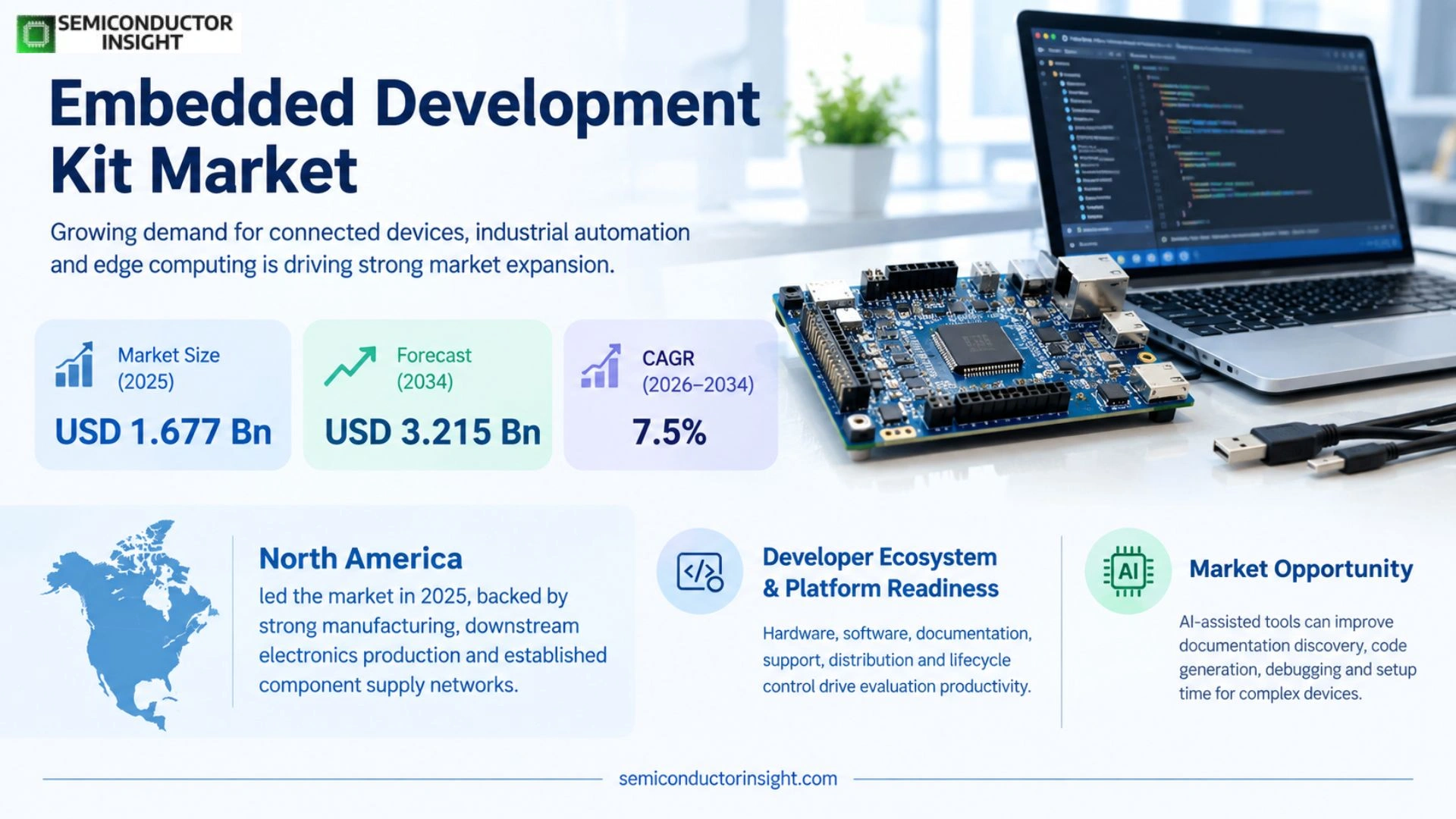
Embedded Development Kit Market was valued at USD 1.677 billion in 2025 and is projected to reach USD 3.215 billion by 2034, growing at a CAGR of 7.5% during 2026–2034. North America held the largest regional position in 2025, supported by concentrated manufacturing, downstream electronics production and established component supply networks.

Get the sample PDF with study scope, segmentation and methodology details.

Key Statistics

2025 Market Size
USD 1.677 billion
2034 Projected Size
USD 3.215 billion
CAGR (2026–2034)
7.5%
Largest Market in 2025
North America

Key Takeaways

  • The Embedded Development Kit Market was valued at USD 1.677 billion in the 2025 base year and is projected to reach USD 3.215 billion by 2034, expanding at a 7.5% CAGR during 2026–2034.
  • MCU development boards lead the type mix because microcontrollers address connected products, controls, appliances, vehicles, medical equipment, industrial systems, and education at broad price points.
  • IoT is the principal growth application, supported by integrated wireless connectivity, cloud onboarding, security provisioning, energy profiling, maintained protocol stacks, and production-ready reference designs.
  • North America leads through semiconductor vendors, embedded-software talent, cloud platforms, universities, startups, defense, aerospace, automotive, industrial, and medical-device engineering.
  • Developer experience determines design-in conversion. Board availability attracts evaluation, but reliable SDKs, examples, debuggers, documentation, lifecycle support, and a clear route to production secure recurring value.

Embedded Development Kit Market Overview

Embedded Development Kit Market was valued at USD 1.677 billion in 2025 and is projected to reach USD 3.215 billion by 2034, growing at a CAGR of 7.5% during 2026–2034. North America held the largest regional position in 2025, supported by concentrated manufacturing, downstream electronics production and established component supply networks.

Base year: 2025 · Estimated year: 2026 · Forecast year: 2034 · Historical data: 2021–2025 · Values in USD; volumes reported where disclosed

Embedded development kits combine a processor or programmable device with power management, interfaces, memories, sensors, debugging hardware, documentation, examples, and software so engineers can evaluate silicon and build prototypes before committing to a custom board. The category includes microcontroller, FPGA, DSP, Arm, MIPS, and PowerPC platforms. Commercial value therefore extends beyond the board to toolchains, reference designs, middleware, technical support, and the developer community surrounding each architecture.

The market enters the 2026 estimated year with expanding demand for accessible evaluation hardware, production-grade software, and connected reference designs. Growth through 2034 will be supported by wider embedded intelligence across industrial equipment, vehicles, medical devices, consumer products, and educational platforms. Revenue opportunities will increasingly favor suppliers that combine capable silicon with dependable tools, security support, long product lifecycles, and a practical migration route from prototype to volume production.

Demand is shifting toward kits that shorten work on connected, secure, low-power, and AI-enabled products. Buyers assess processor performance, memory, wireless protocols, sensor and camera interfaces, real-time operating-system support, security provisioning, compiler quality, debugger stability, example coverage, lifecycle policy, and inventory availability. A low board price can encourage trials, but design-in conversion depends on whether engineers can move quickly from demonstration code to a qualified production architecture.

Segment Analysis: By Type

By type, the Embedded Development Kit market is segmented into MCU Development Boards · CPLD/FPGA Development Boards · DSP Development Boards · ARM Development Boards · MIPS Development Boards · PPC Development Boards. Each category represents a different degree of integration, qualification burden and value capture, so suppliers compete through a combination of material performance, design support, manufacturing consistency, package architecture and application-specific testing rather than through unit price alone. Procurement also reflects lifecycle support, interoperability, compliance evidence, warranty exposure, and the cost of unsuccessful qualification.

Type Market relevance
MCU Development Boards Distinct performance, condition, integration, and qualification requirements shape demand and supplier positioning.
CPLD/FPGA Development Boards Distinct performance, condition, integration, and qualification requirements shape demand and supplier positioning.
DSP Development Boards Distinct performance, condition, integration, and qualification requirements shape demand and supplier positioning.
ARM Development Boards Distinct performance, condition, integration, and qualification requirements shape demand and supplier positioning.
MIPS Development Boards Distinct performance, condition, integration, and qualification requirements shape demand and supplier positioning.
PPC Development Boards Distinct performance, condition, integration, and qualification requirements shape demand and supplier positioning.

Segment Analysis: By Application

By application, the market covers 3C Products · Automotive · Internet of Things · Medical Equipment · Defense & Aerospace · Other Applications. Demand varies by production volume and qualification intensity: consumer programmes reward scale and miniaturisation, while automotive, industrial, aerospace, medical or security designs place greater weight on reliability evidence, long product availability and system-level performance under demanding operating conditions. Channel design, documentation, service coverage, and total ownership economics further determine which application converts technical interest into repeat purchasing.

Application Market relevance
3C Products Purchasing criteria reflect use-case economics, technical requirements, warranty expectations, and channel support.
Automotive Purchasing criteria reflect use-case economics, technical requirements, warranty expectations, and channel support.
Internet of Things Purchasing criteria reflect use-case economics, technical requirements, warranty expectations, and channel support.
Medical Equipment Purchasing criteria reflect use-case economics, technical requirements, warranty expectations, and channel support.
Defense & Aerospace Purchasing criteria reflect use-case economics, technical requirements, warranty expectations, and channel support.
Other Applications Purchasing criteria reflect use-case economics, technical requirements, warranty expectations, and channel support.

Embedded Development Kit Market Outlook

Regional Analysis

North America is the largest regional market for Embedded Development Kit products, combining an established component-production ecosystem with major downstream customers. North America and Europe are strategically important for premium, automotive, aerospace, industrial and specialised applications, while South America and Middle East & Africa are primarily import- and project-led markets where distributor reach, local support and supply continuity shape vendor selection.

How does regional demand differ across this market?

For Embedded Development Kit, North America holds the largest position, supported by an established customer base, supplier presence, and mature purchasing channels. Europe contributes regulation, industrial demand, and technical expertise, while Asia Pacific combines electronics manufacturing, large device populations, and expanding engineering capability. South America and the Middle East and Africa develop through targeted infrastructure, enterprise, research, consumer, or public-sector programs rather than uniform adoption.

Region Position
North America Largest and most established demand base
Europe Developing demand shaped by local applications, channels, and qualification conditions
Asia Pacific Developing demand shaped by local applications, channels, and qualification conditions
South America Developing demand shaped by local applications, channels, and qualification conditions
Middle East & Africa Developing demand shaped by local applications, channels, and qualification conditions
North America LARGEST & FASTEST-GROWING

Why is North America strategically important?

North America demand for Embedded Development Kit reflects its mix of research, industrial, consumer, enterprise, infrastructure, and technology investment. Commercial outcomes depend on local procurement, technical or quality qualification, channel trust, service coverage, and total ownership economics. The region is assessed separately because adoption conditions and routes to market differ materially across countries, even when the underlying product or measurement need is similar.

Market positionLargest region
Growth outlookAbove market average
Demand profileProduction and demand hub
Market access gateScale and local qualification
Indicator Assessment
Demand base Application- and program-led
Supplier access Direct sales, partners, distributors, or marketplaces
Decision criteria Performance, quality, compliance, price, and support

Market instances

  • Official and industry evidence for North America shows that adoption is tied to documented performance, repair or measurement capability, and dependable after-sales support. The report therefore evaluates concrete programs, regulatory signals, supplier activity, channel maturity, and customer requirements rather than treating population or headline technology spending as a direct proxy for market revenue. Source Source
  • 2025–2026 commercial signal. North America demand is governed by the same application and qualification conditions described above, but purchasing decisions are made through local OEM programmes, distributors and technical approvals. Suppliers that document electrical performance, reliability and continuity of supply can convert a regional deployment into repeat orders; vendors relying only on headline pricing face a slower qualification path.
  • 2026–2034 execution issue. Growth in North America will depend on whether suppliers align manufacturing, field engineering and inventory with the region’s downstream customers. The practical opportunity is not uniform across every country: it concentrates where device assembly, telecom investment, vehicle production, industrial automation or security deployment creates a repeatable design-in pipeline backed by local technical support.
In the full report: country-level market size, sales volume, pricing, application mix and CAGR for every market listed above across 2021–2034.
Europe HIGH-VALUE SPECIALTY

Why is Europe strategically important?

Europe demand for Embedded Development Kit reflects its mix of research, industrial, consumer, enterprise, infrastructure, and technology investment. Commercial outcomes depend on local procurement, technical or quality qualification, channel trust, service coverage, and total ownership economics. The region is assessed separately because adoption conditions and routes to market differ materially across countries, even when the underlying product or measurement need is similar.

Market positionHigh-value market
Growth outlookModerate
Demand profileSpecialty demand
Market access gateReliability and long-term support
Indicator Assessment
Demand base Application- and program-led
Supplier access Direct sales, partners, distributors, or marketplaces
Decision criteria Performance, quality, compliance, price, and support

Market instances

  • Official and industry evidence for Europe shows that adoption is tied to documented performance, repair or measurement capability, and dependable after-sales support. The report therefore evaluates concrete programs, regulatory signals, supplier activity, channel maturity, and customer requirements rather than treating population or headline technology spending as a direct proxy for market revenue. Source Source
  • 2025–2026 commercial signal. Europe demand is governed by the same application and qualification conditions described above, but purchasing decisions are made through local OEM programmes, distributors and technical approvals. Suppliers that document electrical performance, reliability and continuity of supply can convert a regional deployment into repeat orders; vendors relying only on headline pricing face a slower qualification path.
  • 2026–2034 execution issue.Growth in Europe will depend on whether suppliers align manufacturing, field engineering and inventory with the region’s downstream customers. The practical opportunity is not uniform across every country: it concentrates where device assembly, telecom investment, vehicle production, industrial automation or security deployment creates a repeatable design-in pipeline backed by local technical support.
In the full report: country-level market size, sales volume, pricing, application mix and CAGR for every market listed above across 2021–2034.
Asia Pacific AUTOMOTIVE & INDUSTRIAL

Why is Asia Pacific strategically important?

Asia Pacific demand for Embedded Development Kit reflects its mix of research, industrial, consumer, enterprise, infrastructure, and technology investment. Commercial outcomes depend on local procurement, technical or quality qualification, channel trust, service coverage, and total ownership economics. The region is assessed separately because adoption conditions and routes to market differ materially across countries, even when the underlying product or measurement need is similar.

Market positionEstablished market
Growth outlookSteady
Demand profileQualification led
Market access gateAutomotive or industrial approval
Indicator Assessment
Demand base Application- and program-led
Supplier access Direct sales, partners, distributors, or marketplaces
Decision criteria Performance, quality, compliance, price, and support

Market instances

  • Official and industry evidence for Asia Pacific shows that adoption is tied to documented performance, repair or measurement capability, and dependable after-sales support. The report therefore evaluates concrete programs, regulatory signals, supplier activity, channel maturity, and customer requirements rather than treating population or headline technology spending as a direct proxy for market revenue. Source Source
  • 2025–2026 commercial signal. Asia Pacific demand is governed by the same application and qualification conditions described above, but purchasing decisions are made through local OEM programmes, distributors and technical approvals. Suppliers that document electrical performance, reliability and continuity of supply can convert a regional deployment into repeat orders; vendors relying only on headline pricing face a slower qualification path.
  • 2026–2034 execution issue. Growth in Asia Pacific will depend on whether suppliers align manufacturing, field engineering and inventory with the region’s downstream customers. The practical opportunity is not uniform across every country: it concentrates where device assembly, telecom investment, vehicle production, industrial automation or security deployment creates a repeatable design-in pipeline backed by local technical support.
In the full report: country-level market size, sales volume, pricing, application mix and CAGR for every market listed above across 2021–2034.
South America IMPORT-LED

Why is South America strategically important?

South America demand for Embedded Development Kit reflects its mix of research, industrial, consumer, enterprise, infrastructure, and technology investment. Commercial outcomes depend on local procurement, technical or quality qualification, channel trust, service coverage, and total ownership economics. The region is assessed separately because adoption conditions and routes to market differ materially across countries, even when the underlying product or measurement need is similar.

Market positionEmerging market
Growth outlookSelective growth
Demand profileImport dependent
Market access gateLanded cost and distribution
Indicator Assessment
Demand base Application- and program-led
Supplier access Direct sales, partners, distributors, or marketplaces
Decision criteria Performance, quality, compliance, price, and support

Market instances

  • Official and industry evidence for South America shows that adoption is tied to documented performance, repair or measurement capability, and dependable after-sales support. The report therefore evaluates concrete programs, regulatory signals, supplier activity, channel maturity, and customer requirements rather than treating population or headline technology spending as a direct proxy for market revenue. Source Source
  • 2025–2026 commercial signal. South America demand is governed by the same application and qualification conditions described above, but purchasing decisions are made through local OEM programmes, distributors and technical approvals. Suppliers that document electrical performance, reliability and continuity of supply can convert a regional deployment into repeat orders; vendors relying only on headline pricing face a slower qualification path.
  • 2026–2034 execution issue. Growth in South America will depend on whether suppliers align manufacturing, field engineering and inventory with the region’s downstream customers. The practical opportunity is not uniform across every country: it concentrates where device assembly, telecom investment, vehicle production, industrial automation or security deployment creates a repeatable design-in pipeline backed by local technical support.
In the full report: country-level market size, sales volume, pricing, application mix and CAGR for every market listed above across 2021–2034.
Middle East & Africa

Why is Middle East & Africa strategically important?

Middle East & Africa demand for Embedded Development Kit reflects its mix of research, industrial, consumer, enterprise, infrastructure, and technology investment. Commercial outcomes depend on local procurement, technical or quality qualification, channel trust, service coverage, and total ownership economics. The region is assessed separately because adoption conditions and routes to market differ materially across countries, even when the underlying product or measurement need is similar.

Market positionDeveloping market
Growth outlookInfrastructure-led
Demand profileProject dependent
Market access gateProject access and logistics
Indicator Assessment
Demand base Application- and program-led
Supplier access Direct sales, partners, distributors, or marketplaces
Decision criteria Performance, quality, compliance, price, and support

Market instances

  • Official and industry evidence for Middle East & Africa shows that adoption is tied to documented performance, repair or measurement capability, and dependable after-sales support. The report therefore evaluates concrete programs, regulatory signals, supplier activity, channel maturity, and customer requirements rather than treating population or headline technology spending as a direct proxy for market revenue. Source Source
  • 2025–2026 commercial signal. Middle East & Africa demand is governed by the same application and qualification conditions described above, but purchasing decisions are made through local OEM programmes, distributors and technical approvals. Suppliers that document electrical performance, reliability and continuity of supply can convert a regional deployment into repeat orders; vendors relying only on headline pricing face a slower qualification path.
  • 2026–2034 execution issue. Growth in Middle East & Africa will depend on whether suppliers align manufacturing, field engineering and inventory with the region’s downstream customers. The practical opportunity is not uniform across every country: it concentrates where device assembly, telecom investment, vehicle production, industrial automation or security deployment creates a repeatable design-in pipeline backed by local technical support.
In the full report: country-level market size, sales volume, pricing, application mix and CAGR for every market listed above across 2021–2034.

Key Embedded Development Kit Manufacturers and Competitive Landscape

The Embedded Development Kit competitive landscape includes global technology leaders, diversified semiconductor or component groups, RF and imaging specialists, and regional manufacturers. The report profiles every named company across product positioning, manufacturing footprint, application exposure, recent development activity and strategic strengths; the complete coverage list is reproduced below so the intended company universe is explicit.

Competition includes semiconductor suppliers with proprietary evaluation ecosystems and platform companies serving education, makers, startups, and professional prototyping. STMicroelectronics, Texas Instruments, NXP, Infineon, Renesas, Analog Devices, Intel, Silicon Labs, Microchip, Espressif, Nordic Semiconductor, and Raspberry Pi are covered in the report. Their portfolios differ across MCU, MPU, FPGA, connectivity, analog, edge-AI, industrial, automotive, and general-purpose computing workloads.

The principal competitive unit is the complete developer experience rather than the printed circuit board alone. Vendors differentiate through silicon breadth, board availability, integrated debuggers, expansion standards, IDE and command-line support, open-source repositories, documentation, certified software, cloud integration, security tools, sample applications, community depth, and a credible route to volume production. Distributor inventory and responsive applications engineering frequently determine which evaluated platform becomes the customer’s final design.

Key companies profiled

  • STMicroelectronics
  • Texas Instruments
  • NXP Semiconductors
  • Infineon Technologies
  • Renesas Electronics
  • Analog Devices
  • Raspberry Pi
  • Intel Corporation
  • Silicon Labs
  • Microchip Technology
  • Espressif Systems
  • Nordic Semiconductor

Embedded Development Kit Developer Ecosystem and Platform Readiness Analysis

Developer ecosystem and platform readiness are material competitive factors in the Embedded Development Kit market because evaluation productivity depends on synchronized hardware, software, documentation, support, distribution, and lifecycle control. Readiness cannot be measured only by boards shipped: effective capacity is the number of developers who can obtain a kit, reproduce a supported software baseline, test their application, resolve defects, and move to a production design without an avoidable platform change.

For this market, developer-ecosystem readiness is more informative than conventional production capacity. Effective availability combines finished board inventory with stable silicon supply, working firmware, current documentation, downloadable examples, compatible debuggers, and maintained toolchains. A board in stock cannot support productive evaluation if its software package is incomplete, a required probe is unavailable, or critical examples fail against the latest compiler and operating-system versions.

Platform readiness depends on coordinated release engineering. Hardware revisions, bootloaders, board-support packages, peripheral drivers, real-time operating systems, middleware, IDE plug-ins, security-provisioning flows, and cloud examples must be tested as a compatible baseline. Suppliers that automate regression testing and publish clear version matrices reduce setup failures. Long-term product programs additionally require lifecycle statements, controlled change notices, and a migration path when a board or target device is superseded.

Community and channel capacity also determine market reach. Universities, independent developers, design consultancies, distributors, and field-application engineers create tutorials, troubleshoot integration, stock common kits, and demonstrate reference designs. Open schematics and accessible repositories help customers diagnose problems, while regional technical support accelerates professional qualification. The most scalable ecosystems reuse software and connector standards across device families so knowledge and expansion hardware remain valuable after the first evaluation.

Embedded Development Kit Market Dynamics: Drivers, Restraints and Opportunities

Embedded Development Kit market growth reflects expanding electronic content and higher performance requirements, moderated by manufacturing complexity, long qualification cycles and competing technologies. The impact ranges below are directional analytical estimates rather than additive forecasts; they show the relative pressure each factor can place on the baseline CAGR when other assumptions remain broadly stable.

Growth is supported by rising electronic content, connected devices, industrial automation, software-defined products, electrified vehicles, edge AI, and expanded engineering education. Development kits reduce the cost of testing a processor, radio, sensor interface, or accelerator before a custom design is frozen. Revenue nevertheless remains exposed to semiconductor cycles because vendors may subsidize boards to stimulate silicon adoption and customers can delay experiments when engineering budgets or component availability deteriorate.

The market is fragmented across architectures, operating systems, wireless stacks, connector formats, and programming environments. Virtual simulation and cloud emulation can replace physical hardware during some early software tasks, while production-ready system-on-modules can bypass board-level prototyping altogether. Physical kits retain an advantage when engineers must validate timing, power, radio performance, sensors, motors, displays, analog behavior, thermals, or security provisioning under real operating conditions.

MARKET DRIVERS

Drivers Impact Analysis*

Driver (~) % impact on CAGR forecast Geographic relevance Impact timeline
IoT and industrial-edge prototyping +1.7% North America, Europe, Asia Pacific Short term (≤2 years)
Edge-AI evaluation and heterogeneous computing +1.3% North America, developed Asia, Europe Medium term (2–4 years)
Automotive, medical and safety-oriented design +1.0% Europe, North America, Japan, China Long term (≥4 years)
Engineering education and maker ecosystems +0.8% Global universities and training markets Medium term (2–4 years)
RISC-V and open development ecosystems +0.6% Asia Pacific, North America, Europe Long term (≥4 years)
AI-assisted coding and configuration tools +0.5% Global professional developer base Short term (≤2 years)

Rapid expansion of IoT and industrial edge systems drives demand for platforms with integrated Wi-Fi, Bluetooth, Thread, Matter, Ethernet, cellular, or sub-GHz connectivity. Engineers use these kits to validate radio coexistence, power behavior, cloud onboarding, security credentials, and application code before designing production hardware. Kits that combine certified modules, mature protocol stacks, reference antennas, energy profiling, and maintained examples reduce technical risk and shorten the path from proof of concept to field trial.

Edge AI is increasing the value of higher-performance development platforms. Neural accelerators, DSP blocks, camera interfaces, audio front ends, and optimized inference libraries let developers benchmark vision, voice, anomaly detection, and predictive-maintenance workloads locally. Adoption depends on more than headline operations per second: memory capacity, quantization tools, model conversion, power measurement, supported operators, reference models, debugging, and integration with common machine-learning frameworks determine whether a demonstration can become a reliable embedded product.

Automotive, medical, aerospace, and industrial programs create durable demand for kits that expose safety, security, motor-control, networking, and real-time features. These customers require traceable documentation, long device availability, quality evidence, and production-grade software rather than a maker-oriented demonstration alone. Evaluation kits can accelerate architecture selection, but suppliers must connect them to qualified libraries, functional-safety packages, security services, reference designs, and applications support suitable for multi-year regulated development.

MARKET RESTRAINTS

Restraints Impact Analysis*

Restraint (~) % impact on CAGR forecast Geographic relevance Impact timeline
Fragmented architectures, SDKs and toolchains −1.2% Global developer community Persistent
Board and semiconductor availability disruptions −0.9% All manufacturing and distribution regions Short term (≤2 years)
Short product cycles and inconsistent lifecycle support −0.7% Professional and regulated designs Medium term (2–4 years)
Competition from simulation and production-ready modules −0.5% Cloud-first and startup programs Medium term (2–4 years)
Documentation, licensing and security complexity −0.4% Connected and regulated applications Persistent

Ecosystem fragmentation raises switching and learning costs. Similar processor cores may use different peripherals, pin assignments, SDK structures, debuggers, license terms, and build systems, limiting software portability. Developers can spend substantial time resolving version incompatibilities rather than evaluating the target application. Vendors that change repositories, retire tools, or provide inconsistent documentation may lose design-ins even when their silicon is technically competitive, because engineering teams prioritize predictable workflows and maintainable code.

Semiconductor and board availability can interrupt evaluations. Development kits contain the target processor plus memories, power devices, connectors, radios, sensors, oscillators, and interface components, any of which can trigger a revision or shortage. A substituted component may invalidate example code or measurements. Professional customers therefore assess inventory, change notices, schematic transparency, and the availability of the intended production device before adopting a kit, especially when a prototype must progress rapidly into certification or pilot manufacturing.

Simulation, low-cost modules, and integrated system-on-modules constrain portions of the market. Software teams can begin development using emulators or virtual platforms, while startups may choose a production-ready module that already solves radio certification, memory routing, and operating-system integration. Traditional kits remain valuable for hardware interaction and architectural exploration, but vendors must demonstrate a clear transition to production and avoid locking customers into an evaluation platform with no economical or supported deployment path.

MARKET OPPORTUNITIES

AI-assisted development tools can improve documentation discovery, code generation, peripheral configuration, debugging, and example adaptation. When these assistants are grounded in official device data and validated libraries, they can reduce setup time for complex microcontrollers and processors. Suppliers have an opportunity to integrate contextual help into IDEs and repositories, but they must manage code accuracy, security, licensing, reproducibility, and disclosure so generated suggestions do not create hidden defects in production firmware.

RISC-V and heterogeneous computing create opportunities for new boards and ecosystems. Open instruction-set architectures encourage experimentation across microcontrollers, accelerators, education, and custom silicon, while heterogeneous platforms combine general-purpose cores with DSP, FPGA, GPU, NPU, or real-time subsystems. Successful vendors will provide unified build flows, interprocessor communication examples, profiling, debug visibility, and migration guidance because architectural flexibility becomes valuable only when engineers can partition and maintain workloads without excessive tool complexity.

Application-specific kits can capture greater value than generic boards. Industrial motor control, smart energy, secure access, medical sensing, automotive networking, robotics, and machine vision each benefit from bundled sensors, power stages, connectors, safety software, communication stacks, and reference applications. Partnerships among silicon vendors, module makers, cloud platforms, universities, and distributors can create validated solution paths that shorten customer qualification and increase the probability that an evaluation kit converts into sustained component revenue.

Embedded Development Kit Hardware–Software Ecosystem and Distribution Analysis

The Embedded Development Kit ecosystem links semiconductor and board hardware to bootloaders, drivers, middleware, toolchains, documentation, distribution, education, technical support, and downstream design-in conversion. Commercial resilience depends on synchronized configuration control across these layers because a nominally available board cannot support customer progress when its examples, compiler, debugger, security flow, or intended production device are unavailable or incompatible.

Hardware PlatformMCUs, MPUs, FPGAs, DSPs, memory, power, sensors, radios, connectors, debug circuits, printed boards and enclosures.
Software FoundationBootloaders, board-support packages, drivers, RTOS, middleware, security tools, IDEs, compilers, debuggers and repositories.
Channel and CommunityDistributors, universities, field engineers, training partners, makers, consultancies, forums, documentation and technical support.
Design-in ConversionReference designs, prototypes, pilots, compliance packages, custom hardware, production software, cloud services and volume devices.

The ecosystem begins with processors, programmable logic, memories, power devices, sensors, connectivity chips, oscillators, connectors, displays, cameras, printed circuit boards, enclosures, and debug hardware. Semiconductor vendors or board partners integrate these components and publish schematics, board-support packages, drivers, examples, and mechanical files. Distributors, universities, software communities, cloud providers, engineering firms, and customers then turn the kit into prototypes, courses, reference designs, pilots, and ultimately production systems.

Continuity depends on synchronized hardware and software configuration control. A replacement memory, sensor, debugger, radio module, or board revision may require firmware changes and new validation. Strong suppliers publish revision histories, maintain downloadable archives, tag repositories, provide bills of materials, document errata, and preserve toolchain compatibility. This digital continuity is as important as physical sourcing because an unsupported SDK or broken build environment can strand a customer even when replacement boards remain available.

Recent Developments in the Embedded Development Kit Market

Developments tracked to September 2026 and linked to official company or industry sources.

  • November 2025 Published
    STMicroelectronics introduced STM32CubeIDE for Visual Studio Code support as part of its wider developer-tool evolution, extending embedded workflows toward modern editing, CI/CD, extension, and collaboration environments. Source
  • November 2025 Published
    Microchip expanded its Visual Studio Code workflow with MPLAB Code Configurator support, complementing the company’s AI-assisted embedded-development tools and reducing context switching during configuration and code generation. Source
  • April 2025 Published
    Microchip introduced the PIC16F17576 microcontroller family with support through MPLAB tools and the Curiosity Nano development board, illustrating the continuing linkage between new silicon and accessible evaluation hardware. Source
  • March 2025 Published
    Microchip unveiled the PIC32A family with integrated high-performance analog peripherals and associated development support, broadening evaluation options for real-time control and mixed-signal embedded applications. Source
  • February 2025 Published
    Microchip launched its MPLAB AI Coding Assistant for Visual Studio Code, using official product knowledge to help engineers write, understand, and debug code within an established embedded-development workflow. Source

REPORT SCOPE & SEGMENTATION

Attribute Details
Study Period 2021–2034
Base Year 2025
Estimated Year 2026
Forecast Year 2034
Historical Period 2021–2025
Market Size 2025 USD 1.677 billion
Market Size 2034 USD 3.215 billion
Growth Rate CAGR of 7.5% from 2026–2034
Unit Value in USD billion and shipment or production volume where disclosed
Segmentation By Type, By Application, additional technology axis and By Region
By Type MCU Development Boards · CPLD/FPGA Development Boards · DSP Development Boards · ARM Development Boards · MIPS Development Boards · PPC Development Boards
By Application 3C Products · Automotive · Internet of Things · Medical Equipment · Defense & Aerospace · Other Applications
By Architecture and Connectivity 8-bit · 16-bit · 32-bit · 64-bit · Wired · Wireless
By Region Each region analysed by type, application and countryNorth AmericaU.S., Canada, MexicoEuropeGermany, France, U.K., Italy, Nordic Countries, BeneluxAsia PacificChina, Japan, South Korea, India, Southeast AsiaSouth AmericaBrazil, Argentina, Rest of South AmericaMiddle East & AfricaTurkey, Israel, Saudi Arabia, UAE, Rest of MEA
Key Companies Profiled STMicroelectronics; Texas Instruments; NXP Semiconductors; Infineon Technologies; Renesas Electronics; Analog Devices; Raspberry Pi; Intel Corporation; Silicon Labs; Microchip Technology; Espressif Systems; Nordic Semiconductor
Customization Scope Free report customization equivalent to up to four analyst working days with purchase, including additions or alterations to country, regional and segment coverage.

Frequently Asked Questions

What is an embedded development kit?

The Embedded Development Kit Market is valued at USD 1.677 billion in the 2025 base year and is projected to reach USD 3.215 billion by 2034, expanding at a CAGR of 7.5% during 2026–2034. The outlook covers MCU, FPGA, DSP, Arm, MIPS, and PowerPC development platforms used across IoT, automotive, medical, defense, aerospace, industrial, consumer, and educational applications, with North America holding the leading regional position.

What is the market outlook through 2034?

The market is expected to expand steadily through 2034 as developers require faster ways to evaluate connected, secure, low-power, and AI-enabled embedded architectures. Demand will be supported by industrial automation, automotive electronics, connected medical equipment, consumer devices, engineering education, and edge computing. Suppliers with reliable software, strong documentation, broad distribution, active communities, and clear prototype-to-production migration paths are positioned to capture the strongest design-in opportunities.

Which kit type leads the market?

MCU development boards lead because microcontrollers are used broadly in connected devices, industrial controls, appliances, vehicles, medical equipment, consumer electronics, and education. FPGA, DSP, Arm, MIPS, and PowerPC boards address workloads requiring programmability, signal processing, higher compute performance, or established architectures. Revenue leadership can vary depending on whether software, debuggers, training, and high-value evaluation systems are included.

Which applications create the strongest demand?

Internet of Things, automotive, consumer and computing products, industrial automation, medical equipment, defense, aerospace, robotics, and education generate demand. IoT projects value connectivity, low power, and cloud onboarding; automotive and medical teams prioritize qualification and lifecycle support; education values affordability and documentation. Across applications, reliable software and an economical transition from prototype to production determine sustained adoption.

Why does North America lead?

North America combines leading semiconductor and platform vendors, a large base of embedded-software developers, automotive and aerospace engineering, industrial automation, medical-device development, cloud ecosystems, universities, startups, and defense programs. These users purchase premium evaluation platforms and software tools. Asia Pacific remains essential for electronics manufacturing and fast adoption, while Europe is strong in automotive, industrial, energy, and secure embedded applications.

What limits market growth?

Fragmented architectures and toolchains, board and component shortages, short product cycles, inconsistent documentation, software-version conflicts, and competition from simulation or production-ready modules limit growth. A kit may be inexpensive yet costly to evaluate if examples are outdated or support is weak. Suppliers reduce barriers through stable SDKs, clear lifecycle policies, transparent revisions, active repositories, available production devices, and responsive applications engineering.

How do suppliers compete?

Suppliers compete through processor breadth, board price and availability, integrated debugging, expansion interfaces, software quality, operating-system support, middleware, security tooling, examples, documentation, community activity, distributor reach, and the route to production. Professional customers also evaluate qualification evidence, change control, long-term availability, and support responsiveness. The winning platform is often the one that reduces total engineering time rather than the one with the lowest board price.

What is the role of edge AI?

Edge AI kits combine capable processors or accelerators with cameras, microphones, sensors, memory, and optimized inference software. They help engineers benchmark latency, power, model accuracy, memory use, and supported operations before building custom hardware. Market value depends on model-conversion tools, reference applications, profiling, documentation, and framework compatibility because accelerator specifications alone do not ensure that a customer’s model will execute efficiently or reliably.

Where are the best opportunities?

Strong opportunities include application-specific kits for industrial control, robotics, motor drives, automotive networking, medical sensing, smart energy, secure access, machine vision, and connected products. AI-assisted coding and configuration, RISC-V experimentation, heterogeneous compute, and modular expansion can widen adoption. Vendors create more defensible value when hardware, production-grade software, cloud services, training, support, and a clear volume-device migration path are packaged together.

Which companies are covered?

The report covers STMicroelectronics, Texas Instruments, NXP Semiconductors, Infineon Technologies, Renesas Electronics, Analog Devices, Raspberry Pi, Intel Corporation, Silicon Labs, Microchip Technology, Espressif Systems, and Nordic Semiconductor. Profiles examine development platforms, target architectures, software ecosystems, connectivity and application strengths, geographic reach, lifecycle support, partnerships, strategic positioning, and recent developments for every company included in the report.

Embedded Development Kit Market Size, Emerging Trends, Technological Advancements, and Business Strategies 2026-2034

Get Sample Report PDF for Exclusive Insights

Report Sample Includes

  • Table of Contents
  • List of Tables & Figures
  • Charts, Research Methodology, and more...

PDF Icon Download Sample Report PDF

Download Sample Report

Table of Content

1 Introduction to Research & Analysis Reports
1.1 Embedded Development Kit Market Definition
1.2 Market Segments
1.2.1 Segment by Type
1.2.2 Segment by Application
1.3 Global Embedded Development Kit Market Overview
1.4 Features & Benefits of This Report
1.5 Methodology & Sources of Information
1.5.1 Research Methodology
1.5.2 Research Process
1.5.3 Base Year
1.5.4 Report Assumptions & Caveats
2 Global Embedded Development Kit Overall Market Size
2.1 Global Embedded Development Kit Market Size: 2024 VS 2032
2.2 Global Embedded Development Kit Market Size, Prospects & Forecasts: 2020-2032
2.3 Global Embedded Development Kit Sales: 2020-2032
3 Company Landscape
3.1 Top Embedded Development Kit Players in Global Market
3.2 Top Global Embedded Development Kit Companies Ranked by Revenue
3.3 Global Embedded Development Kit Revenue by Companies
3.4 Global Embedded Development Kit Sales by Companies
3.5 Global Embedded Development Kit Price by Manufacturer (2020-2025)
3.6 Top 3 and Top 5 Embedded Development Kit Companies in Global Market, by Revenue in 2024
3.7 Global Manufacturers Embedded Development Kit Product Type
3.8 Tier 1, Tier 2, and Tier 3 Embedded Development Kit Players in Global Market
3.8.1 List of Global Tier 1 Embedded Development Kit Companies
3.8.2 List of Global Tier 2 and Tier 3 Embedded Development Kit Companies
4 Sights by Product
4.1 Overview
4.1.1 Segment by Type – Global Embedded Development Kit Market Size Markets, 2024 & 2032
4.1.2 Real-time Embedded Systems
4.1.3 Standalone Embedded Systems
4.1.4 Networked or Networked Embedded Systems
4.1.5 Mobile Embedded Systems
4.2 Segment by Type – Global Embedded Development Kit Revenue & Forecasts
4.2.1 Segment by Type – Global Embedded Development Kit Revenue, 2020-2025
4.2.2 Segment by Type – Global Embedded Development Kit Revenue, 2026-2032
4.2.3 Segment by Type – Global Embedded Development Kit Revenue Market Share, 2020-2032
4.3 Segment by Type – Global Embedded Development Kit Sales & Forecasts
4.3.1 Segment by Type – Global Embedded Development Kit Sales, 2020-2025
4.3.2 Segment by Type – Global Embedded Development Kit Sales, 2026-2032
4.3.3 Segment by Type – Global Embedded Development Kit Sales Market Share, 2020-2032
4.4 Segment by Type – Global Embedded Development Kit Price (Manufacturers Selling Prices), 2020-2032
5 Sights by Application
5.1 Overview
5.1.1 Segment by Application – Global Embedded Development Kit Market Size, 2024 & 2032
5.1.2 Energy Industry
5.1.3 Textile Industry
5.1.4 Food & Beverage
5.1.5 Pharmaceutical Industry
5.1.6 Others
5.2 Segment by Application – Global Embedded Development Kit Revenue & Forecasts
5.2.1 Segment by Application – Global Embedded Development Kit Revenue, 2020-2025
5.2.2 Segment by Application – Global Embedded Development Kit Revenue, 2026-2032
5.2.3 Segment by Application – Global Embedded Development Kit Revenue Market Share, 2020-2032
5.3 Segment by Application – Global Embedded Development Kit Sales & Forecasts
5.3.1 Segment by Application – Global Embedded Development Kit Sales, 2020-2025
5.3.2 Segment by Application – Global Embedded Development Kit Sales, 2026-2032
5.3.3 Segment by Application – Global Embedded Development Kit Sales Market Share, 2020-2032
5.4 Segment by Application – Global Embedded Development Kit Price (Manufacturers Selling Prices), 2020-2032
6 Sights by Region
6.1 By Region – Global Embedded Development Kit Market Size, 2024 & 2032
6.2 By Region – Global Embedded Development Kit Revenue & Forecasts
6.2.1 By Region – Global Embedded Development Kit Revenue, 2020-2025
6.2.2 By Region – Global Embedded Development Kit Revenue, 2026-2032
6.2.3 By Region – Global Embedded Development Kit Revenue Market Share, 2020-2032
6.3 By Region – Global Embedded Development Kit Sales & Forecasts
6.3.1 By Region – Global Embedded Development Kit Sales, 2020-2025
6.3.2 By Region – Global Embedded Development Kit Sales, 2026-2032
6.3.3 By Region – Global Embedded Development Kit Sales Market Share, 2020-2032
6.4 North America
6.4.1 By Country – North America Embedded Development Kit Revenue, 2020-2032
6.4.2 By Country – North America Embedded Development Kit Sales, 2020-2032
6.4.3 United States Embedded Development Kit Market Size, 2020-2032
6.4.4 Canada Embedded Development Kit Market Size, 2020-2032
6.4.5 Mexico Embedded Development Kit Market Size, 2020-2032
6.5 Europe
6.5.1 By Country – Europe Embedded Development Kit Revenue, 2020-2032
6.5.2 By Country – Europe Embedded Development Kit Sales, 2020-2032
6.5.3 Germany Embedded Development Kit Market Size, 2020-2032
6.5.4 France Embedded Development Kit Market Size, 2020-2032
6.5.5 U.K. Embedded Development Kit Market Size, 2020-2032
6.5.6 Italy Embedded Development Kit Market Size, 2020-2032
6.5.7 Russia Embedded Development Kit Market Size, 2020-2032
6.5.8 Nordic Countries Embedded Development Kit Market Size, 2020-2032
6.5.9 Benelux Embedded Development Kit Market Size, 2020-2032
6.6 Asia
6.6.1 By Region – Asia Embedded Development Kit Revenue, 2020-2032
6.6.2 By Region – Asia Embedded Development Kit Sales, 2020-2032
6.6.3 China Embedded Development Kit Market Size, 2020-2032
6.6.4 Japan Embedded Development Kit Market Size, 2020-2032
6.6.5 South Korea Embedded Development Kit Market Size, 2020-2032
6.6.6 Southeast Asia Embedded Development Kit Market Size, 2020-2032
6.6.7 India Embedded Development Kit Market Size, 2020-2032
6.7 South America
6.7.1 By Country – South America Embedded Development Kit Revenue, 2020-2032
6.7.2 By Country – South America Embedded Development Kit Sales, 2020-2032
6.7.3 Brazil Embedded Development Kit Market Size, 2020-2032
6.7.4 Argentina Embedded Development Kit Market Size, 2020-2032
6.8 Middle East & Africa
6.8.1 By Country – Middle East & Africa Embedded Development Kit Revenue, 2020-2032
6.8.2 By Country – Middle East & Africa Embedded Development Kit Sales, 2020-2032
6.8.3 Turkey Embedded Development Kit Market Size, 2020-2032
6.8.4 Israel Embedded Development Kit Market Size, 2020-2032
6.8.5 Saudi Arabia Embedded Development Kit Market Size, 2020-2032
6.8.6 UAE Embedded Development Kit Market Size, 2020-2032
7 Manufacturers & Brands Profiles
7.1 Atmel
7.1.1 Atmel Company Summary
7.1.2 Atmel Business Overview
7.1.3 Atmel Embedded Development Kit Major Product Offerings
7.1.4 Atmel Embedded Development Kit Sales and Revenue in Global (2020-2025)
7.1.5 Atmel Key News & Latest Developments
7.2 ON Semiconductor
7.2.1 ON Semiconductor Company Summary
7.2.2 ON Semiconductor Business Overview
7.2.3 ON Semiconductor Embedded Development Kit Major Product Offerings
7.2.4 ON Semiconductor Embedded Development Kit Sales and Revenue in Global (2020-2025)
7.2.5 ON Semiconductor Key News & Latest Developments
7.3 STMicroelectronics
7.3.1 STMicroelectronics Company Summary
7.3.2 STMicroelectronics Business Overview
7.3.3 STMicroelectronics Embedded Development Kit Major Product Offerings
7.3.4 STMicroelectronics Embedded Development Kit Sales and Revenue in Global (2020-2025)
7.3.5 STMicroelectronics Key News & Latest Developments
7.4 NXP
7.4.1 NXP Company Summary
7.4.2 NXP Business Overview
7.4.3 NXP Embedded Development Kit Major Product Offerings
7.4.4 NXP Embedded Development Kit Sales and Revenue in Global (2020-2025)
7.4.5 NXP Key News & Latest Developments
7.5 Microchip
7.5.1 Microchip Company Summary
7.5.2 Microchip Business Overview
7.5.3 Microchip Embedded Development Kit Major Product Offerings
7.5.4 Microchip Embedded Development Kit Sales and Revenue in Global (2020-2025)
7.5.5 Microchip Key News & Latest Developments
7.6 Thales
7.6.1 Thales Company Summary
7.6.2 Thales Business Overview
7.6.3 Thales Embedded Development Kit Major Product Offerings
7.6.4 Thales Embedded Development Kit Sales and Revenue in Global (2020-2025)
7.6.5 Thales Key News & Latest Developments
7.7 Nordic Semiconductor
7.7.1 Nordic Semiconductor Company Summary
7.7.2 Nordic Semiconductor Business Overview
7.7.3 Nordic Semiconductor Embedded Development Kit Major Product Offerings
7.7.4 Nordic Semiconductor Embedded Development Kit Sales and Revenue in Global (2020-2025)
7.7.5 Nordic Semiconductor Key News & Latest Developments
7.8 Infineon
7.8.1 Infineon Company Summary
7.8.2 Infineon Business Overview
7.8.3 Infineon Embedded Development Kit Major Product Offerings
7.8.4 Infineon Embedded Development Kit Sales and Revenue in Global (2020-2025)
7.8.5 Infineon Key News & Latest Developments
7.9 Cypress
7.9.1 Cypress Company Summary
7.9.2 Cypress Business Overview
7.9.3 Cypress Embedded Development Kit Major Product Offerings
7.9.4 Cypress Embedded Development Kit Sales and Revenue in Global (2020-2025)
7.9.5 Cypress Key News & Latest Developments
7.10 Lattice Semiconductor
7.10.1 Lattice Semiconductor Company Summary
7.10.2 Lattice Semiconductor Business Overview
7.10.3 Lattice Semiconductor Embedded Development Kit Major Product Offerings
7.10.4 Lattice Semiconductor Embedded Development Kit Sales and Revenue in Global (2020-2025)
7.10.5 Lattice Semiconductor Key News & Latest Developments
8 Global Embedded Development Kit Production Capacity, Analysis
8.1 Global Embedded Development Kit Production Capacity, 2020-2032
8.2 Embedded Development Kit Production Capacity of Key Manufacturers in Global Market
8.3 Global Embedded Development Kit Production by Region
9 Key Market Trends, Opportunity, Drivers and Restraints
9.1 Market Opportunities & Trends
9.2 Market Drivers
9.3 Market Restraints
10 Embedded Development Kit Supply Chain Analysis
10.1 Embedded Development Kit Industry Value Chain
10.2 Embedded Development Kit Upstream Market
10.3 Embedded Development Kit Downstream and Clients
10.4 Marketing Channels Analysis
10.4.1 Marketing Channels
10.4.2 Embedded Development Kit Distributors and Sales Agents in Global
11 Conclusion
12 Appendix
12.1 Note
12.2 Examples of Clients
12.3 DisclaimerList of Tables
Table 1. Key Players of Embedded Development Kit in Global Market
Table 2. Top Embedded Development Kit Players in Global Market, Ranking by Revenue (2024)
Table 3. Global Embedded Development Kit Revenue by Companies, (US$, Mn), 2020-2025
Table 4. Global Embedded Development Kit Revenue Share by Companies, 2020-2025
Table 5. Global Embedded Development Kit Sales by Companies, (K Units), 2020-2025
Table 6. Global Embedded Development Kit Sales Share by Companies, 2020-2025
Table 7. Key Manufacturers Embedded Development Kit Price (2020-2025) & (US$/Unit)
Table 8. Global Manufacturers Embedded Development Kit Product Type
Table 9. List of Global Tier 1 Embedded Development Kit Companies, Revenue (US$, Mn) in 2024 and Market Share
Table 10. List of Global Tier 2 and Tier 3 Embedded Development Kit Companies, Revenue (US$, Mn) in 2024 and Market Share
Table 11. Segment by Type – Global Embedded Development Kit Revenue, (US$, Mn), 2024 & 2032
Table 12. Segment by Type – Global Embedded Development Kit Revenue (US$, Mn), 2020-2025
Table 13. Segment by Type – Global Embedded Development Kit Revenue (US$, Mn), 2026-2032
Table 14. Segment by Type – Global Embedded Development Kit Sales (K Units), 2020-2025
Table 15. Segment by Type – Global Embedded Development Kit Sales (K Units), 2026-2032
Table 16. Segment by Application – Global Embedded Development Kit Revenue, (US$, Mn), 2024 & 2032
Table 17. Segment by Application – Global Embedded Development Kit Revenue, (US$, Mn), 2020-2025
Table 18. Segment by Application – Global Embedded Development Kit Revenue, (US$, Mn), 2026-2032
Table 19. Segment by Application – Global Embedded Development Kit Sales, (K Units), 2020-2025
Table 20. Segment by Application – Global Embedded Development Kit Sales, (K Units), 2026-2032
Table 21. By Region – Global Embedded Development Kit Revenue, (US$, Mn), 2025-2032
Table 22. By Region – Global Embedded Development Kit Revenue, (US$, Mn), 2020-2025
Table 23. By Region – Global Embedded Development Kit Revenue, (US$, Mn), 2026-2032
Table 24. By Region – Global Embedded Development Kit Sales, (K Units), 2020-2025
Table 25. By Region – Global Embedded Development Kit Sales, (K Units), 2026-2032
Table 26. By Country – North America Embedded Development Kit Revenue, (US$, Mn), 2020-2025
Table 27. By Country – North America Embedded Development Kit Revenue, (US$, Mn), 2026-2032
Table 28. By Country – North America Embedded Development Kit Sales, (K Units), 2020-2025
Table 29. By Country – North America Embedded Development Kit Sales, (K Units), 2026-2032
Table 30. By Country – Europe Embedded Development Kit Revenue, (US$, Mn), 2020-2025
Table 31. By Country – Europe Embedded Development Kit Revenue, (US$, Mn), 2026-2032
Table 32. By Country – Europe Embedded Development Kit Sales, (K Units), 2020-2025
Table 33. By Country – Europe Embedded Development Kit Sales, (K Units), 2026-2032
Table 34. By Region – Asia Embedded Development Kit Revenue, (US$, Mn), 2020-2025
Table 35. By Region – Asia Embedded Development Kit Revenue, (US$, Mn), 2026-2032
Table 36. By Region – Asia Embedded Development Kit Sales, (K Units), 2020-2025
Table 37. By Region – Asia Embedded Development Kit Sales, (K Units), 2026-2032
Table 38. By Country – South America Embedded Development Kit Revenue, (US$, Mn), 2020-2025
Table 39. By Country – South America Embedded Development Kit Revenue, (US$, Mn), 2026-2032
Table 40. By Country – South America Embedded Development Kit Sales, (K Units), 2020-2025
Table 41. By Country – South America Embedded Development Kit Sales, (K Units), 2026-2032
Table 42. By Country – Middle East & Africa Embedded Development Kit Revenue, (US$, Mn), 2020-2025
Table 43. By Country – Middle East & Africa Embedded Development Kit Revenue, (US$, Mn), 2026-2032
Table 44. By Country – Middle East & Africa Embedded Development Kit Sales, (K Units), 2020-2025
Table 45. By Country – Middle East & Africa Embedded Development Kit Sales, (K Units), 2026-2032
Table 46. Atmel Company Summary
Table 47. Atmel Embedded Development Kit Product Offerings
Table 48. Atmel Embedded Development Kit Sales (K Units), Revenue (US$, Mn) and Average Price (US$/Unit) & (2020-2025)
Table 49. Atmel Key News & Latest Developments
Table 50. ON Semiconductor Company Summary
Table 51. ON Semiconductor Embedded Development Kit Product Offerings
Table 52. ON Semiconductor Embedded Development Kit Sales (K Units), Revenue (US$, Mn) and Average Price (US$/Unit) & (2020-2025)
Table 53. ON Semiconductor Key News & Latest Developments
Table 54. STMicroelectronics Company Summary
Table 55. STMicroelectronics Embedded Development Kit Product Offerings
Table 56. STMicroelectronics Embedded Development Kit Sales (K Units), Revenue (US$, Mn) and Average Price (US$/Unit) & (2020-2025)
Table 57. STMicroelectronics Key News & Latest Developments
Table 58. NXP Company Summary
Table 59. NXP Embedded Development Kit Product Offerings
Table 60. NXP Embedded Development Kit Sales (K Units), Revenue (US$, Mn) and Average Price (US$/Unit) & (2020-2025)
Table 61. NXP Key News & Latest Developments
Table 62. Microchip Company Summary
Table 63. Microchip Embedded Development Kit Product Offerings
Table 64. Microchip Embedded Development Kit Sales (K Units), Revenue (US$, Mn) and Average Price (US$/Unit) & (2020-2025)
Table 65. Microchip Key News & Latest Developments
Table 66. Thales Company Summary
Table 67. Thales Embedded Development Kit Product Offerings
Table 68. Thales Embedded Development Kit Sales (K Units), Revenue (US$, Mn) and Average Price (US$/Unit) & (2020-2025)
Table 69. Thales Key News & Latest Developments
Table 70. Nordic Semiconductor Company Summary
Table 71. Nordic Semiconductor Embedded Development Kit Product Offerings
Table 72. Nordic Semiconductor Embedded Development Kit Sales (K Units), Revenue (US$, Mn) and Average Price (US$/Unit) & (2020-2025)
Table 73. Nordic Semiconductor Key News & Latest Developments
Table 74. Infineon Company Summary
Table 75. Infineon Embedded Development Kit Product Offerings
Table 76. Infineon Embedded Development Kit Sales (K Units), Revenue (US$, Mn) and Average Price (US$/Unit) & (2020-2025)
Table 77. Infineon Key News & Latest Developments
Table 78. Cypress Company Summary
Table 79. Cypress Embedded Development Kit Product Offerings
Table 80. Cypress Embedded Development Kit Sales (K Units), Revenue (US$, Mn) and Average Price (US$/Unit) & (2020-2025)
Table 81. Cypress Key News & Latest Developments
Table 82. Lattice Semiconductor Company Summary
Table 83. Lattice Semiconductor Embedded Development Kit Product Offerings
Table 84. Lattice Semiconductor Embedded Development Kit Sales (K Units), Revenue (US$, Mn) and Average Price (US$/Unit) & (2020-2025)
Table 85. Lattice Semiconductor Key News & Latest Developments
Table 86. Embedded Development Kit Capacity of Key Manufacturers in Global Market, 2023-2025 (K Units)
Table 87. Global Embedded Development Kit Capacity Market Share of Key Manufacturers, 2023-2025
Table 88. Global Embedded Development Kit Production by Region, 2020-2025 (K Units)
Table 89. Global Embedded Development Kit Production by Region, 2026-2032 (K Units)
Table 90. Embedded Development Kit Market Opportunities & Trends in Global Market
Table 91. Embedded Development Kit Market Drivers in Global Market
Table 92. Embedded Development Kit Market Restraints in Global Market
Table 93. Embedded Development Kit Raw Materials
Table 94. Embedded Development Kit Raw Materials Suppliers in Global Market
Table 95. Typical Embedded Development Kit Downstream
Table 96. Embedded Development Kit Downstream Clients in Global Market
Table 97. Embedded Development Kit Distributors and Sales Agents in Global Market

List of Figures
Figure 1. Embedded Development Kit Product Picture
Figure 2. Embedded Development Kit Segment by Type in 2024
Figure 3. Embedded Development Kit Segment by Application in 2024
Figure 4. Global Embedded Development Kit Market Overview: 2024
Figure 5. Key Caveats
Figure 6. Global Embedded Development Kit Market Size: 2024 VS 2032 (US$, Mn)
Figure 7. Global Embedded Development Kit Revenue: 2020-2032 (US$, Mn)
Figure 8. Embedded Development Kit Sales in Global Market: 2020-2032 (K Units)
Figure 9. The Top 3 and 5 Players Market Share by Embedded Development Kit Revenue in 2024
Figure 10. Segment by Type – Global Embedded Development Kit Revenue, (US$, Mn), 2024 & 2032
Figure 11. Segment by Type – Global Embedded Development Kit Revenue Market Share, 2020-2032
Figure 12. Segment by Type – Global Embedded Development Kit Sales Market Share, 2020-2032
Figure 13. Segment by Type – Global Embedded Development Kit Price (US$/Unit), 2020-2032
Figure 14. Segment by Application – Global Embedded Development Kit Revenue, (US$, Mn), 2024 & 2032
Figure 15. Segment by Application – Global Embedded Development Kit Revenue Market Share, 2020-2032
Figure 16. Segment by Application – Global Embedded Development Kit Sales Market Share, 2020-2032
Figure 17. Segment by Application -Global Embedded Development Kit Price (US$/Unit), 2020-2032
Figure 18. By Region – Global Embedded Development Kit Revenue, (US$, Mn), 2025 & 2032
Figure 19. By Region – Global Embedded Development Kit Revenue Market Share, 2020 VS 2024 VS 2032
Figure 20. By Region – Global Embedded Development Kit Revenue Market Share, 2020-2032
Figure 21. By Region – Global Embedded Development Kit Sales Market Share, 2020-2032
Figure 22. By Country – North America Embedded Development Kit Revenue Market Share, 2020-2032
Figure 23. By Country – North America Embedded Development Kit Sales Market Share, 2020-2032
Figure 24. United States Embedded Development Kit Revenue, (US$, Mn), 2020-2032
Figure 25. Canada Embedded Development Kit Revenue, (US$, Mn), 2020-2032
Figure 26. Mexico Embedded Development Kit Revenue, (US$, Mn), 2020-2032
Figure 27. By Country – Europe Embedded Development Kit Revenue Market Share, 2020-2032
Figure 28. By Country – Europe Embedded Development Kit Sales Market Share, 2020-2032
Figure 29. Germany Embedded Development Kit Revenue, (US$, Mn), 2020-2032
Figure 30. France Embedded Development Kit Revenue, (US$, Mn), 2020-2032
Figure 31. U.K. Embedded Development Kit Revenue, (US$, Mn), 2020-2032
Figure 32. Italy Embedded Development Kit Revenue, (US$, Mn), 2020-2032
Figure 33. Russia Embedded Development Kit Revenue, (US$, Mn), 2020-2032
Figure 34. Nordic Countries Embedded Development Kit Revenue, (US$, Mn), 2020-2032
Figure 35. Benelux Embedded Development Kit Revenue, (US$, Mn), 2020-2032
Figure 36. By Region – Asia Embedded Development Kit Revenue Market Share, 2020-2032
Figure 37. By Region – Asia Embedded Development Kit Sales Market Share, 2020-2032
Figure 38. China Embedded Development Kit Revenue, (US$, Mn), 2020-2032
Figure 39. Japan Embedded Development Kit Revenue, (US$, Mn), 2020-2032
Figure 40. South Korea Embedded Development Kit Revenue, (US$, Mn), 2020-2032
Figure 41. Southeast Asia Embedded Development Kit Revenue, (US$, Mn), 2020-2032
Figure 42. India Embedded Development Kit Revenue, (US$, Mn), 2020-2032
Figure 43. By Country – South America Embedded Development Kit Revenue Market Share, 2020-2032
Figure 44. By Country – South America Embedded Development Kit Sales, Market Share, 2020-2032
Figure 45. Brazil Embedded Development Kit Revenue, (US$, Mn), 2020-2032
Figure 46. Argentina Embedded Development Kit Revenue, (US$, Mn), 2020-2032
Figure 47. By Country – Middle East & Africa Embedded Development Kit Revenue, Market Share, 2020-2032
Figure 48. By Country – Middle East & Africa Embedded Development Kit Sales, Market Share, 2020-2032
Figure 49. Turkey Embedded Development Kit Revenue, (US$, Mn), 2020-2032
Figure 50. Israel Embedded Development Kit Revenue, (US$, Mn), 2020-2032
Figure 51. Saudi Arabia Embedded Development Kit Revenue, (US$, Mn), 2020-2032
Figure 52. UAE Embedded Development Kit Revenue, (US$, Mn), 2020-2032
Figure 53. Global Embedded Development Kit Production Capacity (K Units), 2020-2032
Figure 54. The Percentage of Production Embedded Development Kit by Region, 2024 VS 2032
Figure 55. Embedded Development Kit Industry Value Chain
Figure 56. Marketing Channels