Edge AI Semiconductor Market Insights
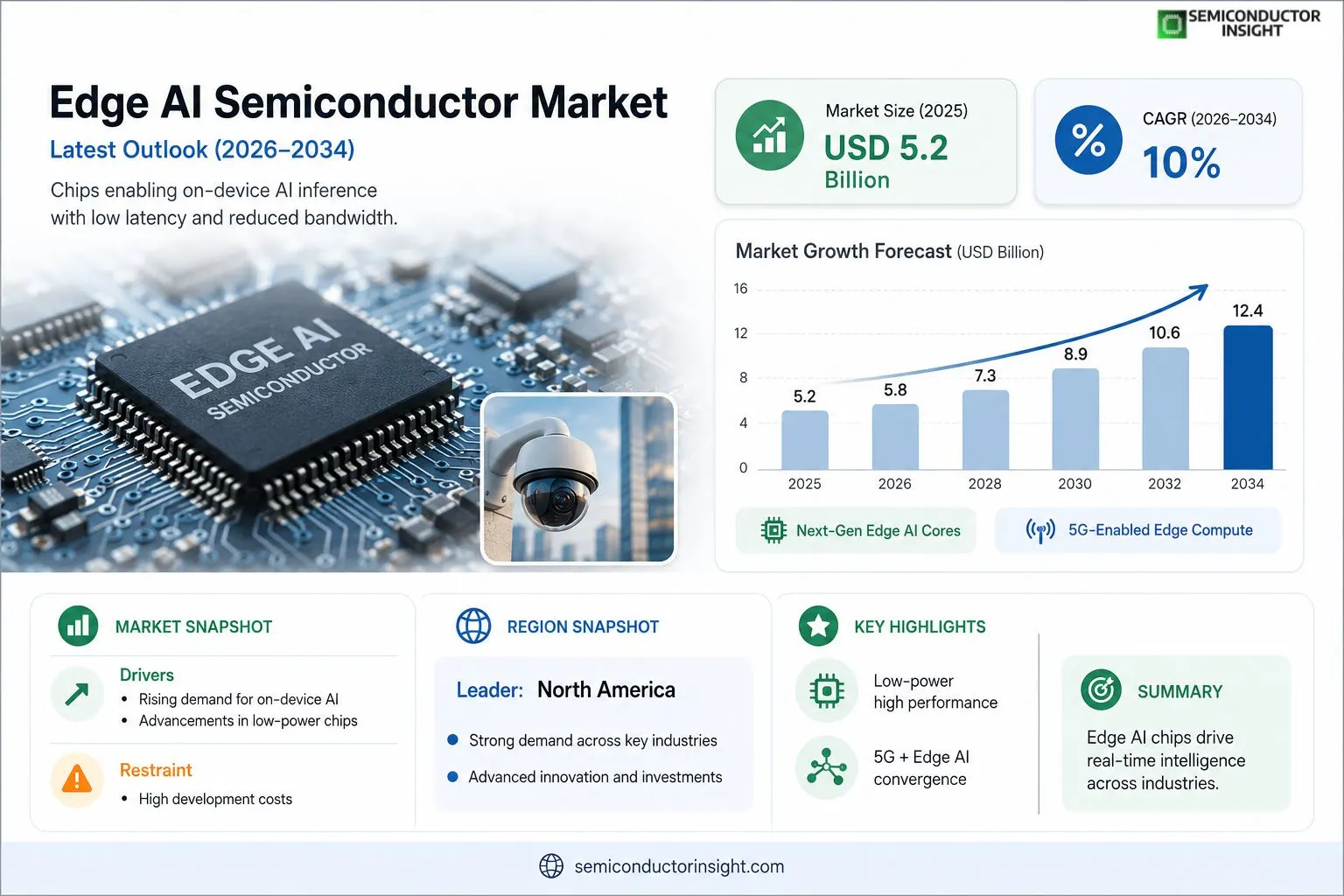
Global Edge AI Semiconductor market size was valued at USD 5.2 billion in 2025. The market is projected to grow from USD 5.8 billion in 2026 to USD 12.4 billion by 2034, exhibiting a CAGR of 10 % during the forecast period.
Edge AI semiconductors are specialized integrated circuits designed to execute artificial‑intelligence inference directly on devices at the network edge, reducing latency and bandwidth usage. These chips combine low‑power micro‑controllers with dedicated neural‑network accelerators, enabling real‑time vision, speech, and sensor analytics in autonomous vehicles, industrial IoT gateways, and smart cameras.The market is accelerating because enterprises are investing heavily in on‑device intelligence to meet privacy regulations and demand for instantaneous decision‑making. Furthermore, the rollout of 5G networks is expanding edge compute capacity, while collaborations such as Nvidia’s partnership with Arm announced in April 2024 to co‑develop next‑generation edge AI cores are driving adoption. Key players including Qualcomm, Intel, MediaTek, and Apple continue to broaden their portfolios, reinforcing the rapid expansion of Edge AI Semiconductor Market.
MARKET DRIVERS
Rising Demand for On‑Device Processing
The proliferation of Internet‑of‑Things (IoT) sensors and smart cameras is pushing manufacturers to embed AI directly at the edge. Edge AI semiconductor solutions reduce bandwidth costs and enable sub‑second decision making, which is critical for autonomous vehicles, industrial robotics, and retail analytics.
Advancements in Low‑Power Chip Design
Recent node‑scale innovations and heterogeneous integration allow designers to achieve sub‑10 mW power envelopes while delivering tera‑operations per second (TOPS) performance. This efficiency breakthrough expands feasible applications in battery‑operated wearables and remote monitoring stations.
➤ Edge AI chips enable real‑time analytics with sub‑millisecond latency, fostering new revenue streams in predictive maintenance and smart city services.
Manufacturers are also benefitting from stronger ecosystems around open‑source AI frameworks, which accelerate time‑to‑market and lower software development risk for Edge AI semiconductor projects.
MARKET CHALLENGES
Complexity of Integrated AI Workloads
Designers must balance heterogeneous compute unitsCPU, GPU, NPU, and DSPwithin a single die. Achieving optimal partitioning of neural‑network inference across these units requires sophisticated toolchains, and mismatches can erode performance gains.
Other Challenges
Security & Data Privacy
Embedding AI at the edge exposes devices to physical tampering and network attacks. Robust secure‑boot, encrypted model storage, and runtime attestation are becoming mandatory, increasing bill‑of‑materials (BOM) costs.
MARKET RESTRAINTS
High Development Costs
The R&D cycle for custom AI accelerators remains capital intensive. Plexus of silicon validation, silicon‑turn‑round, and firmware integration pushes project budgets beyond the threshold of many mid‑sized OEMs, limiting broader market adoption.
MARKET OPPORTUNITIES
Growth in Autonomous Systems
Autonomous drones, delivery robots, and next‑generation driver‑assist platforms require real‑time perception without reliance on cloud connectivity. Edge AI semiconductor suppliers that can deliver rugged, low‑latency processors stand to capture a rapidly expanding share of this high‑growth segment.
Edge AI Semiconductor Market Trends
Growing Adoption of Edge AI Chips
Enterprises are accelerating investments in on‑device intelligence to satisfy privacy regulations and the need for instantaneous decision‑making. Edge AI semiconductors, which embed low‑power micro‑controllers with dedicated neural‑network accelerators, enable real‑time vision, speech, and sensor analytics directly at the network edge. This capability reduces latency and bandwidth consumption, making Edge AI Semiconductor Market a focal point for autonomous vehicles, industrial IoT gateways, and smart cameras. The convergence of AI workloads with edge compute resources is reshaping product roadmaps across multiple verticals, driving a steady surge in demand for specialized integrated circuits.
Other Trends
Impact of 5G Rollout
The deployment of 5G networks expands edge compute capacity by delivering higher bandwidth and lower latency connections. This infrastructure improvement allows more sophisticated AI models to run on edge devices without relying on centralized clouds. As a result, manufacturers are integrating 5G‑compatible edge AI chips to support seamless data processing in scenarios such as remote healthcare monitoring and real‑time industrial automation. The synergy between 5G and edge AI strengthens the overall market momentum, enabling new use cases that were previously constrained by network limitations.
Strategic Partnerships and Ecosystem Expansion
Collaborations are a decisive factor in Edge AI Semiconductor Market’s evolution. In April 2024, Nvidia announced a partnership with Arm to co‑develop next‑generation edge AI cores, pooling design expertise and silicon‑intellectual‑property assets. Leading vendors such as Qualcomm, Intel, MediaTek, and Apple are also broadening their portfolios, introducing chipsets that blend power efficiency with high‑throughput inference capabilities. These strategic moves create a more competitive ecosystem, accelerate technology diffusion, and provide customers with a wider selection of optimized solutions for edge deployments.
COMPETITIVE LANDSCAPEKey Industry Players
Edge AI Semiconductor Market Competitive Overview
Edge AI Semiconductor Market is presently dominated by a handful of large integrated‑circuit designers that combine low‑power micro‑controllers with dedicated neural‑network accelerators. Qualcomm leads the space with its Snapdragon 7c and 8cx series, which are widely adopted in smart‑camera and industrial‑gateway deployments. Intel leverages its Xeon Edge and Agilex families to capture data‑center‑adjacent workloads, while Nvidia’s Jetson modules remain the preferred choice for robotics and autonomous‑vehicle prototypes. Apple’s custom silicon, notably the A‑series and M‑series chips, embeds edge‑AI capabilities that set a high bar for performance‑per‑watt, influencing the broader market dynamics. These incumbents shape a tiered market structure where premium, high‑volume products coexist with specialized solutions for niche verticals.Beyond the headline leaders, a robust cohort of niche innovators is expanding the competitive landscape. MediaTek supplies cost‑effective AI‑enabled SoCs for consumer‑grade smart devices, whereas Samsung’s Exynos line delivers heterogeneous compute engines for 5G‑enabled edge nodes. ARM, through its Cortex‑M and Ethos‑U IP, powers countless third‑party designs, and Google’s Coral edge‑TPU offers a cloud‑aligned accelerator for rapid prototyping. Emerging contenders such as Huawei’s HiSilicon, Renesas, STMicroelectronics, NXP Semiconductors, Texas Instruments, and Microchip Technology contribute domain‑specific solutions ranging from automotive safety processors to low‑power sensor hubs, ensuring that the ecosystem remains diverse and resilient.
List of Key Edge AI Semiconductor Companies Profiled
- Qualcomm
- Intel
- Nvidia
- Apple
- MediaTek
- Samsung Electronics
- ARM
- Google (Coral)
- Huawei HiSilicon
- Renesas Electronics
- STMicroelectronics
- NXP Semiconductors
- Texas Instruments
- Microchip Technology
- AMD
Segment Analysis:
| Segment Category | Sub-Segments | Key Insights |
| By Type |
|
Microcontroller‑based AI chips are emerging as the dominant type because they blend ultra‑low power consumption with sufficient compute for on‑device inference.
|
| By Application |
|
Autonomous Vehicles drive the most demanding application requirements, pushing developers to adopt Edge AI semiconductors that can process sensor streams instantly.
|
| By End User |
|
Automotive OEMs prioritize Edge AI chips that can be hardened for automotive temperature ranges while delivering deterministic performance.
|
| By Functionality |
|
Real‑time Vision Processing is the most compelling functionality because visual data dominates edge workloads in surveillance, robotics, and automotive.
|
| By Architecture |
|
Neural Network Processors (NNPs) dominate the architectural landscape due to their ability to deliver high compute density for deep‑learning inference.
|
Regional Analysis: North America
United States
The Industrial Automation sector in North America is witnessing a surge in demand for Edge AI Semiconductor Market solutions, driven by the need for predictive maintenance, real-time quality control, and enhanced operational efficiency. This trend underscores the importance of deploying intelligent systems directly on factory floors.
The healthcare industry in North America is increasingly leveraging Edge AI Semiconductor Market technology for applications such as medical imaging analysis, patient monitoring, and personalized medicine. The emphasis on data privacy and security is a critical consideration within this sector.
Retailers in North America are deploying Edge AI Semiconductor Market solutions to enhance customer experience, optimize inventory management, and improve store operations. Real-time analytics at the point of sale are proving invaluable for personalized marketing and targeted promotions.
The automotive sector in North America is a major driver of Edge AI Semiconductor Market, with applications ranging from autonomous driving and advanced driver-assistance systems (ADAS) to in-car infotainment and vehicle diagnostics.
Europe
Europe represents a significant and evolving market for Edge AI Semiconductor Market. While facing challenges related to regulatory complexities and fragmented industry structures, the region is witnessing strong growth driven by increasing adoption across various sectors. Key applications include smart manufacturing, logistics optimization, and advanced robotics. European businesses are focusing on developing energy-efficient and environmentally sustainable solutions within Edge AI Semiconductor Market. Government initiatives promoting digital transformation and industrial competitiveness are further boosting market expansion. The focus on data privacy and security, as mandated by GDPR, plays a crucial role in shaping business strategies in Europe. A key trend is the collaboration between research institutions and industrial players to accelerate innovation in Edge AI Semiconductor Market technologies.
Asia-Pacific
Asia-Pacific is poised to become the largest and fastest-growing market for Edge AI Semiconductor Market in the coming years. Driven by rapid industrialization, burgeoning economies, and increasing digital adoption, the region presents substantial opportunities for market players. China, in particular, is a key driver of growth, with significant investments in AI infrastructure and applications. Other key markets in the region include Japan, South Korea, and India. The demand for Edge AI Semiconductor Market solutions is particularly strong in manufacturing, automotive, and consumer electronics. Business strategies in Asia-Pacific emphasize cost-effectiveness, localized solutions, and strong partnerships with local players. The government support for technological innovation and the availability of a skilled workforce contribute to the region’s attractiveness for investment in Edge AI Semiconductor Market.
South America
South America presents a relatively nascent but promising market for Edge AI Semiconductor Market. Increasing investments in infrastructure development, coupled with a growing focus on digitalization, are driving demand for AI-powered solutions. Key applications are emerging in agriculture, mining, and logistics. The market is characterized by diverse economic conditions and varying levels of technological adoption across different countries. Business strategies in South America prioritize affordability and the development of tailored solutions to meet specific regional needs. Government initiatives aimed at promoting technological innovation and attracting foreign investment are expected to further accelerate growth in Edge AI Semiconductor Market.
Middle East & Africa
The Middle East & Africa region is an emerging market for Edge AI Semiconductor Market, with significant potential for growth. Driven by investments in smart cities, industrial digitalization, and a growing focus on cybersecurity, the region is witnessing increasing demand for AI-powered solutions. Key applications are emerging in transportation, energy, and healthcare. The market is characterized by a relatively young population and strong government support for technological development. Business strategies in the Middle East & Africa emphasize the development of localized solutions and partnerships with regional players. The focus on energy efficiency and resource optimization is also a key driver of adoption in Edge AI Semiconductor Market.
Report Scope
This market research report provides a comprehensive analysis of the Edge AI Semiconductor Market , covering the forecast period 2026–2034. It offers detailed insights into market dynamics, technological advancements, competitive landscape, and key trends shaping the industry.
Key focus areas of the report include:
- Market Overview: The report begins with an overview outlining its current market scenario, key growth indicators, and industry transformation drivers. It discusses macroeconomic factors, demand–supply balance, regulatory landscape, and the strategic role of semiconductors in powering advancements across industries such as automotive, telecommunications, consumer electronics, and industrial automation.
- Market Size & Forecast: Historical data and future projections for revenue, unit shipments, and market value across major regions and segments.
- Segmentation Analysis: Detailed breakdown by product type, technology, application, and end-user industry to identify high-growth segments and investment opportunities.
- Regional Insights: Insights into market performance across North America, Europe, Asia-Pacific, Latin America, and the Middle East & Africa, including country-level analysis where relevant.
- Competitive Landscape: Profiles of leading market participants, including their product offerings, R&D focus, manufacturing capacity, pricing strategies, and recent developments such as mergers, acquisitions, and partnerships.
- Technology Trends & Innovation: Assessment of emerging technologies, integration of AI/IoT, semiconductor design trends, fabrication techniques, and evolving industry standards.
- Market Drivers & Restraints: Evaluation of factors driving market growth along with challenges, supply chain constraints, regulatory issues, and market-entry barriers.
- Stakeholder Insights: Insights for component suppliers, OEMs, system integrators, investors, and policymakers regarding the evolving ecosystem and strategic opportunities.
Primary and secondary research methods are employed, including interviews with industry experts, data from verified sources, and real-time market intelligence to ensure the accuracy and reliability of the insights presented.
FREQUENTLY ASKED QUESTIONS:
What is the current market size of Edge AI Semiconductor Market?
-> Edge AI Semiconductor Market was valued at USD 5.2 billion in 2025 and is expected to reach USD 12.4 billion by 2034.
Which key companies operate in Edge AI Semiconductor Market?
-> Key players include Qualcomm, Intel, MediaTek, and Apple, among others.
What are the key growth drivers?
-> Key growth drivers include enterprise investment in on‑device intelligence for privacy and instant decision‑making, expansion of 5G networks, and strategic collaborations such as the Nvidia‑Arm partnership.
Which region dominates the market?
-> Global demand drives the market, with strong adoption across all major regions.
What are the emerging trends?
-> Emerging trends include development of next‑generation edge AI cores, deeper integration with 5G connectivity, and increased focus on low‑power, high‑performance AI inference at the edge.

Get Sample Report PDF for Exclusive Insights
Report Sample Includes
- Table of Contents
- List of Tables & Figures
- Charts, Research Methodology, and more...
 Download Sample Report PDF