Key Statistics
Key Takeaways
- ARM Core Board is the leading type because power efficiency, processor ecosystem breadth and scalable performance make ARM modules a natural fit for industrial IoT and compact edge systems.
- AI Accelerated Type is the strongest technology-growth theme as integrated NPUs, GPUs and dedicated accelerators allow customers to run computer vision and inference locally without a separate high-power server.
- Industrial Automation remains the principal application, where factories need rugged, long-life compute platforms that can connect sensors, run control software and increasingly execute AI workloads close to the machine.
- Asia Pacific is the largest regional market in 2025, supported by China, Japan, South Korea and Taiwan combine electronics manufacturing, industrial automation investment and a dense module and carrier-board supply ecosystem.
- Asia Pacific has the strongest regional growth profile because regional factories are adding automation while local module suppliers rapidly commercialize ARM and AI-enabled platforms at multiple performance and price points.
- processor obsolescence and software-maintenance complexity is the main structural restraint, limiting how quickly new suppliers can displace qualified incumbents.
Embedded Core Board Market Overview
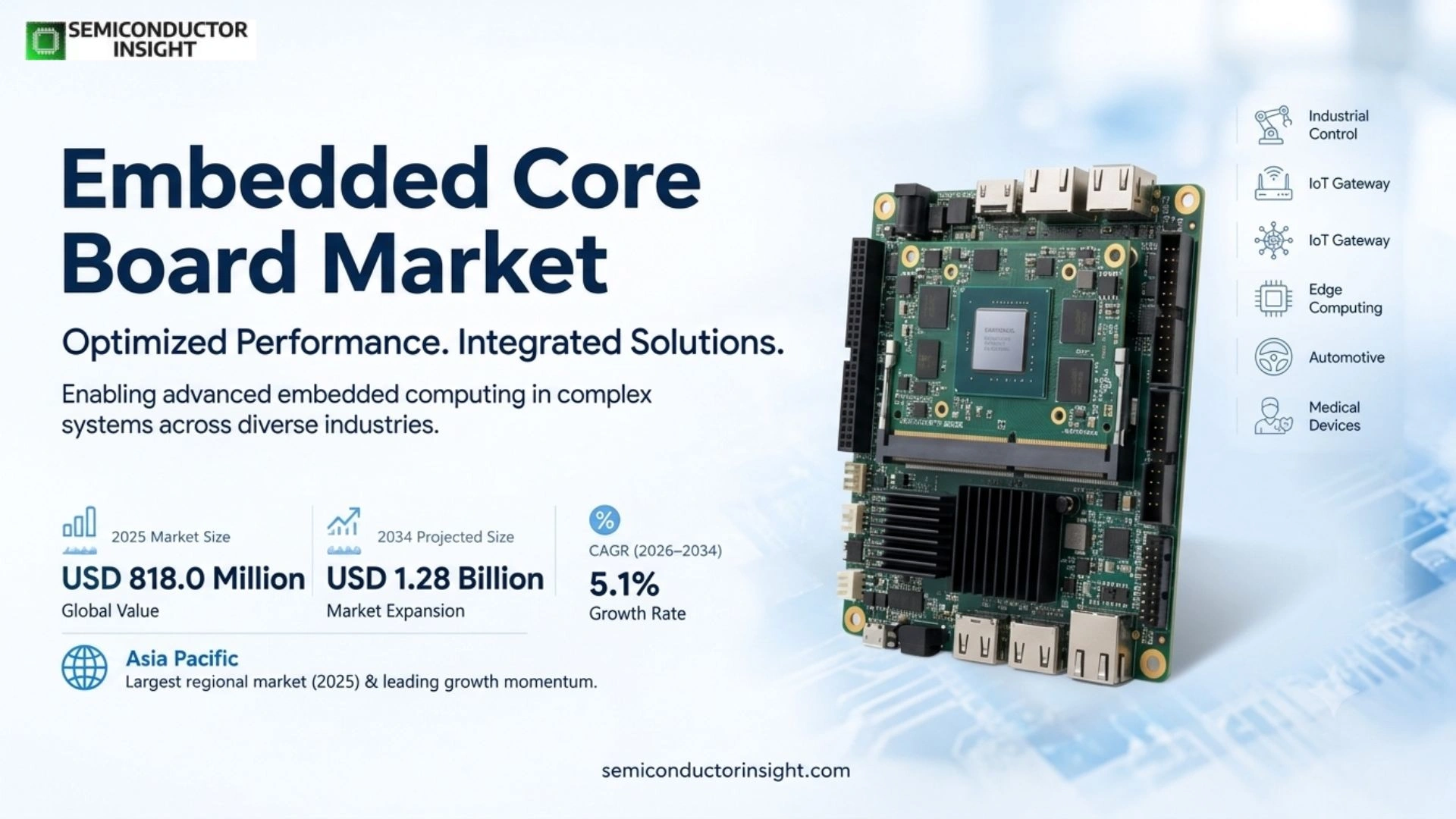
Embedded Core Board was valued at USD 818.0 million in 2025 and is projected to reach USD 1.28 billion by 2034, representing a 5.1% CAGR during 2026–2034. The 2026 estimated market size is USD 859.8 million. Asia Pacific is the largest market in 2025, while Asia Pacific shows the strongest structural growth momentum.
An embedded core board is a compact compute module that integrates a processor or SoC with memory, flash, power management and core I/O so an OEM can add application-specific interfaces on a carrier board. The category overlaps with System on Module designs and is used where customers want faster development and lower hardware risk than a fully custom processor board while retaining more integration flexibility than a finished industrial computer.
The core board typically contains the compute engine, DRAM, nonvolatile storage, power sequencing and high-speed interfaces, while the baseboard provides connectors, field I/O, power input, wireless modules and mechanical integration. This split lets an OEM reuse one validated compute module across several products, upgrade processor capability without redesigning every interface, and concentrate engineering effort on the application rather than on high-speed memory routing or SoC bring-up.
Demand is created when equipment makers need more local processing but cannot justify designing a complete high-speed computing board for every product generation. Industrial automation, robotics, medical equipment and IoT systems benefit from pre-validated modules because they shorten prototyping and reduce signal-integrity risk. Supplier selection then depends heavily on software support, long-term availability and the ability to maintain compatible module families across processor transitions.
Segment Analysis: By Type
By type, the embedded core board is segmented into ARM Core Board, X86 Core Board, Others. ARM Core Board is the leading segment, while AI Accelerated Type has the strongest growth momentum. The distinction reflects differences in performance requirements, installed-base compatibility and the amount of engineering or qualification work a customer must complete before deployment. For embedded core board, the commercial consequence is that buyers evaluate qualification effort, integration risk, supplier continuity and lifecycle support alongside headline specifications. Vendors that reduce those deployment risks can defend design wins for multiple product cycles, while suppliers competing only on unit price face a harder path into applications where requalification or system redesign is costly.
| Type | Technical / purchasing role | Market position |
|---|---|---|
| ARM Core Board | Modules based on ARM SoCs combine application processors, memory, power management and integrated multimedia or AI functions in compact, power-efficient formats. | Largest type. Strong ecosystem support and broad silicon availability make ARM the default for many industrial IoT, vision, robotics and connected-device designs. |
| X86 Core Board | x86 modules target applications that need PC-class software compatibility, higher general-purpose compute, virtualization or established Windows and Linux application stacks. | Important high-performance segment. It retains strong positions in industrial PCs, medical systems and applications where software compatibility outweighs higher power consumption. |
| Others | Specialized processor architectures and application-specific modules address legacy, real-time or niche compute requirements that do not fit mainstream ARM or x86 roadmaps. | Niche segment. Design wins can be durable when the architecture is embedded in certified equipment, but ecosystem scale is smaller than ARM or x86. |
Functional positioning and integration level
The source scope also divides the market into General Type, Industrial Type and AI Accelerated Type, and into System on Module versus Core board + Baseboard integration. AI Accelerated Type is the strongest technology-growth theme because newer modules integrate NPUs or GPUs for local inference, while the System on Module approach remains the dominant integration model for OEMs seeking fast development with application-specific carrier boards.
Segment Analysis: By Application
By application, the market is segmented into Industrial Automation, IoT Devices, Smart Manufacturing, Robotics, Medical Equipment. Industrial Automation represents the most important demand pool, while Industrial Automation is gaining momentum as customers add more compute, automation, precision or reliability requirements to deployed systems. For embedded core board, the commercial consequence is that buyers evaluate qualification effort, integration risk, supplier continuity and lifecycle support alongside headline specifications. Vendors that reduce those deployment risks can defend design wins for multiple product cycles, while suppliers competing only on unit price face a harder path into applications where requalification or system redesign is costly.
| Application | Demand characteristics |
|---|---|
| Industrial Automation | The leading application uses core boards in machine controllers, vision systems, data gateways, human-machine interfaces and edge analytics. Customers value rugged operation, deterministic interfaces, long lifecycle support and software stability because industrial equipment often remains in production far longer than consumer computing platforms. |
| IoT Devices | Connected gateways and intelligent field devices use compact modules to combine processing, networking and security without a full custom board. The segment favors low power, flexible wireless and long software support, particularly when devices are deployed remotely and must receive security updates over an extended service life. |
| Smart Manufacturing | Factory digitalization adds edge gateways, machine vision and data-acquisition systems that bridge operational technology with cloud analytics. Core boards reduce development time for these specialized devices and allow OEMs to scale performance across product families while maintaining the same carrier-board and enclosure architecture. |
| Robotics | Robots and autonomous machines increasingly run perception, motion planning and AI inference locally. The application pushes module suppliers toward integrated GPUs or NPUs, high-speed camera interfaces and deterministic networking while preserving power efficiency and mechanical compactness. |
| Medical Equipment | Imaging, diagnostics and patient-monitoring systems use embedded modules where long lifecycle, software validation and controlled hardware changes are important. Medical OEMs often value a supplier’s product-change discipline and documentation as highly as raw processor performance because hardware updates can trigger system revalidation. |
Regional Analysis
Asia Pacific leads the embedded core board in 2025, while Asia Pacific has the strongest growth outlook. Regional demand differs materially because manufacturing location, defense or industrial spending, installed semiconductor capacity, customer qualification practice and local supply-chain depth vary sharply by geography. For embedded core board, the commercial consequence is that buyers evaluate qualification effort, integration risk, supplier continuity and lifecycle support alongside headline specifications. Vendors that reduce those deployment risks can defend design wins for multiple product cycles, while suppliers competing only on unit price face a harder path into applications where requalification or system redesign is costly.
How does regional demand differ across the embedded core board?
Asia Pacific leads both production and consumption because the region combines electronics manufacturing scale with rapid industrial automation. North America has a high-value market for robotics, medical, defense and AI edge systems. Europe is strong in machine building and industrial automation, with Germany and other manufacturing economies favoring long-life industrial modules. South America and the Middle East & Africa are smaller, primarily using imported modules through system integrators and industrial-distribution channels.
| Region | Position | Growth outlook | Demand profile | What decides supplier selection |
|---|---|---|---|---|
| Asia Pacific | Largest | Highest | Electronics manufacturing, automation and robotics led | Cost-performance, local engineering, software ecosystem and supply continuity |
| North America | Major high-value market | Strong | AI edge, robotics, medical and defense led | Compute capability, security, software stack, certification support and lifecycle |
| Europe | Major industrial market | Steady to strong | Machine building and industrial automation led | Long-term availability, ruggedness, documentation and deterministic I/O |
| South America | Emerging | Selective | Industrial modernization and imported equipment led | Distributor support, cost, replacement availability and integration services |
| Middle East & Africa | Emerging | Selective | Infrastructure, energy and industrial projects led | System-integrator support, thermal robustness, supply continuity and remote service |
Competitive Landscape
Competition centers on the module as a development platform rather than on processor specifications alone. Kontron, Advantech, Congatec, Toradex, PHYTEC, Variscite and other suppliers differentiate through board-support packages, operating-system images, thermal design, carrier-board services and long-term availability. Once an OEM builds software and a carrier board around one module family, switching costs can be substantial even when competing processors offer similar benchmark performance.
Large industrial-computing suppliers can offer broad x86 and ARM portfolios, global manufacturing and application engineering for regulated or rugged industries. Their scale helps with lifecycle management and multi-region support, which is valuable for machine builders selling one product globally. The trade-off is that standardized product roadmaps may be less flexible than a specialist supplier willing to customize interfaces, firmware or carrier boards for a narrower vertical.
Specialist System on Module suppliers compete through software quality and fast access to new processors. Toradex, Variscite and PHYTEC, for example, emphasize compact ARM platforms with operating-system support and carrier-board ecosystems that shorten customer development. Their competitive moat is created after the first design win because the customer accumulates application software, mechanical integration and validation around the selected module family.
AI acceleration is creating a new competitive layer. NVIDIA Jetson, NXP i.MX processors with integrated acceleration, Intel Core Ultra and other heterogeneous compute platforms allow module vendors to target machine vision and robotics without designing custom accelerators. The suppliers that provide optimized AI runtimes, camera support and thermal solutions can capture more value than vendors selling an undifferentiated processor board.
Tier structure
| Competitive tier | Representative participants | How suppliers compete |
|---|---|---|
| Global industrial-computing platforms | Kontron; Advantech; AAEON; DFI; Adlink Technology; CONTEC | Broad module portfolios, global manufacturing, industrial certifications, application engineering and long lifecycle support. |
| Specialist SoM / core-board suppliers | Toradex; Variscite; PHYTEC; Congatec; Tronlong | Fast adoption of new processors, strong BSPs, carrier-board ecosystems and focused support for embedded OEM development. |
| Vertical and regional specialists | Winmate; AEWIN; Corvalent; Centralp | Application-specific ruggedization, custom integration, niche architectures and regional customer relationships. |
Key companies profiled
Companies profiled in the report include Kontron; PHYTEC; Centralp; AAEON; Winmate; Toradex; Variscite; AEWIN; CONTEC; Corvalent; Congatec; DFI; Adlink Technology; Advantech; Tronlong. Competitive position varies by application and qualification depth: scale matters for global availability, while specialized vendors can retain strong positions where customers require unusual environmental tolerance, process know-how, software enablement or application-specific engineering. For embedded core board, the commercial consequence is that buyers evaluate qualification effort, integration risk, supplier continuity and lifecycle support alongside headline specifications. Vendors that reduce those deployment risks can defend design wins for multiple product cycles, while suppliers competing only on unit price face a harder path into applications where requalification or system redesign is costly.
Production Capacity Analysis
Embedded core board capacity is built on access to processors, memory, power-management ICs, PCB fabrication and automated assembly, but practical supply is constrained by processor allocations and the need to keep a specific bill of materials stable for years. A module vendor can usually add SMT capacity faster than it can replace a discontinued SoC or requalify a changed memory device for customers already in production.
Processor supply is the most strategic upstream dependency because each module family is designed around a particular SoC or CPU generation. When a silicon vendor changes allocation, package or lifecycle status, the module supplier cannot freely substitute another processor without redesigning the board and software stack. Long-term supply agreements and close semiconductor-vendor relationships therefore influence which module companies can support industrial customers reliably.
PCB layout and assembly require high-speed memory routing, dense ball-grid-array packages and careful power design, but the manufacturing processes are widely available across established electronics clusters. Differentiation comes from design-for-manufacture, automated test coverage and configuration control rather than a unique assembly method. Taiwan and China remain important supply bases, while global vendors increasingly diversify production for resilience. For embedded core board, the commercial consequence is that buyers evaluate qualification effort, integration risk, supplier continuity and lifecycle support alongside headline specifications. Vendors that reduce those deployment risks can defend design wins for multiple product cycles, while suppliers competing only on unit price face a harder path into applications where requalification or system redesign is costly.
Software release capacity is effectively part of production capacity because every shipped module depends on a working bootloader, kernel, drivers and security updates. A vendor can have boards physically available yet still delay customer deployment if the board-support package is immature. Engineering headcount for software maintenance therefore limits the number of processor families a supplier can support well over a long industrial lifecycle.
Embedded Core Board Market Dynamics: Drivers, Restraints and Opportunities
The market benefits from a structural shift toward modular edge computing: OEMs want more performance and AI capability but still need long-life, application-specific hardware. System on Module architectures let suppliers absorb the complexity of processor and memory design while customers focus on carrier boards and software. Growth is constrained by rapid silicon roadmaps and the cost of maintaining software compatibility across long industrial product cycles.
MARKET DRIVERS
Drivers Impact Analysis*
| Factor | Relative impact* | Commercial mechanism |
|---|---|---|
| Industrial automation and smart factories | High | More connected machines, vision systems and predictive-maintenance nodes increase the need for compact local computing. |
| Edge AI and robotics | High | Integrated NPUs and GPUs raise module value and create new use cases for local inference near sensors and actuators. |
| Faster OEM development cycles | Medium-High | Pre-validated modules reduce high-speed board-design effort and allow customers to launch products sooner. |
| IoT and distributed infrastructure | Medium | Gateways and intelligent field devices need secure local processing with flexible networking and long software support. |
Industrial automation pushes intelligence closer to machines
Factories increasingly combine control, data acquisition, machine vision and analytics at the edge. A core board lets equipment makers add this processing without developing a full CPU platform from scratch, shortening engineering schedules while keeping application-specific I/O on a carrier board. The modular approach becomes more valuable as compute requirements rise faster than OEM hardware teams can expand.
Edge AI raises compute value per module
Machine vision, robotics and predictive maintenance increasingly execute neural-network inference locally to reduce latency and network bandwidth. Integrated NPUs and GPUs allow module suppliers to deliver much more compute within established industrial power envelopes. That shifts competition from simple CPU speed toward AI toolchains, camera interfaces, thermal design and optimized software images. For embedded core board, the commercial consequence is that buyers evaluate qualification effort, integration risk, supplier continuity and lifecycle support alongside headline specifications. Vendors that reduce those deployment risks can defend design wins for multiple product cycles, while suppliers competing only on unit price face a harder path into applications where requalification or system redesign is costly.
System on Module architectures reduce development risk
High-speed DDR routing, processor power sequencing and multilayer BGA escape are specialized engineering tasks. By buying a validated core module, an OEM can avoid much of that risk and focus on its own sensors, field interfaces and enclosure. The savings are especially valuable for low-to-medium-volume industrial or medical products that cannot amortize a large custom motherboard team. For embedded core board, the commercial consequence is that buyers evaluate qualification effort, integration risk, supplier continuity and lifecycle support alongside headline specifications. Vendors that reduce those deployment risks can defend design wins for multiple product cycles, while suppliers competing only on unit price face a harder path into applications where requalification or system redesign is costly.
Long-life connected equipment expands software requirements
Industrial and medical devices increasingly stay connected for remote diagnostics and security updates throughout their service life. Customers therefore choose module suppliers based on Linux or Windows support, security patching and controlled hardware revisions as well as initial specifications. Vendors that maintain stable software branches can convert engineering support into a durable competitive advantage. For embedded core board, the commercial consequence is that buyers evaluate qualification effort, integration risk, supplier continuity and lifecycle support alongside headline specifications. Vendors that reduce those deployment risks can defend design wins for multiple product cycles, while suppliers competing only on unit price face a harder path into applications where requalification or system redesign is costly.
MARKET RESTRAINTS
Restraints Impact Analysis*
| Factor | Relative impact* | Commercial mechanism |
|---|---|---|
| Processor lifecycle and obsolescence | High | Rapid silicon roadmaps can force module redesign before an industrial customer is ready to change platforms. |
| Software maintenance burden | High | Kernel, driver and security support must continue for years, increasing engineering cost across broad product portfolios. |
| Semiconductor supply concentration | Medium-High | A shortage of one processor, memory or PMIC can stop a module even when assembly capacity is available. |
| Carrier-board and certification rework | Medium | Changing module families can trigger mechanical, I/O, EMC, safety or medical revalidation at the customer. |
Processor roadmaps are shorter than industrial product lives
Semiconductor vendors regularly introduce new processor generations and eventually discontinue older devices, while factories and medical systems may remain in production for a decade or longer. Module suppliers must bridge that mismatch through lifecycle agreements, pin-compatible migration paths and advance change notices. Failure to do so can force customers into expensive carrier-board and software redesigns. For embedded core board, the commercial consequence is that buyers evaluate qualification effort, integration risk, supplier continuity and lifecycle support alongside headline specifications. Vendors that reduce those deployment risks can defend design wins for multiple product cycles, while suppliers competing only on unit price face a harder path into applications where requalification or system redesign is costly.
Software support becomes a recurring cost center
A module is only useful if bootloader, operating system, drivers and security patches remain maintained. Supporting many processor families across several Linux releases or Windows versions creates a large engineering burden, particularly when upstream silicon vendors stop maintaining older kernels. Smaller suppliers can struggle to sustain broad portfolios even when their hardware remains technically competitive. For embedded core board, the commercial consequence is that buyers evaluate qualification effort, integration risk, supplier continuity and lifecycle support alongside headline specifications. Vendors that reduce those deployment risks can defend design wins for multiple product cycles, while suppliers competing only on unit price face a harder path into applications where requalification or system redesign is costly.
Supply disruptions propagate through complex bills of materials
A core board contains a processor, memory, flash, PMICs, clocks, Ethernet devices and many passive components. A shortage or discontinuation of one critical part can halt production because substituting it may require layout changes and validation. Vendors with better component planning and second-source strategies can therefore win business during supply disruptions even without superior benchmark performance. For embedded core board, the commercial consequence is that buyers evaluate qualification effort, integration risk, supplier continuity and lifecycle support alongside headline specifications. Vendors that reduce those deployment risks can defend design wins for multiple product cycles, while suppliers competing only on unit price face a harder path into applications where requalification or system redesign is costly.
Customer requalification discourages rapid migration
Industrial, railway, defense and medical OEMs validate thermal behavior, electromagnetic compatibility and application software around a specific module. Moving to a different pinout or power envelope can require carrier-board redesign and regulatory testing. The resulting switching cost protects incumbent module suppliers but also makes customers cautious about adopting a new platform without a credible long-term roadmap. For embedded core board, the commercial consequence is that buyers evaluate qualification effort, integration risk, supplier continuity and lifecycle support alongside headline specifications. Vendors that reduce those deployment risks can defend design wins for multiple product cycles, while suppliers competing only on unit price face a harder path into applications where requalification or system redesign is costly.
MARKET OPPORTUNITIES
AI-accelerated industrial modules
The strongest opportunity is to package NPUs, GPUs and optimized AI software into industrial form factors that can be deployed directly in machine vision and robotics. Customers need camera interfaces, deterministic networking and validated thermal performance in addition to TOPS ratings, allowing module vendors to add integration value above the underlying processor price. For embedded core board, the commercial consequence is that buyers evaluate qualification effort, integration risk, supplier continuity and lifecycle support alongside headline specifications. Vendors that reduce those deployment risks can defend design wins for multiple product cycles, while suppliers competing only on unit price face a harder path into applications where requalification or system redesign is costly.
Robotics and autonomous machines
Collaborative robots, mobile robots and autonomous equipment require compact compute close to motors and sensors. System on Module suppliers can target these platforms with synchronized camera input, real-time control interfaces and local inference while maintaining upgrade paths across processor generations. Successful platform designs can generate repeat orders as the robot family expands into multiple payload and performance variants.
Medical and regulated edge systems
Medical-device companies often prefer modules because a stable compute platform reduces hardware design risk and allows the OEM to focus on clinical functionality. Suppliers that provide long lifecycle, detailed documentation and controlled changes can capture premium design wins, particularly in imaging, diagnostics and patient-monitoring systems where requalification is expensive. For embedded core board, the commercial consequence is that buyers evaluate qualification effort, integration risk, supplier continuity and lifecycle support alongside headline specifications. Vendors that reduce those deployment risks can defend design wins for multiple product cycles, while suppliers competing only on unit price face a harder path into applications where requalification or system redesign is costly.
Lifecycle-managed module families
Customers increasingly want a migration path rather than a single board. Vendors can differentiate by maintaining compatible footprints across several processor generations, preserving carrier-board investment while allowing compute upgrades. This strategy turns lifecycle management into a product feature and can deepen customer lock-in without relying on proprietary software or connectors. For embedded core board, the commercial consequence is that buyers evaluate qualification effort, integration risk, supplier continuity and lifecycle support alongside headline specifications. Vendors that reduce those deployment risks can defend design wins for multiple product cycles, while suppliers competing only on unit price face a harder path into applications where requalification or system redesign is costly.
Embedded Core Board Supply Chain Analysis
Processors, memory & power ICs
Semiconductor selection sets performance, power and software architecture for the whole module family. Module suppliers need early roadmap access and long-term availability commitments because changing a processor or memory device can affect board layout, firmware and customer qualification. Strategic vendor relationships therefore influence both product timing and supply resilience. For embedded core board, the commercial consequence is that buyers evaluate qualification effort, integration risk, supplier continuity and lifecycle support alongside headline specifications. Vendors that reduce those deployment risks can defend design wins for multiple product cycles, while suppliers competing only on unit price face a harder path into applications where requalification or system redesign is costly.
Module design & PCB assembly
Design engineering concentrates the difficult high-speed interfaces on the module so customers do not have to route DDR memory or complex processor packages themselves. Manufacturing can be outsourced, but the module vendor retains responsibility for signal integrity, thermal behavior, functional test and configuration control across component revisions. For embedded core board, the commercial consequence is that buyers evaluate qualification effort, integration risk, supplier continuity and lifecycle support alongside headline specifications. Vendors that reduce those deployment risks can defend design wins for multiple product cycles, while suppliers competing only on unit price face a harder path into applications where requalification or system redesign is costly.
BSP, middleware & carrier ecosystem
Software and ecosystem support convert a board into a development platform. Customers compare documentation, update cadence, camera and networking support, and the availability of reference carrier designs. A strong BSP can shorten months of engineering work and is therefore a material purchasing factor rather than a free accessory. For embedded core board, the commercial consequence is that buyers evaluate qualification effort, integration risk, supplier continuity and lifecycle support alongside headline specifications. Vendors that reduce those deployment risks can defend design wins for multiple product cycles, while suppliers competing only on unit price face a harder path into applications where requalification or system redesign is costly.
OEM integration & lifecycle support
The OEM validates the final product for thermal, EMC, safety and application performance. Once qualified, switching modules can trigger substantial redesign, creating long customer relationships. Product-change notices, security patches and migration paths therefore determine whether the supplier retains the account through the full equipment lifecycle. For embedded core board, the commercial consequence is that buyers evaluate qualification effort, integration risk, supplier continuity and lifecycle support alongside headline specifications. Vendors that reduce those deployment risks can defend design wins for multiple product cycles, while suppliers competing only on unit price face a harder path into applications where requalification or system redesign is costly.
Recent Developments in the Embedded Core Board Market
Recent module launches and robotics-platform announcements show the market moving toward heterogeneous compute with integrated AI while preserving modular hardware formats. The commercial change is not only more processing power: customers increasingly expect a complete software and lifecycle platform, making BSP quality, thermal design, carrier-board compatibility and manufacturing resilience central to competition among embedded core board suppliers. For embedded core board, the commercial consequence is that buyers evaluate qualification effort, integration risk, supplier continuity and lifecycle support alongside headline specifications. Vendors that reduce those deployment risks can defend design wins for multiple product cycles, while suppliers competing only on unit price face a harder path into applications where requalification or system redesign is costly.
NVIDIA announced general availability of Jetson Thor modules for physical AI and robotics, with a major step up in AI compute and energy efficiency versus the prior generation. The platform creates a new high-performance module class for robot developers and increases demand for carrier boards, rugged integration and long-life deployment support. For embedded core board, the commercial consequence is that buyers evaluate qualification effort, integration risk, supplier continuity and lifecycle support alongside headline specifications. Vendors that reduce those deployment risks can defend design wins for multiple product cycles, while suppliers competing only on unit price face a harder path into applications where requalification or system redesign is costly.
Advantech announced edge-AI solutions accelerated by NVIDIA Jetson Thor for robotics, medical AI and data-intelligence applications. The move demonstrates how industrial-computing suppliers translate new processor modules into deployable platforms with application I/O and lifecycle services for OEM customers. For embedded core board, the commercial consequence is that buyers evaluate qualification effort, integration risk, supplier continuity and lifecycle support alongside headline specifications. Vendors that reduce those deployment risks can defend design wins for multiple product cycles, while suppliers competing only on unit price face a harder path into applications where requalification or system redesign is costly.
Congatec introduced the conga-TC750 module based on Intel Core Ultra Series 2 for industrial, robotics and medical applications. The launch reflects growing demand for x86-compatible modular platforms that combine CPU, GPU and AI acceleration within established embedded-computing standards. For embedded core board, the commercial consequence is that buyers evaluate qualification effort, integration risk, supplier continuity and lifecycle support alongside headline specifications. Vendors that reduce those deployment risks can defend design wins for multiple product cycles, while suppliers competing only on unit price face a harder path into applications where requalification or system redesign is costly.
Toradex introduced the Verdin iMX95 module family around NXP’s i.MX95 architecture, extending a standardized System on Module ecosystem with newer compute, safety and AI capabilities. The product illustrates how module vendors preserve carrier-board investment while moving customers to a new processor generation. For embedded core board, the commercial consequence is that buyers evaluate qualification effort, integration risk, supplier continuity and lifecycle support alongside headline specifications. Vendors that reduce those deployment risks can defend design wins for multiple product cycles, while suppliers competing only on unit price face a harder path into applications where requalification or system redesign is costly.
REPORT SCOPE & SEGMENTATION
The report scope covers the embedded core board across its published type, application and additional segmentation axes, with regional analysis spanning North America, Europe, Asia Pacific, South America, and the Middle East & Africa. It also profiles the companies listed below and tracks the market from the 2025 base year through the 2034 forecast endpoint. For embedded core board, the commercial consequence is that buyers evaluate qualification effort, integration risk, supplier continuity and lifecycle support alongside headline specifications. Vendors that reduce those deployment risks can defend design wins for multiple product cycles, while suppliers competing only on unit price face a harder path into applications where requalification or system redesign is costly.
| Report attribute | Coverage |
|---|---|
| Market | Embedded Core Board |
| Base year | 2025 |
| Estimated year | 2026 |
| Forecast period | 2026–2034 |
| 2025 market size | USD 818.0 million |
| 2034 forecast size | USD 1.28 billion |
| CAGR | 5.1% during 2026–2034 |
| Largest market in 2025 | Asia Pacific |
| By Type | ARM Core Board; X86 Core Board; Others |
| By Application | Industrial Automation; IoT Devices; Smart Manufacturing; Robotics; Medical Equipment |
| Additional segmentation | By End User: OEMs; System Integrators; Research Institutions. By Functional Positioning: General Type; Industrial Type; AI Accelerated Type. By Integration Level: System on Module (SoM); Core board + Baseboard. |
| Regions | North America; Europe; Asia Pacific; South America; Middle East & Africa |
| Companies profiled | Kontron; PHYTEC; Centralp; AAEON; Winmate; Toradex; Variscite; AEWIN; CONTEC; Corvalent; Congatec; DFI; Adlink Technology; Advantech; Tronlong |
Frequently Asked Questions
What is the embedded core board size in 2025?
The global embedded core board is valued at USD 818.0 million in 2025. That base-year value frames the demand discussion across product types, applications and regions, and it is consistent with the 2034 endpoint of USD 1.28 billion and the 5.1% growth rate used throughout this overview. For embedded core board, the commercial consequence is that buyers evaluate qualification effort, integration risk, supplier continuity and lifecycle support alongside headline specifications. Vendors that reduce those deployment risks can defend design wins for multiple product cycles, while suppliers competing only on unit price face a harder path into applications where requalification or system redesign is costly.
What is the projected embedded core board size by 2034?
The global embedded core board is projected to reach USD 1.28 billion by 2034. The forecast reflects sustained purchasing from industrial automation and adjacent applications, while qualification cycles, manufacturing constraints and technology substitution determine how quickly individual suppliers convert industry demand into recognized revenue. For embedded core board, the commercial consequence is that buyers evaluate qualification effort, integration risk, supplier continuity and lifecycle support alongside headline specifications. Vendors that reduce those deployment risks can defend design wins for multiple product cycles, while suppliers competing only on unit price face a harder path into applications where requalification or system redesign is costly.
What CAGR is expected for the embedded core board during 2026–2034?
The market outlook corresponds to a 5.1% CAGR during 2026–2034. Growth is not expected to be uniform across the portfolio: AI Accelerated Type and Industrial Automation have stronger structural momentum, while established segments retain substantial revenue because customers value proven compatibility and lifecycle continuity. For embedded core board, the commercial consequence is that buyers evaluate qualification effort, integration risk, supplier continuity and lifecycle support alongside headline specifications. Vendors that reduce those deployment risks can defend design wins for multiple product cycles, while suppliers competing only on unit price face a harder path into applications where requalification or system redesign is costly.
Which region is the largest embedded core board market in 2025?
Asia Pacific is the largest market in 2025. Its position reflects China, Japan, South Korea and Taiwan combine electronics manufacturing, industrial automation investment and a dense module and carrier-board supply ecosystem. Regional leadership matters commercially because suppliers often need local engineering support, qualification relationships and dependable logistics near the customer base, particularly when the component or module is tied closely to system yield or mission reliability.
Which product type leads the embedded core board?
ARM Core Board is the leading type identified in the market segmentation. Its position is supported by the installed base, broad application fit and customer familiarity, while AI Accelerated Type is gaining attention where newer system requirements reward higher performance, integration density or lower design risk. For embedded core board, the commercial consequence is that buyers evaluate qualification effort, integration risk, supplier continuity and lifecycle support alongside headline specifications. Vendors that reduce those deployment risks can defend design wins for multiple product cycles, while suppliers competing only on unit price face a harder path into applications where requalification or system redesign is costly.
Which application is most important in the embedded core board?
Industrial Automation is the principal application in the current market structure. Purchasing is driven by factories need rugged, long-life compute platforms that can connect sensors, run control software and increasingly execute AI workloads close to the machine. The segment therefore rewards suppliers that can provide not only a functional product but also validated interfaces, documentation and support that shorten the customer qualification cycle.
What is the fastest-growing area of the embedded core board?
Industrial Automation and AI Accelerated Type represent the clearest high-growth themes in the market. Their momentum comes from predictive maintenance, machine vision, collaborative robotics and autonomous material handling shift more intelligence from centralized servers to deterministic edge nodes. The opportunity is strongest for vendors able to bridge new technology with the reliability and lifecycle expectations already established in the incumbent customer base.
MARKET OPPORTUNITIES
AI-accelerated industrial modules
The strongest opportunity is to package NPUs, GPUs and optimized AI software into industrial form factors that can be deployed directly in machine vision and robotics. Customers need camera interfaces, deterministic networking and validated thermal performance in addition to TOPS ratings, allowing module vendors to add integration value above the underlying processor price. For embedded core board, the commercial consequence is that buyers evaluate qualification effort, integration risk, supplier continuity and lifecycle support alongside headline specifications. Vendors that reduce those deployment risks can defend design wins for multiple product cycles, while suppliers competing only on unit price face a harder path into applications where requalification or system redesign is costly.
Robotics and autonomous machines
Collaborative robots, mobile robots and autonomous equipment require compact compute close to motors and sensors. System on Module suppliers can target these platforms with synchronized camera input, real-time control interfaces and local inference while maintaining upgrade paths across processor generations. Successful platform designs can generate repeat orders as the robot family expands into multiple payload and performance variants.
Medical and regulated edge systems
Medical-device companies often prefer modules because a stable compute platform reduces hardware design risk and allows the OEM to focus on clinical functionality. Suppliers that provide long lifecycle, detailed documentation and controlled changes can capture premium design wins, particularly in imaging, diagnostics and patient-monitoring systems where requalification is expensive. For embedded core board, the commercial consequence is that buyers evaluate qualification effort, integration risk, supplier continuity and lifecycle support alongside headline specifications. Vendors that reduce those deployment risks can defend design wins for multiple product cycles, while suppliers competing only on unit price face a harder path into applications where requalification or system redesign is costly.
Lifecycle-managed module families
Customers increasingly want a migration path rather than a single board. Vendors can differentiate by maintaining compatible footprints across several processor generations, preserving carrier-board investment while allowing compute upgrades. This strategy turns lifecycle management into a product feature and can deepen customer lock-in without relying on proprietary software or connectors. For embedded core board, the commercial consequence is that buyers evaluate qualification effort, integration risk, supplier continuity and lifecycle support alongside headline specifications. Vendors that reduce those deployment risks can defend design wins for multiple product cycles, while suppliers competing only on unit price face a harder path into applications where requalification or system redesign is costly.
Embedded Core Board Supply Chain Analysis
Processors, memory & power ICs
Semiconductor selection sets performance, power and software architecture for the whole module family. Module suppliers need early roadmap access and long-term availability commitments because changing a processor or memory device can affect board layout, firmware and customer qualification. Strategic vendor relationships therefore influence both product timing and supply resilience. For embedded core board, the commercial consequence is that buyers evaluate qualification effort, integration risk, supplier continuity and lifecycle support alongside headline specifications. Vendors that reduce those deployment risks can defend design wins for multiple product cycles, while suppliers competing only on unit price face a harder path into applications where requalification or system redesign is costly.
Module design & PCB assembly
Design engineering concentrates the difficult high-speed interfaces on the module so customers do not have to route DDR memory or complex processor packages themselves. Manufacturing can be outsourced, but the module vendor retains responsibility for signal integrity, thermal behavior, functional test and configuration control across component revisions. For embedded core board, the commercial consequence is that buyers evaluate qualification effort, integration risk, supplier continuity and lifecycle support alongside headline specifications. Vendors that reduce those deployment risks can defend design wins for multiple product cycles, while suppliers competing only on unit price face a harder path into applications where requalification or system redesign is costly.
BSP, middleware & carrier ecosystem
Software and ecosystem support convert a board into a development platform. Customers compare documentation, update cadence, camera and networking support, and the availability of reference carrier designs. A strong BSP can shorten months of engineering work and is therefore a material purchasing factor rather than a free accessory. For embedded core board, the commercial consequence is that buyers evaluate qualification effort, integration risk, supplier continuity and lifecycle support alongside headline specifications. Vendors that reduce those deployment risks can defend design wins for multiple product cycles, while suppliers competing only on unit price face a harder path into applications where requalification or system redesign is costly.
OEM integration & lifecycle support
The OEM validates the final product for thermal, EMC, safety and application performance. Once qualified, switching modules can trigger substantial redesign, creating long customer relationships. Product-change notices, security patches and migration paths therefore determine whether the supplier retains the account through the full equipment lifecycle. For embedded core board, the commercial consequence is that buyers evaluate qualification effort, integration risk, supplier continuity and lifecycle support alongside headline specifications. Vendors that reduce those deployment risks can defend design wins for multiple product cycles, while suppliers competing only on unit price face a harder path into applications where requalification or system redesign is costly.
Recent Developments in the Embedded Core Board Market
Recent module launches and robotics-platform announcements show the market moving toward heterogeneous compute with integrated AI while preserving modular hardware formats. The commercial change is not only more processing power: customers increasingly expect a complete software and lifecycle platform, making BSP quality, thermal design, carrier-board compatibility and manufacturing resilience central to competition among embedded core board suppliers. For embedded core board, the commercial consequence is that buyers evaluate qualification effort, integration risk, supplier continuity and lifecycle support alongside headline specifications. Vendors that reduce those deployment risks can defend design wins for multiple product cycles, while suppliers competing only on unit price face a harder path into applications where requalification or system redesign is costly.
NVIDIA announced general availability of Jetson Thor modules for physical AI and robotics, with a major step up in AI compute and energy efficiency versus the prior generation. The platform creates a new high-performance module class for robot developers and increases demand for carrier boards, rugged integration and long-life deployment support. For embedded core board, the commercial consequence is that buyers evaluate qualification effort, integration risk, supplier continuity and lifecycle support alongside headline specifications. Vendors that reduce those deployment risks can defend design wins for multiple product cycles, while suppliers competing only on unit price face a harder path into applications where requalification or system redesign is costly.
Advantech announced edge-AI solutions accelerated by NVIDIA Jetson Thor for robotics, medical AI and data-intelligence applications. The move demonstrates how industrial-computing suppliers translate new processor modules into deployable platforms with application I/O and lifecycle services for OEM customers. For embedded core board, the commercial consequence is that buyers evaluate qualification effort, integration risk, supplier continuity and lifecycle support alongside headline specifications. Vendors that reduce those deployment risks can defend design wins for multiple product cycles, while suppliers competing only on unit price face a harder path into applications where requalification or system redesign is costly.
Congatec introduced the conga-TC750 module based on Intel Core Ultra Series 2 for industrial, robotics and medical applications. The launch reflects growing demand for x86-compatible modular platforms that combine CPU, GPU and AI acceleration within established embedded-computing standards. For embedded core board, the commercial consequence is that buyers evaluate qualification effort, integration risk, supplier continuity and lifecycle support alongside headline specifications. Vendors that reduce those deployment risks can defend design wins for multiple product cycles, while suppliers competing only on unit price face a harder path into applications where requalification or system redesign is costly.
Toradex introduced the Verdin iMX95 module family around NXP’s i.MX95 architecture, extending a standardized System on Module ecosystem with newer compute, safety and AI capabilities. The product illustrates how module vendors preserve carrier-board investment while moving customers to a new processor generation. For embedded core board, the commercial consequence is that buyers evaluate qualification effort, integration risk, supplier continuity and lifecycle support alongside headline specifications. Vendors that reduce those deployment risks can defend design wins for multiple product cycles, while suppliers competing only on unit price face a harder path into applications where requalification or system redesign is costly.
REPORT SCOPE & SEGMENTATION
The report scope covers the embedded core board across its published type, application and additional segmentation axes, with regional analysis spanning North America, Europe, Asia Pacific, South America, and the Middle East & Africa. It also profiles the companies listed below and tracks the market from the 2025 base year through the 2034 forecast endpoint. For embedded core board, the commercial consequence is that buyers evaluate qualification effort, integration risk, supplier continuity and lifecycle support alongside headline specifications. Vendors that reduce those deployment risks can defend design wins for multiple product cycles, while suppliers competing only on unit price face a harder path into applications where requalification or system redesign is costly.
| Report attribute | Coverage |
|---|---|
| Market | Embedded Core Board |
| Base year | 2025 |
| Estimated year | 2026 |
| Forecast period | 2026–2034 |
| 2025 market size | USD 818.0 million |
| 2034 forecast size | USD 1.28 billion |
| CAGR | 5.1% during 2026–2034 |
| Largest market in 2025 | Asia Pacific |
| By Type | ARM Core Board; X86 Core Board; Others |
| By Application | Industrial Automation; IoT Devices; Smart Manufacturing; Robotics; Medical Equipment |
| Additional segmentation | By End User: OEMs; System Integrators; Research Institutions. By Functional Positioning: General Type; Industrial Type; AI Accelerated Type. By Integration Level: System on Module (SoM); Core board + Baseboard. |
| Regions | North America; Europe; Asia Pacific; South America; Middle East & Africa |
| Companies profiled | Kontron; PHYTEC; Centralp; AAEON; Winmate; Toradex; Variscite; AEWIN; CONTEC; Corvalent; Congatec; DFI; Adlink Technology; Advantech; Tronlong |
Frequently Asked Questions
What is the embedded core board size in 2025?
The global embedded core board is valued at USD 818.0 million in 2025. That base-year value frames the demand discussion across product types, applications and regions, and it is consistent with the 2034 endpoint of USD 1.28 billion and the 5.1% growth rate used throughout this overview. For embedded core board, the commercial consequence is that buyers evaluate qualification effort, integration risk, supplier continuity and lifecycle support alongside headline specifications. Vendors that reduce those deployment risks can defend design wins for multiple product cycles, while suppliers competing only on unit price face a harder path into applications where requalification or system redesign is costly.
What is the projected embedded core board size by 2034?
The global embedded core board is projected to reach USD 1.28 billion by 2034. The forecast reflects sustained purchasing from industrial automation and adjacent applications, while qualification cycles, manufacturing constraints and technology substitution determine how quickly individual suppliers convert industry demand into recognized revenue. For embedded core board, the commercial consequence is that buyers evaluate qualification effort, integration risk, supplier continuity and lifecycle support alongside headline specifications. Vendors that reduce those deployment risks can defend design wins for multiple product cycles, while suppliers competing only on unit price face a harder path into applications where requalification or system redesign is costly.
What CAGR is expected for the embedded core board during 2026–2034?
The market outlook corresponds to a 5.1% CAGR during 2026–2034. Growth is not expected to be uniform across the portfolio: AI Accelerated Type and Industrial Automation have stronger structural momentum, while established segments retain substantial revenue because customers value proven compatibility and lifecycle continuity. For embedded core board, the commercial consequence is that buyers evaluate qualification effort, integration risk, supplier continuity and lifecycle support alongside headline specifications. Vendors that reduce those deployment risks can defend design wins for multiple product cycles, while suppliers competing only on unit price face a harder path into applications where requalification or system redesign is costly.
Which region is the largest embedded core board market in 2025?
Asia Pacific is the largest market in 2025. Its position reflects China, Japan, South Korea and Taiwan combine electronics manufacturing, industrial automation investment and a dense module and carrier-board supply ecosystem. Regional leadership matters commercially because suppliers often need local engineering support, qualification relationships and dependable logistics near the customer base, particularly when the component or module is tied closely to system yield or mission reliability.
Which product type leads the embedded core board?
ARM Core Board is the leading type identified in the market segmentation. Its position is supported by the installed base, broad application fit and customer familiarity, while AI Accelerated Type is gaining attention where newer system requirements reward higher performance, integration density or lower design risk. For embedded core board, the commercial consequence is that buyers evaluate qualification effort, integration risk, supplier continuity and lifecycle support alongside headline specifications. Vendors that reduce those deployment risks can defend design wins for multiple product cycles, while suppliers competing only on unit price face a harder path into applications where requalification or system redesign is costly.
Which application is most important in the embedded core board?
Industrial Automation is the principal application in the current market structure. Purchasing is driven by factories need rugged, long-life compute platforms that can connect sensors, run control software and increasingly execute AI workloads close to the machine. The segment therefore rewards suppliers that can provide not only a functional product but also validated interfaces, documentation and support that shorten the customer qualification cycle.
What is the fastest-growing area of the embedded core board?
Industrial Automation and AI Accelerated Type represent the clearest high-growth themes in the market. Their momentum comes from predictive maintenance, machine vision, collaborative robotics and autonomous material handling shift more intelligence from centralized servers to deterministic edge nodes. The opportunity is strongest for vendors able to bridge new technology with the reliability and lifecycle expectations already established in the incumbent customer base.
What are the main growth drivers for the embedded core board?
The main drivers are industrial automation, edge AI, robotics, IoT deployment and demand for shorter OEM development cycles using pre-validated compute modules. These forces increase system complexity or deployment volume, which in turn raises the value of qualified embedded core board solutions. The strongest commercial benefit accrues to suppliers that can convert those technology requirements into repeatable platforms rather than one-off custom projects.
What are the main restraints on the embedded core board?
The most important restraints are processor lifecycle risk, software and BSP maintenance, semiconductor supply concentration, carrier-board redesign and certification requirements for industrial and medical systems. These issues do not eliminate demand, but they can extend design cycles, concentrate purchasing among proven vendors and make customers reluctant to change a qualified component. Suppliers therefore need strong quality systems, change-control discipline and long product-support commitments.
Which companies are profiled in the embedded core board?
The report profiles Kontron; PHYTEC; Centralp; AAEON; Winmate; Toradex; Variscite; AEWIN; CONTEC; Corvalent; Congatec; DFI; Adlink Technology; Advantech; Tronlong. The list spans large semiconductor or electronics suppliers and specialized participants serving narrower applications, allowing the competitive analysis to distinguish broad platform scale from the engineering depth needed to win demanding design-specific programs. For embedded core board, the commercial consequence is that buyers evaluate qualification effort, integration risk, supplier continuity and lifecycle support alongside headline specifications. Vendors that reduce those deployment risks can defend design wins for multiple product cycles, while suppliers competing only on unit price face a harder path into applications where requalification or system redesign is costly.
Research Sources & Evidence Base
Get Sample Report PDF for Exclusive Insights
Report Sample Includes
- Table of Contents
- List of Tables & Figures
- Charts, Research Methodology, and more...
 Download Sample Report PDF