
Robotics Suite Market Insights
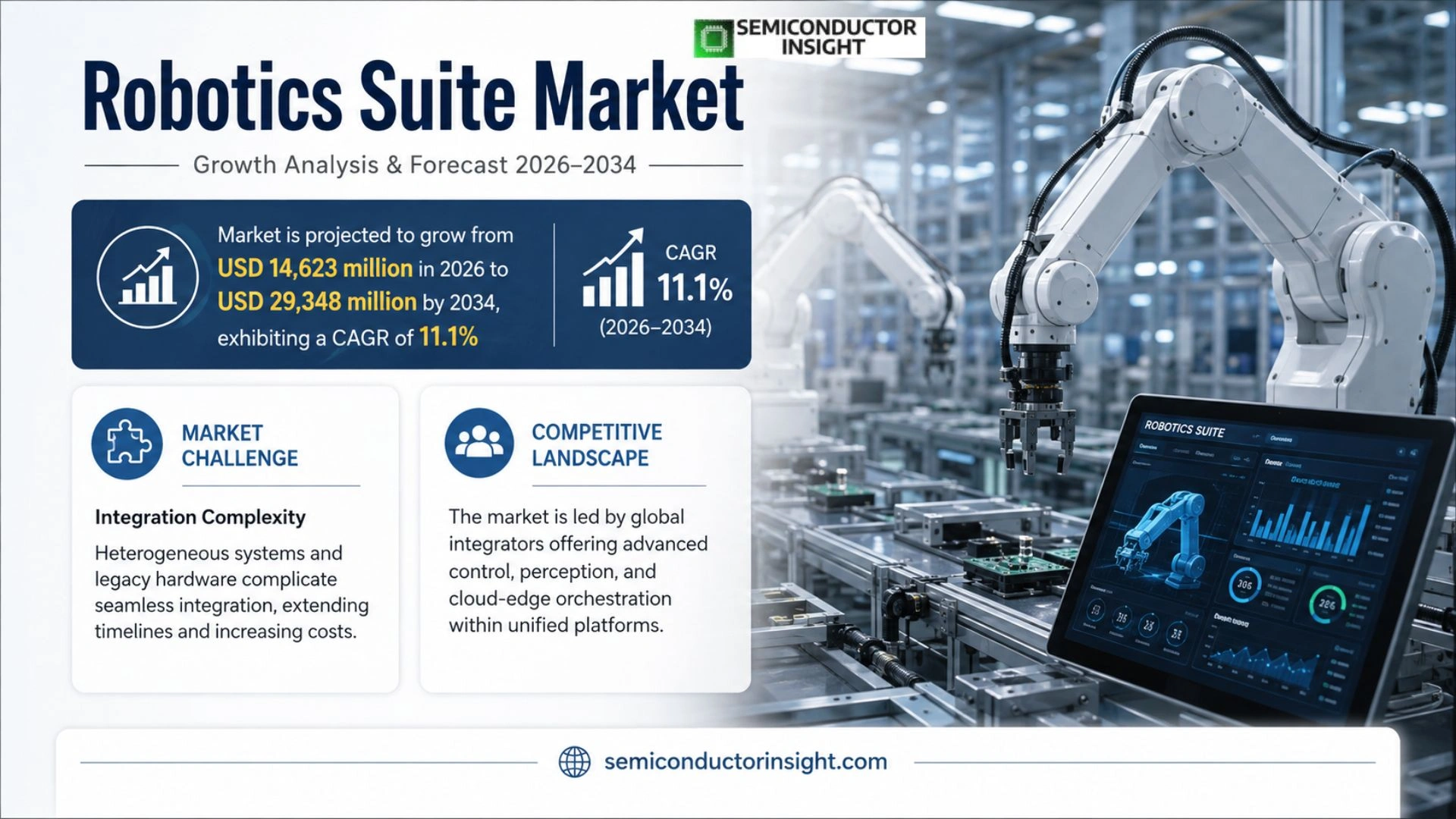
Robotics Suite market is projected to grow from USD 14,623 million in 2026 to USD 29,348 million by 2034, exhibiting a CAGR of 11.1% during the forecast period.
A Robotics Suite refers to an integrated set of hardware, software, and control modules designed to enable development, deployment, and operation of robotic systems. It typically combines robot control software, motion planning and execution, perception and vision modules, sensor integration, safety and communication interfaces, and development tools such as SDKs and simulation environments.
MARKET DRIVERS
Increasing Automation Demands
Manufacturers across automotive, electronics, and consumer goods are accelerating the shift from manual assembly to programmable robotics. The need to sustain throughput while trimming labor costs forces firms to evaluate comprehensive software stacks that orchestrate multiple robot types. As a result, Robotics Suite market experiences heightened interest from vendors capable of delivering end‑to‑end coordination tools.
Advances in AI Integration
Recent breakthroughs in machine vision and reinforcement learning enable robots to adapt to unstructured environments. When AI modules are embedded within a unified suite, operators can program adaptive behaviors without deep coding expertise. This functional depth expands the addressable user base beyond traditional engineering teams, fueling demand for more sophisticated platforms.
➤ “Enterprises that adopt an integrated robotics suite see a measurable reduction in cycle time, often within the first six months of deployment.”
Large‑scale adopters are also leveraging bundled analytics to mine performance data, turning operational metrics into continuous improvement loops. The strategic advantage of real‑time insights drives procurement decisions that prioritize platforms offering built‑in reporting and predictive maintenance capabilities.
Overall, the convergence of cost pressures, AI‑driven flexibility, and data‑centric operations creates a solid foundation for growth in Robotics Suite market.
MARKET CHALLENGES
Integration Complexity
Enterprises often operate heterogeneous hardware ecosystems, mixing legacy controllers with next‑generation collaborative robots. Aligning disparate protocols under a single suite demands extensive middleware development, which can stretch project timelines and inflate budgets. Clients frequently encounter unforeseen incompatibilities that erode the anticipated return on investment.
Other Challenges
Talent Gap
Skilled professionals who understand both robotic hardware and the software layers that bind them remain scarce. Companies must either invest in upskilling programs or rely on external consultants, both of which add cost pressure and can slow time‑to‑market.
Regulatory Compliance
Safety standards such as ISO 10218 and emerging data‑privacy mandates impose additional validation steps. Ensuring that a suite adheres to these regulations across multiple jurisdictions requires rigorous testing, which can deter smaller firms from adopting comprehensive solutions.
MARKET RESTRAINTS
High Capital Expenditure
Implementing a full‑featured robotics suite often entails upfront licensing fees, integration services, and hardware upgrades. For organizations operating on thin margins, the initial financial outlay can outweigh the perceived benefits, leading to delayed or phased rollouts.
Limited Standardization
The absence of universally accepted data models hampers interoperability between vendors. When manufacturers cannot guarantee seamless data exchange, they become cautious about committing to a single-suite strategy, preferring modular point solutions instead.
These fiscal and technical constraints temper the velocity at which Robotics Suite market can saturate certain segments, especially in regions where capital investment cycles are longer.
MARKET OPPORTUNITIES
Emerging Service Robotics
Beyond manufacturing, service sectors such as healthcare, hospitality, and logistics are experimenting with mobile manipulators and autonomous delivery bots. These applications require software that can handle dynamic task allocation, fleet management, and remote monitoring,capabilities that are still under‑served in current offerings.
Cloud‑Native Deployment Models
Shifting to subscription‑based, cloud‑hosted suites reduces the barrier of large upfront costs and provides scalable compute resources for AI inference. Early adopters report faster iteration cycles and easier access to the latest algorithmic updates, positioning cloud models as a compelling growth lever.
By targeting these nascent verticals and embracing flexible delivery mechanisms, providers can capture new revenue streams and broaden the overall footprint of Robotics Suite market.
Robotics Suite Market Trends
Modular and AI‑Enabled Suites
In 2025 Robotics Suite market supplied roughly 52,445 units, each priced near US$ 305,000 and delivering a gross margin of 37 %. Production capacity sits at about 60,000 units, indicating that manufacturers are operating with a modest excess that can be mobilised quickly when demand spikes. The current mix of hardware, motion‑planning software and sensor interfaces is shifting toward tighter modularity. Vendors now package independent AI kernels, perception stacks and safety layers that can be swapped without redesigning the underlying controller. This approach shortens time‑to‑market for specialised robots, lowers engineering overhead, and makes it feasible for system integrators to assemble bespoke solutions from a common set of building blocks. The financial implication is a gradual erosion of price‑sensitivity; customers are willing to pay a premium for suites that can be re‑configured across multiple projects, thereby stretching the return on each investment.
Other Trends
Cloud‑Connected and Edge AI Integration
The next wave of Robotics Suite market hinges on hybrid architectures that blend cloud resources with on‑device edge processors. By off‑loading heavy‑weight inference and simulation to the cloud, robots can receive continuous software updates, fleet‑wide analytics and remote diagnostics without interrupting their primary tasks. At the same time, edge AI chips retain low‑latency control loops, ensuring safety‑critical operations remain insulated from network latency. This duality unlocks new business models such as subscription‑based functionality and pay‑per‑use analytics, turning what was once a capital‑intensive purchase into an operational‑expense proposition. Companies that embed secure, OTA‑capable frameworks are positioning themselves to capture recurring revenue streams while helping end‑users mitigate the risk of obsolescence.
Open Interoperability and Ecosystem Expansion
Vendor lock‑in has long limited the scalability of robotic deployments. Recent introductions of open‑source middleware, standards‑based communication protocols and multi‑platform SDKs are eroding that barrier. When a suite can speak to hardware from Yaskawa, KUKA or emerging start‑ups alike, the ecosystem becomes more attractive for system integrators seeking to hedge against single‑supplier risk. This openness also accelerates innovation: third‑party developers can contribute perception algorithms or digital‑twin models that enrich the base offering without additional R&D spend from the core vendor. For Robotics Suite market, the strategic consequence is a redistribution of market share toward firms that act as platform orchestrators rather than pure hardware manufacturers, a shift that will shape partnership strategies and investment priorities over the next several years.
COMPETITIVE LANDSCAPE
Key Industry Players
Robotics Suite Market Competitive Overview
The segment is anchored by a handful of global integrators whose platforms combine advanced control algorithms, modular perception stacks, and cloud‑edge orchestration. ABB Robotics and Siemens stand out by leveraging deep automation portfolios and extensive service networks to capture the majority of high‑value contracts in automotive, electronics, and heavy‑industry factories. Their suites benefit from long‑standing relationships with OEMs, which translate into standardized engineering toolchains and predictable upgrade paths. Both firms maintain pricing power through patented middleware and a breadth of certification options that reduce customers’ integration risk. In parallel, Fanuc’s ecosystem emphasizes real‑time motion precision and a streamlined development environment that appeals to manufacturers prioritizing throughput over breadth of functionality. The concentration around these leaders creates a tiered market where mid‑size system integrators must either align with a dominant platform or differentiate through niche extensions, a dynamic that shapes partnership strategies and influences long‑term investment decisions.
Beyond the tier‑one manufacturers, a diversified cohort of specialist providers fuels innovation in specific functional blocks. Yaskawa and KUKA, for example, have built reputation for high‑performance motion‑control suites that excel in collaborative‑robot applications, a segment experiencing rapid adoption in small‑batch production. Denso and Mitsubishi Electric focus on perception‑heavy solutions, integrating vision, lidar, and AI inference engines optimized for logistics and warehousing. Bosch Rexroth and Schneider Electric bring strong expertise in safety‑rated communication interfaces, enabling seamless integration of legacy equipment with modern digital twins. Companies such as Omron, Keyence, and SICK AG concentrate on sensor‑fusion and real‑time diagnostics, providing valuable plug‑in modules for customers seeking incremental upgrades without overhauling existing hardware. This constellation of niche players generates competitive pressure that compels the larger vendors to expand their module libraries, accelerate open‑source collaborations, and enhance after‑sales support structures.
List of Key Robotics Suite Companies Profiled
- ABB Robotics
- Siemens
- Fanuc
- Yaskawa
- KUKA
- Denso
- Mitsubishi Electric
- Bosch Rexroth
- Schneider Electric
- Omron
- Keyence
- SICK AG
- Rockwell Automation
- Panasonic Industrial Devices
Segment Analysis:
| Segment Category | Sub-Segments | Key Insights |
| By Type |
|
Control & Software Suite is emerging as the foundational layer for most robotics deployments.
|
| By Application |
|
Industrial Automation remains the dominant driver for suite adoption.
|
| By End User |
|
System Integrators benefit most from mature suite ecosystems.
|
| By Deployment |
|
Cloud‑Enabled suites are gaining traction as organizations seek scalable fleet management.
|
| By Product Scale |
|
Modular Suites are reshaping adoption curves across diverse market participants.
|
Regional Analysis: Robotics Suite Market
Leading manufacturers are layering AI perception modules onto legacy robot controllers, turning static equipment into adaptive platforms. The move reflects a broader appetite for suites that can ingest sensor streams and self‑optimize motion paths without extensive re‑engineering.
Safety certifications such as ISO 10218 and emerging collaborative‑robot guidelines provide a predictable framework, encouraging firms to invest in higher‑level software that automates compliance documentation.
Universities and bootcamps are tailoring curricula toward robotics‑software engineering, creating a pipeline of developers fluent in ROS‑based suites. Employers benefit from reduced onboarding cycles and faster iteration on custom extensions.
Beyond traditional heavy‑industry, the consumer‑goods sector is leveraging suites to orchestrate rapid SKU changes, while logistics firms adopt collaborative robot orchestration to flexibly scale fulfilment centres.
Europe
European firms are capitalising on strong public‑private partnerships that fund the development of open‑source robotics frameworks. The region’s emphasis on sustainability drives deployment of suites that optimise energy consumption and enable circular‑economy practices. Moreover, fragmented national standards are gradually coalescing under EU directives, simplifying cross‑border implementation for multinational players.
Asia‑Pacific
In Asia‑Pacific, rapid industrialisation coupled with a surge in electronics manufacturing creates a fertile ground for Robotics Suite Market growth. Companies are favouring cloud‑native architectures that support remote monitoring, a response to the region’s dispersed production networks. Local software vendors are forging alliances with global OEMs to embed advanced analytics, reinforcing the shift toward data‑centric automation.
South America
South American adopters are navigating economic volatility by prioritising modular suites that allow incremental upgrades. The focus on agriculture and mining sectors underscores a need for rugged solutions that can integrate with existing equipment while delivering higher precision and reduced downtime.
Middle East & Africa
In the Middle East & Africa, sovereign wealth funds are channeling capital into smart‑factory initiatives, positioning robotics suites as the backbone of diversification strategies. The market is characterised by bespoke deployments that address both oil‑field automation and emerging renewable‑energy projects, highlighting the versatility of integrated software ecosystems.
Report Scope
This market research report provides a comprehensive analysis of the Robotics Suite Market , covering the forecast period 2026–2034. It offers detailed insights into market dynamics, technological advancements, competitive landscape, and key trends shaping the industry.
Key focus areas of the report include:
- Market Overview: The report begins with an overview outlining its current market scenario, key growth indicators, and industry transformation drivers. It discusses macroeconomic factors, demand–supply balance, regulatory landscape, and the strategic role of semiconductors in powering advancements across industries such as automotive, telecommunications, consumer electronics, and industrial automation.
- Market Size & Forecast: Historical data and future projections for revenue, unit shipments, and market value across major regions and segments.
- Segmentation Analysis: Detailed breakdown by product type, technology, application, and end-user industry to identify high-growth segments and investment opportunities.
- Regional Insights: Insights into market performance across North America, Europe, Asia-Pacific, Latin America, and the Middle East & Africa, including country-level analysis where relevant.
- Competitive Landscape: Profiles of leading market participants, including their product offerings, R&D focus, manufacturing capacity, pricing strategies, and recent developments such as mergers, acquisitions, and partnerships.
- Technology Trends & Innovation: Assessment of emerging technologies, integration of AI/IoT, semiconductor design trends, fabrication techniques, and evolving industry standards.
- Market Drivers & Restraints: Evaluation of factors driving market growth along with challenges, supply chain constraints, regulatory issues, and market-entry barriers.
- Stakeholder Insights: Insights for component suppliers, OEMs, system integrators, investors, and policymakers regarding the evolving ecosystem and strategic opportunities.
Primary and secondary research methods are employed, including interviews with industry experts, data from verified sources, and real-time market intelligence to ensure the accuracy and reliability of the insights presented.
FREQUENTLY ASKED QUESTIONS:
What is the current market size of Robotics Suite Market?
-> Robotics Suite market is projected to grow from USD 14,623 million in 2026 to USD 29,348 million by 2034, exhibiting a CAGR of 11.1%
Which key companies operate in Robotics Suite Market?
-> Key players include Yaskawa, Fanuc, KUKA, ABB Robotics, Mitsubishi Electric, Denso, Nachi, Kawasaki Robotics, STMicroelectronics, Schneider Electric, Siemens, Rockwell Automation, Renishaw, Harmonic Drive, THK, Bosch Rexroth, Maxon Motor, Kollmorgen, Panasonic Industrial Devices, Omron, Keyence, SICK AG.
What are the key growth drivers?
-> Key growth drivers include rising demand for industrial automation and logistics robotics, increased adoption of service and humanoid robots, integration of advanced AI and edge‑computing capabilities, modular and open‑architecture designs, and the push for cloud‑enabled fleet management and digital‑twin simulation.
Which region dominates the market?
-> Asia dominates Robotics Suite market, driven primarily by large manufacturing bases in China, Japan, and South Korea, extensive automation investments, and rapid growth in both industrial and service robotics applications.
What are the emerging trends?
-> Emerging trends include AI‑driven perception and decision‑making modules, cloud‑connected and edge‑AI architectures, enhanced digital‑twin and simulation tools, greater emphasis on safety, cybersecurity, and open‑interoperable frameworks that reduce vendor lock‑in.

Get Sample Report PDF for Exclusive Insights
Report Sample Includes
- Table of Contents
- List of Tables & Figures
- Charts, Research Methodology, and more...
