
AI Workload-Optimized DRAM Module Market Insights
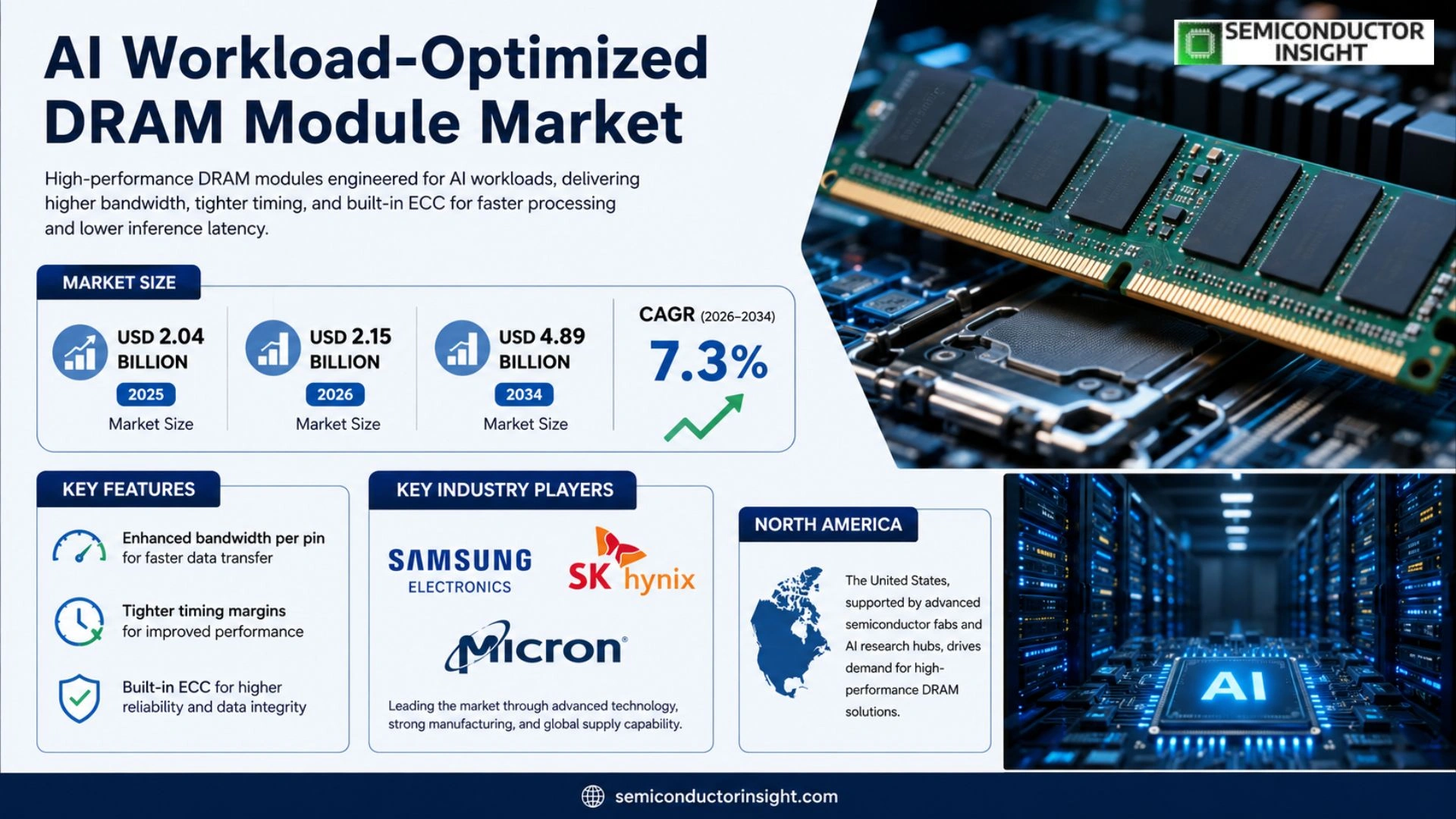
Global AI Workload-Optimized DRAM Module market size was valued at USD 2.04 billion in 2025. The market will increase from USD 2.15 billion in 2026 to USD 4.89 billion by 2034, reflecting a CAGR of 7.3% during the forecast period.
AI workload‑optimized DRAM modules are high‑performance memory components engineered for artificial‑intelligence tasks; they typically feature enhanced bandwidth per pin, tighter timing margins and built‑in error‑correction code (ECC) that together enable faster matrix multiplications and reduced inference latency compared with standard DDR memories.
Adoption accelerates because large language models demand ever‑greater data throughput, while hyperscale cloud providers seek cost‑effective ways to boost compute density. Consequently, server manufacturers are integrating these modules into next‑generation GPU/CPU platforms. Companies such as Samsung Electronics, SK Hynix, Micron Technology and Nanya Technology are actively expanding production capacity and announcing newer generations that support DDR5‑based AI profiles.
MARKET DRIVERS
Rising AI Compute Demands
Enterprises are scaling generative‑AI models that require memory bandwidth far beyond conventional DRAM capabilities. As model parameters swell, latency becomes a decisive factor for training turnaround times. Companies that can supply modules calibrated for high‑throughput workloads gain a competitive edge, prompting OEMs to redesign system architectures around these memory solutions.
Advances in Memory Architecture
Recent innovations such as on‑die error correction and variable‑rate refresh have lowered power draw while preserving data integrity under intensive access patterns. These technical refinements translate into higher effective capacity per watt, a metric that data‑center operators now monitor closely when budgeting for AI infrastructure.
➤ “Optimizing DRAM for AI workloads reduces training cost per epoch by up to 15 %, a margin that directly influences profit projections for AI‑driven services.”
Because the economic case for accelerated AI pipelines is now quantifiable, investors are allocating capital to vendors that promise memory subsystems tuned for tensor operations, reinforcing the upward trajectory of the AI Workload‑Optimized DRAM Module Market.
MARKET CHALLENGES
Cost Pressures
Fabricating high‑performance DRAM with tighter timing windows incurs additional mask and testing expenses. When the price differential exceeds the perceived performance gain, customers may revert to standard modules, diluting adoption rates. Balancing margin expectations with the need for premium pricing remains a delicate exercise for suppliers.
Other Challenges
Supply Chain Constraints
The semiconductor ecosystem is still recovering from capacity bottlenecks, and the specialized equipment required for AI‑tuned DRAM is limited to a handful of fabs. Lead times have lengthened, forcing system integrators to hold larger inventories, which in turn raises total cost of ownership.
MARKET RESTRAINTS
Thermal Management Limits
AI‑intensive workloads drive DRAM modules into higher power envelopes, generating heat that can exceed the thermal design limits of existing server racks. Without adequate cooling solutions, error rates rise, eroding the reliability advantage these modules are meant to provide.
Designers often have to trade off raw frequency for lower voltage operation to stay within thermal budgets, which can blunt the performance edge that the optimized modules promise. This compromise deters some data‑center operators from committing fully to the newer memory class.
Furthermore, retrofitting legacy infrastructure with advanced cooling technologies entails capital expenditures that many organizations postpone, creating a restraint on widespread deployment.
MARKET OPPORTUNITIES
Emerging Edge AI Deployments
Edge devices such as autonomous drones and smart factories are beginning to run inference models that rival cloud‑based counterparts. These scenarios demand memory that can sustain bursts of computation with minimal latency, opening a niche for AI‑specific DRAM outside traditional data‑center boundaries.
Manufacturers that can integrate low‑power, high‑bandwidth modules into compact edge platforms stand to capture early‑adopter revenue, especially as regulatory pressures push for on‑premise processing of sensitive data.
Strategic partnerships between memory vendors and edge‑AI chipset designers are already materializing, suggesting a pipeline of co‑engineered products that could expand the addressable market considerably.
AI Workload-Optimized DRAM Module Market Trends
Growing Demand from Large‑Language‑Model Deployments
The proliferation of massive transformer‑based models has forced hyperscale data centers to re‑examine their memory hierarchy. Standard DDR memories, while cost‑effective, impose latency ceilings that translate into slower inference cycles for multi‑billion‑parameter networks. By contrast, AI Workload-Optimized DRAM modules deliver tighter timing windows and built‑in ECC, which together shrink the time required for matrix multiplication kernels. This technical advantage has prompted cloud operators to replace legacy sticks with AI‑tuned parts, especially in racks where GPU density is at its peak. The shift is not merely a hardware refresh; it reflects a broader strategic move to squeeze more AI throughput per square foot of floor space, thereby improving the economics of large‑scale model serving.
Other Trends
Capacity Expansion by Leading Semiconductor Vendors
Manufacturers such as Samsung Electronics, SK Hynix, Micron Technology and Nanya Technology have announced multi‑year capacity plans that double their AI‑optimized DDR output within the next five years. These programs are anchored in new fab lines that prioritize DDR5‑based AI profiles, allowing higher data rates without sacrificing signal integrity. The expansion is accompanied by product‑roadmap updates that feature larger die stacks and on‑chip calibration engines, which reduce the need for external error‑correction logic. For OEMs, the increased supply translates into shorter lead times and a more predictable cost structure, encouraging broader adoption across mid‑range server platforms.
Shift Toward DDR5‑Based AI Profiles
While early‑generation AI‑optimized modules were built on DDR4, the industry is now converging on DDR5 as the foundational substrate. DDR5’s inherent higher per‑pin bandwidth and deeper bank architecture align naturally with the throughput demands of inference workloads. Moreover, the newer standard embeds on‑die ECC, which dovetails with the error‑resilience requirements of continuous learning pipelines. This transition is already influencing procurement strategies: buyers are specifying DDR5‑compatible AI profiles in their RFPs, and system integrators are redesigning memory controllers to exploit the expanded burst lengths. The result is a virtuous cycle where software teams can push larger batch sizes, and hardware teams can deliver modules that keep latency in check, ultimately delivering a more competitive AI Workload-Optimized DRAM Module Market.
COMPETITIVE LANDSCAPE
Key Industry Players
AI Workload‑Optimized DRAM Modules: Competitive Overview
The upper tier of the market is occupied by three silicon giants,Samsung Electronics, SK Hynix and Micron Technology,each leveraging deep vertical integration to command both fab capacity and advanced packaging lines. Their recent roadmaps emphasize DDR5‑based AI profiles, with silicon‑process refinements that push per‑pin bandwidth beyond 8 Gb/s and embed latency‑optimised ECC. By aligning product releases with hyperscale cloud adopters and next‑generation GPU/CPU reference designs, these firms have secured multi‑year supply contracts that lock in premium pricing. Their scale enables aggressive cost engineering, allowing them to absorb the higher wafer‑count associated with wider I/O interfaces while still delivering competitive total‑cost‑of‑ownership to data‑center operators.
Beyond the leaders, a cadre of specialist manufacturers is shaping a more diversified supply side. Nanya Technology and Kioxia (formerly Toshiba Memory) focus on niche server segments that prioritize cost‑effective density over absolute peak performance, often pairing their modules with third‑party ECC controllers. Powerchip Technology, Winbond Electronics, Macronix International and GigaDevice Semiconductor target emerging‑market OEMs, offering custom timing profiles and localized production to reduce lead‑time. These players typically adopt a fab‑sharing model, collaborating with foundries in Taiwan and South Korea to accelerate time‑to‑market for DDR5‑AI variants. Their collective strategy hinges on flexibility,rapidly iterating on error‑correction schemes and power‑management features,to capture clients that are price‑sensitive yet require reliable inference acceleration.
List of Key AI Workload-Optimized DRAM Module Companies Profiled
- Samsung Electronics
- SK Hynix
- Micron Technology
- Nanya Technology
- Kioxia (Toshiba Memory)
- Powerchip Technology
- Winbond Electronics
- Macronix International
- GigaDevice Semiconductor
- Alliance Memory
- Integrated Silicon Solutions (ISSI)
- Rambus (through licensing agreements)
Segment Analysis:
| Segment Category | Sub-Segments | Key Insights |
| By Type |
|
DDR5 AI‑Optimized
|
| By Application |
|
Model Training
|
| By End User |
|
Hyperscale Cloud Providers
|
| By Architecture |
|
GPU‑Centric Systems
|
| By Performance Tier |
|
Premium AI Modules
|
Regional Analysis: AI Workload-Optimized DRAM Module Market
North America
Cloud operators in the U.S. are redeploying server clusters with DRAM modules that feature on‑die error correction and AI‑centric bandwidth scaling, a move that enables multi‑tenant AI workloads to coexist without compromising throughput.
Proximity to fabs in Arizona and Texas shortens the design‑to‑silicon cycle, allowing OEMs to iterate on memory timings that directly benefit transformer‑based models.
Federal programs that subsidize high‑performance computing clusters encourage early adoption of AI‑optimized DRAM, reinforcing the region’s competitive edge.
A concentration of AI PhDs and memory‑architecture specialists fuels collaborative R&D, accelerating the translation of research breakthroughs into commercial DRAM designs.
Europe
Western Europe’s industrial automation and fintech sectors are re‑engineering their compute stacks to accommodate AI‑centric memory footprints. German manufacturing plants, for instance, replace conventional modules with those offering higher bank parallelism, a tweak that aligns with the continent’s push toward “Industry 4.0” standards. The United Kingdom’s focus on sovereign AI capability has spurred public‑private partnerships that test AI‑optimized DRAM in edge‑cloud deployments, creating a niche market for low‑power, high‑bandwidth solutions. Collectively, these moves reflect Europe’s strategic aim to embed AI performance at the hardware layer rather than relying solely on software optimizations.
Asia-Pacific
In Asia‑Pacific, China’s aggressive AI rollout and South Korea’s memory‑chip heritage generate a potent blend of demand and manufacturing depth. Chinese cloud giants are experimenting with bespoke DRAM configurations that prioritize throughput for massive language models, prompting Taiwanese and Korean manufacturers to tailor product lines for regional specifications. Meanwhile, Japan’s emphasis on robotics and vision systems drives interest in modules that can sustain continuous, high‑resolution data streams without thermal throttling. The region’s competitive landscape forces vendors to maintain parallel development tracks, balancing performance aspirations with cost sensitivities unique to each market.
South America
South America remains an emerging arena where multinational chip distributors introduce AI‑optimized DRAM through pilot projects in Brazil’s growing fintech and agritech sectors. Local startups, seeking to differentiate their AI services, favor memory that offers deterministic latency, a characteristic that can translate into more reliable predictive analytics for crop yields. Although the market size is modest, early adopters are influencing regional supply chains, encouraging distributors to stock a broader array of AI‑tuned modules to meet nascent demand.
Middle East & Africa
The Middle East & Africa region is witnessing a gradual shift as sovereign wealth funds allocate capital to AI research hubs in the United Arab Emirates and South Africa. These hubs prioritize low‑power, high‑density DRAM modules to support edge‑computing deployments in smart‑city projects and oil‑field analytics. While overall adoption remains at an exploratory stage, the strategic focus on data‑intensive applications signals a long‑term appetite for memory solutions that can underpin AI workloads without incurring prohibitive energy costs.
Report Scope
This market research report provides a comprehensive analysis of the AI Workload-Optimized DRAM Module Market , covering the forecast period 2026–2034. It offers detailed insights into market dynamics, technological advancements, competitive landscape, and key trends shaping the industry.
Key focus areas of the report include:
- Market Overview: The report begins with an overview outlining its current market scenario, key growth indicators, and industry transformation drivers. It discusses macroeconomic factors, demand–supply balance, regulatory landscape, and the strategic role of semiconductors in powering advancements across industries such as automotive, telecommunications, consumer electronics, and industrial automation.
- Market Size & Forecast: Historical data and future projections for revenue, unit shipments, and market value across major regions and segments.
- Segmentation Analysis: Detailed breakdown by product type, technology, application, and end-user industry to identify high-growth segments and investment opportunities.
- Regional Insights: Insights into market performance across North America, Europe, Asia-Pacific, Latin America, and the Middle East & Africa, including country-level analysis where relevant.
- Competitive Landscape: Profiles of leading market participants, including their product offerings, R&D focus, manufacturing capacity, pricing strategies, and recent developments such as mergers, acquisitions, and partnerships.
- Technology Trends & Innovation: Assessment of emerging technologies, integration of AI/IoT, semiconductor design trends, fabrication techniques, and evolving industry standards.
- Market Drivers & Restraints: Evaluation of factors driving market growth along with challenges, supply chain constraints, regulatory issues, and market-entry barriers.
- Stakeholder Insights: Insights for component suppliers, OEMs, system integrators, investors, and policymakers regarding the evolving ecosystem and strategic opportunities.
Primary and secondary research methods are employed, including interviews with industry experts, data from verified sources, and real-time market intelligence to ensure the accuracy and reliability of the insights presented.
FREQUENTLY ASKED QUESTIONS:
What is the current market size of AI Workload-Optimized DRAM Module Market?
-> AI Workload-Optimized DRAM Module market will increase from USD 2.15 billion in 2026 to USD 4.89 billion by 2034, reflecting a CAGR of 7.3%
Which key companies operate in AI Workload-Optimized DRAM Module Market?
-> Key players include Samsung Electronics, SK Hynix, Micron Technology, and Nanya Technology, among others.
What are the key growth drivers?
-> Key growth drivers include rising data‑throughput demands of large language models, hyperscale cloud providers seeking higher compute density, and the integration of these modules into next‑generation GPU/CPU platforms.
Which region dominates the market?
-> The reference does not specify a single dominant region; market activity is driven globally by major hyperscale cloud hubs.
What are the emerging trends?
-> Emerging trends include DDR5‑based AI profiles, enhanced bandwidth per pin, tighter timing margins, and built‑in error‑correction code (ECC) to accelerate matrix multiplications and reduce inference latency.
Get Sample Report PDF for Exclusive Insights
Report Sample Includes
- Table of Contents
- List of Tables & Figures
- Charts, Research Methodology, and more...
 Download Sample Report PDF





