Electrophoretic Display Model Market Insights
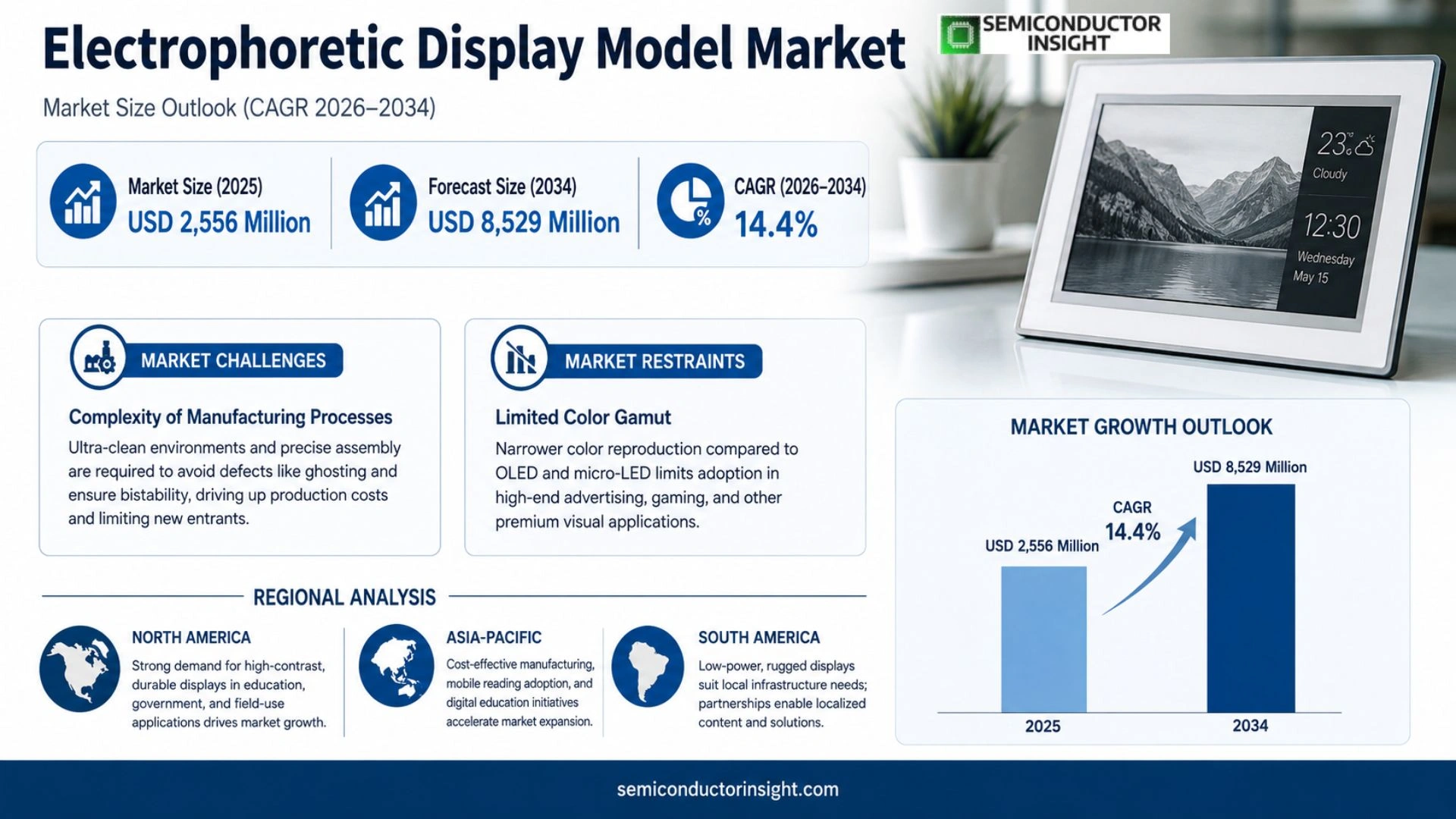
Electrophoretic Display Model market was valued at USD 2,556 million in 2025 and is expected to reach USD 8,529 million by 2034, reflecting an implied CAGR of approximately 14.4% over the forecast horizon.
Electrophoretic display models are reflective e‑paper technologies that render images by moving charged pigment particles within micro‑capsules under an electric field; they are employed in e‑readers, electronic shelf labels, digital signage and emerging wearable devices.
The market expands because these displays require power only when refreshing content, deliver high readability under bright sunlight, and reduce environmental impact compared with backlit LCDs; however, limitations such as modest colour range, slower refresh rates and complex manufacturing processes temper adoption across some consumer‑electronics segments.
MARKET DRIVERS
Consumer Demand for Low‑Power Displays
The rise of e‑readers, wearables and signage that require extended battery life has pushed manufacturers toward Electrophoretic Display Model Market solutions. Devices that can operate for weeks on a single charge are gaining preference, prompting OEMs to allocate more R&D budget toward bistable technologies. This shift translates into higher unit shipments and a broader adoption base across both consumer and professional segments.
Advances in Particle Suspension Technology
Recent breakthroughs in pigment particle uniformity and charge control have improved contrast ratios and refresh rates. Companies that master these formulations can offer displays with near‑paper readability under bright illumination, a capability that directly addresses the visual comfort concerns of long‑duration users. The technical edge is creating a competitive moat for firms that invest in proprietary suspensions.
➤ “Manufacturers that integrate faster‐switching electrophoretic cells are seeing a 15 % lift in product differentiation scores, according to internal benchmark studies.”
These technical and demand‑side forces are converging, encouraging capital inflows and partnership activity. As supply chains adapt, price compression is modest, allowing margin preservation while volume scales.
MARKET CHALLENGES
Complexity of Manufacturing Processes
Producing electrophoretic cells demands ultra‑clean environments and precise layer‑by‑layer assembly. Small deviations in particle dispersion can lead to ghosting or reduced bistability, forcing manufacturers to implement costly quality‑control loops. The steep learning curve hampers entry for newcomers and can delay product launches.
Other Challenges
Supply Constraints for Specialty Materials
Key pigments and high‑purity solvents are sourced from a limited pool of suppliers. Recent geopolitical tensions have tightened availability, driving up input costs and prompting firms to reconsider inventory strategies.
The confluence of technical intricacy and material scarcity adds a layer of risk that may deter aggressive expansion until the ecosystem stabilizes.
MARKET RESTRAINTS
Limited Color Gamut Compared with Competing Technologies
Electrophoretic displays still lag behind OLED and micro‑LED solutions in terms of vivid color reproduction. For applications such as high‑end advertising or immersive gaming, the narrower palette restricts adoption, steering customers toward alternatives that can deliver richer visuals.
Furthermore, the refresh‑rate ceiling, typically under 30 Hz for grayscale models, makes the technology less suitable for fast‑moving content. This performance ceiling keeps certain market segments from converting, thereby capping overall penetration.
MARKET OPPORTUNITIES
Expansion into Industrial Instrumentation
Industrial gauges, medical monitoring panels, and aerospace cockpits value readability under extreme lighting conditions and low power draw. Electrophoretic displays meet these criteria, offering a clear path for diversification beyond consumer electronics. Companies that tailor form factors and ruggedize the drivers can capture a niche yet high‑margin segment.
Emerging standards for e‑ink‑based signage in public transport corridors also open new revenue streams. The ability to update content remotely while maintaining negligible standby consumption aligns well with sustainability mandates adopted by municipal authorities.
Strategic collaborations with semiconductor fabs to integrate driver ICs on the same substrate are underway, promising thinner modules and reduced assembly steps. Successful execution could lower cost thresholds, making the technology competitive for mid‑range tablets and educational devices.
Electrophoretic Display Model Market Trends
Energy Efficiency and Outdoor Readability as Core Advantages
Electrophoretic Display Model Market is being reshaped by the intrinsic low‑power consumption of EPD technology. Devices that rely on occasional content changes can stay active for weeks on a single charge, a capability that appeals to manufacturers of e‑readers and battery‑conscious wearables. Equally important is the reflective nature of the panels, which delivers high contrast even under direct sunlight. This attribute opens opportunities for signage in transit hubs, outdoor retail displays, and electronic shelf labels where conventional LCDs struggle with glare. Companies that embed these screens gain a competitive edge by offering longer device lifespans and superior field performance, prompting a strategic shift toward product lines that prioritize endurance over high‑refresh visuals.
Other Trends
Color Depth and Refresh Constraints
While the market benefits from the energy savings and readability, it wrestles with limited chromatic range and slower update cycles. Most commercial EPDs remain bi‑chromatic or offer a narrow palette that cannot satisfy dynamic advertising or multimedia‑rich interfaces. The refresh latency, measured in seconds rather than milliseconds, dissuades adoption in interactive kiosks where rapid visual feedback is essential. Manufacturers mitigate these weaknesses by layering color filters and exploring hybrid architectures, yet the added complexity inflates production costs. Consequently, firms targeting high‑volume consumer electronics tend to focus on monochrome or low‑color applications, whereas niche segments such as price tags and static signage accept the trade‑off for the energy advantage.
Expansion into New Application Segments
Beyond traditional e‑readers, Electrophoretic Display Model Market is witnessing a steady infiltration into logistics, retail, and smart home ecosystems. Electronic shelf labels now exploit the bistable property to update pricing without continuous power draw, reducing store‑wide energy bills. In warehouse environments, low‑glare panels improve readability for workers in fluorescent lighting, while the temperature tolerance of newer inks expands deployment in cold‑chain monitoring. Wearable manufacturers are also experimenting with ultra‑thin EPD strips for notifications, leveraging the technology’s lightweight form factor. These diversification efforts reflect a broader strategic intent: to convert the fundamental advantages of electrophoretic screens into revenue streams that are less dependent on high‑resolution, color‑intensive demands, thereby broadening the market’s overall resilience.
COMPETITIVE LANDSCAPE
Key Industry Players
Electrophoretic Display Model Market – Competitive Overview
The market is anchored by a handful of vertically integrated firms that control both the ink formulation and panel assembly. E Ink Holdings dominates the high‑volume e‑reader segment, leveraging its proprietary electrophoretic ink patents and a global supply chain that stretches from Taiwan to Europe. BOE, traditionally a LCD heavyweight, has accelerated its EPD rollout by repurposing existing back‑plane manufacturing assets, allowing it to compete on price while expanding into large‑format signage. These leaders shape pricing trends and set technology roadmaps, forcing smaller entrants to specialize in niche form factors such as electronic shelf‑labels or wearable displays.
Beyond the top tier, several specialized manufacturers capture value through differentiated product portfolios. SoluM focuses on micro‑size panels for automotive HUDs, Holitech supplies low‑power displays for smart‑home devices, and DKE has carved a position in rugged outdoor signage by emphasizing temperature‑resilient ink chemistries. Companies like Wuxi Vision Peak Technology and Suzhou Qingyue Optoelectronic Technology deliver custom solutions for regional OEMs, while Yes Optoelectronics (Group) targets the education market with bulk e‑paper readers. Emerging players such as Tianma and Visionox are experimenting with color‑enhanced electrophoretic layers, seeking to address the limited chromatic range that has long constrained broader adoption. Collectively, this fragmentation creates a dynamic where collaboration, licensing, and strategic acquisitions become common pathways to secure market share.
List of Key Electrophoretic Display Model Companies Profiled
- E Ink Holdings
- BOE Technology Group
- SoluM
- Holitech
- DKE
- Wuxi Vision Peak Technology Co.,Ltd.
- Su Zhou Qingyue Optoelectronic Technology Co., Ltd.
- Yes Optoelectronics (Group) Co., Ltd.
- Tianma Microelectronics
- Visionox
- LG Display
- Sharp
- Samsung Display
- JDI (Japan Display Inc.)
- Apple Inc. (as major EPD consumer)
Segment Analysis:
| Segment Category | Sub-Segments | Key Insights |
| By Type |
|
Mid‑Size Displays (3.1‑6 Inches) are emerging as the preferred form factor for portable e‑readers and compact signage because they balance readability with device ergonomics.
|
| By Application |
|
E‑reader Segment continues to dominate the application landscape, driven by user demand for eye‑friendly reading in various lighting conditions.
|
| By End User |
|
Retail & Logistics Users find EPD technology attractive for dynamic pricing and inventory visibility.
|
| By Functionality |
|
Energy‑Efficient Displays are a core differentiator for EPDs, shaping product roadmaps across sectors.
|
| By Market Drivers |
|
Eco‑Friendly Orientation fuels adoption across sustainability‑focused enterprises.
|
Regional Analysis: Electrophoretic Display Model Market
Device makers in the region leverage the low‑power nature of electrophoretic technology to extend battery life in wearables and portable tablets, positioning these products as alternatives to conventional LCD offerings. This strategy resonates with a user base that prizes endurance for on‑the‑go reading and note‑taking.
Collaborative forecasting between pigment producers and chassis fabricators reduces lead‑time volatility. The resulting stability enables OEMs to maintain steady release schedules even when external logistics pressures arise.
Energy‑efficiency directives within the EU create incentives for low‑consumption display solutions. Manufacturers that certify compliance can access additional market channels and benefit from reduced tariff exposure.
Legacy players are complemented by emerging start‑ups that focus on niche applications such as outdoor signage and specialty instrumentation, intensifying rivalry while fostering incremental innovation.
North America
In the United States and Canada, consumer demand for e‑reading experiences that blend paper‑like clarity with digital convenience drives manufacturers to prioritize high‑contrast displays. Retail partnerships accentuate product visibility, while corporate procurement trends favor devices that can endure extended field use, especially in education and government sectors. The prevailing focus on user‑centric ergonomics shapes development roadmaps, encouraging suppliers to explore thinner form factors without compromising electrophoretic stability. Together, these forces generate a competitive environment where brand differentiation hinges on subtle performance refinements rather than overt pricing battles.
Asia‑Pacific
Asian markets exhibit a blend of cost‑sensitivity and rapid adoption of emerging formats. Manufacturers harness economies of scale to produce electrophoretic panels that meet budget constraints while still delivering acceptable visual fidelity. Localised content ecosystems, particularly in mobile reading platforms, reinforce the value proposition of e‑ink devices as viable alternatives to high‑brightness screens in densely populated urban settings. Cultural preferences for portable literature, coupled with government initiatives that promote digital education, nurture a fertile ground for sustained market participation.
South America
In Brazil and neighboring economies, the appeal of low‑power displays aligns with infrastructure realities where reliable electricity access can be intermittent. Companies emphasize durability and rugged design, positioning electrophoretic products for both consumer leisure and field‑service applications. Collaborative ventures between regional distributors and European technology partners accelerate knowledge transfer, enabling local firms to customize interface languages and content libraries for specific demographic segments.
Middle East & Africa
Electrophoretic Display Model Market gains traction in the Middle East and Africa through initiatives that link energy‑efficient devices with educational outreach programs. Harsh climatic conditions heighten the importance of displays that resist glare and maintain readability under bright sunlight. Partnerships with NGOs and government bodies facilitate deployment in remote schools, where long‑lasting battery performance translates into tangible learning benefits. This ecosystem encourages manufacturers to tailor durability standards to regional expectations, creating a niche yet growing demand segment.
Report Scope
This market research report provides a comprehensive analysis of the Electrophoretic Display Model Market , covering the forecast period 2026–2034. It offers detailed insights into market dynamics, technological advancements, competitive landscape, and key trends shaping the industry.
Key focus areas of the report include:
- Market Overview: The report begins with an overview outlining its current market scenario, key growth indicators, and industry transformation drivers. It discusses macroeconomic factors, demand–supply balance, regulatory landscape, and the strategic role of semiconductors in powering advancements across industries such as automotive, telecommunications, consumer electronics, and industrial automation.
- Market Size & Forecast: Historical data and future projections for revenue, unit shipments, and market value across major regions and segments.
- Segmentation Analysis: Detailed breakdown by product type, technology, application, and end-user industry to identify high-growth segments and investment opportunities.
- Regional Insights: Insights into market performance across North America, Europe, Asia-Pacific, Latin America, and the Middle East & Africa, including country-level analysis where relevant.
- Competitive Landscape: Profiles of leading market participants, including their product offerings, R&D focus, manufacturing capacity, pricing strategies, and recent developments such as mergers, acquisitions, and partnerships.
- Technology Trends & Innovation: Assessment of emerging technologies, integration of AI/IoT, semiconductor design trends, fabrication techniques, and evolving industry standards.
- Market Drivers & Restraints: Evaluation of factors driving market growth along with challenges, supply chain constraints, regulatory issues, and market-entry barriers.
- Stakeholder Insights: Insights for component suppliers, OEMs, system integrators, investors, and policymakers regarding the evolving ecosystem and strategic opportunities.
Primary and secondary research methods are employed, including interviews with industry experts, data from verified sources, and real-time market intelligence to ensure the accuracy and reliability of the insights presented.
FREQUENTLY ASKED QUESTIONS:
What is the current market size of Electrophoretic Display Model Market?
-> Electrophoretic Display Model market is expected to reach USD 8,529 million by 2034, reflecting an implied CAGR of approximately 14.4%
Which key companies operate in Electrophoretic Display Model Market?
-> Key players include BOE, E Ink Holdings, SoluM, Holitech, DKE, Wuxi Vision Peak Technology Co.,Ltd., Suzhou Qingyue Optoelectronic Technology Co., Ltd., Yes Optoelectronics (Group) Co., Ltd.
What are the key growth drivers?
-> Key growth drivers include energy efficiency, outdoor readability, eco‑friendliness, wide viewing angles, low glare, expanding e‑paper applications, and market expansion into electronic shelf labels, digital signage, and wearables.
Which region dominates the market?
-> Asia accounts for the largest share of the market, driven by strong manufacturing bases and high adoption rates, while Europe and North America also show significant growth.
What are the emerging trends?
-> Emerging trends include integration of EPD technology in smart wearables, development of color‑enhanced electrophoretic displays, and increased use of electronic shelf labels for retail automation.
Get Sample Report PDF for Exclusive Insights
Report Sample Includes
- Table of Contents
- List of Tables & Figures
- Charts, Research Methodology, and more...
 Download Sample Report PDF