Electronic Shelf Label Module Market Insights
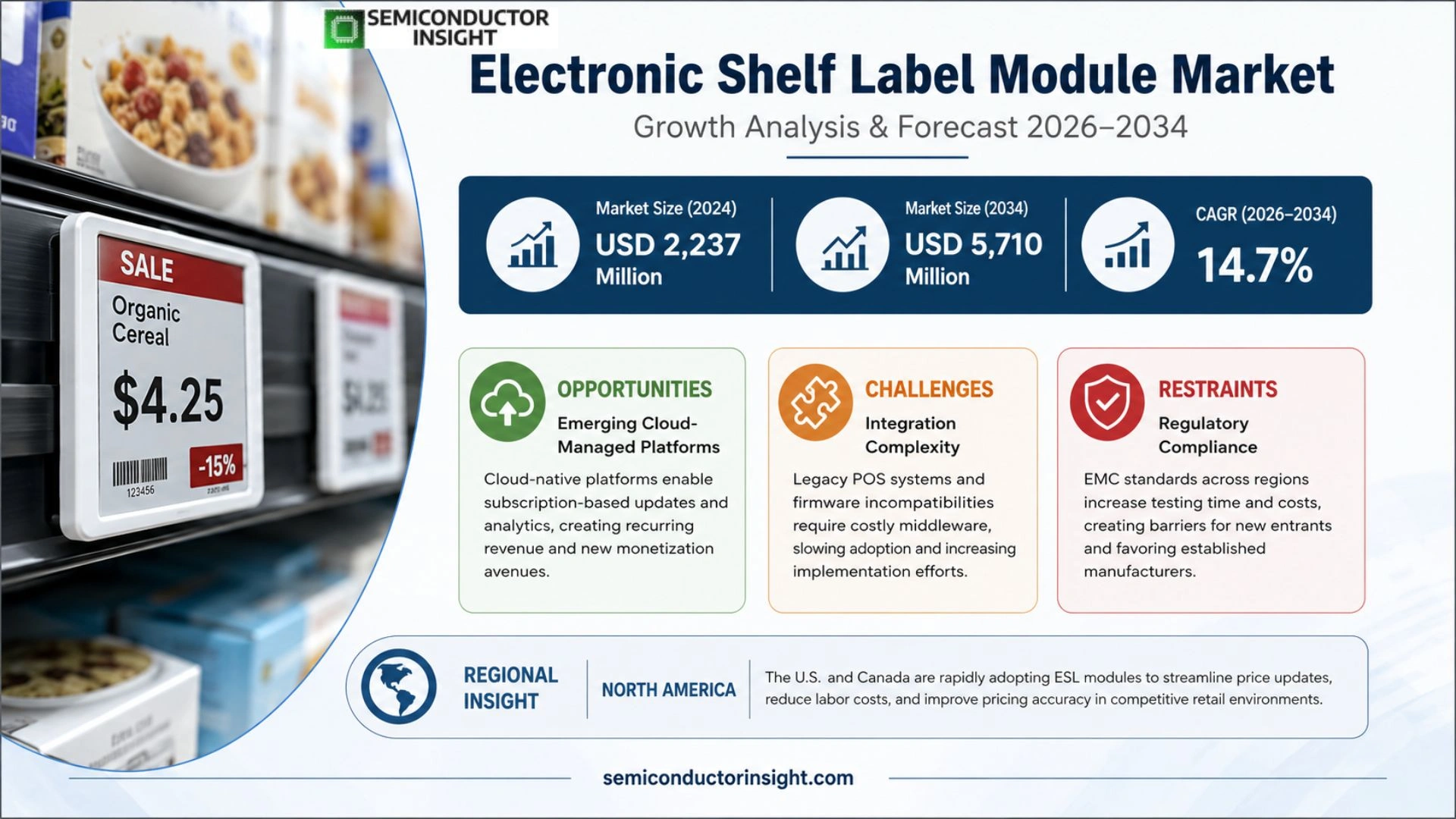
Electronic Shelf Label Module market was valued at USD 2,237 million in 2024 and is projected to reach USD 5,710 million by 2034, exhibiting a CAGR of 14.7% during the forecast period.
Electronic Shelf Label (ESL) modules are compact electronic units mounted on retail shelves that replace traditional paper tags. Each module integrates an e‑ink or LCD display, a microcontroller for data processing, wireless connectivity such as Bluetooth Low Energy or Zigbee for real‑time updates, and a long‑life battery or energy‑harvesting source. The design enables retailers to modify prices instantly, show product details or promotional messages across thousands of items.
The expansion is driven by retailers’ demand for pricing automation, inventory visibility and sustainability benefits while high initial investment and system integration requirements temper adoption speed. Leading manufacturers,including BOE, E Ink Holdings and SoluM,are focusing on ultra‑low power consumption and modular architectures to lower total cost of ownership.
MARKET DRIVERS
Rising Retail Automation
Retail operators are replacing static price tags with digital alternatives to react to inventory fluctuations in real time. Electronic Shelf Label Module Market benefits from this shift because e‑ink displays consume minimal power while delivering crisp, legible pricing. Chains that prioritize shelf‑edge agility find that digital labels cut labor hours associated with manual price updates, freeing staff for customer‑focused activities.
Cost Efficiency Gains
Advances in semiconductor fabrication have driven module prices down by double‑digit percentages over the past two years. When combined with the elimination of printed label waste, the total cost of ownership for store‑wide deployments becomes attractive even for mid‑size retailers. Electronic Shelf Label Module Market participants report quicker ROI as the per‑unit expense aligns with narrower margin pressures.
➤ Operators that integrate cloud‑based management platforms see a 25 % reduction in label‑related downtime, underscoring the importance of software‑hardware synergy.
Beyond immediate savings, digital labels generate data streams that feed pricing algorithms and shopper behavior models. This analytic dimension transforms what was once a simple price display into a revenue‑optimization tool, encouraging vendors to invest in more sophisticated module ecosystems.
MARKET CHALLENGES
Integration Complexity
Many legacy point‑of‑sale infrastructures lack the open APIs required for seamless label synchronization. When retailers attempt retrofits, they encounter firmware incompatibilities that necessitate costly middleware layers. The friction slows adoption curves and forces system integrators to allocate additional engineering resources.
Other Challenges
Bullet Point Title
Supply chain bottlenecks for specialized e‑ink substrates have emerged as a practical obstacle. Manufacturers experience lead‑time extensions that strain project timelines, especially for regional rollouts that depend on just‑in‑time delivery models.
MARKET RESTRAINTS
Regulatory Compliance
Electronic labeling devices must meet electromagnetic emission standards across multiple jurisdictions. Compliance testing adds both time and expense, particularly for vendors seeking certification in Europe and North America simultaneously. The added procedural burden can deter smaller players from entering Electronic Shelf Label Module Market, consolidating market share among established manufacturers.
MARKET OPPORTUNITIES
Emerging Cloud‑Managed Platforms
Cloud‑native label management services are reshaping the value proposition of digital shelving. By offering subscription‑based updates, vendors can monetize software upgrades independently of hardware refresh cycles. This model aligns with retailer preferences for predictable operating expenditures and opens cross‑selling avenues for analytics packages.
Another fertile avenue lies in the integration of RFID and sensor data directly into label modules. When a shelf sensor detects low stock, the attached label can trigger an automatic price markdown, creating a feedback loop that enhances inventory turnover. Early adopters that pilot such capabilities stand to differentiate their store experience and capture incremental margin.
Electronic Shelf Label Module Market Trends
Automation and Real‑Time Pricing as Growth Engines
The adoption of electronic shelf label modules has reshaped pricing operations across grocery chains and specialty retailers. By shifting price updates from manual tag changes to software‑driven commands, stores cut labor hours dramatically and eliminate the lag between price decisions and shelf manifestation. This immediacy enables retailers to react to competitor moves, inventory levels, and short‑term demand spikes within minutes, a flexibility that traditional paper tags cannot match. The cumulative effect is a tighter alignment of revenue management with supply‑chain realities, which in turn improves gross margins and reduces markdown risk.
Other Trends
Sustainability and Energy Efficiency
Environmental stewardship has become a decisive factor for large‑format retailers seeking to lower waste footprints. Electronic labels replace thousands of paper tags per store, translating into measurable reductions in landfill contribution. Moreover, advances in low‑power e‑ink technology have extended battery life to three‑plus years, diminishing maintenance cycles and associated carbon emissions. Companies that highlight these green credentials are gaining favor with corporate‑social‑responsibility programs and cost‑conscious investors alike.
Cost, Integration, and Security Challenges
Despite clear operational upside, the upfront capital outlay for a full‑store roll‑out remains a barrier for mid‑size operators. Installation costs rise when legacy point‑of‑sale systems lack compatible APIs, forcing retailers to allocate resources for system integration and staff training. Additionally, the wireless nature of the labels introduces cybersecurity considerations; unauthorized access could lead to price manipulation or data breaches. Vendors are therefore prioritising encrypted communication protocols and modular firmware updates to reassure risk‑averse clients.
COMPETITIVE LANDSCAPE
Key Industry Players
Electronic Shelf Label Module Market: Competitive Overview
The ESL module arena is dominated by a handful of vertically integrated manufacturers that control both display panel production and firmware integration. BOE and E Ink Holdings occupy the top tier, each leveraging extensive thin‑film transistor (TFT) and electrophoretic display (EPD) capabilities to supply large‑format modules for global retail chains. Their scale enables price‑competitiveness and rapid rollout of firmware updates, which in turn creates a high barrier for new entrants. A secondary tier comprises specialist firms such as SoluM, Holitech and DKE, which focus on midsize modules (3–6 inches) and differentiate through ultra‑low power consumption and customizable communication protocols. These companies often serve regional grocery and drug‑store operators, where integration with legacy POS systems is a decisive factor. The market structure therefore resembles a concentric hierarchy: a core of global giants, a middle ring of niche innovators, and an outer layer of smaller assemblers that rely on OEM partnerships to reach end users.
Beyond the primary rings, several regional players have carved out profitable niches by aligning product roadmaps with local regulatory requirements and sustainability agendas. Wuxi Vision Peak Technology and Suzhou Qingyue Optoelectronic, both headquartered in China’s manufacturing hubs, have secured contracts with fast‑moving consumer‑goods (FMCG) distributors by offering modular designs that accommodate 1‑10‑inch form factors. Yes Optoelectronics exploits a portfolio of e‑ink and OLED hybrids to address specialty retail segments such as high‑end boutique stores. Meanwhile, multinational electronics firms,Samsung, LG Display and Sharp,have entered the ESL module market through strategic acquisitions, supplying high‑resolution panels to premium department‑store pilots in Europe and North America. Smaller innovators like Quark Display, Papyrus Technologies and Pentalogix capitalize on open‑source communication stacks, allowing rapid customization for start‑up retailers seeking differentiated in‑store experiences. Collectively, this diverse set of actors intensifies competitive pressure on pricing, feature sets and after‑sales support.
List of Key Electronic Shelf Label Module Companies Profiled
- BOE Technology Group Co., Ltd.
- E Ink Holdings
- SoluM
- Holitech
- DKE Electronics
- Wuxi Vision Peak Technology Co., Ltd.
- Suzhou Qingyue Optoelectronic Technology Co., Ltd.
- Yes Optoelectronics (Group) Co., Ltd.
- Samsung Electronics
- LG Display
- Sharp Corporation
- Quark Display
- Papyrus Technologies
- Pentalogix Ltd.
Segment Analysis:
| Segment Category | Sub-Segments | Key Insights |
| By Type |
|
Compact Modules are favored for high‑density retail shelves where space is limited.
|
| By Application |
|
Grocery and Supermarket adoption drives dynamic pricing and inventory visibility.
|
| By End User |
|
Large Retail Chains leverage ESL modules to unify pricing strategy across extensive store networks.
|
| By Integration Level |
|
Cloud‑Connected Modules are emerging as the preferred choice for forward‑looking retailers.
|
| By Energy Source |
|
Energy‑Harvesting Modules align closely with sustainability objectives of modern retailers.
|
Regional Analysis: Electronic Shelf Label Module Market
Large‑format grocers and specialty chains are prioritizing near‑real‑time price updates to align with dynamic discount strategies. The ability to cascade pricing changes from a central system to every shelf eliminates manual errors and shortens the promotional lead time, which retailers value as a competitive differentiator.
ESL modules reduce the need for physical price tag inventories, allowing distributors to allocate warehouse space to higher‑margin SKUs. This shift also curtails the carbon footprint associated with paper tag production and disposal, aligning with sustainability pledges.
Modern ESL solutions are converging with IoT platforms, enabling data‑rich dashboards that monitor tag health, battery status, and compliance metrics. This integration supports predictive maintenance schedules, extending device lifespans without interrupting store operations.
Federal guidelines on electronic device emissions and data security have been clarified, giving retailers confidence to roll out networked tags at scale. Compliance checks are now embedded in certification processes, smoothing the path to market entry.
Europe
European retailers are balancing cost pressures with consumer expectations for transparency. In markets such as Germany and France, the shift to electronic shelf label modules is propelled by a blend of labor‑cost moderation and consumer demand for accurate pricing. Retail chains are integrating ESL systems with existing ERP platforms to harmonize cross‑border pricing strategies, especially within the EU’s single market. Suppliers are customizing module form factors to comply with varied shelf dimensions across the continent, which has prompted a wave of modular designs that can be adapted with minimal retrofit. Sustainability regulations across the EU also incentivize the reduction of paper waste, adding an environmental dimension to the business case for ESL adoption.
Asia‑Pacific
The Asia‑Pacific region presents a heterogeneous landscape where fast‑growing economies such as China and India are experimenting with ESL technology in both hyper‑market and convenience‑store formats. Retail operators view digital tags as a mechanism to bridge the gap between offline shelves and burgeoning e‑commerce price engines, ensuring price parity across channels. Local manufacturers are focusing on low‑cost silicon‑based displays to meet price‑sensitive market expectations, while larger multinational suppliers are leveraging their R&D hubs to introduce high‑resolution e‑ink screens that cater to premium retail concepts. The rapid rollout of 5G networks further enables real‑time data transmission, enhancing the responsiveness of pricing strategies.
South America
In Brazil and Argentina, retail chains are still navigating the cost‑benefit equation of electronic shelf label modules. While labor costs are lower than in North America, the fragmented retail environment demands scalable solutions that can be deployed across diverse store formats. Early adopters report that ESL modules improve auditability of price compliance, a factor that resonates with regional consumer protection agencies. Vendors are adapting to local supply‑chain constraints by establishing regional assembly lines, thereby shortening lead times and reducing import duties. The incremental efficiency gains are beginning to outweigh the initial capital outlay for forward‑thinking operators.
Middle East & Africa
Retail environments in the Gulf Cooperation Council and South‑African markets are increasingly driven by luxury and high‑end grocery concepts, where brand perception is closely tied to in‑store technology. Electronic shelf label modules are being positioned as part of a broader digital transformation agenda that includes mobile checkout and personalized promotions. Operators appreciate the ability to instantly adjust pricing in response to currency fluctuations, which are common in the region. Meanwhile, local distributors are expanding their service portfolios to include installation, calibration, and ongoing support for ESL systems, recognizing that after‑sales expertise is a decisive factor for retailers transitioning from traditional paper tags.
Report Scope
This market research report provides a comprehensive analysis of the Electronic Shelf Label Module Market , covering the forecast period 2026–2034. It offers detailed insights into market dynamics, technological advancements, competitive landscape, and key trends shaping the industry.
Key focus areas of the report include:
- Market Overview: The report begins with an overview outlining its current market scenario, key growth indicators, and industry transformation drivers. It discusses macroeconomic factors, demand–supply balance, regulatory landscape, and the strategic role of semiconductors in powering advancements across industries such as automotive, telecommunications, consumer electronics, and industrial automation.
- Market Size & Forecast: Historical data and future projections for revenue, unit shipments, and market value across major regions and segments.
- Segmentation Analysis: Detailed breakdown by product type, technology, application, and end-user industry to identify high-growth segments and investment opportunities.
- Regional Insights: Insights into market performance across North America, Europe, Asia-Pacific, Latin America, and the Middle East & Africa, including country-level analysis where relevant.
- Competitive Landscape: Profiles of leading market participants, including their product offerings, R&D focus, manufacturing capacity, pricing strategies, and recent developments such as mergers, acquisitions, and partnerships.
- Technology Trends & Innovation: Assessment of emerging technologies, integration of AI/IoT, semiconductor design trends, fabrication techniques, and evolving industry standards.
- Market Drivers & Restraints: Evaluation of factors driving market growth along with challenges, supply chain constraints, regulatory issues, and market-entry barriers.
- Stakeholder Insights: Insights for component suppliers, OEMs, system integrators, investors, and policymakers regarding the evolving ecosystem and strategic opportunities.
Primary and secondary research methods are employed, including interviews with industry experts, data from verified sources, and real-time market intelligence to ensure the accuracy and reliability of the insights presented.
FREQUENTLY ASKED QUESTIONS:
What is the current market size of Electronic Shelf Label Module Market?
-> Electronic Shelf Label Module market is projected to reach USD 5,710 million by 2034, exhibiting a CAGR of 14.7% during the forecast period.
Which key companies operate in Electronic Shelf Label Module Market?
-> Key players include BOE, E Ink Holdings, SoluM, Holitech, DKE, Wuxi Vision Peak Technology Co.,Ltd., Suzhou Qingyue Optoelectronic Technology Co., Ltd., Yes Optoelectronics (Group) Co., Ltd.
What are the key growth drivers?
-> Key growth drivers include Efficiency and Automation, Real-Time Pricing, Inventory Management, Enhanced Customer Experience, Energy Efficiency, Sustainability, and Competitive Advantage.
Which region dominates the market?
-> Asia-Pacific shows strong adoption due to extensive retail expansion, while North America and Europe also hold significant market share.
What are the emerging trends?
-> Emerging trends include IoT integration for smart shelf management, AI-driven dynamic pricing algorithms, and ultra‑low‑power battery technologies.

Get Sample Report PDF for Exclusive Insights
Report Sample Includes
- Table of Contents
- List of Tables & Figures
- Charts, Research Methodology, and more...
 Download Sample Report PDF