Electrocardiogram (ECG) Analog Front End IC Market Insights
Global Electrocardiogram (ECG) Analog Front End IC market size was valued at USD 1.12 billion in 2025. The market is projected to grow from USD 1.21 billion in 2026 to USD 2.18 billion by 2034, exhibiting a CAGR of 6.8% during the forecast period.
ECG Analog Front End (AFE) ICs are specialized integrated circuits designed to acquire, amplify, and process the weak bioelectrical signals generated by cardiac activity. These components serve as the critical interface between the human body and digital signal processing systems, incorporating instrumentation amplifiers, programmable gain amplifiers, analog-to-digital converters (ADCs), and noise filtering elements. ECG AFE ICs are widely deployed across clinical-grade electrocardiographs, wearable cardiac monitors, implantable devices, and portable diagnostic equipment.
The market is witnessing robust expansion driven by the rising global prevalence of cardiovascular diseases, which remain the leading cause of mortality worldwide, as well as the accelerating adoption of wearable health monitoring devices. Furthermore, advancements in low-power, high-resolution AFE IC designs are enabling next-generation continuous cardiac monitoring solutions. Key industry participants including Texas Instruments, Analog Devices, Inc., Maxim Integrated (now part of Analog Devices), and STMicroelectronics continue to expand their ECG AFE IC portfolios to address the growing demand across both clinical and consumer health segments.
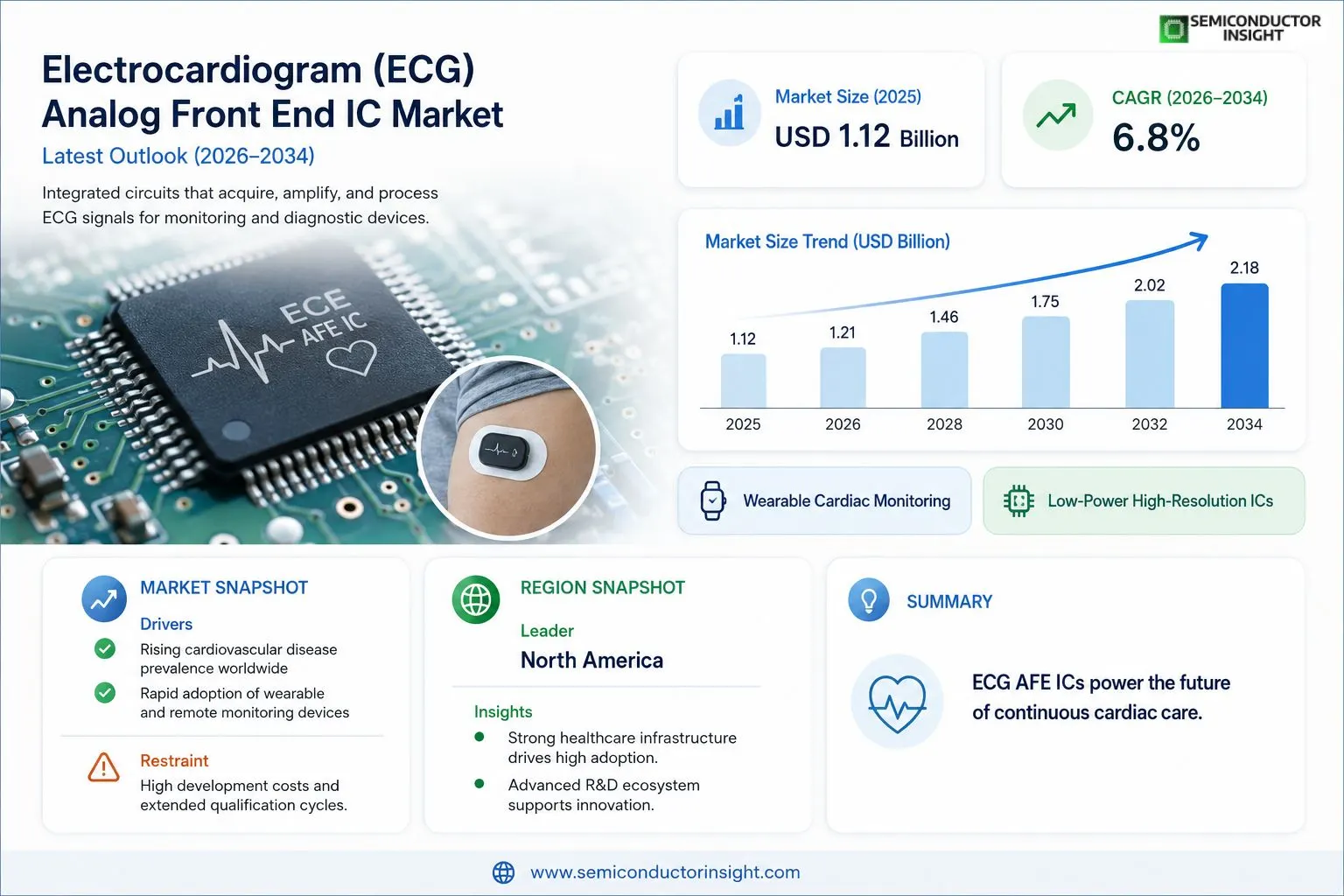
MARKET DRIVERS
Rising Prevalence of Cardiovascular Diseases Fueling Demand for ECG Analog Front End ICs
Global burden of cardiovascular diseases (CVDs) continues to escalate, driving substantial demand for advanced cardiac monitoring solutions. Cardiovascular conditions remain one of the leading causes of mortality worldwide, prompting healthcare systems to prioritize early detection and continuous monitoring technologies. The Electrocardiogram (ECG) Analog Front End IC Market is directly benefiting from this clinical imperative, as ECG AFE ICs serve as the critical signal acquisition layer in portable, wearable, and clinical-grade cardiac monitors. Increased screening programs and government-led cardiac health initiatives are translating into higher procurement of ECG-enabled devices across hospitals, diagnostic centers, and home care settings.
Rapid Expansion of Wearable and Remote Patient Monitoring Technologies
The proliferation of wearable health devices , including smartwatches, fitness bands, and dedicated cardiac patches , has emerged as a defining growth catalyst for the ECG Analog Front End IC market. Consumers and clinicians alike are embracing continuous, real-time cardiac monitoring outside traditional clinical settings. ECG AFE ICs, valued for their ultra-low power consumption, miniaturized form factors, and high signal fidelity, are integral to these next-generation wearable platforms. Leading semiconductor manufacturers are investing heavily in developing single-chip ECG front-end solutions that integrate biopotential amplifiers, analog-to-digital converters, and noise suppression circuitry to meet the stringent performance demands of wearable applications.
➤ The convergence of Internet of Medical Things (IoMT) infrastructure with advanced ECG AFE IC technology is accelerating the transition from episodic to continuous cardiac care, fundamentally reshaping the diagnostics landscape and expanding addressable markets for semiconductor suppliers.
Telehealth adoption, which witnessed an unprecedented acceleration in recent years, has reinforced the need for reliable home-based ECG monitoring equipment. Remote patient monitoring platforms depend on accurate ECG signal acquisition, making high-performance ECG Analog Front End ICs a mission-critical component. Healthcare providers and payers are increasingly reimbursing remote cardiac monitoring services, further incentivizing device manufacturers to integrate sophisticated ECG AFE chipsets into their product portfolios. This structural shift toward decentralized care delivery is expected to sustain robust demand across the ECG AFE IC supply chain.
MARKET CHALLENGES
Technical Complexity in Achieving High Signal-to-Noise Ratio in Miniaturized ECG Analog Front End IC Designs
One of the foremost technical challenges confronting the Electrocardiogram (ECG) Analog Front End IC market is achieving clinical-grade signal quality within increasingly miniaturized and power-constrained device architectures. ECG signals are inherently low-amplitude biopotentials susceptible to interference from motion artifacts, electromagnetic noise, and electrode-skin impedance variability. Designing ECG AFE ICs that maintain high common-mode rejection ratios (CMRR) and low input-referred noise while operating at sub-microwatt power levels demands significant engineering expertise and iterative silicon development cycles. These technical barriers elevate development costs and extend time-to-market for new entrants and established players alike.
Other Challenges
Stringent Regulatory Requirements
ECG monitoring devices incorporating ECG Analog Front End ICs must comply with rigorous international medical device standards, including IEC 60601-2-47 for ambulatory ECG systems and FDA clearance pathways in the United States. Meeting these regulatory benchmarks necessitates extensive clinical validation, documentation, and quality management processes, adding considerable cost and timeline burdens for device manufacturers and, by extension, influencing component sourcing decisions and supplier qualification timelines within the ECG AFE IC ecosystem.
Intense Price Competition and Margin Pressure
The commoditization of entry-level ECG AFE IC solutions has intensified price competition among semiconductor vendors, particularly in high-volume consumer wearable segments. Original equipment manufacturers (OEMs) consistently exert downward pricing pressure on component suppliers, compressing gross margins and challenging the economic viability of sustained R&D investment. Balancing the need for continuous innovation in performance and integration with the commercial realities of competitive pricing remains a persistent challenge across the ECG Analog Front End IC market.
MARKET RESTRAINTS
High Development Costs and Extended Qualification Cycles Limiting Market Participation
The development of medically compliant ECG Analog Front End ICs involves substantial upfront investment in analog mixed-signal design, process node selection, and application-specific validation. Unlike digital semiconductors, analog front-end ICs for medical applications require specialized fabrication processes and extensive characterization across temperature, humidity, and operating condition variations to ensure reliable performance in clinical environments. These high barriers to entry restrict the competitive field primarily to well-capitalized semiconductor companies with dedicated medical-grade IC divisions, limiting the pace of innovation that a broader competitive landscape might otherwise accelerate.
Global Semiconductor Supply Chain Vulnerabilities Impacting ECG AFE IC Availability
The broader semiconductor industry has faced well-documented supply chain disruptions, and the Electrocardiogram (ECG) Analog Front End IC market has not been immune to these pressures. Dependence on a concentrated base of advanced analog semiconductor foundries creates single-point-of-failure risks for medical device manufacturers reliant on consistent ECG AFE IC supply. Extended lead times, allocation constraints, and geopolitical uncertainties affecting key semiconductor manufacturing regions introduce procurement risks that can delay product launches, inflate inventory carrying costs, and disrupt production planning for ECG device OEMs. These supply-side vulnerabilities represent a structural restraint on near-term market growth potential.
MARKET OPPORTUNITIES
Integration of Artificial Intelligence and Advanced Signal Processing in Next-Generation ECG AFE IC Platforms
The integration of on-chip intelligence and advanced digital signal processing capabilities with traditional analog front-end circuitry represents a compelling growth opportunity for the ECG Analog Front End IC market. Semiconductor developers are exploring system-on-chip (SoC) architectures that combine ECG AFE functionality with embedded AI accelerators, enabling real-time arrhythmia detection, atrial fibrillation screening, and anomaly flagging directly at the edge. This on-device processing paradigm reduces reliance on cloud connectivity, enhances patient data privacy, and lowers system-level power consumption , attributes that are highly valued in both clinical and consumer wearable applications. Companies that successfully commercialize intelligent ECG AFE ICs stand to capture significant premium positioning in an increasingly differentiated market.
Emerging Market Expansion and Increasing Healthcare Infrastructure Investment
Rapidly developing economies across Asia-Pacific, Latin America, and the Middle East and Africa represent substantial untapped opportunities for the Electrocardiogram (ECG) Analog Front End IC market. Rising healthcare expenditure, expanding health insurance coverage, and government initiatives to modernize cardiac care infrastructure in these regions are driving accelerated adoption of ECG diagnostic equipment at primary, secondary, and tertiary care levels. The growing middle-class population in these markets, combined with increasing awareness of cardiovascular risk factors, is fueling consumer demand for affordable ECG-enabled wearables. Medical device manufacturers targeting these geographies are seeking cost-optimized ECG AFE IC solutions that preserve performance while meeting the price sensitivities of emerging market end-users, creating a distinct and sizable commercial opportunity for adaptable semiconductor suppliers.
Electrocardiogram (ECG) Analog Front End IC Market Trends
Rising Cardiovascular Disease Burden Driving Demand for ECG Analog Front End ICs
The Electrocardiogram (ECG) Analog Front End IC Market is experiencing significant momentum, largely propelled by the escalating global prevalence of cardiovascular diseases, which continue to rank as the foremost cause of mortality worldwide. Healthcare systems across both developed and emerging economies are increasingly prioritizing early cardiac diagnostics, creating sustained demand for high-performance ECG Analog Front End (AFE) ICs. These specialized integrated circuits , incorporating instrumentation amplifiers, programmable gain amplifiers, analog-to-digital converters, and noise filtering elements , serve as the essential interface between bioelectrical cardiac signals and downstream digital processing systems. As clinical institutions expand their diagnostic infrastructure, procurement of clinical-grade electrocardiographs equipped with advanced AFE IC solutions continues to rise steadily.
Other Trends
Accelerating Adoption of Wearable Cardiac Monitoring Devices
A defining trend shaping the Electrocardiogram (ECG) Analog Front End IC Market is the rapid proliferation of wearable health monitoring technologies. Consumer-grade smartwatches, fitness trackers, and dedicated cardiac monitors are increasingly integrating ECG AFE ICs to deliver continuous, real-time heart rhythm analysis directly to end users. This shift toward personal cardiac health management is compelling semiconductor manufacturers to engineer AFE ICs with ultra-low power consumption profiles without compromising signal resolution or acquisition accuracy. The convergence of miniaturization demands and performance requirements is directing significant research and development investment across the industry.
Advancements in Low-Power, High-Resolution AFE IC Design
Technological innovation in low-power and high-resolution ECG AFE IC architectures is enabling a new generation of continuous cardiac monitoring solutions, particularly for portable and implantable diagnostic devices. Leading industry participants including Texas Instruments, Analog Devices, Maxim Integrated (now part of Analog Devices), and STMicroelectronics are actively expanding their ECG AFE IC product portfolios to address evolving performance benchmarks across both clinical and consumer health segments. Improved noise filtering capabilities and higher dynamic range in next-generation designs are supporting more reliable signal acquisition in ambulatory and remote patient monitoring environments.
Expansion Across Clinical and Consumer Health Segments
The Electrocardiogram (ECG) Analog Front End IC Market is witnessing parallel growth across clinical-grade electrocardiographs, implantable cardiac devices, and portable diagnostic equipment. This broad application spectrum reflects the versatility of modern ECG AFE IC solutions and underscores the market’s resilience across diverse end-use environments. As regulatory frameworks for cardiac monitoring devices evolve globally and telehealth infrastructure continues to mature, demand for reliable, high-precision ECG AFE ICs is expected to remain robust throughout the forecast period.
COMPETITIVE LANDSCAPE
Key Industry Players
Electrocardiogram (ECG) Analog Front End IC Market , Global Competitive Landscape and Leading Manufacturer Analysis
Global Electrocardiogram (ECG) Analog Front End IC market is characterized by the dominant presence of a select group of established semiconductor giants that command significant market share through deep R&D investments, extensive product portfolios, and long-standing relationships with medical device OEMs. Texas Instruments and Analog Devices, Inc. (which now incorporates Maxim Integrated following its acquisition) collectively represent some of the most comprehensive ECG AFE IC offerings available, spanning clinical-grade electrocardiographs, wearable cardiac monitors, and implantable devices. STMicroelectronics further reinforces the competitive intensity at the top tier, leveraging its broad analog and mixed-signal expertise to address both high-performance clinical applications and cost-sensitive consumer health wearables. These leading players continue to advance low-power, high-resolution AFE IC architectures, supporting the industry’s transition toward continuous, real-time cardiac monitoring solutions as cardiovascular disease remains the foremost cause of global mortality.
Beyond the dominant players, several specialized and emerging semiconductor firms contribute meaningfully to the ECG AFE IC competitive ecosystem. Companies such as Microchip Technology, ONSEMI (formerly ON Semiconductor), NXP Semiconductors, and Renesas Electronics have established notable footholds by delivering highly integrated, application-specific AFE solutions optimized for portable and wearable diagnostic equipment. Additionally, firms including Silicon Laboratories, Infineon Technologies, and Mindray Medical International address niche segments within the market, particularly in compact patch-based cardiac monitors and next-generation IoT-connected health platforms. Emerging fabless design houses and regional players in Asia-Pacific are also intensifying competition, particularly in cost-competitive consumer-grade ECG devices, further diversifying Global competitive landscape as the market advances toward a projected value of USD 2.18 billion by 2034.
List of Key Electrocardiogram (ECG) Analog Front End IC Companies Profiled
- Texas Instruments Incorporated
- Analog Devices, Inc. (including Maxim Integrated)
- STMicroelectronics
- Microchip Technology Inc.
- ONSEMI (formerly ON Semiconductor)
- NXP Semiconductors
- Renesas Electronics Corporation
- Silicon Laboratories Inc.
- Infineon Technologies AG
- Qualcomm Technologies, Inc.
- Espressif Systems
- ROHM Semiconductor
- Leadtek Research Inc.
- Shenzhen Huiding Technology Co., Ltd. (Goodix)
- Mindray Medical International Limited
Segment Analysis:
| Segment Category | Sub-Segments | Key Insights |
| By Type |
|
Multi-Channel ECG AFE ICs represent the leading segment within the type category, owing to their ability to simultaneously capture multiple cardiac leads, which is essential for comprehensive clinical-grade diagnostics.
|
| By Application |
|
Wearable Cardiac Monitors have emerged as the fastest-growing and increasingly dominant application segment, propelled by the widespread consumer and clinical adoption of continuous cardiac monitoring technologies.
|
| By End User |
|
Hospitals and Cardiac Care Centers continue to represent the most prominent end user segment, driven by the high volume of cardiac diagnostic procedures performed in inpatient and critical care settings globally.
|
| By Power Consumption |
|
Ultra-Low Power ECG AFE ICs are rapidly becoming the most strategically important segment within the power consumption classification, as the industry pivots toward continuous, unobtrusive cardiac monitoring solutions.
|
| By Integration Level |
|
Fully Integrated System-on-Chip ECG AFE Solutions are gaining decisive momentum as the preferred integration approach for modern cardiac monitoring device development across both clinical and consumer segments.
|
Regional Analysis: Electrocardiogram (ECG) Analog Front End IC Market
North America
North America’s dense network of hospitals, cardiac care centers, and outpatient diagnostic facilities creates a consistent and high-volume demand for precise ECG analog front end ICs. Clinical adoption is accelerated by physician familiarity with digital ECG platforms and an insurance reimbursement environment that supports advanced cardiac diagnostics, reinforcing the region’s technological leadership in this market segment.
The United States leads globally in the consumer wearable segment, with smartwatches and fitness bands increasingly embedding single-lead and multi-lead ECG capabilities. This trend has driven semiconductor developers to engineer ultra-low-power, miniaturized ECG analog front end ICs capable of delivering clinical-grade signal fidelity within compact form factors suited for continuous, everyday cardiac monitoring applications.
The FDA’s rigorous pre-market approval and clearance pathways necessitate that ECG analog front end IC designs meet exacting standards for signal accuracy, electromagnetic compatibility, and patient safety. This regulatory rigor, while demanding, has cultivated a culture of engineering excellence among North American IC developers and medical device manufacturers, ultimately elevating product quality across the Electrocardiogram (ECG) Analog Front End IC Market.
North America hosts a concentration of semiconductor research hubs, university-affiliated innovation centers, and venture-backed health-tech startups that continuously advance ECG analog front end IC architectures. Strategic collaborations between fabless chip designers and academic institutions drive breakthroughs in noise reduction, power management, and multi-channel signal acquisition, sustaining the region’s competitive advantage in this specialized IC market through 2034.
Europe
Europe represents a mature and highly regulated market for the Electrocardiogram (ECG) Analog Front End IC Market, characterized by universal healthcare systems that drive consistent institutional procurement of cardiac diagnostic technologies. Germany, the Netherlands, and the United Kingdom serve as key innovation and manufacturing hubs, where established semiconductor companies and medical device developers collaborate to refine ECG analog front end IC performance. The European Union’s Medical Device Regulation framework imposes comprehensive performance and safety requirements, compelling manufacturers to invest in high-precision, low-noise IC architectures. The region’s aging population and rising prevalence of cardiovascular conditions have elevated demand for both hospital-grade and home-based ECG monitoring solutions. European research initiatives and cross-border innovation programs further stimulate advancement in analog signal processing technologies tailored for cardiac applications, reinforcing Europe’s significant and sustained contribution to Global Electrocardiogram (ECG) Analog Front End IC Market landscape through 2034.
Asia-Pacific
Asia-Pacific is emerging as the fastest-growing region in the Electrocardiogram (ECG) Analog Front End IC Market, propelled by rapid healthcare infrastructure expansion, a surging middle-class population with increasing cardiovascular health awareness, and a thriving domestic semiconductor industry. China, Japan, South Korea, and India are the primary growth engines, each contributing distinct dynamics to regional demand. China’s government-backed healthcare modernization programs and domestic IC manufacturing capabilities have significantly reduced import dependency, while Japan’s precision engineering tradition continues to yield high-performance ECG analog front end solutions. India’s expanding hospital networks and growing adoption of affordable remote cardiac monitoring devices are opening new application avenues. The region also benefits from a large electronics manufacturing base that enables cost-competitive integration of ECG analog front end ICs into diverse consumer and clinical device categories, making Asia-Pacific a critical growth frontier for this market through 2034.
South America
South America presents a developing but progressively expanding market for the Electrocardiogram (ECG) Analog Front End IC Market, with Brazil and Argentina serving as the primary demand centers. The region’s healthcare sector is undergoing gradual modernization, supported by government health initiatives aimed at improving cardiac care accessibility in both urban and rural populations. Importation of ECG analog front end ICs from North America, Europe, and Asia-Pacific remains predominant, given the limited local semiconductor manufacturing capacity. However, rising investments in telemedicine infrastructure and the growing penetration of affordable wearable health devices are stimulating demand for compact, energy-efficient ECG analog front end IC solutions. While regulatory harmonization with international standards remains an ongoing process, South America’s improving healthcare policies and expanding medical device distribution networks point to steady market growth potential throughout the forecast period extending to 2034.
Middle East & Africa
The Middle East & Africa region occupies an early but progressively developing position within Global Electrocardiogram (ECG) Analog Front End IC Market. The Gulf Cooperation Council countries, particularly the UAE and Saudi Arabia, are leading regional adoption through ambitious healthcare transformation programs and investments in smart hospital infrastructure that incorporate advanced cardiac monitoring technologies. Africa, while facing significant challenges related to healthcare access and affordability, is witnessing gradual adoption of low-cost, portable ECG monitoring devices in urban healthcare settings, creating nascent demand for ECG analog front end ICs suited for resource-constrained environments. International medical device manufacturers and development organizations are increasingly focusing on designing rugged, energy-efficient ECG analog front end IC platforms for deployment across underserved regions. As healthcare digitization initiatives gain momentum across both sub-regions, the Middle East & Africa is expected to represent an incremental but meaningful growth opportunity within the broader Electrocardiogram (ECG) Analog Front End IC Market through 2034.
Report Scope
This market research report provides a comprehensive analysis of the Electrocardiogram (ECG) Analog Front End IC Market , covering the forecast period 2026–2034. It offers detailed insights into market dynamics, technological advancements, competitive landscape, and key trends shaping the industry.
Key focus areas of the report include:
- Market Overview: The report begins with an overview outlining its current market scenario, key growth indicators, and industry transformation drivers. It discusses macroeconomic factors, demand–supply balance, regulatory landscape, and the strategic role of semiconductors in powering advancements across industries such as automotive, telecommunications, consumer electronics, and industrial automation.
- Market Size & Forecast: Historical data and future projections for revenue, unit shipments, and market value across major regions and segments.
- Segmentation Analysis: Detailed breakdown by product type, technology, application, and end-user industry to identify high-growth segments and investment opportunities.
- Regional Insights: Insights into market performance across North America, Europe, Asia-Pacific, Latin America, and the Middle East & Africa, including country-level analysis where relevant.
- Competitive Landscape: Profiles of leading market participants, including their product offerings, R&D focus, manufacturing capacity, pricing strategies, and recent developments such as mergers, acquisitions, and partnerships.
- Technology Trends & Innovation: Assessment of emerging technologies, integration of AI/IoT, semiconductor design trends, fabrication techniques, and evolving industry standards.
- Market Drivers & Restraints: Evaluation of factors driving market growth along with challenges, supply chain constraints, regulatory issues, and market-entry barriers.
- Stakeholder Insights: Insights for component suppliers, OEMs, system integrators, investors, and policymakers regarding the evolving ecosystem and strategic opportunities.
Primary and secondary research methods are employed, including interviews with industry experts, data from verified sources, and real-time market intelligence to ensure the accuracy and reliability of the insights presented.
FREQUENTLY ASKED QUESTIONS:
What is the current market size of Electrocardiogram (ECG) Analog Front End IC Market?
-> Global Electrocardiogram (ECG) Analog Front End IC Market was valued at USD 1.12 billion in 2025 and is projected to grow from USD 1.21 billion in 2026 to USD 2.18 billion by 2034, exhibiting a CAGR of 6.8% during the forecast period.
Which key companies operate in Electrocardiogram (ECG) Analog Front End IC Market?
-> Key players include Texas Instruments, Analog Devices, Inc., Maxim Integrated (now part of Analog Devices), and STMicroelectronics, among others.
What are the key growth drivers?
-> Key growth drivers include the rising global prevalence of cardiovascular diseases, accelerating adoption of wearable health monitoring devices, and advancements in low-power, high-resolution AFE IC designs enabling next-generation continuous cardiac monitoring solutions.
Which region dominates the market?
-> Asia-Pacific is the fastest-growing region, while North America remains a dominant market, driven by strong healthcare infrastructure and high adoption of advanced cardiac monitoring technologies.
What are the emerging trends?
-> Emerging trends include wearable cardiac monitors, implantable ECG devices, portable diagnostic equipment, and the integration of low-power high-resolution AFE IC designs enabling continuous cardiac monitoring solutions across both clinical and consumer health segments.

Get Sample Report PDF for Exclusive Insights
Report Sample Includes
- Table of Contents
- List of Tables & Figures
- Charts, Research Methodology, and more...
 Download Sample Report PDF