Electrially Driven Ion Removal Module Market Insights
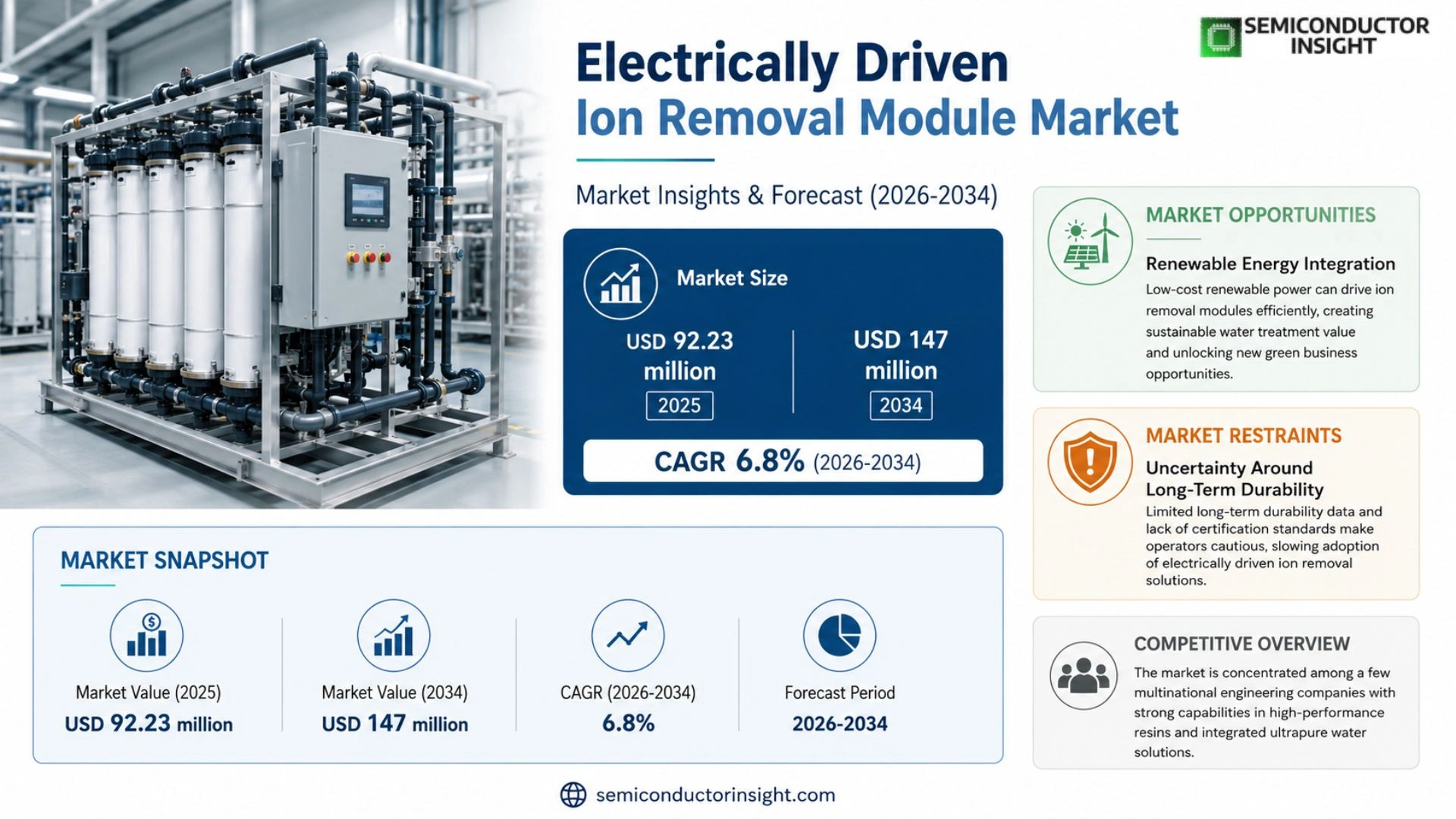
Electrially Driven Ion Removal Module market was valued at USD 92.23 million in 2025 and reaches USD 147 million by 2034, exhibiting a CAGR of 6.8% during the forecast period.
An electrically driven ion removal module removes dissolved ions from continuously flowing water by employing ion‑exchange resins, selective ion‑exchange membranes and a direct‑current electric field. The technology delivers continuous ion removal and high‑purity water without chemical regenerators, making it essential for ultrapure water systems in power generation, semiconductor manufacturing, pharmaceuticals and chemical processing.
The market gains traction because industries require stable water quality while lowering operating expenses. Combining these modules with reverse‑osmosis creates multi‑stage treatment that improves overall efficiency; meanwhile advances in membrane selectivity and intelligent control reduce energy use. Major suppliers such as Veolia, SUEZ, DuPont and Xylem are broadening their portfolios and allocating resources toward research and development to meet rising demand.
MARKET DRIVERS
Regulatory Momentum Boosting Adoption
Electrically Driven Ion Removal Module Market is feeling the weight of tighter discharge limits imposed by environmental agencies. Operators of municipal and industrial water treatment facilities are compelled to replace legacy methods with solutions that can guarantee consistent ion selectivity while meeting stricter compliance deadlines. This regulatory impetus translates into a steady stream of procurement cycles, prompting vendors to expand capacity and accelerate product roll‑outs.
Technological Innovation Enhancing Economic Viability
Recent breakthroughs in electrode materials and membrane engineering have shaved energy consumption to levels that rival conventional chemical dosing. When the cost per kilowatt‑hour of operation falls, the total cost of ownership for an electrically driven ion removal system becomes competitive against entrenched alternatives. Clients are therefore re‑evaluating capital budgets, shifting preference toward modular units that promise lower lifecycle expenses.
➤ “The convergence of policy pressure and efficiency gains is reshaping investment decisions across the water sector.”
Collectively, these forces are redefining the purchasing calculus for water utilities. By aligning compliance risk mitigation with operational savings, the Electrically Driven Ion Removal Module Market is witnessing a strategic realignment that favors electrochemical approaches over chemical precipitation.
MARKET CHALLENGES
Capital Intensity and Project Financing
While operating costs are decreasing, the upfront outlay for full‑scale electrically driven systems remains substantial. Financial institutions often view such projects as higher‑risk compared with familiar chemical treatment plants, leading to longer approval cycles and the need for robust contractual guarantees. This financing friction can deter mid‑size operators from committing to large‑scale deployments.
Other Challenges
Supply Chain Constraints
The specialized membranes and high‑purity electrodes required for ion removal modules are sourced from a limited pool of manufacturers. Recent geopolitical disruptions have exposed vulnerabilities in the supply chain, causing lead times to extend beyond typical project schedules. Companies that fail to secure reliable component pipelines risk schedule overruns and cost inflation.
Addressing these concerns demands proactive risk‑sharing arrangements and strategic inventory planning, otherwise the market’s momentum may be tempered by procurement bottlenecks.
MARKET RESTRAINTS
Uncertainty Around Long‑Term Module Durability
Clients are cautious because comprehensive durability data for electrically driven ion removal modules remain scarce. Without clear degradation curves, operators hesitate to replace established treatment baselines, fearing unexpected maintenance spikes that could erode the promised cost advantages.
Furthermore, the lack of industry‑wide certification standards complicates procurement decisions. When performance guarantees are ambiguous, decision‑makers may default to familiar technologies, slowing market penetration.
To overcome this restraint, manufacturers must invest in extended pilot programs and publish transparent lifespan metrics that reassure end users of consistent performance over years of operation.
MARKET OPPORTUNITIES
Renewable Energy Integration
The surge in renewable electricity generation creates a natural synergy with electrically driven ion removal modules. Facilities located near solar farms or wind parks can harness low‑cost, intermittently available power to run electrochemical cells, turning excess generation into water‑treatment value. This alignment not only enhances sustainability credentials but also improves the economic case for electrified solutions.
Emerging business models,such as power‑as‑a‑service paired with ion removal,offer utilities the flexibility to scale treatment capacity in parallel with renewable output. Companies that bundle smart‑grid interfaces with their modules stand to capture a new segment of environmentally conscious clients, positioning themselves at the forefront of the next wave of water‑treatment innovation.
In addition, regional initiatives that reward carbon‑neutral operations provide financial incentives for projects that can demonstrate reduced reliance on carbon‑intensive chemicals. By framing electrically driven ion removal as a carbon‑reduction tool, vendors can tap into subsidy streams and green‑finance instruments, further expanding market reach.
Electrically Driven Ion Removal Module Market Trends
Continuous Ion Removal Gains Traction in High‑Purity Applications
Manufacturers are increasingly positioning electrically driven ion removal modules as the core component of ultrapure water loops that serve semiconductor fabs, pharmaceutical plants, and power‑generation boilers. The technology replaces traditional chemical regenerants with a direct‑current field, allowing operators to maintain ion concentrations at sub‑ppm levels while cutting consumable costs. Because the module delivers steady‑state water quality, downstream processes such as resistivity‑critical rinses experience fewer excursions, which translates into higher yield for chips and tighter compliance for drug‑manufacturing batches. The 43 % gross profit margin reported for 2025 reflects the premium that end‑users are willing to pay for operational reliability and reduced chemical handling risk.
Other Trends
Supply‑Chain Consolidation Around Core Components
The upstream segment of the electrically driven ion removal module ecosystem is coalescing around a limited set of high‑performance ion‑exchange resins and selective membranes. As OEMs standardize on these materials, bulk‑purchase agreements are driving down per‑unit costs for resins while encouraging manufacturers to invest in proprietary membrane chemistries that improve selectivity for multivalent ions. This concentration reduces lead times for module assembly and strengthens bargaining power for major players such as Veolia, SUEZ, and DuPont, who can integrate component sourcing with in‑house module design. Downstream, system integrators benefit from a narrower vendor list, enabling tighter quality control and faster rollout of turnkey water‑treatment solutions.
Regional Adoption Accelerates in Asia‑Pacific
While North America continues to dominate early‑stage deployments, the Asia‑Pacific region is witnessing a noticeable uptick in module installations driven by expanding semiconductor capacity in China, South Korea, and Taiwan. Plant managers in these locales are pairing electrically driven ion removal modules with reverse‑osmosis pretreatment trains to achieve multi‑stage ion rejection without escalating energy consumption. The $5,000 average price point, combined with a production capacity of roughly 29 k units, provides a scalable economics model that aligns with the capital‑intensive expansion plans of regional manufacturers. As a result, the Electrically Driven Ion Removal Module Market is seeing a shift in revenue concentration toward markets that prioritize high‑volume, low‑downtime water‑purification infrastructure.
COMPETITIVE LANDSCAPE
Key Industry Players
Electrically Driven Ion Removal Module Market: Competitive Overview
Market concentration centers on a handful of multinational engineering groups that control both the upstream supply of high‑performance ion‑exchange resins and the downstream integration of modules into ultrapure‑water systems. Veolia and SUEZ together account for roughly one‑third of global module shipments, leveraging extensive water‑treatment portfolios and strong service networks in North America, Europe and Asia‑Pacific. DuPont distinguishes itself through proprietary membrane chemistries that enable higher current efficiencies, while Xylem’s acquisition strategy has expanded its footprint in semiconductor and pharmaceutical facilities. These leaders benefit from economies of scale in component sourcing and from long‑term maintenance contracts that lock in recurring revenue. Their dominance forces midsize manufacturers to specialize either in niche high‑purity designs or in cost‑optimized standard modules, creating a tiered competitive structure where brand reputation and engineering depth dictate market access.
Beyond the top tier, a vibrant set of regional innovators fills gaps left by the larger players. SnowPure, headquartered in the United States, focuses on compact modules for data‑center cooling loops, emphasizing plug‑and‑play installation. MEGA in Germany targets high‑flow applications for power‑plant boiler water, while QUA Group from Japan supplies custom electrode configurations for batch processing plants. Omexell (France) and Applied Membranes (UK) differentiate through advanced control algorithms that reduce energy draw. Pure Aqua, Newterra and Agape Water Solutions address emerging markets in Southeast Asia with modular kits priced for cost‑sensitive customers. Chinese firms such as Dongguan Techun Membrane Environmental Protection Technology, Huamo Environmental Protection Technology, Kunshan Lianchun Electromechanical Equipment, and Beijing Zhongyang Yongkang Environmental Protection Technology combine local supply chains with aggressive pricing, challenging imports in domestic projects. Collectively, these niche players expand the technology ecosystem, push incremental performance gains, and provide buyers with alternatives that can be tailored to specific regulatory or process constraints.
List of Key Electrically Driven Ion Removal Module Companies Profiled
- Veolia
- SUEZ
- DuPont
- Xylem
- SnowPure
- MEGA
- QUA Group
- Omexell
- Applied Membranes
- Pure Aqua
- Newterra
- Agape Water Solutions
- Dongguan Techun Membrane Environmental Protection Technology
- Huamo Environmental Protection Technology
- Kunshan Lianchun Electromechanical Equipment
- Beijing Zhongyang Yongkang Environmental Protection Technology
Segment Analysis:
| Segment Category | Sub-Segments | Key Insights |
| By Type |
|
Standard EDI Modules are favoured because they: – Offer reliable continuous ion removal without complex regeneration steps. – Integrate easily with existing water treatment trains, reducing plant footprint. – Deliver stable water quality that aligns with the stringent demands of many industrial processes. – Enable straightforward operational control, which appeals to facilities seeking low‑maintenance solutions. |
| By Application |
|
Semiconductor and Electronics Industry drives adoption because: – Ultra‑pure water is essential for photolithography and wafer cleaning, where any ionic contamination can compromise device yields. – The modular nature of EDI allows seamless scaling as fabs expand capacity. – Continuous operation aligns with the 24/7 production schedules typical of high‑volume manufacturing. – Integration with reverse osmosis provides a multi‑stage barrier that meets the most demanding purity specifications. |
| By End User |
|
Semiconductor Fabrication Facilities benefit from EDI because: – They require consistent low‑ionic content across every processing step, and EDI delivers that without chemical waste. – Operational flexibility allows rapid response to changes in production recipes. – Reduced downtime associated with traditional ion exchange regeneration enhances overall plant efficiency. – The technology supports the stringent compliance regimes governing high‑tech manufacturing. |
| By Technology |
|
Continuous Electrodeionization is preferred because: – It supplies a steady stream of treated water, matching the flow demands of large‑scale operations. – The absence of periodic regeneration cycles simplifies plant logistics. – Real‑time control enables proactive adjustments to maintain target conductivity levels. – Continuous mode aligns with the lean manufacturing ethos of many downstream users. |
| By Flow Rate |
|
Medium Flow Rate solutions gain traction because: – They strike a balance between treatment capacity and energy consumption, appealing to midsize installations. – Flexibility to accommodate variable demand without sacrificing water quality. – Compatibility with both low‑volume specialty processes and higher‑volume industrial streams. – Ease of integration with auxiliary systems such as reverse osmosis or ultrafiltration. |
Regional Analysis: Electrically Driven Ion Removal Module Market
Europe
EU directives compel water‑intensive sectors to curtail chemical footprints, prompting early trials of electrically driven ion removal units across municipal and industrial sites. The regulatory impetus accelerates procurement cycles and justifies premium pricing for compliant technologies.
Major chemical plants in Germany have retrofitted legacy streams with modular ion removal devices, noting smoother integration with existing control systems and reduced downtime compared with batch‑wise chemical dosing.
European manufacturers benefit from proximity to supply chains for advanced electrode materials, allowing them to offer differentiated performance guarantees and faster after‑sales support than distant rivals.
Growing awareness of circular‑economy principles among European processors fuels interest in technologies that enable water reuse while maintaining product purity, creating a steady pipeline of project inquiries.
North America
In North America, the market narrative is shaped by a pragmatic focus on operational cost savings and the scaling of renewable‑energy‑linked treatment facilities. Utilities in the United States are piloting electrically driven ion removal modules to align water‑treatment budgets with aggressive energy‑price forecasts. Concurrently, Canadian processors emphasize technology that can be bundled with existing low‑temperature heat recovery systems, leveraging the modules’ electrical flexibility. The competitive arena is fragmented, with several niche players offering customized solutions for mining and oil‑and‑gas applications, where contaminant specificity is paramount. Stakeholders view the technology as a risk‑balanced alternative to aggressive chemical dosing, especially in regions where environmental compliance penalties are intensifying.
Asia‑Pacific
Asia‑Pacific presents a contrasting landscape where rapid industrial expansion collides with emerging environmental standards. Nations such as India and China are witnessing heightened scrutiny over effluent discharge, prompting early‑stage adoption of electrically driven ion removal in high‑volume textile and fertilizer sectors. The cost‑sensitivity of the market drives manufacturers to prioritize modules that can operate efficiently at lower voltages, while local suppliers experiment with indigenous electrode composites to curtail import reliance. Although large‑scale rollout remains limited, the region’s appetite for modular, scalable solutions suggests a trajectory that could soon rival more mature markets, especially as governments begin to incentivize water‑reuse projects in urban megacities.
South America
South American water‑management strategies are increasingly constrained by erratic rainfall patterns and aging infrastructure. In Brazil and Argentina, industrial users are exploring electrically driven ion removal as a means to extend the lifespan of existing treatment plants without extensive civil works. The market is still nascent, with a handful of multinational equipment providers establishing demonstration sites in petrochemical complexes. Local firms are attentive to the technology’s potential to reduce reliance on imported chemical reagents, which can be costly and logistically challenging in remote locations. Successful pilots could catalyze broader adoption, especially in the mining sector where ion‑specific removal aligns with ore‑processing quality targets.
Middle East & Africa
In the Middle East and Africa, water scarcity underscores the strategic importance of any technology that can improve reuse rates. Utilities in the Gulf Cooperation Council are allocating capital toward electrically driven ion removal modules that can operate under high‑salinity conditions prevalent in desalination brine streams. African nations, meanwhile, face budgetary constraints that favor low‑maintenance solutions; the modular nature of the technology appeals to NGOs and government agencies seeking scalable interventions for mining runoff. Partnerships between regional engineering firms and European technology leaders are emerging, aiming to adapt the modules to harsh climatic conditions while retaining performance benchmarks established in more temperate markets.
Report Scope
This market research report provides a comprehensive analysis of the Electrically Driven Ion Removal Module Market , covering the forecast period 2026–2034. It offers detailed insights into market dynamics, technological advancements, competitive landscape, and key trends shaping the industry.
Key focus areas of the report include:
- Market Overview: The report begins with an overview outlining its current market scenario, key growth indicators, and industry transformation drivers. It discusses macroeconomic factors, demand–supply balance, regulatory landscape, and the strategic role of semiconductors in powering advancements across industries such as automotive, telecommunications, consumer electronics, and industrial automation.
- Market Size & Forecast: Historical data and future projections for revenue, unit shipments, and market value across major regions and segments.
- Segmentation Analysis: Detailed breakdown by product type, technology, application, and end-user industry to identify high‑growth segments and investment opportunities.
- Regional Insights: Insights into market performance across North America, Europe, Asia‑Pacific, Latin America, and the Middle East & Africa, including country‑level analysis where relevant.
- Competitive Landscape: Profiles of leading market participants, including their product offerings, R&D focus, manufacturing capacity, pricing strategies, and recent developments such as mergers, acquisitions, and partnerships.
- Technology Trends & Innovation: Assessment of emerging technologies, integration of AI/IoT, semiconductor design trends, fabrication techniques, and evolving industry standards.
- Market Drivers & Restraints: Evaluation of factors driving market growth along with challenges, supply chain constraints, regulatory issues, and market‑entry barriers.
- Stakeholder Insights: Insights for component suppliers, OEMs, system integrators, investors, and policymakers regarding the evolving ecosystem and strategic opportunities.
Primary and secondary research methods are employed, including interviews with industry experts, data from verified sources, and real‑time market intelligence to ensure the accuracy and reliability of the insights presented.
FREQUENTLY ASKED QUESTIONS:
What is the current market size of Electrically Driven Ion Removal Module Market?
-> Electrically Driven Ion Removal Module Market was valued at USD 92.23 million in 2025 and is expected to reach USD 147 million by 2032, growing at a CAGR of 6.8%
Which key companies operate in Electrically Driven Ion Removal Module Market?
-> Key players include Veolia, SUEZ, DuPont, Xylem, SnowPure, MEGA, QUA Group, Omexell, Applied Membranes, Pure Aqua, among others.
What are the key growth drivers?
-> Key growth drivers include rising demand for ultrapure water in power, electronics, pharmaceutical and chemical sectors, cost‑effective continuous ion removal technology, and the ability to integrate with reverse osmosis for multi‑stage water treatment.
Which region dominates the market?
-> Asia leads the market due to its extensive manufacturing base, significant semiconductor and pharmaceutical production, and increasing investments in advanced water‑treatment infrastructure.
What are the emerging trends?
-> Emerging trends include integration of intelligent control and IoT monitoring, hybrid systems combining EDI with reverse osmosis, and development of high‑purity modules for advanced semiconductor fabrication.
Get Sample Report PDF for Exclusive Insights
Report Sample Includes
- Table of Contents
- List of Tables & Figures
- Charts, Research Methodology, and more...
 Download Sample Report PDF