eFuse (Electronic Fuse) IC Market Insights
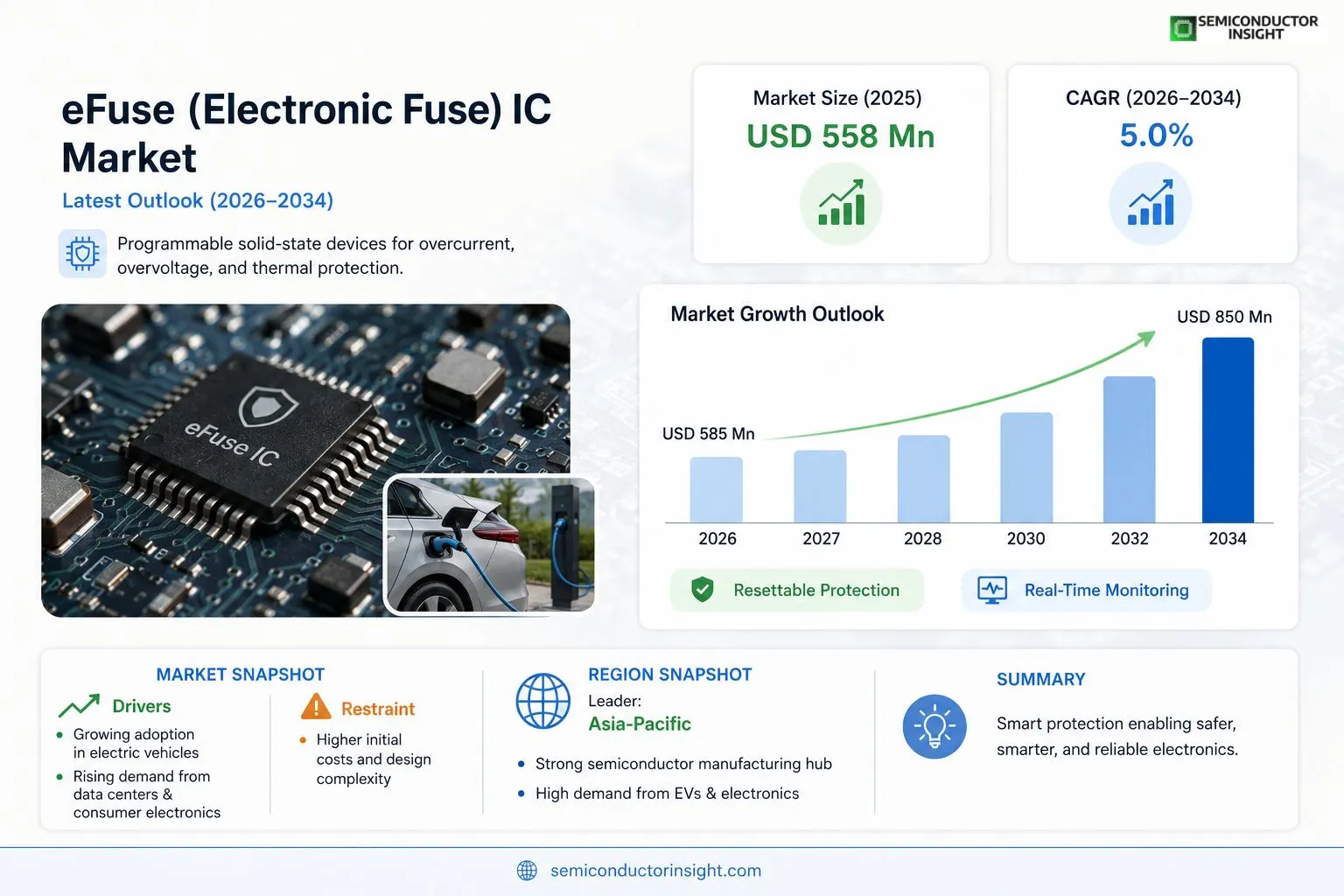
Global eFuse (Electronic Fuse) IC market size was valued at USD 558 million in 2025. The market is projected to grow from USD 585 million in 2026 to USD 850 million by 2034, exhibiting a CAGR of 5.0% during the forecast period.
eFuse (Electronic Fuse) ICs are programmable solid-state devices that provide precise overcurrent, overvoltage, and thermal protection in electronic circuits. Unlike traditional mechanical fuses, these integrated circuits offer resettable functionality, real-time monitoring, and diagnostic capabilities, making them essential for modern power management applications. They typically integrate features such as current limiting, fault detection, and controlled power distribution.
The market is experiencing steady growth due to several factors, including the rapid expansion of electric vehicles, increasing complexity in consumer electronics, and the rising demand for reliable circuit protection in data centers and telecommunications infrastructure. Furthermore, the shift toward compact and energy-efficient designs in automotive and industrial sectors is accelerating adoption. Advancements in semiconductor technology continue to enhance eFuse performance, enabling better integration with advanced power systems.
Key players are actively investing in innovative solutions to address evolving industry needs. Texas Instruments, Analog Devices, and Infineon Technologies are prominent companies operating in the market with extensive portfolios of eFuse IC products tailored for automotive, consumer, and industrial applications.
MARKET DRIVERS
Growing Adoption in Electric Vehicles and High-Voltage Architectures
eFuse (Electronic Fuse) IC Market is experiencing robust growth driven by the rapid expansion of electric vehicles (EVs), which require advanced circuit protection solutions for battery management systems, onboard chargers, and high-voltage power distribution. eFuses provide precise, programmable overcurrent and thermal protection that traditional fuses cannot match, supporting the shift toward 48V architectures and enhancing overall system reliability in EVs.
Rising Demand from Data Centers and Consumer Electronics
Expansion of hyperscale data centers and cloud infrastructure is accelerating the integration of eFuse ICs for reliable power management in servers and networking equipment. Additionally, the proliferation of compact, high-power consumer electronics such as smartphones and wearables favors eFuses due to their small footprint, resettable functionality, and diagnostic capabilities, reducing downtime and maintenance costs.
➤ The transition to intelligent power protection solutions continues to replace mechanical fuses across automotive, industrial, and computing applications.
Market projections indicate steady expansion supported by these trends, with Global eFuse market expected to grow at a CAGR of approximately 4.9-5.2% through the early 2030s, fueled by electrification and digitalization initiatives.
MARKET CHALLENGES
Integration and Design Complexities
While eFuse ICs offer superior performance, their integration into existing systems can present technical hurdles, including the need for additional power supply circuitry and careful management of biased current during operation. Designers must address these factors to ensure compatibility with legacy platforms and high-reliability requirements in automotive and industrial environments.
Other Challenges
Supply Chain Volatility
Ongoing semiconductor supply constraints and component lead time fluctuations continue to impact production planning for eFuse manufacturers and OEMs, potentially delaying deployment in high-growth sectors like EVs and data centers.
Limited Awareness and Regulatory Complexity
Many potential adopters still have limited familiarity with eFuse technology advantages compared to traditional solutions. Furthermore, navigating evolving safety standards and certification processes adds layers of complexity to market penetration.
MARKET RESTRAINTS
Higher Initial Costs and Technical Barriers
eFuse (Electronic Fuse) IC Market faces restraints from the relatively higher upfront costs of electronic fuses compared to conventional mechanical or polymer-based alternatives. This price differential can slow adoption in cost-sensitive applications despite long-term benefits in reliability and reduced maintenance. Design complexities, including the need for precise current biasing and additional supporting circuitry, further limit rapid substitution in certain legacy systems.
MARKET OPPORTUNITIES
Expansion in Renewable Energy, IoT, and Advanced Automotive Systems
Significant opportunities exist in the growing renewable energy sector and IoT ecosystems, where eFuse ICs deliver smart, programmable protection for distributed power systems and connected devices. The continued rise of hyperscale data centers, autonomous vehicles, and fast-charging infrastructure presents substantial avenues for innovation in high-voltage and intelligent power management solutions. Reduced certification workloads through standardized eFuse implementations further enhance market potential across these high-growth verticals.
eFuse (Electronic Fuse) IC Market Trends
Rising Adoption Driven by Electric Vehicles and Advanced Power Management Needs
eFuse (Electronic Fuse) IC Market continues to evolve as industries seek more reliable and intelligent circuit protection solutions. These programmable solid-state devices deliver precise overcurrent, overvoltage, and thermal protection while offering resettable functionality, real-time monitoring, and diagnostic capabilities that traditional mechanical fuses cannot match. This shift supports modern power management applications across multiple sectors, particularly where safety and system uptime are critical.
Other Trends
Growing Complexity in Consumer Electronics
As consumer electronics become more sophisticated with higher power densities and compact designs, eFuse (Electronic Fuse) IC solutions are increasingly integrated to provide controlled power distribution, current limiting, and fault detection. This trend reflects the need for enhanced protection in devices that demand efficient energy use and minimized downtime from electrical faults.
Expansion in Data Centers and Telecommunications Infrastructure
The rising demand for reliable circuit protection in data centers and telecommunications infrastructure is accelerating the use of eFuse (Electronic Fuse) ICs. These applications benefit from the advanced monitoring features that help maintain operational stability in high-performance computing environments where power fluctuations can impact service quality.
Technological Advancements Enhancing Integration and Efficiency
Advancements in semiconductor technology are enabling better performance and seamless integration of eFuse (Electronic Fuse) ICs with advanced power systems. Leading companies such as Texas Instruments, Analog Devices, and Infineon Technologies are developing tailored solutions for automotive, consumer, and industrial applications. The ongoing shift toward compact and energy-efficient designs further supports broader adoption in automotive and industrial sectors, where precise power control contributes to overall system reliability and safety. These developments position eFuse (Electronic Fuse) ICs as essential components in next-generation electronic architectures.
COMPETITIVE LANDSCAPE
Key Industry Players
eFuse IC Market Competitive Analysis
eFuse (Electronic Fuse) IC Market features a competitive structure dominated by established semiconductor leaders with strong expertise in power management and circuit protection technologies. Texas Instruments stands out as a leading player, leveraging its extensive portfolio of intelligent eFuse solutions that integrate advanced features like precise current limiting, fault diagnostics, and seamless compatibility with automotive and industrial applications. The market exhibits moderate concentration among top firms, which collectively hold significant share through continuous innovation in resettable protection devices, while the broader ecosystem includes specialized providers addressing niche voltage and current requirements.
Other significant players focus on differentiated offerings for emerging applications such as electric vehicles, data centers, and consumer electronics. Companies like Littelfuse, Infineon Technologies, and STMicroelectronics excel in high-reliability solutions tailored for harsh environments, while Analog Devices and onsemi emphasize integration with advanced power systems. This dynamic landscape is characterized by strategic partnerships, product launches, and R&D investments aimed at enhancing efficiency, compactness, and diagnostic capabilities amid growing demand for solid-state protection.
List of Key eFuse (Electronic Fuse) IC Companies Profiled
- Texas Instruments Incorporated
- Analog Devices, Inc.
- Littelfuse, Inc.
- Infineon Technologies AG
- Semiconductor Components Industries, LLC (onsemi)
- STMicroelectronics N.V.
- Toshiba Electronic Devices & Storage Corporation
- Alpha and Omega Semiconductor
- Diodes Incorporated
- Microchip Technology Inc.
- Monolithic Power Systems, Inc.
- Qorvo, Inc.
- Vishay Intertechnology, Inc.
- Renesas Electronics Corporation
- NXP Semiconductors
Segment Analysis:
| Segment Category | Sub-Segments | Key Insights |
| By Type |
|
Multi-Channel eFuse ICs stand out as the preferred choice for complex power distribution networks. They enable simultaneous management of multiple power rails within a single device, significantly reducing component count and board space. These solutions excel in delivering precise current limiting and fault isolation across channels while supporting seamless integration with modern system controllers. Their programmable nature allows dynamic adjustment of protection thresholds, making them highly adaptable to evolving design requirements in sophisticated electronic systems. |
| By Application |
|
Battery Management Systems represent the leading application segment due to their critical role in ensuring safe and efficient energy utilization. eFuse ICs provide resettable overcurrent and overvoltage protection that prevents catastrophic failures in high-energy environments. They facilitate real-time monitoring and rapid response to anomalies, enhancing overall system safety and longevity. Designers value their compact footprint and diagnostic capabilities which support predictive maintenance strategies across various battery-powered platforms. |
| By End User |
|
Automotive Manufacturers lead adoption as eFuse ICs deliver robust circuit protection essential for advanced vehicle architectures. These components withstand harsh operating conditions including wide temperature fluctuations and electrical transients common in automotive environments. They support the integration of sophisticated safety features in electric powertrains and ADAS modules while offering resettable functionality that minimizes downtime. Their precise protection mechanisms align perfectly with stringent automotive reliability standards and functional safety requirements. |
| By Voltage Rating |
|
Medium Voltage eFuse ICs emerge as the dominant category for their versatility across diverse applications. They effectively balance protection capabilities with power efficiency in systems requiring moderate voltage handling. These devices support reliable operation in industrial automation, automotive subsystems, and data infrastructure where consistent performance under varying loads is crucial. Their design flexibility allows seamless incorporation into both new and legacy power management architectures while maintaining thermal stability and fault tolerance. |
| By Feature Integration |
|
Smart eFuse with Communication Interfaces lead the segment by enabling intelligent power management and system-level diagnostics. These advanced solutions integrate I2C or similar protocols for seamless interaction with host controllers, providing detailed fault reporting and configuration options. They empower engineers to implement sophisticated protection strategies with predictive analytics capabilities. The combination of programmability and connectivity supports rapid prototyping and field updates, making them indispensable for next-generation electronic designs focused on reliability and operational intelligence. |
Regional Analysis: eFuse (Electronic Fuse) IC Market
Asia-Pacific
Asia-Pacific hosts world-class semiconductor clusters that enable seamless integration of eFuse (Electronic Fuse) IC solutions. Strong vertical integration from wafer fabrication to final assembly supports rapid prototyping and volume production, allowing suppliers to meet diverse requirements for consumer gadgets and automotive electronics with enhanced reliability and cost efficiency.
The region leads in developing advanced eFuse architectures featuring programmable trip points and real-time monitoring. Local firms focus on embedding these ICs into power management units for next-generation devices, emphasizing thermal stability and compact form factors suitable for high-performance computing and wearable technologies.
Explosive growth in electronics consumption, electric mobility, and smart city initiatives drives demand for robust circuit protection. eFuse ICs are increasingly specified for their precision and reprogrammability, helping manufacturers enhance product safety and longevity across diverse applications.
Market players pursue aggressive R&D investments and strategic alliances to expand portfolios. Focus areas include customization for local OEMs and scaling production to address both premium and mid-tier segments while navigating intellectual property considerations.
North America
North America maintains a significant position in eFuse (Electronic Fuse) IC Market through its strength in design innovation and high-value applications. The region excels in developing sophisticated eFuse solutions for aerospace, defense, and premium automotive sectors where reliability and performance are paramount. Companies emphasize advanced simulation tools and compliance with stringent safety standards, fostering the creation of intelligent protection circuits that integrate seamlessly with complex system-on-chip designs. Strategic focus on research collaborations with universities and technology consortia supports the evolution of eFuse technologies for data centers and industrial automation. Market participants leverage their expertise in software-defined protection mechanisms to differentiate offerings, targeting customers seeking enhanced system uptime and fault isolation capabilities through the forecast period.
Europe
Europe demonstrates steady progress in eFuse (Electronic Fuse) IC Market, propelled by robust automotive and industrial automation sectors. Emphasis on functional safety and regulatory compliance drives adoption of eFuse solutions that offer precise overcurrent protection and diagnostic features. Regional strategies highlight sustainability initiatives, encouraging the development of energy-efficient ICs suitable for green technologies and renewable energy systems. Collaborative ecosystems involving semiconductor firms, equipment manufacturers, and research institutions accelerate innovation in programmable fuse technologies for electric vehicles and smart grids. The market benefits from a balanced approach combining high-quality manufacturing with forward-looking design practices aimed at future-proofing electronic systems against emerging operational challenges.
South America
South America is gradually expanding its footprint in eFuse (Electronic Fuse) IC Market as local electronics assembly and automotive industries mature. Growing investment in infrastructure modernization creates opportunities for eFuse integration in telecommunications and energy management applications. Businesses adopt strategies centered on technology importation paired with localized adaptation to address specific environmental and operational conditions. While still developing core semiconductor capabilities, the region shows increasing interest in cost-effective protection solutions that enhance device durability in consumer and industrial segments. Market development focuses on building partnerships with global suppliers to improve access to advanced eFuse components and support gradual self-reliance in electronics manufacturing.
Middle East & Africa
The Middle East and Africa region presents emerging potential within eFuse (Electronic Fuse) IC Market, particularly in oil & gas, smart infrastructure, and consumer electronics diversification efforts. Strategic initiatives aim to leverage eFuse technologies for reliable power distribution and equipment protection in harsh operating environments. Governments and private entities pursue technology transfer programs to build local competencies in semiconductor applications. Market players concentrate on tailored solutions that combine robustness with affordability, targeting sectors undergoing digital transformation. Long-term business strategies involve establishing distribution networks and training programs to facilitate wider adoption of eFuse ICs as regional industries advance toward greater technological sophistication.
Report Scope
This market research report provides a comprehensive analysis of the eFuse (Electronic Fuse) IC Market , covering the forecast period 2026–2034. It offers detailed insights into market dynamics, technological advancements, competitive landscape, and key trends shaping the industry.
Key focus areas of the report include:
- Market Overview: The report begins with an overview outlining its current market scenario, key growth indicators, and industry transformation drivers. It discusses macroeconomic factors, demand–supply balance, regulatory landscape, and the strategic role of semiconductors in powering advancements across industries such as automotive, telecommunications, consumer electronics, and industrial automation.
- Market Size & Forecast: Historical data and future projections for revenue, unit shipments, and market value across major regions and segments.
- Segmentation Analysis: Detailed breakdown by product type, technology, application, and end-user industry to identify high-growth segments and investment opportunities.
- Regional Insights: Insights into market performance across North America, Europe, Asia-Pacific, Latin America, and the Middle East & Africa, including country-level analysis where relevant.
- Competitive Landscape: Profiles of leading market participants, including their product offerings, R&D focus, manufacturing capacity, pricing strategies, and recent developments such as mergers, acquisitions, and partnerships.
- Technology Trends & Innovation: Assessment of emerging technologies, integration of AI/IoT, semiconductor design trends, fabrication techniques, and evolving industry standards.
- Market Drivers & Restraints: Evaluation of factors driving market growth along with challenges, supply chain constraints, regulatory issues, and market-entry barriers.
- Stakeholder Insights: Insights for component suppliers, OEMs, system integrators, investors, and policymakers regarding the evolving ecosystem and strategic opportunities.
Primary and secondary research methods are employed, including interviews with industry experts, data from verified sources, and real-time market intelligence to ensure the accuracy and reliability of the insights presented.
FREQUENTLY ASKED QUESTIONS:
What is the current market size of eFuse (Electronic Fuse) IC Market?
-> eFuse (Electronic Fuse) IC Market was valued at USD 558 million in 2025 and is expected to reach USD 850 million by 2034.
Which key companies operate in eFuse (Electronic Fuse) IC Market?
-> Key players include Texas Instruments, Analog Devices, and Infineon Technologies, among others.
What are the key growth drivers?
-> Key growth drivers include rapid expansion of electric vehicles, increasing complexity in consumer electronics, and the rising demand for reliable circuit protection in data centers and telecommunications infrastructure.
Which region dominates the market?
-> Asia-Pacific is the fastest-growing region with strong semiconductor manufacturing, while North America remains a dominant market due to technology innovation.
What are the emerging trends?
-> Emerging trends include advancements in semiconductor technology, integration of resettable protection features, and compact energy-efficient designs for automotive and industrial applications.

Get Sample Report PDF for Exclusive Insights
Report Sample Includes
- Table of Contents
- List of Tables & Figures
- Charts, Research Methodology, and more...
 Download Sample Report PDF