Dry Resist for EUV Market Insights
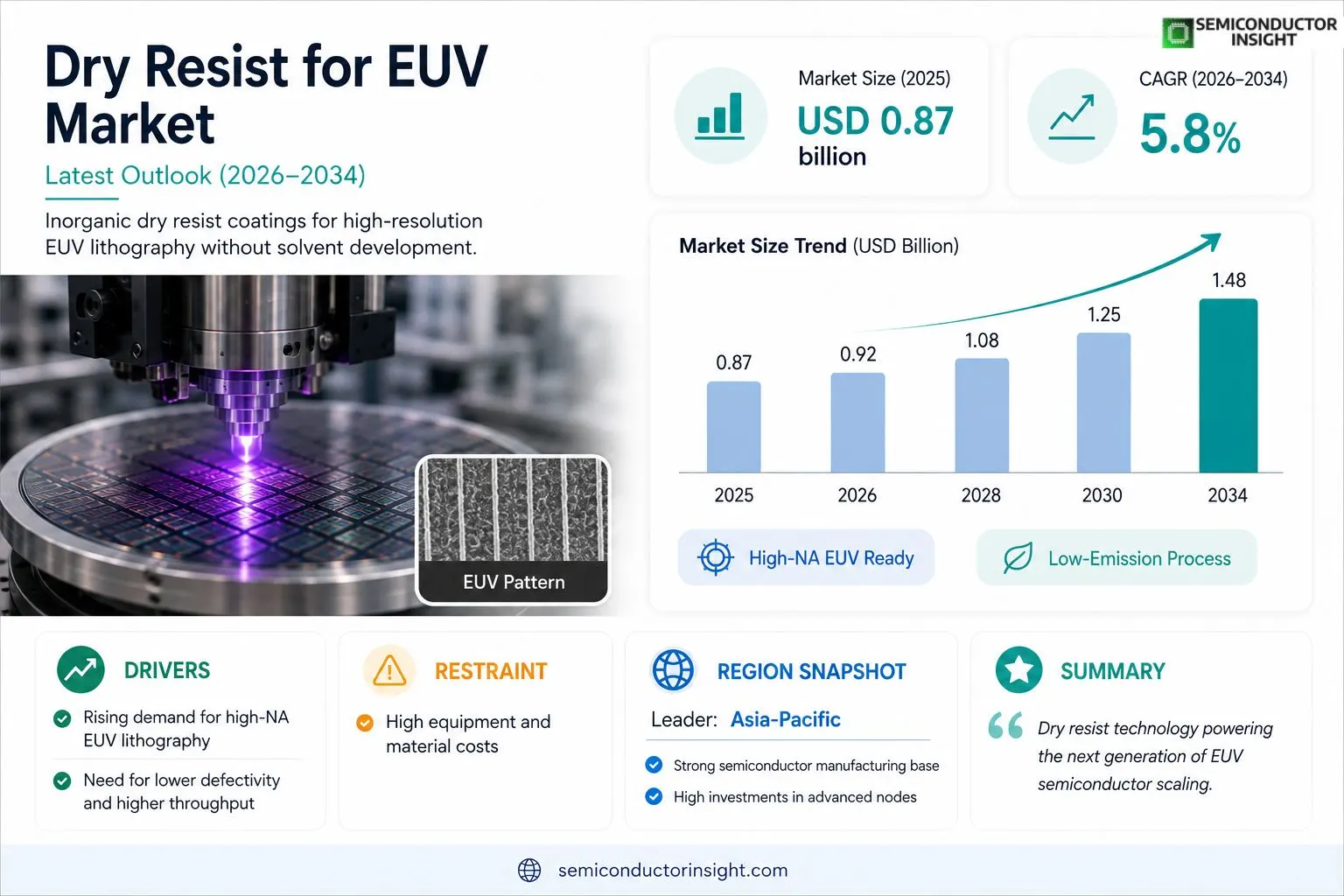
Global dry resist for EUV market size was valued at USD 0.87 billion in 2025. The market is projected to grow from USD 0.92 billion in 2026 to USD 1.48 billion by 2034, exhibiting a CAGR of 5.8% during the forecast period.
Dry resist for extreme ultraviolet (EUV) lithography is a chemically engineered coating that enables pattern transfer without the need for a traditional solvent‑based development step. By leveraging inorganic‑based polymers and tailored surfactants, these resists provide high resolution, low line‑edge roughness, and improved etch resistance,critical attributes for sub‑10 nm node manufacturing.The market is accelerating because semiconductor manufacturers are scaling down device geometries while seeking higher throughput and lower defectivity; however, challenges such as material stability under high photon flux remain. Furthermore, major players like ASML Holding, JSR Corporation, TOK (Tokyo Ohka Kogyo), and Fujifilm are investing heavily in R&D collaborations and capacity expansion to meet the growing demand for next‑generation EUV lithography solutions.
MARKET DRIVERS
Rising Demand for High‑NA EUV Lithography
The adoption of high‑numerical‑aperture (NA) EUV tools has accelerated the need for Dry Resist for EUV Market solutions that can sustain higher exposure powers while maintaining line‑edge roughness below 2 nm. Foundries are increasingly targeting sub‑2 nm node production, and dry resist chemistries provide the required etch resistance and pattern fidelity.
Environmental and Cost Pressures
Regulatory trends toward reduced solvent emissions have spotlighted dry‑coat processes as a greener alternative. Manufacturers benefit from lower waste‑treatment costs and a smaller carbon footprint, driving investment in dry resist platforms that align with sustainability goals.
➤ Industry analysts project that dry resist adoption could capture up to 30% of EUV lithography consumables by 2030.
These dynamics collectively enhance the attractiveness of Dry Resist for EUV Market, positioning it as a strategic enabler for next‑generation semiconductor scaling.
MARKET CHALLENGES
Technical Integration Barriers
Integrating dry resist into existing fab lines requires substantial equipment retrofitting. The lack of standardized deposition tools can lead to process variability, slowing adoption rates despite clear performance benefits.
Other Challenges
Cost Considerations
Initial capital expenditures for specialized dry‑coat reactors remain high, and the per‑wafer material cost can exceed that of traditional solvent‑based resists, posing budgetary constraints for mid‑size facilities.
MARKET RESTRAINTS
Limited Manufacturing Capacity
Current production capacity for dry‑resist coatings is concentrated in a few advanced nodes, creating supply bottlenecks. This restriction hampers the ability of smaller foundries to meet demand promptly, slowing overall market penetration.
MARKET OPPORTUNITIES
Emerging High‑Volume Applications
Beyond leading‑edge logic, emerging sectors such as automotive lidar and high‑performance memory are adopting EUV lithography. These segments present a growth avenue for dry resist providers, as they require robust, high‑throughput coating solutions.
Dry Resist for EUV Market Trends
Scaling Down Geometries Drives Adoption
The semiconductor industry is pushing pattern dimensions well below the 10 nm node, and the demand for higher throughput has intensified. In this environment, Dry Resist for EUV Market gains relevance because the inorganic‑based polymers enable sub‑10 nm resolution while eliminating a conventional solvent‑based development step. This simplification reduces process cycle time and lowers defectivity, which aligns with manufacturers’ goals for cost‑effective high‑volume production. The trend is reinforced by the need for low line‑edge roughness and superior etch resistance, attributes that are intrinsic to dry resist chemistries.
Other Trends
Material Stability Challenges
One of the critical concerns for the market is the stability of dry resist films under the high photon flux characteristic of EUV exposure. Researchers are focusing on enhancing polymer cross‑linking and surfactant formulations to mitigate degradation during long‑run operations. Early field data indicate that optimized formulations can sustain pattern fidelity over extended exposure cycles, thereby improving overall equipment uptime. However, residual outgassing and contamination remain areas that require continuous monitoring and refinement.
Strategic R&D Investments
Leading equipment and material suppliers, such as ASML Holding, JSR Corporation, Tokyo Ohka Kogyo, and Fujifilm, are channeling significant resources into collaborative research programs. These initiatives target the co‑development of next‑generation photo‑absorbers and high‑performance polymer backbones that can withstand the demanding EUV environment. The combined effect of joint R&D and capacity expansion is accelerating the rollout of dry resist solutions across major fabs, positioning the market for sustained growth over the next decade.
COMPETITIVE LANDSCAPEKey Industry Players
Competitive Landscape of Dry Resist for EUV Market
The dry‑resist segment is presently dominated by a handful of technology‑heavy firms that combine lithography equipment expertise with advanced polymer chemistry. ASML Holding, while best known for its EUV scanners, has leveraged its ecosystem position to co‑develop dry‑resist formulations with leading material suppliers, ensuring seamless integration and rapid throughput. JSR Corporation remains the most dedicated dry‑resist specialist, offering inorganic‑based polymer systems that deliver sub‑10 nm resolution with markedly low line‑edge roughness. This duopoly is reinforced by strategic R&D consortia that pool wafer‑fab demand forecasts, driving capacity expansion that aligns with the projected market growth from USD 0.92 billion in 2026 to USD 1.48 billion by 2034. The competitive structure is therefore characterized by a tiered hierarchy: equipment manufacturers at the apex, pure‑play resist developers in the middle, and a growing cohort of niche innovators that supply complementary surfactants and coating technologies.Beyond the top tier, several niche players contribute critical depth to the dry‑resist supply chain. Tokyo Ohka Kogyo (TOK) has introduced high‑purity inorganic polymers targeting the most aggressive nodes, while Fujifilm supplies specialty surfactants that improve coating uniformity under high photon flux. Hoya Corporation and Nitto Denko bring decades of optical material experience, enabling specialty glass substrates that support resist adhesion. Smaller but technically agile firms such as NanoInk, CVD Inc., and Entegris focus on spin‑coating hardware and contamination control, enhancing overall process yield. This diversified ecosystem promotes healthy competition, accelerates innovation cycles, and mitigates supply‑chain risk for semiconductor manufacturers pursuing EUV‑driven scaling.
List of Key Dry Resist for EUV Market Companies Profiled
- ASML Holding
- JSR Corporation
- Tokyo Ohka Kogyo (TOK)
- Fujifilm
- Hoya Corporation
- Nitto Denko Corporation
- NanoInk
- CVD Inc.
- Entegris
- Applied Materials
- Canon Tokki
- Oxford Lithography Ltd.
- Lam Research
- Merck KGaA
- Quaker Chemical
Segment Analysis:
| Segment Category | Sub-Segments | Key Insights |
| By Type |
|
Positive‑tone Dry Resist
|
| By Application |
|
High‑NA EUV Lithography
|
| By End User |
|
Foundry Service Providers
|
| By Technology |
|
Inorganic Polymer Systems
|
| By Process Integration |
|
Post‑Exposure Etch Integration
|
Regional Analysis: Europe
Europe
The primary drivers for Dry Resist in the EUV Market in Europe include the push for miniaturization in chip design, increasing demand for high-performance computing, and government funding for semiconductor technology development.
Major players in the European dry resist market are focusing on developing high-resolution, chemically robust, and EUV-compatible materials. Collaboration between established chemical companies and specialized materials developers is a common strategy.
Current trends in dry resist technology for EUV involve advanced formulation techniques, novel polymer chemistries, and improved pattern resolution capabilities. Research is increasingly focused on enhancing etch resistance and minimizing defects at the nanoscale.
Significant investments are being directed towards EUV equipment and associated materials, including dry resists, across Europe. Government initiatives and private sector funding are playing a crucial role in supporting this growth.
North America
North America, led by the United States, represents a mature and dynamic market for Dry Resist for EUV. Fueled by substantial investments in semiconductor R&D and manufacturing, the region is a primary adopter of advanced lithography technologies. The concentration of leading semiconductor manufacturers and research institutions in the US and Canada drives continuous innovation in dry resist materials. The focus on high-performance computing, artificial intelligence, and advanced packaging further strengthens the demand for superior dry resist solutions. Government initiatives promoting domestic semiconductor manufacturing and supply chain resilience are also contributing to market growth. While a mature market, North America continues to see significant innovation in dry resist technology, with a strong emphasis on enhancing resolution, etch resistance, and chemical compatibility. The proactive approach to technological advancements positions the region as a key driver for the global Dry Resist for EUV Market.
Asia-Pacific
Asia-Pacific, particularly countries like Japan, South Korea, and Taiwan, is projected to be the fastest-growing market for Dry Resist for EUV. This region is home to the world’s largest semiconductor manufacturers, including TSMC and Samsung, which are aggressively investing in EUV technology. The strong focus on high-volume manufacturing of advanced chips drives significant demand for high-performance dry resists. Government support for the semiconductor industry in these countries is substantial, further accelerating market growth. The increasing adoption of EUV lithography for leading-edge chip production in Asia-Pacific is positioning the region as a dominant force in Dry Resist for EUV Market. The competitive landscape within Asia-Pacific is intense, with numerous companies vying for market share through innovation and cost optimization. This competitive environment is expected to drive further advancements in dry resist technology, focusing on enhancing performance and reducing costs.
South America
South America presents a relatively nascent market for Dry Resist for EUV, with opportunities for future growth. While semiconductor manufacturing is not as mature as in North America or Asia-Pacific, the increasing demand for electronics and industrial applications is expected to drive adoption of advanced lithography technologies. Government initiatives to promote technological development within the region could accelerate market growth. The initial focus is likely to be on smaller-scale adoption of EUV for specialized applications, with potential for expansion as the semiconductor industry matures. The cost of EUV equipment and dry resists remains a barrier to entry, but continued technological advancements and economies of scale are expected to improve affordability. Strategic partnerships and technology transfer initiatives will be crucial for fostering growth in the South American Dry Resist for EUV Market.
Middle East & Africa
The Middle East and Africa represent the least developed market for Dry Resist for EUV, but with potential for long-term growth. The region’s growing investments in technology and infrastructure development could spark demand for more advanced semiconductor manufacturing capabilities. Government initiatives focused on diversifying economies and promoting technological innovation could also contribute to market expansion. Initial adoption is likely to be driven by specialized applications and research institutions. The high capital expenditure associated with EUV technology and dry resists represents a significant barrier to adoption in the near term. However, as the semiconductor industry in the region matures, and as costs decrease, there will be increasing opportunities for Dry Resist for EUV market growth. Strategic partnerships and investment in human capital development will be crucial for fostering the growth of this market.
Report Scope
This market research report provides a comprehensive analysis of the Dry Resist for EUV Market , covering the forecast period 2026–2034. It offers detailed insights into market dynamics, technological advancements, competitive landscape, and key trends shaping the industry.
Key focus areas of the report include:
- Market Overview: The report begins with an overview outlining its current market scenario, key growth indicators, and industry transformation drivers. It discusses macroeconomic factors, demand–supply balance, regulatory landscape, and the strategic role of semiconductors in powering advancements across industries such as automotive, telecommunications, consumer electronics, and industrial automation.
- Market Size & Forecast: Historical data and future projections for revenue, unit shipments, and market value across major regions and segments.
- Segmentation Analysis: Detailed breakdown by product type, technology, application, and end-user industry to identify high-growth segments and investment opportunities.
- Regional Insights: Insights into market performance across North America, Europe, Asia-Pacific, Latin America, and the Middle East & Africa, including country-level analysis where relevant.
- Competitive Landscape: Profiles of leading market participants, including their product offerings, R&D focus, manufacturing capacity, pricing strategies, and recent developments such as mergers, acquisitions, and partnerships.
- Technology Trends & Innovation: Assessment of emerging technologies, integration of AI/IoT, semiconductor design trends, fabrication techniques, and evolving industry standards.
- Market Drivers & Restraints: Evaluation of factors driving market growth along with challenges, supply chain constraints, regulatory issues, and market-entry barriers.
- Stakeholder Insights: Insights for component suppliers, OEMs, system integrators, investors, and policymakers regarding the evolving ecosystem and strategic opportunities.
Primary and secondary research methods are employed, including interviews with industry experts, data from verified sources, and real-time market intelligence to ensure the accuracy and reliability of the insights presented.
FREQUENTLY ASKED QUESTIONS:
What is the current market size of Dry Resist for EUV Market?
-> Dry Resist for EUV Market was valued at USD 0.87 billion in 2025 and is expected to reach USD 1.48 billion by 2034.
Which key companies operate in Dry Resist for EUV Market?
-> Key players include ASML Holding, JSR Corporation, TOK (Tokyo Ohka Kogyo), and Fujifilm.
What are the key growth drivers?
-> Key growth drivers include scaling down device geometries, higher throughput requirements, and lower defectivity in semiconductor manufacturing.
Which region dominates the market?
-> The market is globally distributed with strong activity in North America, Europe, and Asia‑Pacific, and Asia‑Pacific showing notable growth.
What are the emerging trends?
-> Emerging trends include inorganic‑based polymer resists, tailored surfactant formulations, and advanced technologies for higher resolution and etch resistance.

Get Sample Report PDF for Exclusive Insights
Report Sample Includes
- Table of Contents
- List of Tables & Figures
- Charts, Research Methodology, and more...
 Download Sample Report PDF