DRAM Burn-in & Test Handler Market Insights
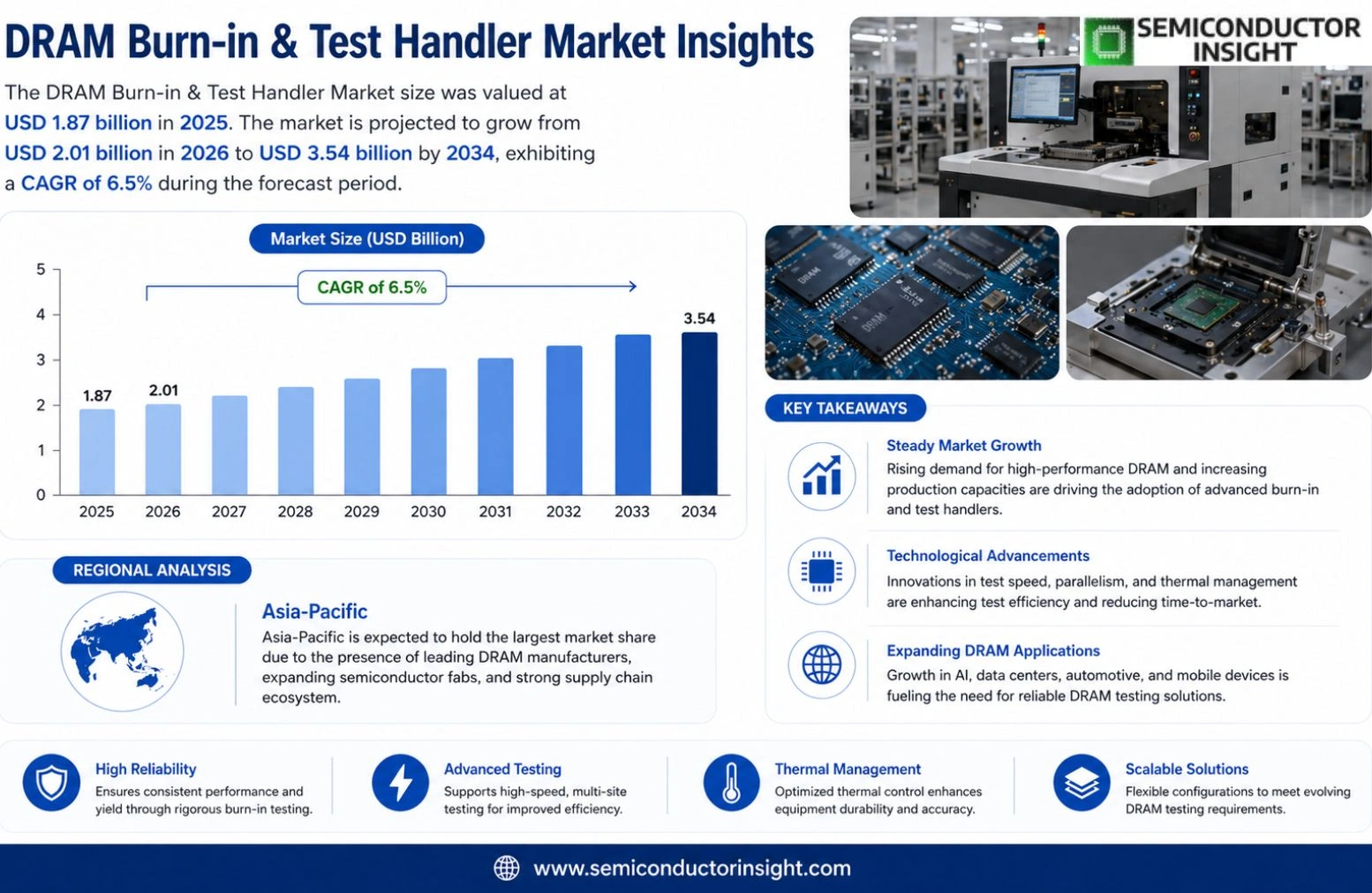
DRAM Burn-in & Test Handler Market size was valued at USD 1.87 billion in 2025. The market is projected to grow from USD 2.01 billion in 2026 to USD 3.54 billion by 2034, exhibiting a CAGR of 6.5% during the forecast period.
DRAM burn-in and test handlers are specialized semiconductor equipment used to subject dynamic random-access memory chips to elevated voltage and temperature conditions, identifying early-life failures and ensuring device reliability before deployment. These systems encompass a range of handler types, including gravity-feed handlers, pick-and-place handlers, and strip handlers, all engineered to automate the sorting, testing, and classification of DRAM devices across various package formats such as DDR4, DDR5, LPDDR4, and LPDDR5.
The market is gaining strong momentum driven by surging global demand for high-capacity memory in data centers, AI accelerators, and consumer electronics. Furthermore, the rapid transition to advanced DRAM generations, particularly DDR5 and LPDDR5, requires more rigorous and precise burn-in validation, directly increasing handler adoption. The growing presence of hyperscale cloud infrastructure and edge computing deployments has reinforced the need for zero-defect memory components, making burn-in testing an indispensable step in the semiconductor manufacturing process. Key players operating in this market include Advantest Corporation, Cohu Inc., and Teradyne Inc., each offering broad handler portfolios catering to high-volume memory production environments.
MARKET DRIVERS
Surging Demand for High-Performance DRAM in Data Centers and AI Workloads
Global DRAM Burn-in & Test Handler Market is experiencing robust growth, primarily driven by the accelerating adoption of high-bandwidth memory (HBM) and DDR5 DRAM modules across hyperscale data centers, artificial intelligence infrastructure, and high-performance computing platforms. As cloud service providers and enterprise IT operators scale up their server deployments to support generative AI and machine learning workloads, the need for rigorously validated and burn-in tested DRAM components has intensified significantly. Burn-in and test handlers play a critical role in ensuring that memory modules meet stringent reliability and performance benchmarks before deployment, making them indispensable in modern semiconductor manufacturing workflows.
Expansion of Consumer Electronics and Mobile Device Manufacturing
The proliferation of smartphones, tablets, laptops, and wearable devices continues to sustain strong demand for LPDDR and mobile DRAM variants, directly fueling procurement of advanced DRAM burn-in and test handler systems among memory module manufacturers. As device OEMs push for higher memory capacities and faster data transfer speeds within increasingly compact form factors, semiconductor test equipment suppliers are responding with next-generation handler platforms capable of processing a wider range of package types under precise thermal and electrical stress conditions. This dynamic is compelling memory manufacturers across Asia-Pacific , particularly in South Korea, Taiwan, and China , to invest in expanded test handler capacity to maintain throughput and yield optimization.
➤ The transition from DDR4 to DDR5 and the rapid commercialization of HBM3 and HBM3E memory stacks are creating sustained capital expenditure cycles within the DRAM burn-in and test handler ecosystem, as manufacturers require new handler configurations to accommodate evolved package architectures and higher operating voltages.
Furthermore, automotive-grade DRAM adoption is emerging as a significant incremental driver for DRAM Burn-in & Test Handler Market. The integration of DRAM into advanced driver-assistance systems (ADAS), in-vehicle infotainment, and autonomous driving compute platforms demands adherence to AEC-Q100 qualification standards, where burn-in testing is a mandatory process step. This automotive memory segment is expected to maintain above-average growth relative to the broader DRAM market, providing test handler OEMs with a reliable and expanding addressable opportunity through the forecast period.
MARKET CHALLENGES
High Capital Expenditure and Equipment Cost Pressures Facing Memory Manufacturers
One of the foremost challenges confronting participants DRAM Burn-in & Test Handler Market is the substantial capital investment required to procure, install, and maintain advanced handler systems. Modern burn-in and test handler platforms incorporating precision thermal control, parallel device handling, and automated optical inspection capabilities command significant per-unit costs, creating financial pressure particularly for smaller or emerging memory manufacturers operating with constrained capital budgets. The cyclical nature of the semiconductor industry further compounds this challenge, as memory producers must balance long-term equipment investment decisions against periods of DRAM pricing volatility and demand softness, occasionally leading to deferred purchasing decisions that impact handler market revenue cadence.
Other Challenges
Increasing Complexity of Memory Package Architectures
The rapid evolution of DRAM packaging technologies , including stacked HBM configurations, fine-pitch BGA packages, and embedded memory modules , is placing considerable technical demands on burn-in and test handler platform designs. Handler manufacturers must continuously invest in research and development to engineer contact mechanisms, thermal management subsystems, and socket technologies capable of reliably interfacing with next-generation DRAM packages without inducing mechanical stress or thermal non-uniformity, which can compromise test accuracy and device yield.
Supply Chain Constraints for Precision Handler Components
DRAM Burn-in & Test Handler Market is also vulnerable to supply chain disruptions affecting precision mechanical components, specialty contact materials, and embedded electronics used in handler assembly. Sourcing lead time extensions for critical subcomponents can delay handler delivery schedules, impacting memory manufacturers’ ability to ramp production capacity in alignment with demand upswings. This supply chain sensitivity underscores the need for handler OEMs to develop diversified supplier networks and maintain strategic inventory buffers for critical materials.
MARKET RESTRAINTS
Cyclicality of the DRAM Industry and Its Impact on Test Equipment Investment
DRAM Burn-in & Test Handler Market is inherently exposed to the cyclical demand-supply dynamics of the broader DRAM industry. During periods of memory oversupply and price compression, leading DRAM producers such as Samsung Electronics, SK Hynix, and Micron Technology have historically curtailed capital expenditure on new test and back-end equipment, directly suppressing handler procurement volumes. This cyclicality introduces meaningful revenue volatility for test handler vendors, making long-range capacity planning and R&D investment allocation more complex. The dependency on a relatively concentrated base of large DRAM manufacturers further amplifies this restraint, as purchasing decisions at a handful of major customers can have outsized effects on overall market performance.
Consolidation Among DRAM Producers Limiting Diversification of the Customer Base
The ongoing consolidation of global DRAM production among a small number of vertically integrated manufacturers represents a structural restraint for DRAM Burn-in & Test Handler Market. As the industry has evolved toward an oligopolistic supply structure, test handler vendors face heightened customer concentration risk, reduced competitive tendering across accounts, and stronger buyer bargaining power over equipment pricing and service contract terms. This dynamic limits the ability of handler manufacturers to sustain premium pricing, particularly for standardized or commodity handler configurations, and places increasing pressure on suppliers to differentiate through proprietary technology, application engineering support, and total cost of ownership advantages.
MARKET OPPORTUNITIES
Adoption of AI-Integrated Test Handler Platforms to Improve Throughput and Yield Analytics
A compelling growth opportunity withDRAM Burn-in & Test Handler Market lies in the integration of artificial intelligence and machine learning algorithms into handler control software and test data analytics platforms. By leveraging AI-driven predictive analytics, handler systems can dynamically optimize thermal stress profiles, identify early-life failure patterns, and reduce unnecessary test time without compromising screening effectiveness. Memory manufacturers stand to achieve meaningful improvements in test cell throughput and wafer-level yield through these intelligent handler platforms, creating a strong value proposition that is accelerating evaluation and adoption cycles among forward-looking DRAM producers seeking competitive differentiation in production efficiency.
Growth in Automotive and Industrial DRAM Applications Expanding Addressable Market Scope
The expanding deployment of DRAM in safety-critical automotive and industrial applications is creating a structurally attractive incremental opportunity for DRAM Burn-in & Test Handler Market. Automotive-grade memory components require extended burn-in durations and broader operating temperature validation ranges compared to standard consumer DRAM, translating into higher handler utilization rates and greater per-unit test time per device. As global vehicle electrification and autonomous driving development programs accelerate, the volume of automotive DRAM requiring qualification-level burn-in testing is projected to grow at an above-market rate, incentivizing test handler OEMs to develop purpose-built automotive memory handler configurations and expand their application engineering capabilities in this high-value vertical.
Emerging Memory Manufacturers in China Creating New Regional Demand Centers
The ongoing development of domestic DRAM manufacturing capabilities in China, led by companies investing in independent memory production capacity, represents a significant emerging opportunity for DRAM Burn-in & Test Handler Market. As Chinese memory producers advance along the technology learning curve and scale production volumes, their requirements for burn-in and test handler infrastructure are expected to increase substantially. International handler suppliers and locally established equipment vendors are positioning to capture this demand by offering customized handler solutions tailored to the specific DRAM process nodes and package types being developed within China’s memory industry ecosystem, opening a geographically diversified revenue stream for the broader handler market.
Trends
Accelerating Demand for Advanced DRAM Validation Drives Handler Adoption
DRAM Burn-in & Test Handler Market is witnessing a significant shift driven by the rapid global transition to next-generation memory architectures. As DDR5 and LPDDR5 DRAM devices become the dominant standards across data centers, AI accelerators, and high-performance consumer electronics, semiconductor manufacturers are under increasing pressure to deploy more precise and rigorous burn-in validation processes. Unlike their predecessors, DDR5 and LPDDR5 modules operate at higher speeds and tighter electrical tolerances, necessitating more sophisticated handler systems capable of maintaining controlled temperature and voltage stress conditions throughout the testing cycle. This transition is directly expanding the installed base of advanced burn-in and test handlers across high-volume memory production facilities worldwide.
Other Trends
Hyperscale Cloud Infrastructure Reinforcing Zero-Defect Memory Requirements
The rapid expansion of hyperscale cloud infrastructure operated by major technology companies has placed renewed emphasis on memory reliability standards. Data center operators increasingly demand zero-defect DRAM components to maintain uptime and system integrity across large-scale deployments. This operational requirement has made burn-in testing a non-negotiable step in the semiconductor manufacturing supply chain, pushing memory producers to invest in high-throughput handler systems. DRAM Burn-in & Test Handler Market continues to benefit as cloud and edge computing deployments scale globally, sustaining consistent demand for reliable handler solutions across both gravity-feed and pick-and-place handler segments.
Automation and Multi-Package Compatibility Becoming Key Differentiators
Handler manufacturers are increasingly focused on delivering automated systems that support multiple DRAM package formats within a single platform. As memory producers manage diverse product portfolios spanning DDR4, DDR5, LPDDR4, and LPDDR5 formats, the ability to handle various package types without significant retooling represents a critical operational advantage. Leading players such as Advantest Corporation, Cohu Inc., and Teradyne Inc. have responded by expanding their handler portfolios with flexible, high-throughput platforms designed to address the evolving needs of high-volume memory production environments. Automation capabilities that reduce manual intervention and improve sorting accuracy are becoming primary selection criteria for memory manufacturers globally.
AI Workload Expansion Sustaining Long-Term Handler Demand
The proliferation of artificial intelligence workloads across cloud platforms, autonomous systems, and edge devices has created sustained downstream demand for high-capacity, high-reliability DRAM. As AI accelerators and inference hardware increasingly depend on large memory bandwidths, the quality assurance requirements placed on DRAM components have intensified. This trend is reinforcing the strategic importance of burn-in and test handlers within semiconductor manufacturing pipelines, ensuring DRAM Burn-in & Test Handler Market remains a critical segment of the broader semiconductor equipment industry in the years ahead.
COMPETITIVE LANDSCAPE
Key Industry Players
DRAM Burn-in & Test Handler Market: Competitive Dynamics and Leading Manufacturer Profiles
DRAM Burn-in & Test Handler Market is characterized by a moderately consolidated competitive structure, with a handful of globally established semiconductor equipment manufacturers commanding significant market share. Advantest Corporation, Cohu Inc., and Teradyne Inc. represent the foremost players in this space, each maintaining broad handler portfolios engineered to support high-volume DRAM production across package formats including DDR4, DDR5, LPDDR4, and LPDDR5. These companies leverage decades of semiconductor test expertise and continuous R&D investment to deliver gravity-feed, pick-and-place, and strip handler solutions capable of meeting the increasingly stringent burn-in validation requirements driven by the global transition to next-generation memory architectures. Their entrenched relationships with leading DRAM manufacturers such as Samsung, SK Hynix, and Micron Technology further reinforce their dominant positioning in a market valued at USD 1.87 billion in 2025 and projected to reach USD 3.54 billion by 2034, growing at a CAGR of 6.5%.
Beyond the leading incumbents, a number of specialized and regionally significant players contribute meaningfully to the competitive ecosystem. Companies such as Chroma ATE, Hangzhou Changchuan Technology, and Amtech Systems address niche segments within the burn-in and test handler value chain, offering cost-competitive alternatives particularly relevant to mid-tier memory producers in Asia-Pacific. The intensifying demand for zero-defect memory components across hyperscale data centers, AI accelerators, and edge computing infrastructure has further expanded the addressable market, prompting both established players and emerging entrants to invest in handler platforms capable of accommodating advanced thermal management, high-parallelism testing, and automated device classification at scale. Strategic partnerships, technology licensing arrangements, and capacity expansions remain primary competitive strategies shaping the market landscape through the forecast period.
List of Key DRAM Burn-in & Test Handler Companies Profiled
- Advantest Corporation
- Cohu Inc.
- Teradyne Inc.
- Chroma ATE Inc.
- Hangzhou Changchuan Technology Co., Ltd.
- Amtech Systems Inc.
- Aehr Test Systems
- Multitest Electronic Systems GmbH
- Seiko Epson Corporation
- Enplas Corporation
- Yamaichi Electronics Co., Ltd.
- WEB Technology Inc.
- Micronics Japan Co., Ltd.
- Synax Co., Ltd.
- Reliability Incorporated
Segment Analysis:
| Segment Category | Sub-Segments | Key Insights |
| By Type |
|
Pick-and-Place Handlers dominate the DRAM burn-in and test handler market owing to their exceptional versatility and compatibility with a wide range of DRAM package formats, including DDR4, DDR5, LPDDR4, and LPDDR5.
|
| By Application |
|
Burn-in Testing represents the most critical and widely adopted application within the DRAM test handler market, as it subjects memory components to elevated voltage and temperature stress to expose latent defects prior to deployment.
|
| By End User |
|
DRAM Manufacturers constitute the dominant end-user category, as integrated device manufacturers invest heavily in in-house burn-in and test infrastructure to maintain stringent quality benchmarks across their memory product portfolios.
|
| By Package Format |
|
DDR5 is rapidly emerging as the leading package format driving handler upgrades and new equipment investments across the DRAM burn-in and test handler market.
|
| By Automation Level |
|
Fully Automated Handlers are increasingly becoming the industry standard across high-volume DRAM production facilities, driven by the dual imperatives of throughput maximization and defect rate minimization.
|
Regional Analysis: DRAM Burn-in & Test Handler Market
Asia-Pacific
South Korea and Taiwan collectively anchor the Asia-Pacific DRAM burn-in & test handler market. Leading memory chipmakers in South Korea demand state-of-the-art test handler platforms to validate high-density DRAM modules, while Taiwan’s thriving OSAT sector ensures continuous procurement of burn-in equipment, fostering a dynamic and competitive regional supply landscape.
China’s strategic semiconductor independence initiative is a significant growth catalyst for DRAM Burn-in & Test Handler Market across Asia-Pacific. Substantial government funding channeled into domestic memory chip production has resulted in rapid capacity expansions, generating growing demand for reliable burn-in and test handler equipment as local producers strive to meet international quality benchmarks.
The Asia-Pacific region is at the forefront of adopting next-generation DRAM burn-in and test handler technologies. Equipment vendors operating in this region continuously innovate to address the evolving requirements of LPDDR, HBM, and DDR5 memory technologies, ensuring that test handler platforms can accommodate higher pin counts, elevated thermal management demands, and faster throughput requirements.
A deeply integrated supply chain ecosystem distinguishes Asia-Pacific DRAM Burn-in & Test Handler Market. The proximity of semiconductor equipment manufacturers, component suppliers, and end-users within the same geography reduces lead times, enables rapid customization, and fosters collaborative innovation , advantages that regions elsewhere find difficult to replicate in the near term.
North America
North America represents a strategically significant region DRAM Burn-in & Test Handler Market, underpinned by its robust semiconductor design ecosystem, growing domestic fabrication ambitions, and a strong culture of technology innovation. The United States, in particular, has renewed its focus on bringing memory chip manufacturing onshore, supported by federal legislative initiatives aimed at strengthening national semiconductor supply chain resilience. This policy-driven momentum is expected to gradually expand the installed base of DRAM burn-in and test handler equipment across the region. Furthermore, North America is home to several leading semiconductor equipment companies and research institutions that actively shape the technological direction of test handler solutions. The region’s advanced data center infrastructure and hyperscaler investments continue to generate sustained downstream demand for high-reliability DRAM components, indirectly reinforcing the need for rigorous burn-in and testing protocols across the memory supply chain.
Europe
Europe occupies a notable position Global DRAM Burn-in & Test Handler Market, characterized by its emphasis on high-precision manufacturing, stringent quality standards, and a growing commitment to semiconductor sovereignty. The European Chips Act has injected fresh momentum into the region’s ambitions to expand domestic semiconductor production capacity, which bodes well for the long-term adoption of advanced burn-in and test handler equipment. Germany, the Netherlands, and France stand out as key contributors, hosting a combination of semiconductor manufacturers, specialized test equipment providers, and automotive-grade electronics producers that demand exceptionally rigorous DRAM validation processes. Europe’s automotive and industrial electronics sectors are particularly influential demand drivers, given that memory components deployed in these applications must pass extensive burn-in cycles to ensure operational reliability under demanding environmental conditions.
South America
South America remains an emerging region withDRAM Burn-in & Test Handler Market, characterized by a developing electronics manufacturing base and gradually expanding semiconductor assembly activities. Brazil leads the region’s electronics sector, supported by government incentives designed to attract foreign technology investment and stimulate domestic production capabilities. While South America does not yet host large-scale DRAM fabrication facilities, the region’s growing demand for consumer electronics, telecommunications infrastructure, and automotive systems is creating indirect market opportunities for burn-in and test handler equipment suppliers. As regional electronics manufacturers increasingly source memory components requiring validated quality assurance, the awareness and adoption of professional burn-in testing protocols is expected to grow steadily over the forecast period, positioning South America as a market of emerging relevance in the global DRAM burn-in & test handler landscape.
Middle East & Africa
The Middle East & Africa region currently represents the nascent stage of participation DRAM Burn-in & Test Handler Market, yet it harbors noteworthy long-term potential linked to broader technology infrastructure expansion. Several Gulf Cooperation Council nations are actively investing in digital transformation, smart city development, and data center construction , all of which depend on reliable, high-performance DRAM components and create downstream validation requirements. Israel stands out as a regional exception, with a sophisticated semiconductor design and testing ecosystem that contributes meaningfully to the regional market. In Africa, the gradual proliferation of mobile technology and expanding telecommunications networks is creating foundational demand for memory components, though large-scale adoption of burn-in and test handler equipment remains a longer-term prospect contingent on accelerated industrialization across the continent.
Report Scope
This market research report provides a comprehensive analysis of the DRAM Burn-in & Test Handler Market , covering the forecast period 2026–2034. It offers detailed insights into market dynamics, technological advancements, competitive landscape, and key trends shaping the industry.
Key focus areas of the report include:
- Market Overview: The report begins with an overview outlining its current market scenario, key growth indicators, and industry transformation drivers. It discusses macroeconomic factors, demand–supply balance, regulatory landscape, and the strategic role of semiconductors in powering advancements across industries such as automotive, telecommunications, consumer electronics, and industrial automation.
- Market Size & Forecast: Historical data and future projections for revenue, unit shipments, and market value across major regions and segments.
- Segmentation Analysis: Detailed breakdown by product type, technology, application, and end-user industry to identify high-growth segments and investment opportunities.
- Regional Insights: Insights into market performance across North America, Europe, Asia-Pacific, Latin America, and the Middle East & Africa, including country-level analysis where relevant.
- Competitive Landscape: Profiles of leading market participants, including their product offerings, R&D focus, manufacturing capacity, pricing strategies, and recent developments such as mergers, acquisitions, and partnerships.
- Technology Trends & Innovation: Assessment of emerging technologies, integration of AI/IoT, semiconductor design trends, fabrication techniques, and evolving industry standards.
- Market Drivers & Restraints: Evaluation of factors driving market growth along with challenges, supply chain constraints, regulatory issues, and market-entry barriers.
- Stakeholder Insights: Insights for component suppliers, OEMs, system integrators, investors, and policymakers regarding the evolving ecosystem and strategic opportunities.
Primary and secondary research methods are employed, including interviews with industry experts, data from verified sources, and real-time market intelligence to ensure the accuracy and reliability of the insights presented.
FREQUENTLY ASKED QUESTIONS:
What is the current market size of DRAM Burn-in & Test Handler Market?
-> DRAM Burn-in & Test Handler Market was valued at USD 1.87 billion in 2025 and is expected to reach USD 3.54 billion by 2034, growing at a CAGR of 6.5% during the forecast period from 2026 to 2034.
Which key companies operate DRAM Burn-in & Test Handler Market?
-> Key players include Advantest Corporation, Cohu Inc., and Teradyne Inc., among others, each offering broad handler portfolios catering to high-volume memory production environments.
What are the key growth drivers?
-> Key growth drivers include surging global demand for high-capacity memory in data centers, AI accelerators, and consumer electronics, as well as the rapid transition to advanced DRAM generations such as DDR5 and LPDDR5, which require more rigorous burn-in validation. The growing presence of hyperscale cloud infrastructure and edge computing deployments has further reinforced the need for zero-defect memory components.
Which region dominates the market?
-> Asia-Pacific is the fastest-growing region, driven by the concentration of leading semiconductor manufacturers and high-volume DRAM production facilities, while North America remains a significant market supported by hyperscale data center investments and AI infrastructure buildout.
What are the emerging trends?
-> Emerging trends include adoption of DDR5 and LPDDR5 memory standards, integration of automated pick-and-place and gravity-feed handler technologies, and increasing demand for zero-defect memory validation driven by the expansion of AI accelerators, edge computing, and hyperscale cloud infrastructure deployments.

Get Sample Report PDF for Exclusive Insights
Report Sample Includes
- Table of Contents
- List of Tables & Figures
- Charts, Research Methodology, and more...
 Download Sample Report PDF