Double Sided FPC Coverlay Market Insights
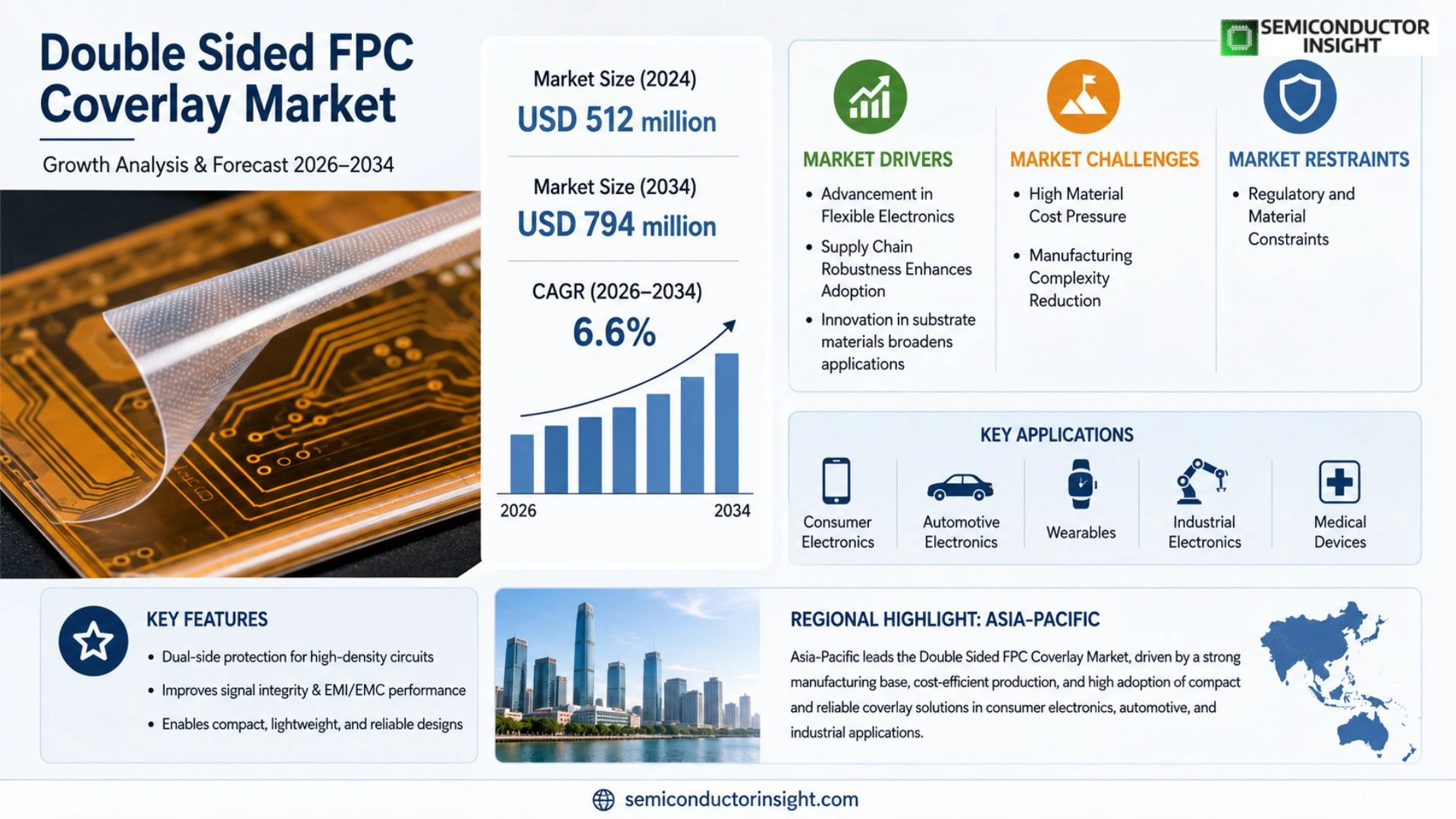
Double Sided FPC Coverlay market was valued at USD 512 million in 2024 and is forecasted to reach USD 794 million by 2034, reflecting a CAGR of 6.6% over the forecast period.
A double‑sided coverlay refers to an adhesive film applied on both sides of a flexible printed circuit board (FPCB) that protects the copper traces while allowing high‑density interconnections on either surface. These films are typically made from polyimide or polyester substrates coated with metalized layers, providing electrical insulation, mechanical strength and chemical resistance required for demanding applications such as mobile devices, medical implants and aerospace avionics.
MARKET DRIVERS
Advancement in Flexible Electronics
Developments in polymer‑based substrates allow Double Sided FPC Coverlay Market to deliver unparalleled flexibility while maintaining signal integrity. The ability to route traces on both sides of a single FPC layer reduces board real estate, a critical advantage for compaction‑centric devices such as foldable phones and high‑density wearables. This push for finer line widths, together with rigorous EMI/EMC performance, drives the demand for premium double‑sided coverlays.
Supply Chain Robustness Enhances Adoption
Governments and industry bodies are tightening semiconductor component certification regimes. The resulting focus on traceability and material purity encourages firms to invest in double‑sided coverlay solutions that provide robust isolation between power lines and sensor arrays, thereby lowering failure rates and import duties on component parts. This stability in sourcing fuels market momentum.
➤ Innovation in substrate materials fuels market momentum, broadening the applicability of double‑sided coverlays across consumer, automotive, and industrial sectors.
Emerging packaging techniques such as fan‑out and open‑delta designs rely on a double‑layered coverlay to integrate routing complexity without introducing additional layers. This converges with the market’s tendency toward thinner, lighter products, ensuring that Double Sided FPC Coverlay Market remains a strategic component for next‑generation electronics.
MARKET CHALLENGES
High Material Cost Pressure
Standard coverlay materials, particularly those incorporating high‑temperature resins and copper‑free inks, represent a significant portion of the bill of materials in double‑sided FPCs. Fluctuations in copper prices and the limited supply of specialty polymers constrain profitability, especially for small‑to‑mid‑scale manufacturers who lack purchasing power. This economic pressure hampers scaling efforts in Double Sided FPC Coverlay Market.
Other Challenges
Manufacturing Complexity Reduction
The precision required for reliable solder joint formation on dual‑side substrates increases process iterations, scrap rates, and tooling capital. Companies wrestling with high defect rates often seek alternative single‑sided solutions, thereby diluting market share. Additionally, the scarcity of certified technicians adept at handling double‑sided coverlay surfaces limits quick product roll‑outs.
MARKET RESTRAINTS
Regulatory and Material Constraints
Lead‑free and REACH‑compliant resins impose stricter curing cycles and lower dielectric constants, impacting both cost and performance of double‑sided FPC coverlays. Manufacturers that fail to meet these standards face re‑work or rejection cycles, which can delay product launches in the competitive electronics domain. Consequently, regulatory compliance remains a persistent market restraint.
MARKET OPPORTUNITIES
Expansion into Automotive Electronics
The automotive sector’s shift toward electrification and advanced driver‑assist systems demands high‑density, high‑frequency interconnects. Double‑sided FPC coverlays, with their superior shielding capability, are increasingly preferred for control units, sensor matrices, and infotainment modules. This penetration offers a robust revenue stream for innovators within Double Sided FPC Coverlay Market.
Edge‑computing and 5G infrastructure also present fertile ground, as base stations and small cells benefit from the compactness and RF performance of double‑sided solutions. By engaging early with network operators, suppliers can secure long‑term contracts that bolster the longevity of the market.
Finally, the rise of wearables and IoT devices,often constrained by power and space,creates additive demand for flexible double‑sided coverlays that maintain performance while supporting form‑factor innovation. Targeting these high‑growth niches ensures sustained momentum for Double Sided FPC Coverlay Market.
Double Sided FPC Coverlay Market Trends
Rising Demand Driven by High‑Density Electronics
The push for slimmer, lighter devices has amplified the need for boards that can pack more circuitry into less space. Double‑sided FPC coverlays now serve as the backbone for compact power management modules, flexible displays, and advanced sensor arrays. Customers are demanding higher conductor density without sacrificing reliability, and vendors respond by refining copper routing and insulating layers to meet these performance thresholds. The resulting uptick in orders underscores a broader trend toward appliance integration and network densification in consumer and industrial environments alike.
Other Trends
Materials Innovation: Shift to Roll‑Coated Copper
Increasing flexibility is now achieved through refined roll‑coated copper layers that maintain structural integrity during repeated bends. Manufacturers are phasing out rigid electrolytic copper because it offers limited compliance and higher distortion risk. This material change translates into lower failure rates for wearable technology and automotive sensors, where dynamic movement is a constant factor. Consequently, firms that secure patents on advanced roll‑coating techniques secure a competitive advantage, especially in the automotive aftermarket segment.
Automation in Manufacturing Processes
Robotic pick‑and‑place systems and machine vision now routinely handle the precise alignment of double‑sided coverlays, reducing labor cost and human error. This automation movement is driven by the escalating need for rapid prototyping and volume production of flexible modules. Companies that adopt fully integrated production lines accelerate time‑to‑market for next‑generation smart homes and industrial IoT devices, thereby capturing market share among early adopters and system integrators.
Geographic Shift Toward Emerging Markets
Production base is increasingly migrating to cost‑efficient regions where skilled labor meets supportive infrastructure. Chinese mainland manufacturers, in particular, sustain a near 50 % market share due to a mature material supply chain and a high‑volume capability pipeline. South‑East Asian hubs are also expanding, fueled by government incentives for semiconductor manufacturing. As a result, clients that tap into this diversified network can mitigate supply risk and maintain pricing leverage in the face of global trade volatility.
COMPETITIVE LANDSCAPE
Key Industry Players
Double Sided FPC Coverlay Market
At the core of the double‑sided FPC coverlay landscape DuPont maintains a dominant position, interpreting the 512‑million USD 2024 valuation as an anchor point for the industry. Its patented epoxy systems provide the structural integrity that permits the high‑density, double‑layer designs required in 5G radio units and automotive electronic control modules. The company’s global supply chain, spanning North America, Asia‑Pacific, and Europe, underpins the sector’s resilience, while its R&D pipeline targets next‑generation carbon‑nanotube composites to cut weight and enhance thermal conductivity. These capabilities translate into a roughly 30% share of revenue streams, making DuPont the benchmark against which new entrants and regional players are measured. The company’s ability to seamlessly integrate supply chain operations across continents also mitigates regional supply shocks, which few competitors can match.
Beyond DuPont, the competitive field is populated by a coalition of niche specialists that collectively drive innovation and capture regional markets. Hanwha Solutions, with its integrated substrate‑coating competence, dominates the Korean and Japanese segments, while Dexerials’ high‑temperature black coverlay attracts cooling‑intensive automotive suppliers. Taiflex and Namics, each offering proprietary micro‑patterned lead frames, have expanded their footprints into emerging Chinese cities, leveraging cost‑efficient production lines. Henkel’s chemical master batch solutions, alongside ITEQ Corporation’s cutting‑edge fabrication technologies, combine to satisfy the stringent reliability standards of aerospace and medical devices. The network is further enriched by Panasonic, which secures a stable base in premium industrial applications, and Microcosm Technology, whose polymer blends enhance moisture resistance. 3M and Selemet provide complementary raw‑material platforms that reduce lead times for mid‑tier manufacturers. Moreover, cost competitiveness drives another layer of dynamics, with Chinese manufacturers leveraging lower labor costs to pressure margins, prompting incumbents to emphasize quality differentiation.
List of Key Double Sided FPC Coverlay Companies Profiled
- DuPont
- Hanwha Solutions
- Dexerials
- Henkel
- Taiflex
- Namics
- ITEQ Corporation
- Arisawa Manufacturing
- INNOX Advanced Materials
- Panasonic
- Microcosm Technology
- 3M
- Selemet
Segment Analysis:
| Segment Category | Sub-Segments | Key Insights |
| By Type |
|
Black Coverlay drives growth through its superior electrical conductivity and flexibility, allowing tighter integration in high‑density circuitry. Its compatibility with thin substrates attracts designers seeking high repeatability. The material’s well‑established manufacturing processes reduce lead times, making it a preferred choice for rapid product roll‑outs. Technology recipients value its chemical stability in harsh environments. |
| By Application |
|
Consumer Mobile Products exhibit heightened demand for compact, high‑performance circuitry, positioning double‑sided FPC coverlay as a critical enabler. Designers prioritize weight reduction while maintaining signal integrity, leading to widespread adoption in flagship devices. Rapid prototyping cycles and evolving form factors reinforce the importance of flexible, durable coverings. Market players capitalize on these needs to differentiate their offerings. |
| By End User |
|
Mobile Device Manufacturers drive adoption by seeking robust, thin, and flexible boards that can endure multiple fold‑cycles. Emphasis on reliable power delivery and signal fidelity encourages these users to select double‑sided coverlay solutions. Continuous innovation in screen‑on‑glass and foldable designs speeds up cycle periods, intensifying supply chain demands. Strategic supplier partnerships become critical for secure component acquisition. |
| By Coverlay Material |
|
Polyimide Coverlay stands out due to its excellent thermal stability and insulating properties, enabling reliable operation across wide temperature ranges. The material supports high‑density routing while maintaining mechanical resilience, which appeals to battery‑powered devices. It also offers consistent barrier performance against moisture and contaminants, a key factor for mission‑critical electronics. Suppliers highlight its compatibility with multi‑layer stack‑up designs. |
| By Thickness |
|
Lesser than or equal to 5 µm offers minimal dimensional impact, making it ideal for ultra‑compact or foldable devices that demand extreme thinness. Despite challenges in handling and lamination, manufacturers are overcoming these through advanced tooling and surface‑treatments. This thickness range enables higher circuit density and simplifies stack‑up configurations, providing a competitive edge in emerging electronics markets. The trade‑off in durability is mitigated by rigorous post‑process treatments. |
Regional Analysis: Double Sided FPC Coverlay Market
Asia‑Pacific
Regional manufacturers have carved out a strategy that balances volume production with custom solutions. By leveraging local silicon foundries and co‑processors, they provide OEMs with rapid turnaround and flexible design parameters. The supply network’s geographic diversity reduces dependency on any single source, a feature increasingly valued by global brands seeking resilience.
End‑user demand is shifting toward compact, multifunctional devices that require robust protective layers on both sides of the FPC. The composite protection offered by double‑sided coverlays aligns with the design philosophy of next‑generation smartphones, drones, and automotive infotainment systems where space and reliability are critical.
Innovations in nano‑ceramic coatings and flexible polymer blends are expanding the operating envelope of coverlays, allowing them to endure higher temperature cycles without compromising signal integrity. These breakthroughs translate into extended product life cycles and lower maintenance costs for OEMs.
Stringent environmental regulations in major markets are encouraging the use of recyclable materials. Compliance with RoHS and REACH directives has become an integral part of design, pushing suppliers to integrate sustainable practices into their manufacturing trains.
North America
The North American market benefits from a strong OEM presence in the aerospace and medical device sectors, where double‑sided coverlays provide essential protection for fragile circuitry. Despite higher production costs, local manufacturers focus on precision engineering and stringent quality certifications, which resonate with buyers that prioritize reliability over price. Recent shifts toward satellite miniaturization are creating niche opportunities for ultra‑thin coverlays, reinforcing the region’s role as a catalyst for high‑performance solutions.
Europe
Europe’s regulatory framework, coupled with a deep pool of engineering talent, drives a demand for coverlays that meet both performance and sustainability criteria. Automotive suppliers in Germany and the UK are investing in coverlays that safeguard electrical assemblies in electric vehicles, taking advantage of industry standards that emphasize recyclability and longevity. Collaborative R&D initiatives across EU member states accelerate technology transfer and help maintain the region’s competitive edge.
South America
South America’s growing electronics footprint is supported by bullish growth in mobile handset exports and a burgeoning start‑up ecosystem. Local manufacturers are leveraging cost efficiencies while adapting to the unique challenges of tropical operating environments, which demand coverlays with enhanced thermal and moisture resistance. Partnerships with regional telecom operators help embed double‑sided coverlays into next‑generation infrastructure, gradually cementing the region’s market presence.
Middle East & Africa
The Middle East and African markets are experiencing a gradual uptick in demand for robust electronic components, spurred by rapid industrialization and a focus on smart infrastructure. While supply chains are less mature, increasing investment in local fabrication facilities is bridging capabilities gaps. Demand for coverlays that can withstand high temperatures and dust exposure is rising in subsea and energy sectors, setting the stage for future growth opportunities.
Report Scope
This market research report provides a comprehensive analysis of the Double Sided FPC Coverlay Market , covering the forecast period 2026–2034. It offers detailed insights into market dynamics, technological advancements, competitive landscape, and key trends shaping the industry.
Key focus areas of the report include:
- Market Overview: The report begins with an overview outlining its current market scenario, key growth indicators, and industry transformation drivers. It discusses macroeconomic factors, demand–supply balance, regulatory landscape, and the strategic role of semiconductors in powering advancements across industries such as automotive, telecommunications, consumer electronics, and industrial automation.
- Market Size & Forecast: Historical data and future projections for revenue, unit shipments, and market value across major regions and segments.
- Segmentation Analysis: Detailed breakdown by product type, technology, application, and end-user industry to identify high-growth segments and investment opportunities.
- Regional Insights: Insights into market performance across North America, Europe, Asia-Pacific, Latin America, and the Middle East & Africa, including country-level analysis where relevant.
- Competitive Landscape: Profiles of leading market participants, including their product offerings, R&D focus, manufacturing capacity, pricing strategies, and recent developments such as mergers, acquisitions, and partnerships.
- Technology Trends & Innovation: Assessment of emerging technologies, integration of AI/IoT, semiconductor design trends, fabrication techniques, and evolving industry standards.
- Market Drivers & Restraints: Evaluation of factors driving market growth along with challenges, supply chain constraints, regulatory issues, and market-entry barriers.
- Stakeholder Insights: Insights for component suppliers, OEMs, system integrators, investors, and policymakers regarding the evolving ecosystem and strategic opportunities.
Primary and secondary research methods are employed, including interviews with industry experts, data from verified sources, and real-time market intelligence to ensure the accuracy and reliability of the insights presented.
FREQUENTLY ASKED QUESTIONS:
What is the current market size of Double Sided FPC Coverlay Market?
-> Double Sided FPC Coverlay market is forecasted to reach USD 794 million by 2034, reflecting a CAGR of 6.6% over the forecast period.
Which key companies operate in Double Sided FPC Coverlay Market?
-> Key players include DuPont, Hanwha Solutions, Dexerials, Taiflex, Namics, Henkel, ITEQ Corporation, Arisawa Mfg, INNOX Advanced Materials, Panasonic, Microcosm Technology, among others.
What are the key growth drivers?
-> Key growth drivers include rapid adoption of AI and 5G technologies, the expansion of new energy vehicle markets, and the increasing demand for high-density flexible PCBs.
Which region dominates the market?
-> Asia (China) dominates the market, owing to its significant share of global PCB manufacturing activities.
What are the emerging trends?
-> Emerging trends include integration of advanced materials for improved durability, widespread adoption of AI-driven manufacturing processes, and development of sustainable, eco-friendly coverlays.

Get Sample Report PDF for Exclusive Insights
Report Sample Includes
- Table of Contents
- List of Tables & Figures
- Charts, Research Methodology, and more...