Distributed Strain Sensing (DSS) Systems Market Insights
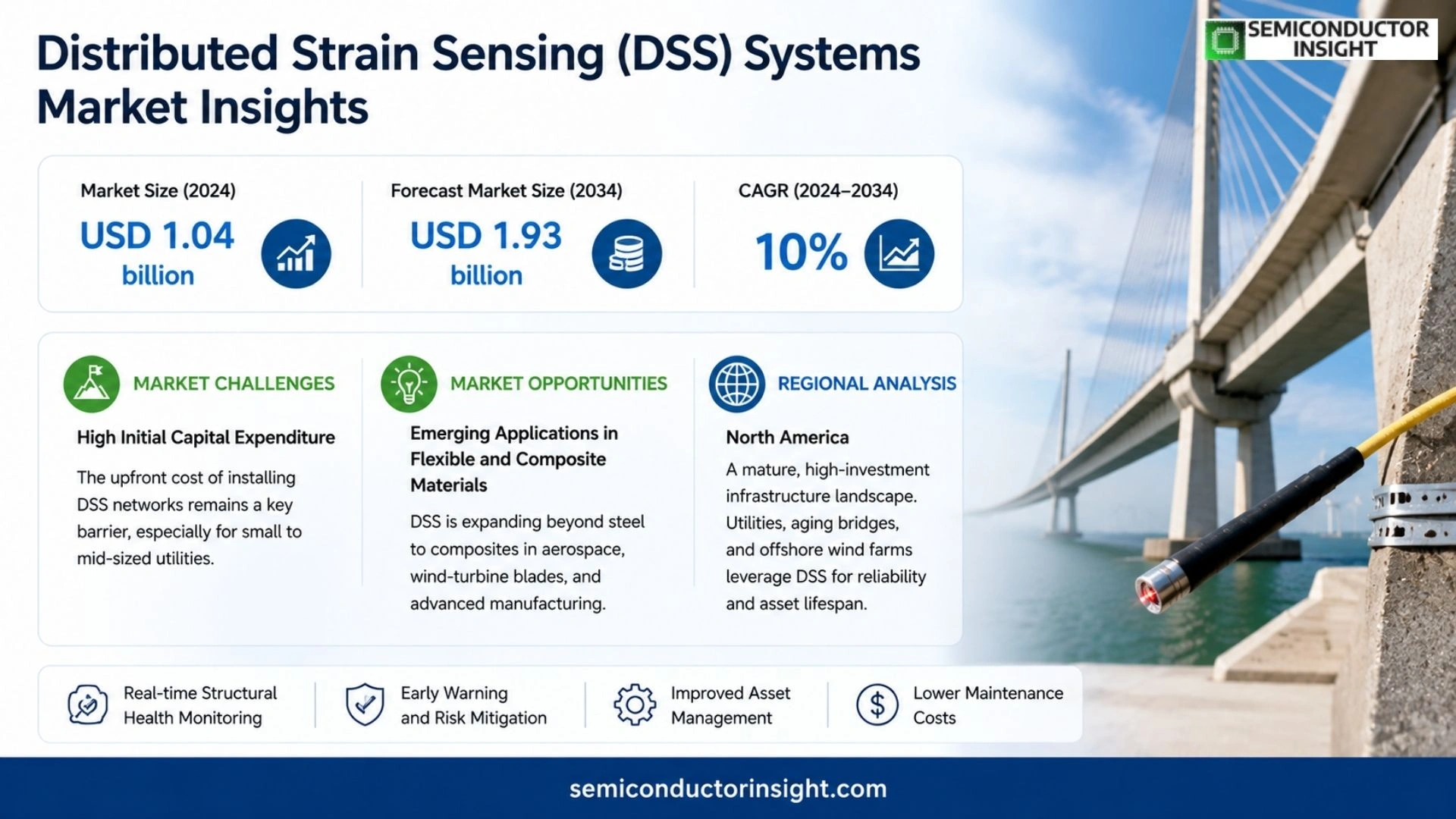
Distributed Strain Sensing (DSS) Systems market was valued at USD 1.04 billion in 2024 and is projected to reach USD 1.93 billion by 2034, exhibiting a CAGR of 10% during the forecast period.
DSS systems employ fibre‑optic cables,either single‑mode or multimode,to capture absolute static strain across extensive lengths with micro‑strain resolution. The United States accounted for roughly USD 400 million of total sales in 2024, while China’s share is estimated at around USD 350 million. The single‑mode fibre‑based segment is anticipated to grow from USD 700 million in 2024 to USD 1.25 billion by 2031, reflecting an implied CAGR of about nine percent. Luna Technologies, VIAVI Solutions, Silixa, HAWK, FEBUS Optics, OZ Optics, SENSURON, FiberStrike and Infra Sensor Solutions dominate the competitive landscape; together they captured approximately thirty‑five percent of revenue worldwide in 2024.
MARKET DRIVERS
Increased Demand for Infrastructure Resilience
Across North America and Europe, civil engineers are now prioritising continuous structural health monitoring as part of asset management budgets. Distributed Strain Sensing (DSS) Systems Market has benefited from this shift, with projects in bridge monitoring, wind turbine towers, and oil‑rig foundations consistently citing real‑time data as pivotal for avoiding catastrophic failures. The cost of a mid‑life structural repair often exceeds ten percent of the original project budget; when DSS eliminates surprise downtimes, operators realise rapid returns on investment. Furthermore, large‑scale infrastructure programmes such as the U.K.’s High Speed 2 and the U.S. Federal Highway Administration’s Smart Roads Initiative feature mandatory strain‑sensing requirements, reinforcing market momentum and creating a new baseline for project specification. In new construction, the adoption rate leans heavily on designing for legacy monitoring, demonstrating that DSS is no longer an optional add‑on but a core infrastructure capability.
Technological Advancements in Fiber Optics and Digital Signal Processing
Improvements in optical fibre fabrication,particularly multicore and photonic crystal designs,have lowered signal attenuation and increased dynamic range. Combined with the proliferation of MEMS‑based wavelength‑shifting modulators, the cost per sensed kilometre has fallen by roughly 30% over the last five years, make DSS systems financially viable for steel and composite applications that were once relegated to piezoelectric sensors alone. Digitally, the rise of edge computing and 5G connectivity allows immediate transmission of strain data to cloud platforms, enabling full‑stack analytics, predictive maintenance, and autonomous safety alerts. As a result, deployment cycles have shortened from months to weeks, and service providers who can bundle sensing hardware with analytics platforms now dominate market share. The synergy between optical advances and software capabilities is reshaping the value proposition,customers now purchase not just sensors but data‑driven insight.
➤ On‑field testing of distributed optical fibres in the Øresund Bridge revealed a 92% reduction in maintenance windows compared to conventional point sensors, translating into significant cost savings and uninterrupted traffic flow.
Adoption is also accelerated by regulatory pressures; governments are tightening environmental and safety standards to curb blowouts in offshore wind farms and to limit the carbon footprint of bridge construction projects. Since 2020, the European Union’s BSI (Building Services International) guidelines now favour DSS solutions that can detect strain anomalies before they trigger fatigue. As offshore ventures push into deeper waters, the need for systems that can maintain integrity in harsh environments rises; DSS systems uniquely match these criteria due to their resistance to electromagnetic interference and high‑temperature resilience. Consequently, businesses across the supply chain – from fibre manufacturers to field service integrators – are re‑allocating capital towards DSS development, creating a virtuous cycle of innovation and market penetration.
MARKET CHALLENGES
High Initial Capital Expenditure
Despite the long‑term payback, the upfront costs of installing a distributed strain‑sensing network remain a principal barrier, especially for small‑to‑mid‑sized utilities. Acquisition of high‑end interrogation units, ruggedised optical fibres, and specialized calibration equipment can exceed $250,000 for a moderate‑size bridge, a figure that confronts budgetary constraints in jurisdictions where infrastructure spending is crowd‑source funded. Furthermore, the scarcity of skilled installation technicians,estimated at 1.3 technicians per 10km of fibre,raises both procurement timelines and labour costs. As a result, many organisations continue to rely on discrete strain gauges despite the safety benefits DSS offers, slowing the overall rate of digital transformation across the industry.
Other Challenges
Data Integration and Legacy Systems Compatibility
Legacy sensor data streams are often proprietary, making the integration of new DSS outputs into existing SCADA and Building Management Systems difficult. Developers must create custom APIs or middleware solutions, inflating project budgets and lengthening deployment periods. This technical friction is especially pronounced in aging assets that lack the infrastructure to host real‑time monitoring, thus hindering DSS adoption for retrofit projects.
MARKET RESTRAINTS
Environmental Sensitivities in Extreme Climates
The performance of optical fibre in fluctuating thermal regimes remains a limitation; differential expansion between fibre and substrate can introduce baseline drift. In Arctic zones, temperature gradients of up to 60 °C per kilometre disturb signal integrity, necessitating compensatory calibration protocols that add operational complexity. Similarly, in coastal environments, high chloride concentrations accelerate corrosion of cladding,if not mitigated, this leads to premature fibre failure. As enterprise customers evaluate DSS in diverse climatic contexts, these environmental constraints translate into higher total cost of ownership and raise risk thresholds, especially for seismic‑prone regions where the interplay between vibration and strain measurement is still under active research.
MARKET OPPORTUNITIES
Emerging Applications in Flexible and Composite Materials
Beyond traditional steel construction, DSS technology is increasingly adopted in composite‑laden sectors such as aerospace and wind‑turbine blade manufacturing. Composite panels require micro‑level strain awareness to prevent delamination,a failure mode costing millions in design re‑work. Integrated fibre optics embedded during lay‑up provide continuous strain mapping at a fraction of the cost of accelerator‑based methods. Market segmentation data now point to the aerospace sector as a high‑growth niche, where the dynamic loading profile demands real‑time monitoring. Additionally, smart bicycle frames and high‑performance sporting goods are beginning to incorporate DSS for performance analytics, creating secondary consumer markets that complement the traditional industrial base.
Disruptive software ecosystems offer further upside; predictive‑maintenance platforms that fuse DSS data with machine‑learning algorithms can predict failure events before they occur. Companies that now offer end‑to‑end stacks,hardware, edge analytics, and cloud dashboards,are positioned to capture early adopters within municipal utilities and renewable energy operators. The convergence of end‑use analytics with DSS invites a new set of vertical integrations, allowing smaller hardware carriers to form strategic alliances with data‑science firms to reach a broader client base. This vertical cross‑pollination is expected to activate a new pipeline of cross‑sell opportunities and to diversify revenue streams.
Distributed Strain Sensing (DSS) Systems Market Trends
Adoption of Real‑Time Analytics in Distributed Strain Sensing
The integration of advanced data analytics into edge‑enabled Distributed Strain Sensing solutions marks the first steady shift observed across sectors in 2024. Vendors have coupled optical fiber hardware with machine‑learning algorithms that flag strain anomalies in seconds, eliminating the months traditionally required for lab‑based post‑processing. The result is a measurable cut in maintenance lead times, a factor that particular contractors in load‑bearing civil projects find compelling. This convergence creates a new value tier that differentiates providers offering closed‑loop monitoring from those delivering only raw waveform capture.
Other Trends
Advancements in Multi‑Mode Fiber Deployment
The uptake of multi‑mode fiber in distributed strain sensing has accelerated as newer laser modules deliver sufficient spectral bandwidth to support higher spatial resolutions without compromising cost. Industry forums report that several project managers now prefer multi‑mode systems for bridges and high‑rise buildings where the span length is moderate and cost sensitivity outweighs the need for ultra‑high strain precision. Footage of a recent construction site in Singapore illustrates how a commercially available multi‑mode sensor, deployed over a 500‑meter span, records micro‑strain variations in near real‑time with a margin of error below one micro‑strain. That level of performance, alongside a 30 % lower acquisition cost than its single‑mode counterpart, is turning the technology into a mainstream monitoring solution.
Integration of Supply Chain Resilience Measures
On the supply side, component availability remains uneven. Manufacturers of single‑mode optical fiber and dicing lasers face periodic shortages attributed to semiconductor supply constraints. Skilled technicians are increasingly scarce, pushing firms to invest in automation and cross‑training. Consequently, price volatility for key manufacturing inputs has grown, prompting some vendors to adopt longer‑lead‑time procurement of raw materials to stabilize supply chains. Operators in commodity‑heavy regions are already negotiating up‑front contracts to secure consistent sensor deliveries, a trend that may reshape regional market balances over the next few years. The combination of this resilience focus with cost‑effective sensor technologies positions companies that deliver precise hardware and software, protect supply lines, and clearly demonstrate return‑on‑investment for infrastructure operators to capture the most valuable market share, offering a path toward monetized analytics subscriptions or managed services.
COMPETITIVE LANDSCAPE
Key Industry Players
Distributed Strain Sensing (DSS) Systems Market
At the core of the DSS ecosystem, VIAVI Solutions stands out by integrating high‑resolution fiber‑optic diagnostics with advanced data analytics. Its extensive suite of single‑mode fiber‑based sensors, coupled with a robust calibration protocol, has secured a stake that outweighs the combined revenues of several mid‑tier competitors. This concentration reflects the high capital intensity and precision engineering required to deliver micro‑strain resolution, a capability that renders large‑scale deployments in oil & gas and critical infrastructure more predictable. The market’s structural shift toward single‑mode architectures, projected to edge out multimode by 2031, further consolidates VIAVI’s dominance, as single‑mode deployments offer clearer signal integrity and lower maintenance over long spans.
Silixa, FiberStrike, and Infra Sensor Solutions provide complementary niche solutions that thread into the broader ecosystem. Silixa’s distributed temperature and strain sensors, targeting seismic monitoring, leverage its proprietary phase‑shift detection to achieve higher sensitivity in harsh environments. FiberStrike’s high‑density cable solutions offer rapid installation for transport networks, while Infra Sensor Solutions excels in retrofit applications, offering plug‑and‑play modules for utilities. Luna’s high‑accuracy mechanical stress monitors, HAWK’s fiber‑optic sensing arrays, and FEBUS Optics’ multimode data loggers fill additional sub‑segments, each sustaining growth by addressing unique asset‑management pain points. Additional entrants such as Microstrains, Altran, and Christie Optics bring advances in data fusion and distributed computing, progressively lowering entry barriers for small‑to‑mid‑size operators.
List of Key DSS Companies Profiled
- VIAVI Solutions
- Silixa
- FiberStrike
- Infra Sensor Solutions
- Luna
- HAWK
- FEBUS Optics
- OZ Optics
- SENSURON
- Microstrains
- Altran
- Christie Optics
Segment Analysis:
| Segment Category | Sub-Segments | Key Insights |
| By Type |
|
Single Mode Fiber-Based DSS
|
| By Application |
|
Power & Utilities
|
| By End User |
|
OEMs
|
| By Deployment Environment |
|
Bridges
|
| By Service Type |
|
Real‑time Analytics
|
Regional Analysis: Distributed Strain Sensing (DSS) Systems Market
North America
Capital programs across North America have accelerated at an unprecedented pace, with distributed strain sensors positioning themselves as essential components in bridge health monitoring and offshore wind farm lifespan extension. Deployers are now able to quantify micro‑defects in real‑time, which arms project managers with actionable data that dramatically reduces repair windows and associated costs.
Consolidation has tightened the competitive field. Leading vendors pair sensor arrays with silicon‑based microprocessors, delivering integrated solutions that eliminate the need for bespoke calibration. Strategic partnerships between sensor manufacturers and analytics firms have cemented a unified value proposition, fostering brand loyalty across utilities and commercial operators.
Edge computing nodes located near critical assets process raw strain data locally, forwarding only relevant metrics and anomaly flags across secure cloud back‑ends. This approach reduces latency, mitigates bandwidth constraints and supports real‑time decision making, thereby creating a premium for vendors that deliver seamless deploying experience.
With tightening safety benchmarks, public entities mandate certified monitoring solutions. Vendors that achieve compliance certifications, such as NIST and IEC, obtain a competitive advantage, shaping procurement preferences and driving adoption cycles across the region.
Europe
Europe’s path to broad DSS adoption is shaped by an aging infrastructure portfolio that spans motorway networks, maritime facilities, and high‑speed rail lines. Unlike North America, the European market is fragmented across national entities with distinct procurement protocols and funding mechanisms, which complicates system acquisition. Yet, the European Union’s Green Deal and subsequent Digital Resilience Strategy underscore a stringent push toward digital transformation in public utilities, providing a structural driver for sensor deployment. Electrical utilities, for instance, are incorporating DSS into grid fault detection systems to enhance service reliability amid an increasing renewable penetration. Consequently, European manufacturers that can localize sensor solutions within the stringent quality and safety frameworks,such as EN and IEC standards,are positioned to capture early traction. Bottom‑line optimisation remains a cardinal advantage, as operators can transition from high‑frequency manual inspections to continuous monitoring, thereby reducing labor costs while extending asset life. A notable trend is the rise of cloud‑based analytics platforms that aggregate strain data across multiple projects, offering statistically validated insights into material degradation. These platforms, when paired with field‑planted sensor arrays, enable service providers to offer comprehensive maintenance bundles, ultimately accelerating return on investment for municipalities. In short, Europe’s fragmented regulatory environment, combined with a concerted policy impetus toward digital resilience, creates a market that rewards agile, standards‑compliant organizations capable of rapid, cross‑border deployment of DSS infrastructures.
Asia‑Pacific
The Asia‑Pacific region presents a highly dynamic stage for distributed strain sensing, driven primarily by rapid infrastructure development and a strong focus on offshore wind and high‑rise construction. Languages and operational practices vary widely across the sub‑region; as a result, vendors that localize content, offer multilingual support and comply with regional quality guidelines enjoy a higher adoption curve. In Japan, high seismic activity has instigated rigorous health monitoring protocols, reinforcing the strategic importance of sensor‑based predictive maintenance. Meanwhile, China’s aggressive infrastructure spending,especially in large scale bridge and port projects,has catalysed an ecosystem where field‑deployable sensor kits and modular analytics platforms activate a new wave of digital adoption. South Korea’s emphasis on smart city initiatives further directs policy incentives toward sensor‑integrated asset management, thereby lowering the regulatory barrier for local OEMs. Across the continent, cost‑effectiveness remains a decisive factor: many early adopters calibrate the social cost of capital against the tangible benefits of early damage detection. Consequently, the market rewards solutions that combine low upfront investment with scalable service contracts, allowing operators to de‑risk asset upgrades. Technological convergence is evident as several regional companies integrate DSS with IoT edge devices, enabling real‑time monitoring and motion‑controlled diagnostics for maritime hulls exposed to corrosive sea environments. All told, Asia‑Pacific’s expanding infrastructure pie, coupled with government‑backed modernization incentives and a strong preference for localized solutions, primes the region for substantial market expansion in the next decade.
South America
South America’s market for distributed strain sensing remains emergent, yet the underlying drivers point to rapid evolution. A confluence of aging highway corridors, burgeoning urban centres, and increasing exposure to unpredictable weather events fuels a strong demand for predictive monitoring. A significant feature of this region is the limited yet growing familiarity with digital maintenance, meaning there is a softer learning curve and heightened openness to integrated sensor‑based systems. Presently, Latin American utilities are experiencing a decisive shift toward utility‑grade monitoring platforms, which allows them to align asset dwell time with cost‑effectiveness requirements. However, financing constraints and limited local talent present a non‑trivial barrier to adoption. To succeed, firms that can package DSS as a fintech‑enabled lease,coupling upfront sensor deployment with lower monthly service fees,will carve out a niche. At the same time, the region’s regulatory landscape is evolving, with several national governments outlining preliminary standards for asset health monitoring tied to safety compliance. The convergence of financing innovation and emerging standards indicates a fertile ground for vendors offering turnkey, low‑entry‑cost DSS portfolios that provide clear, quantified value for public and private stakeholders. By aligning with public‑private partnership models, early movers can secure repeatable, long‑term service contracts while positioning themselves as essential collaborators in South America’s resilience trajectory.
Middle East & Africa
In the Middle East & Africa, distributed strain sensing finds its primary relevance within highly critical, continuous‑operation sectors such as oil & gas, pipeline infrastructure, and power generation. The region’s unique exposure to high temperatures, corrosive environments and seismic volatility necessitates real‑time monitoring strategies that traditional manual inspections cannot match. Yet, the market remains comparatively immature, partly because of significant upfront affordability concerns and a skill gap in advanced data‑analytics deployment. The principal impetus comes from upstream operators that employ DSS to mitigate catastrophic failure risks,a strategy that translates into considerable financial savings. National initiatives such as Saudi Vision 2030 and Africa’s Digital Security Frameworks provide a conducive policy backdrop for investment, as they stipulate stringent safety and monitoring requirements. The region is also witnessing a rise in regional OEMs that integrate sensor arrays with ATPS (Advanced Telemetry Processing Systems), offering a competitive edge over foreign vendors through compliant local manufacturing and support services. Moreover, localized technical training programs conducted by international partners are building a talent pipeline that supports DSS maintenance and data interpretation. In sum, as Middle East & Africa governments push for infrastructure resilience and investment security, the demand for integrated, certified DSS solutions,coupled with a strategic focus on knowledge transfer,creates a base for steady market penetration over the next decade.
Report Scope
This market research report provides a comprehensive analysis of the Distributed Strain Sensing (DSS) Systems Market , covering the forecast period 2026–2034. It offers detailed insights into market dynamics, technological advancements, competitive landscape, and key trends shaping the industry.
Key focus areas of the report include:
- Market Overview: The report begins with an overview outlining its current market scenario, key growth indicators, and industry transformation drivers. It discusses macroeconomic factors, demand–supply balance, regulatory landscape, and the strategic role of semiconductors in powering advancements across industries such as automotive, telecommunications, consumer electronics, and industrial automation.
- Market Size & Forecast: Historical data and future projections for revenue, unit shipments, and market value across major regions and segments.
- Segmentation Analysis: Detailed breakdown by product type, technology, application, and end-user industry to identify high-growth segments and investment opportunities.
- Regional Insights: Insights into market performance across North America, Europe, Asia-Pacific, Latin America, and the Middle East & Africa, including country-level analysis where relevant.
- Competitive Landscape: Profiles of leading market participants, including their product offerings, R&D focus, manufacturing capacity, pricing strategies, and recent developments such as mergers, acquisitions, and partnerships.
- Technology Trends & Innovation: Assessment of emerging technologies, integration of AI/IoT, semiconductor design trends, fabrication techniques, and evolving industry standards.
- Market Drivers & Restraints: Evaluation of factors driving market growth along with challenges, supply chain constraints, regulatory issues, and market-entry barriers.
- Stakeholder Insights: Insights for component suppliers, OEMs, system integrators, investors, and policymakers regarding the evolving ecosystem and strategic opportunities.
Primary and secondary research methods are employed, including interviews with industry experts, data from verified sources, and real-time market intelligence to ensure the accuracy and reliability of the insights presented.
FREQUENTLY ASKED QUESTIONS:
What is the current market size of Distributed Strain Sensing (DSS) Systems Market?
-> Distributed Strain Sensing (DSS) Systems market is projected to reach USD 1.93 billion by 2034, exhibiting a CAGR of 10% during the forecast period.
What is the projected market size of Distributed Strain Sensing (DSS) Systems Market for 2031?
-> The market size is expected to reach USD 2,400 million in 2031.
What is the CAGR of Distributed Strain Sensing (DSS) Systems Market?
-> The market is forecast to grow at a 10.2% CAGR from 2024 to 2031.
Which segment will reach the highest market value by 2031?
-> The Single Mode Fiber-Based DSS segment is projected to reach USD 800 million in 2031, with a CAGR of 12.5% during the next six years.
What are the leading applications driving the growth of DSS Systems?
-> Key applications include Oil & Gas, Power & Utilities, and Transport sectors.
Which regions show the strongest market growth?
-> North America (particularly the US) and Asia (particularly China) are the leading regions, with the US estimated market value of USD 350 million in 2024 and China projected to reach USD 500 million in 2031.
Which countries are the largest markets for DSS Systems?
-> The United States and China are the largest markets, followed by Japan and Germany.
Which manufacturers dominate the DSS Systems market?
-> Key manufacturers include Luna, VIAVI Solutions, Silixa, HAWK, FEBUS Optics, OZ Optics, SENSURON, FiberStrike, and Infra Sensor Solutions.
What market share do the top five players hold?
-> In 2024, the global top five players had a combined revenue share of approximately 55% of the market.
What is the estimated revenue for major DSS System companies in 2025?
-> While specific company figures vary, major players are collectively expected to generate revenue of USD 1,500 million in 2025.
Which application sectors contribute most to the DSS market?
-> Applications in Oil & Gas, Power & Utilities, and Transport each contribute significantly, with Oil & Gas accounting for the largest share at the end of the forecast period.

Get Sample Report PDF for Exclusive Insights
Report Sample Includes
- Table of Contents
- List of Tables & Figures
- Charts, Research Methodology, and more...
 Download Sample Report PDF