Digital Step Attenuator (DSA) MMIC Market Insights
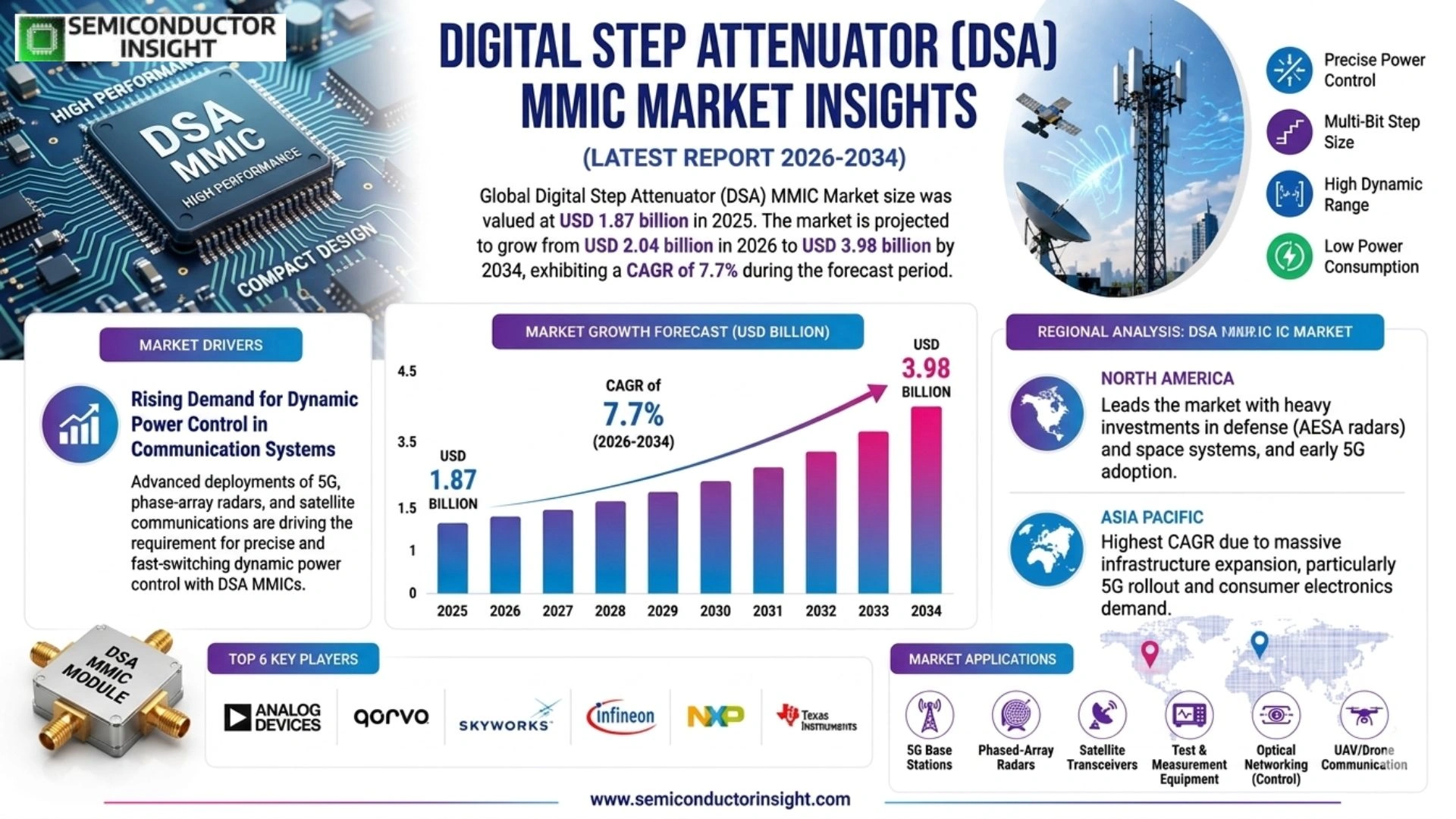
Digital Step Attenuator (DSA) MMIC Market size was valued at USD 1.87 billion in 2025. The market is projected to grow from USD 2.04 billion in 2026 to USD 3.98 billion by 2034, exhibiting a CAGR of 7.7% during the forecast period.
Digital Step Attenuators (DSA) based on Monolithic Microwave Integrated Circuit (MMIC) technology are precision semiconductor components designed to provide programmable, digitally controlled signal attenuation across microwave and millimeter-wave frequency bands. These devices are integral to a wide range of RF and microwave systems, enabling accurate gain control in applications spanning 5G infrastructure, defense electronics, satellite communications, radar systems, and test & measurement equipment. DSA MMICs are typically fabricated using compound semiconductor processes such as GaAs, GaN, and SiGe, offering low insertion loss, high linearity, and wide dynamic range in compact, highly integrated form factors.
The market is witnessing robust expansion driven by accelerating global 5G network deployments, growing defense modernization programs, and the increasing complexity of phased-array antenna systems that demand precise signal management. Furthermore, the proliferation of autonomous vehicles and advanced driver-assistance systems (ADAS) requiring reliable radar front-ends is creating additional demand for DSA MMIC solutions. Key industry participants including Analog Devices, Inc., Qorvo, Inc., MACOM Technology Solutions, and Skyworks Solutions continue to advance their DSA MMIC portfolios, reinforcing competitive dynamics across the global market.
MARKET DRIVERS
Surging Demand for 5G Infrastructure Accelerating Adoption of Digital Step Attenuator MMIC Solutions
Global Digital Step Attenuator (DSA) MMIC Market is experiencing robust growth, primarily driven by the rapid expansion of 5G wireless infrastructure worldwide. As network operators accelerate deployment of 5G base stations and small cells, the requirement for precise signal attenuation and power control in radio frequency front-end modules has intensified significantly. Digital Step Attenuator MMICs offer fine-grain attenuation resolution, compact footprint, and high integration capability, making them indispensable components in modern 5G transceivers, massive MIMO arrays, and beamforming systems. The transition from 4G LTE to 5G New Radio architectures has fundamentally expanded the addressable market for DSA MMIC devices across both sub-6 GHz and millimeter-wave frequency bands.
Defense and Aerospace Modernization Programs Fueling DSA MMIC Procurement
Defense sector modernization initiatives represent a significant driver for Digital Step Attenuator (DSA) MMIC Market. Electronic warfare systems, phased-array radar platforms, and software-defined radios increasingly rely on high-performance DSA MMICs to achieve the precise signal control and dynamic range required in contested electromagnetic environments. Military-grade DSA MMICs designed to operate across wide temperature ranges and withstand mechanical shock are witnessing growing procurement from defense agencies in North America, Europe, and the Asia-Pacific region. Investment in next-generation radar systems and electronic countermeasure platforms continues to create sustained demand for radiation-hardened and high-reliability DSA MMIC components.
➤ The convergence of 5G infrastructure buildout, defense modernization, and expanding satellite communication networks positions Digital Step Attenuator (DSA) MMIC Market for sustained multi-year growth, with precision signal management becoming a foundational requirement across virtually every advanced RF system architecture.
The proliferation of satellite communication systems, including low-earth orbit constellations for broadband connectivity, further reinforces demand withDigital Step Attenuator (DSA) MMIC Market. Satellite payloads and ground terminals require highly integrated RF components capable of precise attenuation control across broad frequency ranges. DSA MMICs fabricated on GaAs, GaN, and SiGe process nodes are increasingly specified in satellite communication designs due to their ability to meet stringent insertion loss, attenuation accuracy, and phase consistency requirements essential for reliable space and terrestrial communication link budgets.
MARKET CHALLENGES
Design Complexity and Stringent Performance Specifications Posing Technical Challenges for DSA MMIC Developers
One of the foremost challenges confronting Digital Step Attenuator (DSA) MMIC Market is the increasing complexity of RF system requirements. As operating frequencies extend into millimeter-wave bands above 24 GHz for 5G and emerging 6G research, maintaining low insertion loss, high attenuation accuracy, and consistent phase performance across wide bandwidths becomes significantly more difficult. Achieving sub-0.5 dB attenuation step accuracy alongside low return loss at these frequencies demands advanced semiconductor processes and rigorous design methodologies. Parasitic effects, substrate coupling, and layout sensitivities at millimeter-wave frequencies introduce substantial design risk, extending development cycles and increasing engineering resource requirements for DSA MMIC suppliers.
Other Challenges
Supply Chain Vulnerabilities and Semiconductor Fab Capacity Constraints
Digital Step Attenuator (DSA) MMIC Market faces ongoing supply chain challenges stemming from constrained semiconductor foundry capacity, particularly for compound semiconductor processes such as GaAs and GaN. Global disruptions to specialty IC supply chains have increased lead times and created procurement uncertainty for OEMs designing DSA MMICs into telecommunications and defense platforms. Dependence on a limited number of qualified compound semiconductor foundries creates concentration risk, and geopolitical factors influencing semiconductor manufacturing access continue to pose strategic challenges for market participants.
Price Sensitivity and Commoditization Pressure in Commercial Applications
In high-volume commercial segments such as consumer wireless infrastructure and automotive radar, Digital Step Attenuator (DSA) MMIC Market faces intensifying price competition. As multiple fabless and integrated device manufacturers target similar performance tiers, average selling prices for standard DSA MMIC products face downward pressure. Balancing cost competitiveness with continued investment in process technology and product differentiation presents an ongoing strategic challenge, particularly for smaller suppliers competing against well-capitalized analog semiconductor companies with broader product portfolios and established customer relationships.
MARKET RESTRAINTS
High Development Costs and Long Qualification Cycles Restraining Faster Market Penetration
Digital Step Attenuator (DSA) MMIC Market is meaningfully restrained by the substantial non-recurring engineering costs and extended qualification timelines associated with bringing new DSA MMIC products to market. Compound semiconductor tape-out costs, particularly on advanced GaAs or GaN processes, represent significant capital outlays that can constrain product development velocity, especially for emerging and mid-size suppliers. Furthermore, qualification requirements in defense and aerospace applications , including MIL-PRF-38535 and related standards , impose rigorous reliability screening, documentation, and traceability obligations that can extend time-to-market by one to two years beyond commercial product timelines, limiting the pace at which new DSA MMIC solutions reach end customers.
Regulatory and Export Control Restrictions Limiting Market Accessibility
Export control regulations, including International Traffic in Arms Regulations (ITAR) and Export Administration Regulations (EAR) frameworks governing advanced RF semiconductor components, represent a structural restraint on Digital Step Attenuator (DSA) MMIC Market. High-performance DSA MMICs with defense-relevant specifications are subject to stringent export licensing requirements that can delay international sales cycles, increase compliance costs, and restrict market access in certain geographies. Compliance with evolving multilateral export control regimes requires dedicated legal and regulatory resources, creating disproportionate burden for smaller market participants and limiting the geographic addressability of the highest-performance DSA MMIC product segments.
Integration Challenges with Legacy RF System Architectures Slowing Replacement Cycles
A further restraint withDigital Step Attenuator (DSA) MMIC Market involves the installed base of legacy RF systems designed around discrete attenuator and PIN diode-based solutions. System integrators and OEMs upgrading existing platforms must navigate non-trivial redesign, requalification, and re-testing requirements when transitioning to DSA MMIC-based architectures, even when performance and integration benefits are clearly demonstrable. In cost-sensitive upgrade programs and long-lifecycle defense platforms, the burden of redesign often defers adoption of new DSA MMIC solutions, moderating near-term replacement demand despite clear long-term advantages in size, weight, power consumption, and digital control capability.
MARKET OPPORTUNITIES
Emergence of Open RAN Architecture Creating New Design Opportunities for DSA MMIC Suppliers
The accelerating adoption of Open RAN (O-RAN) architecture in telecommunications infrastructure presents a compelling opportunity for Digital Step Attenuator (DSA) MMIC Market. O-RAN’s disaggregated, multi-vendor framework increases the number of independent radio unit suppliers designing their own RF front-end solutions, expanding the addressable customer base for DSA MMIC component providers. Standardized interfaces and interoperability requirements within O-RAN ecosystems encourage innovation at the component level, allowing DSA MMIC suppliers to differentiate on performance metrics including attenuation range, step size resolution, switching speed, and integration density. This architectural shift is expected to broaden procurement diversity and reduce concentration among a small number of vertically integrated equipment vendors.
Automotive Radar and Advanced Driver Assistance Systems Expanding the DSA MMIC Addressable Market
The automotive sector represents an emerging high-growth opportunity for Digital Step Attenuator (DSA) MMIC Market. The rapid expansion of advanced driver assistance systems (ADAS) and autonomous vehicle sensing platforms is driving demand for 77 GHz and 79 GHz automotive radar chipsets where precise signal level control is critical for reliable target detection and range performance. DSA MMICs integrated within automotive radar front-end modules enable dynamic gain calibration, sensitivity optimization, and interference mitigation across varying driving environments. As global regulatory frameworks increasingly mandate collision avoidance and pedestrian detection capabilities, automotive radar content per vehicle is growing, expanding the long-term opportunity for automotive-qualified DSA MMIC solutions.
Advances in Silicon-Based MMIC Processes Opening Cost-Competitive Opportunities in High-Volume Markets
Continued advances in silicon-germanium (SiGe) BiCMOS and advanced CMOS process technologies are creating significant opportunities to expand Digital Step Attenuator (DSA) MMIC Market into higher-volume, cost-sensitive application segments. Silicon-based DSA MMICs are increasingly capable of delivering competitive RF performance at millimeter-wave frequencies, enabling integration with digital control logic and other baseband functions within a single chip or multi-chip module. Lower fabrication costs relative to compound semiconductor processes, combined with access to high-volume silicon foundry capacity, allow suppliers leveraging silicon-based DSA MMIC designs to address mass-market wireless infrastructure, consumer fixed wireless access, and industrial IoT applications that were previously economically inaccessible to compound semiconductor-based solutions.
Trends
5G Network Expansion Driving Demand for DSA MMIC Solutions
Digital Step Attenuator (DSA) MMIC Market is experiencing significant momentum, largely propelled by the accelerating global rollout of 5G infrastructure. As telecommunications operators worldwide invest heavily in next-generation network deployments, the need for precise, digitally controlled signal attenuation in base stations, massive MIMO systems, and beamforming arrays has grown substantially. DSA MMICs, fabricated using advanced compound semiconductor technologies such as GaAs, GaN, and SiGe, are uniquely positioned to meet the stringent performance requirements of 5G front-end architectures, offering low insertion loss, high linearity, and wide dynamic range in highly compact form factors. This trend is expected to remain a primary growth catalyst throughout the forecast period, as 5G densification continues across both urban and suburban environments globally.
Other Trends
Defense Modernization and Radar System Upgrades
Defense electronics represent another critical growth avenue for Digital Step Attenuator (DSA) MMIC Market. Governments across North America, Europe, and the Asia-Pacific region are actively funding modernization programs that encompass advanced radar platforms, electronic warfare systems, and satellite communication terminals. Phased-array antenna systems used in these defense applications require precise gain control across wide microwave and millimeter-wave frequency bands, making DSA MMICs an indispensable component. Key market participants including Qorvo, Inc., MACOM Technology Solutions, and Analog Devices, Inc. have been actively expanding their defense-grade DSA MMIC portfolios to address these evolving requirements.
Proliferation of Automotive Radar and ADAS Technologies
The rapid adoption of autonomous vehicles and advanced driver-assistance systems (ADAS) is creating a new and expanding demand segment within the DSA MMIC market. Automotive radar front-ends operating at 77 GHz require highly reliable and programmable signal attenuation components to ensure accurate object detection and ranging performance. As automotive OEMs and Tier-1 suppliers scale production of radar-enabled vehicles, DSA MMIC solutions are increasingly being integrated into radar transceiver modules, broadening the addressable market beyond traditional telecommunications and defense end-users.
Satellite Communications and Test & Measurement Applications Sustaining Market Breadth
Beyond 5G and defense, Digital Step Attenuator (DSA) MMIC Market continues to benefit from sustained demand in satellite communications and test & measurement equipment. Low Earth Orbit (LEO) satellite constellations require sophisticated signal management solutions to maintain link quality across dynamic channel conditions, with DSA MMICs playing a central role in ground terminal and payload designs. Simultaneously, the test & measurement sector relies on high-precision DSA MMIC components to calibrate and validate RF systems across a broad frequency spectrum. Industry leaders such as Skyworks Solutions continue to invest in DSA MMIC innovation to serve these diverse application domains, reinforcing the overall resilience and long-term growth trajectory of the global market.
COMPETITIVE LANDSCAPE
Key Industry Players
Digital Step Attenuator (DSA) MMIC Market: Competitive Dynamics and Leading Manufacturers
Global Digital Step Attenuator (DSA) MMIC Market is characterized by the presence of a handful of dominant semiconductor companies that command significant market share through continuous R&D investment, advanced compound semiconductor fabrication capabilities, and broad product portfolios. Analog Devices, Inc. and Qorvo, Inc. stand out as frontrunners, leveraging their deep expertise in GaAs and GaN process technologies to deliver high-performance DSA MMIC solutions optimized for 5G infrastructure, defense electronics, phased-array radar, and satellite communications. These industry leaders maintain competitive advantages through vertically integrated manufacturing, long-standing customer relationships with defense primes and telecom OEMs, and consistent innovation in low insertion loss, high linearity attenuator architectures. MACOM Technology Solutions and Skyworks Solutions also hold notable positions, offering differentiated DSA MMIC portfolios that address the growing demand for precise digital gain control in advanced RF front-end modules across both commercial and military platforms.
Beyond the tier-one players, several specialized and regionally significant companies are actively shaping the competitive landscape of the DSA MMIC market. Renesas Electronics, Peregrine Semiconductor (a subsidiary of Murata Manufacturing), and Mini-Circuits have established credible product lines targeting test and measurement, wireless infrastructure, and defense radar applications. Companies such as Broadcom Inc., NXP Semiconductors, and Infineon Technologies are leveraging their extensive semiconductor ecosystems to expand into digitally controlled attenuation solutions, particularly for automotive radar and millimeter-wave 5G use cases. Emerging players including pSemi Corporation and Guerrilla RF are gaining traction by offering compact, highly integrated DSA MMICs suited for next-generation wireless and electronic warfare systems. The competitive intensity is further amplified by continuous miniaturization trends and the increasing adoption of SiGe BiCMOS and advanced GaN-on-SiC processes, pushing all market participants to accelerate their technology roadmaps and forge strategic partnerships with Tier-1 system integrators.
List of Key Digital Step Attenuator (DSA) MMIC Companies Profiled
- Analog Devices, Inc.
- Qorvo, Inc.
- MACOM Technology Solutions
- Skyworks Solutions, Inc.
- Broadcom Inc.
- NXP Semiconductors
- Infineon Technologies AG
- Renesas Electronics Corporation
- Peregrine Semiconductor (Murata Manufacturing)
- pSemi Corporation
- Mini-Circuits
- Guerrilla RF
- Keysight Technologies
- Microchip Technology Inc.
- Wolfspeed, Inc.
Segment Analysis:
| Segment Category | Sub-Segments | Key Insights |
| By Type |
|
GaAs-Based DSA MMICs represent the leading segment within the type category, owing to their well-established fabrication maturity and inherent material properties that deliver superior high-frequency performance across microwave and millimeter-wave bands.
|
| By Application |
|
5G Infrastructure & Wireless Communications stands as the dominant application segment, propelled by the accelerating global rollout of fifth-generation networks that necessitate precise and programmable gain control across massive MIMO and phased-array antenna architectures.
|
| By End User |
|
Telecommunications Service Providers & OEMs constitute the leading end-user segment, as the relentless global expansion of 5G network infrastructure compels network equipment manufacturers and system integrators to source high-performance DSA MMICs in significant volumes for deployment in base stations, remote radio heads, and active antenna systems.
|
| By Frequency Band |
|
Sub-6 GHz remains the dominant frequency band segment, driven by its widespread adoption in commercial 5G base stations, legacy LTE infrastructure, and broadband wireless communication systems where coverage range and penetration characteristics are prioritized alongside precision gain management.
|
| By Attenuation Range |
|
16 dB – 31.5 dB attenuation range represents the leading segment, as this range aligns closely with the dynamic range requirements of the most prevalent commercial and defense RF system architectures, including phased-array beamforming modules, radar receiver chains, and 5G massive MIMO front-end units.
|
Regional Analysis: Digital Step Attenuator (DSA) MMIC Market
Asia-Pacific
Asia-Pacific’s aggressive 5G deployment timelines are among the most ambitious globally. The widespread adoption of massive MIMO and beamforming antenna arrays in next-generation base stations creates sustained demand for high-performance Digital Step Attenuator MMIC components. China, South Korea, and Japan lead network densification initiatives, ensuring a continuous pipeline of DSA MMIC procurement for both commercial and public safety communication systems.
The region hosts the world’s most advanced compound semiconductor foundries, including GaAs and GaN fabrication facilities essential for producing high-frequency DSA MMIC devices. Taiwan’s and South Korea’s foundry industries provide cutting-edge process nodes that enable superior device performance. This manufacturing depth gives Asia-Pacific a decisive competitive advantage in Digital Step Attenuator MMIC production cost efficiency and technology scalability.
Defense modernization programs across China, India, Japan, and South Korea are generating significant demand for sophisticated radar, electronic warfare, and satellite communication systems that rely on precision Digital Step Attenuator MMIC solutions. Regional governments are funding indigenous development of defense electronics, reducing reliance on imports and accelerating the adoption of domestically produced DSA MMIC components in mission-critical military applications.
Academic institutions and government-backed research centers across Japan, South Korea, and China are actively advancing DSA MMIC design methodologies, focusing on wider bandwidth, lower insertion loss, and enhanced linearity. Significant venture and state capital is flowing into fabless semiconductor startups specializing in Digital Step Attenuator technologies, ensuring a robust innovation pipeline that will sustain Asia-Pacific’s regional leadership well into the 2030s.
North America
North America represents the second most significant region Digital Step Attenuator (DSA) MMIC Market, underpinned by a mature defense electronics sector, robust commercial wireless infrastructure, and a highly developed semiconductor design ecosystem. The United States remains the dominant force, with leading fabless semiconductor companies and Tier-1 defense contractors driving consistent demand for advanced DSA MMIC solutions across radar, electronic warfare, and software-defined radio platforms. The sustained expansion of 5G networks and the proliferation of satellite communication constellations further amplify regional consumption of precision signal attenuation devices. Federal investment in domestic semiconductor manufacturing, catalyzed by strategic industrial policy initiatives, is reinforcing North America’s position as both an innovator and consumer in the DSA MMIC landscape. Canada contributes through its growing defense and aerospace programs, while strong university-industry research partnerships continue to yield advancements in high-frequency MMIC design methodologies relevant to Digital Step Attenuator applications throughout the forecast period.
Europe
Europe occupies a strategically important position in Global Digital Step Attenuator (DSA) MMIC Market, supported by strong aerospace and defense industries, advanced telecommunications research, and a commitment to technological sovereignty in critical semiconductor components. Germany, France, the United Kingdom, and the Netherlands are central to regional DSA MMIC activity, with established defense primes and specialized compound semiconductor foundries contributing meaningfully to supply capabilities. The European Union’s concerted push to reduce semiconductor import dependency has accelerated investment in domestic GaAs and GaN fabrication, directly benefiting the Digital Step Attenuator MMIC segment. Growing adoption of 5G infrastructure across Western and Central Europe, combined with expanding satellite broadband initiatives, is generating new demand vectors. European space agency programs and NATO-aligned defense modernization projects further sustain procurement of high-performance DSA MMIC components across a range of phased array radar, electronic countermeasure, and communications system applications throughout the 2026–2034 period.
South America
South America represents an emerging and developing region within Global Digital Step Attenuator (DSA) MMIC Market, with growth largely driven by expanding telecommunications infrastructure and selective defense sector modernization. Brazil stands as the region’s anchor market, with ongoing 5G network deployment creating foundational demand for DSA MMIC components in base station and signal management applications. While the region does not yet possess significant indigenous semiconductor manufacturing capability, it serves as an important end-market for imported Digital Step Attenuator MMIC solutions. Government-supported defense procurement programs in Brazil, Chile, and Colombia are introducing radar and communication systems that incorporate advanced MMIC technologies. As regional economic conditions stabilize and foreign direct investment in digital infrastructure increases, South America is anticipated to register progressive growth in DSA MMIC adoption. The region’s long-term trajectory will be shaped by telecom operator capital expenditure cycles, defense budget allocations, and the pace of broader semiconductor industry localization efforts.
Middle East & Africa
The Middle East and Africa region presents a nascent but strategically notable market for Digital Step Attenuator (DSA) MMIC solutions, primarily shaped by defense modernization, telecommunications infrastructure expansion, and growing interest in satellite connectivity. Gulf Cooperation Council nations, particularly Saudi Arabia and the United Arab Emirates, are investing heavily in advanced defense systems, smart city infrastructure, and next-generation communication networks, all of which create demand for precision RF components including DSA MMICs. Africa’s accelerating mobile broadband adoption and the deployment of telecommunications infrastructure in underserved areas are gradually creating downstream demand for signal management components. While indigenous manufacturing capacity remains limited across the region, strong import channels and technology transfer agreements with North American, European, and Asian suppliers ensure access to advanced Digital Step Attenuator MMIC devices. Over the 2026–2034 forecast horizon, increasing defense budgets, national digitalization strategies, and expanding satellite communication projects are expected to progressively elevate the region’s role in the global DSA MMIC market landscape.
Report Scope
This market research report provides a comprehensive analysis of the Digital Step Attenuator (DSA) MMIC Market , covering the forecast period 2026–2034. It offers detailed insights into market dynamics, technological advancements, competitive landscape, and key trends shaping the industry.
Key focus areas of the report include:
- Market Overview: The report begins with an overview outlining its current market scenario, key growth indicators, and industry transformation drivers. It discusses macroeconomic factors, demand–supply balance, regulatory landscape, and the strategic role of semiconductors in powering advancements across industries such as automotive, telecommunications, consumer electronics, and industrial automation.
- Market Size & Forecast: Historical data and future projections for revenue, unit shipments, and market value across major regions and segments.
- Segmentation Analysis: Detailed breakdown by product type, technology, application, and end-user industry to identify high-growth segments and investment opportunities.
- Regional Insights: Insights into market performance across North America, Europe, Asia-Pacific, Latin America, and the Middle East & Africa, including country-level analysis where relevant.
- Competitive Landscape: Profiles of leading market participants, including their product offerings, R&D focus, manufacturing capacity, pricing strategies, and recent developments such as mergers, acquisitions, and partnerships.
- Technology Trends & Innovation: Assessment of emerging technologies, integration of AI/IoT, semiconductor design trends, fabrication techniques, and evolving industry standards.
- Market Drivers & Restraints: Evaluation of factors driving market growth along with challenges, supply chain constraints, regulatory issues, and market-entry barriers.
- Stakeholder Insights: Insights for component suppliers, OEMs, system integrators, investors, and policymakers regarding the evolving ecosystem and strategic opportunities.
Primary and secondary research methods are employed, including interviews with industry experts, data from verified sources, and real-time market intelligence to ensure the accuracy and reliability of the insights presented.
FREQUENTLY ASKED QUESTIONS:
What is the current market size of Digital Step Attenuator (DSA) MMIC Market?
-> Digital Step Attenuator (DSA) MMIC Market was valued at USD 1.87 billion in 2025 and is expected to reach USD 3.98 billion by 2034, growing at a CAGR of 7.7% during the forecast period from 2026 to 2034.
Which key companies operate Digital Step Attenuator (DSA) MMIC Market?
-> Key players include Analog Devices, Inc., Qorvo, Inc., MACOM Technology Solutions, and Skyworks Solutions, among others.
What are the key growth drivers?
-> Key growth drivers include accelerating global 5G network deployments, growing defense modernization programs, increasing complexity of phased-array antenna systems, and the proliferation of autonomous vehicles and advanced driver-assistance systems (ADAS) requiring reliable radar front-ends.
Which region dominates the market?
-> Asia-Pacific is the fastest-growing region driven by large-scale 5G infrastructure rollouts, while North America remains a dominant market supported by robust defense electronics and satellite communications investments.
What are the emerging trends?
-> Emerging trends include adoption of GaAs, GaN, and SiGe compound semiconductor fabrication processes, integration of DSA MMICs in phased-array antenna systems, expansion into millimeter-wave frequency bands, and increasing demand for compact high-linearity solutions in 5G infrastructure, defense electronics, satellite communications, radar systems, and test & measurement equipment.

Get Sample Report PDF for Exclusive Insights
Report Sample Includes
- Table of Contents
- List of Tables & Figures
- Charts, Research Methodology, and more...
 Download Sample Report PDF