Developer & Rinse (TMAH) Solution Market Insights
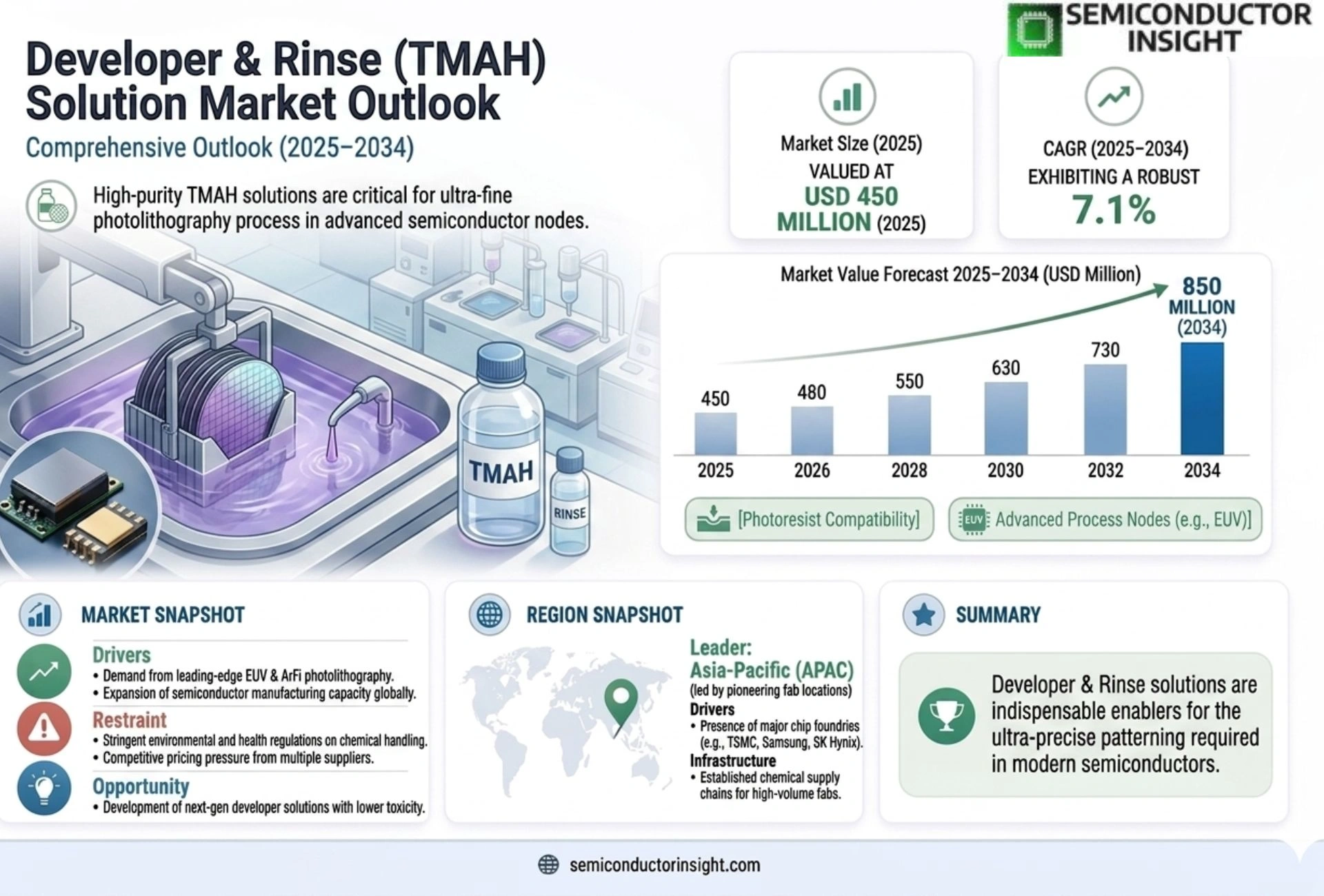
Global Developer & Rinse (TMAH) Solution Market size was valued at USD 450 million in 2025. The market is projected to grow from USD 480 million in 2026 to USD 850 million by 2034, exhibiting a CAGR of 7.1% during the forecast period.
Developer & Rinse (TMAH) Solutions, primarily composed of tetramethylammonium hydroxide (TMAH), are high-purity alkaline chemicals widely utilized in semiconductor manufacturing and microfabrication processes. These solutions play a critical role in photoresist development and wafer cleaning, ensuring precise pattern transfer and surface conditioning during lithography. TMAH-based developers offer superior resolution, selectivity, and compatibility with advanced photoresists, making them indispensable in sub-10nm node production and emerging technologies like extreme ultraviolet (EUV) lithography. Additionally, their low metal ion content minimizes contamination risks, further enhancing yield and reliability in semiconductor fabrication.
The market is witnessing steady expansion due to the escalating demand for high-performance computing devices, rapid adoption of 5G technology, and continuous advancements in AI-driven hardware. Furthermore, the proliferation of Internet of Things (IoT) devices and the growing complexity of integrated circuits are amplifying the need for high-purity TMAH solutions. Strategic collaborations among key industry players are also fostering innovation; for instance, recent partnerships have focused on developing next-generation formulations optimized for high-aspect-ratio etching and environmentally sustainable manufacturing practices. Leading suppliers such as Tokyo Ohka Kogyo Co., Ltd., Merck KGaA, and Fujifilm Electronic Materials dominate the market with extensive portfolios tailored to evolving industry standards.
MARKET DRIVERS
Expansion of Semiconductor Fabrication Capacity
Developer & Rinse (TMAH) Solution Market is primarily propelled by the exponential growth in semiconductor wafer fabrication facilities globally. As manufacturers pursue advanced smaller nodes and higher yields, the demand for high-purity TMAH solutions in critical photoresist development processes becomes essential. Industry reports suggest that consistent capital expenditure in cleanrooms directly correlates with increased consumption of wet chemicals, including specific TMAH variants required for silicon etching.
Integration of 5G and IoT Technologies
Modern communication systems require high-performance microchips, which necessitates robust etching and rinsing processes during manufacturing. The proliferation of 5G infrastructure and the Internet of Things (IoT) acts as a significant catalyst for the global TMAH market. As electronic device complexity increases, the reliance on reliable developer and rinse solutions to ensure defect-free semiconductor surfaces intensifies, driving adoption of sophisticated chemical processing.
➤ Efficiency in wet processing is increasingly becoming a key performance indicator for fab productivity.
Furthermore, the global surge in consumer electronics and automotive applications drives the need for advanced materials that can withstand rigorous testing standards, boosting the utilization of TMAH solutions.
MARKET CHALLENGES
Stringent Environmental and Safety Regulations
Safeguarding against the hazards associated with alkaline chemicals is a major hurdle for stakeholders Developer & Rinse (TMAH) Solution Market. TMAH solutions are highly corrosive and require specialized storage and disposal protocols. Compliance with regional environmental laws often demands significant investment in safety equipment and waste management systems, which can impact operational cost structures for chemical suppliers and semiconductor manufacturers alike.
Other Challenges
Skilled Labor Shortage
Finding specialized personnel capable of handling hazardous wet chemicals safely adds complexity and cost to manufacturing operations.
MARKET RESTRAINTS
Oversupply and Price Volatility of Raw Materials
The high cost and availability of raw materials such as tetramethylammonium hydroxide can constrain market growth. Fluctuations in the supply chain, influenced by geopolitical factors and raw material scarcity, lead to unstable pricing models. This volatility makes it difficult for semiconductor foundries to forecast budget allocations for process chemicals, potentially slowing down expansion plans within the developing TMAH sector.
MARKET OPPORTUNITIES
Adoption of Advanced Packaging Solutions
Emerging technologies such as chiplet designs and 3D integrated circuits offer substantial growth potential for Developer & Rinse (TMAH) Solution Market. These advanced architectures require complex multi-step wet processes that rely heavily on specialized developer and rinse chemistries. Companies focusing on R&D for tailored TMAH solutions that cater to these specific packaging needs present a lucrative avenue for market expansion.
Trends
Advanced Lithography Node Evolution
The development of smaller, more powerful integrated circuits has fundamentally altered the demand for Developer & Rinse (TMAH) Solution Market solutions. These solutions, composed primarily of tetramethylammonium hydroxide (TMAH), serve as high-purity alkaline chemicals vital for semiconductor manufacturing. They are strictly required for photoresist development and wafer cleaning, ensuring the precise pattern transfer and surface conditioning necessary during the critical lithography phase. As the industry moves toward sub-10nm node production and extreme ultraviolet (EUV) lithography, TMAH-based developers offer the superior resolution and selectivity required to meet these stringent physical limits. Furthermore, the low metal ion content in these formulations effectively minimizes contamination risks, which is paramount for maintaining high yields and reliability within advanced fabrication facilities.
Other Trends
High Performance Computing and AI Integration
The rapid adoption of 5G technology and the expanding Internet of Things (IoT) ecosystem have created a robust demand for high-performance computing devices. Analysts observe that these connectivity trends drive the complexity of integrated circuits, necessitating the consistent availability of high-purity TMAH solutions to support continuous innovation in AI-driven hardware. Without these specialized chemicals, the precise cleaning and development steps required for AI chips would be impossible to achieve with the necessary efficiency.
Strategic Industry Partnerships and Sustainability
To address the logistical and technical challenges of modern microelectronics, key industry players are increasingly engaging in strategic collaborations. Suppliers such as Tokyo Ohka Kogyo Co., Ltd., Merck KGaA, and Fujifilm Electronic Materials are focusing on developing next-generation formulations optimized for high-aspect-ratio etching. Additionally, there is a strong push toward environmentally sustainable manufacturing practices, reflecting the broader industry commitment to responsible production processes that reduce waste while maintaining the highest technical standards.
COMPETITIVE LANDSCAPE
Key Industry Players
Global market poised for robust growth driven by AI and 5G applications
Global Developer & Rinse (TMAH) Solution Market size was valued at USD 450 million in 2025. The market is projected to grow from USD 480 million in 2026 to USD 850 million by 2034, exhibiting a CAGR of 7.1% during the forecast period. Developer & Rinse (TMAH) Solutions, primarily composed of tetramethylammonium hydroxide (TMAH), are high-purity alkaline chemicals widely utilized in semiconductor manufacturing and microfabrication processes. These solutions play a critical role in photoresist development and wafer cleaning, ensuring precise pattern transfer and surface conditioning during lithography. TMAH-based developers offer superior resolution, selectivity, and compatibility with advanced photoresists, making them indispensable in sub-10nm node production and emerging technologies like extreme ultraviolet (EUV) lithography.
TMAH-based developers offer superior resolution, selectivity, and compatibility with advanced photoresists, making them indispensable in sub-10nm node production and emerging technologies like extreme ultraviolet (EUV) lithography. Additionally, their low metal ion content minimizes contamination risks, further enhancing yield and reliability in semiconductor fabrication.
List of Key Developer and Rinse (TMAH) Solution Companies Profiled
- Shin-Etsu Chemical Co., Ltd.
- Fujifilm Corporation
- Merck KGaA
- TOK (Tokyo Ohka Kogyo Co., Ltd.)
- JSR Corporation
- Air Products and Chemicals, Inc.
- BASF SE
- LTS Inc.
- Fujimicro
- Dow Chemical Company
- Nippon Chemical Industrial Co., Ltd. (NCI)
- LG Chem Ltd.
- DuPont (Electronics)
- Sumika Corporation
- JS Research Corporation
Segment Analysis:
| Segment Category | Sub-Segments | Key Insights |
| By Type |
|
High Concentration Grades are emerging as the dominant segment driven by the industry’s transition to advanced lithography nodes requiring finer resolution and enhanced process efficiency. As semiconductor manufacturing scales down to smaller geometries, the demand for high-purity solutions that reduce surface defects has surged. Standard TMAH grades continue to hold relevance for legacy processes and specific etching applications where cost sensitivity is higher. Furthermore, the shift towards ultra-low contamination environments has significantly increased the adoption of specifically formulated low ionic impurity grades to ensure yield consistency in high-volume production environments. |
| By Application |
|
Lithography (Photoresist Development) constitutes the primary application area due to the chemical solution’s indispensable role in removing unexposed photoresist and enabling precise pattern transfer on silicon wafers. The complexity of modern circuit designs necessitates highly selective developers that can handle extremely high-aspect-ratio structures without damaging underlying layers. While wafer cleaning remains a steadily growing use case, the stringent requirements for pattern fidelity in the first step of the fabrication process ensure that Lithography applications maintain a leading position in market share, serving as a critical gateway for subsequent manufacturing steps. |
| By End User |
|
Semiconductor Fabrication Facilities represent the dominant end-user category, characterized by high-volume consumption and rigid compliance with purity standards. These facilities require robust supply chains to maintain uninterrupted production schedules for computing and communication devices. R&D laboratories play a crucial supporting role by driving innovation in new chemical compositions and testing the limits of material compatibility for future technologies. Additionally, the expanding display manufacturing sector, particularly for OLED and LCD production, has become a significant niche end-user, creating a diversified demand landscape that supports continuous market expansion through varied industrial applications. |
| By Formulation |
|
Eco-Friendly Formulations are rapidly gaining traction as environmental regulations tighten regarding chemical disposal and waste management in cleanroom environments. Suppliers are increasingly investing in sustainable chemistries that minimize hazardous by-products without compromising the efficacy of the development process. Simultaneously, corrosion-resistant variants are seeing high utilization in equipment maintenance protocols to prevent damage to critical processing machinery over long operational cycles. The introduction of extended shelf-life solutions also supports logistics optimization for global manufacturers, ensuring that high-purity chemicals remain viable and safe for use throughout their distribution chain and before eventual deployment in the fab line. |
| By Technology Requirement |
|
EUV-Compatible Solutions are at the forefront of technological advancements, specifically designed to handle the shorter wavelengths and unique photoresist behaviors associated with Extreme Ultraviolet lithography. As the industry pushes towards smaller feature sizes, the need for highly specialized sub-10nm node solutions has become a critical differentiator for leading chemical suppliers. These sophisticated formulations must offer exceptional control and selectivity to manage the intricate geometries inherent in next-generation integrated circuits. Furthermore, the demand for high-aspect-ratio etching solutions is rising as chip designers create 3D structures and complex packaging solutions, underscoring the market’s evolution beyond traditional planar processes. |
Regional Analysis: Developer & Rinse (TMAH) Solution Market
In the APAC market, the most prominent business strategy observed is the deepening of symbiotic relationships between solution providers and integrated device manufacturers. This collaboration allows for bespoke chemical formulations tailored to specific lithography steps, significantly reducing trial run times and accelerating time-to-market for advanced processing nodes.
A significant trend involves the migration to advanced process nodes. As manufacturers shrink feature sizes, the margin for error in developer and rinse chemistry decreases. Consequently, companies are adopting more sophisticated high-purity TMAH solutions that ensure crystal clear etching without residue, reflecting a strategic move toward manufacturing excellence.
The rapid expansion of the OLED displays sector directly propels demand in this region. Display fabs require specialized rinse steps to prevent particle formation on active matrix organic light-emitting diode substrates. This sector-focused growth necessitates specialized TMAH mixtures that maintain high fluidity and resistivity under high-speed coating conditions.
To combat global logistic challenges, key players are establishing localized manufacturing hubs within the region. This strategy not only safeguards against maritime disruptions but also ensures that critical TMAH developer supplies are available for maintenance or unexpected equipment overhauls, maintaining production continuity.
North America
North America has carved out a niche as the primary engine for innovation and R&D within the global Developer & Rinse (TMAH) Solution Market. Driven by a robust semiconductor ecosystem in the United States, the region is seeing increased demand for next-generation TMAH developers designed specifically for artificial intelligence and high-performance computing chips. The market is characterized by a strong emphasis on maintaining supply chain integrity and investing in advanced packaging technologies like Chiplets. Unlike the manufacturing-centric approach found elsewhere, the North American strategy focuses on the downstream application development and the creation of proprietary rinse solutions that optimize post-exposure development. This creates a demand for highly customizable chemical solutions that meet stringent regulatory standards for environmental safety and worker health.
Europe
The European segment of Developer & Rinse (TMAH) Solution Market is heavily influenced by the automotive and industrial sector’s need for reliable electronic components. Key manufacturing hubs in countries like Germany are integrating more sophisticated rinse processes to support the production of advanced automotive control units and sensor systems. Business strategies here are heavily skewed towards eco-friendly innovation, with a significant push to develop TMAH solutions that minimize hazardous byproducts without compromising technical performance. The region also benefits from a rich history of lithography research, fostering a market that values technical precision and quality assurance above all else. Manufacturers in Europe are adopting hybrid models that combine traditional semiconductor manufacturing with emerging automotive electronics, creating unique demands for versatile developer solutions.
South America
South America represents a developing frontier for Developer & Rinse (TMAH) Solution Market, with a gradual but steady expansion in manufacturing capabilities. The primary growth drivers are the increasing local assembly of consumer electronics and the modernization of telecommunications infrastructure. However, market dynamics here are often constrained by economic volatility and import dependencies for high-tech raw materials. Strategic business approaches in this region focus on cost-effective solutions that can be adapted for multiple industrial applications, ranging from general electronics to basic automotive components. As the region invests in digitalization, there is a rising need for standard-grade developer solutions that offer optimal performance at a lower price point, driving a competitive environment focused on market penetration rather than premium differentiation.
Middle East & Africa
The Middle East & Africa region is currently a niche but emerging player Developer & Rinse (TMAH) Solution Market. Growth is largely driven by the massive investments being made in smart city projects and data center construction across the Gulf Cooperation Council (GCC) countries. The market dynamics largely revolve around the import of pre-mixed developers to support these infrastructure projects, rather than domestic chemical synthesis. Strategic business development in this area focuses on partnerships with multinational chemical distributors to ensure a consistent supply chain. While the demand is currently specialized and localized to specific high-tech zones, the potential for growth is significant given the region’s aggressive digital transformation plans and investments in semiconductor research centers.
Report Scope
This market research report provides a comprehensive analysis of the Developer & Rinse (TMAH) Solution Market , covering the forecast period 2026–2034. It offers detailed insights into market dynamics, technological advancements, competitive landscape, and key trends shaping the industry.
Key focus areas of the report include:
- Market Overview: The report begins with an overview outlining its current market scenario, key growth indicators, and industry transformation drivers. It discusses macroeconomic factors, demand–supply balance, regulatory landscape, and the strategic role of semiconductors in powering advancements across industries such as automotive, telecommunications, consumer electronics, and industrial automation.
- Market Size & Forecast: Historical data and future projections for revenue, unit shipments, and market value across major regions and segments.
- Segmentation Analysis: Detailed breakdown by product type, technology, application, and end-user industry to identify high-growth segments and investment opportunities.
- Regional Insights: Insights into market performance across North America, Europe, Asia-Pacific, Latin America, and the Middle East & Africa, including country-level analysis where relevant.
- Competitive Landscape: Profiles of leading market participants, including their product offerings, R&D focus, manufacturing capacity, pricing strategies, and recent developments such as mergers, acquisitions, and partnerships.
- Technology Trends & Innovation: Assessment of emerging technologies, integration of AI/IoT, semiconductor design trends, fabrication techniques, and evolving industry standards.
- Market Drivers & Restraints: Evaluation of factors driving market growth along with challenges, supply chain constraints, regulatory issues, and market-entry barriers.
- Stakeholder Insights: Insights for component suppliers, OEMs, system integrators, investors, and policymakers regarding the evolving ecosystem and strategic opportunities.
Primary and secondary research methods are employed, including interviews with industry experts, data from verified sources, and real-time market intelligence to ensure the accuracy and reliability of the insights presented.
FREQUENTLY ASKED QUESTIONS:
What is the current market size of Developer & Rinse (TMAH) Solution Market?
-> Developer & Rinse (TMAH) Solution Market size was valued at USD 450 million in 2025. The market is projected to grow from USD 480 million in 2026 to USD 850 million by 2034, exhibiting a CAGR of 7.1% during the forecast period.
Which key companies operate Developer & Rinse (TMAH) Solution Market?
-> Key players include Tokyo Ohka Kogyo Co., Ltd., Merck KGaA, and Fujifilm Electronic Materials, among others.
What are the key growth drivers?
-> Key growth drivers include high-performance computing devices, 5G technology, and AI-driven hardware.
Which region dominates the market?
-> Asia-Pacific is a dominant region, driven by the rapid adoption of semiconductor manufacturing technologies and 5G infrastructure.
What are the emerging trends?
-> Emerging trends include sub-10nm node production, EUV lithography, and environmentally sustainable manufacturing practices.

Get Sample Report PDF for Exclusive Insights
Report Sample Includes
- Table of Contents
- List of Tables & Figures
- Charts, Research Methodology, and more...
 Download Sample Report PDF