Definite-Purpose DC Contactors Market Insights
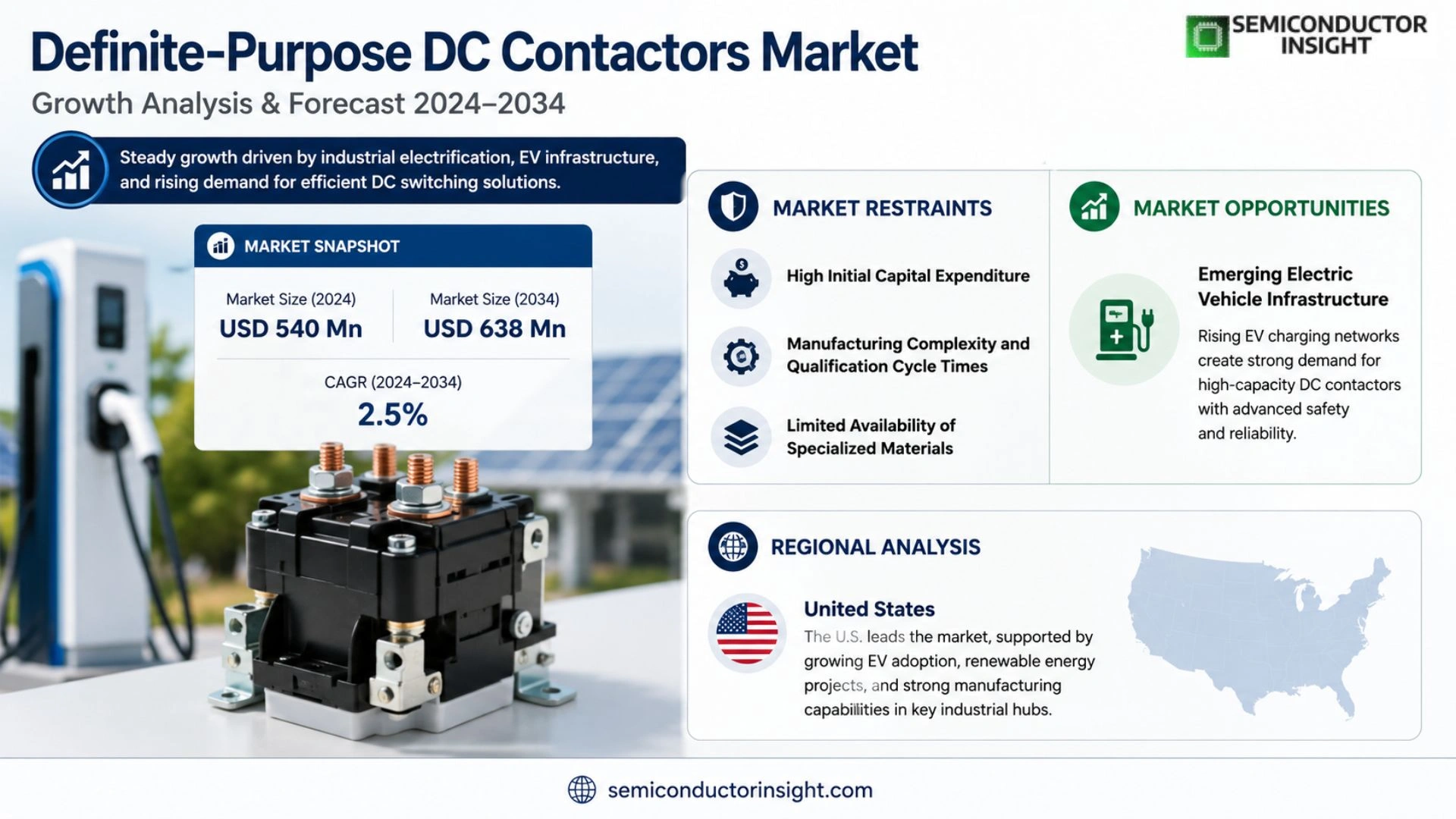
Definite-Purpose DC Contactors market was valued at USD 540 million in 2024 and is expected to rise to USD 638 million by 2034, reflecting a CAGR of approximately 2.5% over the forecast period.
Definite‑Purpose DC Contactors are dedicated electrical switching devices engineered for particular applications such as electric‑vehicle propulsion control, photovoltaic module operation, charging station management, industrial automation units, and aerospace power systems. Their design prioritises precise current handling capacities, compact form factors, and durable insulation materials that withstand the specialised operating conditions of each sector.
MARKET DRIVERS
Rising Demand for DC Drives in Industrial Automation
The proliferation of high‑efficiency DC drives across the manufacturing sector is a primary catalyst. Industrial plants are increasingly migrating from legacy AC systems to hybrid or all‑DC configurations to reduce energy consumption, improve process flexibility, and support real‑time monitoring capabilities. These shifts necessitate reliable, low‑contact‑wear contactors that can manage high current densities and rapid switching cycles. Consequently, the supply chain for dedicated contactors has become more responsive, offering tighter tolerance specifications and extended operational life. These developments translate directly into heightened investment in DC contactor prototypes and enhanced manufacturing capabilities.
Technological Advances in Contactor Design
Material science breakthroughs,particularly in conductive alloys and dielectric coatings,have reduced arcing losses and extended component lifespan. Integrated sensor technologies now enable predictive maintenance by detecting contact wear before failure occurs. Coupled with standardized module designs, these innovations lower maintenance overhead for end‑users and give manufacturers a competitive advantage through improved product reliability. The synergy between design innovation and maintenance economy is a decisive factor in future adoption curves.
➤ Electric propulsion isn’t just a trend; it’s a new mode of operational reliability that demands uncompromised contactor performance.
Equally important is the regulatory momentum that promotes emission reductions. Government mandates for energy‑efficient equipment create a steady pipeline of contracts for new industrial installations. This regulatory landscape fosters an environment in which investing in robust contactor solutions is not merely a choice but a compliance requirement. Together, these drivers position Definite-Purpose DC Contactors Market for significant consolidation around technology leaders that can deliver high‑performance and longevity.
MARKET CHALLENGES
Supply Chain Strain from Rapid Technology Adoption
Manufacturers face pressure to accelerate production cycles while maintaining strict quality controls. Short‑term ramp‑up requirements demand higher inventory turnover, often leading to rapid obsolescence if component specifications shift too quickly. Coupled with fluctuating raw‑material prices, many firms struggle to balance cost and availability, threatening margin stability.
Other Challenges
Capital Expenditure Constraints
Organizations often allocate budget to upstream equipment upgrades rather than to downstream components such as contactors, limiting the speed at which new technology can be deployed.
Global Trade Policy Uncertainty
Tariff adjustments and import duties introduced in 2025 have introduced volatility, especially for high‑precision components sourced from specialized suppliers outside the core market region.
Integration Complexity with Legacy Systems
Upgrading to DC‑centric designs frequently requires compatibility layers or retrofits, adding unplanned engineering effort and delaying ROI.
MARKET RESTRAINTS
High Initial Capital Expenditure
While the operational savings of DC drives are clear, the upfront cost of replacing existing AC infrastructure, including motor drives and contactors, remains a significant barrier, especially for small‑to‑medium enterprises that operate on limited cash flows. This financial hurdle often delays technology uptake, concentrating demand in larger industrial chains that can absorb capital investments more readily.
Manufacturing Complexity and Qualification Cycle Times
Developing contactors that can withstand the stringent electrical and mechanical demands of DC applications requires extensive testing across temperature, vibration, and fault conditions. Extended qualification periods increase lead times and raise the risk of missed market windows if competitors introduce certified alternatives quicker.
Limited Availability of Specialized Materials
Certain alloys and insulating composites are scarce, and their supply chains have become more fragile. This scarcity can cause production bottlenecks, leading to delayed shipments and compromised service levels in critical manufacturing scenarios.
MARKET OPPORTUNITIES
Emerging Electric Vehicle Infrastructure
The global expansion of EV charging stations is a compelling growth vector. These stations increasingly rely on DC fast charging, which demands high‑capacity, high‑density contactors capable of rapid load balancing and fault isolation. Manufacturers that secure strategic partnerships with charging infrastructure developers stand to capture a significant share of this nascent but fast‑growing market segment.
Smart Grid and Distributed Energy Resources
Smart grid initiatives, powered by distributed energy resources such as rooftop solar and battery storage, necessitate contactors that can interface with variable power profiles while maintaining grid stability. Integrating sensor‑enabled contactors into microgrid configurations offers an avenue for differentiated product offerings that go beyond traditional duty cycles.
Cross‑Industry Adoption of Hybrid Drives
Beyond manufacturing, sectors such as logistics, robotics, and medical equipment are adopting hybrid AC/DC drives to meet stringent performance metrics. This shift opens avenues for contactors to be positioned as essential components in control systems that demand both high speed and high torque, creating new synergies with industrial automation vendors.
Definite-Purpose DC Contactors Market Trends
Emerging Focus on Electrified Mobility and Renewable Integration
As electric vehicles proliferate and photovoltaic systems scale, Definite-Purpose DC Contactors Market is witnessing a pronounced shift toward components tailored for high‑voltage power electronics, bidirectional charging, and grid‑edge energy storage. The rising penetration of 400 and 800‑volt electric drivetrains demands contactors that can handle rapid cycling and precise current regulation, while solar inverters require devices that survive sustained high duty cycles and temperature excursions. These new application profiles are reshaping product development cycles, pushing manufacturers toward compact, modular solutions that reduce installation footprints and simplify integration into vehicle, utility, and residential systems.
Other Trends
PV and Charging Infrastructure Adoption
Large‑scale solar farms and urban charging hubs are driving an almost parallel escalation in demand for Definite-Purpose DC Contactors. The integration of intelligent control layers,such as grid‑frequency regulation and demand‑response triggers,necessitates contactors capable of swift state changes without compromising thermal stability. Suppliers who embed sensor arrays, predictive wear monitoring, and adaptive latching mechanisms are gaining market share, as operators seek to minimize unplanned downtime and extend equipment life in environments where maintenance access is costly.
Customization Drives Cost Efficiency and Reliability
Sector‑specific tailoring has proven to be a decisive differentiator. By matching materials, insulation classes, and mechanical dimensions to the exact load profile of an application,whether it be a high‑torque industrial motor or a lightweight automotive actuator,companies can erase the need for costly retrofits or over‑specification. This precision manufacturing approach translates to lower initial capital expenditure and a reduction in field service interventions, thereby improving the total cost of ownership for end users. Executives monitoring operational budgets are increasingly using these performance metrics as buying criteria, creating a virtuous cycle where niche design expertise fuels further innovation.
COMPETITIVE LANDSCAPE
Key Industry Players
Definite-Purpose DC Contactors Market Overview
With a 2024 market value of USD 540 million and a forecasted rise to USD 638 million by 2031, the Definite‑Purpose DC Contactors segment demonstrates a measured yet persistent expansion, reflected in the 2.5 % CAGR over the next decade. Within this framework, global leaders such as TE Connectivity and Panasonic exhibit dominant positionings, combining rigorous design expertise with extensive distribution networks. Their product portfolios,centered on high‑current switches and compact solenoid modules,meet stringent demands across electric‑vehicle control, solar power inverters, and industrial automation, thereby reinforcing their market footholds through consistent quality and process innovation.
A broader competitor ecosystem of niche specialists amplifies market depth. Sensata Technologies (GIGAVAC) and Schaltbau GmbH focus on tailored solutions for aerospace and industrial applications, achieving high margins by aligning material selection and thermal management with rigorous industry specifications. Chint and Tianshui 213 Electrical Apparatus contribute amid fast‑growing APAC regions, leveraging cost‑effective manufacturing coupled with growing demand for renewable‑energy infrastructure. ABB, Eaton, AMETEK, Albright, Trombetta, and Zhejiang Dongya Electronic collectively introduce diversified capabilities,from regenerative braking modules to robust control units for heavy‑duty machinery,enhancing competitive pressure and encouraging continuous product evolution across segments.
List of Key Definite-Purpose DC Contactors Companies Profiled
- TE Connectivity
- Panasonic
- Sensata Technologies
- Schaltbau GmbH
- Chint
- Tianshui 213 Electrical Apparatus
- ABB
- Eaton
- AMETEK
- Albright
- Trombetta
- Zhejiang Dongya Electronic
Segment Analysis:
| Segment Category | Sub-Segments | Key Insights |
| By Type |
|
Medium/Large Capacity devices dominate the market due to their ability to handle higher load currents and sustain long operational cycles. The robust construction of these units enhances their suitability for high‑energy applications where surge handling and reliability are critical. Their pre‑configured switching characteristics reduce system integration effort for complex motor control schemes, making them attractive for platforms requiring consistent performance over time. |
| By Application |
|
EVs and Charging Infrastructure is the most forward‑looking use case, demanding high durability and rapid response to charging cycles. Manufacturers tailor contactor specifications to tolerate temperature swings and electromagnetic noise typical of battery management systems. The integration of intelligent control logic into base units supports adaptive load profiles, ensuring compatibility with multiple vehicle types and charging standards. |
| By End User |
|
OEM drive adoption by embedding durable contactors into product standards, ensuring reliability across supply chains. Their focus on design minification encourages manufacturers to adopt compact, high‑capacity units, thereby shaping component specifications. OEMs also collaborate with material innovators to develop contacts resilient to extreme electromagnetic conditions. |
| By Capacity |
|
High Capacities are becoming pivotal in grid‑connected renewable systems where bulk power conversion requires seamless switching. These units are engineered with enhanced heat‑sinking and metal‑core designs to mitigate contact wear under continuous high loads. Their capability to integrate with inverters and smart grid controllers reduces overall system complexity, thereby accelerating deployment timelines. |
| By Operating Environment |
|
Outdoor / Harsh Environments demand superior ingress protection and corrosion resistance, especially for coastal or desert installations. Manufacturers are incorporating case coatings and sealed contacts coupled with advanced thermal regulation to maintain performance over extended life cycles. The ability to preserve functionality under high UV exposure and temperature extremes positions these units as preferred choices for remote grid or industrial sites. |
Regional Analysis: Definite-Purpose DC Contactors Market
Product-grade differentiation is the hinge of the price structure, with low‑voltage contactors supporting small‑scale industrial automation and high‑voltage modules catering to large‑scale grid interfaces. New‑generation capacitive‑circuit designs have begun to eclipse legacy threshold devices by adding remote diagnostic output, appealing particularly to sectors demanding precision energy management. The segmentation, therefore, is evolving from size and voltage to data‑enabled performance, creating a layered tier that larger suppliers are layering into their portfolio mix.
Silicon carbide and gallium‑nitride backend controllers have moved from niche niche to core‑line, boosting efficiency margins for DC contactor manufacturers. Embedded microcontrollers with Ethernet‑Industrial protocol allow real‑time status feedback across power hubs, while wireless sensor networks cluster settings across distributed battery‑banks. Industry players that stage multi‑layered firmware updates through OTA channels gain a substantive advantage in system longevity, enabling service models beyond the traditional OEM scope.
The field is defined by a mixture of high‑capacity OEMs, particularly in North America, and agile European component integrators. Recent consolidation in the supply‑chain space has blurred boundaries: quiet alliances between solid‑state suppliers and transformer manufacturers consolidate vertical capabilities, while niche firms sustain connectivity solutions for industrial IoT. Company‑specific R&D investment remains the decisive factor in sustaining market share, given the current cost sensitivity around complete energy‑storage systems.
Industry‑wide mandates for battery‑electric fleets and push‑for decarbonization generate a persistent lift in demand. Meanwhile regulatory standards in complex electromagnetics and thermal performance systematically raise entry barriers. Enterprises have begun to outsource maintenance contracts that wrap contactor life‑cycle with predictive analytics. As a consequence, every new installation embeds a touch point for aftermarket service, creating a secondary revenue stream that has begun to shape corporate strategy in the sector.
North America
Broad distribution of renewable projects and a mature electric‑vehicle rollout keep the region firmly positioned for customer‑driven innovation. The sovereign emphasis on energy‑storage projects injects a steady demand for high‑current DC contactors, particularly in utilities seeking grid‑rebalancing solutions. Local manufacturers are capitalizing on this momentum by supplying redundancies in safety‑critical control architecture, thereby positioning themselves as trusted partners for ETS‑compliant filings. The combination of regulatory readiness and a network of skilled engineering firms fosters an ecosystem that values data‑centric modules over purely mechanical assemblies, gradually redefining standard spare‑parts inventory strategies.
Europe
The European footprint is characterized by a strong regulatory push toward decarbonization, prompting utilities and industrial operators to substitute aging AC setups with DC‑centric architectures. In this arena, precision temperature control and harmonic‑suppression features become pivotal, pushing vendors to innovate beyond conventional relay‑based designs. European manufacturers, well‑versed in compliance certifications, are partnering with smart‑grid integrators to embed CSAT‑enabled contactors into composite energy‑storage systems. This path is shaping a marketplace where certification advantage drives procurement cycles, tipping the balance toward firms that aggressively pursue cross‑module interoperability.
Asia-Pacific
The region hosts the most expansive demand for battery‑electric vehicles, and corresponding DC contactor solutions form the backbone of that supply chain. Rapid manufacturing scaling in China and South Korea has fostered a competitive manufacturer ecosystem, while domestic market authorities set standardized testing protocols that increasingly favour solid‑state approaches. There is also an uptick in OEMs employing remote‑diagnostic contactors within their flagship automobile lines, revealing a maturation trend toward integrated maintenance suites. These developments generate a meaningful uptick in sales cadence, prompting entrants to focus on cost‑effective, high‑density contactor solutions suitable for large-vehicle platforms.
South America
Emerging economies in Brazil and Argentina are capitalizing on renewable energy projects, with a focus on solar photovoltaic, wind, and off‑grid storage solutions that require robust DC contactors. Although the penetration rate remains lower than in developed markets, a concerted move toward localization of power electronics components is underway to reduce import dependency. This drive is fostering a niche where agile suppliers can cater to bespoke grid‑size solutions, particularly for offshore wind farms that demand higher voltage reliability. The potential for sector‑specific partnerships is growing as infrastructure financing models expand to support electrification projects.
Middle East & Africa
The region’s energy strategy, anchored in large‑scale solar and battery storage deployments, has ignited a measurable uptick in demand for efficient DC contactors. Rising electrification of industrial hubs necessitates high‑current capacity and excellent fault‑management features. While the supply chain remains fragmented, foreign direct investment is spurring the introduction of semi‑advanced component manufacturers, creating a hybrid marketplace that merges imported technology with regional assembly capabilities. Supplier adaptability to harsh operating environments is quickly becoming a differentiator, especially for power‑constrained, high‑temperature zones.
Report Scope
This market research report provides a comprehensive analysis of the Definite-Purpose DC Contactors Market , covering the forecast period 2026–2034. It offers detailed insights into market dynamics, technological advancements, competitive landscape, and key trends shaping the industry.
Key focus areas of the report include:
- Market Overview: The report begins with an overview outlining its current market scenario, key growth indicators, and industry transformation drivers. It discusses macroeconomic factors, demand–supply balance, regulatory landscape, and the strategic role of semiconductors in powering advancements across industries such as automotive, telecommunications, consumer electronics, and industrial automation.
- Market Size & Forecast: Historical data and future projections for revenue, unit shipments, and market value across major regions and segments.
- Segmentation Analysis: Detailed breakdown by product type, technology, application, and end-user industry to identify high-growth segments and investment opportunities.
- Regional Insights: Insights into market performance across North America, Europe, Asia-Pacific, Latin America, and the Middle East & Africa, including country-level analysis where relevant.
- Competitive Landscape: Profiles of leading market participants, including their product offerings, R&D focus, manufacturing capacity, pricing strategies, and recent developments such as mergers, acquisitions, and partnerships.
- Technology Trends & Innovation: Assessment of emerging technologies, integration of AI/IoT, semiconductor design trends, fabrication techniques, and evolving industry standards.
- Market Drivers & Restraints: Evaluation of factors driving market growth along with challenges, supply chain constraints, regulatory issues, and market-entry barriers.
- Stakeholder Insights: Insights for component suppliers, OEMs, system integrators, investors, and policymakers regarding the evolving ecosystem and strategic opportunities.
Primary and secondary research methods are employed, including interviews with industry experts, data from verified sources, and real-time market intelligence to ensure the accuracy and reliability of the insights presented.
FREQUENTLY ASKED QUESTIONS:
What is the current market size of Definite-Purpose DC Contactors Market?
-> Definite-Purpose DC Contactors market is expected to rise to USD 638 million by 2034, reflecting a CAGR of approximately 2.5% over the forecast period.
Which key companies operate in Definite-Purpose DC Contactors Market?
-> Key players include TE Connectivity, Panasonic, Sensata Technologies (GIGAVAC), Schaltbau GmbH, Chint, Tianshui 213 Electrical Apparatus, ABB, Eaton, AMETEK, Albright, Trombetta, Zhejiang Dongya Electronic.
What are the key growth drivers?
-> Key growth drivers include rising demand for electric vehicle infrastructure, expansion of solar photovoltaic installations, and increased automation in industrial applications.
Which region dominates the market?
-> Asia‑Pacific shows the highest growth rate driven by abundant renewable energy projects and electric vehicle adoption, while North America maintains a significant share due to advanced manufacturing and grid modernization.
What are the emerging trends?
-> Emerging trends include integration of Internet of Things for intelligent control, adoption of high‑efficiency contactors for energy savings, and development of compact designs for electric vehicles.

Get Sample Report PDF for Exclusive Insights
Report Sample Includes
- Table of Contents
- List of Tables & Figures
- Charts, Research Methodology, and more...
 Download Sample Report PDF