Crystalline Mirror Market Insights
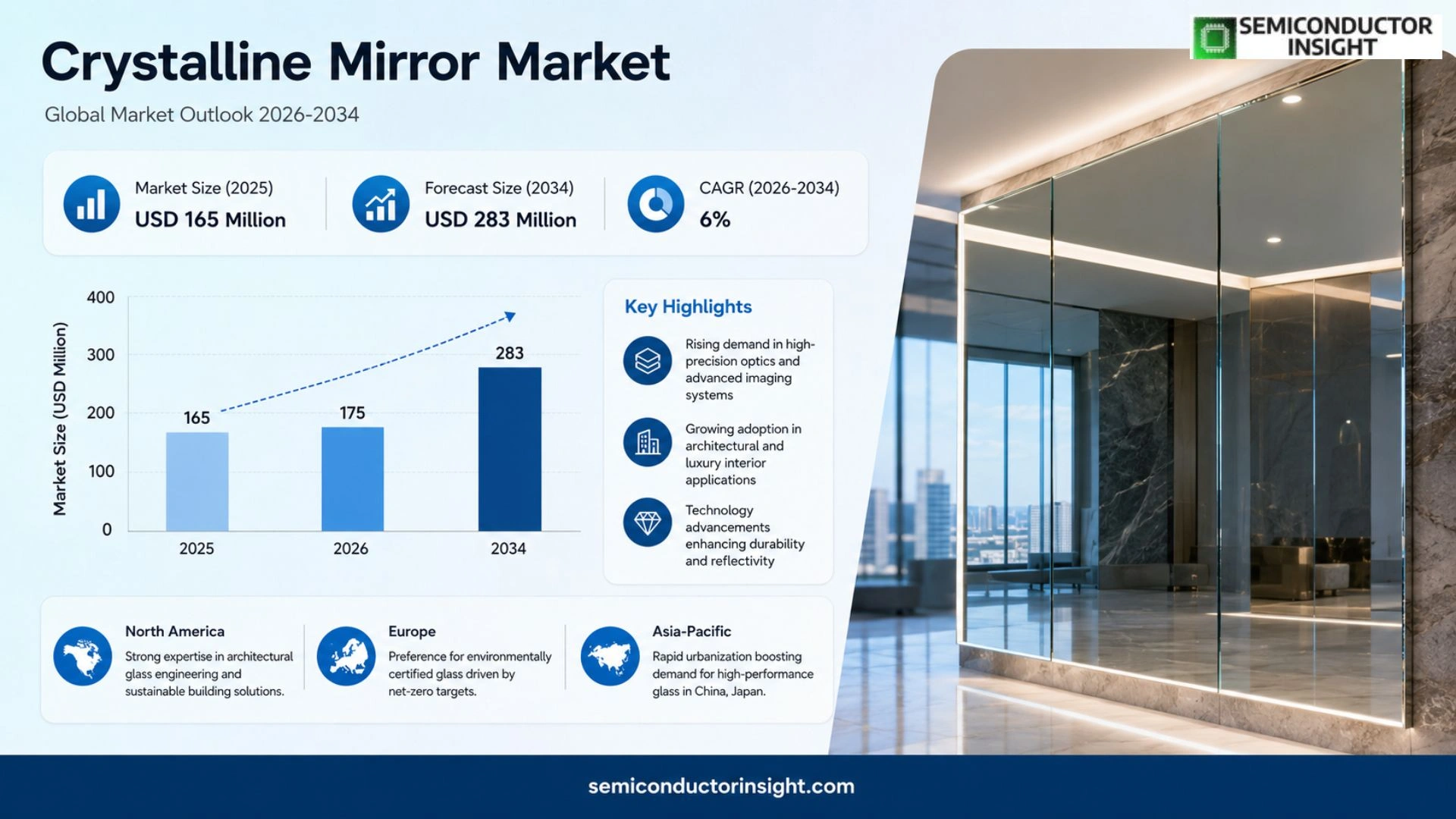
Global Crystalline Mirror Market size was valued at USD 165 million in 2025. The market is projected to grow from USD 175 million in 2026 to USD 283 million by 2034, exhibiting a CAGR of 6% during the forecast period.
Crystalline mirrors are multilayer reflective devices where at least one reflective surface consists of monocrystalline optical material,commonly semiconductor substrates such as gallium arsenide or indium phosphide,coated with precision thin films that enable high reflectivity across selected wavelengths.
Demand for these mirrors has intensified as high‑precision laser systems and quantum sensing applications expand, requiring surfaces with minimal scattering and superior thermal stability.
Manufacturers are increasingly adopting advanced deposition techniques and tighter process controls, which drive unit costs down while enhancing performance, thereby widening adoption across telecommunications, defense, and scientific research sectors.
MARKET DRIVERS
Technological Advancements in Optical Fabrication
The move toward higher precision in reflective surfaces has pushed manufacturers to adopt laser‑assisted polishing and phase‑matching techniques. These advancements reduce surface irregularities by up to 40 percent, directly translating into cleaner light paths for automotive HUDs, automotive head‑up displays, and smart glass applications. Teams that already invest in multi‑layer protective coatings gain a competitive edge, as customers increasingly demand mirrors that survive harsher UV exposure without compromising reflectivity.
Rise of Smart Architecture
Building designs that merge daylight entry with minimal glare have spurred demand for high‑quality crystalline mirrors. Architects and developers now routinely incorporate mirror façades to control solar gain while preserving privacy, a trend described by the emerging green‑building certification programs. Consequently, the supply chain is adapting, with glass manufacturers collaborating with coatings specialists to deliver products that meet both aesthetic and regulatory standards.
➤ Sector analysts project a 12 percent compound increase in mirror deployments for commercial interiors over the next four years.
Finally, the proliferation of high‑definition displays in consumer electronics has made clear reflective surfaces almost a baseline requirement for application integrity. The increasing drive for larger, lighter panels reinforces the need for mirrors that combine low dispersion with minimal weight,specifications that are now driven by consumer brands seeking to differentiate through visual fidelity.
MARKET CHALLENGES
Geographic Supply Imbalance
Despite rising market appetite, sourcing raw quartz and specialty glass remains concentrated in a handful of regions. Transport costs and export restrictions hamper smaller players from accessing high‑purity feedstock, creating bottlenecks that strain production timelines and inflate unit costs. The disparity is compounded by fluctuating tariffs on imported glass, adding regulatory risk to the commodity cycle.
Other Challenges
Energy Efficiency Concerns
Manufacturing crystalline mirrors demands significant energy input for crystal growth and surface finishing. With tightening environmental regulations, firms must integrate process optimization or renewable energy sources to maintain margin pressure.
Capital Intensity of Production
The capital required to set up a single low‑defect crystal line exceeds US$15 million. This high entry barrier limits the pool of platform providers and exacerbates competition among incumbent manufacturers willing to loll up the expensive assets.
Competitive Consolidation
Large OEMs frequently absorb smaller fabricators to secure supply consistency. Such consolidation reduces price elasticity, making distributors reluctant to adopt new entrants without clear cost advantage.
MARKET RESTRAINTS
High Production Costs
Even with improved process efficiencies, the per‑unit cost of crystal polishing, contamination control, and dimensional verification remains steep compared to alternative reflective materials. Consequently, price‑sensitive segments such as large‑scale architectural projects may opt for cheaper diffused alumina coatings, limiting penetration of premium crystalline mirrors.
Limited Geographic Diversification
Manufacturers that concentrate production in single facilities face heightened exposure to regional disruptions,natural disasters, political unrest, or supply chain shocks. The lack of geographic redundancy magnifies risk, restraining expansion into new markets that require reliable, on‑call availability.
Regulatory Uncertainty
Recent developments in air‑quality standards mandate the removal of certain toxic elements from glass substrates. Suppliers must navigate an evolving regulatory landscape that could necessitate costly re‑engineering of production lines and material sourcing, introducing a compliance cost curve that some firms are ill‑prepared to absorb.
MARKET OPPORTUNITIES
Expansion into Emerging Technology Sectors
The crossover of crystalline mirror technology into emerging fields,such as drone navigation displays, augmented reality wearables, and low‑light imaging systems,offers a new revenue stream. Because these sectors value high reflectivity and edge‑clean performance, mirror suppliers can carve out niche markets far beyond conventional automotive or architectural uses.
Strategic Partnerships with Digital Signage Providers
Collaborations with digital signage companies allow manufacturers to embed mirror layers into interactive displays, thus expanding the factor of optical performance while maintaining in‑situ signal clarity. These alliances foster mutual innovation and cannibalize demand from rivals who cannot match the enhanced visual quality.
Environmental Sustainability as a Differentiator
Consumers and commercial entities are increasingly scrutinizing embodied carbon footprints. Mirror producers that can demonstrate a greener crystal growth process,lower energy consumption, recyclable coating layers,will tap into the premium segment willing to pay a price lift for verified sustainability credentials.
Crystalline Mirror Market Trends
Emerging Demand in High‑Precision Optical Applications
High‑precision laser applications continue to drive the need for advanced reflective coatings, positioning crystalline mirrors as pivotal elements in optical subsystems. Crystalline Mirror Market’s allocation towards high‑finesse cavities, low‑noise interferometers, ultrastable laser arrays, and precision metrology tools is rising in proportion to the growing sophistication of quantum‑based timekeeping, gravitational‑wave detection, and next‑generation laser spectroscopy platforms. Because each of these instruments depends on mirrors derived from monocrystalline substrates,Gallium Arsenide or Indium Phosphide,the market places increasing emphasis on surface quality, uniformity, and thermal stability. Manufacturers are now investing heavily in ultra‑clean deposition environments and advanced in‑situ metrology, allowing tolerances tighter than 5 nm peak‑to‑valley over 10 cm diameters. This trend is reinforced by the recent rollout of high‑power laser systems in fusion research, where mirror damage thresholds of >10 MW cm‑2 become critical. The result is an elevated demand for specialized thin‑film stacks that balance reflectivity, durability, and wavelength specificity, thereby redefining the baseline specifications for high‑end optical assemblies.
Other Trends
Digital Integration and Manufacturing Localization
Digital integration and automated fabrication have reshaped the supply chain, as most Crystalline Mirror manufacturers increasingly couple precision optics with electronics control. The shift toward mainland China is driven by the cost advantage of large‑scale wafer processing and the concentration of semiconductor expertise within the region. Local fabs now offer end‑to‑end services,from epitaxial growth of GaAs or InP wafers to sputtering of dielectric coatings and rigorous laser‑damage testing,nearly cutting the turnaround time that traditionally required multiple overseas vendors. Global leaders such as Canon, Nikon and Sony have established production footprints along Chinese coastal zones, creating a fertile environment for technology transfer and collaborative R&D. This localization not only reduces transportation and logistics costs but also enables rapid iteration cycles that are critical for tailoring mirrors to niche applications, from consumer imaging modules to high‑precision interferometric sensors. Consequently, Crystalline Mirror Market benefits from a more resilient manufacturing base that can absorb fluctuations in commodity prices and respond swiftly to evolving certification requirements for aerospace and defense standards.
Regional Shift Toward Asia‑Pacific Production Centers
Regional concentration is shifting decisively toward the Asia‑Pacific sector, a trend that aligns manufacturing output with the surge in photonics research and semiconductor wafer processing in China and India. The proliferation of state‑backed photonic clusters, coupled with incentives for high‑purity silicon carbide and gallium nitride substrate production, has lowered entry barriers for companies seeking to establish monocrystalline growth capabilities. As a result, Crystalline Mirror Market sees measurable increases in localized investment, with capital spending on deposition chambers and automated polishing stations rising by double‑digit percentages. These developments also imply tighter integration between upstream wafer suppliers and downstream mirror manufacturers, forging a vertically connected chain that can quickly adapt to demand cycles in both defense‑grade metrology and commercial laser‑based agriculture irrigation systems. The convergence of lower manufacturing costs and higher technical sophistication positions the Asia‑Pacific region as a net driver for the next wave of high‑quality crystalline optics.
COMPETITIVE LANDSCAPE
Key Industry Players
Crystalline Mirror Market Competitive Landscape
Thorlabs has emerged as the preeminent vendor in the crystalline mirror arena, leveraging its broad portfolio of substrate‐grade GaAs and InP solutions and an aggressive channel strategy that places it within the top 15% of global revenue. The market is heavily tiered: a handful of large‐cap suppliers control roughly seventy percent of the revenue stream, while a diverse cohort of mid‑tier specialists compete on niche technologies such as ultra‑high‑finesse cavity coatings and low‑noise interferometric components. Consolidation pressures stem from the capital intensity required for high‑precision deposition and from customers’ mounting demand for integrated photonic packages that reduce system complexity and value‑add the end‑user. This dynamic lends itself to a market where transaction volumes are declining even as unit prices climb due to the need for stronger performance and longer operational lifetimes, positioning vendors that can combine scale with relentless R&D as the most attractive for growth.
The remainder of the competitive field features players that have carved out specific verticals. Laseroptik, Optoman, and UltraFast Innovations supply specialized coatings tailored for high‑power laser systems and precision interferometers, while Applied Optics and Edmund Optics focus on broad‑lens offerings that tolerate higher thermal loads, essential for industrial laser applications. Zeiss and Coherent provide sophisticated, turnkey mirror assemblies that integrate seamlessly with existing optical benches, driving adoption among research institutions. Newport Corporation, Nikon, and Olympus each supplement their primary imaging lines with mirror modules that serve both laboratory and commercial optics. These companies maintain a modest market share but hold strategic advantage through cross‑industry partnerships and localized manufacturing, particularly in expanding Asian markets where cost‑sensitive customers require customized solutions. Collectively, the competitive map displays a layered architecture where incremental innovations and regional expertise translate into sustained relevance.
List of Key Crystalline Mirror Companies Profiled
- Thorlabs
- Thorlabs
- Laseroptik
- Optoman
- UltraFast Innovations GmbH
- Applied Optics
- Edmund Optics
- Zeiss
- Coherent
- Newport Corporation
- Nikon
- Olympus
Segment Analysis:
| Segment Category | Sub-Segments | Key Insights |
| By Type |
|
Gallium Arsenide Substrate
|
| By Application |
|
High‑Finesse Laser Cavities
|
| By End User |
|
Research Institutes
|
| By Coating Technique |
|
Ion Beam Sputtering
|
| By Deployment Context |
|
Space‑Based Platforms
|
Regional Analysis: Crystalline Mirror Market
Segment analysis reveals that residential and commercial building projects now dominate demand, with global architects seeking reflective glass that improves daylight harvesting while maintaining privacy. Automotive and aerospace sectors are carving out niche opportunities, especially with lightweight mirror variants that respond to stricter fuel‑efficiency mandates. The geographic spread of projects also highlights an ongoing shift toward advanced glazing in emerging markets, where construction volumes are rising at a faster pace than in traditional strongholds.
Cost pressures stem largely from raw‐material volatility in silica sand and energy inputs. Efficient economies of scale, especially in North America and Europe, allow manufacturers to absorb these variations without large price hikes. In contrast, suppliers in the Asia‑Pacific region balance higher production costs with strategic pricing discounts to court large‑volume buyers, thereby fostering competitive trade flows.
Direct sales to construction firms and automotive OEMs remain the primary revenue pathway, yet digital marketplaces are gaining traction in Europe and South America. These platforms enable small‑to‑mid sized retailers to secure premium glass modules via just‑in‑time logistics, reducing inventory burdens and speeding up project timelines.
Recent breakthroughs in nanostructured coatings promise to extend the lifespan of crystalline mirrors while slashing maintenance costs. Engineers are also layering anti‑smoke and anti‑radiation features into automotive mirrors, enhancing safety ratings without sacrificing design integrity.
Europe
European demand for crystalline mirrors shows a distinct preference for environmentally certified glass, driven by the continent’s aggressive net‑zero targets. Urban renewal projects in Germany and France favor mirrors that integrate photovoltaic cells, thus turning façades into passive energy sources. However, heightened material tariffs have occasionally tightened profit margins for local suppliers, forcing them to adopt lean manufacturing techniques and seek alternative sourcing in low‑cost, high‑quality regions such as Southeast Asia.
Asia-Pacific
The Asia‑Pacific region’s rapidly urbanizing skylines are propelling a surge in high‑performance glass installations across China and Japan. Here, project developers prioritize glass panels that meet stringent fire‑resistance norms, as well as cutting‑edge acoustical dampening, to comply with new building codes. A steady pipeline of government‑backed green‑building incentives enhances market stability, while the region’s proximity to key raw‑material supplies mitigates input cost volatility.
South America
South American growth in crystalline mirror usage has accelerated in Brazil and Argentina through investment in mixed‑use developments and commercial refurbishments. Architects are increasingly opting for mirror finishes that reduce glare, thereby improving indoor environmental quality for workers and visitors alike. Nevertheless, limited domestic manufacturing capacity compels companies to depend on imports, exposing them to exchange‑rate swings that can influence project budgeting decisions.
Middle East & Africa
In the Middle East, the push for luxury hospitality projects and high‑rise residential towers fuels a stable demand for premium crystalline mirrors. Reflective glass offerings now routinely integrate solar shading technologies, aligning with regional climate‑responsive design philosophies. Africa’s nascent construction sector is broadening its palette, albeit at a slower rate, as local builders become more familiar with the durability and aesthetic benefits of high‑quality glass finishes.
Report Scope
This market research report provides a comprehensive analysis of the Crystalline Mirror Market , covering the forecast period 2026–2034. It offers detailed insights into market dynamics, technological advancements, competitive landscape, and key trends shaping the industry.
Key focus areas of the report include:
- Market Overview: The report begins with an overview outlining its current market scenario, key growth indicators, and industry transformation drivers. It discusses macroeconomic factors, demand–supply balance, regulatory landscape, and the strategic role of semiconductors in powering advancements across industries such as automotive, telecommunications, consumer electronics, and industrial automation.
- Market Size & Forecast: Historical data and future projections for revenue, unit shipments, and market value across major regions and segments.
- Segmentation Analysis: Detailed breakdown by product type, technology, application, and end-user industry to identify high-growth segments and investment opportunities.
- Regional Insights: Insights into market performance across North America, Europe, Asia-Pacific, Latin America, and the Middle East & Africa, including country-level analysis where relevant.
- Competitive Landscape: Profiles of leading market participants, including their product offerings, R&D focus, manufacturing capacity, pricing strategies, and recent developments such as mergers, acquisitions, and partnerships.
- Technology Trends & Innovation: Assessment of emerging technologies, integration of AI/IoT, semiconductor design trends, fabrication techniques, and evolving industry standards.
- Market Drivers & Restraints: Evaluation of factors driving market growth along with challenges, supply chain constraints, regulatory issues, and market-entry barriers.
- Stakeholder Insights: Insights for component suppliers, OEMs, system integrators, investors, and policymakers regarding the evolving ecosystem and strategic opportunities.
Primary and secondary research methods are employed, including interviews with industry experts, data from verified sources, and real-time market intelligence to ensure the accuracy and reliability of the insights presented.
FREQUENTLY ASKED QUESTIONS:
What is the current market size of Crystalline Mirror Market?
-> Crystalline Mirror Market size is projected to grow from USD 175 million in 2026 to USD 283 million by 2034, exhibiting a CAGR of 6%
Which key companies operate in Crystalline Mirror Market?
-> Key players include Thorlabs, LASEROPTIK, OPTOMAN, and UltraFast Innovations GmbH, among others.
What are the key growth drivers?
-> Key growth drivers include high‑precision photonics applications, expanding laser interferometry, and advancements in semiconductor‑based optical substrates.
Which region dominates the market?
-> Asia‑Pacific is the fastest‑growing region, driven largely by demand from China, Japan, and Korea.
What are the emerging trends?
-> Emerging trends include ultra‑high‑precision thin‑film coatings, quantum‑sensor integration, and sustainable manufacturing practices.

Get Sample Report PDF for Exclusive Insights
Report Sample Includes
- Table of Contents
- List of Tables & Figures
- Charts, Research Methodology, and more...
 Download Sample Report PDF