Condition Monitoring (Vibration MEMS + AI) IC Market Insights
Global Condition Monitoring (Vibration MEMS + AI) IC Market size was valued at USD 1.45 billion in 2025. The market is projected to grow from USD 1.55 billion in 2026 to USD 2.85 billion by 2034, exhibiting a CAGR of 7.9% during the forecast period.
Condition Monitoring (Vibration MEMS + AI) ICs integrate micro-electromechanical systems (MEMS) vibration sensors with artificial intelligence processing capabilities on a single chip or compact module. These specialized integrated circuits capture, process, and analyze vibration data in real time to detect equipment anomalies, predict failures, and enable proactive maintenance strategies. By combining high-sensitivity MEMS accelerometers with on-chip or edge-based AI algorithms, they deliver compact, low-power solutions ideal for industrial machinery, rotating equipment, and smart manufacturing environments.
The market is experiencing rapid growth due to several factors, including the accelerating adoption of predictive maintenance across manufacturing, energy, and oil and gas sectors, where unplanned downtime can result in significant financial losses. Rising investments in Industry 4.0 initiatives and Industrial Internet of Things (IIoT) deployments further propel demand for intelligent, miniaturized vibration monitoring components. Advancements in MEMS fabrication have enabled smaller, more cost-effective, and highly accurate sensors, while AI integration improves pattern recognition and reduces false positives in fault detection. This convergence allows operators to move from reactive to condition-based strategies, extending asset life and optimizing operational efficiency. Key players continue to innovate in low-power designs and sensor fusion technologies to meet the needs of wireless and battery-operated monitoring systems.
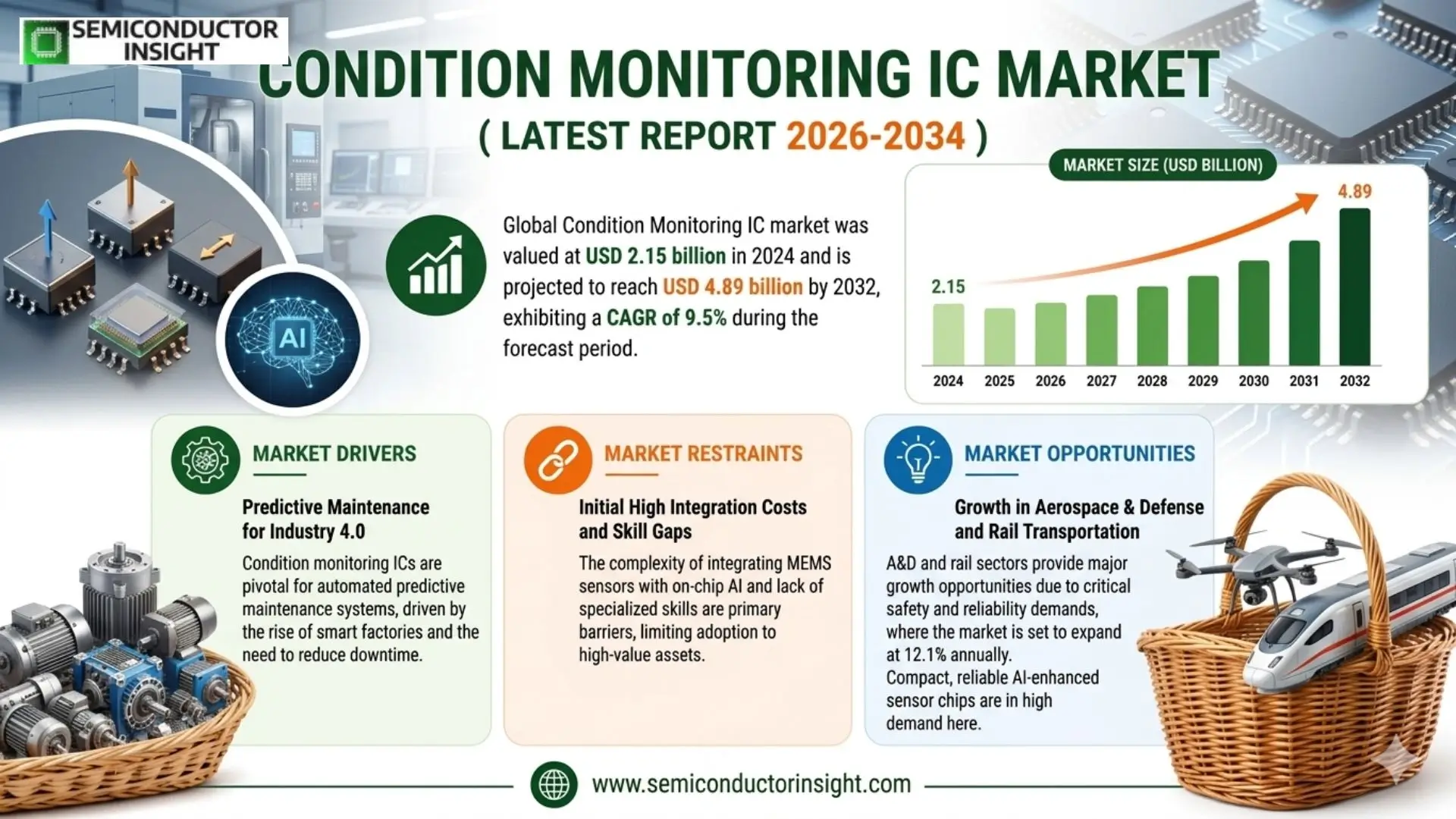
MARKET DRIVERS
Rising Adoption of Predictive Maintenance Strategies
Condition Monitoring (Vibration MEMS + AI) IC Market is propelled by the accelerating shift from reactive and preventive maintenance to predictive approaches across manufacturing, energy, oil & gas, and transportation sectors. Vibration analysis using MEMS-based accelerometers enables early detection of faults such as imbalance, misalignment, and bearing wear in rotating equipment, significantly reducing unplanned downtime and extending asset lifespan.
Advancements in MEMS Technology and AI Integration
Miniaturization, low power consumption, and cost-effectiveness of Vibration MEMS sensors have made dense deployments feasible even on non-critical assets. When combined with AI and machine learning algorithms for anomaly detection and spectral analysis like FFT, these IC solutions deliver higher diagnostic accuracy and real-time insights, transforming raw vibration data into actionable maintenance recommendations.
➤ Integration of edge AI in MEMS vibration ICs allows on-device processing, minimizing latency and bandwidth requirements in Industrial IoT environments.
Industry 4.0 initiatives and wireless sensor networks further amplify demand, as manufacturers seek to optimize operational efficiency and enhance safety through continuous condition monitoring.
MARKET CHALLENGES
Data Quality and Model Accuracy Issues
Condition Monitoring (Vibration MEMS + AI) IC Market, ensuring high-quality vibration data from MEMS sensors remains challenging due to environmental noise, varying operating conditions, and sensor placement limitations. AI models require extensive historical failure data for training, which is often scarce for legacy equipment, leading to potential inaccuracies in fault prediction.
Other Challenges
Integration Complexity with Legacy Systems
Many industrial facilities operate with outdated OT infrastructure, creating compatibility issues when incorporating modern Vibration MEMS + AI IC solutions. Bridging protocols and ensuring seamless data flow demands significant customization and testing efforts.
Shortage of Skilled Expertise
Interpreting AI-driven vibration analytics and managing predictive maintenance programs requires specialized knowledge in data science, sensor technology, and domain-specific machinery behavior, constraining widespread adoption among smaller enterprises.
MARKET RESTRAINTS
High Initial Implementation and Integration Costs
Despite declining per-unit costs for MEMS vibration sensors, the upfront investment for comprehensive Condition Monitoring (Vibration MEMS + AI) IC systems,including hardware, software platforms, wireless infrastructure, and AI model development,can be substantial. This particularly restrains adoption in cost-sensitive industries or among SMEs with limited capital budgets for digital transformation.
Cybersecurity and Data Privacy Concerns
Connected vibration monitoring solutions relying on IoT and cloud analytics expose critical industrial assets to potential cyber threats. Securing data transmission from MEMS ICs and protecting proprietary machine health information adds complexity and ongoing compliance costs, slowing deployment in highly regulated sectors.
MARKET OPPORTUNITIES
Expansion in Emerging Industrial IoT Applications
Condition Monitoring (Vibration MEMS + AI) IC Market presents significant growth potential through deeper integration into smart factories, renewable energy infrastructure, and electric vehicle manufacturing. Advancements in low-power MEMS designs and edge AI enable battery-operated wireless nodes suitable for remote or harsh environments, unlocking new use cases in predictive maintenance for wind turbines, robotics, and process industries.
Growth of AI-Enhanced Analytics Platforms
Opportunities abound in developing subscription-based AI analytics services that process vibration data from MEMS ICs to provide prescriptive maintenance actions. As sensor fusion and machine learning capabilities mature, these solutions can reduce false alarms, improve fault classification accuracy, and support fleet-wide optimization, driving recurring revenue streams for IC providers and system integrators.
TrendsIntegration of MEMS Vibration Sensors with Edge AI Processing
Condition Monitoring (Vibration MEMS + AI) IC Market is witnessing significant advancements through the seamless integration of micro-electromechanical systems (MEMS) vibration sensors with artificial intelligence capabilities directly on compact integrated circuits. These specialized ICs enable real-time capture, processing, and analysis of vibration data to identify equipment anomalies and support predictive maintenance strategies in industrial settings. High-sensitivity MEMS accelerometers combined with on-chip AI algorithms deliver low-power, miniaturized solutions well-suited for rotating machinery and smart manufacturing environments.
Other Trends
Advancements in MEMS Fabrication and Sensor Performance
Recent developments in MEMS technology have resulted in sensors with improved frequency response reaching up to 10kHz and lower noise floors, making them suitable for a wide range of industrial assets including pumps, fans, conveyors, and motors. These enhancements allow Condition Monitoring (Vibration MEMS + AI) IC solutions to achieve higher accuracy while maintaining compact form factors and cost-effectiveness, facilitating broader adoption beyond traditional high-end piezoelectric systems.
Rising Adoption of Wireless and Low-Power Designs
The shift toward wireless sensor networks in condition monitoring is accelerating demand for low-power Condition Monitoring (Vibration MEMS + AI) IC designs. Energy-efficient architectures support battery-operated and energy-harvesting devices, enabling dense deployment across large industrial facilities without extensive cabling infrastructure. This trend aligns with Industrial Internet of Things (IIoT) deployments, where reliable, continuous vibration data transmission is essential for centralized analytics and proactive maintenance planning.
AI-Driven Pattern Recognition and Reduced False Positives
Artificial intelligence integration within vibration monitoring ICs is transforming data interpretation by enhancing pattern recognition capabilities. Advanced algorithms analyze vibration signatures in real time to distinguish genuine faults such as bearing wear, misalignment, or imbalance from normal operational variations. This capability significantly reduces false positives, allowing maintenance teams to focus resources effectively and transition from reactive to condition-based maintenance approaches across manufacturing, energy, and oil and gas sectors.
Support for Industry 4.0 and Predictive Maintenance Initiatives
Condition Monitoring (Vibration MEMS + AI) IC Market trends are closely tied to the broader acceleration of Industry 4.0 initiatives. Investments in smart factories and connected reliability strategies are driving the need for intelligent, miniaturized components that deliver actionable insights at the edge. Sensor fusion techniques combining vibration data with other parameters further enhance diagnostic accuracy, extending asset lifespan and optimizing operational efficiency in demanding industrial environments. Key innovations continue to focus on robust designs capable of operating in harsh conditions while maintaining high performance standards.
COMPETITIVE LANDSCAPE
Key Industry Players
Condition Monitoring (Vibration MEMS + AI) IC Market
Condition Monitoring (Vibration MEMS + AI) IC Market features a mix of established semiconductor leaders specializing in high-performance MEMS accelerometers and industrial automation giants integrating these components into intelligent predictive maintenance solutions. Analog Devices stands out as a leading player with its advanced vibration monitoring platforms and MEMS-based solutions optimized for edge processing and AI-driven anomaly detection in industrial environments. The market structure is moderately consolidated at the component level, where MEMS IC specialists compete on sensor accuracy, low-power operation, and integration with machine learning cores, while system-level players bundle these ICs with software analytics for comprehensive condition-based maintenance.
Other significant niche players include semiconductor manufacturers focused on industrial-grade MEMS sensors and companies advancing sensor fusion with AI algorithms. Bosch Sensortec, STMicroelectronics, and TDK Tronics contribute specialized vibration sensing ICs with bandwidth capabilities suited for real-time fault detection. System integrators and bearing experts like SKF and Schaeffler leverage these IC technologies within broader IIoT ecosystems, enhancing predictive capabilities for rotating equipment in manufacturing, energy, and oil & gas sectors.
List of Key Condition Monitoring Companies Profiled
- Analog Devices Inc.
- Analog Devices
- Bosch Sensortec
- STMicroelectronics
- TDK Corporation (Tronics Microsystems)
- Emerson Electric Co.
- Emerson Electric Co.
- SKF Group
- Schaeffler AG
- Honeywell International Inc.
- Baker Hughes Company
- Rockwell Automation Inc.
- Parker Hannifin Corp
- TE Connectivity
Segment Analysis:
| Segment Category | Sub-Segments | Key Insights |
| By Type |
|
Integrated Sensor Fusion ICs represent the leading segment due to their ability to combine high-sensitivity MEMS accelerometers with on-chip AI algorithms in a single compact package. This integration enables real-time vibration data capture, advanced pattern recognition, and immediate anomaly detection directly at the edge. Key advantages include significantly reduced system complexity, lower power consumption for battery-operated devices, and enhanced accuracy in distinguishing genuine faults from operational noise. These ICs facilitate seamless deployment in space-constrained environments while supporting sophisticated predictive analytics without relying on external processors. |
| By Application |
|
Rotating Equipment Monitoring stands out as the dominant application segment. These specialized ICs excel in continuously tracking vibration signatures from motors, pumps, turbines, and compressors, enabling early identification of imbalance, misalignment, bearing wear, or looseness. The embedded AI capabilities allow for nuanced differentiation of fault patterns, supporting proactive maintenance decisions that minimize unplanned downtime. Integration with Industry 4.0 frameworks further enhances their value by delivering actionable insights directly to control systems, thereby improving overall operational reliability and extending asset longevity in critical industrial processes. |
| By End User |
|
Manufacturing Facilities emerge as the leading end-user segment for Condition Monitoring (Vibration MEMS + AI) ICs. In smart factories, these ICs play a pivotal role in supporting predictive maintenance strategies across production lines, where equipment reliability directly impacts throughput and product quality. The combination of MEMS precision and AI-driven analytics empowers operators to detect subtle vibration changes indicative of impending failures, allowing scheduled interventions that optimize maintenance schedules and reduce operational disruptions. Their compact, low-power design makes them particularly suitable for retrofitting existing machinery and integration into new IIoT-enabled equipment, fostering a shift toward more resilient and efficient manufacturing ecosystems. |
| By Deployment Mode |
|
Wireless Battery-Powered Nodes lead this segment owing to their flexibility in deployment across hard-to-reach or mobile assets. These ICs incorporate ultra-low-power MEMS sensors and efficient AI processing to deliver continuous monitoring without the constraints of cabling infrastructure. This enables rapid installation, scalability in large facilities, and real-time alerts through industrial wireless protocols. The design prioritizes energy efficiency while maintaining high-fidelity vibration data analysis, making them ideal for dynamic industrial environments where traditional wired systems would be impractical or cost-prohibitive. |
| By Technology Integration |
|
Sensor Fusion with Machine Learning is the leading category in technology integration. By combining vibration data from MEMS sensors with additional inputs such as temperature or acoustic signals, these ICs provide a more comprehensive view of equipment health. On-chip machine learning models enhance fault classification accuracy and reduce false alarms by learning normal operating patterns unique to each asset. This multi-dimensional analysis supports more confident predictive maintenance decisions, helping industries transition from time-based to truly condition-based strategies while improving overall system intelligence and operational decision-making. |
Regional Analysis: Condition Monitoring (Vibration MEMS + AI) IC Market
Asia-Pacific
Asia-Pacific stands as the leading region Condition Monitoring (Vibration MEMS + AI) IC Market, driven by rapid industrialization and aggressive adoption of smart manufacturing technologies across key economies. The integration of Vibration MEMS sensors with advanced AI algorithms in integrated circuits is transforming predictive maintenance strategies in manufacturing hubs, particularly in automotive, electronics, and heavy machinery sectors. Countries are prioritizing operational efficiency and equipment reliability to maintain competitive edges in global supply chains.The convergence of MEMS vibration sensing capabilities with edge-based AI processing enables real-time anomaly detection and health diagnostics directly at the machine level. This technological synergy reduces unplanned downtime and extends asset lifespan in high-volume production environments. Government initiatives supporting Industry 4.0 transformation further accelerate demand for sophisticated Condition Monitoring (Vibration MEMS + AI) IC solutions. Local semiconductor manufacturers are increasingly investing in specialized IC designs that combine high-sensitivity vibration detection with low-power AI inference engines, creating a robust regional innovation ecosystem.
The region benefits from concentrated semiconductor design and fabrication capabilities that support custom Vibration MEMS + AI IC development. Collaborative ecosystems between sensor specialists, AI software providers, and end-user industries foster rapid prototyping and deployment of next-generation condition monitoring solutions tailored to local manufacturing needs.
Extensive industrial bases provide ideal testing grounds for Condition Monitoring (Vibration MEMS + AI) IC technologies. Large-scale factories with diverse machinery types generate rich operational data, enabling continuous improvement of AI models and validation of vibration sensing accuracy across varied applications.
Strategic national policies promoting digital transformation and smart factories create favorable conditions for widespread adoption of AI-enhanced vibration monitoring ICs. Investments in 5G infrastructure and edge computing further enhance the performance and responsiveness of condition monitoring systems.
Deep integration within global electronics and automotive value chains positions the region as both a major consumer and innovator of Condition Monitoring (Vibration MEMS + AI) IC technologies, with strong emphasis on compact, cost-effective, and energy-efficient designs suitable for mass deployment.
North America
North America maintains a strong position Condition Monitoring (Vibration MEMS + AI) IC Market through its focus on high-value industrial applications and technological leadership. The region excels in developing advanced AI inference capabilities integrated with high-precision Vibration MEMS sensors for critical infrastructure and aerospace applications. Emphasis on reliability and safety drives adoption in sectors where equipment failure carries significant consequences. Companies prioritize seamless integration of these ICs into existing industrial IoT platforms, leveraging mature software ecosystems and data analytics expertise to maximize the value of real-time vibration insights.
Europe
Europe demonstrates sophisticated demand for Condition Monitoring (Vibration MEMS + AI) IC solutions, particularly in precision manufacturing, energy, and transportation sectors. The region’s stringent regulatory environment regarding equipment safety and environmental impact encourages proactive deployment of intelligent monitoring technologies. European industries value the combination of MEMS vibration sensing accuracy with AI-driven predictive analytics for optimizing maintenance schedules and reducing energy consumption. Collaborative research initiatives between academia and industry continue to push boundaries in multi-parameter sensing and advanced algorithm development for next-generation ICs.
South America
South America is gradually expanding its presence Condition Monitoring (Vibration MEMS + AI) IC Market, primarily driven by mining, oil & gas, and agricultural machinery sectors. Growing awareness of the benefits of predictive maintenance is encouraging adoption of vibration monitoring technologies to improve operational continuity in remote and harsh environments. While infrastructure development varies across countries, increasing investments in industrial automation are creating opportunities for deployment of cost-effective MEMS + AI IC solutions tailored to regional operational challenges and climatic conditions.
Middle East & Africa
The Middle East & Africa region shows emerging potential Condition Monitoring (Vibration MEMS + AI) IC Market, fueled by energy sector modernization efforts and infrastructure development projects. Oil & gas operators are increasingly exploring AI-enhanced vibration monitoring to optimize asset performance and safety in upstream and downstream operations. As industrial diversification progresses, demand for reliable condition monitoring solutions is expected to grow, particularly in new manufacturing facilities and power generation projects where equipment uptime is critical for economic objectives.
Report Scope
This market research report provides a comprehensive analysis of the Condition Monitoring (Vibration MEMS + AI) IC Market , covering the forecast period 2026–2034. It offers detailed insights into market dynamics, technological advancements, competitive landscape, and key trends shaping the industry.
Key focus areas of the report include:
- Market Overview: The report begins with an overview outlining its current market scenario, key growth indicators, and industry transformation drivers. It discusses macroeconomic factors, demand–supply balance, regulatory landscape, and the strategic role of semiconductors in powering advancements across industries such as automotive, telecommunications, consumer electronics, and industrial automation.
- Market Size & Forecast: Historical data and future projections for revenue, unit shipments, and market value across major regions and segments.
- Segmentation Analysis: Detailed breakdown by product type, technology, application, and end-user industry to identify high-growth segments and investment opportunities.
- Regional Insights: Insights into market performance across North America, Europe, Asia-Pacific, Latin America, and the Middle East & Africa, including country-level analysis where relevant.
- Competitive Landscape: Profiles of leading market participants, including their product offerings, R&D focus, manufacturing capacity, pricing strategies, and recent developments such as mergers, acquisitions, and partnerships.
- Technology Trends & Innovation: Assessment of emerging technologies, integration of AI/IoT, semiconductor design trends, fabrication techniques, and evolving industry standards.
- Market Drivers & Restraints: Evaluation of factors driving market growth along with challenges, supply chain constraints, regulatory issues, and market-entry barriers.
- Stakeholder Insights: Insights for component suppliers, OEMs, system integrators, investors, and policymakers regarding the evolving ecosystem and strategic opportunities.
Primary and secondary research methods are employed, including interviews with industry experts, data from verified sources, and real-time market intelligence to ensure the accuracy and reliability of the insights presented.
FREQUENTLY ASKED QUESTIONS:
What is the current market size of Condition Monitoring (Vibration MEMS + AI) IC Market?
-> Condition Monitoring (Vibration MEMS + AI) IC Market was valued at USD 1.45 billion in 2025 and is expected to reach USD 2.85 billion by 2034, supported by a CAGR of 7.9%.
Which key companies operate Condition Monitoring (Vibration MEMS + AI) IC Market?
-> Key players include leading global MEMS sensor manufacturers, AI-enabled semiconductor companies, and industrial monitoring solution providers, among others.
What are the key growth drivers?
-> Key growth drivers include rapid adoption of predictive maintenance, expansion of Industry 4.0 and IIoT deployments, advancements in MEMS fabrication, and increasing demand for real-time vibration analytics.
Which region dominates the market?
-> Asia-Pacific is the fastest-growing region, driven by strong manufacturing activity and IIoT adoption, while Europe remains a major hub for industrial automation technologies.
What are the emerging trends?
-> Emerging trends include sensor fusion, low-power edge AI processing, miniaturization of MEMS vibration sensors, and adoption of wireless condition monitoring systems.

Get Sample Report PDF for Exclusive Insights
Report Sample Includes
- Table of Contents
- List of Tables & Figures
- Charts, Research Methodology, and more...
 Download Sample Report PDF