Compute Storage Drive (In-Situ Processing) Market Insights
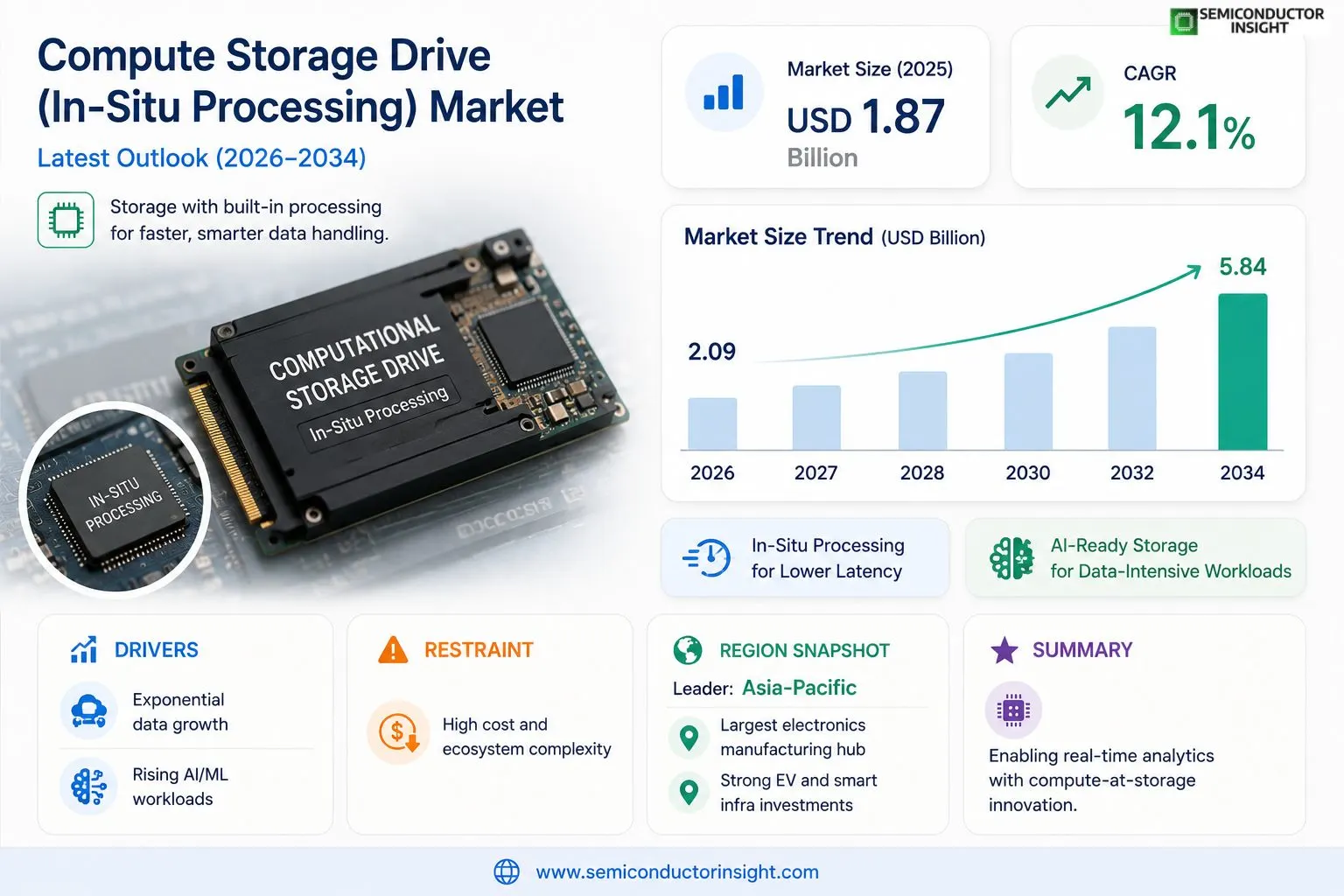
Global Compute Storage Drive (In-Situ Processing) market size was valued at USD 1.87 billion in 2025. The market is projected to grow from USD 2.09 billion in 2026 to USD 5.84 billion by 2034, exhibiting a CAGR of 12.1% during the forecast period.
Compute Storage Drives with in-situ processing , also referred to as computational storage devices (CSDs) , are a class of advanced storage technology that integrates processing capabilities directly within the storage medium. Rather than transferring raw data to a central CPU or GPU for computation, these drives perform data processing at the point of storage, significantly reducing data movement latency and alleviating bottlenecks in data-intensive workloads. The technology encompasses a range of form factors and interfaces, including NVMe-based computational SSDs, FPGA-embedded drives, and AI-accelerated storage solutions.
The market is gaining strong momentum driven by the exponential growth in data generation, the rising adoption of AI and machine learning workloads, and increasing demand for real-time analytics across hyperscale data centers. Furthermore, the limitations of traditional von Neumann computing architectures , where data movement between storage and processor consumes disproportionate energy and time , have made in-situ processing an increasingly attractive solution. Key industry players such as Samsung Electronics, Western Digital, Seagate Technology, ScaleFlux, and NGD Systems are actively advancing their computational storage portfolios to address these evolving infrastructure demands.
MARKET DRIVERS
Exponential Data Growth Fueling Demand for In-Situ Processing Architectures
Global Compute Storage Drive (In-Situ Processing) Market is experiencing robust momentum driven by the unprecedented surge in data generation across enterprise, hyperscale, and edge computing environments. Traditional storage architectures that rely on moving large volumes of data between storage and compute nodes are increasingly inefficient, creating a compelling case for computational storage drives that process data at the point of storage. As organizations grapple with data volumes growing at compound annual rates exceeding 20%, in-situ processing technologies are becoming a strategic imperative rather than an optional upgrade. This architectural shift is fundamentally redefining how enterprises design their data infrastructure strategies.
Acceleration of AI and Machine Learning Workloads at the Storage Layer
Artificial intelligence and machine learning pipelines generate intense data movement bottlenecks between storage and processing units, making Compute Storage Drive (In-Situ Processing) Market a critical enabler of next-generation AI infrastructure. By embedding programmable processing elements,including FPGAs and ASICs,directly within storage drives, vendors are enabling pre-processing, filtering, and inference tasks to execute at the storage layer before data traverses the system bus. This dramatically reduces latency and CPU offloading requirements, allowing data centers to run more AI inference tasks per rack unit. Hyperscale cloud providers and enterprise AI adopters are increasingly piloting computational storage solutions to accelerate training data pipelines and real-time analytics workloads.
➤ The convergence of NVMe protocol advancements with embedded compute capabilities is establishing a new performance baseline for enterprise storage, with computational storage drives demonstrating latency reductions of up to 60% for data-intensive analytics workloads compared to conventional SSD architectures.
The proliferation of NVMe over Fabrics (NVMe-oF) and the maturation of the Computational Storage Architecture (CSA) standard by SNIA are providing the interoperability frameworks necessary for widespread enterprise adoption. These standardization efforts are reducing vendor lock-in concerns and encouraging a broader ecosystem of hardware, firmware, and software developers to contribute to Compute Storage Drive (In-Situ Processing) Market. As open standards gain traction, procurement cycles are shortening and enterprise confidence in long-term technology investments is strengthening, collectively reinforcing market expansion trajectories.
MARKET CHALLENGES
Complexity of Software Ecosystem Development for Computational Storage Platforms
One of the most significant challenges facing Compute Storage Drive (In-Situ Processing) Market is the immaturity of the software and developer toolchain ecosystem surrounding computational storage platforms. Unlike conventional SSDs where storage management software is well-established, in-situ processing drives require specialized programming environments, middleware layers, and application-level APIs that enable developers to offload computational tasks effectively. The lack of standardized software development kits (SDKs) and the steep learning curve associated with programming embedded FPGAs or custom ASICs within storage devices creates significant friction for enterprise IT teams and independent software vendors. Until the developer ecosystem matures sufficiently, adoption will remain concentrated among large hyperscalers and specialized research institutions with dedicated hardware engineering resources.
Other Challenges
Thermal Management and Form Factor Constraints
Embedding active compute elements within the physical confines of standard drive form factors such as M.2, U.2, and EDSFF introduces significant thermal dissipation challenges. In-situ processing drives generate substantially more heat than passive storage devices, requiring enhanced cooling infrastructure that may not be readily available in legacy data center environments. The thermal design power (TDP) constraints of standard drive bays limit the complexity and clock speeds of embedded processors, potentially capping the computational performance gains achievable through in-situ architectures. Manufacturers must continuously innovate in materials science, heat spreader design, and power management firmware to deliver commercially viable products that do not compromise drive longevity or data integrity under sustained compute-intensive workloads.
Integration with Legacy Infrastructure and Workload Orchestration Frameworks
Enterprises operating existing storage area networks (SANs) and hyperconverged infrastructure (HCI) stacks face considerable compatibility and integration challenges when evaluating Compute Storage Drive (In-Situ Processing) solutions. Legacy workload schedulers, storage resource managers, and data fabric orchestration tools were not architected to recognize or leverage the computational capabilities embedded within next-generation drives. Bridging this architectural gap requires middleware development, driver-level modifications, and in some cases, a fundamental redesign of data pipeline workflows,investments that can extend project timelines and elevate total cost of ownership during the transition period, creating hesitation among risk-averse IT decision-makers.
MARKET RESTRAINTS
Elevated Unit Economics and Total Cost of Ownership Concerns
Compute Storage Drive (In-Situ Processing) Market faces a meaningful restraint in the form of significantly higher per-unit costs compared to conventional NVMe SSDs. The integration of programmable logic, additional DRAM buffers, and custom controller silicon within drive enclosures materially increases bill-of-materials costs, resulting in price premiums that can range from two to four times the cost of equivalent-capacity standard SSDs. For cost-sensitive segments including mid-market enterprises, government agencies operating under fixed IT budgets, and emerging-market data center operators, this price differential represents a substantial barrier to near-term adoption. Until manufacturing scale and competitive dynamics drive cost normalization, the addressable market will remain somewhat constrained to performance-driven verticals where the ROI from reduced data movement and CPU offloading can be quantified clearly.
Limited Awareness and Organizational Readiness Among Mid-Market Enterprises
Beyond cost considerations, a pervasive awareness gap regarding the technical capabilities and applicable use cases of computational storage drives continues to restrain market penetration beyond early adopters. Many IT infrastructure teams remain unfamiliar with the SNIA Computational Storage Architecture specifications and lack internal expertise to evaluate, deploy, and manage in-situ processing storage systems effectively. This organizational readiness deficit is compounded by a shortage of certified implementation partners and managed service providers with demonstrated competency in computational storage deployments. Without robust channel education programs, reference architecture documentation, and proof-of-concept support from vendors, the pace of evaluation cycles will remain elongated, limiting the velocity of commercial adoption across the broader enterprise segment of Compute Storage Drive (In-Situ Processing) Market.
MARKET OPPORTUNITIES
Edge Computing and IoT Infrastructure as a High-Growth Adoption Frontier
The rapid expansion of edge computing deployments across industrial IoT, autonomous systems, telecommunications, and smart infrastructure presents a substantial growth opportunity for Compute Storage Drive (In-Situ Processing) Market. Edge nodes operating in bandwidth-constrained or latency-sensitive environments are ideally suited for in-situ processing architectures, as transmitting raw sensor data to centralized cloud infrastructure is often technically impractical and economically prohibitive. Computational storage drives embedded within edge servers and ruggedized appliances can perform local data filtering, anomaly detection, and lightweight inferencing without requiring constant connectivity to upstream compute resources. As 5G network densification accelerates edge compute deployments globally, demand for power-efficient, space-constrained in-situ processing storage solutions is expected to grow substantially through the latter half of this decade.
Strategic Partnerships and Ecosystem Co-Development Unlocking New Vertical Markets
Collaborative ecosystem development between computational storage drive manufacturers, cloud service providers, database vendors, and workload-specific ISVs represents a powerful opportunity to accelerate market penetration across specialized verticals including genomics, financial services, media and entertainment, and cybersecurity analytics. Co-engineered solutions that pre-optimize computational storage drives for specific workloads,such as database query acceleration, video transcoding, or real-time threat detection,can substantially reduce the integration complexity that currently restrains adoption. Vendors who invest in building certified partner ecosystems, establishing interoperability testing programs, and co-marketing reference architectures with hyperscale cloud providers are well-positioned to capture disproportionate share of the expanding Compute Storage Drive (In-Situ Processing) Market as enterprise awareness and ecosystem maturity continue to advance
Compute Storage Drive (In-Situ Processing) Market Trends
Rising Integration of AI and Machine Learning Workloads Driving Computational Storage Adoption
Compute Storage Drive (In-Situ Processing) Market is witnessing accelerated momentum as enterprises and hyperscale data centers grapple with the challenges posed by exponential data generation. Computational storage devices (CSDs) , which integrate processing capabilities directly within the storage medium , are increasingly being recognized as a strategic solution to overcome the latency and energy inefficiencies inherent in traditional von Neumann computing architectures. By performing data processing at the point of storage rather than transferring raw data to a central CPU or GPU, these drives significantly reduce data movement overhead, making them particularly well-suited for AI, machine learning, and real-time analytics workloads. Leading industry players including Samsung Electronics, Western Digital, Seagate Technology, ScaleFlux, and NGD Systems are actively expanding their computational storage portfolios to address these infrastructure demands.
Other Trends
NVMe-Based Computational SSDs Emerging as Dominant Form Factor
Within Compute Storage Drive (In-Situ Processing) Market, NVMe-based computational SSDs are establishing themselves as the preferred form factor for enterprise deployments. The high-bandwidth, low-latency characteristics of the NVMe interface align closely with the performance requirements of in-situ processing workloads. Data centers handling large-scale AI inference, genomics processing, and financial analytics are increasingly deploying NVMe computational storage to streamline pipeline efficiency and reduce dependence on costly CPU cycles.
FPGA-Embedded and AI-Accelerated Storage Solutions Gaining Traction
Another notable trend shaping Compute Storage Drive (In-Situ Processing) Market is the growing adoption of FPGA-embedded drives and AI-accelerated storage solutions. These technologies offer reconfigurable processing logic that can be optimized for specific workloads, providing flexibility that traditional fixed-function architectures cannot match. Industries such as autonomous vehicles, edge computing, and telecommunications are leveraging these solutions to process sensor and network data closer to the source, minimizing latency and bandwidth consumption across distributed infrastructure.
Hyperscale Data Center Expansion Reinforcing Demand for In-Situ Processing Technology
The continued global expansion of hyperscale data centers is serving as a key structural driver for Compute Storage Drive (In-Situ Processing) Market. As data volumes scale beyond what conventional storage-compute architectures can efficiently manage, operators are turning to computational storage to improve energy efficiency, reduce total cost of ownership, and accelerate data-intensive workloads. The convergence of storage and compute at the hardware level represents a fundamental shift in data infrastructure design, positioning the in-situ processing market for sustained long-term growth across cloud, enterprise, and edge environments.
COMPETITIVE LANDSCAPE
Key Industry Players
Compute Storage Drive (In-Situ Processing) Market: Competitive Dynamics and Leading Innovators Shaping the Future of Computational Storage
Global Compute Storage Drive (In-Situ Processing) market is characterized by a competitive and rapidly evolving landscape, with a mix of established semiconductor and storage giants alongside specialized startups driving technological innovation. Samsung Electronics holds a dominant position in the market, leveraging its deep expertise in NAND flash manufacturing and semiconductor design to develop advanced computational storage devices (CSDs) that integrate processing logic directly within the storage medium. Western Digital and Seagate Technology are also prominent incumbents, both actively investing in NVMe-based computational SSD architectures and AI-accelerated storage platforms to capture growing demand from hyperscale data centers and enterprise workloads. These leading players benefit from extensive R&D infrastructure, established supply chains, and long-standing relationships with cloud and enterprise customers, enabling them to scale their computational storage portfolios at pace with surging data generation and real-time analytics requirements.
Beyond the tier-one storage vendors, a number of agile and highly specialized companies are carving out significant niches within the Compute Storage Drive market. ScaleFlux has emerged as a notable innovator, offering NVMe computational storage solutions with embedded processing engines optimized for database acceleration and data compression workloads. NGD Systems has similarly gained recognition for its Newport platform, which integrates ARM-based compute cores directly into U.2 NVMe SSDs, enabling in-situ analytics for edge and data center deployments. FPGA-embedded drive solutions from companies such as Xilinx (now part of AMD) and Intel (via its Optane and FPGA divisions) further expand the competitive spectrum, offering programmable in-storage compute capabilities suited for diverse, high-performance workloads. Micron Technology, SK Hynix, and Kioxia also participate actively in the computational storage ecosystem, advancing memory-centric architectures and CSD-compatible NAND technologies. Collectively, these players are intensifying competition across form factors, interfaces, and target verticals, accelerating the market toward its projected value of USD 5.84 billion by 2034.
List of Key Compute Storage Drive (In-Situ Processing) Companies Profiled
- Samsung Electronics
- Western Digital Corporation
- Seagate Technology Holdings
- ScaleFlux
- NGD Systems
- Micron Technology
- SK Hynix
- Kioxia Holdings
- AMD (Xilinx)
- Intel Corporation
- Pliops
- Eideticom
- Nyriad
- Phison Electronics
- SNIA Computational Storage Initiative Members
Segment Analysis:
| Segment Category | Sub-Segments | Key Insights |
| By Type |
|
NVMe-Based Computational SSDs represent the leading segment within the type category, owing to their widespread compatibility with existing enterprise storage infrastructure and their ability to deliver high-throughput in-situ processing with minimal architectural disruption.
|
| By Application |
|
AI and Machine Learning Inference stands as the dominant application segment, as the proliferation of AI workloads continues to expose the limitations of conventional data transfer-dependent architectures and drives urgent demand for compute-at-storage solutions.
|
| By End User |
|
Hyperscale Data Centers and Cloud Providers constitute the leading end-user segment, driven by their perpetual need to process enormous volumes of data with the highest possible efficiency and the lowest possible latency overhead.
|
| By Interface Standard |
|
NVMe / PCIe Interface leads this segment by a considerable margin, as its high-bandwidth, low-latency communication protocol is uniquely suited to the demanding data throughput requirements that in-situ processing architectures depend upon.
|
| By Deployment Model |
|
On-Premises Deployment currently holds the leading position within the deployment model segment, as organizations managing sensitive, high-volume data workloads continue to prioritize direct control over their storage infrastructure and computational resources.
|
Regional Analysis: Compute Storage Drive (In-Situ Processing) Market
North America
North America’s dominance in Compute Storage Drive (In-Situ Processing) Market is deeply rooted in its rich technology ecosystem. Leading semiconductor firms and storage solution developers are headquartered across Silicon Valley, Texas, and the Pacific Northwest, continuously pushing the boundaries of in-situ processing architectures. This dense concentration of R&D talent accelerates product innovation cycles and shortens time-to-market for next-generation computational storage solutions.
The explosive growth of hyperscale cloud platforms and enterprise data centers across North America has created sustained demand for in-situ processing-enabled storage drives. Cloud giants are actively deploying computational storage to reduce CPU offload bottlenecks and improve total cost of ownership at scale. This trend is reinforcing the region’s leading position in Compute Storage Drive (In-Situ Processing) Market through continuous infrastructure upgrades.
Government-backed programs such as the CHIPS and Science Act have amplified investments in domestic semiconductor production and advanced storage technologies in North America. These policy tailwinds directly benefit Compute Storage Drive (In-Situ Processing) Market by encouraging local manufacturing capabilities, reducing supply chain vulnerabilities, and fostering public-private partnerships that fast-track the commercialization of in-situ processing-enabled storage architectures.
North America’s early adoption of edge computing frameworks and AI-intensive workloads has created fertile ground for computational storage expansion. Industries including autonomous vehicles, smart manufacturing, financial analytics, and healthcare informatics are rapidly integrating in-situ processing drives to handle real-time data decisioning at the source. This cross-sector adoption breadth solidifies North America’s strategic advantage within Compute Storage Drive (In-Situ Processing) Market.
Europe
Europe represents a strategically significant region within Compute Storage Drive (In-Situ Processing) Market, characterized by a strong emphasis on data sovereignty, digital infrastructure investment, and sustainability-driven technology adoption. The European Union’s ambitious digital decade agenda has accelerated deployment of advanced storage solutions across member states, with Germany, the Netherlands, France, and the Nordic countries emerging as primary growth hubs. European enterprises are increasingly adopting computational storage to align with stringent data localization regulations, including GDPR compliance requirements that necessitate efficient on-premise and edge data processing. The region’s thriving automotive and industrial manufacturing sectors are notable adopters of in-situ processing storage, leveraging the technology to support connected vehicle platforms and smart factory operations. Europe’s focus on green data center standards also positions computational storage drives as energy-efficient alternatives to conventional data movement architectures, further stimulating regional demand across Compute Storage Drive (In-Situ Processing) Market through the forecast period.
Asia-Pacific
Asia-Pacific is emerging as the fastest-growing region in Compute Storage Drive (In-Situ Processing) Market, propelled by rapid digital transformation across China, Japan, South Korea, India, and Southeast Asian economies. The region’s massive investments in 5G infrastructure, smart city initiatives, and AI-driven industrial automation are generating unprecedented volumes of data that demand efficient in-situ processing capabilities. China’s national semiconductor self-sufficiency programs are fostering indigenous development of computational storage technologies, while South Korea and Japan continue to leverage their advanced electronics manufacturing expertise to produce cutting-edge storage solutions. India’s burgeoning cloud services market and expanding data center capacity are additional catalysts for in-situ processing adoption. The combination of cost-competitive manufacturing environments, government-supported technology policies, and a rapidly growing technology consumer base collectively positions Asia-Pacific as a critical growth engine for Compute Storage Drive (In-Situ Processing) Market over the 2026–2034 forecast horizon.
South America
South America presents a developing yet increasingly promising landscape for Compute Storage Drive (In-Situ Processing) Market. Brazil leads regional adoption, supported by a growing fintech sector, expanding e-commerce infrastructure, and rising enterprise investment in cloud and edge computing solutions. Chile and Colombia are also witnessing meaningful growth in data center construction, creating gradual demand for advanced storage architectures inclusive of in-situ processing capabilities. While the region currently operates at a nascent stage compared to North America and Europe, improving broadband penetration, foreign direct investment in digital infrastructure, and growing awareness of computational storage benefits are slowly reshaping the market trajectory. Challenges such as economic volatility, inconsistent regulatory frameworks, and limited local semiconductor manufacturing constrain near-term growth; however, long-term opportunities remain substantial as regional enterprises prioritize digital modernization within Compute Storage Drive (In-Situ Processing) Market.
Middle East & Africa
The Middle East & Africa region represents an emerging frontier within Compute Storage Drive (In-Situ Processing) Market, underpinned by ambitious smart city projects, sovereign data infrastructure investments, and expanding hyperscale data center deployments. Gulf Cooperation Council nations , particularly the UAE and Saudi Arabia , are channeling significant capital into national digital transformation programs such as Saudi Vision 2030, which directly accelerates demand for high-performance and energy-efficient storage architectures. South Africa anchors technology adoption on the African continent, with Nigeria and Kenya following as growing markets for cloud and edge infrastructure. The region’s unique operational requirements, including extreme temperature resilience and remote edge deployment scenarios in energy and mining sectors, make in-situ processing drives particularly relevant. As digital literacy expands and regulatory environments mature, the Middle East & Africa region is expected to register progressive uptake of computational storage solutions, gradually increasing its contribution to Global Compute Storage Drive (In-Situ Processing) Market through the forecast period.
Report Scope
This market research report provides a comprehensive analysis of the Compute Storage Drive (In-Situ Processing) Market , covering the forecast period 2026–2034. It offers detailed insights into market dynamics, technological advancements, competitive landscape, and key trends shaping the industry.
Key focus areas of the report include:
-
Market Overview: The report begins with an overview outlining its current market scenario, key growth indicators, and industry transformation drivers. It discusses macroeconomic factors, demand–supply balance, regulatory landscape, and the strategic role of semiconductors in powering advancements across industries such as automotive, telecommunications, consumer electronics, and industrial automation.
- Market Size & Forecast: Historical data and future projections for revenue, unit shipments, and market value across major regions and segments.
- Segmentation Analysis: Detailed breakdown by product type, technology, application, and end-user industry to identify high-growth segments and investment opportunities.
- Regional Insights: Insights into market performance across North America, Europe, Asia-Pacific, Latin America, and the Middle East & Africa, including country-level analysis where relevant.
- Competitive Landscape: Profiles of leading market participants, including their product offerings, R&D focus, manufacturing capacity, pricing strategies, and recent developments such as mergers, acquisitions, and partnerships.
- Technology Trends & Innovation: Assessment of emerging technologies, integration of AI/IoT, semiconductor design trends, fabrication techniques, and evolving industry standards.
- Market Drivers & Restraints: Evaluation of factors driving market growth along with challenges, supply chain constraints, regulatory issues, and market-entry barriers.
- Stakeholder Insights: Insights for component suppliers, OEMs, system integrators, investors, and policymakers regarding the evolving ecosystem and strategic opportunities.
Primary and secondary research methods are employed, including interviews with industry experts, data from verified sources, and real-time market intelligence to ensure the accuracy and reliability of the insights presented.
FREQUENTLY ASKED QUESTIONS:
What is the current market size of Compute Storage Drive (In-Situ Processing) Market?
-> Global Compute Storage Drive (In-Situ Processing) Market was valued at USD 1.87 billion in 2025 and is expected to reach USD 5.84 billion by 2034, growing at a CAGR of 12.1% during the forecast period from 2026 to 2034.
Which key companies operate in Compute Storage Drive (In-Situ Processing) Market?
-> Key players include Samsung Electronics, Western Digital, Seagate Technology, ScaleFlux, and NGD Systems, among others.
What are the key growth drivers?
-> Key growth drivers include exponential growth in data generation, rising adoption of AI and machine learning workloads, and increasing demand for real-time analytics across hyperscale data centers.
Which region dominates the market?
-> Asia-Pacific is the fastest-growing region, while North America remains a dominant market driven by hyperscale data center investments and early adoption of computational storage technologies.
What are the emerging trends?
-> Emerging trends include NVMe-based computational SSDs, FPGA-embedded drives, and AI-accelerated storage solutions that perform data processing directly at the point of storage, reducing latency and alleviating bottlenecks in data-intensive workloads.

Get Sample Report PDF for Exclusive Insights
Report Sample Includes
- Table of Contents
- List of Tables & Figures
- Charts, Research Methodology, and more...
 Download Sample Report PDF