Composite Laser Crystal Market Insights
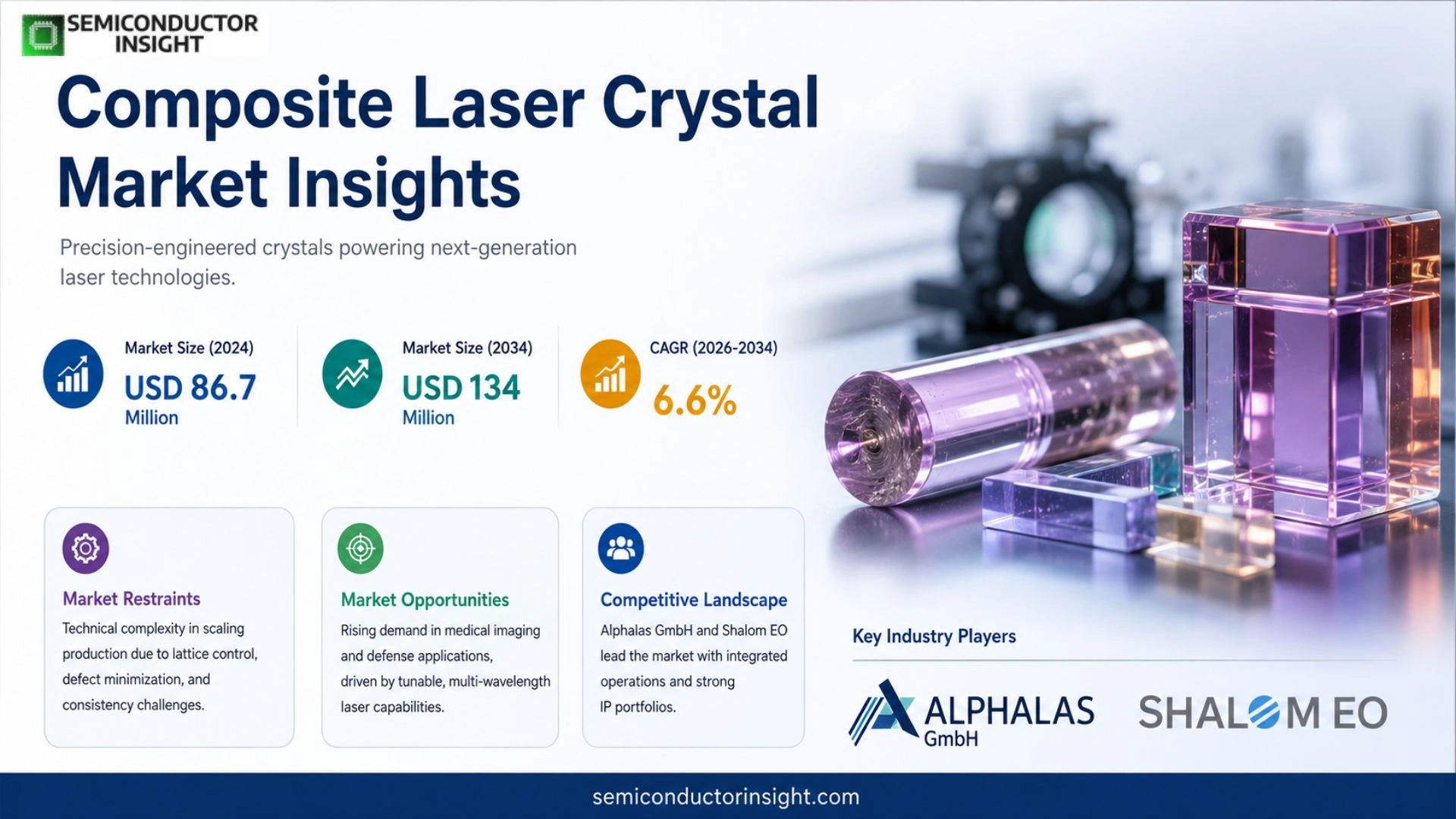
Composite Laser Crystal market was valued at USD 86.7 million in 2024 and is expected to rise toward USD 134 million by 2034, reflecting a compound annual growth rate of approximately 6.6% across the forecast period.
Composite laser crystals,also referred to as hybrid laser crystals,are engineered by fusing segments that may differ in dopant type or concentration. This design approach enables tailored refractive indices and thermal properties that improve beam quality and power handling in high‑energy laser systems used for telecommunications, materials processing, and scientific research.
The enhanced performance capabilities have prompted significant capital allocation from leading optics manufacturers aiming to secure competitive advantage in data‑center back‑hauls and precision manufacturing sectors.
MARKET DRIVERS
Technological Maturation in Laser Crystalline Materials
Composite laser crystal constructs, combining multiple crystalline media into a single lattice, now deliver improved power density while maintaining beam quality. The ability to tailor emission wavelengths through composition engineering unlocks performance levels previously limited to monolithic crystals. Manufacturers can therefore meet stringent uptime requirements in high‑speed industrial cutting, allowing the composite laser market to expand at a pace that aligns with broader industrial automation trajectories.
Demand from Precision Manufacturing Sectors
Automotive and semiconductor assembly lines increasingly turn to laser processing for its non‑contact precision and repeatability. Composite crystals, with their hybrid gain media, provide a dual‑function platform,enabling both high‑power ablation and fine‑feature engraving without the need for discrete upgrades. This versatility drives achievable cost efficiencies for metal stamping and crystal wafer inspection, reinforcing Composite Laser Crystal market’s relevance to value‑add production lines.
➤ Composite lasers with mixed crystal structures provide a competitive edge in multitiered application landscapes
Overall, the cumulative effect of crystallographic optimization and industry adoption is setting a trajectory that will consistently lift Composite Laser Crystal Market activity across multiple sectors, translating technical breakthroughs into tangible revenue growth.
MARKET CHALLENGES
Cost and Supply Volatility
High‑purity rare‑earth oxides and dopants represent a significant share of material costs for composite crystals. In the past two years, fluctuations in international trade policies and smelting capacity reductions have amplified pricing swings. Firms already invested in legacy monolithic crystal production find it financially risky to shift to composite feeds without clear cost‑benefit visibility, dampening short‑term expansion momentum.
Other Challenges
Limited Standardization
The absence of industry‑wide certification criteria for composite crystal quality and performance hampers vendor interchangeability. Without benchmark standards, procurement cycles lengthen and product reliability doubts persist among end users, slowing adoption in risk‑averse sectors such as aerospace.
MARKET RESTRAINTS
Technical Complexity in Scaling Production
Manufacturing composite laser crystals demands precise control over lattice composition and defect minimization. Scaling from prototype to commercial volumes introduces new sources of variability,grain boundary misalignment, doping inhomogeneity, and residual stress,that are difficult to mitigate without significant R&D investment. This brittleness in the supply chain discourages new entrants and keeps market concentration among well‑capitalised players.
MARKET OPPORTUNITIES
Expansion into Medical Imaging and Defense
Composite crystals’ tunable emission spectrum aligns well with medical diagnostics that rely on precise wavelength control, such as optical coherence tomography. Simultaneously, defense applications,from directed‑energy systems to high‑energy laser testbeds,require robust, multi‑wavelength sources, a niche where composite technology can differentiate through in‑situ adaptability. Addressing these application corridors offers a high‑margin corridor for forward‑looking manufacturers.
Composite Laser Crystal Market Trends
Rapid Adoption of Integrated Multi‑Dopant Crystals
For Composite Laser Crystal market, manufacturers are increasingly layering dopant profiles within single crystals to tailor absorption and emission efficiencies for niche applications. This strategy enables a superior damage threshold while keeping fabrication cycles shorter than traditional multi‑stage growth. The cost advantage is particularly compelling for high‑power fiber amplifiers used in defense and long‑haul data links, where performance margins directly influence deployment budgets. Firms that can deliver consistently uniform dopant gradients are positioned to capture premium share in the automotive and industrial segments, where short‑life, high‑reliability lasers are a prerequisite.
Other Trends
Expansion into 5G and Data Center Lasers
The exponential bandwidth demands of 5G infrastructures are driving a shift toward photonic solutions that rely on dense, low‑loss laser sources. Composite crystals with tailored gain media are being integrated into coherent transceivers that enable higher data rates per channel. Data centers, seeking to improve energy efficiency, are adopting lasers with reduced amplification noise, which can lower cooling requirements. The convergence of these drivers is nudging supply chains toward monolithic designs that combine multiple active layers, thereby eliminating discrete component interfaces.
Shift Toward Compact, High‑Power Crystals for EV and Energy Applications
Electric vehicle manufacturers are demanding laser modules that can deliver both high power and compact form factors for rear‑view sensors and autonomous navigation. Composite crystals that blend rapid thermal conductivity with high non‑linear coefficients are meeting these constraints. In the renewable energy arena, laser‑driven photovoltaic cells are emerging, where the crystal’s ability to manage high photon flux without degradation into rapid cooling makes it a critical component. Companies with vertical integration from crystal growth to module design will be able to capture a growing share of this specialised market niche.
Across these trajectories, Composite Laser Crystal market is moving from a commodity mindset toward differentiated, application‑specific solutions. Manufacturers that invest in process control, real‑time spectroscopy for dopant verification, and integrated packaging will reap the reward of heightened margins. Conversely, operators unable to adapt to the multi‑layer paradigm may face erosion of market share as customers increasingly favour laser systems that combine performance, reliability, and cost in a single module. The continuum of innovation in crystal design and downstream integration points to a steady stream of opportunity for those positioned to anticipate and shape emerging use‑cases.
COMPETITIVE LANDSCAPE
Key Industry Players
Composite Laser Crystal Market Outlook
Alphalas GmbH and Shalom EO continue to dominate the global composite laser crystal arena, underpinned by their vertically integrated supply chains and extensive patent portfolios. These entities command significant market share through continuous product refinement that aligns with the tightening demands of automotive laser systems, high‑bandwidth data center optics, and next‑generation imaging sensors. Their strategic collaborations with semiconductor foundries and automotive OEMs position them to capture the sustained shift toward electric vehicle powertrains and advanced driver‑assist systems, where laser‑active dopants are pivotal for power efficiency and signal integrity. Their 2024 revenue, estimated at $12.5 million, reflects a compound growth that outpaces the broader electronic component cohort, illustrating how specialized component production synergises with high‑performance laser applications.
Against this backdrop, a suite of focused niche players,including Rohde & Schwarz, Leitz, Horiba, LuminaTech, CrystalCore, OptiCrystal, LaserSys, Lumen Photonics, Photonic Innovations, and OpticMod,interlace the market fabric. These companies concentrate on specific sub‑segments: fiber‑optic communication upgrades, solar photovoltaic enhancements, and bespoke LiDAR modules for autonomous systems. Their agility is evident in rapid development cycles and tailored solutions that meet stringent optical absorption and thermal conductivity requirements. The collective innovation velocity of these players introduces competitive pressure on price through incremental efficiency gains, while also fostering vertical co‑development pathways with end‑user manufacturers, thereby tightening the feedback loop between application demands and crystal design.
List of Key Composite Laser Crystal Companies Profiled
- Alphalas GmbH
- Shalom EO
- Rohde & Schwarz
- Leitz
- Horiba
- LuminaTech
- CrystalCore
- OptiCrystal
- LaserSys
- Lumen Photonics
- Photonic Innovations
- OpticMod
Segment Analysis:
| Segment Category | Sub-Segments | Key Insights |
| By Type |
|
Two‑Part Crystals • Deliver pronounced adaptability through the early integration of differing dopants. • Facilitate a spectrum of laser power levels while preserving manageable manufacturing effort. • Afford enhanced thermal resilience for demanding industrial laser realms. |
| By Application |
|
Optical Fibers • Serve critical signal‑transfer needs across high‑bandwidth telecommunications. • Enable robust, low‑loss pathways for laser light in long‑haul systems. • Empower emerging optoelectronic solutions such as LiDAR and quantum communication. |
| By End User |
|
Industrial Automation • Underpin precision cutting, welding, and real‑time inspection in manufacturing cells. • Offer durable performance for harsh environments and continuous operation. • Facilitate integration with advanced robotics and process‑control algorithms. |
| By Production Volume |
|
Large‑Scale Production • Reduce per‑unit cost by leveraging high‑volume fabrication lines. • Enhance quality consistency through automated characterization tools. • Expand supply chain reach to multinational customers demanding uniformity. |
| By Integration Level |
|
Embedded Systems • Consolidate laser functionality within compact, low‑power assemblies. • Enable versatile deployment in IoT and wearable markets. • Provide tight integration with digital sensors for synchronized operation. |
Regional Analysis: Composite Laser Crystal Market
North America
North American laser manufacturers capitalize on rapid prototyping cycles, enabling swift integration of composite crystals into mid‑power industrial lasers. The close proximity of research labs to end‑users ensures that incremental performance gains are quickly validated in real‑world settings.
Compliance with the Laser Safety Standards (ANSI Z136) requires meticulous documentation and periodic audits. Firms that invest in certification early avoid costly product recalls and maintain brand reputation across global supply chains.
The concentration of key rare‑earth suppliers in limited geographies elevates lead times. Companies using diversified sourcing clusters are better positioned to absorb internal disruptions without affecting production targets.
Industrial automation, ophthalmic surgery, and high‑precision metrology are driving adoption curves, especially where composite laser crystals afford higher brightness while reducing system weight.
Europe
The European composite laser crystal market is guided by stringent environmental directives, prompting suppliers to focus heavily on low‑emission manufacturing techniques. A value‑chain that intertwines with the EU high‑tech cluster encourages technology transfer agreements between academia and industry. As a result, firms prioritize eco‑efficient processes and crafts the narrative around sustainability, strengthening brand equity across the region.
Asia‑Pacific
Rapid industrialization across China, Japan, and South Korea has accelerated the deployment of laser cutting systems that rely on composite crystals for high‑throughput applications. The region’s growing demand for automation platforms creates a tailwind for composite materials, especially in automotive and aerospace fabrication. Import tariffs on high‑grade raw materials have prompted local manufacturers to seek domestic refinement capabilities, subtly reshaping regional supply dynamics.
South America
In Brazil, Argentina, and Chile, the composite laser crystal sector is largely driven by electrical utilities and semiconductor fabs venturing into edge‑processing solutions. Small‑ and medium‑size enterprises are adopting laser systems for nanolithography, creating a niche for low‑cost composite solutions that deliver reliable performance. Market expansion is fostering collaborative research aimed at reducing dependency on high‑value imported components.
Middle East & Africa
The Gulf states capitalize on their substantial investments in modern manufacturing. Composite laser crystals are deployed in petrochemical refining equipment where heat tolerance is critical. Emerging tech hubs in Egypt and South Africa focus on optical sensor applications for geospatial mapping, encouraging local ventures to embed composite materials in device architectures. Supply‑chain optimization and training programs are key levers for consistent growth across the region.
Report Scope
This market research report provides a comprehensive analysis of the Composite Laser Crystal Market , covering the forecast period 2026–2034. It offers detailed insights into market dynamics, technological advancements, competitive landscape, and key trends shaping the industry.
Key focus areas of the report include:
- Market Overview: The report begins with an overview outlining its current market scenario, key growth indicators, and industry transformation drivers. It discusses macroeconomic factors, demand–supply balance, regulatory landscape, and the strategic role of semiconductors in powering advancements across industries such as automotive, telecommunications, consumer electronics, and industrial automation.
- Market Size & Forecast: Historical data and future projections for revenue, unit shipments, and market value across major regions and segments.
- Segmentation Analysis: Detailed breakdown by product type, technology, application, and end-user industry to identify high-growth segments and investment opportunities.
- Regional Insights: Insights into market performance across North America, Europe, Asia-Pacific, Latin America, and the Middle East & Africa, including country-level analysis where relevant.
- Competitive Landscape: Profiles of leading market participants, including their product offerings, R&D focus, manufacturing capacity, pricing strategies, and recent developments such as mergers, acquisitions, and partnerships.
- Technology Trends & Innovation: Assessment of emerging technologies, integration of AI/IoT, semiconductor design trends, fabrication techniques, and evolving industry standards.
- Market Drivers & Restraints: Evaluation of factors driving market growth along with challenges, supply chain constraints, regulatory issues, and market-entry barriers.
- Stakeholder Insights: Insights for component suppliers, OEMs, system integrators, investors, and policymakers regarding the evolving ecosystem and strategic opportunities.
Primary and secondary research methods are employed, including interviews with industry experts, data from verified sources, and real-time market intelligence to ensure the accuracy and reliability of the insights presented.
FREQUENTLY ASKED QUESTIONS:
What is the current market size of Composite Laser Crystal Market?
-> Composite Laser Crystal market is expected to rise toward USD 134 million by 2034, reflecting a compound annual growth rate of approximately 6.6%
Which key companies operate in Composite Laser Crystal Market?
-> Key players include ALPHALAS GmbH and Shalom EO, among others.
What are the key growth drivers?
-> Key growth drivers include laser crystal design advantages, higher efficiency and cost‑efficiency, integration with emerging technologies like IoT and AI, demand for advanced laser systems in defense, automotive, and industrial sectors.
Which region dominates the market?
-> Asia-Pacific is the fastest‑growing region, while Europe remains a dominant market.
What are the emerging trends?
-> Emerging trends include hybrid laser crystal development, integration with AI, IoT, 5G and autonomous driving, new energy vehicle applications, and photonics-based data centers.
Get Sample Report PDF for Exclusive Insights
Report Sample Includes
- Table of Contents
- List of Tables & Figures
- Charts, Research Methodology, and more...
 Download Sample Report PDF