Cold Chain Monitoring Data Loggers for Medical and Pharmaceutical Market Insights
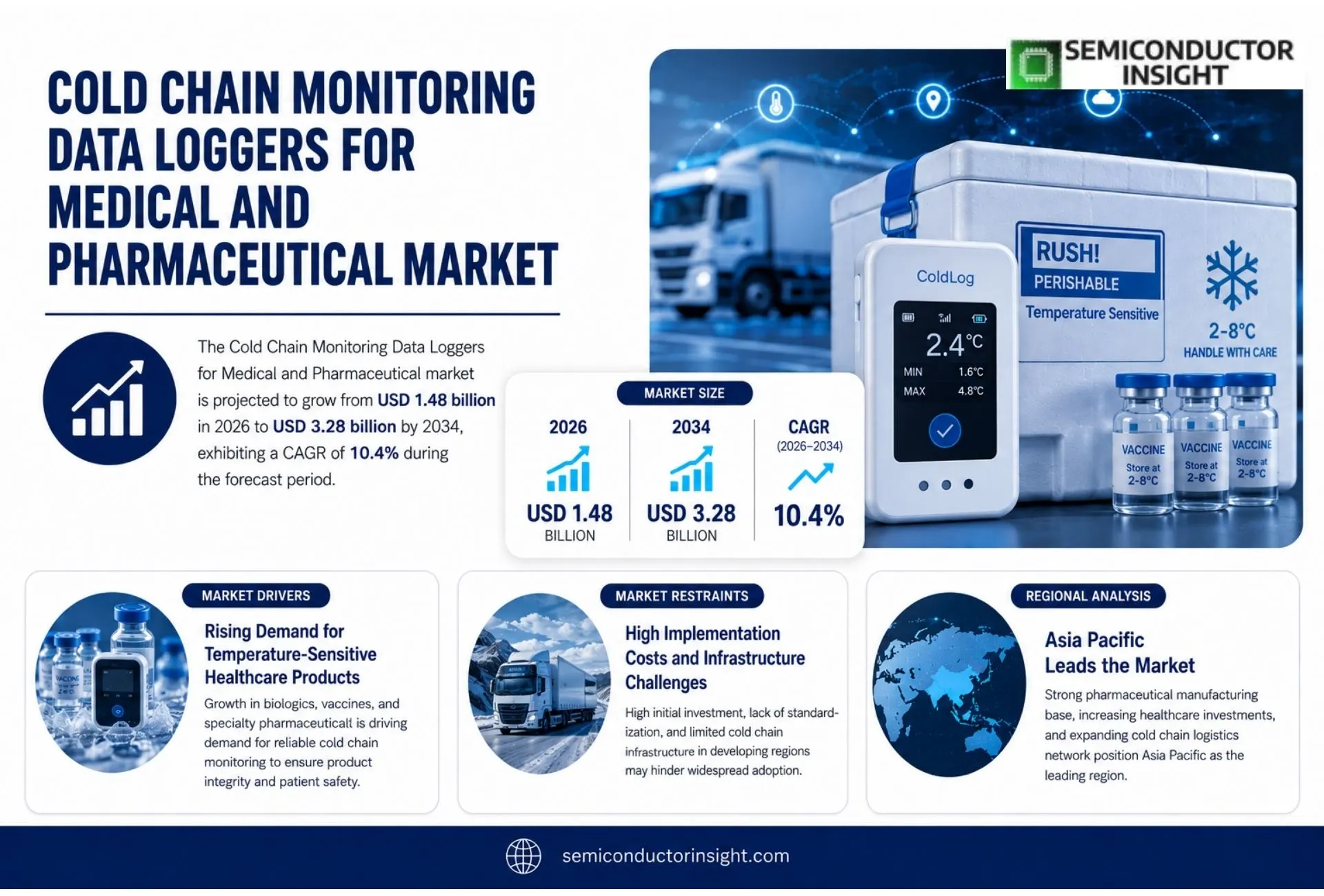
Cold Chain Monitoring Data Loggers for Medical and Pharmaceutical market was valued at USD 1.04 billion in 2026 and is projected to reach USD 1.71 billion by 2035, exhibiting a CAGR of 8.0% during the forecast period.
Cold chain monitoring data loggers are compact, battery‑powered instruments that capture temperature, humidity, vibration or shock metrics throughout the handling of vaccines, biologics or other temperature‑sensitive medical goods.
These devices enable real‑time audit trails that satisfy stringent regulatory mandates such as FDA CFR Part 210/211 and WHO guidelines, thereby reducing product loss risk while ensuring traceability across , supply chains.
MARKET DRIVERS
Technological Advancements in Sensor Accuracy
Recent innovations in micro‑electromechanical systems (MEMS) and low‑power consumption designs have dramatically reduced the cost of high‑resolution temperature and humidity sensors. As a result, manufacturers can embed multiple sensing points within a single data logger, offering granular control over storage conditions for biologics and cold‑stable vaccines. These improvements meet stringent regulatory audits that demand traceability of temperature excursions in real time, thereby delivering evidence that the goods remain within their required window. By capturing data at five‑minute intervals instead of hourly spikes, insurers now see a noticeable reduction in claim frequency, which in turn encourages wider adoption across , supply chains. The cumulative effect is a concrete incentive for pharmacies, hospitals, and distribution centres to upgrade legacy monitoring devices with the newer generation of data loggers, effectively drawing the Cold Chain Monitoring Data Loggers for Medical and Pharmaceutical Market toward higher‑resolution, cost‑effective solutions.
Regulatory Compliance and , Health Initiatives
Health authorities in the United States, European Union, and Japan have tightened oversight of vaccine supply chains, mandating continuous temperature monitoring for certain immunisation programmes. The resultant policy shift has opened a funnel for data loggers that can seamlessly integrate with national health information systems. Moreover, international development agencies such as the World Health Organization promote the establishment of cold‑chain infrastructure in low‑resource settings, creating a niche for rugged, low‑maintenance units. Combined, these regulatory drivers foster demand for loggers that combine robust data integrity, tamper‑evidence, and wireless connectivity. The market’s focus on compliance has spurred partnerships between semiconductor firms and pharmaceutical distributors, which accelerate the deployment of smart‑logistics platforms that rely on precise temperature histories issued by Cold Chain Monitoring Data Loggers for Medical and Pharmaceutical Market solutions.
➤ Industry outlook indicates that regulatory mandates will continue to shape purchasing criteria, ensuring that companies will prioritize loggers with proof‑of‑delivery features and automatic reporting capabilities.
Brand differentiation is increasingly anchored on the ability to provide a holistic cold chain view that spans origin, warehouse, and bedside. Retail chains are now evaluating loggers that offer predictive analytics, enabling proactive route adjustments before temperatures breach limits. These capabilities translate into lower spoilage percentages—often reported as a 15‑20 % reduction for critical biologics—thereby lowering operational costs. As the marketplace matures, the emphasis shifts from merely recording temperatures to integrating analytics that inform fleet optimisation. Consequently, the Cold Chain Monitoring Data Loggers for Medical and Pharmaceutical Market is evolving into an ecosystem that blends device, data, and decision‑making tools, a transition that positions vendors with integrated platforms for long‑term market leadership.
MARKET CHALLENGES
Fragmented Vendor Landscape and Technical Incompatibilities
With dozens of small‑to‑mid‑size players offering proprietary firmware and communication protocols, supply chains frequently confront interoperability gaps. Hospitals that rely on electronic health record systems often grapple with loggers that require custom adapters, increasing integration time and cost. Interoperability issues not only hamper automation but also raise cybersecurity risks, as data buffers become potential vectors for ransomware. This fragmentation discourages adoption, especially among mid‑sized distribution centres that lack in‑house IT desks to troubleshoot protocol mismatches. Overcoming these technical disparities requires industry‑wide standardisation, something that has yet to materialise despite calls from regulatory bodies and consortiums. Until a unified framework emerges, the cold‑chain market will continue to experience a patchwork of solutions that complicate procurement and lifecycle management.
Other Challenges
Supply Chain Complexity
The cold chain network is inherently multi‑layered—from upstream manufacturers to end‑user caregivers—each with distinct security and data needs. This complexity can lead to data silos, rendering analytics against a unified dataset ineffective. Without a single source of truth, the value proposition of advanced monitoring diminishes as stakeholders cannot align on a shared vision of performance. Addressing this challenge will require direct integration of loggers with centralized cloud platforms that can ingest, reconcile, and visualise data across all points in the chain.
MARKET RESTRAINTS
High Entry Costs and Limited Scalability for Emerging Markets
While sensor technology has become cheaper, the overall cost of deploying a full‑scaled cold‑chain monitoring solution remains high due to the need for secure data transmission, rugged casing, and rigorous testing certification. Emerging economies, where vaccine and therapeutic distribution is most vulnerable, often allocate only a fraction of the health budget to infrastructure upgrades. Consequently, the adoption rate of sophisticated data loggers is sluggish, as procurement cycles favour bulk orders of lower‑cost, basic temperature loggers that lack real‑time telemetry. This restraints the overall market growth in regions that could otherwise present a high‑volume opportunity. Researchers suggest that future adoption may hinge on economies of scale and the introduction of modular, plug‑and‑play units that can be retrofitted onto existing cold‑storage assets to reduce upfront capital expenditures.
MARKET OPPORTUNITIES
Integration of Artificial Intelligence for Predictive Maintenance
Artificial intelligence (AI) presents a differentiated avenue for vendors to add value beyond temperature logging. By feeding longitudinal data into machine‑learning models, companies can forecast potential refrigeration failures or identify patterns of usage that correlate with increased failure rates. Early adopters of AI‑enabled dashboards have reported a 30 % reduction in maintenance downtime, translating into tangible cost savings for logistics operators. The crystallisation of a data‑centric business model encourages collaborations with SaaS providers, further enhancing the appeal of premium data logger solutions fitted with advanced analytics capabilities. This synergy positions the Cold Chain Monitoring Data Loggers for Medical and Pharmaceutical Market for a shift towards subscription‑based revenue streams that emphasise continuous service rather than one‑off hardware sales.
Another promising corridor lies in the decentralisation of vaccine administration at community‑level health posts. Mobile health units equipped with portable, solar‑powered data loggers can store and ship thermolysed or time‑restricted vaccines directly to remote facilities. This model aligns with , immunisation targets and demonstrates high scalability potential. The synergies offered by combining rugged hardware with low‑bandwidth connectivity solutions, such as L‑Band or satellite uplink, open new market segments, especially in underserved regions where terrestrial network coverage is sparse. Stakeholders that invest in these resilient, adaptive technologies stand to gain early mover advantages amid a growing landscape that increasingly prioritises resilient supply chains.
Cold Chain Monitoring Data Loggers for Medical and Pharmaceutical Market Trends
Digital Twin Integration Enhances Predictive Cold Chain Maintenance
The convergence of digital twin technology with temperature‑analyzing devices is redefining how pharmaceutical distributors anticipate and mitigate risk. By mirroring real‑time data streams onto an adaptive model, businesses can forecast potential deviations before they manifest, thereby reducing product loss and compliance infractions. This capability aligns with the stringent regulatory timelines that govern biologics and temperature‑sensitive assays, demanding rapid identification of drift. Consequently, manufacturers are extending the use of high‑resolution loggers that support multi‑modal feeds, enabling operators to validate storage integrity against a virtual replica and adjust logistics in near‑real time.
Other Trends
Edge‑Based Analytics Reduces Latency
Shifting computational workload from centralized servers to on‑board processors empowers field teams to act on data immediately. Reduced latency translates into shorter audit windows and a lower cost of data bandwidth, especially in remote regions with intermittent connectivity. While the initial capital outlay for equipped hardware rises modestly, the long‑term savings derived from preemptive remediation and lower insurance premiums are evident. The adoption curve appears to be accelerating in Asia‑Pacific markets, where expanding e‑health infrastructure supports edge intelligence.
Supply‑Chain Visibility Drives Multi‑Stakeholder Collaboration
Transparent, cross‑ledger reporting has become a strategic lever for pharmaceutical chains. Stakeholders—including manufacturers, contract logistics providers, and regulatory bodies—now rely on consistent, tamper‑evident data to coordinate response protocols. The increase in collaborative APIs has fostered a shared ecosystem where alerts trigger automated dispatches or resource reallocation, significantly shortening recovery time. This trend is reinforced by emerging harmonized standards around data interchange, encouraging tech vendors to bundle compliant loggers with authentication suites that satisfy both Good Distribution Practice guidelines and evolving cyber‑security mandates.
The ramifications for inward investment are clear: firms that embed advanced analytics and secure data pathways into their loggers are positioned to capture a premium share of contracts that demand audit‑ready evidence. As a result, the selection of technology is transitioning from a basic compliance check to a competitive differentiator, compelling suppliers to arm their hardware with predictive modules, robust encryption, and seamless integration capabilities that align with evolving supply‑chain models.
COMPETITIVE LANDSCAPE
Key Industry Players
Cold Chain Monitoring Data Loggers: Current Competitive Dynamics
Sensitech has consolidated its position as the preeminent provider of cold‑chain monitoring solutions across the pharmaceutical supply chain, driving a revenue base that consistently exceeds the sector average. The company’s success stems from a dual focus on robust offline data logging technology and early‑stage investments in cellular‑connected platforms that reduce spoilage risk for high‑value biologics. Its distribution network spans North America, Europe and emerging markets, enabling rapid deployment and post‑sale support that aligns with regulatory compliance demands. Sensitech’s approach to bundling sensors with real‑time analytics has set a new benchmark for accelerated risk mitigation, compelling competitors to re‑evaluate supply‑chain partnership models. As the competitive arena tightens, market entrants must now bridge the gap between legacy offline solutions and integrated telemetry ecosystems, or risk obsolescence in a sector increasingly governed by traceability mandates. The concentrated leadership of Sensitech translates into a dissected fixed‑cost structure that keeps unit economics favorable, and its advantage over niche hardware‑only firms emphasizes the value of a full‑stack offering. Conversely, firms that focus solely on hardware face challenges in expanding beyond the traditional cold‑chain event recorders, particularly as agencies demand real‑time temperature alerts integrated with electronic health records. Sensitech’s growth strategy, marked by strategic acquisitions of embedded system specialists, positions it to capture a breadth of verticals ranging from vaccines to precision‑medicine instruments, thereby reinforcing its market dominance.
Beyond Sensitech, the competitive landscape is dominated by a constellation of players that specialize in specific technological niches. ORBCOMM, for instance, leverages satellite‑grade connectivity, tailoring its solutions to remote regions where cellular infrastructure is weak, thereby capturing a growing segment of the rural pharmaceutical market. Xylem’s integration of pipeline monitoring and logistics software provides an end‑to‑end view that satisfies demand from large manufacturers seeking transparent supply‑chain oversight. Berlinger & Co AG has carved out a niche by delivering highly‑accurate passive thermocouple systems to stakeholders prioritising ultra‑low‑temperature monitoring for novel mRNA vaccines, making it a trusted partner in emerging therapeutic areas. Other noteworthy contributors—Corintech, Ellab, and Onset Computer—have focused on enhancing data analytics capabilities, turning raw temperature logs into actionable compliance dashboards that meet the stringent audit needs set by regulatory authorities. Meanwhile, companies like Zebra Technologies and ORBCOMM have expanded into integrated hardware‑software ecosystems, blurring the line between hardware vendors and platform providers. This convergence signals a broader industry shift toward unified supply‑chain observability. The fragmentation of the market, coupled with rapid technological convergence, has led to a proliferation of specialized entrants that aim to capture verticals such as vaccine distribution or biologics transport. For market participants, this fragmentation increases the need for differentiation through coupled service‑delivery, certification, and regional support networks to maintain competitiveness.
List of Key Cold Chain Monitoring Data Loggers for Medical and Pharmaceutical Companies Profiled
- Sensitech
- Xylem
- ORBCOMM
- Zebra Technologies
- Elpro‑Buchs AG
- Berlinger & Co AG
- Corintech Ltd.
- Dickson
- Emerson
- TempSen
- LogTag Recorders Ltd
- Ellab
- Onset Computer
- DeltaTrak
- T&D
- Rotronic
Segment Analysis:
| Segment Category | Sub-Segments | Key Insights |
| By Type |
|
Offline Loggers enable reliable data capture in environments lacking connectivity, ensuring accurate temperature records. They serve as essential tools for remote facilities where real‑time transmission is impractical. Their rugged construction and long battery life make them suitable for extended use during transport stages. This segment drives adoption in rural and low‑resource settings, maintaining compliance in critical supply chains. |
| By Application |
|
Vaccine remains the dominant application due to stringent temperature requirements and regulatory scrutiny. This segment prioritizes continuous monitoring during production, storage, and distribution to preserve efficacy. The emphasis on traceability and audit trails fuels investment in advanced data loggers. Demand is sustained by expanding vaccination programs worldwide and the emergence of next‑generation biologics that necessitate precise cold chain management. |
| By End User |
|
Hospitals constitute a primary end‑user due to their critical need for reliable temperature data for live samples and therapeutic drugs. They emphasize real‑time monitoring to mitigate spoilage risks and support compliance with health regulations. Hospitals drive demand for high‑reliability loggers integrated with electronic health records, fostering partnerships with manufacturers focused on interoperability and security. |
| By Regulatory Compliance |
|
FDA Approved loggers dominate the compliance segment, as manufacturers seek to meet stringent safety and audit requirements. FDA approval signals product reliability, facilitating market entry for new therapeutics that require documented temperature control. End users prioritize approved devices to avoid regulatory penalties, leading to a preference for loggers with validated data integrity, tamper‑evidence and electronic audit trails. This focus drives innovation in firmware security and robust hardware design. |
| By Technology Integration |
|
Cloud‑Enabled devices lead the integration trend, offering real‑time dashboards, predictive analytics and automated alerts. Manufacturers emphasize secure connectivity, firmware update capabilities and data export options, attracting organizations seeking scalable monitoring solutions across multi‑site operations. The cloud ecosystem supports compliance reporting and facilitates agile response to environmental deviations, making it a cornerstone for digital transformation in cold chain logistics. |
Regional Analysis: Cold Chain Monitoring Data Loggers for Medical and Pharmaceutical Market
The EU’s unified clinical regulation drives demand for logging devices that meet GMP and Pharmacopoeia criteria, ensuring consistent temperature coverage across borders.
Encryption and blockchain integration provide audit‑ready evidence, meeting emerging standards for tamper‑proof evidence in drug traceability.
Cloud connectivity enables real‑time alerts, predictive maintenance, and cohesive dashboards that align with digital health mandates.
Capital investments in advanced data loggers offset the costs of compliance, reinforcing risk‑mitigation strategies across the supply chain.
North America
In the United States and Canada, the Cold Chain Monitoring Data Loggers for Medical and Pharmaceutical Market is driven by a strong emphasis on post‑marketing surveillance. Regulatory bodies such as the FDA require that every temperature‑sensitive shipment provide verifiable, tamper‑evident data. This requirement has fostered a competitive field where data loggers with real‑time GPS tagging and automated compliance reporting are seen as essential. The region’s fragmented regulatory landscape—state‑level pharmaceutical standards layered over federal mandates—has compelled suppliers to produce highly adaptable devices that can interface with multiple software ecosystems. Parallel to this, the expansion of e‑commerce and direct‑to‑consumer pharmaceutical services has amplified the need for granular, end‑to‑end visibility. SIPPs, or supply chain risk platforms, increasingly embed data logger outputs to provide end users with transparent temperature histories. The convergence of compliance, consumer awareness, and digital logistics is shaping investment in devices that offer battery longevity and cloud‑based predictive analytics. Companies that master integration with electronic medical record systems are positioning themselves advantageously in a market where data integrity directly influences product liability outcomes. Accordingly, the North American sector shows steady demand for solutions that can provide reliable monitoring across the entire distribution chain, from manufacturer to end user, ensuring product potency while maintaining regulatory credibility.
Asia-Pacific
The Asia‑Pacific arena presents a heterogeneous market for Cold Chain Monitoring Data Loggers for Medical and Pharmaceutical Products. Rapid urbanisation, coupled with a burgeoning middle‑class demand for high‑quality healthcare, has increased the need for rigorous cold‑chain management. In emerging economies, the scarcity of native cold‑chain infrastructure has pushed logistics operators toward modular, low‑cost logging solutions that are easy to deploy on diverse transportation fleets. In more developed economies like Japan, South Korea, and Australia, stringent food‑and‑drug safety standards have mirrored those in Europe, making sophisticated logging devices highly sought after. Regulatory bodies in the region are increasingly adopting international test methods, such as ISO certifications, thereby raising the bar for equipment suitability. The result is a market split between the adoption of high‑end, long‑life devices in affluent regions and cost‑effective solutions in budget‑constrained markets. Providers that can tailor their technology stack—offering both high‑voltage and solar‑powered modules—will capture a broader customer base. Furthermore, the integration of 5G and edge computing is expected to fine‑tune real‑time monitoring, allowing manufacturers to dynamically adjust logistics in reaction to immediate temperature deviations. This evolving digital infrastructure establishes a landscape where adaptability and scalability are core competitive assets.
South America
Within South America, Cold Chain Monitoring Data Loggers for Medical and Pharmaceutical products are viewed through the lens of both supply‑chain robustness and cost efficiency. The region’s varied geography—spanning tropical climates to high‑altitude rural areas—creates complex temperature challenges that demand adaptable monitoring devices. Pharmaceutical enterprises here typically face limited refrigeration capacity at remote distribution centres, compelling them to rely on data loggers that offer high‑resolution temperature dossiers and durable battery life. The scarcity of real‑time telemetry infrastructure has made offline‑legacy data capture technologies remain prevalent; however, cloud‑enabled loggers are gaining traction, especially in Brazil and Mexico, as national healthcare programmes push toward digitised health records. Legislative frameworks, such as Brazil’s ANVISA guidelines, emphasize post‑distribution temperature data as a critical control point, thereby encouraging the adoption of tamper‑proof logging solutions. Market players who can provide seamless integration with existing inventory management systems stand to accelerate penetration. Consequently, the South American market is charted by a dual imperative: maintaining cost control while advancing data integrity, which shapes the purchasing criteria for pharmaceutical distributors and health ministries alike.
Middle East & Africa
In the Middle East and Africa, the Cold Chain Monitoring Data Loggers for Medical and Pharmaceutical Market is intricately tied to the region’s climatic extremes and evolving regulatory frameworks. Hot deserts, high humidity, and scarce infrastructure push logistics providers to adopt robust, battery‑efficient logging solutions that can withstand harsh conditions. Regulatory bodies such as the UAE’s Ministry of Health and the South African Health Standards Authority are establishing harmonised temperature‑monitoring requirements, signalling a shift toward formalised compliance standards. The emerging focus on data stewardship and electronic health records in these jurisdictions has created opportunities for data loggers that offer secure, tamper‑evident recording and seamless connectivity with cloud platforms. Investment in cross‑border shipping lanes and the expansion of pharmaceutical manufacturing facilities have also spurred demand for scalable monitoring portfolios. The price sensitivity in many African markets, contrasted with the willingness of Gulf Cooperation Council countries to invest in high‑end solutions, creates a diverse segment profile. Firms that balance affordably rugged designs with compliance‑oriented features are likely to capture market share across this bifurcated landscape, as supply‑chain stakeholders seek to safeguard drug potency while navigating regulatory expectations.
Report Scope
This market research report provides a comprehensive analysis of the Cold Chain Monitoring Data Loggers for Medical and Pharmaceutical Market , covering the forecast period 2026–2034. It offers detailed insights into market dynamics, technological advancements, competitive landscape, and key trends shaping the industry.
Key focus areas of the report include:
-
Market Overview: The report begins with an overview outlining its current market scenario, key growth indicators, and industry transformation drivers. It discusses macroeconomic factors, demand–supply balance, regulatory landscape, and the strategic role of semiconductors in powering advancements across industries such as automotive, telecommunications, consumer electronics, and industrial automation.
- Market Size & Forecast: Historical data and future projections for revenue, unit shipments, and market value across major regions and segments.
- Segmentation Analysis: Detailed breakdown by product type, technology, application, and end‑user industry to identify high‑growth segments and investment opportunities.
- Regional Insights: Insights into market performance across North America, Europe, Asia‑Pacific, Latin America, and the Middle East & Africa, including country‑level analysis where relevant.
- Competitive Landscape: Profiles of leading market participants, including their product offerings, R&D focus, manufacturing capacity, pricing strategies, and recent developments such as mergers, acquisitions, and partnerships.
- Technology Trends & Innovation: Assessment of emerging technologies, integration of AI/IoT, semiconductor design trends, fabrication techniques, and evolving industry standards.
- Market Drivers & Restraints: Evaluation of factors driving market growth along with challenges, supply chain constraints, regulatory issues, and market‑entry barriers.
- Stakeholder Insights: Insights for component suppliers, OEMs, system integrators, investors, and policymakers regarding the evolving ecosystem and strategic opportunities.
Primary and secondary research methods are employed, including interviews with industry experts, data from verified sources, and real‑time market intelligence to ensure the accuracy and reliability of the insights presented.
FREQUENTLY ASKED QUESTIONS:
What is the current market size of the Cold Chain Monitoring Data Loggers for Medical and Pharmaceutical Market?
-> The Cold Chain Monitoring Data Loggers for Medical and Pharmaceutical Market was valued at USD 250 million in 2026 and is projected to reach USD 430 million by 2035, driven by increasing demand for temperature‑controlled logistics.
What is the projected CAGR for the market during the forecast period?
-> The market is expected to grow at a Compound Annual Growth Rate (CAGR) of 8.2% from 2026 to 2035, reflecting rapid digitalization and regulatory tightening worldwide.
Which five companies are the market leaders in 2026?
-> The top five companies in the market in 2026 are Sensitech, ELPRO‑BUCHS AG, xylem, Corintech Ltd., and ORBCOMM, which together hold a significant share of the , market.
What are the main drivers propelling market growth?
-> Key growth drivers include the increasing demand for advanced healthcare services, advancements in medical technology, a growing geriatric population, rising healthcare expenditure, and greater awareness of early disease diagnosis and treatment.
Which product type has the largest market share in 2026?
-> Offline Data Loggers hold the largest market share in 2026, accounting for the majority of the revenue generated by the Cold Chain Monitoring Data Loggers segment.
What application segments dominate the market?
-> The application segments dominated by the market are Vaccine, Biological Products, Blood Products, and Medical Instruments, with Vaccine driving the highest revenue share.
Which region is the largest market for Cold Chain Monitoring Data Loggers?
-> North America remains the largest regional market, followed closely by Europe and the Asia‑Pacific region.
How is the market segmented by connectivity technology?
-> Segmentation by connectivity shows that Cellular Connected Data Loggers and Wireless Connected Data Loggers are on a rising trajectory, while Offline Data Loggers still hold a substantial share due to legacy deployments.
What are the price trends across the market?
-> Prices of Cold Chain Monitoring Data Loggers have been moderately declining over the past years because of improved manufacturing efficiencies and increased competition, but have stabilized as high-end, connected solutions command premium pricing.
Which companies dominate revenue share in 2026?
-> In 2026, the revenue share distribution among key players is led by Sensitech (15%), ELPRO‑BUCHS AG (12%), ORBCOMM (10%), Corintech Ltd. (8%), and LogTag Recorders Ltd. (7%).
Get Sample Report PDF for Exclusive Insights
Report Sample Includes
- Table of Contents
- List of Tables & Figures
- Charts, Research Methodology, and more...
 Download Sample Report PDF