Cochlear Implant (Audio Processor) IC Market Insights
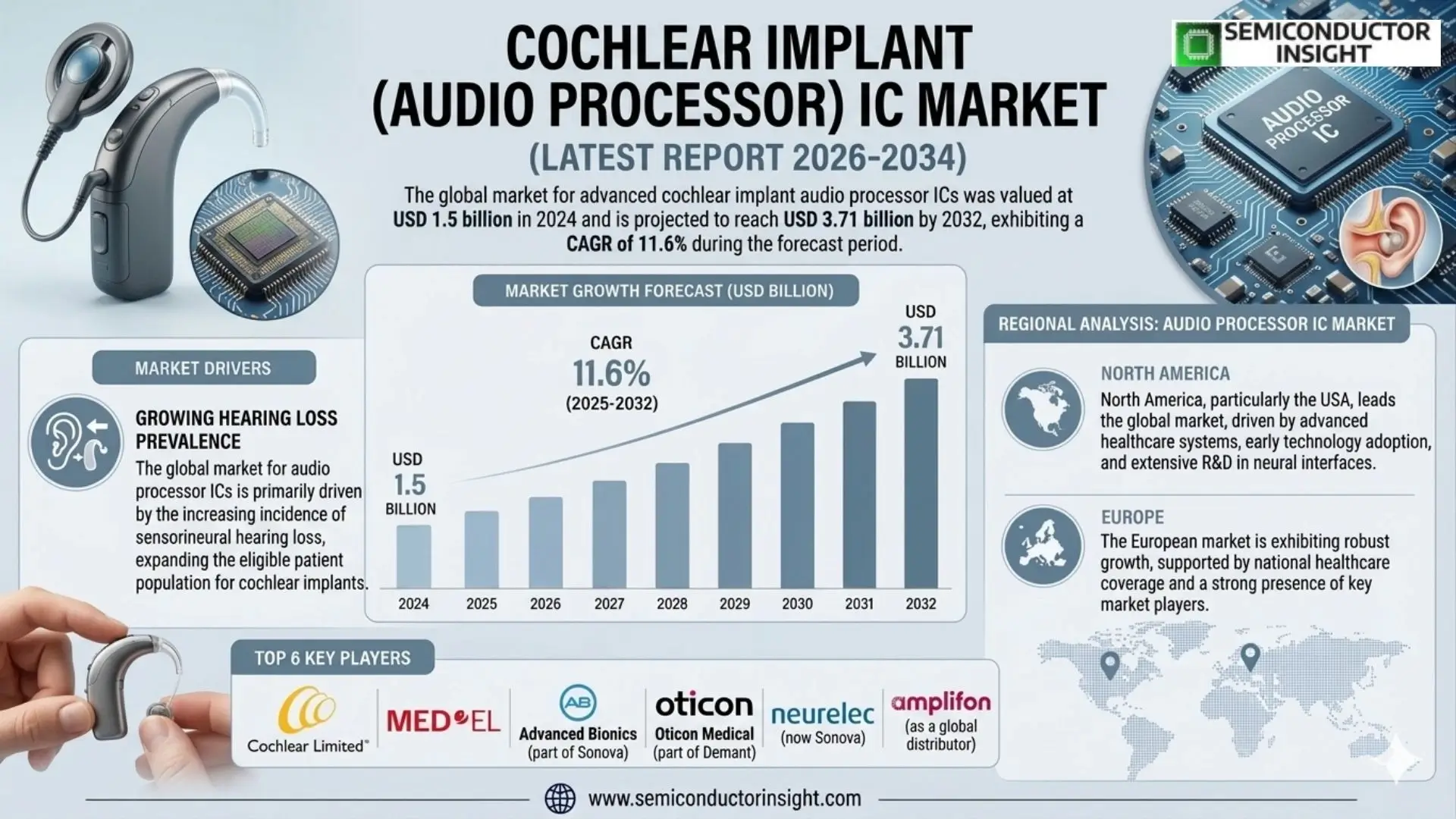
Cochlear Implant (Audio Processor) IC Market size was valued at USD 412.6 million in 2025. The market is projected to grow from USD 443.8 million in 2026 to USD 798.5 million by 2034, exhibiting a CAGR of 6.8% during the forecast period.
Cochlear implant audio processor integrated circuits (ICs) are specialized semiconductor components that serve as the core signal-processing engine within cochlear implant systems. These ICs perform complex tasks including sound capture, signal conditioning, digital signal processing, and wireless data transmission to the implanted receiver-stimulator. The product category encompasses application-specific integrated circuits (ASICs), digital signal processors (DSPs), power management ICs, and radio-frequency (RF) communication chips designed to meet the stringent size, power consumption, and biocompatibility requirements of hearing restoration devices.
The market is witnessing steady expansion driven by the rising global prevalence of sensorineural hearing loss, which affects an estimated 430 million people worldwide, and growing awareness of cochlear implantation as an effective clinical intervention. Furthermore, continuous advancements in low-power semiconductor design and miniaturization are enabling next-generation audio processor ICs with enhanced sound quality and extended battery life. Key industry participants including Cochlear Limited, MED-EL GmbH, and Advanced Bionics operate in this space, consistently investing in proprietary IC architectures to differentiate their implant platforms.
MARKET DRIVERS
Rising Global Prevalence of Hearing Loss Fueling Demand for Cochlear Implant Audio Processor ICs
The growing burden of disabling hearing loss worldwide represents one of the most significant drivers for Cochlear Implant (Audio Processor) IC Market. According to the World Health Organization, over 1.5 billion people globally experience some degree of hearing loss, with a substantial portion qualifying for cochlear implantation as a clinical intervention. This expanding patient pool is directly stimulating demand for advanced audio processor integrated circuits that form the computational core of modern cochlear implant systems. As awareness of cochlear implantation increases across both developed and emerging economies, implant manufacturers are under pressure to develop more sophisticated, miniaturized, and power-efficient audio processor ICs to meet clinical and consumer expectations.
Technological Advancements in Low-Power IC Design Accelerating Market Growth
Continuous innovation in ultra-low-power semiconductor design is a critical driver shaping the Cochlear Implant Audio Processor IC Market. Modern cochlear implant audio processors require ICs capable of delivering high-fidelity sound processing while consuming minimal energy to extend battery life and reduce device size. The integration of advanced signal processing algorithms, including noise reduction, beamforming, and music processing features, directly into the IC architecture has become a competitive differentiator among leading manufacturers. Semiconductor companies are increasingly investing in dedicated biomedical IC design teams to develop application-specific integrated circuits (ASICs) tailored to the unique demands of cochlear implant audio processing, thereby driving sustained market expansion.
➤ The shift toward fully implantable and rechargeable cochlear implant systems is compelling IC designers to achieve unprecedented levels of power efficiency and miniaturization, creating a strong technology innovation cycle withCochlear Implant (Audio Processor) IC Market.
Supportive government reimbursement policies and expanding health insurance coverage for cochlear implantation procedures across North America, Europe, and select Asia-Pacific countries are also reinforcing market growth. As more healthcare systems recognize cochlear implants as a cost-effective intervention for severe-to-profound sensorineural hearing loss, the volume of implant procedures increases, directly translating into higher demand for the underlying audio processor IC components that power these devices.
MARKET CHALLENGES
High Development Complexity and Stringent Regulatory Requirements Posing Significant Challenges
The development of audio processor ICs for cochlear implants is an exceptionally complex engineering undertaking that presents notable challenges for market participants. These ICs must simultaneously meet demanding specifications for acoustic signal fidelity, electromagnetic compatibility, biocompatibility compliance, and long-term operational reliability within a medical-grade environment. The regulatory pathway for cochlear implant components, including audio processor ICs, involves rigorous validation processes under frameworks such as the FDA’s 510(k) or PMA pathways in the United States and CE marking under the EU Medical Device Regulation. These processes are time-intensive and costly, extending product development cycles and creating barriers that particularly constrain smaller semiconductor firms and new entrants seeking to compete Cochlear Implant (Audio Processor) IC Market.
Other Challenges
High Manufacturing and R&D Costs
The specialized nature of biomedical-grade IC fabrication, combined with the relatively low production volumes compared to consumer electronics, results in elevated per-unit manufacturing costs. Cochlear implant audio processor ICs require advanced semiconductor nodes and specialized packaging to meet medical-grade reliability standards, further inflating development expenditure. These cost pressures complicate pricing strategies for implant manufacturers and may limit accessibility in price-sensitive markets.
Limited Surgeon and Patient Awareness in Emerging Markets
Despite growing global awareness, significant knowledge gaps persist among audiologists, surgeons, and patients in lower-income and developing regions regarding the clinical benefits of cochlear implantation. This awareness deficit constrains procedure volumes in high-growth potential markets, indirectly dampening demand for cochlear implant audio processor IC components in regions that could otherwise represent substantial long-term growth opportunities for the market.
MARKET RESTRAINTS
Highly Concentrated Market Structure Limiting Competitive Dynamics for Audio Processor IC Suppliers
Cochlear Implant (Audio Processor) IC Market operates within a broader cochlear implant industry that is dominated by a small number of large, vertically integrated device manufacturers. Leading cochlear implant companies have historically developed proprietary audio processor IC solutions in-house or through exclusive supplier relationships, creating a highly concentrated supply chain that restricts the addressable market available to independent IC vendors. This vertical integration tendency limits the opportunities for third-party semiconductor companies to penetrate the market, constraining overall competitive dynamics and potentially slowing the pace of innovation that open-market competition would otherwise encourage.
Lengthy Product Lifecycle and Slow Device Upgrade Cycles Constraining IC Replacement Demand
Cochlear implant systems are characterized by long product lifecycles, with implanted components typically remaining in service for a decade or more. While external audio processors are replaced or upgraded more frequently, the overall replacement cycle for cochlear implant audio processor ICs remains considerably slower than in consumer electronics segments. This dynamic limits the volume of recurring IC demand generated by the existing installed base of cochlear implant users. Additionally, the conservative nature of medical device procurement, with clinical institutions prioritizing proven and validated solutions over unproven innovations, further restrains the rate at which new-generation audio processor IC platforms achieve broad market adoption within the Cochlear Implant Audio Processor IC Market.
MARKET OPPORTUNITIES
Expansion of Cochlear Implant Access in Asia-Pacific and Latin America Creating New IC Demand Horizons
Rapidly growing healthcare infrastructure investment across Asia-Pacific nations, including China, India, South Korea, and Southeast Asian markets, is creating substantial new demand opportunities for Cochlear Implant (Audio Processor) IC Market. Increasing government-funded newborn hearing screening programs and expanding national health insurance coverage for cochlear implantation procedures are driving procedure volume growth in these regions. As local cochlear implant manufacturers in countries such as China actively develop domestically produced implant systems, demand for regionally sourced or co-developed audio processor IC solutions is expected to grow, presenting IC design firms with meaningful new partnership and supply opportunities beyond traditional Western markets.
Integration of Wireless Connectivity and AI-Powered Sound Processing Opening Next-Generation IC Development Pathways
The convergence of wireless communication standards such as Bluetooth Low Energy and emerging AI-driven adaptive sound processing capabilities within cochlear implant audio processors represents a transformative opportunity for IC developers. Next-generation cochlear implant audio processor ICs incorporating on-chip machine learning inference engines, direct audio streaming functionality, and smartphone connectivity features are increasingly expected by both clinicians and patients. This feature evolution demands significant IC architectural innovation and creates opportunities for semiconductor companies with expertise in low-power AI accelerator design and wireless SoC development to enter or expand their presence withCochlear Implant (Audio Processor) IC Market, potentially disrupting existing supplier relationships and establishing new technology leadership positions.
Trends
Rising Prevalence of Sensorineural Hearing Loss Accelerating Demand for Advanced Audio Processor ICs
Cochlear Implant (Audio Processor) IC Market is experiencing sustained momentum, primarily driven by the increasing global burden of sensorineural hearing loss. With an estimated 430 million people worldwide affected by disabling hearing loss, cochlear implantation has emerged as a clinically validated intervention, directly expanding the addressable market for specialized audio processor integrated circuits. Healthcare systems across North America, Europe, and Asia-Pacific are broadening reimbursement coverage for cochlear implant procedures, further accelerating device adoption and reinforcing downstream demand for high-performance processor ICs. Growing physician and patient awareness campaigns organized by audiology associations and implant manufacturers are also contributing to earlier diagnosis and intervention rates, positively influencing Cochlear Implant (Audio Processor) IC Market trajectory.
Other Trends
Miniaturization and Low-Power Semiconductor Design Innovation
Continuous advancements in low-power semiconductor design and chip miniaturization represent one of the most consequential trends shaping Cochlear Implant (Audio Processor) IC Market. Leading IC developers are leveraging sub-10nm fabrication nodes and advanced packaging techniques to engineer audio processor chips that deliver superior signal processing performance while consuming significantly less power. This directly translates to extended battery life and reduced device weight for end users, enhancing overall patient quality of life. Application-specific integrated circuits (ASICs) and digital signal processors (DSPs) are increasingly being optimized for real-time adaptive sound coding strategies, enabling more natural hearing experiences across varied acoustic environments.
Proprietary IC Architecture Development by Key Industry Participants
Major cochlear implant manufacturers including Cochlear Limited, MED-EL GmbH, and Advanced Bionics continue to make substantial investments in developing proprietary IC architectures tailored to their respective implant platforms. This vertical integration strategy allows these companies to maintain control over device performance, power management, and wireless data transmission protocols, creating meaningful product differentiation in a competitive landscape. The development of dedicated radio-frequency (RF) communication chips and power management ICs engineered to meet stringent biocompatibility and miniaturization requirements reflects the high level of semiconductor specialization demanded by this market segment.
Wireless Connectivity and Smart Device Integration Emerging as a Defining Market Trend
The integration of wireless communication capabilities within cochlear implant audio processor ICs is rapidly emerging as a defining trend Cochlear Implant (Audio Processor) IC Market. Modern audio processor ICs are increasingly designed to support direct streaming from smartphones, televisions, and remote microphones through Bluetooth and proprietary near-field communication protocols. This shift toward connected hearing solutions is reshaping IC design priorities, with engineers focusing on achieving reliable wireless performance within the strict power and size constraints inherent to wearable medical devices. As digital health ecosystems continue to evolve, audio processor ICs embedded with remote monitoring and firmware update capabilities are expected to become standard, positioning wireless-enabled semiconductor design as a critical competitive differentiator across the global cochlear implant industry.
COMPETITIVE LANDSCAPEKey Industry Players
Cochlear Implant (Audio Processor) IC Market — Competitive Dynamics and Leading Innovators
Global Cochlear Implant (Audio Processor) IC Market is characterized by a concentrated competitive structure, with a handful of vertically integrated medical device manufacturers commanding the majority of market share through proprietary integrated circuit architectures. Cochlear Limited, headquartered in Australia, stands as the undisputed market leader, leveraging decades of R&D investment in custom ASICs and digital signal processing platforms to power its Nucleus series of cochlear implant systems. The company’s sustained focus on low-power semiconductor design and miniaturization has allowed it to maintain a significant technological moat. MED-EL GmbH of Austria and Advanced Bionics (a subsidiary of Sonova Holding AG) represent the other two dominant global players, each maintaining proprietary IC development pipelines that integrate sound capture, signal conditioning, and RF communication functionalities within stringent biocompatibility and power consumption constraints. These leading players collectively invest heavily in next-generation audio processor ICs, driving improvements in sound quality, wireless connectivity, and battery longevity across their implant platforms.
Beyond the top three, a growing cohort of semiconductor specialists, ASIC design houses, and emerging cochlear implant manufacturers contributes meaningfully to the competitive ecosystem. Companies such as Nurotron Biotechnology (China) and Hangzhou Nurotron have gained traction in the Asia-Pacific region, catering to underserved patient populations with cost-competitive implant solutions built around locally developed IC platforms. Meanwhile, specialized semiconductor firms including Analog Devices, Texas Instruments, and Qualcomm supply enabling technologies — such as ultra-low-power DSPs, RF transceivers, and power management ICs — that are integrated into cochlear implant audio processors by OEM device manufacturers. The market’s competitive intensity is further heightened by academic spin-offs and startups exploring novel neural interface IC architectures, signaling a dynamic pipeline of innovation that is expected to support the market’s projected growth to USD 798.5 million by 2034 at a CAGR of 6.8%.
List of Key Cochlear Implant (Audio Processor) IC Companies Profiled
- Cochlear Limited
- MED-EL GmbH
- Advanced Bionics (Sonova Holding AG)
- Nurotron Biotechnology Co., Ltd.
- Oticon Medical (Demant A/S)
- Analog Devices, Inc.
- Texas Instruments Incorporated
- Qualcomm Technologies, Inc.
- Microchip Technology Inc.
- Maxim Integrated (now part of Analog Devices)
- Hangzhou Nurotron Medical Technology
- William Demant Holding A/S
- Sonova Holding AG
- Starkey Hearing Technologies
- Envoy Medical Corporation
Segment Analysis:
| Segment Category | Sub-Segments | Key Insights |
| By Type |
|
Application-Specific Integrated Circuits (ASICs) represent the dominant IC type in the cochlear implant audio processor market, owing to their purpose-built architecture tailored precisely to the demanding requirements of hearing restoration systems.
|
| By Application |
|
Digital Signal Processing and Encoding stands as the leading application segment, forming the cognitive core of every cochlear implant audio processor system.
|
| By End User |
|
Pediatric Patients constitute the most clinically prioritized end-user segment in the cochlear implant audio processor IC market, as early implantation during critical developmental windows is widely recognized to yield superior speech, language, and cognitive developmental outcomes.
|
| By Processor Wear Style |
|
Behind-the-Ear (BTE) Processors dominate the processor wear style segment, representing the most widely adopted configuration across both pediatric and adult cochlear implant users globally.
|
| By Power Source Technology |
|
Rechargeable Battery-Powered Systems represent the leading and fastest-growing power source segment, reflecting a decisive shift in patient and clinician preference toward sustainable, cost-effective, and convenient energy solutions for cochlear implant audio processors.
|
Regional Analysis: Cochlear Implant (Audio Processor) IC Market
North America
North America’s dominance Cochlear Implant (Audio Processor) IC Market is underpinned by relentless innovation. Major semiconductor and medical device companies headquartered in the United States are pioneering low-power, high-fidelity audio processor IC architectures. University-industry partnerships further accelerate translational research, ensuring that breakthroughs in signal processing rapidly find their way into commercially viable cochlear implant platforms.
Favorable insurance reimbursement policies across the United States and Canada significantly reduce financial barriers for patients seeking cochlear implant procedures. Government-backed programs and private insurance coverage collectively support high implantation rates, sustaining consistent demand for advanced audio processor ICs. This structured reimbursement environment provides market participants with a degree of revenue predictability uncommon in other regions.
The FDA’s science-driven, transparent approval process for cochlear implant audio processor ICs instills market confidence and encourages sustained investment. Pre-market approval pathways and breakthrough device designations have enabled faster commercialization of innovative IC solutions. This regulatory clarity attracts global manufacturers to establish North American operations, reinforcing the region’s role as a global benchmark for cochlear implant technology standards.
An aging North American population and heightened newborn hearing screening programs are generating durable, long-term demand for cochlear implant audio processor ICs. Early intervention policies mandate hearing assessments for newborns, expanding the pediatric implant population. Simultaneously, rising presbycusis prevalence among older adults is broadening the adult recipient base, ensuring sustained market momentum across diverse age cohorts throughout the forecast period.
Europe
Europe represents a highly mature and strategically significant segment of Global Cochlear Implant (Audio Processor) IC Market. Countries such as Germany, the United Kingdom, France, and the Netherlands have cultivated centers of audiology excellence that sustain strong clinical demand for sophisticated audio processor integrated circuits. The region benefits from universal healthcare coverage in many member states, enabling broader patient access to cochlear implant procedures compared to markets with purely private healthcare models. European manufacturers and research institutions are actively contributing to miniaturization and wireless connectivity advancements in audio processor IC design, aligning with the continent’s broader medtech innovation agenda. Regulatory oversight by the European Medicines Agency and CE marking requirements ensure product quality and safety, maintaining high standards across the cochlear implant supply chain. Collaborative cross-border research initiatives under EU funding frameworks are nurturing a pipeline of next-generation auditory solutions, reinforcing Europe’s role as a critical innovation hub Cochlear Implant (Audio Processor) IC Market through the forecast horizon.
Asia-Pacific
Asia-Pacific is emerging as the most dynamic growth frontier Cochlear Implant (Audio Processor) IC Market, propelled by expanding healthcare infrastructure, rising disposable incomes, and growing governmental focus on addressing hearing impairment at scale. China, Japan, South Korea, and Australia are leading regional adoption, each presenting distinct market characteristics. China’s government-backed hearing rehabilitation programs and large unmet patient population create substantial long-term demand for affordable yet high-performance audio processor ICs. Japan and South Korea contribute through advanced semiconductor manufacturing ecosystems that support localized IC production. Australia, home to a global cochlear implant pioneer, continues to influence regional clinical practices and technology standards. Increasing medical tourism, growing awareness among urban middle-class populations, and expanding health insurance penetration are collectively accelerating market uptake. Regional manufacturers are also investing in cost-optimized IC designs tailored to price-sensitive segments, broadening market accessibility across diverse Asia-Pacific economies.
South America
South America presents a gradually developing landscape withCochlear Implant (Audio Processor) IC Market, with Brazil and Argentina serving as the primary engines of regional activity. Public health initiatives in Brazil, including government-sponsored cochlear implant programs, have meaningfully expanded patient access and stimulated demand for associated audio processor ICs. However, the region continues to face headwinds including economic volatility, import dependency for advanced semiconductor components, and inconsistent insurance coverage that limits market penetration in lower-income segments. Despite these challenges, growing urbanization, improvements in neonatal hearing screening programs, and increased participation from international medical device companies are creating a more favorable market environment. Partnerships between global cochlear implant manufacturers and regional healthcare providers are improving technology availability, and rising awareness campaigns are reducing diagnostic delays. South America’s long-term market potential remains significant, contingent on stable economic conditions and continued public health investment.
Middle East & Africa
The Middle East and Africa region occupies an early-stage but promising position Cochlear Implant (Audio Processor) IC Market, characterized by significant unmet clinical need and gradually improving healthcare investment. Gulf Cooperation Council nations, particularly Saudi Arabia and the UAE, are leading regional market development through well-funded national health strategies and medical city infrastructure projects that support cochlear implant programs. Government initiatives targeting congenital hearing loss in children are creating targeted demand for audio processor ICs in these markets. In contrast, Sub-Saharan Africa faces substantial infrastructural, financial, and awareness-related barriers that constrain market growth in the near term. Nonetheless, international NGO programs, expanding telemedicine capabilities, and growing interest from global cochlear implant manufacturers in underserved markets are laying the groundwork for longer-term development. As healthcare modernization efforts gain momentum across the region, the Middle East and Africa segment is expected to transition from nascent to emerging status withCochlear Implant (Audio Processor) IC Market outlook through 2034.
Report Scope
This market research report provides a comprehensive analysis of the Cochlear Implant (Audio Processor) IC Market , covering the forecast period 2026–2034. It offers detailed insights into market dynamics, technological advancements, competitive landscape, and key trends shaping the industry.
Key focus areas of the report include:
- Market Overview: The report begins with an overview outlining its current market scenario, key growth indicators, and industry transformation drivers. It discusses macroeconomic factors, demand–supply balance, regulatory landscape, and the strategic role of semiconductors in powering advancements across industries such as automotive, telecommunications, consumer electronics, and industrial automation.
- Market Size & Forecast: Historical data and future projections for revenue, unit shipments, and market value across major regions and segments.
- Segmentation Analysis: Detailed breakdown by product type, technology, application, and end-user industry to identify high-growth segments and investment opportunities.
- Regional Insights: Insights into market performance across North America, Europe, Asia-Pacific, Latin America, and the Middle East & Africa, including country-level analysis where relevant.
- Competitive Landscape: Profiles of leading market participants, including their product offerings, R&D focus, manufacturing capacity, pricing strategies, and recent developments such as mergers, acquisitions, and partnerships.
- Technology Trends & Innovation: Assessment of emerging technologies, integration of AI/IoT, semiconductor design trends, fabrication techniques, and evolving industry standards.
- Market Drivers & Restraints: Evaluation of factors driving market growth along with challenges, supply chain constraints, regulatory issues, and market-entry barriers.
- Stakeholder Insights: Insights for component suppliers, OEMs, system integrators, investors, and policymakers regarding the evolving ecosystem and strategic opportunities.
Primary and secondary research methods are employed, including interviews with industry experts, data from verified sources, and real-time market intelligence to ensure the accuracy and reliability of the insights presented.
FREQUENTLY ASKED QUESTIONS:
What is the current market size of Cochlear Implant (Audio Processor) IC Market?
-> Global Cochlear Implant (Audio Processor) IC Market was valued at USD 412.6 million in 2025 and is expected to reach USD 798.5 million by 2034, growing at a CAGR of 6.8% during the forecast period from 2026 to 2034.
Which key companies operate Cochlear Implant (Audio Processor) IC Market?
-> Key players include Cochlear Limited, MED-EL GmbH, and Advanced Bionics, among others, all of which consistently invest in proprietary IC architectures to differentiate their implant platforms.
What are the key growth drivers?
-> Key growth drivers include the rising global prevalence of sensorineural hearing loss affecting an estimated 430 million people worldwide, growing awareness of cochlear implantation as an effective clinical intervention, and continuous advancements in low-power semiconductor design and miniaturization enabling next-generation audio processor ICs with enhanced sound quality and extended battery life.
Which region dominates the market?
-> Asia-Pacific is among the fastest-growing regions driven by increasing healthcare investments and rising awareness, while North America and Europe remain dominant markets due to established healthcare infrastructure and high adoption rates of cochlear implant technologies.
What are the emerging trends?
-> Emerging trends include miniaturization of audio processor ICs, low-power semiconductor design innovations, integration of wireless data transmission capabilities, and the development of application-specific integrated circuits (ASICs), digital signal processors (DSPs), power management ICs, and radio-frequency (RF) communication chips tailored for hearing restoration devices.

Get Sample Report PDF for Exclusive Insights
Report Sample Includes
- Table of Contents
- List of Tables & Figures
- Charts, Research Methodology, and more...
 Download Sample Report PDF