CAN FD & CAN SIC Transceiver Market Insights
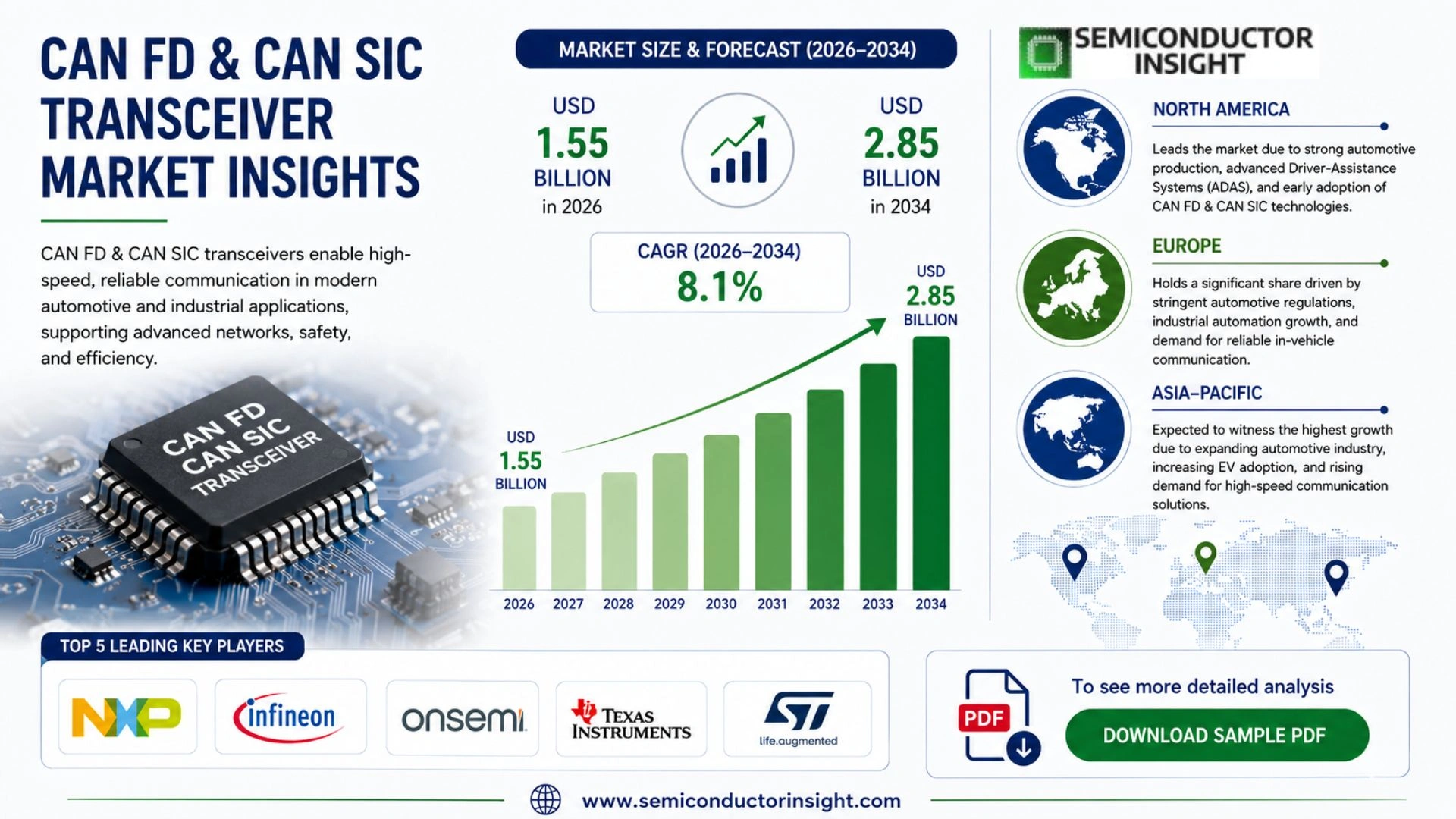
CAN FD & CAN SIC Transceiver Market size was valued at USD 1.45 billion in 2025. The market is projected to grow from USD 1.55 billion in 2026 to USD 2.85 billion by 2034, exhibiting a CAGR of 8.1% during the forecast period.
CAN FD and CAN SIC transceivers are specialized semiconductor devices designed to enable high-speed, reliable communication in Controller Area Network (CAN) systems. CAN FD (Flexible Data-rate) extends traditional CAN capabilities by supporting faster data rates up to 8 Mbps or more, while allowing larger payload sizes for efficient data transfer. CAN SIC (Signal Improvement Capability) further enhances signal integrity, reducing reflections and ringing on the bus to support robust performance in complex networks with higher speeds and longer cable lengths.
The market is experiencing steady growth due to several factors, including the rising adoption of advanced driver-assistance systems (ADAS), vehicle electrification, and the increasing complexity of in-vehicle networking architectures. Furthermore, the shift toward software-defined vehicles and zonal architectures demands higher bandwidth communication, where these transceivers play a critical role. Additionally, expanding applications in industrial automation, robotics, and medical devices contribute to market expansion. Initiatives by key players in the market are also expected to fuel the market growth. For instance, leading semiconductor companies have introduced new families of CAN FD SIC transceivers compliant with ISO 11898-2:2024 standards to support up to 8 Mbps or higher in challenging environments. NXP Semiconductors, Infineon Technologies, Texas Instruments, and STMicroelectronics are some of the key players that operate in the market with a wide range of portfolios.
MARKET DRIVERS
Rising Demand for High-Speed In-Vehicle Communication
CAN FD & CAN SIC Transceiver Market is experiencing robust growth driven by the increasing adoption of advanced driver assistance systems (ADAS), vehicle electrification, and software-defined vehicles. CAN FD technology enables higher data rates up to 8 Mbps in the data phase, addressing the bandwidth limitations of classical CAN in modern automotive architectures with numerous ECUs and complex sensor networks.
Signal Improvement Capability Enhancing Network Flexibility
CAN SIC transceivers actively reduce signal ringing, allowing reliable operation at higher bit rates in complex star topologies without major redesigns. This capability supports larger network architectures while reducing cabling weight and costs, making it highly attractive for automakers transitioning to zonal architectures and domain controllers.
➤ CAN SIC transceivers enable faster bit rates and greater design freedom compared to standard CAN FD solutions, facilitating the next generation of in-vehicle networks.
Additionally, the expansion of industrial automation and Industry 4.0 initiatives is boosting demand for robust, high-speed communication solutions across manufacturing, robotics, and smart infrastructure applications where reliable real-time data exchange is critical.
MARKET CHALLENGES
Signal Integrity and Topology Limitations
Implementing high data rates with CAN FD in complex vehicle networks presents significant signal ringing challenges, which can compromise communication reliability if not properly addressed through advanced transceiver technologies like CAN SIC.
Other Challenges
Backward Compatibility and Migration Costs
Transitioning from legacy CAN systems to CAN FD and CAN SIC requires careful validation to ensure interoperability, posing integration hurdles for manufacturers and increasing development timelines.
Electromagnetic Compatibility (EMC) Requirements
Higher data rates amplify EMC concerns in dense automotive environments with power electronics, demanding rigorous testing and design optimizations to meet stringent industry standards.
MARKET RESTRAINTS
High Development and Implementation Costs
CAN FD & CAN SIC Transceiver Market faces restraints from elevated costs associated with advanced transceiver development, network redesign, and extensive qualification processes required for automotive-grade reliability. These factors can slow adoption rates among cost-sensitive OEMs and Tier-1 suppliers.
Technical Complexity in High-Speed Networks
Achieving optimal performance at elevated bit rates demands precise network topology planning and component matching, limiting widespread deployment in applications where simpler, lower-speed solutions may still suffice for many functions.
MARKET OPPORTUNITIES
Expansion in Electric and Autonomous Vehicles
Significant opportunities exist in the rapidly growing electric vehicle segment and autonomous driving applications, where CAN FD combined with CAN SIC supports the high-bandwidth, low-latency communication essential for battery management systems, powertrain control, and sensor fusion. [[3]](https://dataintelo.com/report/global-can-bus-transceivers-market)
The integration of CAN FD/SIC with emerging technologies such as CAN XL and hybrid networking architectures presents avenues for innovation, enabling scalable solutions across automotive, industrial, and specialized sectors like medical devices and aerospace.
Trends
Rising Demand for High-Speed In-Vehicle Networking
CAN FD & CAN SIC Transceiver Market is witnessing significant momentum as automotive manufacturers increasingly adopt advanced communication solutions to support complex electronic architectures. CAN FD technology extends traditional CAN capabilities by enabling faster data rates up to 8 Mbps and larger payload sizes, facilitating more efficient data transfer across vehicle networks.
CAN SIC transceivers complement this by improving signal integrity, effectively reducing reflections and ringing on the bus. This enhancement allows for robust performance even in challenging environments with higher speeds and extended cable lengths, making them essential for modern vehicle designs.
Other Trends
Integration with ADAS and Vehicle Electrification
The growing implementation of advanced driver-assistance systems and the broader shift toward vehicle electrification are key drivers shaping CAN FD & CAN SIC Transceiver Market. These transceivers provide the reliable, high-bandwidth communication required for real-time data exchange in sophisticated safety and power management systems.
Support for Software-Defined Vehicles and Zonal Architectures
As the industry moves toward software-defined vehicles featuring zonal architectures, the need for higher bandwidth communication continues to rise. CAN FD & CAN SIC solutions play a vital role in meeting these demands, enabling seamless integration and efficient networking across distributed vehicle systems.
Expanding Applications Beyond Automotive
The versatility of CAN FD and CAN SIC transceivers is opening new opportunities in industrial automation, robotics, and medical devices. Their ability to deliver high-speed, reliable communication in demanding conditions positions them as valuable components across multiple sectors requiring robust network performance.
Leading semiconductor companies continue to innovate in this space, introducing new families of CAN FD SIC transceivers that comply with updated ISO 11898-2:2024 standards. This development supports enhanced performance up to 8 Mbps or higher, further strengthening adoption in complex network environments. Key players such as NXP Semiconductors, Infineon Technologies, Texas Instruments, and STMicroelectronics maintain strong portfolios, driving competitive advancements and technology improvements throughout CAN FD & CAN SIC Transceiver Market.
COMPETITIVE LANDSCAPE
Key Industry Players
Competitive Analysis of CAN FD & CAN SIC Transceiver Market
CAN FD & CAN SIC Transceiver Market is led by a concentrated group of established semiconductor giants with deep expertise in automotive and industrial networking solutions. NXP Semiconductors holds a dominant position as the market leader, leveraging its extensive portfolio of CAN FD and CAN SIC devices that support high data rates and signal integrity in complex vehicle architectures. The competitive structure features strong technological differentiation around compliance with ISO 11898-2:2024 standards, integration with ADAS and zonal architectures, and robust EMC performance, creating high barriers to entry for new players.
Other significant players include Infineon Technologies, Texas Instruments, and STMicroelectronics, which maintain substantial market shares through continuous innovation in CAN SIC technology for enhanced signal quality at speeds up to 8 Mbps or higher. Niche contributors such as Microchip Technology, Renesas Electronics, and ROHM Semiconductor focus on specialized applications in industrial automation and cost-effective solutions for emerging markets, while companies like Analog Devices and ON Semiconductor expand the ecosystem with complementary isolation and power management features.
List of Key CAN FD & CAN SIC Transceiver Companies Profiled
- NXP Semiconductors
- Infineon Technologies
- Texas Instruments
- STMicroelectronics
- Microchip Technology
- Renesas Electronics
- ON Semiconductor
- ROHM Semiconductor
- Analog Devices
- Bosch Semiconductors
- Melexis
- Diodes Incorporated
- Elmos Semiconductor
Segment Analysis:
| Segment Category | Sub-Segments | Key Insights |
| By Type |
|
Integrated CAN FD & SIC Transceivers represent the leading segment by combining flexible data-rate capabilities with advanced signal improvement features. These solutions excel in delivering robust communication performance across complex networks.
|
| By Application |
|
Advanced Driver Assistance Systems emerge as the leading application segment. These transceivers are essential for handling the massive data flows required in real-time sensor fusion and decision-making processes.
|
| By End User |
|
Automotive OEMs constitute the dominant end-user segment. They drive adoption as they transition toward software-defined vehicles and sophisticated zonal architectures.
|
| By Network Architecture |
|
Zonal Architecture leads this segment due to its emphasis on efficient, high-speed data routing across distributed zones.
|
| By Feature Enhancement |
|
Signal Integrity Enhancement (CAN SIC) stands out as the leading feature category. It addresses critical challenges in modern high-speed networks by mitigating common transmission issues.
|
Regional Analysis: CAN FD & CAN SIC Transceiver Market
Asia-Pacific
Strong automotive production base combined with government initiatives for smart mobility fuels demand for reliable high-speed transceivers. Focus on vehicle electrification and connectivity creates sustained opportunities for CAN FD & CAN SIC technologies across passenger and commercial vehicles.
Regional players are advancing transceiver robustness to handle electromagnetic interference in dense electronic architectures. Emphasis on signal improvement capabilities supports longer network spans and higher data throughput critical for future vehicle platforms.
Companies pursue vertical integration and joint ventures to secure supply chains and accelerate customization. Market leaders invest in talent development and IP protection to strengthen competitive positioning in the evolving CAN FD & CAN SIC Transceiver Market.
Continued expansion of automotive electronics and supportive policy frameworks position the region for sustained leadership. Innovation in energy-efficient designs and seamless protocol integration will shape growth trajectories through the forecast period.
North America
North America exhibits steady progress CAN FD & CAN SIC Transceiver Market, supported by a mature automotive industry and strong focus on safety and autonomous technologies. The United States leads with significant investments in connected vehicle ecosystems, where enhanced communication protocols play a vital role in advanced driver assistance systems. Manufacturers emphasize compliance with regional safety standards while exploring innovative applications for CAN SIC in improving network reliability. Business strategies often revolve around collaboration with technology startups and research institutions to integrate next-generation features. The region maintains a balanced approach between legacy system upgrades and new platform developments, ensuring smooth transitions for OEMs adopting higher data-rate solutions.
Europe
Europe demonstrates sophisticated demand patterns CAN FD & CAN SIC Transceiver Market, underpinned by stringent emission regulations and leadership in premium vehicle segments. Germany and other key nations drive advancements through collaborative R&D initiatives focused on functional safety and cybersecurity. The region’s emphasis on sustainable mobility encourages transceiver solutions that optimize power consumption and support complex sensor networks. Strategic partnerships between automakers and semiconductor specialists facilitate rapid prototyping and validation of new designs. As the market heads toward 2034, Europe continues to prioritize quality and innovation, positioning itself as a benchmark for high-performance in-vehicle networking technologies.
South America
South America shows emerging potential CAN FD & CAN SIC Transceiver Market, primarily linked to expanding automotive assembly operations and increasing local content requirements. Brazil and Argentina are gradually incorporating advanced electronics in vehicle production to meet both domestic and export demands. Market participants focus on cost-effective adaptation of global technologies while building local technical capabilities. Business strategies include technology transfer agreements and incremental upgrades to existing platforms. Although adoption paces behind more developed regions, growing awareness of connectivity benefits supports gradual integration of CAN FD solutions for improved vehicle performance and diagnostics.
Middle East & Africa
The Middle East & Africa region presents developing opportunities withCAN FD & CAN SIC Transceiver Market, driven by infrastructure modernization and rising vehicle ownership. Key markets are investing in smart transportation initiatives that require reliable communication networks. Local stakeholders collaborate with international suppliers to introduce suitable transceiver technologies adapted to challenging environmental conditions. Strategies emphasize training programs and aftermarket solutions to build ecosystem readiness. While the current focus remains on foundational upgrades, long-term growth prospects align with broader digital transformation goals across the automotive sector through the 2026-2034 period.
Report Scope
This market research report provides a comprehensive analysis of the CAN FD & CAN SIC Transceiver Market , covering the forecast period 2026–2034. It offers detailed insights into market dynamics, technological advancements, competitive landscape, and key trends shaping the industry.
Key focus areas of the report include:
- Market Overview: The report begins with an overview outlining its current market scenario, key growth indicators, and industry transformation drivers. It discusses macroeconomic factors, demand–supply balance, regulatory landscape, and the strategic role of semiconductors in powering advancements across industries such as automotive, telecommunications, consumer electronics, and industrial automation.
- Market Size & Forecast: Historical data and future projections for revenue, unit shipments, and market value across major regions and segments.
- Segmentation Analysis: Detailed breakdown by product type, technology, application, and end-user industry to identify high-growth segments and investment opportunities.
- Regional Insights: Insights into market performance across North America, Europe, Asia-Pacific, Latin America, and the Middle East & Africa, including country-level analysis where relevant.
- Competitive Landscape: Profiles of leading market participants, including their product offerings, R&D focus, manufacturing capacity, pricing strategies, and recent developments such as mergers, acquisitions, and partnerships.
- Technology Trends & Innovation: Assessment of emerging technologies, integration of AI/IoT, semiconductor design trends, fabrication techniques, and evolving industry standards.
- Market Drivers & Restraints: Evaluation of factors driving market growth along with challenges, supply chain constraints, regulatory issues, and market-entry barriers.
- Stakeholder Insights: Insights for component suppliers, OEMs, system integrators, investors, and policymakers regarding the evolving ecosystem and strategic opportunities.
Primary and secondary research methods are employed, including interviews with industry experts, data from verified sources, and real-time market intelligence to ensure the accuracy and reliability of the insights presented.
FREQUENTLY ASKED QUESTIONS:
What is the current market size of CAN FD & CAN SIC Transceiver Market?
-> CAN FD & CAN SIC Transceiver Market was valued at USD 1.45 billion in 2025 and is expected to reach USD 2.85 billion by 2034.
Which key companies operate CAN FD & CAN SIC Transceiver Market?
-> Key players include NXP Semiconductors, Infineon Technologies, Texas Instruments, and STMicroelectronics, among others.
What are the key growth drivers?
-> Key growth drivers include rising adoption of advanced driver-assistance systems (ADAS), vehicle electrification, and the increasing complexity of in-vehicle networking architectures.
Which region dominates the market?
-> Europe and North America remain dominant markets due to strong automotive and industrial sectors, while Asia-Pacific is the fastest-growing region.
What are the emerging trends?
-> Emerging trends include CAN FD SIC transceivers with ISO 11898-2:2024 compliance, support for higher data rates up to 8 Mbps, and integration in software-defined vehicles and zonal architectures.

Get Sample Report PDF for Exclusive Insights
Report Sample Includes
- Table of Contents
- List of Tables & Figures
- Charts, Research Methodology, and more...
 Download Sample Report PDF