Bluetooth Headset Chip Foundry Service Market Insights
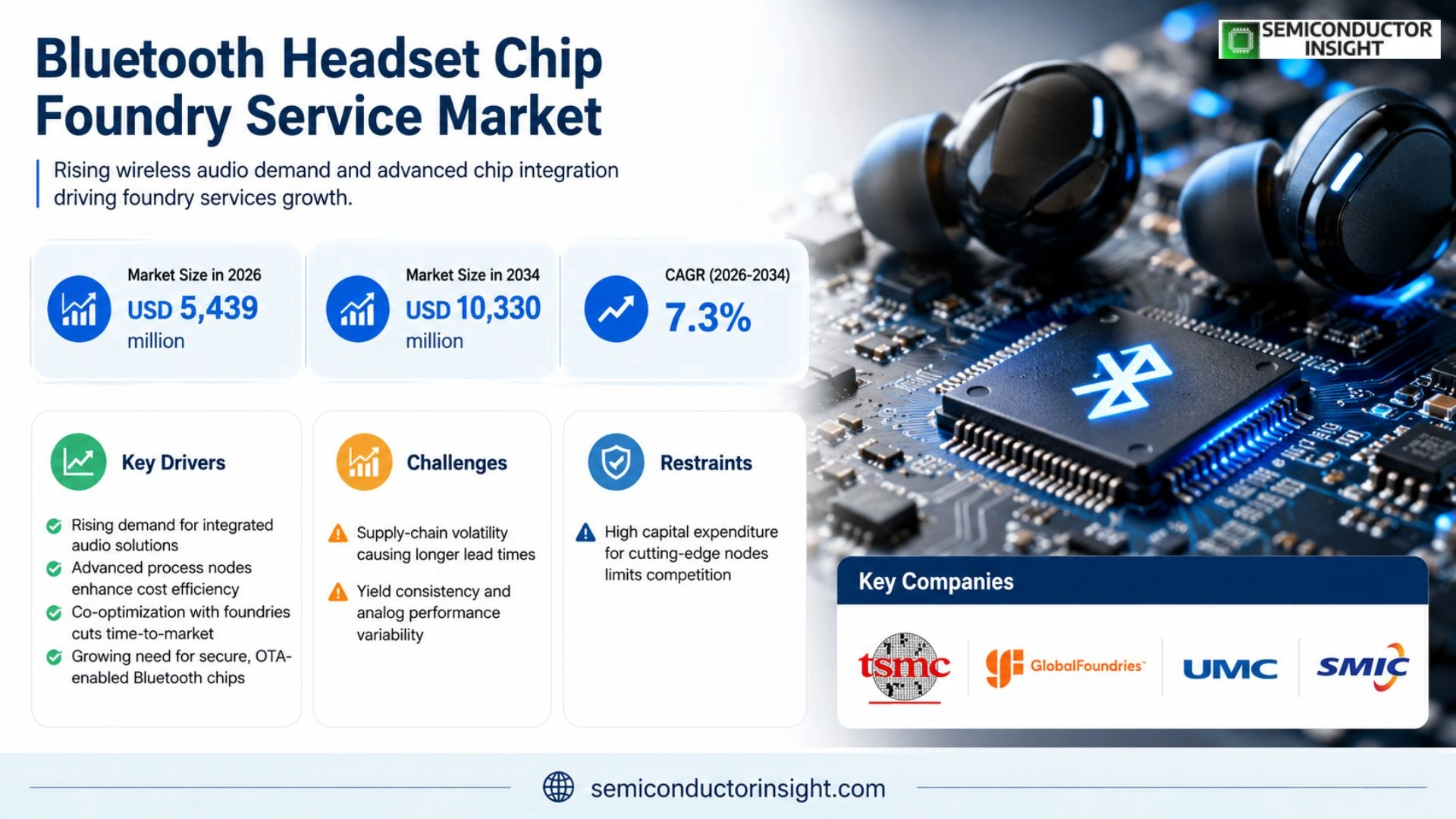
Bluetooth Headset Chip Foundry Service market is expected to rise from USD 5,439 million in 2026 to USD 10,330 million by 2034, exhibiting a CAGR of 7.3% during the forecast period.
Bluetooth Headset Chip Foundry Service refers to semiconductor manufacturing facilities that fabricate integrated circuits tailored for Bluetooth headset devices used across sports, work, entertainment and other sectors.These foundries,often called “fabs”,produce chips for fab‑less designers such as Qualcomm, NVIDIA and Apple. The service encompasses IDM mode, fabless collaborations and pure‑play foundry models, supporting applications ranging from electronic professional manufacturing services to direct supply for fabless semiconductor companies.
MARKET DRIVERS
Rising Demand for Integrated Audio Solutions
The proliferation of remote‑work tools and on‑the‑go entertainment has pushed OEMs to seek chips that combine Bluetooth connectivity, noise‑cancellation, and low‑power audio processing in a single die. Manufacturers that can deliver such integration gain a competitive edge because device designers can reduce board space and streamline certification. This pressure is translating into higher wafer orders for specialized foundries.
Cost Efficiency through Advanced Process Nodes
Foundries that have migrated to 28 nm and 14 nm platforms are offering substantially lower power consumption per megahertz, which directly lowers the bill‑of‑materials for Bluetooth headsets. Clients are trading up to finer geometries to achieve longer battery life, a factor that carries weight in premium segments where consumer expectations are high.
➤ Design houses that partner early with a foundry can co‑optimize silicon and packaging, cutting time‑to‑market by up to 20 %.
As the ecosystem around voice assistants expands, the need for chips that can handle multiple codecs and support OTA updates has become a decisive factor. Foundry services that embed secure boot and firmware‑over‑the‑air capabilities are therefore seeing a noticeable uptick in demand.
MARKET CHALLENGES
Supply‑Chain Volatility
Recent geopolitical tensions and pandemic‑induced logistics bottlenecks have stretched lead times for silicon substrates. Even firms with diversified supplier bases report schedule slips of 8‑12 weeks, pressuring contract manufacturers to hold larger safety stocks, which inflates working capital requirements.
Other Challenges
Yield Consistency
Achieving stable yields on mixed‑signal Bluetooth chips remains difficult, especially when migrating designs to newer nodes. Variability in analog performance can force redesign cycles, eroding margins for both the foundry and the OEM.
MARKET RESTRAINTS
High Capital Expenditure for Cutting‑Edge Nodes
Investments required to qualify 7 nm or sub‑7 nm processes exceed $1 billion, a threshold that only a handful of global players can meet. Smaller regional foundries find it hard to compete, limiting the pool of viable partners for niche headset manufacturers that prefer localized supply chains.
Regulatory Hurdles
Emerging emissions standards for wireless devices, especially in Europe and Asia‑Pacific, impose stricter testing regimes. Compliance costs add layers of complexity to the already intricate qualification process for Bluetooth headsets, discouraging some OEMs from exploring new foundry relationships.
MARKET OPPORTUNITIES
Customization for Niche Applications
Segments such as gaming earpieces, medical communication devices, and industrial safety headsets require specialized RF tuning and ruggedized packaging. Foundry services that offer design‑for‑manufacturability (DFM) assistance can carve out profitable niches by tailoring silicon to these exacting specifications.
Emerging Markets Adoption
Rapid smartphone penetration in Africa and Southeast Asia is driving a secondary market for affordable Bluetooth accessories. Foundries that can deliver low‑cost, high‑volume chip solutions stand to capture a sizable share of this expanding demand.
Bluetooth Headset Chip Foundry Service Market Trends
Higher Penetration of Bluetooth Headsets in Sports and Entertainment
The surge in wearable demand across athletic and leisure activities is reshaping the Bluetooth Headset Chip Foundry Service Market. Consumers now expect seamless audio connectivity during high‑intensity workouts, prompting OEMs to source chips that balance low latency with robust battery life. Foundry partners are responding by integrating advanced power‑management IP, which reduces system footprint and enables slimmer headset designs. This technical refinement not only improves user experience but also opens pricing leeway, allowing brands to differentiate in a crowded market. Consequently, contract volumes have risen steadily since 2022, with a noticeable uptick in orders linked to sports‑focused product lines. The trend underscores how end‑user lifestyle shifts translate into tangible design specifications that foundries must accommodate to stay competitive.
Other Trends
Regional Concentration of Semiconductor Fabric Capacity
Asia dominates the supply side of the Bluetooth Headset Chip Foundry Service Market, with mainland China, Taiwan, and South Korea together accounting for more than seventy percent of global fab capacity. This geographic clustering gives Asian foundries an economies‑of‑scale advantage, especially as equipment spend in the broader semiconductor sector peaked at roughly $109 billion in 2022. North America and Europe, while representing a combined twenty‑three percent share, focus on high‑value niche processes and advanced node development, often collaborating with pure‑play players for specialized audio‑chip geometries. The regional split creates a competitive dynamic where Western designers may opt for co‑development projects to tap Asian mass‑production efficiency, while Asian firms pursue technology licensing to lift their premium‑segment credibility.
Emergence of Pure‑Play Foundry Business Models
Historically, many chipset designers operated under an integrated‑device‑manufacturer (IDM) approach, but recent years have witnessed a decisive pivot toward pure‑play foundry services for Bluetooth headset components. This shift reflects a strategic desire among fabless firms to offload capital‑intensive wafer production, allowing them to allocate more resources to system‑level innovation and software ecosystems. Pure‑play entities, in turn, are expanding their service portfolios to include design‑for‑test and rapid prototyping, thereby shortening time‑to‑market for new headset generations. The ripple effect is clearer market segmentation: IDM mode now captures a shrinking slice, while pure‑play models gain traction across both high‑volume consumer and specialized professional applications. For investors and planners, the pattern signals a longer‑term reallocation of R&D spend toward integration and user‑experience features rather than manufacturing overhead.
COMPETITIVE LANDSCAPE
Key Industry Players
Bluetooth Headset Chip Foundry Service – Competitive Outlook
TSMC continues to dominate the Bluetooth headset chip foundry arena, leveraging its advanced 5‑nm and 7‑nm process nodes to attract premium‑grade fabless designers seeking low‑power, high‑integration IP. The company’s capacity expansion in Taiwan and new facilities in the United States have insulated it from recent geopolitical shocks, allowing it to retain a market‑share comfortably above half of the global foundry revenue for this segment. This concentration gives TSMC bargaining power over pricing and technology road‑maps, compelling smaller foundries to specialize in niche process windows or to focus on cost‑sensitive customers in emerging regions.
Beyond the leader, a constellation of pure‑play and IDM‑type fabs injects competitive pressure. UMC, SMIC, and GlobalFoundries each occupy distinct niches: UMC excels in mature 28‑nm platforms prized by cost‑conscious headset makers, SMIC leverages its home‑market advantage in mainland China to serve domestic OEMs, while GlobalFoundries differentiates through its 22‑nm FD‑SOI offering for audio‑signal‑processing blocks. TowerJazz, Powerchip, Vanguard International, Hua Hong, and Dongbu HiTek round out the field, supplying everything from mixed‑signal RF front‑ends to specialty packaging. Their collective presence keeps pricing elastic and forces the incumbent to accelerate process‑node transitions, fostering a modest but steady influx of new design wins across Asia‑Pacific and Europe.
List of Key Bluetooth Headset Chip Foundry Service Companies Profiled
- TSMC
- GlobalFoundries
- UMC
- SMIC
- TowerJazz
- Powerchip Semiconductor
- Vanguard International Semiconductor
- Hua Hong Semiconductor
- Dongbu HiTek
- Intel Custom Foundry
- Samsung Foundry
- ON Semiconductor
Segment Analysis:
| Segment Category | Sub-Segments | Key Insights |
| By Type |
|
IDM Mode continues to dominate because it offers end‑to‑end control over design and manufacturing, enabling tighter quality assurance. – Manufacturers can rapidly prototype and iterate, shortening time‑to‑market for new headset chip generations. – Close integration of design and fab facilitates incorporation of proprietary low‑power Bluetooth features that are critical for wearables. – Strong engineering expertise in mature process nodes supports reliable performance across diverse application environments. |
| By Application |
|
Electronic Professional Manufacturing Service is the leading application segment as it caters to OEMs that demand scalable production while preserving design confidentiality. – Service providers deliver turnkey solutions that integrate testing, packaging, and supply‑chain logistics, reducing operational complexity for headset makers. – The ability to leverage advanced process technologies ensures that Bluetooth headsets meet stringent power and audio quality expectations. – Close collaboration between foundries and device manufacturers fosters co‑innovation on emerging features such as voice‑assist integration and sensor fusion. |
| By End User |
|
Consumer Electronics drives the bulk of demand because Bluetooth headsets are integral to personal communication, media consumption, and fitness tracking. – End users expect ultra‑low latency and long battery life, prompting foundries to prioritize power‑efficient architectures. – Fashionable designs and seamless integration with smartphones create a competitive environment that rewards rapid iteration. – Integration of multi‑modal sensors (e.g., ANC, voice detection) adds value and requires sophisticated chip layout expertise. |
| By Technology |
|
Low‑Power Bluetooth 5.0 is the leading technology tier as it aligns with the market’s emphasis on extended wear time and compact device form factors. – Process innovations that minimize leakage current directly support longer headset usage between charges. – Compatibility with emerging audio codecs ensures high‑fidelity sound without sacrificing efficiency. – Flexibility to embed additional radio functions (e.g., Wi‑Fi, NFC) creates differentiated product portfolios for OEMs. |
| By Service Model |
|
Turnkey Foundry Services emerge as the preferred model because they relieve fabless designers of logistical burdens while ensuring high‑quality output. – End‑to‑end responsibility for mask making, wafer processing, testing, and packaging streamlines project timelines. – Foundries offer proprietary IP libraries that accelerate functional block integration specific to Bluetooth audio needs. – Collaborative risk‑sharing arrangements encourage joint investment in next‑generation nodes, fostering continuous innovation. |
Regional Analysis: Bluetooth Headset Chip Foundry Service Market
The North American design ecosystem blends legacy audio IP with AI‑driven noise‑cancellation modules, prompting foundries to offer mixed‑signal processes that accommodate both analog front‑ends and digital control blocks. This synergy reduces hand‑off friction and accelerates integration of Bluetooth 5.3 features into compact headsets. Manufacturers therefore rely on a single wafer run to validate RF performance and power budgeting, streamlining product qualification cycles.
Supply chain resilience in North America benefits from a diversified fab base that can shift capacity between 28 nm and 14 nm nodes depending on demand spikes for Bluetooth headset chips. Proximity to raw material depots and logistics hubs shortens lead times, enabling OEMs to mitigate risks associated with global disruptions. Such flexibility also supports rapid adoption of incremental Bluetooth revisions without jeopardizing overall production throughput.
The regulatory environment across the United States and Canada emphasizes RF emissions compliance while encouraging low‑power operation for wearable devices. Foundries tailor their process qualifications to meet FCC Part 15 limits, which pushes designers toward chipset architectures that balance range and battery longevity. Consequently, compliance testing becomes an integral early‑stage activity, reducing costly redesigns later in the product cycle.
Venture capital and corporate R&D spending remain robust, channeling funds toward niche foundry services that specialize in ultra‑low‑power Bluetooth audio chips. This capital influx fuels equipment upgrades and talent acquisition, ensuring that the region can sustain a pipeline of cutting‑edge process technologies for the next generation of headsets. Stakeholders therefore monitor emerging fab‑as‑a‑service models that promise scalability without extensive capex commitments.
Europe
Europe retains a strong design heritage for Bluetooth audio components, anchored by research centres in Germany, France and the United Kingdom. While domestic fab capacity for advanced nodes is modest, the region compensates through strategic partnerships with offshore foundries that specialize in mixed‑signal processes. European OEMs place a premium on sustainable manufacturing, prompting foundry services to adopt green chemistries and energy‑efficient equipment. The European Union’s emphasis on data privacy and strict RF exposure limits requires chipset architects to embed robust security features early in the design phase. Consequently, vendors that can deliver compliant, eco‑friendly solutions while maintaining performance edge are positioned to capture premium contracts within the continent’s expanding wearable market.
Asia‑Pacific
Asia‑Pacific drives the bulk of volume for Bluetooth headset chip demand, propelled by dense consumer electronics manufacturing hubs in China, South Korea, Taiwan and Vietnam. The region’s foundry landscape is dominated by large‑scale fabs offering economies of scale for high‑volume production at sub‑20 nm nodes. However, escalating geopolitical tensions and supply‑chain localization initiatives push some OEMs to diversify away from single‑source strategies. Local design houses increasingly integrate AI‑assisted audio processing, nudging foundries to provide flexible design‑for‑test windows. Ambient intelligence trends in smartphones and IoT devices also expand the functional envelope of Bluetooth headsets, creating opportunities for service providers that can deliver rapid prototyping alongside volume scaling.
South America
South America’s Bluetooth headset chip market is still nascent, with Brazil and Mexico serving as primary gateways for regional adoption. Local OEMs often import design IP from North American and European firms, then rely on contract foundries abroad for wafer production. The relatively high cost of logistics and limited domestic wafer capacity constrain speed‑to‑market, encouraging firms to explore regional assembly and testing facilities as value‑adding steps. Nevertheless, the rise of affordable wearables in emerging urban populations fuels a gradual increase in demand for cost‑effective chip solutions, prompting foundry services to offer tiered pricing models that align with price‑sensitive customers.
Middle East & Africa
The Middle East & Africa region exhibits fragmented demand for Bluetooth headset chips, largely driven by mobile operator‑led device subsidy programs and a growing interest in remote‑work accessories. Local distributors typically source finished silicon from established global foundries, with limited in‑region design activity. Recent investments in technology parks across the United Arab Emirates and South Africa aim to cultivate a nascent ecosystem of audio‑focused startups. As these ventures mature, they will seek foundry partners capable of delivering low‑power, compact solutions tailored to hot‑climate reliability requirements. Providers that can combine rapid sample turn‑around with compliance to regional certification standards stand to establish early footholds.
Report Scope
This market research report provides a comprehensive analysis of the Bluetooth Headset Chip Foundry Service Market , covering the forecast period 2026–2034. It offers detailed insights into market dynamics, technological advancements, competitive landscape, and key trends shaping the industry.
Key focus areas of the report include:
- Market Overview: The report begins with an overview outlining its current market scenario, key growth indicators, and industry transformation drivers. It discusses macroeconomic factors, demand–supply balance, regulatory landscape, and the strategic role of semiconductors in powering advancements across industries such as automotive, telecommunications, consumer electronics, and industrial automation.
- Market Size & Forecast: Historical data and future projections for revenue, unit shipments, and market value across major regions and segments.
- Segmentation Analysis: Detailed breakdown by product type, technology, application, and end-user industry to identify high-growth segments and investment opportunities.
- Regional Insights: Insights into market performance across North America, Europe, Asia-Pacific, Latin America, and the Middle East & Africa, including country-level analysis where relevant.
- Competitive Landscape: Profiles of leading market participants, including their product offerings, R&D focus, manufacturing capacity, pricing strategies, and recent developments such as mergers, acquisitions, and partnerships.
- Technology Trends & Innovation: Assessment of emerging technologies, integration of AI/IoT, semiconductor design trends, fabrication techniques, and evolving industry standards.
- Market Drivers & Restraints: Evaluation of factors driving market growth along with challenges, supply chain constraints, regulatory issues, and market-entry barriers.
- Stakeholder Insights: Insights for component suppliers, OEMs, system integrators, investors, and policymakers regarding the evolving ecosystem and strategic opportunities.
Primary and secondary research methods are employed, including interviews with industry experts, data from verified sources, and real-time market intelligence to ensure the accuracy and reliability of the insights presented.
FREQUENTLY ASKED QUESTIONS:
What is the current market size of Bluetooth Headset Chip Foundry Service Market?
-> Bluetooth Headset Chip Foundry Service market is expected to rise from USD 5,439 million in 2026 to USD 10,330 million by 2034, exhibiting a CAGR of 7.3%
Which key companies operate in Bluetooth Headset Chip Foundry Service Market?
-> Key players include TSMC, GlobalFoundries, UMC Group, SMIC, Tower Jazz, Powerchip, Vanguard (VIS), Hua Hong Semi, Dongbu HiTek.
What are the key growth drivers?
-> Key growth drivers include high‑performance computing, artificial intelligence, cloud computing, servers, 5G deployment, electric vehicles (EV), and the expanding use of Bluetooth headsets in sports, work, entertainment and other applications.
Which region dominates the market?
-> Asia dominates the market, with China mainland, Taiwan and South Korea together accounting for over 70% of global semiconductor equipment share, reflecting strong demand for foundry services in the region.
What are the emerging trends?
-> Emerging trends include the shift toward fabless and pure‑play foundry models, integration of AI/IoT functionalities into Bluetooth headset chips, and increasing adoption of advanced semiconductor processes driven by sports‑focused wearable technology.
Get Sample Report PDF for Exclusive Insights
Report Sample Includes
- Table of Contents
- List of Tables & Figures
- Charts, Research Methodology, and more...
 Download Sample Report PDF