Bluetooth 5.4 / 6.0 LE Audio SoC Market Insights
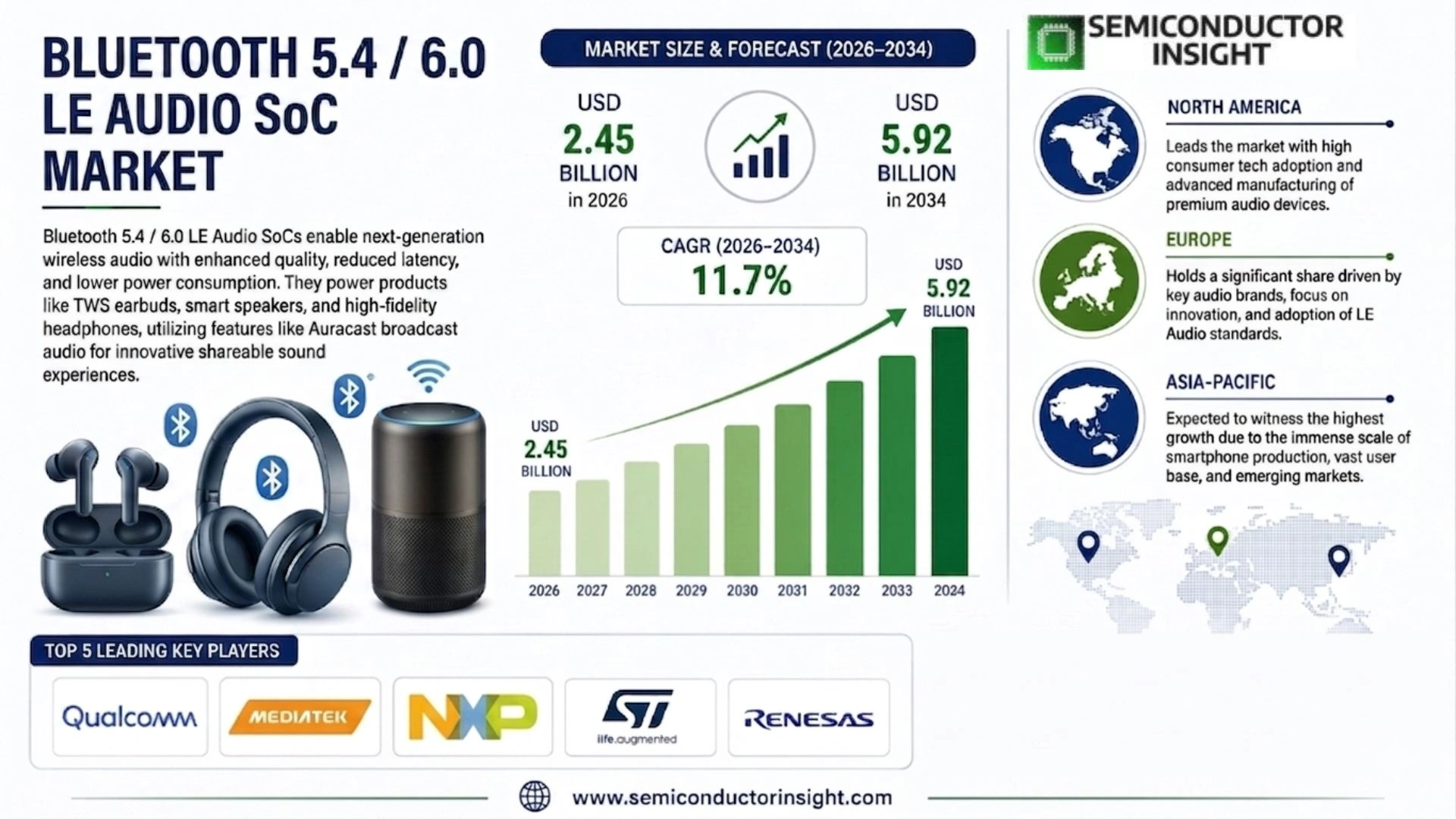
Bluetooth 5.4 / 6.0 LE Audio SoC Market size was valued at USD 2.15 billion in 2025. The market is projected to grow from USD 2.45 billion in 2026 to USD 5.92 billion by 2034, exhibiting a CAGR of 11.7% during the forecast period.
Bluetooth 5.4 and 6.0 LE Audio SoCs are advanced system-on-chip solutions that integrate low-energy Bluetooth radio, audio processing capabilities, microcontrollers, and power management units onto a single die. These semiconductors enable high-quality, low-latency wireless audio streaming while maintaining ultra-low power consumption essential for battery-operated devices. Key features supported include multi-stream audio, Auracast broadcast capabilities, enhanced isochronous channels, and improved channel sounding for precise ranging, making them critical components in modern hearables, true wireless stereo earbuds, hearing aids, and smart audio devices.
The market is experiencing strong growth driven by surging demand for wireless audio solutions across consumer electronics, rising adoption of LE Audio profiles in smartphones and wearables, and continuous advancements in low-power semiconductor design. Furthermore, the proliferation of IoT-enabled audio applications and increasing consumer preference for cable-free experiences contribute significantly to market expansion. Initiatives by key players continue to accelerate innovation, with new product launches supporting Bluetooth 6.0 features such as higher data throughput and better reliability for isochronous traffic. Nordic Semiconductor, Qualcomm, Silicon Laboratories, and Texas Instruments are among the leading companies operating in the market with comprehensive portfolios of LE Audio-ready SoC solutions.
MARKET DRIVERS
Rising Adoption of LE Audio in Consumer Electronics
Bluetooth 5.4 / 6.0 LE Audio SoC Market is experiencing robust growth driven by the widespread integration of LE Audio capabilities across true wireless stereo (TWS) earbuds, headphones, and smart speakers. Bluetooth 5.4 enhances energy efficiency and broadcast features, while 6.0 further improves isochronous channels for lower latency and higher reliability audio streaming. This has accelerated replacement cycles in consumer devices, with LE Audio enabling multi-stream audio, Auracast broadcast, and improved battery life.
Expansion of IoT and Industrial Applications
Proliferation of IoT devices, smart home ecosystems, and industrial automation solutions is fueling demand for advanced Bluetooth SoCs. Features like Periodic Advertising with Responses (PAwR) in Bluetooth 5.4 support large-scale, low-power networks such as electronic shelf labels (ESLs), while Bluetooth 6.0’s channel sounding enhances precise ranging for asset tracking and location services. These advancements position LE Audio SoCs as critical components in healthcare wearables, automotive systems, and connected infrastructure.
➤ The global Bluetooth device shipments are projected to grow significantly, supported by LE Audio adoption in hearables exceeding hundreds of millions of units annually.
Overall, the convergence of ultra-low power consumption, enhanced security, and superior audio performance is driving semiconductor manufacturers to innovate and capture growing market share in the Bluetooth 5.4 / 6.0 LE Audio SoC segment.
MARKET CHALLENGES
Interoperability and Fragmentation Issues
Despite technological advancements, ensuring seamless compatibility between devices supporting different Bluetooth versions and LE Audio profiles remains a significant hurdle. Manufacturers must navigate varying implementation levels of features like LC3 codec and Auracast across ecosystems, which can lead to inconsistent user experiences and slower market penetration for newer SoCs.
Other Challenges
Supply Chain and Manufacturing Complexities
Ongoing semiconductor supply constraints and the need for advanced process nodes to achieve lower power and higher integration increase production costs and lead times for Bluetooth 5.4 / 6.0 LE Audio SoCs.
Security and Privacy Concerns
As these SoCs integrate into sensitive applications such as healthcare and automotive, addressing potential vulnerabilities in wireless protocols requires continuous investment in robust encryption and secure pairing mechanisms.
MARKET RESTRAINTS
High Development Costs and Competition
Bluetooth 5.4 / 6.0 LE Audio SoC Market faces restraints from elevated R&D expenses required to incorporate new features such as enhanced ISOAL in Bluetooth 6.0 and channel sounding. Intense competition among established players and emerging Chinese vendors exerts downward pressure on pricing, impacting margins for premium SoC solutions.
Additionally, slower adoption rates in certain regions due to legacy infrastructure and the complexity of qualifying new silicon designs limit rapid market expansion despite strong underlying demand.
MARKET OPPORTUNITIES
Emerging Applications in Hearables and Automotive
Significant opportunities exist in the hearing aid and premium hearables segments, where Bluetooth LE Audio delivers superior sound quality, lower power consumption, and accessibility features. Automotive integration for digital keys, infotainment, and wireless battery management systems also presents a high-growth avenue for advanced SoCs supporting Bluetooth 5.4 and 6.0 specifications. [[4]](https://www.polarismarketresearch.com/industry-analysis/bluetooth-le-audio-market)
Expansion into smart infrastructure, industrial IoT, and AI-enhanced audio processing further broadens the addressable market for manufacturers investing in next-generation LE Audio solutions.
Trends
Adoption of LE Audio Profiles Driving Innovation
Bluetooth 5.4 / 6.0 LE Audio SoC Market continues to evolve rapidly as manufacturers integrate advanced low-energy Bluetooth capabilities into compact system-on-chip solutions. These SoCs combine Bluetooth radio, audio processing, microcontrollers, and power management on a single die, enabling high-quality, low-latency wireless audio streaming with ultra-low power consumption suitable for battery-operated devices. Key supported features such as multi-stream audio, Auracast broadcast capabilities, enhanced isochronous channels, and improved channel sounding for precise ranging position these components as essential in modern hearables, true wireless stereo earbuds, hearing aids, and smart audio devices.
Other Trends
Rising Demand Across Consumer Electronics and IoT Applications
Market participants observe strong momentum from increasing consumer preference for cable-free audio experiences and the proliferation of IoT-enabled audio applications. The integration of LE Audio profiles in smartphones and wearables has accelerated adoption, with continuous advancements in low-power semiconductor design supporting more efficient performance. This trend reflects broader industry shifts toward seamless wireless connectivity that maintains audio fidelity while extending battery life in portable devices.
Product Innovations and Competitive Landscape
Leading semiconductor companies including Nordic Semiconductor, Qualcomm, Silicon Laboratories, and Texas Instruments maintain comprehensive portfolios of LE Audio-ready SoC solutions. These players actively launch new products that incorporate Bluetooth 6.0 features, focusing on higher data throughput and improved reliability for isochronous traffic. Such developments enhance overall system performance and open new possibilities for multi-device audio sharing and broadcast scenarios. The competitive environment fosters ongoing technical improvements in audio processing efficiency and power optimization, benefiting end applications ranging from premium consumer audio to medical hearing devices. As wireless audio ecosystems mature, Bluetooth 5.4 / 6.0 LE Audio SoC solutions are becoming foundational elements that enable next-generation features while addressing critical requirements for low latency and extended range in diverse operating conditions.
COMPETITIVE LANDSCAPE
Key Industry Players
Bluetooth 5.4 / 6.0 LE Audio SoC Market Competitive Analysis
Bluetooth 5.4 / 6.0 LE Audio SoC Market is led by a select group of semiconductor innovators with strong expertise in low-power wireless technologies. Nordic Semiconductor holds a prominent position as a market leader, particularly with its nRF53 and nRF54 series SoCs optimized for LE Audio applications including multi-stream audio and Auracast broadcasting. Qualcomm follows closely with its advanced audio-focused chipsets that integrate LE Audio capabilities with superior processing power for premium hearables and TWS earbuds, commanding significant share in consumer electronics. The competitive structure features a mix of specialized wireless pure-plays and diversified semiconductor giants, where technological differentiation in power efficiency, audio codec support, and channel sounding drives market positioning.
Other significant players include Silicon Laboratories, Texas Instruments, STMicroelectronics, NXP Semiconductors, and Infineon Technologies, each carving niches in specific segments such as industrial IoT, automotive, or high-volume consumer devices. These companies continue to invest in Bluetooth 6.0 feature enhancements like improved isochronous channels and reliability for audio streaming, fostering a dynamic innovation ecosystem that accelerates adoption across hearables, hearing aids, and smart audio applications.
List of Key Bluetooth 5.4 / 6.0 LE Audio SoC Companies Profiled
- Nordic Semiconductor
- Qualcomm
- Silicon Laboratories
- Texas Instruments
- STMicroelectronics
- NXP Semiconductors
- Infineon Technologies
- Broadcom Inc.
- MediaTek Inc.
- Renesas Electronics (Dialog)
- Espressif Systems
- Realtek Semiconductor
- Onsemi
- Telink Semiconductor
Segment Analysis:
| Segment Category | Sub-Segments | Key Insights |
| By Type |
|
Bluetooth 6.0 LE Audio SoCs represent the forefront of innovation in this market. These solutions deliver enhanced isochronous channels for superior multi-stream audio synchronization and support advanced Auracast broadcast capabilities that enable seamless audio sharing across multiple devices. Their integration of improved channel sounding technology facilitates precise ranging and positioning features, making them ideal for next-generation spatial audio experiences. Manufacturers prioritize these chips for their forward compatibility and ability to handle higher data throughput while preserving the ultra-low power profile essential for extended battery life in portable audio devices. |
| By Application |
|
True Wireless Stereo Earbuds dominate as the leading application segment. These SoCs enable low-latency, high-fidelity audio streaming with robust multi-device connectivity that supports simultaneous audio streams to both earbuds. The integration of advanced audio processing capabilities ensures crystal-clear sound quality and seamless switching between devices. Developers value the enhanced power management that extends usage time between charges while maintaining consistent performance across varying environmental conditions. This application continues to push the boundaries of wireless audio convenience and user experience. |
| By End User |
|
Consumer Electronics stands as the primary end-user segment driving adoption. End users in this category seek immersive, cable-free audio experiences across daily devices, benefiting from the SoCs’ ability to deliver synchronized multi-stream audio and broadcast features. The ultra-low power consumption supports all-day usage in portable gadgets while the compact die size enables sleek product designs. Continuous improvements in audio codec support and connection stability enhance user satisfaction, encouraging broader integration into smartphones, wearables, and smart home audio systems. |
| By Feature Set |
|
Auracast Broadcast Enabled SoCs lead this segment through their transformative audio sharing capabilities. These chips allow a single source to transmit audio to an unlimited number of receivers with exceptional synchronization and reliability. The feature set supports public and private broadcast modes that open new use cases in venues, education, and personal sharing scenarios. Integration with enhanced security protocols ensures protected transmissions, while the efficient handling of isochronous data maintains audio quality without compromising battery performance in receiving devices. |
| By Integration Level |
|
Highly Integrated with DSP solutions are preferred for their comprehensive functionality on a single die. These SoCs combine Bluetooth radio, dedicated audio processing units, microcontrollers, and power management circuits to streamline product development and reduce overall system complexity. The on-chip digital signal processing delivers real-time audio enhancements such as noise cancellation and spatial audio rendering with minimal external components. This integration level supports faster time-to-market for device manufacturers while optimizing power efficiency and lowering production costs through reduced bill of materials. |
Regional Analysis: Bluetooth 5.4 / 6.0 LE Audio SoC Market
Asia-Pacific
The region’s advanced semiconductor foundries and assembly lines enable cost-effective scaling of complex Bluetooth 5.4 / 6.0 LE Audio SoC designs. Integrated ecosystems support rapid prototyping and volume production, allowing swift response to evolving demands for higher audio fidelity and lower latency in wireless solutions.
Deep penetration into smartphones, true wireless earbuds, and smart home devices drives continuous refinement of LE Audio features. Manufacturers prioritize seamless multi-stream audio support and broadcast capabilities, enhancing user experiences across entertainment and communication platforms.
Growing adoption in vehicle connectivity systems and industrial IoT solutions underscores the versatility of these SoCs. Focus remains on robust performance in challenging environments, supporting reliable audio streaming and data synchronization critical for smart mobility and automation.
Strategic partnerships between technology firms and research institutions accelerate development of next-generation features. Emphasis on open standards and interoperability ensures Bluetooth 5.4 / 6.0 LE Audio SoCs meet diverse market requirements while pushing technical boundaries.
North America
North America exhibits robust innovation Bluetooth 5.4 / 6.0 LE Audio SoC Market, fueled by leading technology companies and research institutions focused on premium audio experiences and enterprise applications. The region emphasizes software-hardware co-development, resulting in sophisticated implementations that prioritize security, low power consumption, and high-fidelity audio streaming. Strong demand from professional audio, gaming, and healthcare sectors encourages specialized SoC variants tailored for mission-critical connectivity. Companies invest heavily in ecosystem partnerships to enhance Auracast broadcasting capabilities and multi-device synchronization, positioning the market for steady expansion through advanced use cases in smart environments and connected vehicles.
Europe
Europe maintains a strategic position Bluetooth 5.4 / 6.0 LE Audio SoC Market with emphasis on regulatory compliance, sustainability, and high-quality audio standards. The region drives adoption in automotive infotainment and industrial automation, where reliability and energy efficiency are paramount. Collaborative efforts among manufacturers and standards bodies support seamless integration of LE Audio features across consumer and professional devices. Focus on data privacy and eco-friendly design influences SoC development, fostering solutions that balance performance with environmental considerations. Growing interest in wireless audio for smart cities and public broadcasting further strengthens regional market dynamics.
South America
South America shows emerging potential Bluetooth 5.4 / 6.0 LE Audio SoC Market, particularly within consumer electronics and mobile device segments. Increasing urbanization and digital transformation initiatives create opportunities for affordable wireless audio solutions in entertainment and communication devices. Local manufacturers partner with global technology providers to incorporate advanced LE Audio capabilities, addressing demands for better connectivity in diverse climatic conditions. While infrastructure development varies across countries, rising consumer preference for modern audio experiences in smartphones and wearables supports gradual market maturation and technology localization efforts.
Middle East & Africa
The Middle East and Africa region demonstrates growing interest Bluetooth 5.4 / 6.0 LE Audio SoC Market driven by smart infrastructure projects and expanding consumer technology adoption. Key markets focus on integrating LE Audio solutions into hospitality, retail, and public safety applications where clear audio communication is essential. Investment in digital economy initiatives encourages deployment of wireless audio systems in smart buildings and transportation hubs. Regional players collaborate with international suppliers to customize SoCs for local needs, emphasizing durability and power efficiency suitable for challenging operating environments while building foundational capabilities for future growth.
Report Scope
This market research report provides a comprehensive analysis of the Bluetooth 5.4 / 6.0 LE Audio SoC Market , covering the forecast period 2026–2034. It offers detailed insights into market dynamics, technological advancements, competitive landscape, and key trends shaping the industry.
Key focus areas of the report include:
- Market Overview: The report begins with an overview outlining its current market scenario, key growth indicators, and industry transformation drivers. It discusses macroeconomic factors, demand–supply balance, regulatory landscape, and the strategic role of semiconductors in powering advancements across industries such as automotive, telecommunications, consumer electronics, and industrial automation.
- Market Size & Forecast: Historical data and future projections for revenue, unit shipments, and market value across major regions and segments.
- Segmentation Analysis: Detailed breakdown by product type, technology, application, and end-user industry to identify high-growth segments and investment opportunities.
- Regional Insights: Insights into market performance across North America, Europe, Asia-Pacific, Latin America, and the Middle East & Africa, including country-level analysis where relevant.
- Competitive Landscape: Profiles of leading market participants, including their product offerings, R&D focus, manufacturing capacity, pricing strategies, and recent developments such as mergers, acquisitions, and partnerships.
- Technology Trends & Innovation: Assessment of emerging technologies, integration of AI/IoT, semiconductor design trends, fabrication techniques, and evolving industry standards.
- Market Drivers & Restraints: Evaluation of factors driving market growth along with challenges, supply chain constraints, regulatory issues, and market-entry barriers.
- Stakeholder Insights: Insights for component suppliers, OEMs, system integrators, investors, and policymakers regarding the evolving ecosystem and strategic opportunities.
Primary and secondary research methods are employed, including interviews with industry experts, data from verified sources, and real-time market intelligence to ensure the accuracy and reliability of the insights presented.
FREQUENTLY ASKED QUESTIONS:
What is the current market size of Bluetooth 5.4 / 6.0 LE Audio SoC Market?
-> Bluetooth 5.4 / 6.0 LE Audio SoC Market was valued at USD 2.15 billion in 2025 and is expected to reach USD 5.92 billion by 2034.
Which key companies operate Bluetooth 5.4 / 6.0 LE Audio SoC Market?
-> Key players include Nordic Semiconductor, Qualcomm, Silicon Laboratories, and Texas Instruments, among others.
What are the key growth drivers?
-> Key growth drivers include surging demand for wireless audio solutions across consumer electronics, rising adoption of LE Audio profiles in smartphones and wearables, and continuous advancements in low-power semiconductor design.
Which region dominates the market?
-> Asia-Pacific is the fastest-growing region, while North America remains a dominant market.
What are the emerging trends?
-> Emerging trends include multi-stream audio, Auracast broadcast capabilities, enhanced isochronous channels, and improved channel sounding for precise ranging.

Get Sample Report PDF for Exclusive Insights
Report Sample Includes
- Table of Contents
- List of Tables & Figures
- Charts, Research Methodology, and more...
 Download Sample Report PDF