Blu-ray Storage System for Enterprise Market Insights
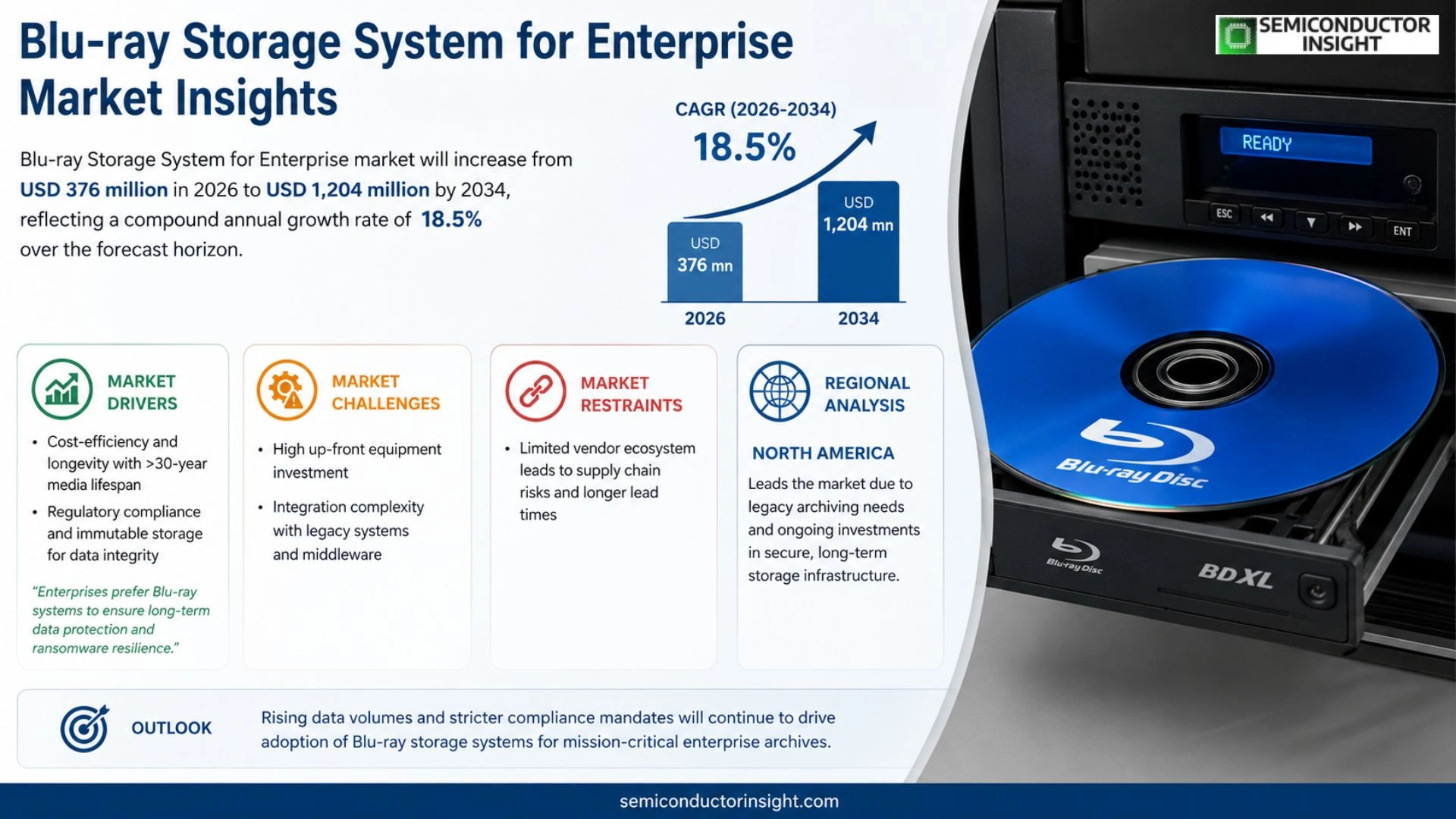
Blu-ray Storage System for Enterprise market will increase from USD 376 million in 2026 to USD 1,204 million by 2034, reflecting a compound annual growth rate of 18.5% over the forecast horizon.
Blu‑ray storage systems designed for enterprise environments provide high‑density optical media capable of preserving large volumes of data on durable discs ranging from 25 GB up to several terabytes per cartridge when multiple layers are employed. Because optical media are immune to magnetic fields and have low bit‑error rates, they are favored for long‑term archiving where data integrity over decades is paramount.
The sector gains momentum as organizations confront exponential data growth and stricter regulatory retention mandates. Cost‑effective scalability, decreasing per‑gigabyte price points, and recent advances such as multi‑layer disc technologies drive adoption across financial services, healthcare archives, and media libraries. Leading manufacturers,including Panasonic, Sony, DISC Archiving System, China Hualu Group Co., Amethystum Storage Tech and Suzhou NETZON,continue expanding product portfolios through higher‑capacity disc formats and integrated robotic retrieval solutions.
MARKET DRIVERS
Cost‑Efficiency and Longevity
The Blu‑ray Storage System for Enterprise Market delivers a media cost per gigabyte that undercuts many competing tape solutions, especially when archival lifespans exceed 30 years. Extended media durability translates into lower refresh cycles for IT departments, allowing capital to be redirected toward higher‑value initiatives.
Regulatory Compliance Pressures
Stringent data‑retention mandates across finance, healthcare, and government sectors compel organizations to adopt storage technologies that can guarantee integrity over decades. Blu‑ray optical media, with its sealed, non‑magnetic format, meets audit requirements while offering a transparent audit trail.
➤ “Enterprises that prioritize immutable storage are increasingly turning to Blu‑ray systems as a safeguard against ransomware‑induced data loss.”
Beyond compliance, the ability to physically isolate archival libraries from networked environments provides a defense‑in‑depth layer that many cloud‑centric strategies lack, reinforcing the business case for optical solutions.
MARKET CHALLENGES
High Up‑Front Equipment Investment
Deploying a Blu‑ray archival infrastructure requires dedicated robotic libraries, media handling software, and trained personnel. The initial outlay can be a deterrent for mid‑sized firms that are weighing capital expenditures against more incremental cloud storage models.
Other Challenges
Integration Complexity
Legacy backup workloads often rely on proprietary tape formats. Migrating to Blu‑ray demands cross‑platform middleware and thorough testing, which can extend project timelines and strain internal resources.
MARKET RESTRAINTS
Limited Vendor Ecosystem
Only a handful of manufacturers currently produce enterprise‑grade Blu‑ray drives and media, constraining bargaining power and creating supply‑chain sensitivities. Should any of these suppliers experience production hiccups, customers may face prolonged lead times.
MARKET OPPORTUNITIES
Growth in Cold‑Data Archiving
As AI and analytics workloads generate ever‑larger data sets, a distinct segment of “cold” data,information accessed less than once a year,requires storage that balances cost with reliability. Blu‑ray optical solutions, with their low power draw and predictable media decay rates, are uniquely positioned to serve this niche.
Blu-ray Storage System for Enterprise Market Trends
Increasing Adoption of Ultra‑Durable Media
The proliferation of data‑intensive workloads,ranging from high‑resolution medical imaging to long‑term financial records,has intensified the search for storage that can survive decades without degradation. Blu-ray technology, with its sealed, polymer‑coated disc architecture, delivers a resilience that tape and hard‑disk solutions struggle to match under fluctuating temperature and humidity. Enterprises are therefore gravitating toward this medium to meet compliance mandates for archival integrity. The shift is evident in the expanding portfolio of multi‑terabyte Blu‑ray cartridges, which now cater to both modest departmental archives and large‑scale data‑center deployments. By embedding these disks within tiered‑storage hierarchies, firms can lower total cost of ownership while preserving access speed for critical datasets. This evolution reflects a broader strategic move to diversify storage media portfolios, reducing reliance on any single technology.
Other Trends
AI‑Enhanced Indexing for Faster Retrieval
Recent collaborations between disc manufacturers and software vendors have produced indexing engines that embed machine‑learning models directly onto the disc’s metadata layer. These models classify files by content type, usage frequency, and regulatory category, enabling instant retrieval without exhaustive scanning of the entire archive. Organizations deploying such intelligent catalogs report up to 30 % reduction in retrieval times for compliance audits. The capability to query vast repositories with natural‑language commands further lowers the skill barrier for IT staff, accelerating adoption across non‑technical business units. As the volume of stored content continues to swell, the value of searchable, self‑describing media becomes a decisive differentiator in procurement decisions.
Geographic Expansion of Supply Chains
Manufacturing footprints for Blu-ray Storage System for Enterprise Market are increasingly distributed across Asia‑Pacific hubs, notably in China and Japan, while legacy players in North America and Europe retain strong design and R&D functions. This bifurcated structure enables faster response to regional demand spikes, such as the surge in archival projects driven by new data‑privacy regulations in the European Union. At the same time, localized component sourcing reduces exposure to global logistics disruptions, safeguarding delivery schedules for critical deployments in the financial and healthcare sectors. Companies that have aligned their production networks with these emerging geographic patterns are better positioned to negotiate pricing and to offer region‑specific warranty extensions, thereby strengthening customer confidence.
COMPETITIVE LANDSCAPE
Key Industry Players
Blu‑ray Storage System for Enterprise – Competitive Overview
Panasonic remains the dominant force in the enterprise Blu‑ray storage arena, leveraging its long‑standing optical‑media expertise and a global distribution network that spans data‑center operators, archival institutions, and regulated industries. Its product portfolio covers capacities from sub‑24 TB cartridges up to 800 TB solutions, offering tiered pricing that aligns with budget‑conscious buyers while still delivering the durability required for long‑term retention. The company’s ability to integrate proprietary error‑correction algorithms into the media has reinforced its reputation for reliability, a decisive advantage when clients evaluate total cost of ownership against competing tape and SSD options.
Beyond the market leaders, a cohort of specialized manufacturers is carving out niches by focusing on regional demand or differentiated technology. Sony’s high‑density drive engineering, DISC Archiving System’s modular rack solutions, and China Hualu Group’s cost‑effective supply chain have each attracted segments that prioritize either performance or price. Smaller innovators such as Amethystum Storage Tech, Suzhou NETZON, and Tsinghua Tongfang Co. are pushing forward with hybrid Blu‑ray/laser‑etched media that promise extended lifespan for mission‑critical archives. Meanwhile firms like Beijing Xingzhen Tongyuan Digital System, Beijing DMX, Beijing Ji Cheng Technology, and Bctop are concentrating on vertical markets,medical imaging, financial records, and media preservation,where compliance and data integrity are non‑negotiable. This diversified competitive fabric creates a dynamic environment where strategic partnerships, targeted R&D, and agile go‑to‑market tactics determine market share.
List of Key Blu‑ray Storage System for Enterprise Companies Profiled
- Panasonic
- Sony
- DISC Archiving System
- China Hualu Group Co.
- Amethystum Storage Tech
- Suzhou NETZON
- Tsinghua Tongfang Co.
- Beijing Xingzhen Tongyuan Digital System
- Beijing DMX
- Beijing Ji Cheng Technology
- Bctop
- Hitachi Data Systems
Segment Analysis:
| Segment Category | Sub-Segments | Key Insights |
| By Type |
|
High‑Capacity (Above 840TB)
|
| By Application |
|
Archival Industry
|
| By End User |
|
Large Enterprises
|
| By Capacity Tier |
|
Mid Tier
|
| By Deployment Model |
|
On‑Premises
|
Regional Analysis: Blu-ray Storage System for Enterprise Market
North America
Tight data‑retention mandates in the United States, especially under FINRA and HIPAA, compel enterprises to adopt storage media that reliably preserve information beyond ten years. Blu‑ray solutions, with their inherent resistance to magnetic interference, align well with audit requirements, prompting IT directors to prioritize them over legacy tape.
The convergence of large‑scale video analytics, AI model checkpoints, and archival video evidence creates a demand for high‑density, long‑term storage. North American firms view Blu‑ray as a cost‑effective bridge between active SSD tiers and offline cold storage, enabling tiered‑access strategies that balance performance and expense.
Proximity to major optical media manufacturers gives North American buyers leverage on lead times and customization options. Vendor‑specific firmware updates can be rolled out quickly, ensuring that enterprise customers maintain compatibility with emerging encryption standards.
While tape remains entrenched, Blu‑ray providers differentiate by bundling data‑management software that automates migration policies. This value‑add resonates with CIOs seeking to offload manual archival tasks, positioning optical systems as a strategic alternative rather than a niche option.
Europe
European enterprises exhibit a cautious yet forward‑looking stance toward optical archiving. GDPR’s stringent data‑privacy clauses encourage firms to select media that can be physically isolated from networked environments, a characteristic inherent to Blu‑ray cartridges. Countries such as Germany and the United Kingdom are piloting optical tiers to complement existing cloud‑based cold storage, leveraging the medium’s immunity to electronic obsolescence. Vendor partnerships with regional system integrators are deepening, allowing for seamless integration with legacy backup software. Although price sensitivity remains higher than in North America, the emphasis on data‑sovereignty and long‑term compliance fuels a steady uptick in procurement cycles.
Asia‑Pacific
The Asia‑Pacific landscape is marked by rapid digital transformation, particularly in China, Japan, and South Korea, where massive content libraries demand scalable archiving solutions. While magnetic tape still dominates due to legacy investments, Blu‑ray is gaining traction in sectors such as media & entertainment, where the medium’s durability aligns with archival standards for high‑resolution footage. Government‑driven initiatives promoting green IT are nudging data centers toward low‑energy storage options, creating an opening for optical media. However, fragmented supply chains and divergent regulatory frameworks across the region introduce variability in adoption speed, making strategic alliances with local distributors essential for market entry.
South America
In South America, enterprises are balancing cost constraints with the need to safeguard expanding data volumes. Brazil and Argentina, as regional economic hubs, are experimenting with Blu‑ray storage as a cost‑effective alternative to expensive tape‑management services. The medium’s plug‑and‑play nature simplifies deployment in remote office environments where network bandwidth for cloud archiving is limited. Local data‑protection regulations, though less prescriptive than EU standards, are evolving to recognize the benefits of immutable, offline storage, encouraging pilot programs in the financial and public‑sector domains.
Middle East & Africa
The Middle East & Africa region presents a mixed picture, with affluent markets such as the United Arab Emirates investing heavily in data‑center resilience, while most African nations contend with limited infrastructure. In the Gulf, oil‑&‑gas companies are adopting Blu‑ray for long‑term seismic data archives, valuing the medium’s temperature tolerance and high read stability. Meanwhile, emerging economies view optical storage as a pragmatic step toward building indigenous data‑preservation capabilities without incurring the costs of extensive tape‑library ecosystems. Partnerships with global manufacturers are beginning to focus on training local technical teams, laying the groundwork for broader market diffusion.
Report Scope
This market research report provides a comprehensive analysis of the Blu-ray Storage System for Enterprise Market , covering the forecast period 2026–2034. It offers detailed insights into market dynamics, technological advancements, competitive landscape, and key trends shaping the industry.
Key focus areas of the report include:
- Market Overview: The report begins with an overview outlining its current market scenario, key growth indicators, and industry transformation drivers. It discusses macroeconomic factors, demand–supply balance, regulatory landscape, and the strategic role of semiconductors in powering advancements across industries such as automotive, telecommunications, consumer electronics, and industrial automation.
- Market Size & Forecast: Historical data and future projections for revenue, unit shipments, and market value across major regions and segments.
- Segmentation Analysis: Detailed breakdown by product type, technology, application, and end-user industry to identify high-growth segments and investment opportunities.
- Regional Insights: Insights into market performance across North America, Europe, Asia-Pacific, Latin America, and the Middle East & Africa, including country-level analysis where relevant.
- Competitive Landscape: Profiles of leading market participants, including their product offerings, R&D focus, manufacturing capacity, pricing strategies, and recent developments such as mergers, acquisitions, and partnerships.
- Technology Trends & Innovation: Assessment of emerging technologies, integration of AI/IoT, semiconductor design trends, fabrication techniques, and evolving industry standards.
- Market Drivers & Restraints: Evaluation of factors driving market growth along with challenges, supply chain constraints, regulatory issues, and market-entry barriers.
- Stakeholder Insights: Insights for component suppliers, OEMs, system integrators, investors, and policymakers regarding the evolving ecosystem and strategic opportunities.
Primary and secondary research methods are employed, including interviews with industry experts, data from verified sources, and real-time market intelligence to ensure the accuracy and reliability of the insights presented.
FREQUENTLY ASKED QUESTIONS:
What is the current market size of Blu-ray Storage System for Enterprise Market?
-> Blu-ray Storage System for Enterprise Market is projected to reach USD 1,204 million by 2034, growing at a CAGR of 18.5% over the forecast period.
Which key companies operate in Blu-ray Storage System for Enterprise Market?
-> Key players include Panasonic, Sony, DISC Archiving System, China Hualu Group Co, Amethystum Storage Tech, Suzhou NETZON, Tsinghua Tongfang Co, Beijing Xingzhen Tongyuan Digital System, Beijing DMX, Beijing Ji Cheng Technology, among others.
What are the key growth drivers?
-> Key growth drivers include increasing demand for high‑capacity archival storage, regulatory requirements for long‑term data retention, and the cost‑effectiveness of optical media for enterprise backup solutions.
Which region dominates the market?
-> North America currently holds a significant share of the enterprise Blu‑ray storage market, while Asia‑Pacific is experiencing rapid growth driven by expanding data centers and digitization initiatives.
What are the emerging trends?
-> Emerging trends include development of higher‑capacity Blu‑ray cartridges (above 360 TB), integration of optical storage with cloud‑based data management platforms, and the use of AI for automated archival indexing.

Get Sample Report PDF for Exclusive Insights
Report Sample Includes
- Table of Contents
- List of Tables & Figures
- Charts, Research Methodology, and more...
 Download Sample Report PDF