Blu-ray Optical Disk Market Insights
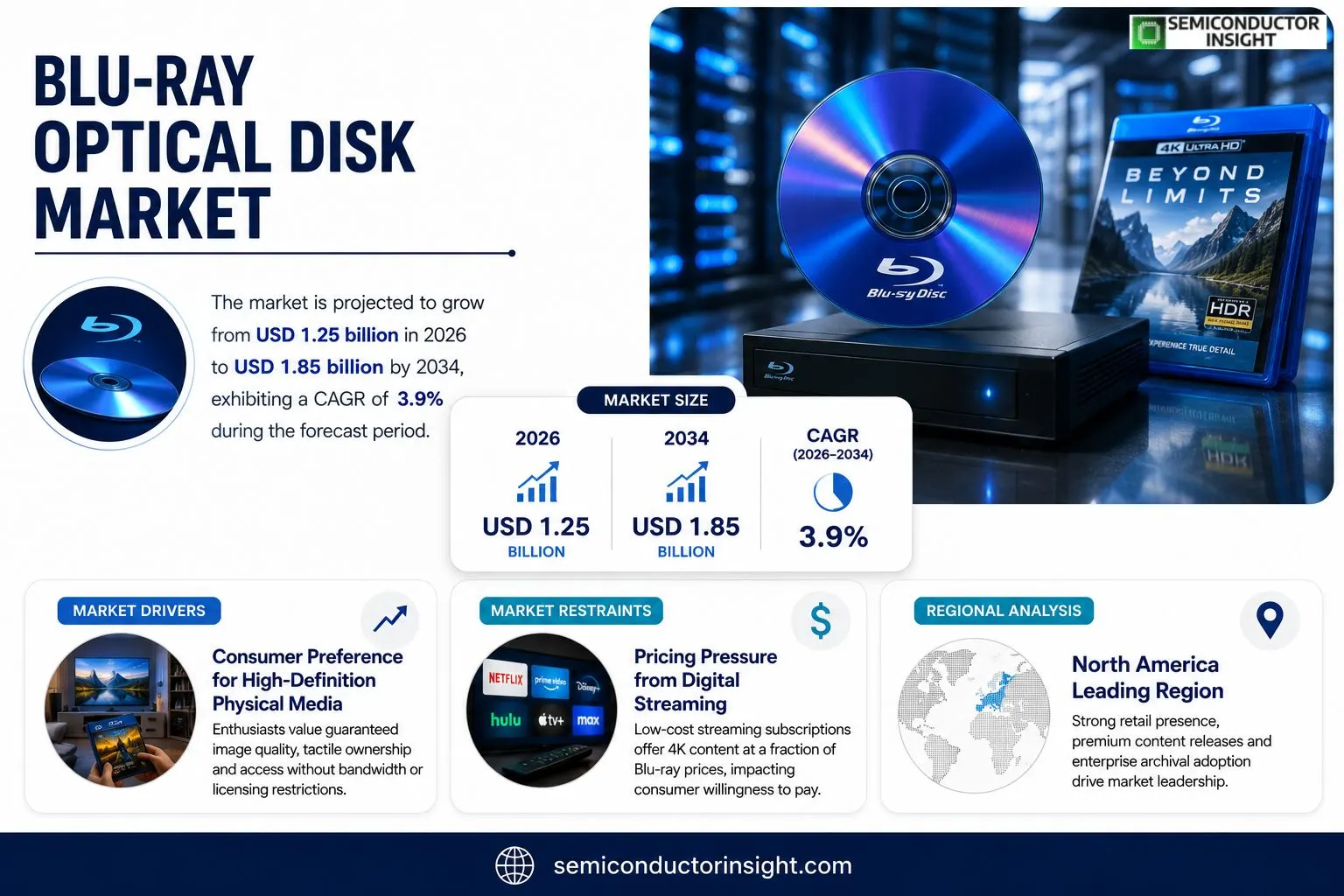
Blu-ray Optical Disk market size was valued at USD 1.20 billion in 2026. The market is projected to grow from USD 1.25 billion in 2026 to USD 1.85 billion by 2034, exhibiting a CAGR of 3.9% during the forecast period.
Blu‑ray Optical Disks are high‑density optical storage media that employ a blue‑violet laser (405 nm) wavelength, enabling up to 50 GB per dual‑layer disc; newer BDXL formats extend capacity beyond 100 GB per disc. They cater both to consumer entertainmentultra‑high‑definition videoand enterprise archiving where long‑term data integrity (often >50 years) is essential.The market is experiencing growth because manufacturers are expanding capacity offerings while enterprise customers seek cost‑effective cold‑storage alternatives amid exploding data volumes. Recent announcementsSony’s launch of next‑generation BDXL drives and Fujifilm’s rollout of archival‑grade discsshow how leading players address demand for higher capacity and reliability. Simultaneously, competition from solid‑state solutions pressures pricing, prompting vendors such as RITEK and CMC Magnetics to innovate on coating technologies and supply‑chain efficiency.
MARKET DRIVERS
Consumer Preference for High‑Definition Physical Media
Even as streaming services dominate broadband usage, a segment of enthusiasts continues to value the tactile experience and guaranteed image fidelity offered by Blu‑ray discs. Physical ownership eliminates concerns about bandwidth caps or regional licensing, prompting retailers to maintain dedicated shelf space for premium titles. This behaviour sustains a baseline demand that buffers the market against short‑term fluctuations in streaming subscriptions.
Industrial Adoption for Archival Storage
Enterprises in media production, aerospace, and government archives cite the long‑term stability of optical media as a safeguard against data loss. The longevity claim of up to 50 years under controlled conditions gives Blu‑ray a pragmatic advantage over magnetic tape, especially for regulatory‑driven record‑keeping. Consequently, bulk‑purchase contracts from institutional buyers contribute a measurable uplift to overall shipments.
➤ Annual unit shipments to institutional customers have risen by roughly 7 % over the past three years, outpacing consumer‑focused growth.
The convergence of enthusiast demand and institutional procurement creates a dual‑track revenue stream. Companies that diversify manufacturing capacity to serve both markets can leverage economies of scale while preserving product differentiation for premium segments.
MARKET CHALLENGES
Pricing Pressure from Digital Streaming
Subscription bundles now bundle 4K content at a fraction of the cost of a single Blu‑ray disc. This price differential forces manufacturers to justify higher unit costs through value‑added features such as special editions, bundled software, or superior audio codecs. Failure to articulate these benefits erodes willingness to pay among price‑sensitive consumers.
Other Challenges
Supply Chain Constraints
Component shortages for high‑precision optical lenses and the limited number of certified replication facilities have extended lead times. When manufacturers cannot meet forecasted demand, retailers defer orders, which in turn amplifies inventory risk across the channel.The combination of aggressive streaming pricing and a fragile supply ecosystem compels producers to re‑evaluate cost structures, potentially shifting some operations to lower‑margin, high‑volume models.
MARKET RESTRAINTS
Declining Retail Shelf Space
Large‑format retailers have reduced floor space allocated to optical media as aisle productivity metrics favor faster‑moving consumer electronics. This contraction limits impulse purchases and diminishes exposure to casual buyers, thereby compressing the lower‑end segment of the market.Moreover, the visibility challenge extends to online marketplaces where algorithmic ranking often privileges newer streaming devices over legacy disc players, further decreasing discoverability for Blu‑ray titles.Retail consolidation trends also mean that regional distributors now serve broader territories, diluting localized promotional efforts and increasing logistical complexity for small‑scale labels.
MARKET OPPORTUNITIES
Emerging Niche Markets in Gaming
High‑definition game installations that exceed the bandwidth of typical USB flash drives are increasingly distributed on Blu‑ray discs. Developers exploit the large capacity (up to 100 GB on triple‑layer discs) to bundle DLC, soundtracks, and art assets, creating a premium product line that commands higher margins.In parallel, indie studios are partnering with boutique publishers to produce limited‑edition physical releases, tapping into collector culture. These collaborations often incorporate unique packaging, holographic inserts, and signed memorabilia, which enhance perceived value and stimulate demand beyond the core gamer base.Finally, emerging markets in Southeast Asia exhibit rising disposable income coupled with improving broadband infrastructure. While streaming adoption is growing, many consumers still prefer owning physical copies for resale or gifting, presenting a geographic growth vector for manufacturers willing to localize packaging and pricing.
Blu-ray Optical Disk Market Trends
Shift Toward Higher‑Capacity Disks
The Blu-ray Optical Disk Market is witnessing a noticeable migration from the legacy 25‑GB tier toward 50‑GB and 100‑GB formats. This evolution is being driven by content creators who require larger storage envelopes for ultra‑high‑definition video, immersive gaming assets, and data‑intensive archival workloads. As production pipelines generate richer media, manufacturers are engineering higher‑density layers without compromising read‑write reliability. The trend matters because it reshapes inventory strategies: distributors must balance legacy stock with emerging formats, while OEMs recalibrate tooling investments to accommodate tighter tolerances. Companies that anticipate the capacity curve can secure premium pricing on next‑generation media, whereas laggards risk margin erosion as customers shift to competitors offering the needed storage envelope.
Other Trends
Enterprise Adoption Accelerates
Beyond consumer entertainment, the Blu-ray Optical Disk Market is gaining traction in corporate environments that value long‑term data integrity. Financial institutions, healthcare providers, and government archives are turning to optical media as a safeguard against ransomware and hard‑drive degradation. The appeal lies in the media’s inherent resistance to magnetic interference and its proven lifespan when stored under controlled conditions. This shift has operational implications: supply chains must incorporate secure logistics, and vendors are developing tamper‑evident packaging to meet compliance standards. Enterprises, in turn, are negotiating longer‑term contracts, prompting manufacturers to offer tiered service agreements that include media testing and certification.
Supply Chain Consolidation among Key Players
Consolidation is reshaping the competitive landscape of the Blu-ray Optical Disk Market. Major manufacturers such as Sony, Panasonic, and Fujifilm are entering strategic alliances with component specialists to streamline wafer sourcing and reduce per‑unit cost. These collaborations are motivated by the need to preserve profit margins in a market where price pressure from alternative storage solutions remains high. By aligning production schedules and sharing R&D outcomes, the leading firms can accelerate time‑to‑market for new capacity grades while mitigating the risk of component shortages. For downstream distributors, the result is a more predictable pricing structure, but it also raises entry barriers for smaller players lacking partnership leverage. The overall effect is a market that rewards scale and coordinated innovation, compelling all participants to reassess their positioning within the value chain.
COMPETITIVE LANDSCAPE
Key Industry Players
Blu‑ray Optical Disk – Competitive Overview
Sony remains the benchmark for high‑capacity Blu‑ray media, leveraging its long‑standing optical disc heritage and an in‑house coating technology that sustains reliability across both consumer and enterprise segments. The company’s ability to marry proprietary laser optics with a distribution network gives it a pricing advantage that pressures smaller manufacturers. Recent investments in 25G and 50G disc formats illustrate Sony’s intent to shape the next wave of data‑intensive applications, from archival storage to 4K video distribution. This strategic positioning forces rivals either to specialize in niche capacities or to form alliances that can match Sony’s scale and R&D intensity.Beyond Sony, the market fragments among a diverse set of players each carving out distinct value propositions. Fujifilm emphasizes high‑density archival solutions for governmental and financial institutions, while Panasonic focuses on consumer‑grade discs with strong brand recall in home entertainment. RITEK and CMC Magnetics dominate the low‑cost, high‑volume segment, exporting large‑scale production to emerging markets. Companies such as Amethystum Storage Tech, Showa Denko and Taiyo Yuden Co excel in specialty substrates that support ultra‑high‑speed write operations, positioning them for data‑center deployments. Falcon Technologies International (FTI) and Philips target professional broadcast equipment manufacturers, offering customized firmware bundles. Lenovo and Tsinghua Unigroup have entered the arena through strategic acquisitions, aiming to integrate optical storage into broader hardware ecosystems. The collective effect is a landscape where scale, niche expertise, and regional reach determine competitive advantage.
List of Key Blu‑ray Optical Disk Companies Profiled
- Sony
- Fujifilm
- Amethystum Storage Tech
- RITEK
- CMC Magnetics
- Hitachi Maxell
- Showa Denko
- Panasonic
- Taiyo Yuden Co
- Falcon Technologies International (FTI)
- Philips
- Lenovo
- Tsinghua Unigroup
Segment Analysis:
| Segment Category | Sub-Segments | Key Insights |
| By Type |
|
High‑Capacity Disks
|
| By Application |
|
Enterprise Storage
|
| By End User |
|
Content Creators & Archivists
|
| By Capacity Tier |
|
Tiered Capacity Strategy
|
| By Distribution Channel |
|
Channel Optimization
|
Regional Analysis: Blu-ray Optical Disk Market
North America
Studios exploit limited‑edition releases, embedding exclusive behind‑the‑scenes footage to justify higher price points. This tactic reinforces Blu‑ray’s relevance among collectors and drives incremental retail traffic.
Companies prioritize Blu‑ray for long‑term records, citing its durability and immune‑to‑network‑risk profile. This niche enterprise usage bolsters overall market stability.
Large‑format retailers allocate dedicated space for Blu‑ray, maintaining visibility that smaller online‑only vendors cannot replicate, thereby sustaining impulse purchases.
Periodic upgrades to disc‑burning hardware prompt a modest resurgence in consumer interest, as enthusiasts replace aging drives with newer, higher‑capacity models.
Europe
European markets display a nuanced relationship with the Blu-ray Optical Disk Market, where cultural appreciation for high‑fidelity media coexists with strong streaming penetration. Major film festivals continue to distribute Blu‑ray editions of award‑winning titles, creating a premium niche that appeals to cinephiles. Retail chains in Germany and the United Kingdom allocate shelf space for curated collections, leveraging local language subtitles to differentiate offerings. Meanwhile, small‑scale indie publishers exploit the format’s durability to reach collectors across the continent, fostering a modest but resilient demand curve.
Asia‑Pacific
The Asia‑Pacific region balances a thriving home‑entertainment culture with a burgeoning gaming sector that relies on Blu‑ray for high‑capacity game discs. Japan remains a hotspot for special edition releases, where limited‑run packaging drives collector enthusiasm. In South Korea, retail promotions pair Blu‑ray movies with popular electronics, reinforcing cross‑category sales. Although streaming services are gaining ground, the tactile experience of owning a physical disc sustains a dedicated consumer segment, particularly in markets where internet bandwidth varies.
South America
South American consumers exhibit a pragmatic approach to the Blu-ray Optical Disk Market, valuing affordability alongside content quality. Retailers in Brazil and Argentina often bundle Blu‑ray titles with budget‑friendly audio‑visual equipment, creating entry points for price‑sensitive buyers. Local distributors focus on popular genressports, music concerts, and family filmsto align with regional viewing preferences. The market’s modest size is offset by occasional spikes tied to major sporting events, when exclusive Blu‑ray compilations generate heightened interest.
Middle East & Africa
In the Middle East and Africa, the Blu-ray Optical Disk Market occupies a niche driven by expatriate communities and premium hotel entertainment systems. Luxury hospitality venues incorporate Blu‑ray libraries to meet discerning guest expectations, prompting a steady procurement rhythm. Meanwhile, smaller urban centers see limited but consistent retail presence, often through specialist electronics outlets. The region’s growth potential hinges on expanding distribution networks and localized content that resonates with diverse cultural audiences.
Report Scope
This market research report provides a comprehensive analysis of the Blu-ray Optical Disk Market , covering the forecast period 2026–2034. It offers detailed insights into market dynamics, technological advancements, competitive landscape, and key trends shaping the industry.
Key focus areas of the report include:
- Market Overview: The report begins with an overview outlining its current market scenario, key growth indicators, and industry transformation drivers. It discusses macroeconomic factors, demand–supply balance, regulatory landscape, and the strategic role of semiconductors in powering advancements across industries such as automotive, telecommunications, consumer electronics, and industrial automation.
- Market Size & Forecast: Historical data and future projections for revenue, unit shipments, and market value across major regions and segments.
- Segmentation Analysis: Detailed breakdown by product type, technology, application, and end-user industry to identify high-growth segments and investment opportunities.
- Regional Insights: Insights into market performance across North America, Europe, Asia-Pacific, Latin America, and the Middle East & Africa, including country-level analysis where relevant.
- Competitive Landscape: Profiles of leading market participants, including their product offerings, R&D focus, manufacturing capacity, pricing strategies, and recent developments such as mergers, acquisitions, and partnerships.
- Technology Trends & Innovation: Assessment of emerging technologies, integration of AI/IoT, semiconductor design trends, fabrication techniques, and evolving industry standards.
- Market Drivers & Restraints: Evaluation of factors driving market growth along with challenges, supply chain constraints, regulatory issues, and market-entry barriers.
- Stakeholder Insights: Insights for component suppliers, OEMs, system integrators, investors, and policymakers regarding the evolving ecosystem and strategic opportunities.
Primary and secondary research methods are employed, including interviews with industry experts, data from verified sources, and real-time market intelligence to ensure the accuracy and reliability of the insights presented.
FREQUENTLY ASKED QUESTIONS:
What is the current market size of Blu-ray Optical Disk Market?
-> Blu-ray Optical Disk Market was valued at USD million in 2024 and is projected to reach USD million by 2031 at a CAGR of % during the forecast period.
Which key companies operate in Blu-ray Optical Disk Market?
-> Key players include Sony, Fujifilm, Amethystum Storage Tech, RITEK, CMC Magnetics, Hitachi Maxell, Showa Denko, Panasonic, Taiyo Yuden Co, Falcon Technologies International (FTI), among others.
What are the key growth drivers?
-> Key growth drivers include increasing demand for high‑capacity storage in consumer and enterprise applications, advancements in optical technology, and growth of 4K/8K media content.
Which region dominates the market?
-> Asia shows the largest revenue share, with China and Japan leading, while North America follows as a strong market.
What are the emerging trends?
-> Emerging trends include development of 25G, 50G and 100G Blu‑ray capacities, integration with cloud backup solutions, and sustainability initiatives in disk manufacturing.

Get Sample Report PDF for Exclusive Insights
Report Sample Includes
- Table of Contents
- List of Tables & Figures
- Charts, Research Methodology, and more...
 Download Sample Report PDF