Blu-ray Jukeboxes Market Insights
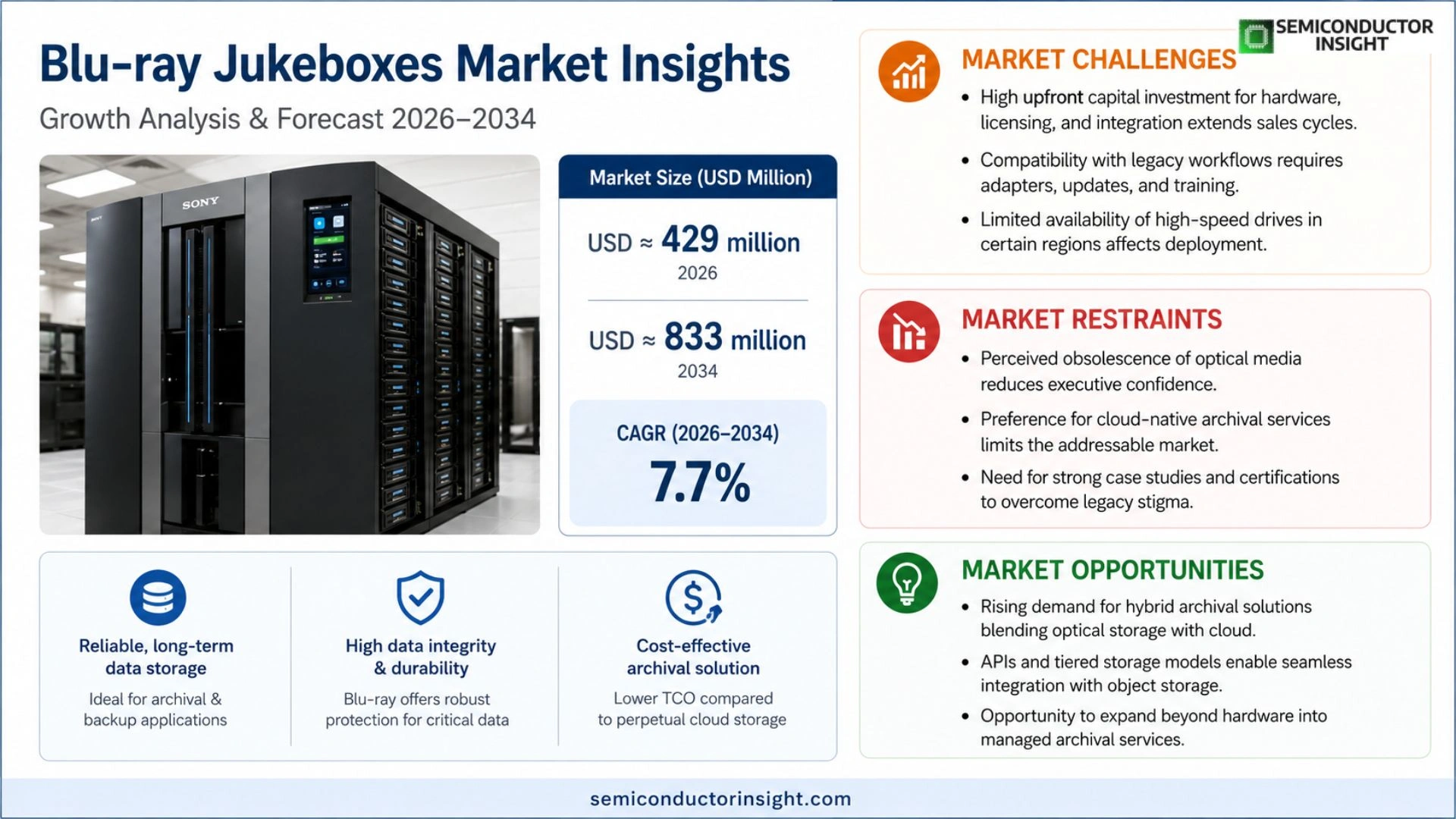
Blu-ray Jukeboxes market size will grow from USD 429 million in 2026 to USD 833 million by 2034, showing a CAGR of roughly 7.7% during the forecast period.
A Blu‑ray jukebox is engineered to accommodate multiple Blu‑ray writers that inscribe BD discs; such media can retain data for more than fifty years, making the solution attractive for long‑term archival strategies.
The upward trajectory is fueled by expanding data‑preservation requirements across media & entertainment firms, growing adoption of high‑capacity optical storage in government archives, continued investment in optical drive technology that improves write speed and reliability, and rising awareness of the cost advantages of optical media versus magnetic tape for cold‑storage workloads.
MARKET DRIVERS
Enterprise Data Archiving Needs
Enterprises handling terabytes of video assets are gravitating toward optical tiered storage because it offers a predictable cost per gigabyte and immunity to magnetic degradation. In the Blu‑ray Jukeboxes Market, the ability to stack multiple discs in a robotic carousel reduces floor space, a factor that resonates with data centers operating under tight real‑estate constraints. Long‑term retention at low power draw further strengthens the value proposition.
Regulatory Compliance Pressures
Legislation governing media preservation, such as standards for broadcast archives and cultural heritage institutions, demands media that sustain integrity over decades. Optical media’s closed‑system architecture and inherent write‑once capability align well with audit‑trail requirements, prompting organizations to allocate budget toward jukebox solutions that can certify archival fidelity. Compliance‑driven procurement therefore fuels adoption.
➤ “For organizations where data loss translates directly to revenue risk, the deterministic reliability of Blu‑ray remains the preferred fallback to cloud‑based tiers.”
The convergence of cost pressures, space efficiency, and compliance mandates creates a fertile environment for vendors that can deliver high‑capacity cartridges and seamless integration with existing backup software. Companies that bundle analytics dashboards to monitor disc health stand to capture a larger share of Blu-ray Jukeboxes market.
MARKET CHALLENGES
High Upfront Capital Investment
Deploying a robotic jukebox requires a sizeable initial outlay for hardware, firmware licensing, and integration services. Mid‑size firms often defer such projects until a clear return‑on‑investment horizon emerges, which can elongate sales cycles. The perception of a steep cost barrier slows momentum, even when total cost of ownership favors optical over perpetual cloud spend.
Other Challenges
Compatibility with Legacy Workflows
Many archival pipelines were built around tape or magnetic disk interfaces. Retrofitting these environments with Blu‑ray controllers necessitates software adapters, driver updates, and staff training. The transitional friction can deter IT departments that lack dedicated storage engineers.
Furthermore, the limited availability of high‑speed optical drives in certain regions adds a geographic dimension to the challenge, compelling vendors to establish localized service networks to sustain confidence.
MARKET RESTRAINTS
Perceived Obsolescence of Optical Media
Industry narratives that label optical storage as a relic of the early 2000s linger in executive briefings. This perception dampens enthusiasm, especially among newer IT leaders who favor purely software‑defined storage models. Overcoming the stigma requires demonstrable case studies and third‑party certifications that validate long‑term durability.
Additionally, the rapid evolution of cloud-native archival services creates a competitive backdrop; organizations may opt for subscription‑based offerings to avoid hardware management, thereby limiting the addressable pool for jukebox providers.
MARKET OPPORTUNITIES
Hybrid Archival Solutions
Clients are increasingly seeking layered strategies that blend on‑premise optical capacity with cloud tiering for instant retrieval. Vendors that deliver APIs enabling seamless offload of selected titles to object storage can position themselves as indispensable partners in a hybrid model, unlocking new revenue streams beyond hardware sales.
Emerging segments such as media production houses and educational repositories are allocating budgets toward ultra‑high‑capacity Blu‑ray cartridges (up to 300 GB per disc). Tailoring jukebox firmware to support automatic metadata tagging and checksum verification can differentiate offerings and accelerate market penetration.
Blu-ray Jukeboxes Market Trends
Shift Toward High‑Capacity 50 TB and 100 TB Systems
The latest sales data show that customers are gravitating to 50 TB and 100 TB jukebox configurations, a movement driven by the need for long‑term preservation of large multimedia libraries. Archivists in cultural institutions cite the 50‑plus‑year media lifespan of BD discs as a decisive factor when selecting storage solutions. As content volumes swell,especially with 4K and immersive media,the economics of a single high‑capacity unit begin to outweigh the operational overhead of multiple lower‑capacity devices. This trend also aligns with enterprise IT policies that favor tiered storage; Blu‑ray Jukeboxes Market players are responding by bundling advanced robotics with remote‑management software, thereby shortening deployment cycles and reducing total cost of ownership.
Other Trends
Emerging Demand from Government Archives
Public‑sector agencies, particularly in North America and Europe, are updating legacy record‑keeping practices to meet stringent compliance timelines. The audit‑ready nature of optical media,immune to electromagnetic interference and offering immutable write‑once capability,makes Blu‑ray Jukeboxes a preferred option for classified document repositories. Recent procurement notices reveal contracts exceeding $20 million for multi‑year supply of 300 TB and larger formats, reflecting confidence in the durability of BD‑based storage. Vendors are therefore allocating R&D resources toward hardened chassis designs and tamper‑evident seals, features that address the security concerns unique to governmental deployments.
Intensifying Competitive Landscape in Asia‑Pacific
Manufacturers based in China, Japan, and South Korea are accelerating product roll‑outs that combine higher platter densities with AI‑optimized disc handling algorithms. The regional share of global shipments rose to roughly 45 % in 2024, propelled by aggressive pricing strategies and localized after‑sales networks. This surge forces established Western players such as DISC and Sony to reassess their value propositions, prompting collaborations with regional component suppliers to lower bill‑of‑materials costs. The competitive pressure is prompting the industry to explore hybrid solutions,pairing optical media with cloud‑based metadata services,to retain relevance in a market where data‑centric workflows are increasingly hybrid in nature.
COMPETITIVE LANDSCAPE
Key Industry Players
Competitive dynamics in the global Blu‑ray Jukeboxes market, 2024‑2031
The segment is dominated by a handful of manufacturers that have leveraged long‑term archival expertise to secure bulk contracts with data‑intensive enterprises. DISC, with its early entry into high‑capacity optical libraries, commands a sizable share by offering modular designs that integrate seamlessly with existing storage infrastructures. HP’s acquisition of a niche optical‑robotics firm has broadened its portfolio, allowing it to bundle Blu‑ray jukeboxes with its broader enterprise storage solutions, which appeals to organizations seeking a single‑vendor footprint. Sony and Panasonic continue to differentiate through advanced media handling algorithms that reduce latency and improve media longevity, positioning them as preferred suppliers for government and financial institutions that prioritize data integrity over pure cost considerations.
Beyond the marquee names, several regionally focused players are carving out profitable niches. Beijing Dynamic Media and Shanghai Bctop have leveraged domestic supply chains to deliver cost‑effective units for Chinese educational and broadcasting entities. Tsinghua Tongfang’s emphasis on energy‑efficient architectures has attracted utilities seeking to extend archival storage without inflating power budgets. Nanjing Superstack, Powerfile, and newer entrants such as LG and Fujitsu are expanding their product lines to include higher‑density (100 TB – 500 TB) tiers, thereby addressing the emerging demand for petabyte‑scale cold storage in research labs and media archives. These firms often partner with system integrators to provide custom‑engineered solutions, reinforcing a fragmented yet highly competitive landscape where differentiation hinges on engineering nuance, service contracts, and regional support capabilities.
List of Key Blu‑ray Jukeboxes Companies Profiled
- DISC
- HP
- JVC
- Panasonic
- Sony
- Powerfile
- Beijing Dynamic Media
- Shanghai Bctop
- Tsinghua Tongfang
- Nanjing Superstack
- LG
- Fujitsu
- Western Digital
- Seagate
- IBM
Segment Analysis:
| Segment Category | Sub-Segments | Key Insights |
| By Type |
|
High‑Capacity Tier dominates the conversation because it aligns with long‑term archival strategies.
|
| By Application |
|
Broadcast & Media Archives emerge as the primary application driver.
|
| By End User |
|
Large Enterprises lead adoption because they require robust, compliance‑friendly storage.
|
| By Capacity |
|
High Capacity segment is viewed as the growth engine.
|
| By Deployment |
|
Hybrid Cloud Integrated Solutions are gaining momentum as organizations seek seamless data tiering.
|
Regional Analysis: Blu-ray Jukeboxes Market
North America
Enthusiasts in this region favor Blu‑ray jukeboxes that support 4K HDR playback, pairing them with premium sound systems. The willingness to invest in bundled ecosystems underscores the importance of brand trust and after‑sales service.
Early‑stage integration of AI‑driven recommendation engines into jukebox interfaces is gaining traction, allowing users to discover content without manual browsing.
A handful of legacy electronics firms dominate, yet niche start‑ups differentiate through customizable cabinet finishes and limited‑edition disc libraries.
Proximity to major component manufacturers shortens lead times, enabling retailers to replenish inventory swiftly in response to seasonal spikes.
Europe
European buyers demonstrate a measured enthusiasm for Blu‑ray jukeboxes, often linking them to a broader resurgence in home cinema projects. Cultural emphasis on design excellence drives demand for units that marry aesthetic appeal with technical performance. Operators capitalize on this by offering region‑specific content collections, including classic cinema archives that resonate with local tastes. Regulatory frameworks surrounding media distribution also influence catalog composition, prompting suppliers to tailor their portfolios to meet compliance standards across the EU.
Asia‑Pacific
In Asia‑Pacific, the market narrative is colored by a youthful demographic that balances streaming convenience with a growing nostalgia for physical media. Urban centers witness pop‑up showrooms where consumers can experience high‑resolution playback firsthand, a tactic that bridges the gap between digital curiosity and tactile ownership. Partnerships with local entertainment studios are fostering exclusive releases, positioning Blu‑ray jukeboxes as conduits for region‑specific blockbuster titles.
South America
South American interest in Blu‑ray jukeboxes is anchored in a vibrant film culture that values collector’s editions and director’s cuts. Retail outlets often bundle devices with locally produced documentaries, enhancing perceived value. While price sensitivity remains a factor, the emergence of financing options through appliance retailers has broadened accessibility, encouraging a gradual expansion of the installed base.
Middle East & Africa
The Middle East & Africa region reflects a niche yet discerning segment of consumers who link Blu‑ray jukeboxes with luxury home entertainment. High‑income households in urban hubs prioritize sophisticated audio‑visual integration, prompting suppliers to showcase premium finishes and bespoke installation services. Meanwhile, emerging markets within the region are beginning to explore entry‑level models, setting the stage for incremental growth as infrastructure improves.
Report Scope
This market research report provides a comprehensive analysis of the Blu-ray Jukeboxes Market , covering the forecast period 2026–2034. It offers detailed insights into market dynamics, technological advancements, competitive landscape, and key trends shaping the industry.
Key focus areas of the report include:
- Market Overview: The report begins with an overview outlining its current market scenario, key growth indicators, and industry transformation drivers. It discusses macroeconomic factors, demand–supply balance, regulatory landscape, and the strategic role of semiconductors in powering advancements across industries such as automotive, telecommunications, consumer electronics, and industrial automation.
- Market Size & Forecast: Historical data and future projections for revenue, unit shipments, and market value across major regions and segments.
- Segmentation Analysis: Detailed breakdown by product type, technology, application, and end-user industry to identify high-growth segments and investment opportunities.
- Regional Insights: Insights into market performance across North America, Europe, Asia-Pacific, Latin America, and the Middle East & Africa, including country-level analysis where relevant.
- Competitive Landscape: Profiles of leading market participants, including their product offerings, R&D focus, manufacturing capacity, pricing strategies, and recent developments such as mergers, acquisitions, and partnerships.
- Technology Trends & Innovation: Assessment of emerging technologies, integration of AI/IoT, semiconductor design trends, fabrication techniques, and evolving industry standards.
- Market Drivers & Restraints: Evaluation of factors driving market growth along with challenges, supply chain constraints, regulatory issues, and market-entry barriers.
- Stakeholder Insights: Insights for component suppliers, OEMs, system integrators, investors, and policymakers regarding the evolving ecosystem and strategic opportunities.
Primary and secondary research methods are employed, including interviews with industry experts, data from verified sources, and real-time market intelligence to ensure the accuracy and reliability of the insights presented.
FREQUENTLY ASKED QUESTIONS:
What is the current market size of Blu-ray Jukeboxes Market?
-> Blu-ray Jukeboxes market size will grow from USD 429 million in 2026 to USD 833 million by 2034, showing a CAGR of roughly 7.7%
Which key companies operate in Blu-ray Jukeboxes Market?
-> Key players include DISC, HP, JVC, Panasonic, Sony, Powerfile, Beijing Dynamic Media, Shanghai Bctop, Tsinghua Tongfang, Nanjing Superstack, among others.
What are the key growth drivers?
-> Key growth drivers include the long‑term archive life of 50+ years for Blu‑ray discs, increasing demand for high‑capacity archival storage, and the adoption of multi‑writer jukebox architectures.
Which region dominates the market?
-> Region dominance information is not disclosed in the available data.
What are the emerging trends?
-> Emerging trends include development of higher capacity segments such as 50 TB, 100 TB and beyond, and the integration of multiple Blu‑ray writers to enhance throughput and reliability for enterprise archival solutions.
Get Sample Report PDF for Exclusive Insights
Report Sample Includes
- Table of Contents
- List of Tables & Figures
- Charts, Research Methodology, and more...
 Download Sample Report PDF