Blood Pressure Monitor (Oscillometric) SoC Market Insights
Blood Pressure Monitor (Oscillometric) SoC Market size was valued at USD 1.87 billion in 2025. The market is projected to grow from USD 2.03 billion in 2026 to USD 3.94 billion by 2034, exhibiting a CAGR of 7.6% during the forecast period.
Oscillometric blood pressure monitor System-on-Chip (SoC) solutions are highly integrated semiconductor devices designed to power automated, non-invasive blood pressure measurement in clinical and consumer-grade devices. These SoCs combine analog front-end circuitry, pressure signal acquisition, digital signal processing, and microcontroller functionality into a single chip, enabling accurate detection of arterial oscillations to derive systolic, diastolic, and mean arterial pressure readings. The technology supports a broad range of form factors, including wrist-worn monitors, upper-arm cuffs, and ambulatory blood pressure monitoring (ABPM) devices.
The market is witnessing sustained momentum driven by the rising global prevalence of hypertension, which affects an estimated 1.28 billion adults worldwide according to the World Health Organization, combined with a growing shift toward home-based and remote patient monitoring. Furthermore, advancements in low-power mixed-signal IC design and the integration of Bluetooth and Wi-Fi connectivity within oscillometric SoCs are expanding device capabilities. Key industry participants such as Texas Instruments Inc., Microchip Technology Inc., and Analog Devices, Inc. continue to innovate within this space, offering purpose-built SoC platforms that meet the stringent accuracy and power efficiency demands of next-generation blood pressure monitoring devices.
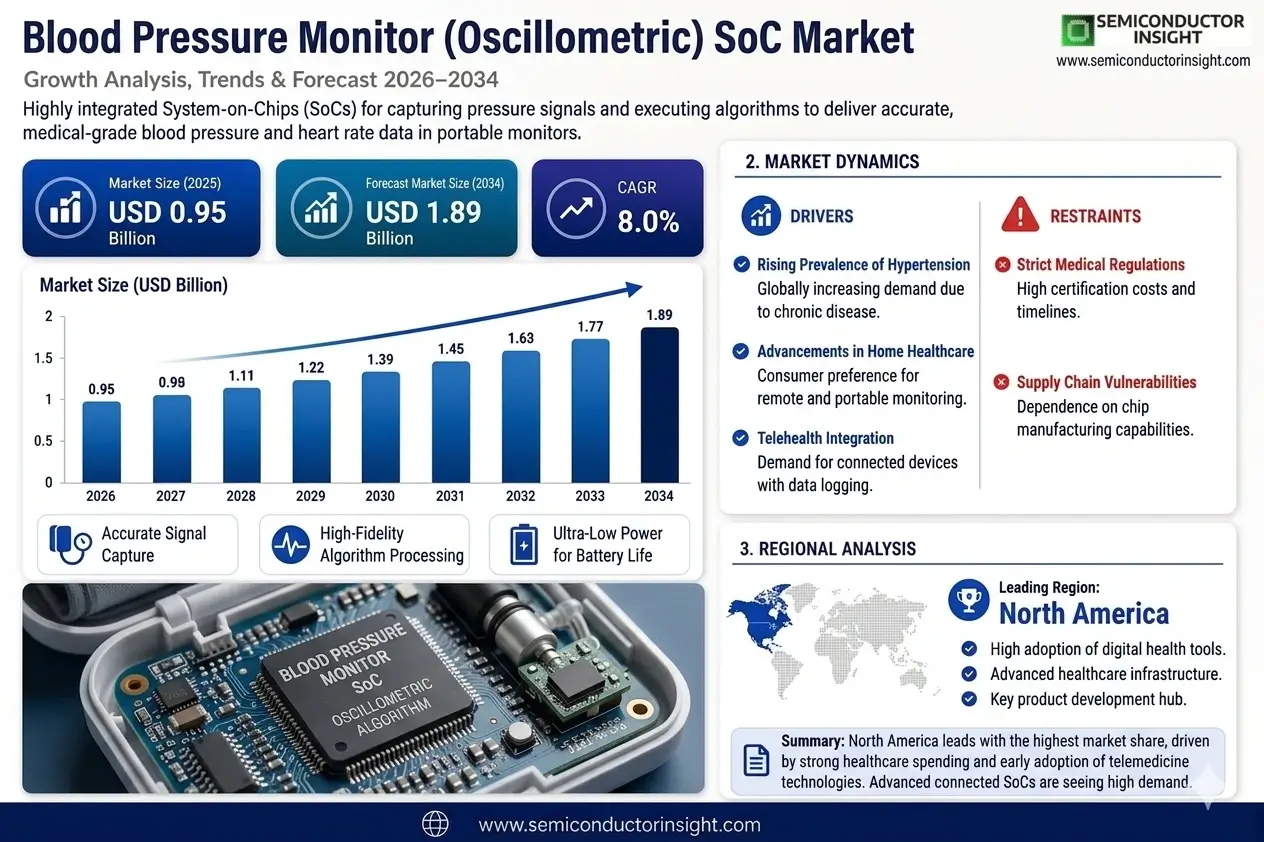
MARKET DRIVERS
Rising Prevalence of Hypertension Fueling Demand for Oscillometric Blood Pressure Monitoring Solutions
The global burden of hypertension continues to expand at a significant pace, creating sustained demand for accurate and cost-effective monitoring technologies. Blood Pressure Monitor (Oscillometric) SoC Market is directly benefiting from this epidemiological trend, as oscillometric measurement remains the dominant method in both clinical and home-use blood pressure monitors. Healthcare systems worldwide are prioritizing early detection and continuous monitoring of cardiovascular risk factors, which is reinforcing the integration of dedicated System-on-Chip (SoC) solutions into next-generation blood pressure monitoring devices. The shift toward preventive healthcare and patient self-monitoring has accelerated adoption of compact, power-efficient oscillometric SoCs across a broad range of device form factors.
Growth of Home Healthcare and Wearable Medical Devices Accelerating SoC Integration
The rapid expansion of the home healthcare segment is one of the most prominent drivers shaping Blood Pressure Monitor (Oscillometric) SoC Market. Consumers are increasingly seeking reliable, user-friendly devices that deliver clinical-grade accuracy outside of traditional medical settings. This has prompted device manufacturers to adopt highly integrated oscillometric SoCs that consolidate analog front-end signal conditioning, analog-to-digital conversion, pressure sensing interfaces, and digital signal processing into a single chip. The result is a significant reduction in device footprint, bill-of-materials cost, and power consumption , all critical factors for portable and wrist-worn blood pressure monitors. The proliferation of connected health wearables and IoT-enabled monitoring platforms is further intensifying the demand for feature-rich oscillometric SoCs with wireless connectivity support.
➤ The convergence of miniaturization, low-power design, and high-accuracy analog signal processing within oscillometric SoC architectures is enabling a new generation of continuous and on-demand blood pressure monitoring solutions, bridging the gap between consumer wellness devices and clinical diagnostic tools.
Technological advancements in semiconductor fabrication, particularly the adoption of advanced CMOS process nodes, have empowered SoC vendors to deliver higher levels of integration with improved noise performance and reduced power envelopes. Leading semiconductor companies are investing in algorithm co-development alongside hardware design to enhance the clinical accuracy of oscillometric measurement within their SoC platforms. This symbiosis between hardware capability and embedded software sophistication is a key differentiator in the competitive landscape of Blood Pressure Monitor (Oscillometric) SoC Market, driving both innovation and vendor consolidation as device OEMs seek comprehensive, validated platform solutions.
MARKET CHALLENGES
Stringent Regulatory Requirements and Clinical Validation Protocols Presenting Barriers for SoC Vendors
One of the most significant challenges confronting participants Blood Pressure Monitor (Oscillometric) SoC Market is the complex and evolving regulatory landscape governing medical-grade blood pressure monitoring devices. SoC solutions intended for use in clinically validated blood pressure monitors must conform to internationally recognized standards such as ISO 81060-2 and ANSI/AAMI SP10, which impose rigorous requirements on measurement accuracy, repeatability, and interference immunity. Achieving and maintaining compliance with these standards demands substantial investment in clinical testing, algorithm validation, and ongoing regulatory surveillance. For smaller semiconductor vendors and new market entrants, these barriers can constrain market access and extend product development timelines considerably, limiting the pace of innovation within the oscillometric SoC ecosystem.
Other Challenges
Intense Price Pressure from Low-Cost Regional Manufacturers
The commoditization of entry-level oscillometric blood pressure monitor SoCs, particularly driven by a concentration of low-cost semiconductor suppliers in the Asia-Pacific region, is exerting downward pressure on average selling prices across the market. While this trend improves accessibility for budget-conscious device manufacturers, it simultaneously compresses profit margins for established SoC vendors and reduces the financial headroom available for research and development investment. Maintaining differentiation through advanced features such as atrial fibrillation detection, multi-user profile management, and Bluetooth Low Energy connectivity is becoming increasingly important for premium SoC suppliers seeking to defend their market positioning against aggressive low-cost competition.
Signal Processing Complexity and Motion Artifact Management
Accurate oscillometric blood pressure measurement is inherently susceptible to motion artifacts, irregular heart rhythms, and patient-related variability, all of which impose demanding requirements on the embedded signal processing algorithms within the SoC. Developing robust artifact rejection and measurement validation algorithms that perform reliably across diverse patient populations , including elderly users and those with cardiovascular conditions , represents a persistent technical challenge. Balancing algorithmic sophistication with the power and computational constraints of a compact SoC architecture requires significant engineering expertise and ongoing refinement, posing a continuous challenge for design teams across Blood Pressure Monitor (Oscillometric) SoC Market.
MARKET RESTRAINTS
High Development Costs and Extended Certification Timelines Constraining Market Expansion
The development of a commercially viable oscillometric SoC for medical blood pressure monitoring entails substantial non-recurring engineering costs, spanning analog circuit design, embedded firmware development, clinical algorithm validation, and regulatory certification support. These upfront investments can be prohibitive for mid-sized semiconductor companies, effectively limiting the competitive pool of credible SoC suppliers and concentrating market share among a relatively small number of well-capitalized vendors. The extended timelines associated with securing regulatory clearance for blood pressure monitoring devices , which downstream OEM customers must navigate before bringing products to market , can also slow the commercial uptake of newly introduced SoC platforms, creating a lag between technology readiness and revenue realization withBlood Pressure Monitor (Oscillometric) SoC Market.
Supply Chain Vulnerabilities and Semiconductor Component Availability Risks
Global semiconductor supply chain disruptions, which have intermittently affected multiple end markets, present a meaningful restraint on the consistent growth of Blood Pressure Monitor (Oscillometric) SoC Market. Blood pressure monitor OEMs sourcing oscillometric SoCs from a limited number of qualified suppliers face concentration risk, and any disruption to foundry capacity, raw material availability, or logistics can translate directly into device production delays and inventory shortfalls. While many device manufacturers have responded by qualifying secondary sources or increasing safety stock levels, the structural dependency on specialized analog and mixed-signal fabrication capacity remains a systemic vulnerability. This supply chain sensitivity can suppress market growth momentum, particularly during periods of elevated global semiconductor demand from competing end markets such as automotive electronics and consumer IoT.
MARKET OPPORTUNITIES
Emergence of AI-Enabled Continuous Blood Pressure Monitoring Creating New SoC Design Requirements
The growing clinical and consumer interest in continuous, cuffless, and AI-assisted blood pressure monitoring is opening a significant new opportunity horizon for Blood Pressure Monitor (Oscillometric) SoC Market. Research advances in photoplethysmography-based calibration combined with oscillometric reference measurements are creating demand for hybrid SoC architectures capable of supporting multi-modal biosignal acquisition and real-time machine learning inference at the edge. SoC vendors that proactively invest in neural processing unit integration, ultra-low-power sensor interfaces, and secure data management capabilities are well positioned to capture design wins in the next generation of intelligent blood pressure monitoring platforms targeting both clinical and high-acuity consumer segments.
Expanding Telehealth Infrastructure and Remote Patient Monitoring Programs Driving Institutional Procurement
The accelerated global adoption of telehealth services and structured remote patient monitoring programs represents a compelling demand catalyst for Blood Pressure Monitor (Oscillometric) SoC Market. Healthcare providers and payers are increasingly deploying connected blood pressure monitors as part of chronic disease management protocols for hypertensive patients, driving institutional procurement of devices that integrate oscillometric SoCs with robust wireless communication and cloud connectivity capabilities. This institutional channel, complementing the established consumer retail market, provides SoC suppliers with access to higher-volume, quality-sensitive procurement opportunities. Markets across North America, Europe, and rapidly developing healthcare systems in Asia-Pacific and Latin America represent significant geographic growth vectors, as governments and health insurers expand reimbursement frameworks for remote monitoring technologies and digital health infrastructure investment continues to scale.
Blood Pressure Monitor (Oscillometric) SoC Market Trends
Rising Hypertension Prevalence Driving Demand for Oscillometric SoC Solutions
Blood Pressure Monitor (Oscillometric) SoC Market is experiencing sustained growth momentum, underpinned by the escalating global burden of hypertension. According to the World Health Organization, an estimated 1.28 billion adults worldwide are affected by high blood pressure, creating a consistent and expanding demand for accurate, non-invasive blood pressure monitoring devices. Oscillometric SoC platforms, which integrate analog front-end circuitry, pressure signal acquisition, digital signal processing, and microcontroller functionality into a single chip, are increasingly positioned as the technology of choice for both clinical-grade and consumer-facing monitoring solutions. This convergence of health urgency and semiconductor innovation is a defining trend shaping the trajectory of the market.
Other Trends
Integration of Wireless Connectivity Within Oscillometric SoC Platforms
A prominent trend Blood Pressure Monitor (Oscillometric) SoC Market is the growing integration of Bluetooth and Wi-Fi connectivity directly within SoC architectures. This advancement enables seamless data transmission to smartphones, cloud platforms, and telehealth systems, supporting the broader shift toward remote patient monitoring and connected health ecosystems. Purpose-built SoC platforms from leading industry participants such as Texas Instruments Inc., Microchip Technology Inc., and Analog Devices, Inc. are increasingly designed to meet both accuracy and wireless communication requirements, reflecting the market’s evolution toward smarter, network-enabled blood pressure devices.
Shift Toward Home-Based and Ambulatory Blood Pressure Monitoring
Consumer preference is increasingly moving away from clinical settings toward home-based monitoring, a trend that is significantly influencing oscillometric SoC design priorities. Devices such as wrist-worn monitors, upper-arm cuffs, and ambulatory blood pressure monitoring (ABPM) systems require SoCs that deliver clinical-grade accuracy within compact, energy-efficient form factors. This demand is accelerating innovation in low-power mixed-signal IC design, enabling manufacturers to develop devices capable of continuous or periodic monitoring without compromising battery life or measurement reliability.
Advancements in Low-Power Mixed-Signal IC Design Reshaping the Competitive Landscape
Blood Pressure Monitor (Oscillometric) SoC Market is also being shaped by rapid advancements in low-power mixed-signal integrated circuit design. As device manufacturers prioritize portability and extended operational life, SoC vendors are responding with highly optimized architectures that reduce power consumption without sacrificing signal fidelity. This technical progression is broadening the addressable application range for oscillometric SoC solutions, from traditional clinical environments to emerging wearable and continuous monitoring use cases, further reinforcing the long-term growth outlook for the market.
COMPETITIVE LANDSCAPEKey Industry Players
Blood Pressure Monitor (Oscillometric) SoC Market: Competitive Dynamics and Leading Innovators
Blood Pressure Monitor (Oscillometric) SoC Market is characterized by the strong presence of established semiconductor and mixed-signal IC manufacturers that have developed purpose-built platforms targeting the stringent accuracy, power efficiency, and regulatory compliance requirements of clinical and consumer blood pressure monitoring devices. Texas Instruments Inc. maintains a prominent position in this space, offering integrated analog front-end and microcontroller solutions widely adopted across upper-arm cuff and ambulatory blood pressure monitoring (ABPM) form factors. Analog Devices, Inc. similarly commands significant market share through its precision signal chain and low-power mixed-signal SoC offerings, while Microchip Technology Inc. contributes through a broad portfolio of microcontroller and analog IP that supports oscillometric pressure signal acquisition and processing. These leading players continue to drive innovation by embedding Bluetooth Low Energy (BLE) and Wi-Fi connectivity within their SoC platforms, enabling seamless integration with remote patient monitoring ecosystems and telehealth infrastructure.
Beyond the dominant tier, the competitive landscape includes several specialized and regionally significant players addressing niche segments such as wrist-worn monitors, pediatric monitoring devices, and ABPM systems. Companies such as NXP Semiconductors and STMicroelectronics have expanded their medical-grade SoC portfolios to address the growing demand for connected, low-power blood pressure monitoring solutions, particularly in Asia-Pacific and European markets where hypertension management programs are scaling rapidly. Renesas Electronics and Silicon Laboratories (Silicon Labs) also contribute competitive offerings, with a focus on ultra-low-power design architectures suited for wearable and ambulatory applications. The market continues to attract fabless semiconductor firms and IP licensing companies developing oscillometric algorithm cores and reference designs that OEM device manufacturers can integrate into customized SoC implementations, further intensifying competitive pressure across both the value and premium segments of the market.
List of Key Blood Pressure Monitor (Oscillometric) SoC Companies Profiled
- Texas Instruments Inc.
- Analog Devices, Inc.
- Microchip Technology Inc.
- NXP Semiconductors N.V.
- STMicroelectronics N.V.
- Renesas Electronics Corporation
- Silicon Laboratories Inc.
- Infineon Technologies AG
- Nordic Semiconductor ASA
- Maxim Integrated Products, Inc. (now part of Analog Devices)
- Qualcomm Technologies, Inc.
- MediaTek Inc.
- Ambiq Micro, Inc.
- EM Microelectronic (EM Marin)
- Nuvoton Technology Corporation
Segment Analysis:
| Segment Category | Sub-Segments | Key Insights |
| By Type |
|
Fully Integrated Oscillometric SoC is the leading segment in the Blood Pressure Monitor SoC market, driven by the compelling advantages it offers to device manufacturers and end users alike.
|
| By Application |
|
Upper-Arm Blood Pressure Monitors retain their position as the dominant application segment for oscillometric SoC integration, owing to their well-established clinical validation and widespread acceptance across both professional and home-use settings.
|
| By End User |
|
Home Care / Individual Consumers represent the fastest-growing and increasingly dominant end-user segment in the oscillometric blood pressure monitor SoC market, propelled by macro-level shifts in healthcare delivery models and patient empowerment trends.
|
| By Connectivity |
|
Bluetooth-Enabled SoC leads the connectivity segment as the preferred wireless integration standard for oscillometric blood pressure monitoring devices across both consumer and clinical applications.
|
| By Power Architecture |
|
Ultra-Low Power SoC is emerging as the most strategically important power architecture segment, reflecting the overarching design priorities of the blood pressure monitor market as it migrates toward wearable, portable, and continuously monitoring form factors.
|
Regional Analysis: Blood Pressure Monitor (Oscillometric) SoC Market
North America
North America leads Blood Pressure Monitor (Oscillometric) SoC Market in chip-level innovation, with semiconductor companies pioneering ultra-low-power architectures and high-resolution analog front-end designs. The integration of AI-assisted signal processing within oscillometric SoCs is progressing rapidly, with several U.S.-based firms investing heavily in algorithm optimization for improved blood pressure waveform analysis and clinical accuracy certification.
The stringent yet well-structured regulatory environment in North America provides a competitive advantage for established oscillometric SoC developers. FDA clearance pathways incentivize rigorous product development cycles, raising the quality benchmark across the blood pressure monitor SoC ecosystem and discouraging underdeveloped solutions from gaining market traction in clinical and consumer segments alike.
A well-funded healthcare infrastructure, combined with high consumer health awareness, propels demand for advanced blood pressure monitoring devices powered by oscillometric SoC technology. Hospitals, outpatient clinics, and home care settings across the United States and Canada are progressively transitioning to digitally connected monitoring solutions, creating sustained procurement cycles for SoC component suppliers throughout the region.
Venture capital activity and strategic mergers in the North American medtech and semiconductor sectors are actively reshaping Blood Pressure Monitor (Oscillometric) SoC Market landscape. Collaborative agreements between SoC designers and wearable device manufacturers are fostering integrated development roadmaps, accelerating time-to-market and enabling more compact, feature-rich oscillometric monitoring chipsets for next-generation consumer and clinical platforms.
Europe
Europe represents a highly mature and strategically significant region withBlood Pressure Monitor (Oscillometric) SoC Market, characterized by a sophisticated medical device industry and strong government emphasis on cardiovascular health monitoring programs. Countries such as Germany, the Netherlands, and Switzerland host globally recognized semiconductor and medtech companies that are actively developing oscillometric SoC solutions aligned with the evolving European Union Medical Device Regulation framework. The region’s aging demographic profile and rising prevalence of hypertension-related disorders are compelling healthcare providers and device manufacturers to invest in more precise, miniaturized blood pressure monitoring technologies. Additionally, Europe’s proactive stance on digital health interoperability standards encourages the deployment of IoT-compatible oscillometric SoCs in both hospital-grade and home monitoring devices. Public health initiatives backed by European governments continue to expand hypertension screening coverage, indirectly sustaining long-term demand withBlood Pressure Monitor (Oscillometric) SoC Market across the continent.
Asia-Pacific
Asia-Pacific is emerging as the fastest-evolving region Blood Pressure Monitor (Oscillometric) SoC Market, propelled by a combination of massive population bases, escalating hypertension prevalence, and the rapid expansion of domestic semiconductor manufacturing capabilities. China, Japan, South Korea, and India are collectively transforming the regional competitive landscape, with local SoC developers increasingly challenging established Western incumbents through cost-competitive yet technically capable oscillometric chip designs. China’s government-backed semiconductor self-sufficiency drive has directly stimulated investments in blood pressure monitor SoC research, while Japan continues to lead in miniaturization and precision analog design expertise. In India, the growing penetration of affordable blood pressure monitoring devices across rural and semi-urban healthcare markets is generating fresh demand for efficient oscillometric SoC solutions. The Asia-Pacific region is expected to remain a dynamic engine of growth for Blood Pressure Monitor (Oscillometric) SoC Market throughout the forecast period, driven by both volume consumption and increasing indigenous innovation.
South America
South America presents a gradually maturing opportunity withBlood Pressure Monitor (Oscillometric) SoC Market, as rising cardiovascular disease awareness and expanding healthcare access drive steady demand for blood pressure monitoring devices across the region. Brazil and Argentina lead regional adoption, with strengthening medical device distribution networks and growing consumer interest in home health monitoring solutions. Although South America largely relies on imported oscillometric SoC components from North American and Asian suppliers, the region’s improving healthcare infrastructure and government-led hypertension management programs are creating a favorable environment for market expansion. Regulatory modernization efforts in key markets are further encouraging international SoC manufacturers to tailor product offerings for South American clinical requirements. While economic volatility presents periodic challenges to sustained market growth, the underlying demographic and epidemiological drivers remain supportive of long-term demand generation withBlood Pressure Monitor (Oscillometric) SoC Market across the South American territory.
Middle East & Africa
The Middle East and Africa region occupies an emerging yet strategically important position in the Global Blood Pressure Monitor (Oscillometric) SoC Market, underpinned by a growing burden of hypertension and non-communicable diseases across both Gulf Cooperation Council nations and Sub-Saharan African markets. GCC countries such as Saudi Arabia and the United Arab Emirates are investing substantially in modernizing their healthcare ecosystems, creating demand for advanced oscillometric blood pressure monitoring technologies in hospital and home care settings. Government Vision programs across the Gulf region are accelerating digital health adoption, which directly benefits SoC-enabled connected monitoring devices. In Africa, expanding primary healthcare initiatives and increasing penetration of affordable diagnostic devices are gradually widening the addressable market for blood pressure monitor SoC suppliers. While infrastructure limitations and procurement budget constraints remain considerations in parts of the region, the overall trajectory for Blood Pressure Monitor (Oscillometric) SoC Market across Middle East and Africa reflects a positive long-term growth outlook.
Report Scope
This market research report provides a comprehensive analysis of the Blood Pressure Monitor (Oscillometric) SoC Market , covering the forecast period 2026–2034. It offers detailed insights into market dynamics, technological advancements, competitive landscape, and key trends shaping the industry.
Key focus areas of the report include:
- Market Overview: The report begins with an overview outlining its current market scenario, key growth indicators, and industry transformation drivers. It discusses macroeconomic factors, demand–supply balance, regulatory landscape, and the strategic role of semiconductors in powering advancements across industries such as automotive, telecommunications, consumer electronics, and industrial automation.
- Market Size & Forecast: Historical data and future projections for revenue, unit shipments, and market value across major regions and segments.
- Segmentation Analysis: Detailed breakdown by product type, technology, application, and end-user industry to identify high-growth segments and investment opportunities.
- Regional Insights: Insights into market performance across North America, Europe, Asia-Pacific, Latin America, and the Middle East & Africa, including country-level analysis where relevant.
- Competitive Landscape: Profiles of leading market participants, including their product offerings, R&D focus, manufacturing capacity, pricing strategies, and recent developments such as mergers, acquisitions, and partnerships.
- Technology Trends & Innovation: Assessment of emerging technologies, integration of AI/IoT, semiconductor design trends, fabrication techniques, and evolving industry standards.
- Market Drivers & Restraints: Evaluation of factors driving market growth along with challenges, supply chain constraints, regulatory issues, and market-entry barriers.
- Stakeholder Insights: Insights for component suppliers, OEMs, system integrators, investors, and policymakers regarding the evolving ecosystem and strategic opportunities.
Primary and secondary research methods are employed, including interviews with industry experts, data from verified sources, and real-time market intelligence to ensure the accuracy and reliability of the insights presented.
FREQUENTLY ASKED QUESTIONS:
What is the current market size of Blood Pressure Monitor (Oscillometric) SoC Market?
-> Blood Pressure Monitor (Oscillometric) SoC Market was valued at USD 1.87 billion in 2025 and is expected to reach USD 3.94 billion by 2034, growing at a CAGR of 7.6% during the forecast period.
Which key companies operate Blood Pressure Monitor (Oscillometric) SoC Market?
-> Key players include Texas Instruments Inc., Microchip Technology Inc., and Analog Devices, Inc., among others.
What are the key growth drivers?
-> Key growth drivers include the rising global prevalence of hypertension affecting an estimated 1.28 billion adults worldwide, a growing shift toward home-based and remote patient monitoring, and advancements in low-power mixed-signal IC design along with the integration of Bluetooth and Wi-Fi connectivity within oscillometric SoCs.
Which region dominates the market?
-> Asia-Pacific is the fastest-growing region, driven by increasing hypertension awareness and expanding healthcare infrastructure, while North America remains a dominant market due to high adoption of advanced medical monitoring devices.
What are the emerging trends?
-> Emerging trends include highly integrated oscillometric SoC platforms combining analog front-end circuitry and digital signal processing, adoption of wrist-worn and ambulatory blood pressure monitoring (ABPM) devices, and the integration of wireless connectivity (Bluetooth and Wi-Fi) enabling next-generation remote patient monitoring solutions.

Get Sample Report PDF for Exclusive Insights
Report Sample Includes
- Table of Contents
- List of Tables & Figures
- Charts, Research Methodology, and more...