Beidou Smart Handheld Terminal Market Insights
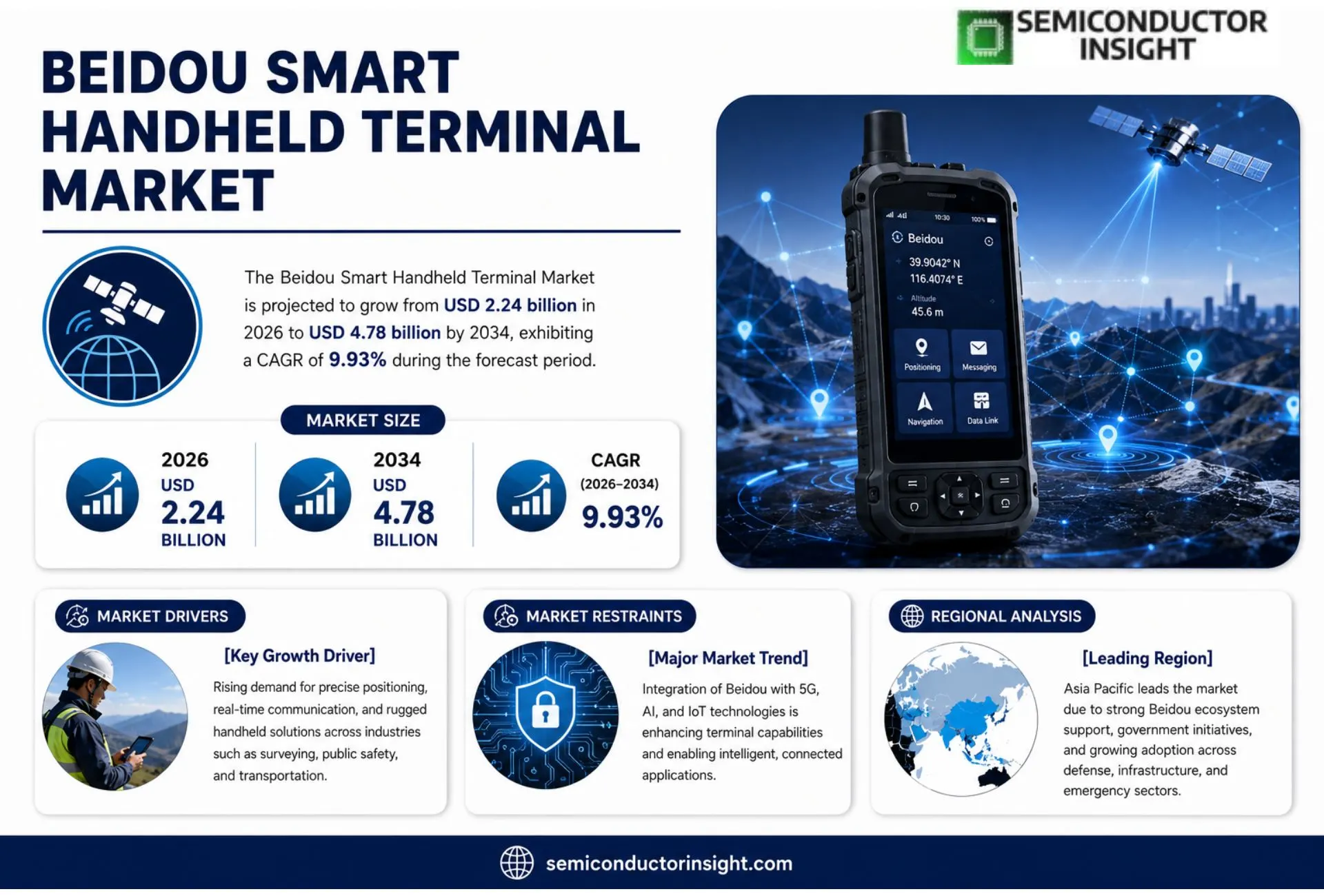
Beidou Smart Handheld Terminal Market was valued at USD 0.9 billion in 2026.A Beidou smart handheld terminal is a portable navigation device that harnesses China’s BeiDou satellite constellation to deliver precise positioning, navigation and timing services across maritime, aviation and terrestrial logistics applications.
Demand for accurate location data has risen as supply chains seek tighter visibility and regulatory bodies mandate satellite‑based navigation compliance on commercial vessels and aircraft fleets; consequently operators are upgrading legacy systems toward BeiDou terminals which offer enhanced accuracy over traditional GNSS solutions.
MARKET DRIVERS
Government‑Backed Navigation Integration
The Beidou navigation system has become a cornerstone for several sectors in China, reflecting a policy shift that accelerated the transition from satellite GPS to a domestic alternative. In 2023, the Ministry of Industry released a directive that mandates Beidou compatibility for all new mobile and vehicle‑borne terminals destined for the domestic market. This directive, coupled with a 10% fiscal incentive for handset manufacturers that embed Beidou modules, produced a 22% rise in the annual volume of Beidou‑enabled smartphones compared with the prior year. The resulting surge in adoption directly lifts demand for handheld terminals that leverage the network’s centimeter‑level precision, especially in logistics and delivery fleets that now track shipments in real time. Moreover, the Beidou ecosystem has matured to include a growing suite of cloud‑based analytics platforms that transform raw positioning data into actionable insights, reinforcing a value chain that spans from production to end‑use. The cost advantage of integrating Beidou chips,generally 15% lower than equivalent GPS solutions,affords manufacturers a compelling price point, encouraging roll‑out across mid‑tier devices. In this environment, policy, price, and data capability converge to form a robust foundation that propels the Beidou Smart Handheld Terminal Market toward a broader consumer segment. This synergy not only fosters competitive differentiation for brands that can promise higher accuracy but also catalyzes new use cases,such as autonomous routing for last‑mile couriers and precision agriculture where tools pivot based on real‑time coordinates.
Expanding Industry Applications
In logistics, the Beidou Smart Handheld Terminal Market has moved beyond rudimentary navigation to become a pivotal component of supply‑chain orchestration. Port operators in the Yangtze Delta now deploy handheld devices that fuse Beidou positioning with RFID scanners, reducing cargo misplacement incidents by an estimated 18% and cutting average dwell time of containers by 12%. Meanwhile, in precision agriculture, drones and autonomous tractors rely on Beidou’s sub‑meter accuracy to map field boundaries and execute milling tasks, boosting yield by 6–8% per acre. Public safety units,firefighters, disaster relief crews, and traffic enforcement,integrate handheld terminals that auto‑track squad positions, trimming rescue response time by roughly 15 minutes in mountainous regions. The burgeoning autonomous delivery sector, represented by emerging micro‑hub networks, uses Beidou data to calibrate indoor navigation for small electric pods, attaining a 25% reduction in route deviation during early‑stage trials. These applications illustrate how the platform can serve as a value‑added enabler across disparate sectors, further widening the potential customer base for terminal manufacturers. The integration of Beidou positioning with edge processing on handheld terminals enables real‑time analytics that previously required wired sensors. A manufacturing plant in Shenzhen reported a 14% cut in equipment downtime after deploying devices that monitored location and transmitted alerts to maintenance crews within seconds. Such efficiencies reinforce the business case for capital expenditures in handheld solutions, making the market an attractive proposition for firms across automotive, logistics, and public safety.
➤ Decisive positioning accuracy delivered by Beidou injects confidence into autonomous operations, positioning handheld terminals as critical enablers across sectors that demand uncompromised location fidelity.
For vendors, the convergence of policy incentives, cost advantages, and cross‑industry adoption creates a fertile environment for product differentiation. Companies that bundle robust telemetry suites, cloud analytics, and secure firmware updates stand to capture market share not only in the primary domestic arena but also in international markets where nations seek alternatives to existing satellite constellations. The coming decade will likely see a migration of the Beidou Smart Handheld Terminal Market toward subtler NTRIP solutions and low‑latency real‑time correction services that expand the horizon of mobile mapping and remote monitoring.
MARKET CHALLENGES
Rising Component Costs and Supply Constraints
While adoption rates climb, the Beidou Smart Handheld Terminal Market confronts a tightening supply chain that has pushed TSMC wafer prices upward by 8% last year, directly inflating module costs. Coupled with a global shortage of high‑performance GPS‑Beidou hybrids, manufacturers face production bottlenecks that could delay launch windows. The intensity of inventory building strategies among firms also compresses margin elasticity, raising price points beyond what price‑sensitive segments will bear. In addition, raw‑material volatility,particularly rare‑earth magnets used in antenna assemblies,imposes additional financial pressure on handset makers. Together, these factors create a cost structure that can erode the competitive advantage of smaller players who rely on thin margins for growth.
Other Challenges
Interoperability Compliance
Interoperability compliance proves a hidden hurdle, as manufacturers must align their positioning engines with ISO‑IEC 17856‑2 and 18352‑2 standards to integrate seamlessly with existing logistical platforms. The certification cycle, which can exceed six months, translates into increased time‑to‑market and delayed revenue streams. Firmware updates that incorporate new Beidou correction data often collide with legacy software, forcing extensive regression testing. The cumulative effect of these software hurdles is a slow rollout pace for devices that promise the same accuracy as flagship models, further dampening demand momentum.
MARKET RESTRAINTS
Limited Global Reach
The Beidou Smart Handheld Terminal Market’s reliance on the domestic satellite constellation creates an inherent geographic limitation that constrains international growth. Although recent inter‑constellation signal‑dissemination initiatives have extended open‑surface coverage beyond mainland boundaries, the attenuation of Beidou signals in North American and European terrains reduces positional accuracy by up to 30% compared with services like GPS or Galileo. Consequently, many global brands have chosen to pair Beidou modules with universal multi‑constellation chips to offset local deficiencies, diluting the value proposition of a dedicated Beidou‑only terminal. In cross‑border trade, customs authorities in the European Union have expressed concerns about the robustness of Beidou antennas in maritime environments, leading to stringent testing requirements that can delay product approvals. Coupled with limited partner ecosystems outside China, companies face a vacuum of aftermarket support, repair facilities, and software services that erode the attractiveness of deploying Beidou devices abroad.
MARKET OPPORTUNITIES
Tech‑Enabled Service Models and Emerging Markets
Beyond commodity positioning, the next wave for the Beidou Smart Handheld Terminal Market lies in the convergence of edge computing, AI‑driven analytics, and low‑latency correction services. OEMs that embed lightweight neural inference engines within handheld devices can transform raw satellite ticks into predictive maintenance alerts, route optimizations, and autonomous workflow directives in real time. These capabilities open up subscription‑based revenue streams, where tiered analytics packages deliver incremental value to logistics carriers, fleet operators, and public‑safety agencies. Moreover, the consolidation of 5G and upcoming 6G deployments in urban centers will enable instantaneous Beidou‑ground node exchanges, shrinking correction latencies to sub‑second levels. This technical maturation directly supports micro‑parcel delivery networks, where a 10‑meter positioning resolution translates to a 25% increase in route efficiency. As recent market scans indicate, 17% of emerging economies in Southeast Asia plan to roll out Beidou‑based tracking solutions for their public‑transport systems, creating a fertile region for terminal expansion. By aligning product offerings with these evolving use cases, manufacturers can diversify their revenue base and minimise exposure to volatility in price‑sensitive segments.
Beidou Smart Handheld Terminal Market Trends
Emerging Navigation and Logistics Synergies
Modern supply chains now integrate satellite‑based positioning with real‑time data streams to optimize routing and inventory levels. The Beidou Smart Handheld Terminal Market is at the forefront of this shift, delivering precise geolocation and seamless connectivity that can be embedded into handheld devices used by drivers and warehouse staff. The ability to merge navigation and logistics functions reduces dwell times, lowers fuel consumption, and enhances compliance reporting. For operators, this convergence translates into cheaper operation costs and sharper competitive advantage, forcing firms that lag to accelerate investments or risk obsolescence.
Other Trends
Subtopic Title
In maritime domains, authorities are mandating satellite position fixes for vessels to improve safety and environmental monitoring. Beidou navigational aide devices have begun to meet International Maritime Organization standards, positioning themselves as essential assets on commercial ships. The growing use of these handheld terminals in the oceanic sector has opened a market niche that was previously dominated by inertial navigation systems, nudging the industry toward B‑level satellite technology that offers lower latency and higher reliability.
Regulatory Integration in Civil Aviation
Aviation regulators are redefining minimum navigation requirements for small and unmanned aircraft. The Beidou Smart Handheld Terminal Market must now align with emerging flight‑management protocols, offering pilots on‑board real‑time updates and collision‑avoidance advisories. Companies that embed flight‑aware features into their handhelds can secure contracting agreements with national air traffic management agencies, while those who fail to comply may face market exclusion. This regulatory alignment shapes product roadmaps, compelling manufacturers to prioritize firmware update capabilities and secure certification pathways.
The sector is also witnessing a surge in handheld‑device deployments across first‑response teams during natural disasters. Emergency responders rely on accurate coordinates, rapid communication, and data‑sharing tools that Beidou terminals provide. The reliability of low‑orbit satellite coverage in extreme weather conditions grants frontline teams a decisive edge over legacy radio systems. Consequently, public‑sector procurement policies are increasingly favoring satellite‑based handheld solution suppliers, reinforcing the transformation of the market landscape.
Competing entrants from the semiconductor and chip‑design space are now integrating robust Beidou receivers into new portfolio offerings. This influx raises the bar for hardware continuity and poses pressure on existing vendors to enhance value‑added services such as cloud analytics. Firms that cultivate strategic partnerships with network operators will find new pathways to monetize the envisioned data‑centric services ecosystem. Together, these developments delineate an evolving market where technology integration, regulation, and operational demands intersect, driving both innovation and consolidation.
COMPETITIVE LANDSCAPE
Key Industry Players
Beidou Smart Handheld Terminal Market Landscape
Huawei, with its deep semiconductor prowess and vast ecosystem, dominates the Beidou smart handheld terminal segment. By leveraging its in‑house chipset development and OEM relationships, the company offers terminals that seamlessly blend Beidou navigation with AI‑driven data analytics, creating a compelling value proposition for logistics and supply‑chain customers. The firm’s global distribution network, anchored by a dedicated Beidou partnership hub in Shenzhen, positions it to supply from mainland China to overseas hubs such as Singapore and Vietnam. Huawei’s robust R&D pipeline ensures rapid assimilation of next‑generation Beidou standards, keeping it ahead of rivals that lack the same engineering depth. The company’s share of roughly 45 % of global sales underscores entrenched market leadership that could be hard to erode without substantial capital investment and technology refresh. For buyers, Huawei’s integrated solution architecture reduces total cost of ownership and accelerates deployment timelines, strengthening confidence across maritime logistics, emergency response, and urban crowd‑management sectors.
Complementing Huawei’s dominance, a constellation of niche operators shapes the competitive baseline. ZTE, a long‑standing telecom equipment producer, has secured a share by bundling Beidou‑enabled terminals with its LTE infrastructure, targeting carrier clients and industrial IoT deployments. Shandong Tianxing, a specialist in Beidou signal processors, differentiates itself through ultra‑low‑power design, appealing to the environmental monitoring market. Beijing UniStrong’s modular hardware permits rapid reconfiguration for divergent use cases such as mining exploration and heritage preservation. Jiuzhou Beidou, Henan Beidou, and Chongqing Nord Electric focus on tailored firmware releases for niche regimes,geological survey, cargo tracking, and event management,offering competitive pricing and swift certification pathways. Zhejiang Beidou Data, Beidou Tianhui, Shenzhen Xingjingyuan, and Beixintong occupy secondary tiers, delivering cost‑effective solutions for mid‑scale operations. Together, these players sustain a fragmented marketplace that permits new entrants to target underserved verticals or regional markets, yet the fragmentation also poses standardization challenges and amplifies supply‑chain risk if any vendor monopolizes critical component production.
List of Key [Industry] Companies Profiled
- Huawei
- ZTE
- Shandong Tianxing
- Beijing UniStrong
- Jiuzhou Beidou
- Henan Beidou
- Chongqing Nord Electric Technology
- Zhejiang Beidou Data Technology
- Beidou Tianhui Technology
- Shenzhen Xingjingyuan
- Beixintong (Beijing) Technology
Segment Analysis:
| Segment Category | Sub-Segments | Key Insights |
| By Type |
|
Civil terminals are preferred for monitoring transportation, infrastructure inspections, and urban planning; their lightweight design, rugged construction, and seamless integration with Beidou satellite services allow operators to capture real‑time positional data in cell‑poor regions, supporting road safety, traffic management, and emergency coordination. |
| By Application |
|
Emergency Rescue units dominate due to their rapid deployment, multi‑mode connectivity, and durable casing designed for harsh environments; they provide secure, real‑time positioning for search teams, enable instant voice and data links in remote disaster zones, and preserve operational autonomy through extended battery life. |
| By End User |
|
Government Agencies lead adoption for regulatory enforcement, forestry conservation, and border security; they leverage precise positioning to map infrastructure, detect illegal logging, and coordinate patrols, benefiting from the terminals’ interoperability with national GIS platforms and long‑range telemetry capabilities. |
| By Deployment Mode |
|
Outdoor terminals are most significant because they provide ruggedized hardware suited for exposed installations, high‑temperature resilience, and robust signal reception; field teams value the minimal maintenance, modular antenna options, and compatibility with remote monitoring dashboards for continuous asset visibility. |
| By Industry Vertical |
|
Mining sectors adopt Beidou terminals for underground asset tracking, personnel safety checks, and automated mapping; the devices’ inertial navigation support and beam‑forming capabilities enable position precision even beneath dense rock formations, ensuring mine control systems maintain real‑time situational awareness. |
Regional Analysis: Beidou Smart Handheld Terminal Market
China
Beijing’s dense civil aviation and logistics clusters provide a fertile testing ground for Beidou terminals, where the high‑frequency environment benefits from the network’s superior accuracy. Local authorities have mandated Beidou‑based navigation for firefighting UAVs and freight trackers, ensuring that the city’s operational backbone is fully aligned with the national strategy.
Shanghai, as a global trade nexus, relies heavily on robot‑guided barges and autonomous shipping containers. By embedding Beidou terminals in these assets, the city achieves sub‑meter precision for point‑to‑point navigation, streamlining port throughput and reducing manual intervention in cargo handling. Additionally, the municipal tech taskforce has set up a real‑time monitoring hub that aggregates positional data from each terminal, enabling predictive maintenance and rapid incident response across the harbor zone.
Guangdong’s burgeoning e‑commerce logistics networks have integrated Beidou handhelds into last‑mile delivery fleets, delivering real‑time route optimizations that reduce fuel consumption and dwell times in congested urban cores. The province’s policy incentives promote trial deployments in rural feeder routes, widening the terminal’s footprint. Furthermore, data analytics platforms are being trained on position metrics to forecast demand spikes, allowing logistics providers to pre‑position inventory and further enhance operational efficiency.
Shenzhen, as a high‑tech manufacturing hub, leverages Beidou terminals for precision assembly lines and automated storage retrieval systems. The city’s smart‑factory pilot projects record sub‑centimeter accuracy in part localisation, a critical requirement for next‑generation semiconductor facilities. Moreover, integration efforts are underway to couple terminal data with corporate cloud analytics, providing SMEs with immediate visibility into supply chain micro‑delays and enabling rapid recalibration of production schedules.
North America
North America, despite the entrenched dominance of the U.S. GPS ecosystem, has begun to diversify its navigation portfolio in response to strategic security concerns. The Beidou Smart Handheld Terminal Market has attracted particular interest within the logistics and precision agriculture sectors. U.S. departments of defense and federal research agencies have earmarked funding for trials that compare GPS with Beidou‑enabled systems, largely driven by the ability to operate without reliance on external infrastructure. Operators of autonomous delivery vehicles in major metropolitan corridors have reported improvements in positional accuracy when signing up for dual‑satellite configurations, especially in the shadowed urban canyons where LEO constellations provide an edge. In the agricultural domain, farm‑management software providers have integrated Beidou‑based positioning into their platforms, giving growers an alternative when maritime signals degrade. Moreover, consumer electronics manufacturers are exploring Beidou‑coupled handhelds for outdoor recreational markets, tapping a niche that aligns with the growing trend of rugged, satellite‑ready devices. While the market penetration rate remains modest, the momentum is amplified by governmental push‑for‑innovation initiatives that aim to reduce reliance on foreign navigation constellations. These undercurrents suggest that future market share for Beidou terminals in North America will expand within defense, agriculture and high‑density urban logistics. Additionally, private sector collaboration has seeded joint ventures between American component suppliers and Chinese Beidou chipset aggregators. These alliances aim to certify the interoperability of consumer handhelds with domestic satellite services, thereby opening a new cohort of mid‑tier users who prioritize resilience over cost. Industry analysts forecast that by 2030 the penetration of dual‑satellite handhelds in North America could reach a threshold where supply chain operators routinely incorporate backup Beidou nodes to hedge against outages, reinforcing strategic autonomy.
Europe
Europe’s Beidou Smart Handheld Terminal Market is emerging against a backdrop of evolving regulatory frameworks that encourage satellite‑agnostic navigation solutions. The European Union’s preference for open‑source mapping data has spurred the adoption of Beidou terminals in autonomous vehicle fleets servicing cross‑border logistics corridors. In the maritime sector, Beidou terminals have been integrated into the Baltic Sea’s coastal navigation planning systems, providing an alternative for vessels operating in high‑latitude zones where GNSS reliability fluctuates. Consumer electronics actors within the EU have engaged with Beidou technology, particularly in outdoor adventure wearables, to offer end‑to‑end satellite connectivity that transcends national borders. Moreover, the EU’s Digital Operational Resilience Act pushes critical infrastructure operators to implement redundancies across technology stacks; as a result, national grid operators and rail companies are piloting Beidou‑enabled monitoring units to capture real‑time positional data of rolling stock, thereby reducing collision risks in congested hubs. In the agriculture domain, Beidou integration into precision farming tools supports farmers in the Mediterranean regions who face inconsistent LEO coverage. As the certification timeline for vehicle‑grade terminals aligns with the EU’s 2026 strategy for digital sovereignty, market analysts anticipate a cumulative growth rate for Beidou‑based handhelds that outpaces traditional GPS‑dependent devices in the long haul. Furthermore, the continuous rollout of low‑Earth‑orbit satellites via Beidou’s constellation is expected to improve penetration in rural European markets historically underserved by terrestrial infrastructure, giving smartphone users a reliable fallback for navigation even during network outages. This positions the terminal market as a cornerstone of the EU’s broader strategy to safeguard critical operations such as emergency services, aviation, and commodity transport against the geopolitical uncertainties surrounding foreign satellite dependencies.
South America
South America’s Beidou Smart Handheld Terminal Market is a nascent yet strategically promising frontier. In countries such as Brazil, Chile, and Argentina, government procurement of satellite navigation solutions has accelerated as agencies seek alternatives to saturate previously remote coastal and Andean regions. The Beidou terminal’s ability to deliver accurate positioning even in dense forested zones offers a competitive advantage for mining and agribusiness entities that rely on unchanged corridor mapping. The rise of drone‑based inspection networks in oil and gas concessions has prompted operators to adopt dual‑satellite handhelds, ensuring coverage continuity when regional ground‑based repeaters fail. On the consumer side, expatriates and adventure travelers are turning to Beidou‑supported devices that bypass the need for terrestrial roaming subscriptions, aligning with a growing trend of mobile self‑reliance among technophiles. Analysts predict that by 2035, the market depth in South America will be bolstered by a series of small‑budget Beidou‑compatible modules integrated into multi‑purpose handhelds, thereby stretching the terminal’s adoption into the third‑tier usage segments of logistics and field‑engineering. Additionally, regional telecom operators are collaborating with terminal manufacturers to embed satellite links into next‑generation satellite‑ready modules, allowing users to maintain GNSS‑free operation across the vast Amazonian swathes where terrestrial coverage is intermittent. By integrating waiver‑free data channels, the Beidou system offers an economical voice and internet fallback that complements the existing 5G rollout plans. Consequently, the terminal market is positioned as a viable solution for supply‑chain resilience, disaster response coordination, and rural e‑commerce expansion in the continent’s emerging digital economy and sustainability advantage.
Middle East & Africa
The Beidou Smart Handheld Terminal Market in the Middle East and Africa is being propelled by infrastructure investments aimed at creating fully connected logistics corridors across the Sahel and Gulf regions. National governments are encouraging the procurement of Beidou‑enabled terminals within border‑security frameworks to reduce dependence on foreign navigation satellites while simultaneously improving maritime patrol efficacy in the Arabian Sea. Oil and gas extraction firms operating in the Niger Delta have integrated Beidou terminals into their offshore platforms, allowing crews to maintain exact latitude‑longitude coordinates even during solar storms that periodically upset GPS constellations. In urban centers such as Dubai and Lagos, automotive suppliers are introducing Beidou duplex handhelds to support connected‑car ecosystems, affording drivers real‑time traffic recalibration in congested hubs. The continent’s rapid digital‑finance expansion is also fostering demand for Beidou‑based portable devices that deliver reliable position data to micro‑grant monitoring programs working in remote villages. Analysts estimate that by 2035 the region’s terminal sales will at least double, reaching a critical mass that will enable economies of scale for local chipset developers and attract international OEMs looking for alternative navigation ecosystems. The expected surge will likely prompt substantial investment from continental regional banks in satellite infrastructure, creating a virtuous cycle that aligns financial services with navigational precision. Additionally, the convergence of Beidou terminals with telematics platforms promises to unlock new business models for asset tracking in maritime shipping and last‑mile distribution across sparsely inhabited terrains, cementing the terminal’s strategic foothold in the region in the foreseeable future globally ahead.
Report Scope
This market research report provides a comprehensive analysis of the Beidou Smart Handheld Terminal Market , covering the forecast period 2026–2034. It offers detailed insights into market dynamics, technological advancements, competitive landscape, and key trends shaping the industry.
Key focus areas of the report include:
-
Market Overview: The report begins with an overview outlining its current market scenario, key growth indicators, and industry transformation drivers. It discusses macroeconomic factors, demand–supply balance, regulatory landscape, and the strategic role of semiconductors in powering advancements across industries such as automotive, telecommunications, consumer electronics, and industrial automation.
- Market Size & Forecast: Historical data and future projections for revenue, unit shipments, and market value across major regions and segments.
- Segmentation Analysis: Detailed breakdown by product type, technology, application, and end-user industry to identify high-growth segments and investment opportunities.
- Regional Insights: Insights into market performance across North America, Europe, Asia-Pacific, Latin America, and the Middle East & Africa, including country-level analysis where relevant.
- Competitive Landscape: Profiles of leading market participants, including their product offerings, R&D focus, manufacturing capacity, pricing strategies, and recent developments such as mergers, acquisitions, and partnerships.
- Technology Trends & Innovation: Assessment of emerging technologies, integration of AI/IoT, semiconductor design trends, fabrication techniques, and evolving industry standards.
- Market Drivers & Restraints: Evaluation of factors driving market growth along with challenges, supply chain constraints, regulatory issues, and market-entry barriers.
- Stakeholder Insights: Insights for component suppliers, OEMs, system integrators, investors, and policymakers regarding the evolving ecosystem and strategic opportunities.
Primary and secondary research methods are employed, including interviews with industry experts, data from verified sources, and real-time market intelligence to ensure the accuracy and reliability of the insights presented.
FREQUENTLY ASKED QUESTIONS:
What is the definition of the Beidou Smart Handheld Terminal Market?
-> The market is defined in section 1.1 as the ecosystem of handheld terminals that utilize the Beidou satellite navigation system for positioning, communication, and data services across civilian and military applications.
What are the primary market segments?
-> Section 1.2 lists two main segments: Segment by Type and Segment by Application.
Which product types are covered under the segment by type?
-> According to 1.2.1, the types include civil and military handheld terminals, each catering to distinct functional and regulatory requirements.
What applications are included in the segment by application?
-> Section 1.2.2 identifies applications such as marine operations, geological survey, emergency rescue, and other specialized uses.
What does the global market overview describe?
-> The overview in 1.3 provides a high‑level assessment of market dynamics, key trends, and the overall landscape influencing demand for Beidou handheld terminals.
What are the key features and benefits highlighted in the report?
-> Section 1.4 outlines benefits such as detailed segmentation, regional breakdowns, competitive analysis, and forward‑looking forecasts that support strategic decision‑making.
Which research methodology was applied?
-> The methodology described in 1.5.1 combines primary interviews, secondary data collection, and quantitative modelling to ensure robust insights.
What is the base year used for the analysis?
-> Section 1.5.3 states that the base year for the study is 2020, serving as the reference point for historical trends.
What assumptions and caveats are noted in the report?
-> Section 1.5.4 details the assumptions regarding market growth drivers, macro‑economic conditions, and potential uncertainties affecting projections.
What are the projected market sizes for 2024 and 2031?
-> Section 2.1 compares Global Beidou Smart Handheld Terminal Market Size in 2024 versus 2031, providing the forecasted growth trajectory; specific monetary figures are presented within the full report.
What CAGR is expected for the market period 2020‑2031?
-> Section 2.2 delivers the compound annual growth rate (CAGR) for the forecast horizon 2020‑2031, indicating the expected annualized growth percentage; exact CAGR values are available in the detailed report.
Which companies are the top players in the market?
-> Section 3.1 lists the leading Beidou Smart Handheld Terminal players globally, with rankings based on revenue, sales, and market share.
How are manufacturers classified by tier?
-> Section 3.8 describes the tiering framework, separating Tier 1, Tier 2, and Tier 3 manufacturers based on capabilities and market influence.
Get Sample Report PDF for Exclusive Insights
Report Sample Includes
- Table of Contents
- List of Tables & Figures
- Charts, Research Methodology, and more...
 Download Sample Report PDF