Key Statistics
Key Takeaways
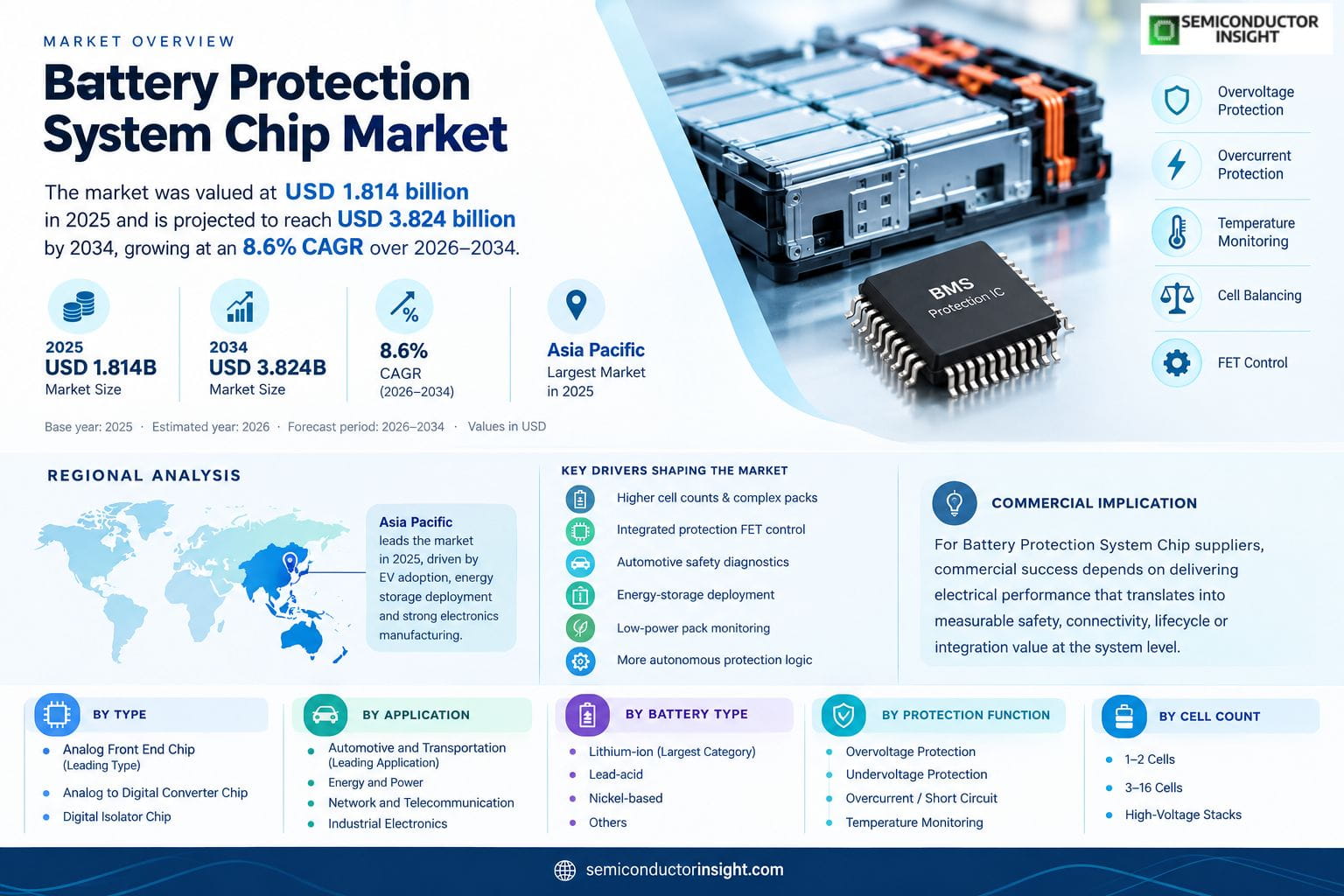
- Market size and growth: the market is valued at USD 1.814 billion in 2025 and is projected to reach USD 3.824 billion by 2034, representing a 8.6% CAGR over 2026–2034.
- Analog Front End Chip leads by type because cell-voltage, current and temperature monitoring sit at the core of battery safety and protection control across automotive, industrial and energy-storage packs.
- Automotive and Transportation leads application demand because electric and hybrid vehicles require multi-cell monitoring, fault detection, cell balancing and functional-safety support at much greater scale than portable single-cell systems.
- Asia Pacific is the largest regional market, while Asia Pacific has the strongest incremental growth profile.
- Primary driver: EVs, stationary storage and connected devices are increasing the number of battery cells that require continuous protection, monitoring and diagnostic coverage
- Principal restraint: automotive safety validation, precision analog design and multi-cell communication make protection ICs complex to qualify and difficult to second-source
Market Overview
The battery protection system chip market was valued at USD 1.814 billion in 2025 and is projected to reach USD 3.824 billion by 2034, expanding at a 8.6% CAGR over 2026–2034. Asia Pacific leads in 2025, while the market is being reshaped by higher cell counts, integrated protection FET control, automotive safety diagnostics, energy-storage deployment, low-power pack monitoring and more autonomous protection logic.. For Battery Protection System Chip suppliers, the commercial implication is that electrical performance must translate into measurable safety, connectivity, lifecycle or integration value at the system level.
Battery protection system chips monitor cell voltage, current and temperature and initiate protective actions when a rechargeable battery moves outside safe operating limits. Texas Instruments’ BQ76952 supports 3–16 series cells and integrates overvoltage, undervoltage, overcurrent, short-circuit and temperature protection together with balancing and high-side FET control. NXP’s MC33771C extends the architecture into automotive and industrial high-voltage packs with up to 14 cells per controller, daisy-chain communication and functional-safety support. These platforms show how protection has evolved from a simple cutoff circuit into a distributed sensing and safety subsystem.
Automotive requirements are raising the value of diagnostics and communication integrity. NXP’s MC33771C supports isolated daisy-chain networking across many devices and is designed for systems targeting ISO 26262 up to ASIL D, while STMicroelectronics’ L9963E monitors up to 14 cells and supports multiple devices in a transformer-isolated chain. These features matter because a traction battery can contain hundreds of cells and must detect open wires, abnormal voltage, thermal faults and communication failures without relying on one measurement path. Protection ICs therefore compete on accuracy, diagnostic coverage and system architecture as much as on channel count.
Industrial and portable batteries create a second design axis centered on autonomy and low power. Renesas’ ISL94202 can control 3–8 cells without a host MCU and includes programmable overvoltage, undervoltage, overcurrent, short-circuit and balancing functions. Analog Devices’ DS2761 illustrates how monitoring, fuel information and protection can be integrated in smaller battery packs, while Microchip’s PS700 family demonstrates low-current monitoring for one- and two-cell systems. These products show why the market spans tiny consumer packs through high-voltage EV and stationary storage, with different integration and qualification economics.
Segment Analysis: By Type
By type, the market is segmented into Analog Front End Chip, Analog to Digital Converter Chip, Digital Isolator Chip. Analog Front End Chip holds the leading position because cell-voltage, current and temperature monitoring sit at the core of battery safety and protection control across automotive, industrial and energy-storage packs. Procurement decisions in the Battery Protection System Chip market therefore consider qualification evidence, integration effort, long-term supply and technical support alongside component or equipment price. As adoption broadens, vendors that combine repeatable manufacturing with application engineering and documented reliability should be better positioned for long production programs and platform design wins.
| Type | Function / role | Market position |
|---|---|---|
| Analog Front End Chip | Measures cell voltages, current and temperature and often adds balancing, FET drivers and fault diagnostics. | Leading type because measurement quality and autonomous protection directly determine pack safety. |
| Analog to Digital Converter Chip | Converts low-level battery measurements for host processing and safety algorithms. | Used where system architects separate precision conversion from protection or MCU functions. |
| Digital Isolator Chip | Transfers battery-management data across high common-mode voltage while preserving galvanic isolation. | Important in high-voltage packs and daisy-chain architectures where communication integrity is safety-critical. |
Commercial implications by type
Battery protection functions are increasingly integrated, so the boundaries between analog front ends, converters and communication devices are becoming less rigid. TI, NXP and ST combine multiple ADC channels, diagnostics, balancing and communication functions in dedicated battery controllers, reducing external component count but increasing the IC’s responsibility for system safety. Stand-alone products such as the Renesas ISL94202 serve lower cell-count packs where an MCU may be unnecessary. Buyers therefore compare total system architecture, diagnostic coverage, current consumption, accuracy and software burden rather than selecting parts by one functional block alone.
Segment Analysis: By Application
By application, the market includes Automotive and Transportation, Energy and Power, Network and Telecommunication, Industrial Electronics. Automotive and Transportation leads demand because electric and hybrid vehicles require multi-cell monitoring, fault detection, cell balancing and functional-safety support at much greater scale than portable single-cell systems. As adoption broadens, vendors that combine repeatable manufacturing with application engineering and documented reliability should be better positioned for long production programs and platform design wins. This makes interoperability, validation and field support increasingly important because requalification or network redesign can cost more than the incremental saving from a lower-priced component.
| Application | Demand characteristics |
|---|---|
| Automotive and Transportation | Leading application across BEVs, PHEVs, HEVs, 48 V systems and commercial vehicles requiring functional-safety-oriented multi-cell monitoring. |
| Energy and Power | Stationary storage, UPS and renewable-energy systems require long-duration monitoring, balancing and fault isolation. |
| Network and Telecommunication | Backup battery systems and distributed telecom equipment need low-power monitoring and reliable protection. |
| Industrial Electronics | Robotics, tools, warehouse equipment and industrial battery packs use configurable protection across diverse cell counts and chemistries. |
By Battery Type
| Battery Type | Commercial relevance |
|---|---|
| Lithium-ion | Largest category because EVs, portable electronics and stationary storage rely heavily on Li-ion chemistries. |
| Lead-acid | Protection and monitoring remain relevant in backup, telecom and industrial systems. |
| Nickel-based | NiMH and related chemistries retain selected industrial and transportation applications. |
| Others | Emerging chemistries create specialized protection and monitoring requirements. |
By Protection Function
| Protection Function | Commercial relevance |
|---|---|
| Overvoltage Protection | Prevents cells from exceeding safe charge voltage and limits overcharge risk. |
| Undervoltage Protection | Disconnects or limits discharge before cells enter damaging low-voltage conditions. |
| Overcurrent / Short Circuit | Detects abnormal pack current rapidly enough to protect cells, FETs and interconnects. |
| Temperature Monitoring | Uses internal sensors or thermistors to detect unsafe charge or discharge temperature. |
By Cell Count
| Cell Count | Commercial relevance |
|---|---|
| 1–2 Cells | Portable and IoT products prioritize tiny packages and microamp current. |
| 3–16 Cells | Tools, light mobility and industrial packs use highly integrated monitor/protector ICs. |
| High-Voltage Stacks | EV and ESS systems daisy-chain multiple battery controllers across hundreds of volts. |
Regional Analysis
Asia Pacific leads the market because the report identifies Asia Pacific with more than 45% of 2024 demand, reflecting China’s battery manufacturing scale, Japan and South Korea’s cell technology, and the region’s large EV and consumer-electronics supply chains. Asia Pacific has the strongest growth profile through EV production, stationary storage and regional semiconductor supply are expanding simultaneously across China, South Korea, Japan, India and Southeast Asia. This makes interoperability, validation and field support increasingly important because requalification or network redesign can cost more than the incremental saving from a lower-priced component.
How does regional demand differ across this market?
Asia Pacific leads because lithium-ion cell manufacturing, EV production and consumer electronics are concentrated across China, South Korea and Japan. North America is strategically important through EV, stationary storage and semiconductor design, while Europe has strong automotive safety requirements and premium BMS demand. South America and the Middle East & Africa are smaller but benefit from energy-storage and electrification projects. Across regions, the value pool is moving toward higher cell counts, stronger diagnostic coverage and communication resilience rather than basic overvoltage cutoff alone.
| Region | Position | Growth outlook | Demand profile | Supplier selection |
|---|---|---|---|---|
| Asia Pacific | Largest | Fastest | EV, cell and electronics manufacturing | Accuracy, cost, local supply |
| North America | Second | Strong | EV, storage and semiconductor design | Safety, diagnostics, supply resilience |
| Europe | Third | Strong | Automotive and energy storage | Functional safety, traceability, lifecycle |
| South America | Smaller | Moderate | Mobility and storage | Cost, availability, application support |
| Middle East & Africa | Emerging | Strong | Storage and infrastructure | Reliability, thermal monitoring, support |
Competitive Landscape
Competition spans analog and automotive semiconductor suppliers with different strengths in precision measurement, autonomous protection, isolated communication and functional-safety support. For Battery Protection System Chip suppliers, the commercial implication is that electrical performance must translate into measurable safety, connectivity, lifecycle or integration value at the system level. Procurement decisions in the Battery Protection System Chip market therefore consider qualification evidence, integration effort, long-term supply and technical support alongside component or equipment price. As adoption broadens, vendors that combine repeatable manufacturing with application engineering and documented reliability should be better positioned for long production programs and platform design wins.
Texas Instruments competes through highly integrated multi-cell monitors such as BQ76952, which combines voltage, current and temperature measurement with protection, cell balancing, high-side FET drive and low-power modes. NXP and ST target automotive and high-voltage packs with daisy-chain architectures that scale across many battery modules and emphasize diagnostics. These suppliers benefit from broad automotive and analog portfolios that allow them to provide isolators, microcontrollers, power devices and reference designs around the protection controller, reducing integration risk for pack developers.
Renesas addresses stand-alone lower-cell-count packs with ISL94202, which can monitor and control 3–8 cells without requiring a host MCU for basic protection. That autonomy is valuable in industrial packs where system simplicity and low standby power matter more than a sophisticated networked BMS. Analog Devices has long integrated battery monitoring, protection and fuel information in compact products, while Microchip historically served smaller smart-battery architectures. The competitive landscape therefore spans portable single-cell designs, medium-voltage industrial packs and high-voltage automotive chains rather than one standardized IC category.
Product differentiation increasingly depends on software and safety documentation. Automotive customers need fault-injection behavior, open-wire diagnostics, communication recovery and evidence that the IC can support system-level safety goals. NXP explicitly positions MC33771C for ISO 26262 systems up to ASIL D, while TI continues to publish application notes on short-circuit recovery and open-wire detection for BQ76952. Suppliers that provide complete technical collateral can shorten qualification and reduce customer risk, creating a durable advantage beyond nominal ADC accuracy or the number of monitored cells.
| Competitive tier | Representative participants | Competitive focus |
|---|---|---|
| Multi-cell battery-monitor leaders | Texas Instruments, NXP, STMicroelectronics | Automotive and industrial monitoring, protection and balancing |
| Stand-alone pack-control suppliers | Renesas, Analog Devices | Autonomous protection, compact pack management and precision monitoring |
| Specialty / legacy battery-control ecosystem | Microchip and regional analog vendors | Small-pack monitors, controllers and application-specific protection |
Companies Profiled
Texas Instruments, NXP Semiconductors, STMicroelectronics, Renesas Electronics, Analog Devices, Microchip Technology, onsemi, ROHM. The set reflects companies directly active in products, process technology, manufacturing or supporting application ecosystems rather than an evaluative ranking. Procurement decisions in the Battery Protection System Chip market therefore consider qualification evidence, integration effort, long-term supply and technical support alongside component or equipment price. As adoption broadens, vendors that combine repeatable manufacturing with application engineering and documented reliability should be better positioned for long production programs and platform design wins.
Production Capacity Analysis
Production depends on precision analog wafer processes, high-voltage device structures, automotive-qualified packaging, trimming, multi-temperature test and the validation infrastructure needed to guarantee measurement accuracy and fault behavior. For Battery Protection System Chip suppliers, the commercial implication is that electrical performance must translate into measurable safety, connectivity, lifecycle or integration value at the system level. Procurement decisions in the Battery Protection System Chip market therefore consider qualification evidence, integration effort, long-term supply and technical support alongside component or equipment price.
Battery protection controllers combine precision ADCs, high-voltage inputs, digital logic and sometimes gate drivers on one die, making production more demanding than a simple low-voltage mixed-signal IC. Cell-voltage accuracy, current offset and protection thresholds often require trimming and final test, while automotive devices add AEC-Q qualification and extended-temperature screening. High-voltage pins must also survive abnormal connection sequences and transients. Effective capacity therefore includes analog test time and qualification equipment, not only wafer starts, because a device that fails measurement accuracy cannot safely enter a battery pack.
High-voltage EV and storage architectures add module-level communication validation. NXP’s MC33771C and ST’s L9963E use chained communication so dozens of controllers can operate across an isolated pack. Production test must verify communication, balancing outputs, GPIOs, diagnostics and fault detection across temperature. Suppliers also need long-term process stability because a battery platform can remain in production for many years. Capacity expansion therefore requires qualified assembly sites, traceability and stable calibration methods, especially when customers need second manufacturing sources without changing system-level safety performance.
Market Dynamics
The market is moving from basic cutoff ICs toward intelligent multi-cell protection platforms that combine precision measurement, diagnostics, balancing, communication and autonomous safety responses. For Battery Protection System Chip suppliers, the commercial implication is that electrical performance must translate into measurable safety, connectivity, lifecycle or integration value at the system level. Procurement decisions in the Battery Protection System Chip market therefore consider qualification evidence, integration effort, long-term supply and technical support alongside component or equipment price.
Battery protection increasingly overlaps with battery management because the same controller may measure cell voltage, count charge, balance cells and coordinate pack FETs. This integration can reduce component count and wiring, but it also concentrates more safety responsibility in one IC and its software configuration. Automotive and storage customers are therefore demanding stronger diagnostics and redundant system concepts, while portable products continue to prioritize microamp standby current and tiny packages. Suppliers must span both directions or specialize in clearly defined cell-count and safety tiers.
Market Drivers
Drivers Impact Analysis
| Driver | Impact | Commercial mechanism |
|---|---|---|
| Electric vehicle growth | High | Traction batteries contain many series cells and require continuous monitoring to prevent overcharge, overdischarge, overheating and abnormal current. Multi-channel controllers reduce wiring by measuring many cells in one device and communicating through a daisy chain to a central BMS. NXP and ST both position their current products for automotive use, reflecting the importance of this demand. As vehicle pack voltage and energy increase, diagnostic coverage and communication reliability become more valuable, supporting higher semiconductor content per vehicle even as individual IC prices decline. |
| Stationary energy storage | High | Grid and commercial storage systems use large lithium-ion packs that must operate for years with high availability and controlled degradation. Protection ICs monitor cell imbalance, temperature and fault current while supporting safe maintenance and module replacement. Industrial systems may value autonomous protection because they cannot depend on a continuously active high-level processor. The spread of solar, wind and backup storage therefore expands demand beyond vehicles and consumer electronics. These systems also use many cells per installation, creating significant chip content even at lower annual unit counts. |
| Integration of balancing and diagnostics | Medium | Modern battery controllers increasingly include passive balancing, thermistor inputs, open-wire detection, current measurement and FET control in addition to voltage monitoring. TI’s BQ76952 and Renesas’ ISL94202 demonstrate how integration can eliminate external comparators and state machines. Fewer components simplify pack assembly and can improve consistency, but customers also expect configurable thresholds and robust failure handling. This raises the value of programmable protection and diagnostics, particularly in industrial packs where one platform may need to support several battery chemistries or product variants. |
| Low-power connected devices | Medium | IoT, wearables and portable electronics need protection circuits that consume extremely little energy during sleep or storage. Legacy smart-battery products from Analog Devices and Microchip demonstrate the long-standing demand for monitors that combine voltage, current, temperature and protection in small packages. Newer devices continue this trend with deeper sleep modes and more integrated functions. The commercial opportunity is large in unit terms, but pricing is aggressive, so suppliers need very small die area, wafer-level packaging and highly automated test to serve these markets profitably. |
Electric vehicle growth
Traction batteries contain many series cells and require continuous monitoring to prevent overcharge, overdischarge, overheating and abnormal current. Multi-channel controllers reduce wiring by measuring many cells in one device and communicating through a daisy chain to a central BMS. NXP and ST both position their current products for automotive use, reflecting the importance of this demand. As vehicle pack voltage and energy increase, diagnostic coverage and communication reliability become more valuable, supporting higher semiconductor content per vehicle even as individual IC prices decline.
Stationary energy storage
Grid and commercial storage systems use large lithium-ion packs that must operate for years with high availability and controlled degradation. Protection ICs monitor cell imbalance, temperature and fault current while supporting safe maintenance and module replacement. Industrial systems may value autonomous protection because they cannot depend on a continuously active high-level processor. The spread of solar, wind and backup storage therefore expands demand beyond vehicles and consumer electronics. These systems also use many cells per installation, creating significant chip content even at lower annual unit counts.
Integration of balancing and diagnostics
Modern battery controllers increasingly include passive balancing, thermistor inputs, open-wire detection, current measurement and FET control in addition to voltage monitoring. TI’s BQ76952 and Renesas’ ISL94202 demonstrate how integration can eliminate external comparators and state machines. Fewer components simplify pack assembly and can improve consistency, but customers also expect configurable thresholds and robust failure handling. This raises the value of programmable protection and diagnostics, particularly in industrial packs where one platform may need to support several battery chemistries or product variants.
Low-power connected devices
IoT, wearables and portable electronics need protection circuits that consume extremely little energy during sleep or storage. Legacy smart-battery products from Analog Devices and Microchip demonstrate the long-standing demand for monitors that combine voltage, current, temperature and protection in small packages. Newer devices continue this trend with deeper sleep modes and more integrated functions. The commercial opportunity is large in unit terms, but pricing is aggressive, so suppliers need very small die area, wafer-level packaging and highly automated test to serve these markets profitably.
Market Restraints
Restraints Impact Analysis
| Restraint | Impact | Commercial mechanism |
|---|---|---|
| Safety qualification complexity | High | Battery protection devices sit directly in the safety path, so automotive and industrial customers require extensive fault testing, documentation and qualification before production. NXP’s ISO 26262 positioning and AEC-Q qualification illustrate the level of evidence expected in vehicle systems. A design change can trigger substantial revalidation, which slows new supplier entry and makes customers cautious about second sourcing. The same barrier protects incumbents after qualification but increases development cost and extends the time between first silicon samples and meaningful production revenue. |
| Precision analog design burden | High | Cell monitoring requires millivolt-level accuracy across a wide common-mode voltage, temperature range and operating current. Current measurement can be even more demanding because offset errors accumulate into fuel or state-of-charge calculations. TI specifies very low current-sense offset and precise cell-voltage measurement in BQ76952, showing the technical bar for integrated monitors. Achieving this performance while adding high-voltage tolerance and low standby current requires specialized analog process and calibration expertise that limits the number of credible high-volume suppliers. |
| Communication and system complexity | Medium | High-voltage packs distribute many monitoring ICs across battery modules, creating communication, isolation and synchronization challenges. NXP and ST use daisy-chain architectures to reduce wiring, but system designers still need robust physical layers, fault recovery and protection against broken links. Communication failures can hide unsafe cells, so automotive systems often require loopback or redundant paths. This increases component count and software verification compared with a simple local protector, making the total BMS more complex even as the individual controller integrates more functions. |
| Fragmented battery architectures | Medium | Battery packs vary widely in chemistry, cell count, voltage, current, balancing strategy and safety concept. A protection IC optimized for a one-cell wearable cannot simply scale into a 400 V EV pack, and an automotive controller can be too expensive for a tool or IoT device. This fragmentation forces suppliers to maintain multiple product families and support different host interfaces, packages and safety requirements. Customers also face design-specific qualification, reducing the degree to which one device can become a universal platform across all battery applications. |
Safety qualification complexity
Battery protection devices sit directly in the safety path, so automotive and industrial customers require extensive fault testing, documentation and qualification before production. NXP’s ISO 26262 positioning and AEC-Q qualification illustrate the level of evidence expected in vehicle systems. A design change can trigger substantial revalidation, which slows new supplier entry and makes customers cautious about second sourcing. The same barrier protects incumbents after qualification but increases development cost and extends the time between first silicon samples and meaningful production revenue.
Precision analog design burden
Cell monitoring requires millivolt-level accuracy across a wide common-mode voltage, temperature range and operating current. Current measurement can be even more demanding because offset errors accumulate into fuel or state-of-charge calculations. TI specifies very low current-sense offset and precise cell-voltage measurement in BQ76952, showing the technical bar for integrated monitors. Achieving this performance while adding high-voltage tolerance and low standby current requires specialized analog process and calibration expertise that limits the number of credible high-volume suppliers.
Communication and system complexity
High-voltage packs distribute many monitoring ICs across battery modules, creating communication, isolation and synchronization challenges. NXP and ST use daisy-chain architectures to reduce wiring, but system designers still need robust physical layers, fault recovery and protection against broken links. Communication failures can hide unsafe cells, so automotive systems often require loopback or redundant paths. This increases component count and software verification compared with a simple local protector, making the total BMS more complex even as the individual controller integrates more functions.
Fragmented battery architectures
Battery packs vary widely in chemistry, cell count, voltage, current, balancing strategy and safety concept. A protection IC optimized for a one-cell wearable cannot simply scale into a 400 V EV pack, and an automotive controller can be too expensive for a tool or IoT device. This fragmentation forces suppliers to maintain multiple product families and support different host interfaces, packages and safety requirements. Customers also face design-specific qualification, reducing the degree to which one device can become a universal platform across all battery applications.
Market Opportunities
High-voltage EV controllers
The largest value opportunity is in multi-cell automotive controllers that combine precise measurement, balancing, fault diagnostics and robust daisy-chain communication. Higher-energy packs require more monitoring channels and stronger safety evidence, increasing semiconductor content per vehicle. Suppliers can expand value by adding functional-safety documentation, isolated communication, pack-current measurement and software tools. Once an IC is qualified into a vehicle platform, long production cycles can create durable revenue because migrating to a different controller requires extensive hardware, software and safety revalidation.
Stationary storage platforms
Commercial, utility and residential energy storage needs scalable protection from small modules to multi-rack systems. The architecture can reuse automotive-style multi-cell monitors but often emphasizes long standby periods, serviceability and total lifecycle cost. Controllers with autonomous protection, balancing and low-power modes can reduce the burden on supervisory processors and improve fault containment. As energy-storage deployments expand, suppliers have an opportunity to provide reference designs that connect battery controllers with pack monitors, isolation, communications and safety power devices as a validated subsystem.
Integrated autonomous protection
Renesas’ stand-alone ISL94202 illustrates demand for protection logic that can operate without a host MCU in medium-cell-count packs. This architecture is valuable for tools, robots, light mobility and industrial equipment where developers want fewer components and deterministic fault response. Future devices can integrate more balancing, current measurement and configurable recovery behavior while keeping standby current low. The opportunity is strongest when one protection IC can support several pack variants through programmable thresholds, reducing the customer’s design and inventory burden across a product family.
Low-power miniaturized packs
Wearables, IoT nodes and portable medical devices require protection with minimal board area and microamp or sub-microamp standby current. Historical products from Analog Devices and Microchip show the value of integrating voltage, current, temperature and safety functions into small footprints. New process and packaging technology can push this further through wafer-level packages and lower quiescent current. Suppliers can differentiate by combining protection with fuel gauging or authentication, reducing total component count in products where battery capacity and PCB area are both severely constrained.
Supply Chain Analysis
Precision ADCs, high-voltage inputs and protection logic
Automotive-grade packages, trimming and fault verification
MCUs, isolators, FETs, shunts, thermistors and software
Cell modules, wiring, balancing and safety qualification
Analog semiconductor processes
Battery protection ICs require a combination of precision low-offset analog circuitry and high-voltage tolerance. Designers integrate ADCs, comparators, current-sense amplifiers, charge pumps, FET drivers and digital state machines while keeping sleep current extremely low. Process selection must support accurate passive components and high-voltage devices without excessive die area. The semiconductor supply chain therefore depends on mature analog fabs and calibration capability rather than leading-edge logic density, which helps long product lifecycles but makes process transfer between foundries more difficult.
Packaging & test
Final test is unusually important because protection thresholds, ADC accuracy, communication and diagnostic functions all need to operate within specification before the IC enters a battery pack. Automotive devices are tested across wide temperature ranges and may require traceability through multiple assembly sites. High-voltage pins and random cell-connection sequences add stress scenarios that must be characterized. Suppliers with automated calibration and fault-testing platforms can scale more efficiently, while customers value stable test limits because small measurement shifts can affect state estimation and safety margins.
BMS integration
A protection controller operates alongside microcontrollers, isolation devices, current shunts, contactors or MOSFETs, thermistors and communication interfaces. TI integrates high-side NFET control in BQ76952, while NXP and ST rely on chained cell-controller architectures for high-voltage packs. System design therefore involves more than choosing one IC; customers need validated schematics, PCB-layout guidance, software drivers and fault-handling strategies. Semiconductor suppliers that provide a broader BMS portfolio can simplify procurement and reduce the engineering risk associated with cross-vendor interface problems.
Battery pack manufacturing
Pack makers must connect monitoring harnesses, thermistors and balancing networks to cells while controlling assembly errors such as open wires, reversed connections or hot-plug transients. NXP and TI publish guidance specifically for layout, hot-plug behavior and open-wire detection because these manufacturing conditions affect protection performance. As pack volumes rise, production-line programming and automated test become critical. Protection ICs with programmable nonvolatile settings and robust connection tolerance can reduce manufacturing rework and support several pack variants on the same assembly line.
Recent Developments
August 2026 — Texas Instruments publishes new BQ76952 protection application notes
TI’s 2026 technical updates address open-wire detection and fast short-circuit recovery, showing continued engineering support for multi-cell protection. Source
March 2026 — NXP updates MC33771C battery cell controller documentation
The current revision documents 14-cell monitoring, diagnostics, daisy-chain communication and automotive safety support. Source
Current — ST L9963E remains in volume production for automotive and ESS BMS
The device monitors up to 14 cells and supports transformer-isolated daisy-chain communication across high-voltage battery systems. Source
Report Scope & Segmentation
| Attribute | Coverage |
|---|---|
| Market | Battery Protection System Chip |
| Base Year | 2025 |
| Estimated Year | 2026 |
| Forecast Period | 2026–2034 |
| 2025 Market Size | USD 1.814 billion |
| 2026 Estimated Size | USD 1.971 billion |
| 2034 Forecast Size | USD 3.824 billion |
| CAGR | 8.6% (2026–2034) |
| By Type | Analog Front End Chip, Analog to Digital Converter Chip, Digital Isolator Chip |
| By Application | Automotive and Transportation, Energy and Power, Network and Telecommunication, Industrial Electronics |
| By Battery Type | Lithium-ion, Lead-acid, Nickel-based, Others |
| By Protection Function | Overvoltage Protection, Undervoltage Protection, Overcurrent / Short Circuit, Temperature Monitoring |
| By Cell Count | 1–2 Cells, 3–16 Cells, High-Voltage Stacks |
| Regions | Asia Pacific, North America, Europe, South America, Middle East & Africa |
| Companies Profiled | Texas Instruments, NXP Semiconductors, STMicroelectronics, Renesas Electronics, Analog Devices, Microchip Technology, onsemi, ROHM |
Frequently Asked Questions
What is the battery protection system chip market size in 2025?
The market is valued at USD 1.814 billion in 2025.
What is the projected market size by 2034?
The market is projected to reach USD 3.824 billion by 2034.
What is the CAGR from 2026 to 2034?
The market is expected to expand at a 8.6% CAGR.
Which region leads the market?
Asia Pacific is the largest regional market in 2025.
Which type leads the market?
Analog Front End Chip is the leading type.
Which application leads demand?
Automotive and Transportation is the leading application.
What is the main growth driver?
EVs, stationary storage and connected devices are increasing the number of battery cells that require continuous protection, monitoring and diagnostic coverage.
What is the principal restraint?
automotive safety validation, precision analog design and multi-cell communication make protection ICs complex to qualify and difficult to second-source.
Where are the strongest opportunities?
high-voltage EV monitoring, stationary storage, autonomous multi-cell protection, low-power IoT packs and more integrated balancing and diagnostics.
Which companies are active in the market?
Texas Instruments, NXP Semiconductors, STMicroelectronics, Renesas Electronics, Analog Devices, Microchip Technology, onsemi, ROHM.
Research Sources & Evidence Base
View primary, official and technical evidence used in this overview
- Texas Instruments: BQ76952 Battery Monitor and Protector — 3–16 cell monitoring, balancing, high-side FET control, low-power modes and integrated protection.
- NXP Semiconductors: MC33771C Battery Cell Controller — 14-cell automotive and industrial battery controller with diagnostics, balancing and daisy-chain communication.
- STMicroelectronics: L9963E Battery Monitoring and Protecting Chip — Automotive and ESS multi-cell monitoring, current measurement and isolated communication.
- Renesas Electronics: ISL94202 Battery Pack Monitor — Stand-alone 3–8 cell monitoring, balancing, FET control and configurable protection.
- Analog Devices: DS2761 High-Precision Li+ Battery Monitor — Integrated single-cell monitoring, current measurement and safety protection architecture.
- Microchip Technology: PS700 Battery Monitor — Low-power one- and two-cell battery monitoring, current accumulation and smart-battery context.

Get Sample Report PDF for Exclusive Insights
Report Sample Includes
- Table of Contents
- List of Tables & Figures
- Charts, Research Methodology, and more...
 Download Sample Report PDF