
Key Statistics
Key Takeaways
- Below 5 TOPS chips form the broadest volume segment because smart cameras, doorbells and basic edge devices need efficient object detection and analytics without the cost or thermal burden of a large accelerator.
- Smart Network Cameras are the leading application, supported by the shift from passive recording toward real-time detection, tracking, classification and anomaly analysis at the edge.
- Security & Surveillance is the largest end-user group because 24/7 video analytics creates sustained demand for SoCs that combine ISP, NPU, video codec and secure connectivity functions.
- System-on-Chip integration is the leading architecture because combining image processing, AI acceleration, CPU and memory interfaces reduces board area, latency, power and bill of materials.
- Asia Pacific leads the market through the concentration of camera manufacturing, consumer electronics, automotive electronics, fabless chip design and advanced semiconductor manufacturing.
- Automotive and multimodal AI are raising performance requirements as in-vehicle cameras, driver monitoring, surround view and vision-language workloads demand more TOPS, higher memory bandwidth and stronger functional safety.
AI Vision System Chips Market Overview
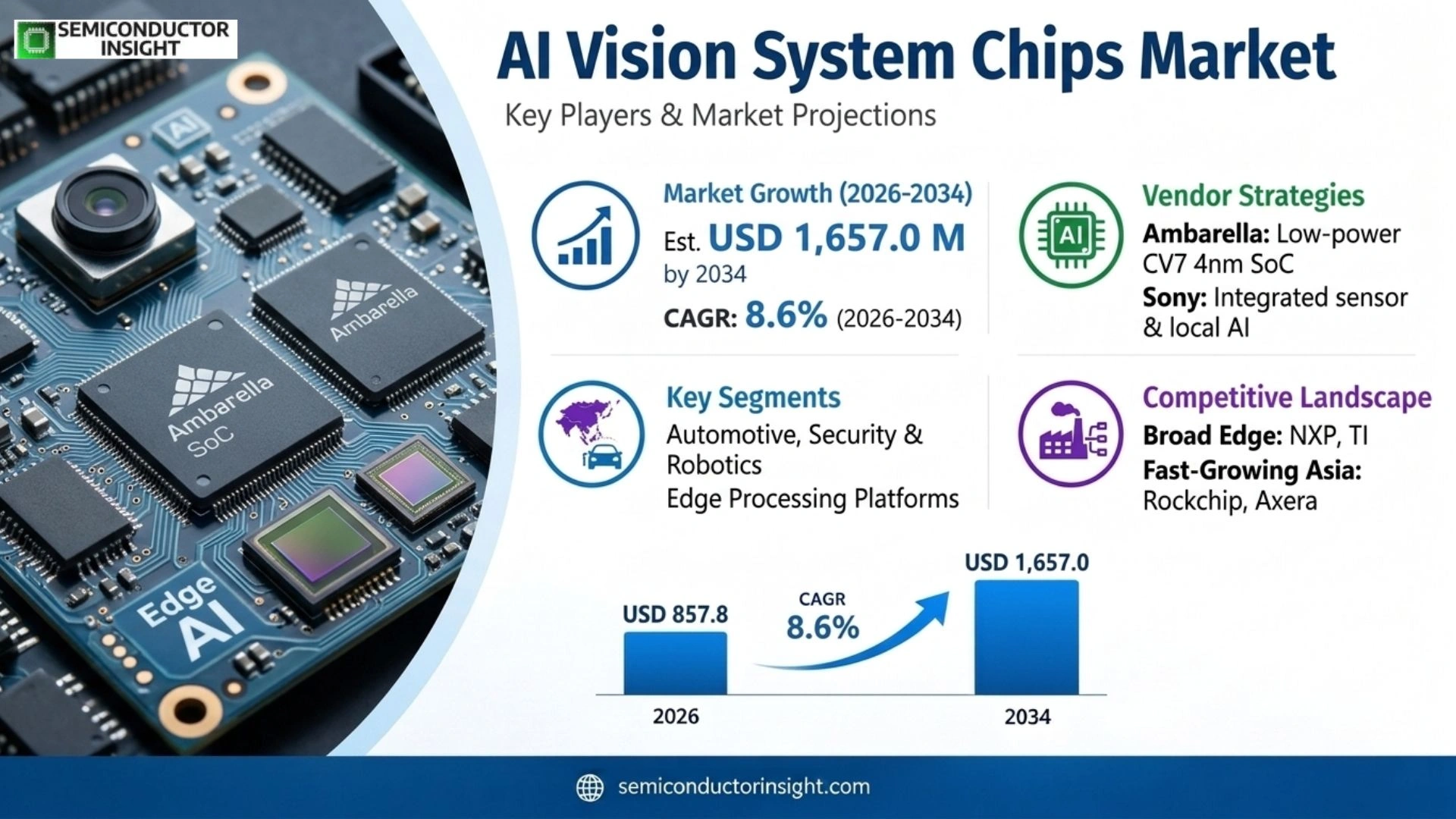
AI Vision System Chips Market was valued at USD 790.0 million in 2025, is estimated at USD 857.8 million in 2026, and is projected to reach USD 1,657.0 million by 2034, representing a CAGR of 8.6% during 2026–2034. Asia Pacific is the largest regional market in 2025, while the commercial growth mechanism is increasingly shaped by edge AI cameras, automotive vision, industrial machine vision, smart security, multimodal perception, and lower-power on-device inference.
AI vision system chips are specialized integrated circuits that combine image signal processing with neural-network acceleration so that cameras and vision-enabled devices can interpret visual data locally. Typical functions include exposure and color processing, object detection, segmentation, classification, tracking and multi-camera fusion. By placing inference close to the sensor, system designers reduce cloud bandwidth, lower latency and keep more sensitive video data inside the endpoint.
The commercial market spans low-cost smart cameras through automotive and industrial vision systems. Entry-level devices emphasize power efficiency and cost, while automotive and robotics platforms require higher TOPS, wider memory interfaces, multiple camera inputs and stronger safety features. The leading chips therefore integrate ISP pipelines, NPUs, video encoders, CPUs, security blocks and high-speed interfaces into one SoC rather than relying on several discrete processors.
Software is as important as silicon. Customers evaluate supported neural-network operators, model-conversion tools, quantization, camera pipelines and long-term SDK maintenance alongside raw compute. A chip with strong TOPS but weak deployment tooling can lose to a lower-specification platform that moves trained models into production faster. Suppliers that combine optimized hardware with mature AI compilers and camera reference designs gain a durable design-in advantage.
Segment Analysis: By Type
By computational capability, the market is segmented into Below 5 TOPS, 5 TOPS–10 TOPS, and Above 10 TOPS. Below 5 TOPS is the leading volume category because mainstream smart cameras and consumer edge devices need economical, always-on inference. Above 10 TOPS is growing faster in automotive, robotics and multi-camera systems where several models must run simultaneously.
| Type | Technical role | Market position |
|---|---|---|
| Below 5 TOPS | Designed for basic object detection, motion analytics, person classification, face or vehicle recognition and single-stream smart-camera workloads. These devices typically combine compact NPUs with mature ISP and video-codec blocks. | The broadest volume segment. Cost, low standby power and strong video integration matter more than peak AI throughput, making the category important in doorbells, home cameras, retail endpoints and entry industrial vision. |
| 5 TOPS–10 TOPS | Targets more complex multi-stream video, higher-resolution analytics and several concurrent neural networks. More on-chip SRAM and faster memory interfaces allow richer models without moving every frame to a host processor. | A balanced performance tier for premium surveillance, smart displays, industrial inspection and mid-range vehicle vision. It offers stronger model headroom while remaining compatible with fanless or compact thermal designs. |
| Above 10 TOPS | Supports high-resolution multi-camera perception, transformer or multimodal models, sensor fusion and advanced automotive or robotic vision. These chips often use advanced process nodes and wider memory bandwidth. | The fastest-growing value segment. Design wins are concentrated in autonomous systems, AI gateways, premium camera hubs and robotics where higher compute can reduce the number of separate processors. |
Why is TOPS alone an incomplete buying metric?
Vision workloads depend on the complete data path. A high-TOPS NPU can still underperform if the ISP, memory bandwidth, video decoder or software compiler becomes the bottleneck. Real products must sustain throughput across multiple camera streams, pre-process images, schedule several models and meet a fixed thermal envelope. Buyers therefore compare inference efficiency, supported precision, memory traffic, camera count, codec performance and toolchain maturity rather than selecting chips solely on peak TOPS.
Segment Analysis: By Application
By application, the market covers Smart Network Camera, Smart Doorbell, Smart Screen Camera, In-vehicle Vision Products, and Others. Smart network cameras lead because intelligent security systems are moving analytics into cameras and edge gateways. In-vehicle vision is a high-growth area as driver monitoring, surround view and ADAS add more cameras per vehicle.
| Application | Demand characteristics | |
|---|---|---|
| Smart Network Camera | Enterprise, city and residential cameras increasingly perform person, vehicle and behavior analytics locally. Edge inference reduces upstream video traffic and enables immediate alerts even when cloud connectivity is limited. | The leading application because the installed camera base is large and video analytics is becoming a standard feature rather than a premium option. |
| Smart Doorbell | Battery or low-power doorbells need person detection, package recognition and event filtering while preserving long battery life. Compact SoCs with efficient ISP, NPU and secure connectivity are favored. | A high-volume consumer use case where power, cost and integration matter more than extreme AI performance. |
| Smart Screen Camera | Video conferencing, smart displays and interactive screens use face tracking, framing, gesture analysis and image enhancement. Local AI improves responsiveness and privacy. | A growing consumer and enterprise segment tied to hybrid work, intelligent displays and integrated camera functions. |
| In-vehicle Vision Products | Driver monitoring, occupant sensing, dash cameras, surround view and ADAS require multiple image streams, low latency and automotive reliability. Higher-end platforms also combine vision with radar or other sensors. | A high-value growth segment with longer qualification cycles and stronger requirements for functional safety, security and temperature range. |
| Others | Industrial robots, retail analytics, drones, medical imaging devices and smart-city infrastructure use AI vision for inspection, navigation, counting and anomaly detection. | A diverse opportunity pool where application-specific software and interfaces often determine the winning chip architecture. |
Why is in-vehicle vision moving to more integrated compute?
Vehicles increasingly use several cameras for driver monitoring, parking, surround view, cabin sensing and advanced driver assistance. Sending each stream to a separate ECU adds cost, wiring and latency. Integrated vision SoCs can consolidate multiple camera inputs, run several perception networks and share results with a central vehicle computer. This reduces electronics complexity while increasing the importance of memory bandwidth, safety mechanisms and long-term semiconductor support.
Regional Analysis
Asia Pacific leads the AI Vision System Chips market because the region combines advanced semiconductor manufacturing with the world’s largest production base for cameras, consumer electronics, automotive electronics and edge devices. North America remains a major innovation center for computer-vision architecture and software, while Europe is strongest in automotive and industrial machine vision.
What makes regional demand structurally different in AI vision chips?
Asia Pacific combines scale manufacturing and local design, so cost, power and rapid product qualification dominate purchasing. North America emphasizes higher-value architecture, software and autonomous systems. Europe is led by automotive safety, industrial vision and regulated deployments. South America is more focused on security, agriculture and industrial modernization, while the Middle East and Africa are driven by smart-city, transport and security projects.
| Region | Position | Growth outlook | Demand profile | What decides supplier selection |
|---|---|---|---|---|
| Asia Pacific | Largest | Strong | Camera, consumer, automotive and industrial scale | Power efficiency, cost, local ecosystem and rapid qualification |
| North America | High-value innovation market | Strong | Autonomous systems, enterprise vision and AI software | Performance, SDK maturity, security and lifecycle support |
| Europe | Automotive & industrial specialist | Moderate to strong | ADAS, machine vision and regulated applications | Functional safety, reliability and software validation |
| South America | Emerging adoption market | Selective | Security, agritech and industrial vision | Cost, channel support and imported system availability |
| Middle East & Africa | Project-led growth market | Selective high growth | Smart cities, transport, security and logistics | System integration, privacy controls and local support |
Competitive Landscape
Competition spans image-sensor leaders, edge-AI SoC specialists, automotive processors and regional fabless vendors. Sony, Ambarella, Huawei HiSilicon, Nextchip, Goke Microelectronics, Rockchip, Axera, Texas Instruments, NXP and Intel/Mobileye address different performance and cost tiers.
Ambarella differentiates through low-power computer-vision SoCs for security, automotive and robotics. Its CV7 launch extends the portfolio into 4nm multi-stream 8K and transformer-capable workloads. Sony approaches the market from the sensor side, combining imaging and local AI to reduce data transfer and support privacy-sensitive applications.
NXP and Texas Instruments compete through broader edge and automotive processing platforms that include AI acceleration alongside real-time control, connectivity and safety. Their advantage is a large embedded customer base and long-lifecycle software support. Intel/Mobileye maintains a strong automotive vision position through tightly integrated perception hardware and software.
Chinese vendors such as Rockchip, Goke, Axera, NextVPU and others compete aggressively in cameras, IoT and local automotive systems. Their cost structures and proximity to device manufacturers make Asia especially competitive in Below 5 TOPS and mid-range SoCs.
| Competitive tier | Representative companies | Commercial basis |
|---|---|---|
| Global vision and edge-AI leaders | Sony; Ambarella; Intel (Mobileye); NXP Semiconductors; Texas Instruments | Imaging expertise, mature SDKs, automotive/industrial qualification and strong global customer relationships. |
| Chinese fabless AI vision suppliers | Huawei HiSilicon; Rockchip Electronics; Goke Microelectronics; Axera Semiconductor | Competitive cost, local device ecosystems and rapid integration into smart cameras, consumer and vehicle platforms. |
| Specialist and emerging vendors | Nextchip; Shanghai NextVPU; Shanghai TaskOrientedAI; Vimicro Technology; Shanghai Visinex Technology; Shanghai Timesintelli | Application-specific accelerators, regional design wins and focused low-power or high-TOPS architectures. |
Key Market Participants
Sony, Ambarella, Huawei HiSilicon, Nextchip, Goke Microelectronics, Rockchip Electronics, Axera Semiconductor, Shanghai TaskOrientedAI, Vimicro Technology Corporation, Shanghai Visinex Technology, Shanghai Timesintelli, Shanghai NextVPU, Texas Instruments, NXP Semiconductors, Intel (Mobileye).
Production Capacity Analysis
AI vision chip production combines advanced or mature CMOS fabrication, high-density memory interfaces, mixed-signal camera I/O and software validation. Below 5 TOPS products can be economically produced on mature nodes, while higher-performance multi-camera designs increasingly use 16/12nm, 7nm and 4nm processes to improve performance per watt.
The front-end manufacturing choice depends on the target workload. Low-cost cameras can use mature 28nm or 40nm processes, while more advanced designs migrate to FinFET nodes to integrate larger NPUs and memory subsystems without exceeding thermal limits. Foundry access and mask cost therefore influence which markets a new chip can economically address.
Packaging is usually conventional compared with data-center AI accelerators, but camera-rich systems require many high-speed interfaces and careful thermal design. Automotive products add AEC qualification, functional-safety documentation and long product lifecycles, increasing validation cost even when the physical package is modest.
Software validation is a practical production constraint. Each chip must support camera sensor tuning, neural-network operators, model conversion and secure updates. Vendors therefore invest heavily in SDKs and reference boards before volume production because a strong silicon design without a stable software environment cannot win high-volume device programs.
| Capacity layer | Where it concentrates | Commercial constraint |
|---|---|---|
| CMOS wafer fabrication | Taiwan, South Korea, China and other Asian foundry hubs | Node economics, NPU density, mixed-signal integration and foundry access. |
| IP and SoC design | United States, Japan, China, Europe and fabless design centers | NPU architecture, ISP quality, memory bandwidth and supported AI operators. |
| Packaging and module integration | Asia Pacific electronics manufacturing clusters | Camera interfaces, thermal limits, package cost and production test. |
| Software qualification | Global developer ecosystems | Model conversion, ISP tuning, security, automotive safety and long-term SDK maintenance. |
Market Dynamics
Demand is being driven by the migration of visual intelligence from cloud servers into cameras, vehicles and machines. The core opportunity is lower latency and reduced data movement, but suppliers must continually adapt to new neural-network architectures while protecting power efficiency and software compatibility.
Market Drivers
| Factor | Directional impact | Why it matters |
|---|---|---|
| Smart security and surveillance | High | Video analytics is moving into cameras and gateways, increasing demand for integrated ISP+NPU SoCs. |
| Automotive vision | High | Driver monitoring, surround view and ADAS raise camera count and compute requirements per vehicle. |
| Industrial machine vision | Medium-High | Factories use embedded AI for defect detection, robotics and safety with deterministic local latency. |
| Multimodal edge AI | Medium-High | Vision-language and transformer models require more flexible accelerators and memory bandwidth. |
Edge analytics reduces bandwidth and latency
Sending every video stream to the cloud creates bandwidth cost, response delay and privacy exposure. A local vision chip can identify events, compress relevant clips and transmit only metadata or selected frames. This materially improves system economics for large camera fleets and enables real-time responses in vehicles and industrial systems.
Automotive platforms add more image streams
Modern vehicles use cameras inside and outside the cabin. As functions consolidate, processors need to ingest several synchronized streams, run detection networks and interface with central vehicle computers. This increases the value of multi-camera SoCs and drives migration toward higher TOPS and stronger memory subsystems.
Industrial inspection needs deterministic inference
Manufacturing lines cannot wait for cloud round trips when a defective product must be rejected immediately. Edge vision chips provide fixed latency and can run near the camera, reducing network dependence. The combination of machine vision and robotics also creates demand for low-power processors that can operate inside compact enclosures.
Multimodal models expand workload diversity
Vision-language and transformer models use different compute patterns from traditional convolutional networks. Chips with flexible NPUs, larger on-chip memory and strong compiler support can run a wider set of models and extend product life as algorithms evolve.
Market Restraints
| Factor | Directional impact | Why it matters |
|---|---|---|
| Rapid model evolution | High | New AI architectures can make fixed-function accelerators inefficient before the hardware lifecycle ends. |
| Advanced-node development cost | High | Higher-performance SoCs require expensive design, masks and verification. |
| Privacy and regulatory constraints | Medium-High | Public-space facial and behavioral analytics can face restrictions that slow deployments. |
| Supply-chain concentration | Medium | Advanced foundry and packaging capacity remains geographically concentrated. |
Model changes can shorten hardware relevance
Vision AI evolves rapidly from CNNs toward transformers and multimodal models. A chip optimized too narrowly for one operator mix can lose efficiency when customer software changes. Programmability therefore becomes essential, but more flexibility increases die area and power.
High-end silicon requires large upfront investment
Moving from 28nm to 7nm or 4nm can improve efficiency, but design and mask costs rise sharply. Smaller vendors must secure large design wins before committing to leading-edge nodes, while mature nodes remain more economical for smart-camera volumes.
Regulation can limit some surveillance deployments
Privacy and biometric rules influence whether facial recognition or public-space analytics can be deployed at scale. Local processing can reduce raw-video transfer, but semiconductor demand still depends on the underlying application being legally and socially acceptable.
Foundry concentration creates geopolitical exposure
Many fabless suppliers depend on a limited set of advanced foundries. Export controls, regional tensions or capacity shortages can disrupt product roadmaps. Multi-node designs, long-term wafer agreements and regional diversification can reduce risk but add engineering complexity.
Market Opportunities
Vision-language edge systems
Multimodal devices that combine cameras with language models can interpret scenes and interact more naturally with users. This creates demand for flexible NPUs, higher memory bandwidth and efficient transformer execution in cameras, robots and smart displays.
Automotive centralized vision gateways
Vehicle architectures are consolidating camera processing into fewer domain or central computers. Dedicated vision SoCs and accelerators can handle sensor ingestion and preprocessing while sharing higher-level perception with the main vehicle compute.
Industrial AI cameras
Compact machine-vision cameras with embedded AI can replace a separate PC for inspection, counting and safety tasks. Integrated SoCs reduce cost and installation complexity, opening volume opportunities in factories and logistics.
Privacy-preserving smart cameras
On-device inference can discard raw video and transmit only events or anonymous metadata. This can improve acceptance in retail, office and public deployments while reducing cloud storage and network costs.
Supply Chain Analysis
IP & Model Architecture. Value begins with the ability to process camera data efficiently from sensor input through AI inference. Vendors design accelerators around common operators while preserving enough programmability for future models. ISP quality is equally important because poor pre-processing can reduce AI accuracy regardless of NPU performance.
SoC Fabrication. Mature nodes dominate cost-sensitive cameras, while advanced FinFET nodes support multi-camera and automotive platforms. The selected process determines power, die size and mask cost, so suppliers often maintain several product tiers rather than moving every device to the newest node.
Packaging & Camera Integration. Vision processors are paired with DRAM, flash, image sensors and connectivity. Compact thermal design matters in sealed cameras and vehicles, while reference hardware helps device makers shorten development cycles.
Software & Deployment. Compilers, model zoos, sensor tuning and security updates determine how quickly customers can launch products. A stable SDK also improves retention because changing chip platforms may require rewriting camera pipelines and revalidating AI models.
Recent Developments in the AI Vision System Chips Market
Developments tracked to September 2026. Entries are dated to the official publication date where available.
- 10 March 2026 Edge AI
Texas Instruments introduced MCU families with integrated TinyEngine NPU and an expanded edge-AI software environment. The move brings AI acceleration into lower-cost embedded devices and broadens the performance range available for vision-enabled endpoints. Source - 6 January 2026 Software
NXP introduced the eIQ Agentic AI Framework for secure, real-time autonomous edge systems. More capable edge software strengthens the commercial case for local perception and decision-making without continuous cloud dependence. Source - 5 January 2026 Product
Ambarella launched the CV7 4nm edge AI vision SoC for 8K multi-stream video, enterprise security, robotics and automotive applications. The platform reflects rising demand for higher AI throughput while maintaining low-power operation at the edge. Source - 10 February 2025 M&A
NXP announced an agreement to acquire Kinara, a specialist in programmable, energy-efficient edge NPUs. The transaction reinforces strategic investment in dedicated edge AI acceleration and software for industrial and automotive systems. Source - 2025 Technology
Sony continued expanding intelligent vision sensor technology that integrates AI processing into the sensor logic layer. Sensor-level inference can reduce data transfer, power and privacy exposure in camera systems. Source
Report Scope & Segmentation
| Attribute | Coverage |
|---|---|
| Report title | AI Vision System Chips Market, Trends, Business Strategies 2026-2034 |
| Base / estimate / forecast | 2025 base year; 2026 estimated year; 2034 forecast end year; CAGR measured for 2026–2034. |
| By Type | Below 5TOPs; 5TOPs-10TOPs; Above 10TOPs |
| By Application | Smart Network Camera; Smart Doorbell; Smart Screen Camera; In-vehicle Vision Products; Others |
| By End User | Consumer Electronics; Automotive & Transportation; Security & Surveillance; Industrial & Robotics |
| By Integration Level | Stand-alone Vision Processor; System-on-Chip (SoC) with Integrated Vision; Multi-Chip Module (MCM) |
| By Technology Node | Mature Nodes (28nm/40nm); Advanced Nodes (16nm/12nm FinFET); Leading-edge Nodes (7nm and below) |
| Regions | North America, Europe, Asia-Pacific, South America, and Middle East & Africa, with country-level analysis across the principal national markets. |
| Companies | Sony, Ambarella, Huawei HiSilicon, Nextchip, Goke Microelectronics, Rockchip Electronics, Axera Semiconductor, Shanghai TaskOrientedAI, Vimicro Technology Corporation, Shanghai Visinex Technology, Shanghai Timesintelli, Shanghai NextVPU, Texas Instruments, NXP Semiconductors, Intel (Mobileye) |
| Customization Scope | Free report customization (equivalent to up to 4 analyst working days) with purchase. Addition or alteration to country, regional and segment scope. |
Frequently Asked Questions
What is the size of the AI Vision System Chips market?
The global AI Vision System Chips market is valued at USD 790.0 million in 2025, is estimated at USD 857.8 million in 2026, and is projected to reach USD 1,657.0 million by 2034, representing an 8.6% CAGR during 2026–2034.
Which region leads the AI Vision System Chips market?
Asia Pacific leads because it combines the largest camera and electronics manufacturing base with advanced semiconductor foundries and a strong group of local AI chip designers across China, Japan, South Korea and Taiwan.
Which chip performance segment is largest?
Below 5 TOPS is the broadest volume segment because smart cameras, doorbells and basic edge devices need economical AI inference with low power and strong ISP integration rather than extreme compute.
Which application is the largest?
Smart Network Cameras are the leading application because security and surveillance systems increasingly perform detection, tracking and classification locally instead of sending every video stream to the cloud.
Why is SoC integration important in AI vision?
Integrating ISP, NPU, CPU, codec and memory interfaces in one SoC lowers board area, latency and power while simplifying camera design. It also helps suppliers optimize the complete image-to-inference pipeline rather than only the neural accelerator.
Why are automotive vision chips growing quickly?
Vehicles use more cameras for driver monitoring, surround view and ADAS. These systems need low latency, multiple synchronized inputs, functional safety and long product lifecycles, increasing semiconductor value per vehicle.
What limits AI vision chip growth?
Key restraints include rapid AI model evolution, high advanced-node development cost, privacy regulation and dependence on concentrated foundry capacity. Software compatibility is also critical because hardware must support changing models over several years.
Who are the major AI Vision System Chips companies?
Major companies include Sony, Ambarella, Huawei HiSilicon, Nextchip, Goke Microelectronics, Rockchip Electronics, Axera Semiconductor, Texas Instruments, NXP Semiconductors and Intel/Mobileye, along with several Chinese specialist vendors.
What technology node is most common?
Advanced nodes such as 16nm/12nm FinFET offer a strong balance of cost and efficiency for mainstream higher-performance vision chips, while mature nodes remain important in low-cost devices and 7nm-and-below processes serve more demanding automotive and multi-camera systems.
Where are the strongest growth opportunities?
The strongest opportunities are in vision-language edge systems, automotive multi-camera gateways, industrial AI cameras and privacy-preserving smart cameras that combine higher local intelligence with lower network and cloud dependence.
Research Sources & Evidence Base

Get Sample Report PDF for Exclusive Insights
Report Sample Includes
- Table of Contents
- List of Tables & Figures
- Charts, Research Methodology, and more...
 Download Sample Report PDF


