Smart City Sensors Market Insights
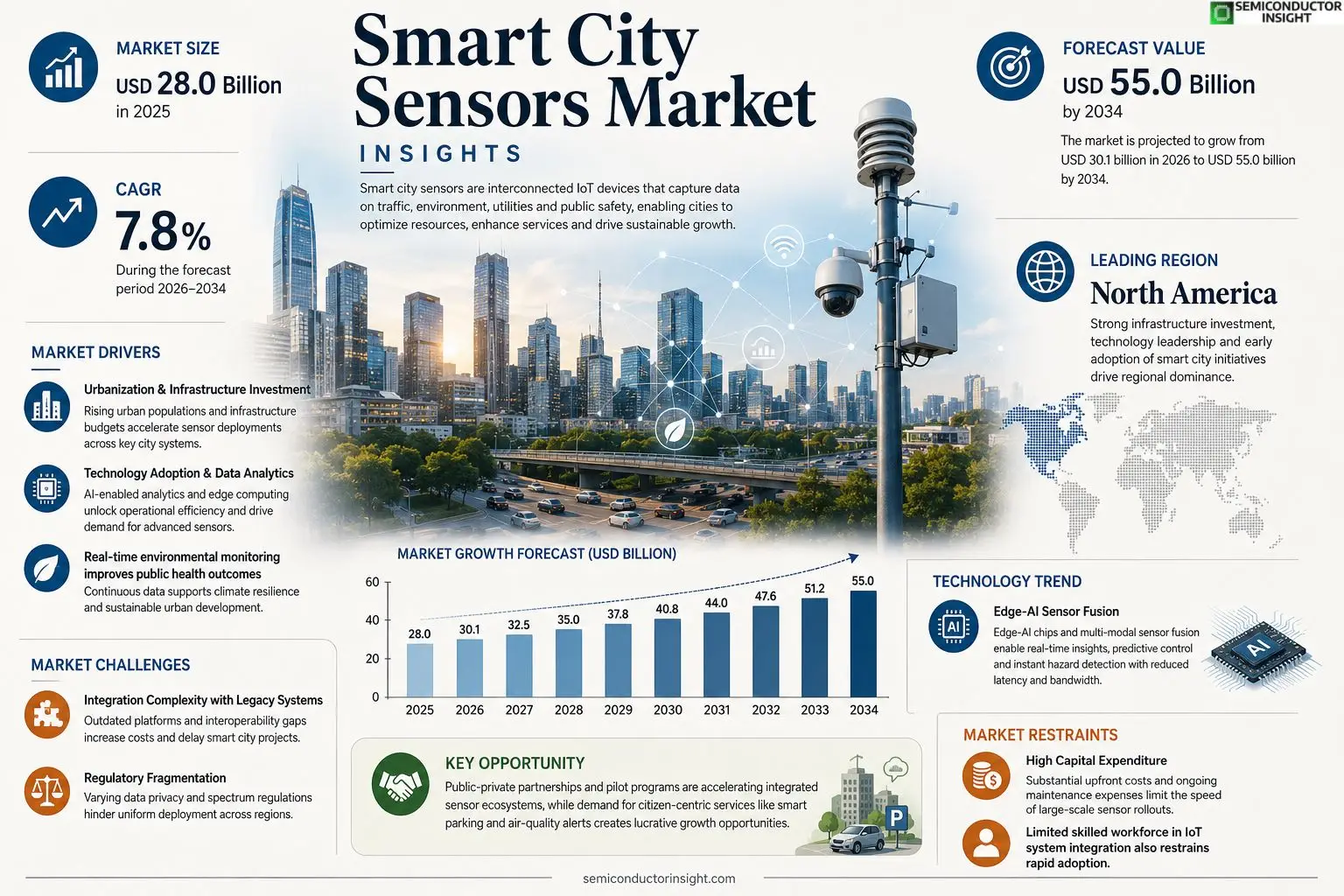
Smart City Sensors market size was valued at USD 28.0 billion in 2025. The market is projected to grow from USD 30.1 billion in 2026 to USD 55.0 billion by 2034, exhibiting a CAGR of 7.8% during the forecast period.
Smart city sensors are interconnected Internet‑of‑Things (IoT) devices that continuously capture data on traffic flow, air quality, noise levels, street lighting, waste collection and public safety parameters. By converting physical phenomena into actionable digital signals, these sensors enable municipalities to optimize resource allocation, improve citizen services and reduce operational costs.The market is experiencing rapid growth because governments worldwide are allocating substantial budgets toward digital‑infrastructure projects and because urban populations demand higher living standards.Further, advancements in low‑power communication protocols (e.g., NB‑IoT and LoRaWAN) lower deployment costs while enhancing scalability.Furthermore, strong partnerships among technology leaders such as Siemens AG, Cisco Systems, IBM Corporation, Huawei Technologies and Bosch Sensortec accelerate innovation pipelines.Consequently, the convergence of policy support, technological maturity and private‑sector investment fuels robust expansion of the smart city sensors ecosystem.
MARKET DRIVERS
Urbanization & Infrastructure Investment
The rapid expansion of urban populations is prompting city planners to allocate billions of dollars toward smart infrastructure. Investments in traffic management, waste collection and utility networks create a robust foundation for Smart City Sensors market, accelerating deployment rates across major metropolitan areas.
Technology Adoption & Data Analytics
Municipal governments are increasingly adopting AI‑enabled analytics platforms that require high‑resolution sensor feeds. This synergy between edge computing and sensor hardware enhances operational efficiency, driving further demand for advanced sensing solutions.
➤ Real‑time environmental monitoring improves public health outcomes
In addition, climate‑resilient strategies rely on continuous air‑quality and flood‑risk data, positioning Smart City Sensors market as a critical enabler for sustainable urban development.
MARKET CHALLENGES
Integration Complexity with Legacy Systems
Many cities operate on outdated SCADA and utility platforms, making seamless integration of new sensors costly and time‑consuming. Interoperability gaps can delay projects and inflate total ownership costs.
Other Challenges
Regulatory Fragmentation
Diverse local regulations on data privacy and radio frequencies create a patchwork of compliance requirements, hampering uniform rollout across regions.
MARKET RESTRAINTS
High Capital Expenditure
Initial deployment costs for dense sensor networks remain substantial, especially for emerging economies where budget constraints limit large‑scale projects.Furthermore, the need for ongoing calibration and maintenance adds recurring operational expenses, limiting the speed at which municipalities can expand coverage.Limited skilled workforce in IoT system integration also restrains rapid adoption, as cities must invest in training programs or outsource expertise.
MARKET OPPORTUNITIES
Edge‑AI Sensor Fusion
Emerging edge‑AI chips enable on‑device data processing, reducing latency and bandwidth requirements. This capability opens new use cases such as predictive traffic light control and instant hazard detection, expanding the addressable market for smart sensors.Additionally, public‑private partnerships are financing pilot programs that test integrated sensor ecosystems, providing a low‑risk pathway for cities to evaluate benefits before full deployment.Growing demand for citizen‑centric services, like smart parking and air‑quality alerts, presents a lucrative niche for specialized sensor manufacturers looking to differentiate within Smart City Sensors market.
Smart City Sensors Market Trends
Policy‑Driven Investment and Infrastructure Expansion
Governments across North America, Europe and Asia‑Pacific are allocating multi‑year budgets to upgrade urban infrastructure with digital capabilities. These public‑sector commitments translate into large‑scale deployments of sensor networks that monitor traffic flow, air quality, street lighting and waste collection. By integrating sensor data into centralized command centres, municipalities achieve measurable reductions in energy consumption and operational costs, while delivering faster response times for citizen services. The policy environment therefore creates a stable revenue pipeline that underpins the continued growth of Smart City Sensors market.
Other Trends
Technology Enablers and Connectivity
Advances in low‑power wide‑area network (LPWAN) protocols such as NB‑IoT and LoRaWAN have lowered the total cost of ownership for sensor installations. These communication standards enable long‑range transmission with minimal energy draw, allowing battery‑operated devices to function for several years without replacement. In parallel, edge‑computing platforms are processing data locally, reducing latency and bandwidth requirements. The convergence of robust connectivity and on‑device analytics accelerates adoption in dense urban environments where real‑time insights are essential for traffic optimization and public safety.
Strategic Partnerships and Ecosystem Development
Leading technology firms are forming alliances that combine hardware expertise with cloud‑based service platforms. Siemens AG, Cisco Systems, IBM Corporation, Huawei Technologies and Bosch Sensortec have announced joint roadmaps that address sensor calibration, data security and integration with existing city management systems. These collaborations shorten time‑to‑market for new solutions and create interoperable standards that simplify procurement for municipalities. As a result, the ecosystem surrounding Smart City Sensors market is becoming more cohesive, driving innovation while mitigating integration risk for end users.
COMPETITIVE LANDSCAPEKey Industry Players
Smart City Sensors Market – Competitive Overview
Smart City Sensors market is anchored by a handful of multinational technology groups that command the majority of platform revenue and R&D spending. Siemens AG leads with its integrated IoT gateway and sensor fusion solutions, leveraging extensive municipal contracts across Europe and North America. Cisco Systems supplies networking infrastructure and edge‑computing capabilities that enable real‑time data pipelines, while IBM Corporation contributes advanced analytics and AI services that turn raw sensor streams into actionable insights. Huawei Technologies and Bosch Sensortec complement the ecosystem with low‑power connectivity modules and highly calibrated environmental sensors, respectively. These dominant players often form strategic alliances—e.g., Bosch with Cisco on LoRaWAN deployments—creating a consolidated market structure in which large, vertically integrated offerings set industry standards and dictate pricing tiers.Niche yet influential participants are expanding the competitive set by specializing in vertical‑specific sensor designs or open‑source platforms. Schneider Electric offers energy‑focused environmental monitors that integrate with building‑management systems, whereas Intel provides edge AI chips that accelerate on‑device processing. Samsung Electronics contributes high‑volume MEMS‑based air‑quality sensors, and Nokia supplies robust NB‑IoT connectivity for city‑wide deployments. Additional innovators such as Qualcomm, Libelium, EverSensors, PTC, LORIOT and Telit bring differentiated low‑power radios, modular sensor kits, and cloud‑native data services, fostering a vibrant secondary tier that pressures incumbents to accelerate feature roll‑outs and price competitiveness.
List of Key Smart City Sensors Companies Profiled
- Siemens AG
- Cisco Systems
- IBM Corporation
- Huawei Technologies
- Bosch Sensortec
- Schneider Electric
- Intel
- Samsung Electronics
- Nokia
- Qualcomm
- Libelium
- EverSensors
- PTC
- LORIOT
- Telit
Segment Analysis:
| Segment Category | Sub-Segments | Key Insights |
| By Type |
|
Environmental Sensors
|
| By Application |
|
Traffic Management
|
| By End User |
|
Municipal Governments
|
| By Sensor Technology |
|
Multi‑Modal Sensors
|
| By Deployment Scale |
|
City‑wide Deployments
|
Regional Analysis: North America
United States
Smart City Sensors are instrumental in optimizing transportation networks. Deployment of sensors for traffic monitoring, parking management, and public transit tracking is enhancing efficiency and reducing congestion.
Sensors play a crucial role in monitoring air and water quality, noise levels, and waste management. This data informs policy decisions and enables proactive environmental interventions.
Smart City Sensors enhance public safety through features like gunshot detection, surveillance, and emergency response systems. Real-time data enables faster and more effective responses to critical situations.
Intelligent streetlights and building energy management systems utilizing sensors contribute to energy efficiency and cost savings. Adaptive lighting adjusts based on real-time conditions, reducing energy consumption.
Europe
Europe is demonstrating strong growth in Smart City Sensors market, with several countries actively investing in smart infrastructure projects. Focus areas include sustainable urban development, efficient public services, and enhanced citizen well-being. The emphasis on data privacy and security regulations, such as GDPR, influences the development and deployment of sensor technologies. Several European cities are pilot projects in smart mobility, waste management, and environmental monitoring, showcasing the potential of integrated sensing solutions. The market is characterized by a blend of established technology providers and innovative startups.
Asia-Pacific
The Asia-Pacific region, particularly countries like China, Japan, and Singapore, is experiencing rapid expansion in Smart City Sensors market. Driven by massive urbanization, increasing government spending on smart city initiatives, and a strong focus on technological advancement, the demand for these sensors is soaring. Smart transportation systems, environmental monitoring, and public safety are key drivers of growth. The region presents significant opportunities for both sensor manufacturers and system integrators. The integration of Artificial Intelligence (AI) and Machine Learning (ML) with sensor data is creating advanced analytics capabilities.
South America
South America is witnessing a gradual but steady growth in Smart City Sensors market. Cities in Brazil, Chile, and Colombia are beginning to adopt sensor-based solutions to address urban challenges such as traffic congestion, pollution, and crime. While the market is still relatively nascent compared to North America and Asia-Pacific, the potential for growth is significant, especially with increasing investment in infrastructure development and smart city projects. The focus is on cost-effective solutions tailored to the specific needs of the region.
Middle East & Africa
The Middle East and Africa represent an emerging market for Smart City Sensors, with significant potential for growth. Governments in countries like the UAE, Saudi Arabia, and South Africa are investing in smart city initiatives to improve urban living, enhance sustainability, and drive economic diversification. Key applications include smart transportation, water management, and public safety. The region’s rapid urbanization and increasing disposable incomes are fueling demand for these technologies. Opportunities exist for innovative sensor solutions that address the unique challenges of the region, such as water scarcity and extreme weather conditions.
Report Scope
This market research report provides a comprehensive analysis of the Smart City Sensors Market , covering the forecast period 2026–2034. It offers detailed insights into market dynamics, technological advancements, competitive landscape, and key trends shaping the industry.
Key focus areas of the report include:
- Market Overview: The report begins with an overview outlining its current market scenario, key growth indicators, and industry transformation drivers. It discusses macroeconomic factors, demand–supply balance, regulatory landscape, and the strategic role of semiconductors in powering advancements across industries such as automotive, telecommunications, consumer electronics, and industrial automation.
- Market Size & Forecast: Historical data and future projections for revenue, unit shipments, and market value across major regions and segments.
- Segmentation Analysis: Detailed breakdown by product type, technology, application, and end-user industry to identify high-growth segments and investment opportunities.
- Regional Insights: Insights into market performance across North America, Europe, Asia-Pacific, Latin America, and the Middle East & Africa, including country-level analysis where relevant.
- Competitive Landscape: Profiles of leading market participants, including their product offerings, R&D focus, manufacturing capacity, pricing strategies, and recent developments such as mergers, acquisitions, and partnerships.
- Technology Trends & Innovation: Assessment of emerging technologies, integration of AI/IoT, semiconductor design trends, fabrication techniques, and evolving industry standards.
- Market Drivers & Restraints: Evaluation of factors driving market growth along with challenges, supply chain constraints, regulatory issues, and market-entry barriers.
- Stakeholder Insights: Insights for component suppliers, OEMs, system integrators, investors, and policymakers regarding the evolving ecosystem and strategic opportunities.
Primary and secondary research methods are employed, including interviews with industry experts, data from verified sources, and real-time market intelligence to ensure the accuracy and reliability of the insights presented.
FREQUENTLY ASKED QUESTIONS:
What is the current market size of Smart City Sensors Market?
-> Smart City Sensors market was valued at USD 28.0 billion in 2025 and is expected to reach USD 55.0 billion by 2034 with a CAGR of 7.8% during the forecast period.
Which key companies operate in Smart City Sensors Market?
-> Key players include Siemens AG, Cisco Systems, IBM Corporation, Huawei Technologies, and Bosch Sensortec, among others.
What are the key growth drivers?
-> Growth is driven by substantial government budgets for digital‑infrastructure, rising urbanization demanding higher living standards, the adoption of low‑power communication protocols such as NB‑IoT and LoRaWAN, and strong partnerships among technology leaders.
Which region dominates the market?
-> The reference does not specify a dominant region.
What are the emerging trends?
-> Emerging trends include integration of AI‑driven analytics with IoT sensors, expansion of low‑power wide‑area networks, and collaborative ecosystems among leading technology providers.

Get Sample Report PDF for Exclusive Insights
Report Sample Includes
- Table of Contents
- List of Tables & Figures
- Charts, Research Methodology, and more...
 Download Sample Report PDF