Market Insights
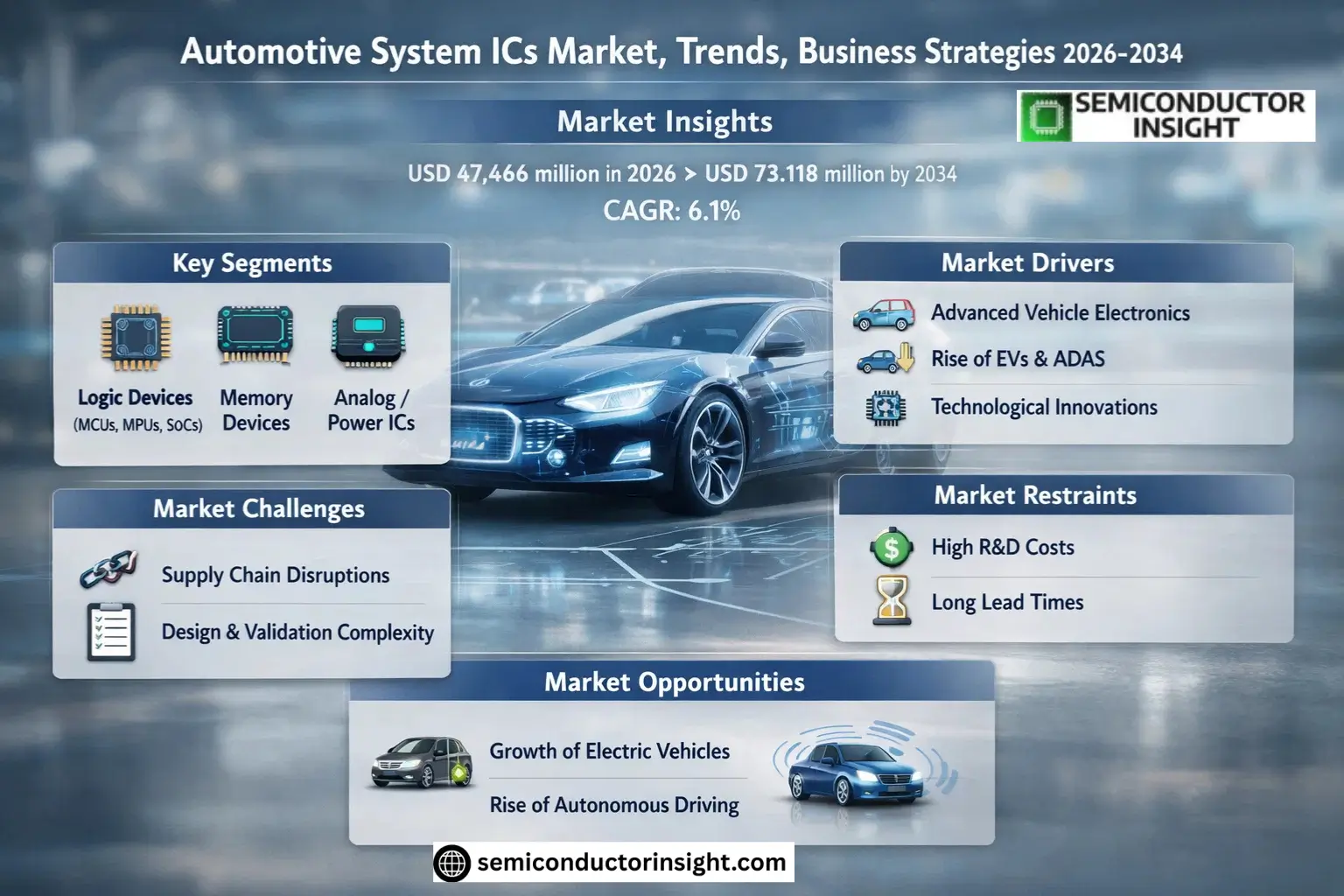
Global Automotive System ICs Market was valued at USD 47,466 million in 2026 and is projected to reach USD 73,118 million by 2034, exhibiting a CAGR of 6.1% during the forecast period.
Automotive System ICs are integrated circuits specifically designed for automotive applications, meeting stringent reliability and functional safety standards. These ICs are categorized into three primary segments: Logic Devices (including MCUs, MPUs, and SoCs), Memory Devices (such as NOR/NAND Flash and DRAM), and Analog/Power ICs (encompassing power management, signal chain, and driver ICs). The market excludes optoelectronic sensors and discrete power modules.
The growth of this market is driven by the shift from traditional ECU-based architectures to electrification and centralized computing in vehicles. High-voltage systems like battery management (BMS) and electric drive inverters have increased demand for Analog/Power ICs, while domain-controlled architectures boost adoption of high-performance SoCs and memory solutions. Leading players such as Infineon Technologies, NXP Semiconductors, and Texas Instruments dominate the market with platform-based solutions that integrate power management, communication interfaces, and safety features.
MARKET DRIVERS
Rising Demand for Advanced Vehicle Electronics
Automotive System ICs Market is experiencing significant growth due to increasing adoption of advanced driver-assistance systems (ADAS) and in-vehicle infotainment. Consumer demand for connected vehicles with enhanced safety features is pushing automakers to integrate more semiconductor solutions. The global shift toward electric vehicles (EVs) is further accelerating this trend.
Technological Advancements in Automotive ICs
Innovations in semiconductor manufacturing are enabling more powerful and energy-efficient Automotive System ICs. The development of 5nm and 7nm process nodes allows for higher integration of functions in smaller chips, reducing system complexity. Manufacturers are focusing on developing ASICs and SoCs specifically designed for automotive applications.
The integration of AI and machine learning capabilities into Automotive System ICs is creating new possibilities for autonomous driving systems and predictive maintenance applications.
MARKET CHALLENGES
Complex Supply Chain Management
Automotive System ICs Market faces significant challenges in maintaining stable supply chains amidst global semiconductor shortages. Automakers are experiencing production delays due to the specialized nature of automotive-grade chips that require stringent quality certifications. The industry is working to improve supply chain resilience through strategic partnerships.
Other Challenges
Design and Validation Complexity
Developing Automotive System ICs requires extensive validation processes to meet strict automotive safety standards like ISO 26262. The increasing complexity of vehicle electronics is pushing development timelines and costs higher.
MARKET RESTRAINTS
High Development Costs and Long Lead Times
Automotive System ICs Market is constrained by the significant investment required for research and development of new semiconductor solutions. The automotive industry’s qualification processes for new components can take 12-18 months, slowing time-to-market for innovative products. Price sensitivity in mass-market vehicles also limits premium IC adoption.
MARKET OPPORTUNITIES
Growth in Electric and Autonomous Vehicles
The rapid expansion of the electric vehicle market presents substantial opportunities for Automotive System ICs. EVs require specialized power management ICs and motor control solutions. Emerging autonomous driving technologies are creating demand for high-performance processors capable of real-time sensor data processing and AI inference.
Automotive System ICs Market Trends
Electrification and Intelligent Computing Driving Market Growth
Automotive System ICs Market is experiencing a paradigm shift from traditional ECU-based architectures to electrification and high-performance computing solutions. This transition has significantly increased demand for analog/power ICs in electric vehicle power management systems, including onboard chargers, DC-DC converters, and battery management systems. Logic devices such as high-performance SoCs and domain control MCUs are becoming critical components as vehicle architectures evolve toward centralized computing platforms.
Other Trends
Platformization of Automotive IC Solutions
Leading semiconductor manufacturers are transitioning from standalone component offerings to integrated platform solutions. System Base Chips (SBCs) are gaining prominence by combining power supply, monitoring, and vehicle network interfaces into single solutions. This platform approach reduces system complexity while meeting stringent automotive reliability standards, creating higher barriers to entry for new market players.
Memory Requirements for Advanced Vehicle Systems
ADAS and autonomous driving systems are driving significant growth in automotive-grade memory ICs, particularly DRAM and NAND/NOR flash. The increasing computational requirements of AI-based vision processing and sensor fusion algorithms are creating new demand patterns for high-bandwidth, low-latency memory solutions that meet automotive temperature and reliability specifications.
Regional Market Developments
Asia-Pacific continues to dominate Automotive System ICs production and consumption, led by China’s expanding EV market and established semiconductor supply chains. North America and Europe remain innovation hubs for advanced driver assistance systems, creating specialized demand for high-performance computing ICs. Emerging markets are seeing increased localization efforts as global suppliers establish regional design and manufacturing capabilities.
COMPETITIVE LANDSCAPE
Key Industry Players
Platformization and System Solutions Define Automotive IC Leadership
Automotive System ICs Market is dominated by established semiconductor leaders with comprehensive product portfolios and automotive-grade certifications. Infineon Technologies leads with 18.7% market share (2026), followed by NXP Semiconductors (12.3%) and Renesas Electronics (9.8%). These top players leverage decades of automotive experience, offering integrated solutions spanning power management, MCUs, and sensor interfaces that meet ASIL-D safety requirements. The shift towards zonal architectures has intensified competition in high-performance SoCs, with NVIDIA and Qualcomm gaining traction in autonomous driving segments.
Specialized suppliers are carving significant niches – ROHM Semiconductor in power ICs for EVs, Micron Technology in automotive-grade memory, and Texas Instruments in analog signal chains. Chinese players like Horizon Robotics and Black Sesame Technologies are rapidly expanding in AI accelerator chips, supported by government EV mandates. The market sees increasing vertical integration, with automakers like BYD Semiconductor and Tesla developing proprietary ICs for battery management and powertrain control.
List of Key Automotive System ICs Companies Profiled
- Infineon Technologies
- NXP Semiconductors
- Renesas Electronics
- Texas Instruments
- STMicroelectronics
- ROHM Semiconductor
- onsemi
- NVIDIA
- Qualcomm
- Micron Technology
- Samsung Electronics
- SK Hynix
- ADI
- Microchip Technology
- BYD Semiconductor
Segment Analysis:
| Segment Category | Sub-Segments | Key Insights |
| By Type |
|
Analog/Power ICs dominate due to increasing electrification trends in vehicles. Key factors include:
|
| By Application |
|
ADAS/Autonomous Driving shows strongest growth potential with:
|
| By End User |
|
Tier 1 Suppliers remain the dominant segment because:
|
| By Vehicle Type |
|
Electric Vehicles demonstrate the highest adoption rate due to:
|
| By Technology |
|
BCD Technology leads in automotive applications because:
|
Regional Analysis: Global Automotive System ICs Market
Asia-Pacific
China’s automotive IC sector is experiencing rapid growth, supported by government initiatives like “Made in China 2026.” Domestic manufacturers are increasing production of MCUs and power management ICs, reducing reliance on imports. The country’s strong EV market provides ideal testing grounds for new automotive IC technologies.
Japanese semiconductor firms maintain leadership in high-reliability automotive ICs for safety-critical systems. The country’s mature automotive industry demands advanced ICs for sophisticated ADAS and infotainment systems. Collaborations between automakers and IC suppliers drive innovation in automotive-grade semiconductors.
South Korean semiconductor companies are leveraging their expertise in memory products to develop specialized automotive ICs. The country’s strong position in electric vehicles creates demand for power electronics and battery management ICs. Domestic automakers are increasingly sourcing system ICs from local suppliers.
Malaysia and Singapore are becoming important hubs for automotive IC packaging and testing. The region benefits from established semiconductor manufacturing infrastructure and proximity to major automotive markets. Several global IDMs are expanding automotive IC production capacity in this region.
North America
North America represents a key innovation center for Automotive System ICs, with strong R&D capabilities in autonomous vehicle technologies. The region’s semiconductor companies are developing cutting-edge ICs for next-generation vehicle architectures. The United States maintains leadership in AI processors for autonomous driving applications, while Canada is emerging as a hub for automotive radar IC development. Strict automotive safety regulations in the region drive demand for high-reliability system ICs with advanced functional safety features.
Europe
Europe’s Automotive System ICs Market benefits from the region’s leadership in premium vehicles and strict emission regulations. German semiconductor firms excel in power management ICs for electric vehicles, while French companies focus on secure automotive MCUs. The European Union’s focus on vehicle connectivity and cybersecurity is shaping IC development priorities. Regional automakers are collaborating closely with IC suppliers to develop customized solutions for luxury vehicle segments.
South America
The South American market shows growing potential for Automotive System ICs as regional automakers modernize their product lines. Brazil is the largest market, with increasing adoption of basic ADAS features in new vehicles. The region faces challenges related to semiconductor supply chain development but benefits from growing local assembly of automotive electronics. Government incentives for vehicle safety systems are creating new opportunities for IC suppliers.
Middle East & Africa
This region shows gradual growth in Automotive System IC adoption, primarily driven by premium vehicle imports with advanced electronics. Gulf countries lead in deploying vehicles with sophisticated IC-based systems. South Africa serves as an automotive manufacturing hub with growing local content requirements for electronic components. The market potential remains constrained by economic factors but shows long-term promise as vehicle electrification gains traction.
Report Scope
This market research report provides a comprehensive analysis of the Automotive System ICs Market , covering the forecast period 2026–2034. It offers detailed insights into market dynamics, technological advancements, competitive landscape, and key trends shaping the industry.
Key focus areas of the report include:
- Market Overview: The report begins with an overview outlining its current market scenario, key growth indicators, and industry transformation drivers. It discusses macroeconomic factors, demand–supply balance, regulatory landscape, and the strategic role of semiconductors in powering advancements across industries such as automotive, telecommunications, consumer electronics, and industrial automation.
- Market Size & Forecast: Historical data and future projections for revenue, unit shipments, and market value across major regions and segments.
- Segmentation Analysis: Detailed breakdown by product type, technology, application, and end-user industry to identify high-growth segments and investment opportunities.
- Regional Insights: Insights into market performance across North America, Europe, Asia-Pacific, Latin America, and the Middle East & Africa, including country-level analysis where relevant.
- Competitive Landscape: Profiles of leading market participants, including their product offerings, R&D focus, manufacturing capacity, pricing strategies, and recent developments such as mergers, acquisitions, and partnerships.
- Technology Trends & Innovation: Assessment of emerging technologies, integration of AI/IoT, semiconductor design trends, fabrication techniques, and evolving industry standards.
- Market Drivers & Restraints: Evaluation of factors driving market growth along with challenges, supply chain constraints, regulatory issues, and market-entry barriers.
- Stakeholder Insights: Insights for component suppliers, OEMs, system integrators, investors, and policymakers regarding the evolving ecosystem and strategic opportunities.
Primary and secondary research methods are employed, including interviews with industry experts, data from verified sources, and real-time market intelligence to ensure the accuracy and reliability of the insights presented.
FREQUENTLY ASKED QUESTIONS:
What is the current market size of Automotive System ICs Market?
-> Automotive System ICs Market was valued at USD 47,466 million in 2026 and is projected to reach USD 73,118 million by 2034, exhibiting a CAGR of 6.1% during the forecast period.
What is the growth rate of Automotive System ICs Market?
-> The market is expected to grow at a CAGR of 6.1% during the forecast period (2026-2034).
Which key companies operate in Automotive System ICs Market?
-> Key players include Infineon Technologies, STMicroelectronics, Texas Instruments, NXP Semiconductors, Renesas Electronics, ADI, NVIDIA, Mobileye, and Samsung, among others.
What are the key market segments?
-> The market is segmented by product type into Logic Devices, Memory Devices, and Analog/Power ICs, and by application into Automotive Powertrain/Electric Drive Systems, ADAS/Autonomous Driving, and Automotive Infotainment, among others.
What are the key growth drivers?
-> Key growth drivers include vehicle electrification, ADAS adoption, domain control architectures, and increasing semiconductor content per vehicle.
Get Sample Report PDF for Exclusive Insights
Report Sample Includes
- Table of Contents
- List of Tables & Figures
- Charts, Research Methodology, and more...